It’s that special time of year, and I’m not just saying that because it’s Christmastime. Truth be told, I’m not crazy about Christmas; I certainly don’t go nuts over it like I do with Halloween—which is why my review roster for this month is not Christmas-themed. My birthday is also this month (it’s the 9th, if you’d like to know), but that’s not why I’m here. Some months thing will be totally normal, but then there are times like this. Oh, we still have the usual rotation, albeit with a little twist (in fact it’s a new department), which I’ll get to in a minute. The real twist is that this will be a single-author lineup, and the guest of honor is Fritz Leiber.
Fritz Leiber was born on Christmas Eve, 1910, and when he made his professional genre debut in 1939, he was about to mark a new era in fantasy writing—although people were not aware of this at the time. His most lasting achievement is the grand episodic narrative of Fafhrd and the Gray Mouser, one of fantasy’s most daring duos and a landmark in what is now called Sword and Sorcery (the same subgenre which contains Robert E. Howard’s Conan, among other things). Leiber’s tales of Fafhrd and the Gray Mouser are by no means his only contribution to the genre, and indeed his turf goes far beyond just fantasy. You know, I really like Leiber, but even with most of my favorite authors I would not dedicate a whole month to reviewing works of theirs; what makes Leiber different from most is his ability to dabble in basically everything, from fantasy to horror to science fiction. Across the half-century of his career, Leiber shfited from genre to genre, mood to mood, not being as easy to pin down as most of his contemporaries.
Since this is a bit of an unusual month for reviews, I decided to go an extra step and introduce another new department—albeit an irregular one. There aren’t too many of them, but there are in fact “complete” novels in the magazines, especially in the ’40s and ’50s. Or rather were, because magazines running novels was basically an attempt to keep paperbacks (which were gaining traction) from biting their heels, an attempt which ultimately and inevitably proved a failure. A lot of “complete” novels being run in magazineare also just novellas, but there are exceptions! Leiber’s 1950 novel You’re All Alone is one such exception, and while it is technically an abridged version of The Sinful Ones (long story), at 40,000 words it’s a bit too long to be comfortably called a novella, at least for my blog. I’ll explain how this new thing will work at the end.
So, we get two serials, two novellas, two short stories, and a complete novel in honoring this bastard. Not the last time I’ll be doing this single-author month deal, but obviously it’s something I’ll only do maybe once a year. But enough! It’s time to reveal what we’ll be reading.
The serials:
Destiny Times Three, first published in the March to April 1945 issues of Astounding Science Fiction. Retro Hugo nominee for Best Novel. Not one of Leiber’s more famous works, if the number of times it’s been reprinted says anything, but then it is quite a short novel—probably too short to sell on its own but also too long to be anthologized easily. One of Leiber’s earliest attempts at depicting alternate timelines, a premise that he would return to fruitfully much later.
Rime Isle, first published in the May to July 1977 issues of Cosmos Science Fiction and Fantasy. Never heard of Cosmos? Don’t worry, it only lasted four issues. Rime Isle is part of the Fafhrd and Gray Mouser series, being a later entry, as well as one of Leiber’s final appearances in the magazines; thereafter he stuck to original anthologies. Whereas some other Fafhrd and Gray Mouser stories are often cited, this is not one of them. I know basically nothing about it.
The novellas:
“Scylla’s Daughter,” from the May 1961 issue of Fantastic. The late ’50s saw a major revival for the Fafhrd and Gray Mouser series, which was not coincidental considering Fantastic‘s new editor, Cele Goldsmith, clearly sympathized with Leiber and wanted to buy what he was selling, with Fafhrd and the Gray Mouser getting at least one story a year in that magazine until Goldsmith left. “Scylla’s Daughter” would later be expanded into The Swords of Lankhmar.
“Ship of Shadows,” from the July 1969 issue of The Magazine of Fantasy and Science Fiction. This is a special issue of F&SF, being one of its author tribute issues, with “Ship of Shadows” as the lead novella. Technically a reread, but it’s been long enough that I could use a refresher, and hell, I remember liking it quite a bit. Leiber stories tend to fall into SF, fantasy, or horror, but “Ship of Shadows” ticks all three boxes, and it won a Hugo while it was at it!
The short stories:
“The Hound,” from the November 1942 issue of Weird Tales. The first several years of Leiber’s career saw him dwell primarily in Weird Tales and Unknown, the top fantasy-horror magazines of the early ’40s. Not being the most comfortable with SF, Leiber distinguished himself at first as a young master of terror and the supernatural. “The Hound” is one such early horror effort from Leiber, and hey, it’s apparently a werewolf story, and I love me some werewolves.
“The Moon Is Green,” from the April 1952 issue of Galaxy Science Fiction. After being relatively inative in the late ’40s, Leiber came back strong early the next decade, and his return to the field coincided with those explosive first years of Galaxy, the new SF magazine on the market. Leiber became one of Galaxy‘s leading writers in the early ’50s, and “The Moon Is Green” is one of those Galaxy-Leiber tales to get adapted for the legendary X Minus One.
Now, finally, the complete novel:
You’re All Alone, from the July 1950 issue of Fantastic Adventures. Apparently the magazine version is an earlier draft that Leiber had tried but failed to get published, since the fantasy market in the latter half of the ’40s was in the dumps, but luckily Fantastic Adventures, previously a second-rate pulp outlet, was under new management. Leiber would then “expand” the novel for book publication under the title The Sinful Ones, but from what I’ve heard the magazine version is better.
About how these complete novel reviews will work. My review schedule is on a rotation basis, switching between short stories, novellas, and serials; depending on how many days there are in a month I would cram in a third novella or short story. The way I have it figured is, if a month has 31 days, and if I’m set to review a novella on the 31st day, I’ll switch that would-be novella out for a complete novel. After all, I wanna save the biggest single review project for last, and I wanna give myself enough time to really digest the extra long material. The resulting review will itself of course be longer than average. Now, how do I separate a complete novel from a novella? How does one tell the difference, especially since magazines, while usually two-columned, have different type sizes and therefore some can pack more wordage into each page? Sometimes magazines give rough word counts, but much of this, admittedly, will come down to my own discretion.
Not making promises, but complete novel reviews will probably be the last department I add to my blog. This is a one-man show, ya know, and I do have a day job to contend with. Still, I wouldn’t be doing this if it wasn’t out of passive, and you also know that I’m a compulsive reader. The more the merrier! Just hope I can do someone as great as Leiber justice with this.
John Kessel is one of the defining SFF authors of the ’80s, although like many of his contemporaries he had debuted in the ’70s, in the likes of Galileo and Galaxy Science Fiction. Adjacent to the newfangled cyberpunk movement of the period but decidedly not a cyberpunk writer himself, Kessel, like close contemporary Bruce Sterling, is startlingly diverse in his output. His 1986 story “The Pure Product” is one of the more haunting explorations of time travel in modern SFF, and his slightly autobiographhical story “Buffalo” could lay claim to being one of the best short stories (inside or outside of SFF) of the ’90s. On top of his fiction, Kessel is an active genre critic and anthologist, the latter often in collaboration with James Patrick Kelly. While he has a few novels to his credit, Kessel has reserved most of his writing energy to short fiction and genre commentary.
“Another Orphan” is a relatively early outing from Kessel, but as we’ll see, it reads like the work of a stone-cold master. I should say it now so that I won’t have to ease you into it in some coy fashion: this is Moby Dick fanfiction. You may be thinking, “Now Brian, this is obviously not fanfiction!” I guess you’re right; it was, after all, published professionally, and so technically it doesn’t count. But “Another Orphan” is about an original character being plopped into a story that was first written by a different author, a premise which has since become an old and tired chestnut for fanfic writers. It’s what Kessel does with such a premise, though, that makes the result special.
Placing Coordinates
First published in the September 1982 issue of The Magazine of Fantasy and Science Fiction, which is on the Archive. Despite winning a Nebula, and being regarded as one of Kessel’s most major works, “Another Orphan” has not been reprinted often. Still, we have two options that I would consider major. The first is The Best Fantasy Stories from the Magazine of Fantasy & Science Fiction, edited by Edward L. Ferman, which is a bulky hardcover that you can find used pretty cheaply, and it also has a lot of stories that I consider of strong interest. More recently (so recent it came out THIS YEAR!) we have The Dark Ride: The Best Short Fiction of John Kessel, a fancy hardcover from Subterranean Press, which I would recommend if you’re already a fan of Kessel and/or you wanna play this game on Hard Mode. Limited edition with copies signed by Kessel himself, so you’re looking at at least $30, and that price will only go up with time.
Enhancing Image
A bit of context, because while it’s not necessary to have read Moby Dick in order to enjoy “Another Orphan,” the latter is very much in conversation with the former. Herman Melville is one of the great eccentrics in American literature, and especiallty 19th century American literally; his magnum opus, Moby Dick, is a bizarre, freewheeling, often meandering novel that alienates a lot of readers because at face value it seems to fail as an adventure narrative, when the reality is that Moby Dick, if anything, is a grand subversion of the seafaring adventure narrative. If you go in expecting what you imagine a canonical work to read like, or if you’re expecting an action-packed romp on the high seas, you’ll be disappointed, but if you’re expecting one of the weirdest and most enigmatic novels in American literature then you might come out of it with a new perspective on what is possible with the written word.
I say all this because our protagonist, Patrick Fallon, is someone who, once he realizes where he is and what he’s in, does not initially give the world of Moby Dick the respect it deserves. Patrick is a commodities analyst for some firm (let’s just call him a yuppie and be done with it) who, after a fight and an apology fuck with his girlfriend (I don’t think they’re married) one night, inexplicably finds himself awaking in the crew’s quarters on a whaling vessel—and not just any whaling vessel! He doesn’t immediately figure it out (he at first thinks it’s a dream, or that he got shanghaied), but he soon realizes that he’s on the Pequod, the doomed ship in Moby Dick that hunts the white whale for three days before being smashed to smitheroons, with only one survivor. Which is a bit of a problem.
Oh right, spoilers for Moby Dick, which is now over 170 years old and whose plot beats a lot of (at least American) readers are familiar with. I know some people are very sensitive about spoilers, but you have to draw a line somewhere. It’s like telling a grad student that Santa Claus isn’t real.
They had been compelled to read Moby Dick in the junior-year American Renaissance class he’d taken to fulfill the last of his Humanities requirements. Fallon remembered being bored to tears by most of Melville’s book, struggling with his interminable sentences, his wooly speculations that had no bearing on the story; he remembered being caught up by parts of that story. He had seen the movie with Gregory Peck. Richard Basehart, king of the sci-fi flicks, had played Ishmael. Fallon had not seen anyone who looked like Richard Basehart on this ship. The mate, Flask—he remembered that name now. He remembered that all the harpooners were savages. Queequeg.
He remembered that in the end, everyone but Ishmael died.
I appreciate the shoutout to the John Huston movie, which, by the way, was written by Ray Bradbury. The more you know…
The first thing I thought of when reading “Another Orphan” was actually L. Ron Hubbard’s Typewriter in the Sky, in which a musician somehow gets sucked into the world of his hack writer friend’s latest novel, in which he’s given the role of the villain. The thing is, of course, that said hack writer always kills off his villains at the end, which means our guy has to find some way to get (or at least alter events so as to avoid his doom) before it’s too late, and there’s a similar ticking-clock element in “Another Orphan.” Just know, though, that while there’s a bit of snarky humor at work, Kessel’s story is a good deal more serious than Hubbard’s, and a lot more thematically ambitious despite having half the word count.
Patrick, interestingly, is not put in the place of Ishmael, but he’s not in the place of some other preexisting character either; he’s known to the whalemen as Patrick Fallon, as if he had always been on the ship, although he’s treated like a bit of an outsider. He’s also not very strong, physically, which presents a problem when trying to fit in as a sailor on a ship full of sweaty hardened whalers. (I wanna go on a slight tangent about the homosexuality or rather the lasck of it. Moby Dick is infamously a pretty homoerotic novel, unintentionally or by design, but Patrick is straight as an arrow and he doesn’t speculate even slightly about homoerotic activity that might sprout between men who go out on a sailing vessel for months on end. Kessel’s story comments on or challenges a lot of things about Moby Dick, but that’s not one of them.) The situation only gets worse when he inevitably encounters the captain of the ship: Ahab.
And boy, Ahab’s flamboyance (really his campiness) does not disappoint. Patrick assumes, though (incorrectly, as it turns out), that Ahab is a caricature because of his maniacal rants. More generally he writes off the heightened atmosphere of the Pequod as unrealistic and silly, partly based on his murky remembrance of the novel and partly because he underestimates Melville’s intentions. A mistake Patrick makes repeatedly is that he fails to respect the artistry and intricacy of the fictional world he’s been thrown into; he thinks that because Ahab is subject to manic episodes and that the sea seemingly conforms to the energy of these episodes (a thunderstorm rages during one of Ahab’s monologues, which Patrick considers on-the-nose) it means these experiences can’t possibly be real. Or can they? Does Ahab’s mania, which to some extent reflects Melville’s own, count as a real experience, and not just scenes of heightened emotion concocted by a writer?
Ahab as represented in Kessel’s story is a pretty interesting character, but I’ll save him for spoilers since his “big scene” is saved for the climax. For now there is the question of Ishmael, and who he is, where he is, and who the hell Patrick is in all this. If you’ve read Moby Dick then you may recall that while Ishmael is the narrator, it would be misleading to call him the protagonist. While the first hundred pages or so have Ishmael as an active presence, once he boards the Pequod he becomes less and less a flesh-and-blood character until, for a good portion of the novel, he basically disappears into vapor. I don’t think there’s a single time while on the Pequod that another character calls Ishmael by his name; he’s a bit of a spook. It takes a minute for the realization that Ishmael is effectively a nonentity, and that he could be anyone on the ship, to hit Patrick.
Then an unsettling realization smothered the hope before it could come fully to bloom: there was not necessarily an Ishmael in the book. “Call me Ishmael,’: it started. Ishmael was a pseudonym for some other man, and there would be no one by that name on the Pequod. Fallon congratulated himself on a clever bit of literary detective work.
Yet the hope refused to remain dead. Yes, there was no Ishmael on the Pequod; or anyone on the ship not specifically named in the book might be Ishmael, any one of the anonymous sailors, within certain broad parameters of age and character—and Fallon wracked his brain trying to remember what the narrator said of himself—might be Ishmael. He grabbed at that; he breathed in the possibility and tried on the suit for size. Why not? If absurdity were to rule to the extent that he had to be there in the first place, then why couldn’t he be the one who lived? More than that, why couldn’t he make himself that man? No one else knew what Fallon knew. He had the advantage over them. Do the things that Ishmael did, and you may be him. If you have to be a character in a book, why not be the hero?
Ishmael is definitely not “the hero,” but that’s beside the point.
Patrick basically has two choices: he can take on the role of Ishmael and hope for the best, or he can find some way to prevent Ahab from going on the three-day hunt for Moby Dick that will doom the ship. Sparking a mutiny would be a high-rick high-reward option, not helped by the fact that with one or two exceptions nobody can stand to be around Patrick, let alone persuaded by him. However, if anyone can be persuaded to go “off script,” then it would be Starbuck, the first mate and the bottom to Ahab’s top. Readers of Moby Dick will remember Starbuck as the well-meaning but ineffectual right-hand man who considers overthrowing Ahab at one point, being well aware of the captain’s mania, but chooses not to through with it. Unfortunately Patrick’s efforts to stoke the fires of rebellion in Starbuck prove unsuccessful, but it seems like these “characters” are ultimately capable of making their own decisions.
At first I was wondering if Kessel genuinely disliked Moby Dick or if it was just Patrick’s snarky narration, but eventually I had to conclude it was the latter. I mean sure, it would make little sense to spill so much ink just to rag on a 170-year-old book, but occasionally it was hard to tell. There’s a scene where Patrick observes the harpooneers (Queequeg, Dagoo, etc.) and how they’re all POC, chocking their roles up to racism—although he’s not clear if it would be due to the ship owners’ racism or Melville’s, though it’s probably the former; Melville, it must be said, was considerably less racist than the average 19th century writer. Unfortunately, in what feels like a bit of a missed opportunity on Kessel’s part, we get practically zero dialogue from the harpooneers, and despite being a modern man with presumably modern-ish sensibilities, Patrick makes no attempt to befriend the harpooneers.
These are criticisms, sure, but they’re really just quibbles, especially in light of the back end of the novella, which is so masterfully done that it made me look back on the rest of the story in awe. The lengths Kessel goes to subvert one’s expectations do not reveal themselves until a good ways in.
There Be Spoilers Here
Normally in this kind of narrative, there’s an explanation for why the protagonist was suddenly taken out of their normal enviornment and plopped into something else; it doesn’t have to be a good explanation, but we would at least get an answer. No such relief for Patrick Fallon. Not only has he so far been unable to avert the ship’s course, but the source of his predicament remains completely mysterious. Is this a Schrodinger’s butterfly scenario? Is the world of the book a horribly elaborate dream, or was his prior life in the “real world” the dream? Which one is real? Could they possibly coexist? Why Moby Dick, a book Patrick had read years ago and wasn’t fond of, of all things? Kessel knowingly piles question upon question and refuses to answer, because to give answers would be to undermine the story’s aura as an existential nightmare.
Why should he not have a choice? Why should that God give him the feeling of freedom if in fact He was directing Fallon’s every breath? Did the Fates weave this trance-like calm blue day to lead Fallon to these particular conclusions, so that not even his thoughts in the end were his own, but only the promptings of some force beyond him? And what force could that be if not the force that created this world, and who created this world but Herman Melville, a man who had been dead for a very long time, a man who had no possible connection with Fallon? And what could be the reason for the motion? If this was the real world, then why had Fallon been given the life he had lived before, tangled himself in, felt trapped within, only to be snatched away and clumsily inserted into a different fantasy? What purpose did it serve? Whose satisfaction was being sought?
What had started out as a whacky misadventure has gradually turned into something more ominous and mysterious, but because of that sense of mystery it also becomes more enthralling. There’s a brief scene where Patrick, inexplicably, wakes up back in his old life, with his girlfriend and his yuppie job and all that, but even at the beginning of that scene something feels off. Before long the world of Moby Dick bleeds into the “real world” and Patrick awakens back on the Pequod, as if the reality of Patrick prior life were waning, giving into the growing reality of Melville’s fiction. The growing disparity between worlds, the diminishing hope of finding a way home, is almost of cosmic proportions. At first Patrick found the operatics of the novel to be unconvincing, but now he thinks them perfectly logical. The fading star of his prior life has become his own white whale.
People don’t realize that Moby Dick is a cosmic horror narrative—possibly the first (and to this day the most experimental) of its kind.
The final scene involves a one-on-one confrontation with Ahab, who while very much a character has not been much of a direct presence thus far. They get into something like an existential debate before a fight breaks out, with Ahab victorious—not just physically the winner, but also spiritually. After all he’s been through, Patrick has come no closer to returning home, indeed now with the Pequod appearing to be where he’s truly supposed to be. The final lines of the story echo those of the novel prior to the epilogue, and some of you might recall that Ishmael reveals himself to have been the ship’s sole survivor in that closing chapter. But no such epilogue exists here. I would say this is an anticlimax, and you could say it is, but it’s too deliberately written to feel like that; the lack of proper closure is necessary to nail home the feeling of existential dread. To cop the final words from the SF Encyclopedia’s entry on Melville (which is surprisingly detailed, given that Melville basically didn’t write any SF), Patrick ultimately finds himself “with no surcease in view, no escape from prison.”
A Step Farther Out
Is it fair to compare a 20,000-word novella to a 200,000-word novel? No, of course not, and I’m not gonna do that. “Another Orphan” is effectively a standalone deal; you’ll miss out on some of the juicy details if you’ve not read Moby Dick, but Patrick provides enough context for things that you probably won’t be confused. But as someone who loves Moby Dick I have to admit I was predisposed to either loving or hating “Another Orphan,” and I’m not sure how one would go about hating it. Kessel, incidentally, was about the same age as Melville (early 30s, which is insane when you consider the intricacies of Moby Dick) when he wrote “Another Orphan,” and part of me wonders if he saw the long-dead author as a kindred spirit. Patrick, on the other hand, while not a villainous character by any means, is what we would call a sellout; he repeatedly says he’s not a hypocrite (which is kind of a weird thing to say about yourself), but clearly he’s lacking in integrity. Maybe it makes sense, then, that a work of pure artistry like Moby Dick would serve as the playground for Patrick’s new purgatorial existence.
Very simple evaluation here. If you want your high seas adventures to be a little more thematically substantive, you’ll like this. If you want an ingeniously constructed fantasy narrative, you’ll like this. If you like Moby Dick, you’ll get a lot out of this. And if you’re a Kessel fan then you’ve probably already read “Another Orphan,” because this is essential reading.
Now we’re back to our regularly scheduled programming! Only not quite, but I’ll save that for the end. We’ve come back to our novella and serial reviews, which I’m thankful for; as fitting as it is to focus only on short stories and novelettes for a month of horror, I found it weirdly draining to review all those short stories back to back. With serials and novellas we’ll have more variety, never mind the lack of a horror theme.
I must’ve gone back and forth on this schedule too many times to count, frankly. The thing is that I like having a schedule for my reviews, as I think it allows me to plan some silly stuff in advance, like the fact that I’ll be tackling Joanna Russ and Poul Anderson stories back-to-back (for those of you who don’t know, I recommend looking up a certain exchange those two reportedly had), not to mention stuff like last month’s review slate. But I’m not here to waste your time, let’s get to the meat of the matter!
For the serials:
We Who Are About To… by Joanna Russ. Published in Galaxy Science Fiction, January to February 1976. Russ was a divisive figure in the field and We Who Are About To… in particular was not received well. Even so, it has its defenders, perhaps the biggest of them being Samuel R. Delany (who I always trust), and it also received a glowing review from Joachim Boaz over on his site. I have to admit my experiences with Russ have not been great up to this point, having found her Hugo-winning novella “Souls” underwhelming, but this could be a change of pace!
We Have Fed Our Sea by Poul Anderson. Published in Astounding Science Fiction, August to September 1958. It was nominated for the Hugo for Best Novel, and was published in book form as The Enemy Stars. Anderson was apparently a beloved figure when he was alive, but since his death his star power has faded somewhat, perhaps due to the scattered vairety of his fiction. He was a reliable and insanely prolific writer, and I often like (but rarely love) his work. We Have Fed Our Sea was one of THREE Anderson serials running in Astounding in 1958.
For the novellas:
“Another Orphan” by John Kessel. Published in the September 1982 issue of The Magazine of Fantasy and Science Fiction. Kessel can be thought of as adjacent to the cyberpunk movement of the ’80s, though it would be a mistake to consider Kessel himself one of the cyberpunks. Renowned for both his fiction and genre criticism, he’s also edited several anthologies, often in collaboration with James Patrick Kelly. “Another Orphan,” which won the Nebula for Best Novella, is apparently a riff on a classic work of American fiction…
“The Kragen” by Jack Vance. Published in the July 1964 issue of Fantastic. Like with Poul Anderson, Vance is a writer I often like but rarely find myself strongly attached to. Also like with Anderson, Vance represents to some extent SF writing typical of the pre-New Wave ’60s (i.e., relatively conservative), focusing less on literary experimentation and more on The Big Picture™. “The Kragen” may strike some readers as familiar because they had read it in a different form: it would be expanded into the novel The Blue World two years later.
For the short stories:
“Don’t Look Now” by Henry Kuttner. Published in the March 1948 issue of Startling Stories. You didn’t think I’d forget about Kuttner, right? Making his professional debut in 1936, Kuttner was not the instant success like hie future wife, C. L. Moore, was; actually he had a reputation as a hack writer for a while, and to this day his immense talent tends to be undervalued. Alongside Moore Kuttner would write some of the most beloved SFF of the ’40s, but he also remaimed prolific more or less on his own, “Don’t Look Now” being an example.
“Mountain Ways” by Ursula K. Le Guin. Published in the August 1996 issue of Asimov’s Science Fiction. Le Guin is one of those grandmasters of the field who really needs no introduction. She only appeared sporadically in the magazines from the ’60s to the ’80s, but the ’90s saw a major resurgance for Le Guin as a magazine presence, with her Hainish cycle especially getting more attention. “Mountain Ways” is a standalone Hainish story, and it won the James Triptree Jr. (now regrettably called the Otherwise) Award for gender-bending SF.
If you’re reading this post and it’s the first day of November then you’ll notice there are two new departments for my blog: one of them is simply a quality-of-life improvement while the other is more of a “I’m doing this for funzies” thing. Firstly we have an author index now! Reviews are organized by authors’ last names, and while this page may be small now, there will come a point when it will be massive, and since I don’t rate my reviews, this is probably the best way to help readers find what they’re looking for. The second is The Observatory, which like Things Beyond is an editorial department, but whereas Things Beyond is meant for forecasting reviews, The Observatory will be more like a conventional magazine editorial where I’ll spend a thousand words on whatever subject I feel like writing about—although, of course, it will be SFF-related.
Since Things Beyond happens at the beginning of every month, it seems only natural to have an Observatory editorial posted on the 15th of every month, so that it’ll never be skipped and it’ll fall exactly between two of my regular review posts. With these changes I feel like I’m one step closer to making my blog a “professional” (by that I really mean well-rounded) review site for magazine SFF.
Lisa Tuttle came about in the early ’70s, as part of a new generation of horror authors, though unlike Stephen King and Anne Rice, who would build their reputations as novelists, Tuttle devoted much more energy to her short fiction. She debuted professionally when she hadn’t quite turned twenty yet, and despite having only put out a couple short stories (none of which were up for awards), she would share the second John W. Campbell Astounding Award for Best New Writer with Spider Robinson (the only time so far that this award resulted in a tie). She also won a Nebula for her 1981 story “The Bone Flute,” under controversial circumtances (not because of Tuttle herself but because of a certain fellow nominee, it’s a bit of a story), but her most lauded (and probably most popular) work was done in collaboration. In the ’70s and early ’80s Tuttle worked with George R. R. Martin on what would become something of a fix-up novel, Windhaven, based on two earlier novellas, both of which were Hugo and Nebula nominees.
While Tuttle’s involvement with SFF has been long-running, she seems to be first and foremost a practicioner of horror, especially of the supernatural variety. Due to changes in the market, with how horror novels have thoroughly superseded horror short stories (in influence, if not in quality) for the past four decades, Tuttle’s short fiction has gone relatively underexamined. Even so, her dedication to the genre has not wavered; for the past half-century she has kept the faith.
Tuttle celebrated her 70th birthday last month.
Placing Coordinates
First published in the June 1977 issue of The Magazine of Fantasy and Science Fiction, which is on the Archive. “The Horse Lord” has three notable reprints, two of them being single-author collections: first we have A Nest of Nightmares, which collected Tuttle’s horror fiction up to about the mid-’80s, and it’s still in print! We also have a real collector’s item, Stranger in the House: The Collected Supernatural Short Fiction, Volume One, which is a limited edition hardcover and which will cost you a pretty penny if you can even find the damn thing. For anthology sluts like myself we have a meaty volume edited by Stephen Jones, confusingly published under three titles, The Mammoth Book of Terror, The Anthology of Horror Stories, and The Giant Book of Horror. Out of print, but it’s easy to find used.
Enhancing Image
Marilyn and Derek are both writers who have, along with their five kids (partly from Derek’s previous marriage and partly from a tragedy involving a relative), moved to a farm in upstate New York that one of Derek’s ancestors owned once upon a time. I don’t know why horror authors tend to have writers be their protagonists. What’re they trying to tell us? (I’m half-joking, don’t kill me!) The place is a shithole, but supposedly the rural and secluded atmosphere will help with the couple’s writing (they write separately, it’s sadly not a Kuttner-Moore situation). Despite being responsible for getting us to the farm in the first place, and despite it also having been owned by an ancestor of his, Derek is not the protagonist—actually he barely registers as more than a footnote, all things considered. Marilyn is our POV character, which is probably for the best since she’s the one most reluctant about living in this maybe-haunted locale and therefore the one most likely to generate conflict.
“The Horse Lord” is a haunted house story, except it’s not the house itself that’s haunted—it’s the horse stable, which hasn’t been used in many years. The ancestor who had owned the farm in the late 19th century, James Hoskins, was apparently killed by Indians, along with his wife, while his daughter went missing and was never found. Does this sound like the start of The Searchers to anyone? I also find it funny that Kelly, the oldest of the children, is a horse girl, because let’s face it, nothing good ever happens with horse girls. The very first thing we’re told about Kelly is that she loves horses and my first thought was, “This does not bode well for the parents.” I wasn’t wrong, but I’ll get into that in the spoilers section.
The farm would be shrouded in mystery, but luckily (or unluckily) for Marilyn there’s a series of a memoirs written by one of Derek’s uncles about his family history, and there are dusty hardcover copies of these memoirs right in the house. How convenient! The memoirs, which are of course biased, speculate that Hoskins and his wife had been killed by Indians, but if Hoskins’s own words are anything to go by it was not the local indians that got him; maybe it was the spirit which lurked on that plot of land, the genius loci (a phrase I’ve grown fond of very recently) that has had dibs on it for a pretty long time. Hoskins does not take the Indians’ advice, and admittedly if you were in his position you would probably not listen to them either, though probably more from a sense of modern materialism (or lack of superstition) than because your homie Jesus got your back.
Get this:
“The land I have won is of great value, at least to a poor, wandering remnant of Indians. Two braves came to the house yesterday, and my dear wife was nearly in tears at their tales of powerful magic and vengeful spirits inhabiting this land.
“Go, they said, for this is a great spirit, as old as the rocks, and your God cannot protect you. This land is not good for people of any race. A spirit (whose name may not be pronounced) set his mark upon this land when the earth was still new. This land is cursed—and more of the same, on and on until I lost patience with them and told them to be off before I made powerful magic with my old Betsy.
“Tho’ my wife trembled, my little daughter proved fiercer than her Ma, swearing she would chop up that pagan spirit and have it for her supper—which made me roar with laughter, and the Indians to shake their heads as they hurried away.”
“The Horse Lord” indulges in a trope I’m not terribly fond of, and while I assume Tuttle means well, I expected a bit better: it’s the Wise Indians Who Know Better™ trope. It’s especially conspicuous here because Hoskins has no legitimate reason to believe the locals, since they don’t back up anything they say with hard evidence—indeed, it comes off more as several layers of hearsay. Even so, despite being a materialist herself, Marilyn is discomforted by the farm’s history, by the grisly and mysterious deaths of Derek’s ancestors, and by the possibility that something otherworldly owns the abandoned horse stable—something which, if disturbed, might just fuck everyone’s shit up. But since the stable is locked and since surely no one wants to enter it, things will be fine this time, right? Marilyn is a rational and educated person, even if she’s frazzled by the fact that she has to look after five kids, something she did not even imagine until recently.
But will history repeat itself? Let’s see…
There Be Spoilers Here
I appreciate that the stable is not haunted because it was built on an Indian burial ground or something; no, it’s haunted by something else. Marilyn reads more about the doomed James Hoskins and finds that he had been warned by the Wise Indians Who Know Better™ about the genius loci that owns this very particular spot of land, and in typical stupid white man fashion he failed to listen. I feel like even by the ’70s the whole Indian burial ground thing must’ve become a worn-out cliché (which did not stop people from continuing to use it, mind you), so I appreciate the subversion, even if it still relies on writing Indian characters as more symbols of wisdom than actual flesh-and-blood people.
The children have been acting weird lately. As Marilyn becomes more paranoid at the prospect of the horse stable being haunted for realz, she’s not helped when she and Derek find a peculiar chalk drawing in the now-opened stable. Get a load of this:
It was not a horse. After examining it more closely, Marilyn wondered how she could have thought it was the depiction of a wild, rearing stallion. Horses have hooves, not three-pronged talons, and they don’t have such a feline snake of a tail. The proportions of the body were wrong, too, once she looked more carefully.
Derek crouched and ran his fingers along the outline of the beast. It had been done in chalk, but it was much more than just a drawing. Lines must have been deeply scored in the earth, and the narrow trough then filled with some pounded white dust.
Do the adults take the drawing of the horse-like creature as a warning and get the hell out? No, of course not. So you have an idea as to what happens next. Of course, since Our Heroes™ don’t have any horses themselves, the thing that happened to James Hoskins can’t happen to them too, right? Well sort of, no. The story has a twist up its sleeve at the very end, and I have to admit it’s… a little silly. The children, who have started gravitating towards this genius loci which rules over the stable, are then possessed by it, despite not being “animals.” Except according to the story’s logic, or at least something Marilyn speculates right before her presumed demise, children are animals! Very scary. I mean normal children are scary enough, imagine possessed children that (inexplicably) now have super-strength. Not to toot my own horn, or to give the wrong impression, but I would’ve beaten the shit out of those kids easy. Like realistically, fuck them kids. It asks too many logistical questions for me, but I do think the ending have a haunting quality about it, not unlike a similar story I’ll bring up in a moment.
The ending makes me think about the story’s strongest theme, especially for someone like me who’s in his mid-20s, which is the fear of parenthood. Tuttle herself must’ve only been 23 or 24 when she wrote “The Horse Lord,” and right from the beginning there’s Marilyn as the put-upon young woman who suddenly finds herself the mother of five. Things only get worse from there! Like something out of a Shirley Jackson story, the children are depicted as being, at best, sort of distant from their parents, and more often as acting as if they live in another dimension—and it’s not a nice dimension. But whereas Jackson seemed to write about the nightmare world of being a parent from day to day (her child characters often being demons in human skin), there’s more the fear of becoming a parent in “The Horse Lord.” Yeah, I think I can do without raising kids for a long time.
A Step Farther Out
There came a point when I was getting a sense of déjà vu with “The Horse Lord,” and I think I know why now: this is basically a ghostly rendition of “Zero Hour” by Ray Bradbury. Ya know, children unwittingly bringing doom to their parents and all that. Structurally it also hits the same beats as Bradbury’s story, using the same chess board but with different pieces. I do think, in Tuttle’s defense, there’s a lot more to chew on thematically with “The Horse Lord,” even if I am deeply weary with the whole Wise Indians Who Know Better™ trope. I suppose I had an experience here similar to another horror story I’ve read recently: “Pig Blood Blues” by Clive Barker. I love me some Barker, but I would not consider “Pig Blood Blues” to be his finest hour by any means, mostly because I struggle to find a spooky farm animal scary. Spooky, sure, and “The Horse Lord” has a good amount of spookiness, but it’s not as scary as it could be.
I admire Tuttle juggling a few themes here, though, in the span of just a dozen pages. We’ve got American colonialism, the mistreatment of indigenous peoples, mistreatment of the environment, reconciling one’s attempts at artistry with one’s personal life, fear of parenthood, a few of these now being old chestnuts for modern horror but which were comparitively fresh at the time. I’m interested in reading more of Tuttle’s solo work, but I also wanna catch her at a later, more mature stage.
Walter M. Miller, Jr. is, along with Daniel Keyes and Tom Godwin, probably the most famous one-story author in the history of SF—in the sense that he is basically only known for one story, that is. The reality is that before he started writing the novellas that he would later revise and conjoin to form A Canticle for Leibowitz, Miller was already a prolific short story writer; between 1951 and 1957 he would write something like forty short stories and novellas, unleashing a meteor shower of content. Of course his career in the field would climax with the publication of A Canticle for Leibowitz, to this day a beloved classic which continues to resonate with both secular and religious readers. After 1960, however, Miller would disappear from the field, never having so much as one more word of his fiction published in his lifetime, with his second novel, Saint Leibowitz and the Wild Horse Woman, being finished by Terry Bisson (at Miller’s request) and released posthumously.
After decades of battling depression and his wartime trauma (he was a bomber crewman during World War II), and with the death of his wife apparently being the last straw, Miller committed suicide in 1996.
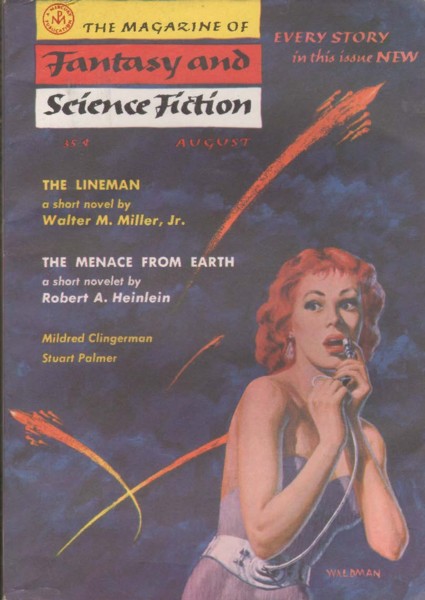
“The Lineman” is the final story of Miller’s to be published during that meteor shower of fiction, and is by extension the last thing he saw published that wasn’t related to A Canticle for Leibowitz. This is a new read for me; the only experience I’ve had with Miller previously are his Hugo-winners, those being Leibowitz and his 1955 novella “The Darfsteller.” I might review “The Darfsteller” eventually, who knows? And I do want to read more by Miller, despite not being a Catholic or even a Christian; I find his brand of theological inquiry to be quite affecting at times.
Placing Coordinates
First published in the August 1957 issue of The Magazine of Fantasy and Science Fiction, which is on the Archive. You’d think Miller having one of the most famous SF novels of the ’50s under his belt would mean his other fiction would be readily available. You’d also be wrong. As far as single-author collections go you basically have one choice, which is The Best of Walter M. Miller, Jr.—and I know what you’re thinking, there’s also Dark Benediction. The Best of Walter M. Miller, Jr. and Dark Benediction are, as far as I can tell, the same damn collection, with the same damn stories in the same damn order; they’re also seemingly out of print. As far as anthology reprints go we also don’t have many options, though “The Lineman” does appear in David G. Hartwell’s super-chunky anthology The World Treasury of Science Fiction, which I’d say is definitely a book to have in your library if you’re a slut for reprint anthologies like myself.
Enhancing Image
Unlike a lot of stories set on the moon, “The Lineman” takes place during the early stages of setting up lunar colonies—not just one colony, but apparently operations headed by several countries, with the U.N. as the referee. Bill Relke is the titular lineman, being part of an American construction crew in the midst of building communication lines. High-speed internet wasn’t a thing yet.
Something to note right off the bat about this novella is that unlike A Canticle for Leibowitz, which only really betrays the time of its conception with references to nuclear armageddon, “The Lineman” eats, lives, breathes, and almost certainly shits the 1950s. Our entirely male construction crewmen talk in ’50s slang, with a heavy dose of hardboiled dialogue that wouldn’t feel out of place in a black-and-white film noir. The conflict of the story is also twofold, and both have to do with the presence of women on the moon during colony-building. Relke has to deal with some goons who work for an underground society that seeks to overturn something called the Schneider-Volkov Act, but that only turns out to be the beginning of his problems.
A ship lands not too far from the site, and it’s not with any known country’s effort to colonize the moon; indeed, it seems to be a commercial vessel. The first twist is that the ship is full of women (“The Ship Is Full of Women” sounds like one of Fritz Leiber’s lesser stories), and the second is that it’s a space-faring whorehouse. Oh yes, our hard-working men are met with French-Algerian “entertainers,” and you know this was written in the mid-’50s because Algeria is still a French colony in the world of the story. Hell, Algeria would no longer be a French colony by 1965, let alone 2065. Since the men (including Relke) have gotten zero pussy for as long as they’ve been on the moon, this causes a big commotion.
Crews being all-male is also given a very of-its-time explanation in the form of the Schneider-Volkov Act. As Joe Novotny, Relke’s superior, explains:
Relke: “Say, Joe, how come they let dames in an entertainment troupe come to the moon, but they won’t let our wives come? I thought the Schneider-Volkov Act was supposed to keep all women out of space, period.”
“No, they couldn’t get away with putting it like that. Against the WP constitution. The law just says that all personnel on any member country’s lunar project must be of a single sex. Theoretically some country—Russia, maybe—could start an all-girl lunar mine project, say. Theoretically. But how many lady muckers do you know? Even in Russia.”
Didn’t Robert Heinlein’s short story “Delilah and the Space-Rigger” already solve this issue?
The master of the ship is, Madame d’Annecy, who turns out to be quite a pragmatic actor. Clearly she’s here for business, and she doesn’t care if the construction guys temporarily jeopardize their own operation to get some tail so long as they’re paying. There is an ulterior motive here, but I’ll save that for spoilers; just saying d’Annecy is one of two major female characters here (which is two more than I was expecting, given the setting), and you sure can’t accuse her of bending the knee for any man who passes her way. The worst thing about d’Annecy, really, is that her business relationship with her girls is shown to be perhaps a little morally dubious (I know what you’re thinking, it’s prostitution, of course it’s morally dubious, but sex work is work). The only way we even figure d’Annecy is on the shady side is by what we know about Giselle, who’s another can of worms.
To make a long story short, Relke and Giselle get stranded together for the middle part of the story, taking refuge in a building which is not quite finished yet. Pressure suits play a big part in “The Lineman,” which makes sense since the moon has no atmosphere, and Giselle (one of d’Annecy’s girls, of course) nearly gets killed before she and Relke have even started to get to know each other. Maybe it’s best that something always conveniently happens to stop them from completing their business transaction, as Relke realizes at one point.
Relke watched her grumpily while she warmed her behind at the oven. She’s not more than fifteen, he decided suddenly. It made him a little queasy. Come on, Joe, hurry.
Uh oh.
In fairness to Relke, he stops getting all touchy-feely with Giselle once it becomes apparent that maybe they shouldn’t be doing this. Not that Giselle would be new to this sort of thing, but safe to say that doesn’t make it not wrong. Relke not only has gotten zero pussy as of late, but is still recovering from his wife leaving him (I imagine the divorce rate for moon men is high), and Giselle… has her own problems. We then come to one of my favorite passages in the story, and one of those things that reminded me that this was, in fact, written by the same guy who wrote A Canticle for Leibowitz.
She was dangerously close to that state of mind which precedes the telling of a life history. He didn’t want to hear it; he already knew it. So she was in a nunnery; Relke was not surprised. Some people had to polarize themselves. If they broke free from one pole, they had to seek its opposite. People with no middle ground. Black, or if not black, then white, never gray. Law, or criminality. God, or Satan. The cloister, or a whorehouse. Eternally a choice of all or nothing-at-all, and they couldn’t see that they made things that way for themselves. They set fire to every bridge they ever crossed—so that even a cow creek became a Rubicon, and every crossing was on a tightrope.
It’s a bit of a downer. You’d think that a religious author like Walter M. Miller Jr. would steer away from the uglier aspects of existence, not to mention the ambivalence of it all, but Miller was not what we’d call a happy camper. Even to compare Miller to other Catholic authors is weird, and to do that I’d also have to venture outside of SFF, since honestly I can hardly think of anyone inside the field off the top of my head. I guess there’s R. A. Lafferty, but none of the Lafferty stories I’ve read have struck me as all that theologically informed. Outside of SFF I’m thinking of Evelyn Waugh, who not so subtly tries to invoke a sense of revelation in the reader by having his characters return to the Church of their childhoods. Then there’s Flannery O’Connor, whose stories are often so grotesque that she basically forces the reader to run in the opposite direction of the horror—the opposite direction being God, naturally.
If Miller tries to invoke revelation, it’s with a good deal of accompanying skepticism, or at least a distinct melancholy that adds bitterness to the moment of divine release. Taken literally, the dilemma of the lunar colonizers being denied one half of the human race seemingly arbitrarily is a bit hard to take, but if taken as a metaphor, with the moon as a purgatorial level of existence, then I can see the logic behind it. Pretty much everyone agrees the Schneider-Volkov Act is something to be repealed (and by today’s standards it sounds nonsensical to boot), but how that problem gets resolved is pretty interesting.
There Be Spoilers Here
There are, to my recollection, three deaths in “The Lineman,” and they’re all accidental and involve pressure suits; they also happen at specific points in the story, each happening in one third of the length. As such, the story begins and ends with a death. The good news is that Madame d’Annecy’s plan to seduce the colonizers with her business will probably result in the Schneider-Volkov Act being repealed, and those secret society goons whom I’ve barely mentioned got their comeuppance. The bad news is that Relke has to let go of Giselle, and he also loses a couple friends by the end of it. Still, he’s the lineman of the crew, and he has to keep building the line—to make the moon a place where people can really live.
It’s during this final scene, where an improvised funeral is held for someone who’s just died in a pressure suit accident, that we get my absolute favorite passage in the story, and it’s something that’s definitely clicked with me—even made me reevaluate what I had been reading to some degree. It’s that powerful, and it also works so well as the end point to Relke’s arc.
Relke looked up slowly and let his eyes wander slowly across the horizon. There were still some meteorites coming in, making bright little winks of fire where they hit into the plain. Deadly stingers out of nowhere, heading nowhere, impartially orbiting, random as rain, random as death. The debris of creation. Relke decided Braxton was wrong. There was a God all right, maybe personal, maybe not, but there was a God, and He wasn’t mean. His universe was a deadly contraption, but maybe there wasn’t any way to build a universe that wasn’t a deadly contraption—like a square circle. He made the contraption, and He put Man in it, and Man was a fairly deadly contraption himself. But the funny part of it was, there wasn’t a damn thing the universe could do to a man that a man wasn’t built to endure. He could even endure it when it killed him. And gradually he could get the better of it. It was the consistency of matched qualities—random mercilessness and human endurance—and it wasn’t mean, it was a fair match.
There’s this old saying in SF about transcendence, and I don’t think it gets brought up anymore. The unique thing about SF is that a transcendent moment can come in a secular context—I’m thinking the ending to A. E. van Vogt’s short story “The Seesaw,” which I think was also reused for The Weapon Shops of Isher. There’s also the ending to 2001: A Space Odyssey, of course. Transcendence in SF comes usually from mankind (be it one person or the whole race) either making contact with something of godlike awesomeness, or becoming that godlike awesomeness. Transcendence is when you meet with something so much greater than yourself that you can’t even calculate it. With “The Lineman” it’s definitely the former, but unlike the vast majority of SF, Miller puts his big transcendental moment in a religious context, with Relke experiencing a religious awakening that sets him on a path of wanting to become not just a man, but a good man.
The ending of “The Lineman” really makes it. I think it’s astounding. As a uniquely science-fictional allegory about mankind getting in touch with the divine part of his nature while in the midst of temptation and horrors, It comes admirably close to striking a fine balance. I’m saying this as someone who doesn’t believe in what Miller believed at the time, and the fact that he would eventually lose both his faith and his life makes the cautious optimism of the ending all the more powerful.
A Step Farther Out
I came out of “The Lineman” a little mixed on it, but ultimately I have to say it was quite effective. Normally when I read something for the sake of reviewing it, I end up with about a page of “notes” on it, which are really just lines from the story that I decided to quote, for good reasons or bad; with “The Lineman” I got about two and a half pages of quotes. When Miller’s on the ball, he’s really on the ball, even if maybe this could’ve been cut down to novelette length. I do have to wonder if the subplot with the secret society was necessary, but then this was back when action narratives were, if not mandatory, then highly incentivized in SF magazine writing. And yet part of what makes “The Lineman” so memorable is how it continually jumps back and forth between pulpy action and genuine metaphysical observations, and how ultimately these two converge.
What fascinates me about Walter M. Miller, Jr. is that he chose to write in a field that was paradoxically both niche and commercial like science fiction, when he could’ve taken his religious concerns and put out some “respectable” literary fiction. That’s the thing, though, isn’t it? “The Lineman” can’t work as literary fiction; its themes are tied intrinsically to its premise. It’s a ruthlessly told story because the moon is a harsh mistress is a ruthless place. The same thing can be said for A Canticle for Leibowitz, which must out of necessity be a post-apocalypse tale in order to justify its inquiries about religion and human nature. It’s weird because science fiction was (and still largely is) stereotypically known for being, if not atheistic or agnostic, then secular; the authors of faith did not tend to write about said faith. Yet Miller, while openly Catholic, did not seek to force conversion upon his readers, but rather to make them think about questions not normally asked in the genre, such as mankind’s place in a universe which is assumed to have a divine overseer—you could say God, Christian or otherwise.
If Miller’s work seems flawed (and everything I’ve read by him so far is prone to a certain excess) then we only have to take the fact that he wrote SF in the ’50s for what it is: the necessary, if imperfect, prerequisite for this artist to find his footing. That Miller stopped writing after 1960, missing out on the New Wave and beyond, speaks perhaps of his fondness for the crossroads which SF in the ’50s found itself at, being more sophisticated than what came in the ’40s but not being as self-consciously experimental as what would come later. Maybe Walter M. Miller Jr. could’ve only done what he did, and say what he wanted to in the way he wanted, during a specific period in the genre’s history. Regardless, we’ll probably never get another voice in the field quite like his.