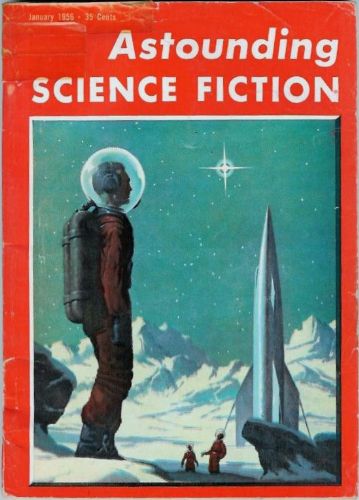
(Cover by H. R. Van Dongen. Astounding, January 1956.)
The Story So Far
John Ramsey is a gifted psychologist on an assignment from Bu-Psych, to play the role of the new electronics officer for the Fenian Ram, a subtug that’s out to raid oil in enemy territory, just off Siberia. This is the 21st century, and not only has the Cold War gotten a bit warmer, but oil has become an increasingly precious resource. The last twenty subtug missions have ended in failure, with the higher-ups suspecting there are “sleepers” aboard these submarines—spies who are sabotaging things from the inside. Ramsey’s job is twofold: to sniff out a possible spy among the Ram‘s small crew, and to evaluate Sparrow, the Ram‘s captain. Sparrow has been shown to be an incredible captain, but he also seems to have a bit of a screw loose, being a Bible-spouting borderline psychotic who expects nothing less than the utmost devotion from his crew. The other crew are Bonnett and Garcia, who’ve been on the Ram for many months by now. Ramsey is an outsider here, which already puts him at a disadvantage, never mind that he has to keep his real profession a secret.
Another problem is that being in a submarine means there’s no such thing as a minor accident, especially when it comes to dealing with enemy patrols. Of course the Ram is totally outmanned and outgunned against the wolf packs that are patrolling the Pacific, so the only option is evasive action. After a close call with the enemy, Sparrow falls ill from radiation sickness for a time, meanwhile the rest of the crew are unsure as to where they stand with each other. There’s the growing sense that somebody here is a spy, and the cards are stacked against Ramsey since he’s fresh meat. For better or worse Garcia has also figured out that Ramsey is a psychologist who has some ulterior motive for hopping aboard the Ram. The two have a kind of mutual respect, if also ambivalence mixed with paranoia. The last installment ended with Bonnett, having misconstrued Ramsey helping with the ship for planting a “spybeam,” jumping the gun and beating Ramsey within an inch of his life. Does this mean Bonnett is really the spy? Is everyone a little too tightly wound with this mission? I would know the answers, considering I’ve read the final installment or else I wouldn’t be here.
Enhancing Image
Surprise! Turns out Garcia is the spy, although how this is revealed is a bit odd; I don’t mean this in a bad way. Prior to the actual reveal Garcia implies, in a conversation with Ramsey, that he’s become tired of working for the Soviets, or more accurately he’s become tired of being a spy, but also knows that it’s too late to turn back now. If he’s caught then he would be tried and most likely executed for espionage. Interestingly, Herbert would’ve written Under Pressure in the wake of the Rosenbergs being tried and executed as spies, which in the age of McCarthyism was a major blow to civil liberties in the US. There was a crackdown on those suspected of having Soviet or generally leftist sentiments, and while Herbert was not a leftist at all, he held a long-standing disdain for government. Garcia is technically the closest thing the novel has to a villain, by virtue of being on the Soviets’ payroll, and yet Herbert writes him sympathetically. I’m not totally sure how this flew over John W. Campbell’s head, given that Campbell was a committed hawk during the Cold War and Under Pressure is evidently ambivalent about the conflict. It’s not unusual to find SF from the era that takes a rather neutral or ambivalent stance on the Cold War, but that’s usually reserved for stuff published in other magazines, and there’s a moral greyness here that is not often seen in SF published in Astounding at the time. I have to admit I didn’t expect that from Herbert.
Of course, stuck between either dying in the Ram or being taken back to the States for the gas chamber, Garcia opts for the former, dying from a heavy dose of radiation, with the wish that his family at least be provided for after his death. Sparrow, a man who prays for the souls of his enemies even as he goes up against them in battle, takes Garcia up on this, although we’re told at the end that the government killed two birds with one stone by giving Garcia’s widow a position so that they can keep an eye on her. There’s a touch of cynicism in what is otherwise a happy ending—just enough to satisfy Herbert’s own tendency toward cynicism, but not enough to scare Campbell. As for Sparrow, there’s a curious insight about how he’s psychologically unfit to live on land, but perfectly adapted to life in a submarine, in the sense that he’s married to the job. What counts as being mentally unfit? It’s a matter of perspective. Sparrow is so attached to the Ram that it’s like a second skin, or like his natural environment. I’ve noticed that in the years leading up to the space race escalating, there was some speculation in SF about the psychology of the astronaut, and how an astronaut might be changed mentally by life in a tin can, in zero gravity; but Herbert posits the same question about people who work in submarines, a question that has only become more pertinent with the invention of long-range nuclear subs. You don’t see this specific kind of speculation often in fiction.
A Step Farther Out
Only been, what, a couple weeks since I last posted here? Feels like it hasn’t been that long on my end. Then again, I was posting every few days here up until recently, and since I can look at the numbers, I can tell you that I’ve written a lot for this site. A fair bit of time and effort with relatively few returns, except of course the pleasure of (sometimes) reading fiction that is in itself enjoyable. I’m nothing if not a compulsive reader; in fact while I’ve mostly taken a break this month from writing, I never stopped reading, say, two or three books at a time.
Well, Under Pressure is a pretty decent serial, to the point where I can see how reviewers in 1956 saw it as an impressive debut from Herbert. For his part Herbert wouldn’t properly follow up Under Pressure (or The Dragon in the Sea as it’s also called) for nearly a decade, but when he did it would be the beginning of maybe the single most famous SF book series of all time. I do recommend Under Pressure if you’re into old-school hard SF that has also aged better than a lot of stuff from that time period, although your mileage may vary with regards to Herbert’s writing quirks, some of which are very much present here.
(Cover by Frank Kelly Freas. Astounding, December 1955.)
The Story So Far
John Ramsey is a gifted psychologist, part of the Bureau of Psychology, who’s given the unenviable assignment of surveying the crew of the subtug Fenian Ram, and especially its captain. Captain Sparrow is on the one hand the master of his ship, and his performance on the job has been off the charts; but he’s also a Christmonger, and the higher-ups fear he might be a little too unhinged. Meanwhile there’s also the suspicion that there’s a spy aboard the submarine, which is a bit odd considering the crew (minus Ramsey) is a total of three men, all of whom have known each other for months. Still. Ramsey takes a crash course in a submarine’s layout and becomes the fourth crewman, as the new electronics officer. (The last one had lost his mind.) Of course, Ramsey’s job as psychologist is kept secret from the others, as well as the fact that he’s here to sniff out a potential rat. You have Captain Sparrow as well as Bonnett and Garcia, with Bonnett being Sparrow’s right-hand man and Garcia being a practicing but rather pessimistic Catholic. Sparrow is fond of spouting prayers and Bible verses, to the point where if I were in Ramsey’s position I would just assume the man was totally psychotic. But that’s just me. There is indeed a whiff of religious mania in the air, but rather than immediately cause problems this instead constributes to a kind of synergy among the three crewmen. Ramsey is the odd one out; his contributions to the team add a degree of tension presumably not there before, and what’s worse is that at one point Ramsey comes to the realization that he’s afraid of being underwater.
While set in the 21st century, actually around the same time as [current year], Under Pressure takes place in a world where the Cold War has gone a bit hot and East and West and battling under the seas for control of oil. Frank Herbert seems to have a fondness for narratives about factions fighting over a precious resource. The Fenian Ram is a top-performing subtug, and she’ll need to be considering the previous twenty subs that have been on this raid have failed—indeed destroyed. We’re in the depths of the sea, off the coast of Siberia, in enemy territory, where Soviet wolf packs have been picking off American subs and, the top brass suspects, there may be a spy sabotaging these subs. For some reason damn near every SF writer in the business at the time thought the Cold War would go on for a century or more, with the exception of John Brunner and one or two others. Sure, the Cold War lasted a while, but it seems nobody had speculated that the Soviet Union would dissolve as early as it did.
Enhancing Image
Much of the first installment is concerned with setting up the context for this undersea voyage, as well as the crew. Now that we’ve become acclimated it’s time for some sweet submarine-on-submarine action, of the sort you may have seen watching Das Boot. (I’m sorry that I’ve mentioned that movie more than once at this point, but in my defense, it is the gold standard for the niche subgenre that is submarine media.) The second installment is a lot heavier on action, which ironically means there’s a lot less for me to talk about. If you’ve been reading my posts for at least a few months then you know I’m not very good at writing about action, nor am I even good at recapping what happens. When it comes to reading fiction I’m about ideas, characters, dialogue, and individual moments, which is probably why I’ve been a Thomas Pynchon fan since college. (Try not to hold that against me.) Thankfully, while he does have weaknesses as a writer (his tendency to jump from one character’s internal monologue to another without pause can be grating at times, and he was by no means a poet), Herbert has a talent for giving what is at least on paper a simple scenario a layer of complexity. Think about it: we’re stuck in this submarine for most of the novel, and with a small set of characters the whole time, none of whom are all that likable. Like sure, Ramsey is not as suspect as the others, but that’s because a) he’s the protagonist, b) he really does wanna do the right thing, and c) he’s not a Jesus freak. Even while these characters are prone to bickering and having tirades, it’s a setting that perfectly calls for such things. When a close call with some enemy subs leads to Sparrow getting a case of radiation sickness and lying in the infirmary for a time, you get the sense that while it wouldn’t happen at this point, if only for the sake of the plot, it’s very possible that a freak incident can leave this little ship without a captain. Everything can go to hell in a second, and it nearly does.
Things are tense while Sparrow is recovering, and even when he resumes control the situation doesn’t lighten any. It becomes apparent to everyone that one of them is probably out to sabotage the subtug, so that there are always two people awake to keep watch on each other. (It does not occur to them, of course, that there could be two spies.) The first revelation is that Garcia has somehow found out that Ramsey is a psychologist and not really an electronics officer by trade, even calling him a “head thumper.” This sparks an uneasy agreement between them, because it would be inconvenient for Sparrow especially to discover that Ramsey’s been sent here to check his head. The second revelation comes at the very end of the installment when Bonnett, having been roused into zealotry by Sparrow and convinced Ramsey is suspect, misunderstands the situation and almost punches Ramsey’s lights out before the latter can even get a word in. Something I have to say about Under Pressure that I usually don’t get to say about SF of this vintage is that I’m really not sure how this is supposed to play out in the final act. All three men are suspect in some way, and of course Ramsey himself could be secretly working for the other side, although I would be much peeved if that were the case considering we’ve been given insight into his thought processes. At that point I’d feel like Herbert was cheating. This also goes for Sparrow, to a lesser extent, since he’s the other character whose internal monologue we’re let in on throughout the novel. Herbert is rather inconsistent about how much attention each man’s internal monologue gets and at what points we’re allowed to read their thoughts, which is a problem that would haunt Herbert for decades.
A Step Farther Out
I had actually read this installment about a week ago, but didn’t feel motivated to write about it until recently. You’d think giving myself time to focus on other things would mean that at some point I’d be really itching to hop back on the horse that is writing, but this is not so. The problem with writing is that in order to be effective you have to work at it at least somewhat regularly or else you will lose the touch, so in that way it’s like how you ought to hit the gym at least a few days a week. I also seem to have not gained any extra insight into what Herbert’s doing with this novel, which I might add is looking to be a pretty solid debut novel, since I finished this installment. My initial thoughts and feelings didn’t change or expand, which disappointed me. It was just a matter of sitting down for a couple hours and pushing out some words. Don’t worry, I’ll have finished reviewing this serial by the end of the month.
(Cover by Frank Kelly Freas. Astounding, December 1955.)
It could be that I’ve simply had too much on my plate, or that I’ve been procrastinating with my projects, but I’ve been feeling sluggish and unfulfilled with my writing as of late. Even in writing this forecast post I feel… uninspired. The drive is not currently in me. Actually the drive has not been there for several days now, which hasn’t stopped me from getting a couple things done. There is a difference, however, between writing like you’re in the midst of a fever and writing as a kind of chore, and it’s felt like the latter too often as of late.
So, I figured it was time I take a break from this site for a month, for the most part. I will still be finishing my review of Under Pressure, and will be writing one or two editorials over the course of this month, but otherwise I’ll stepping away from here momentarily. I have too much going on, and I feel as if I’m the verge of utterly burning myself out with how productive I’ve tried to be, even with missing a couple deadlines. (I might still write a review of The Sorcerer’s Ship sometime this month, but needless to say I could not even start my review, let alone have it posted, yesterday.) I continue to write, often without motivation or imagination, because I really feel like I can’t do anything else. Writers, as opposed to people who write, are like actors, in that they do what they do because they feel helpless or impotent when it comes to other talents. I’m a writer. Unfortunately I don’t even make money from writing, as it stands; maybe if I were to train myself to write fiction, to be published in some of the magazines I take material from for this very site, then I could make some money on top of my meager earnings from my day job. Considering how things are going, it could be that in time I might not even have a choice. I might have to branch out into fiction, and take even more time away from this site, because I might have to do it. But who knows, it might be fulfilling in its own right.
Sometimes I feel like a pastor in an empty church, or with only a few congregates, plus the rats and pigeons. Who am I speaking to? I don’t have much of an audience, and some of the people who say they read my stuff are themselves bloggers, also concerned with traffic for their own projects. It’s a problem that SFF fandom has had for a long time, and I don’t see any way of fixing it. Most fans I know don’t engage with this sort of thing. A lot of people who vote in the fan categories, when it comes time for the Hugos each year, are themselves fan writers, artists, etc. We’re voting for each other. I’m speaking to people who know what it’s like, which is both a good and bad thing. I feel so horribly alone, most of the time, and the time and energy I put into this hobby sometimes only worsen the loneliness and anxiety. I had started this site three years ago as a way to cope with some mental health struggles, but it doesn’t always help.
So I’m taking a break this month, for the most part. There will be a few posts, but I aside from Under Pressure and maybe The Sorcerer’s Ship I don’t feel like writing about any magazine fiction until next month. Maybe I deserve a break like this, but mostly I just feel that I need it. I won’t be entirely gone, so don’t miss me too much.
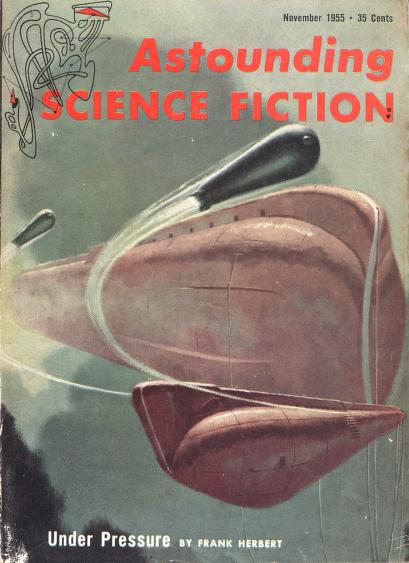
(Cover by H. R. Van Dongen. Astounding, November 1955.)
Who Goes There?
Frank Herbert is one of the most famous authors in the whole history of SF, despite the fact that most of his output continues to wallow in obscurity. How did this happen? He was born in 1920 in Washington State, raised Catholic but taking to Buddhism as an adult, served a brief stint (only six months) in the Navy during World War II, this last part being relevant to today’s story. He started out as a journalist and came to writing science fiction relatively late, already being in his thirties when his first SF story was published in 1952. A few years later and we got his first novel, serialized as Under Pressure and published in book form as The Dragon in the Sea. But that’s no what people know Herbert for. When it seemed like he was about to be another second-tier writer, doomed to be forgotten, Herbert struck gold with the serial Dune World, in Analog, which was very popular, along with its sequel serial Prophet of Dune. Both short novels, totaling eight installments, were then fused into one big novel, Dune, which became a bestseller overnight and which took home both the Hugo and the inaugural Nebula for Best Novel. The rest is history.
Of course, it’s not as simple as all that. Herbert had conducted an enormous amount of research for Dune, with this first novel in what would become a wide-spanning series taking years to gestate—unusual for genre SF at the time. Herbert wrote other novels over the next couple decades, but Dune was the thing that kept his name in the papers and on people’s minds, and indeed, even taking its faults into account, Dune was a revolutionary novel for the field. Herbert himself is a figure of some controversy, from his appropriating of Islamic culture to his well-documented homophobia to the question of whether or not he was even a good writer. Did he just happen to get lucky? I have to admit, being a third into Under Pressure, I do think there was at least some talent there.
Placing Coordinates
Serialized in Astounding Science Fiction, November 1955 to January 1956. It was published in book form later in 1956 as The Dragon in the Sea, revised somewhat (the language is a bit saltier, for one) but otherwise the same novel as its magazine counterpart. It’s still in print, I think, although truth be told I’ve never encountered anything Herbert that isn’t Dune-related in the wild. Has anyone seen a copy of this thing?
Enhancing Image
I assume most if not everyone reading this has already read Dune, which means we’re already aware of Herbert’s writing quirks, and you’ll be pleased (or maybe not) to know some of them have already manifested in Under Pressure. Well, the good news is that this is a much smaller novel than Dune, in both length and the scope of the action. We’re not given a whole world to play with, but instead the cramped and claustrophobic world of an atomic submarine—as envisioned in the 1950s, of course. Whereas it takes seemingly forever for Paul Atreides to emerge as the “hero” of Dune, we’re immediately met with our protagonist for Under Pressure in the form of John Ramsey. Ramsey is trained as an electronic officer, but his real job and profession is as a psychologist, an ensign from BuPsych (the Bureau of Psychology) assigned to the subtug whose crew is rated as the likeliest to succeed on an upcoming oil raid. This is important for two reasons: first is that in the 21st century (around what is now the present, actually), oil has become an increasingly precious resource, with the Western and Eastern (they never say “Soviets,” but we’re clearly meant to understand the East as the Soviets) fighting for control of this resource; the second is that of the last twenty Hell Diver missions, with these subtug oil raiders, all twenty missions ended in failure. A subtug crew is very small, only four men, and with the three men aboard this one BuPsych suspects there’s a “sleeper” among them—a spy who sabotages the submarine. So you have three highly qualified men, including their captain, but one of them is (probably) a traitor.
It’s here that we’re introduced to the crew, that being Captain Sparrow and his men Garcia and Bonnett. Sparrow is sort of an Ahab or maybe Nemo figure, whom BuPsych suspects of having a screw loose, but he’s also shown to be a highly capable skipper. Garcia is a Hispanic Catholic, which is curious because I would’ve expected the subtug’s crew to be all white Americans instead of mostly. Then there’s Bonnett, whom Ramsey nails as having an inferiority complex due to being raised in an orphanage. I should mention at this point that Ramsey is a psychologist of the sort you’d expect to see in pop culture in the post-war years, which is to say he’s clearly read a ton of Freud and Jung. Under Pressure is not nearly as aggressively Freudian as some other SF works from the era, at least not yet, although I’m not sure how much of that boils down to censorship from being printed in Astounding. Magazines at the time were generally more prudish than book publishers, but this was doubly the case with magazines John W. Campbell edited. Looking at the magazine and book texts of Under Pressure, there are immediately some small but still noticeable differences. For example, at the beginning in the magazine version, Ramsey calls a snooty secretary a snob, while in the book version he calls her a bitch. Maybe if Under Pressure had been serialized in Galaxy the mildly salty language would’ve stayed, but Herbert’s brand of SF is maybe a bit too hard-nosed for that magazine. Indeed the most impressive part of this novel, aside from Herbert’s estbablishing a setting that is suffocating both physically and mentally, it’s that Under Pressure reads more as speculative fiction than science fiction. Granted that I’m not even slightly an expert on submarines and have only an elementary knowledge of nautical terminology, it’s impressive that Herbert is able to make the reader feel as if they’re learning about subs while at the same time reading a psychologically gripping adventure story.
So Under Pressure is what might be called edutainment, which is a lable I don’t see used often nowadays, but back in the pre-internet days (and indeed in the early days of the internet, i.e., my childhood) there was a whole school of pop science that worked to educate the layman while also being entertainment. Hard SF is arguably a kind of edutainment, with the caviat that hard SF, being still a kind of SF, must out of necessity work on the basis of at least One Big Lie™. The author has to fudge the numbers or put their thumb on the scales to make something SFnal. Hal Clement admitted this much in an essay that accompanied the serialization of Mission of Gravity. Incidentally, a big reason Herbert’s novel works as edutainment is that Ramsey, who for much of this is our eyes and ears, has to learn about the minutia of the subtug at the same time as the reader. He’s given a five-week crash course in being an electronics officer aboard a sub with only four crewmen, all the while reading up on his shipmates so that he can better figure out if one of them is about to crack, or if one of them is the spy the government’s looking for. Not only does Ramsey have to sniff out the spy, but he’s keeping his job as psychologist a secret from the crew. Thus we’re introduced to a game of cat and mouse, made more intense because Sparrow and Garcia are religious men and Sparrow even more so is prone to episodes of Bible-quoting religious mania.
There Be Spoilers Here
The crew discover the tucked-away corpse of the former electronics officer, who may or may not have committed suicide, but otherwise there’s not too much action in this installment. The big realization Ramsey comes to by the end is that he is quite likely to die on this mission, either through sabotage with the subtug or one of the crew killing him outright. The problem with being in a submarine is that you’re hundreds of leagues below the ocean’s surface, so that there’s no such thing as a “small” mishap aboard ship. If you’ve watched Das Boot then you have an idea as to the mortality rates of submarine crews during WWII, and while the future war of Under Pressure is clearly based off the Cold War instead, the risk has not gone down much. This first installment ends with a kind of bewildering nightmare sequence, in which Ramsey’s fears of dying in the dephs of the ocean come to the surface. It’s a reminder that Herbert can be a creepy bastard, and also that despite his tendency to jump between characters’ heads, namely Ramsey and Sparrow’s he understands psychological drama.
A Step Farther Out
As someone who is a bit of a Herbert skeptic, I have to say I’ve been enjoying this quite a bit. We’ll see where it goes.
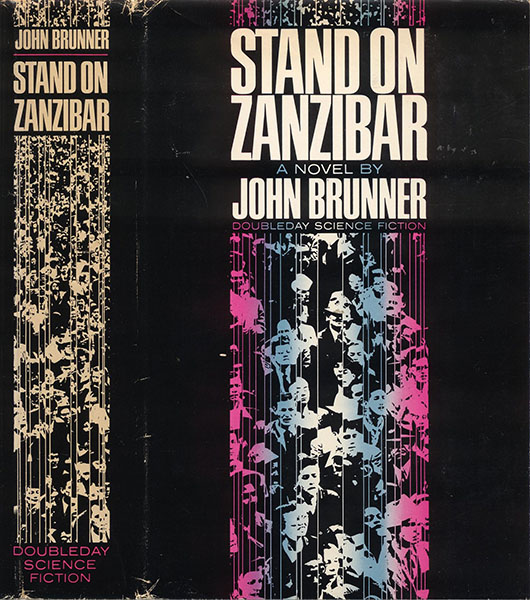
(Stand on Zanzibar. Cover by S. A. Summit, Inc. Doubleday, 1968.)
I’ve been in a bit of a rut recently, or rather I’m facing another bout of depression and lethargy when it comes to writing. I considered tackling something serious, but while we will no doubt get to a serious topic one of these days, such a thing requires more time and effort than what I’m currently able to afford. It’s also been a few months since I last did an Observatory piece. I have to admit I’ve slackened a bit when it came to this department. As such, you can think of this editorial as a warm-up exercise; if nothing else it should provide some food for thought. It’s actually a topic that’s been lingering in the back of my mind for a long time now, as like one of those fun little “what if” scenarios that you would not seriously contemplate, but rather would return to occasionally and twist and turn like a safety valve in your mind. It’s something to do as a distraction while there are some serious problems afoot.
I write about what I think of as the big three fantastic or unrealistic genres, those being science fiction, fantasy, and horror, as opposed to genres that historically rubbed shoulders with realism, namely Westerns and detective fiction. Nowadays I tend to read realistic or “literary” fiction (with some nonfiction thrown in there) in my free time a lot more often than genre fiction, in part because I wanna keep my efforts as a reviewer/blogger at least somewhat segregated from my efforts purely as a reader (I know people who review genre fiction for a living who, because of the time and effort required for the job, barely read anything except genre fiction, and that’s not the way I would like to live), but also I must confess I do often enjoy reading literary fiction more than genre fiction. Of course, the line between those two can be pretty blurry. A literary novel can have genre elements, and as you know I’ve reviewed works by authors on this very site who are typically found in literary and not genre spaces: Graham Greene, Robert Graves, G. K. Chesterton, to name a few. You have people like Jack London who are known primarily for their literary fiction, but who also wrote a good deal of genre fiction; and because for some the term “science fiction” hadn’t been coined yet, there was no effort to separate literary from genre. How do you put something in the SF ghetto if “SF” is not a label in your lexicon? But now that the label does exist, and has existed for almost a century at this point, some lines have been drawn in the sand.
Realistic or literary fiction is really an umbrella that could encompass practically every other genre, but only rarely does a work of genre fiction find its way into the literary canon; and in the case of SF, the number of SF works to worm their way into literary spaces is very small. You have 1984, Brave New World, Fahrenheit 451 and The Martian Chronicles, Frankenstein, the early novels and stories of H. G. Wells, The Handmaid’s Tale, and more recently the works of Octavia E. Butler. With the notable exception of Butler, whose reputation has been heightened to almost an extreme in the years following her death, you may notice that the SF works to have entered the so-called literary canon are the usual suspects. Also, with the exception of maybe Frankenstein, these are works that are far more revered for their historical and/or societal importance than for their literary merits. SF that enters literary spaces has historically been treated as more useful than beautiful, as more of a societal good than as an aesthetic achivement. There’s also the problem that SF, at its core, its unrealistic, which is to say it does not and cannot depict the highs and lows of society as they exist in the current year; it can extrapolate on society as it currently exists (and often does), but that’s not quite the same thing. Meanwhile a realistic novel typically tries to capture some facet (or maybe multiple facets) of current (or past, if it’s a historical novel) society. But as I said, a realistic novel can have traces of SF or even fantasy (we tend to call examples of the latter “magic realism,” which rather smacks of whimsy, but it’ll have to do) in its blood, but the genre element is not the focal point.
This brings us to the question of the Great Novel, by which I mean what is typically considered a country’s defining literary achievement. The Great Novel, for a given country or culture, is a work which ideally, through scope and attention to detail, captures a certain time and place with as much fullness as the author could manage. The Great Russian Novel is War and Peace, the Great French Novel is Les Misérables, the Great English novel is Middlemarch or Vanity Fair, and even Ireland has its clearly designated Great Novel with Ulysses. The Great American Novel is more up for debate, to the point where Wikipedia has a rather long list of candidates: to name some (but not all) we have Moby-Dick, The Great Gatsby, To Kill a Mockingbird, Gravity’s Rainbow, Blood Meridian, Beloved, and Underworld. While they vary greatly in length, subject matter, and perspective, it’s easy enough to understand why each of these novels would be a candidate, since they aim to be nothing less than a definitive look at a certain time and place with a certain point of view. Moby-Dick is “the definitive” novel on whaling and American port towns, The Great Gatsby is “the definitive” novel on the excesses and follies of the 1920s, Beloved is “the definitive” novel on black Americans’ traumatic relationship with chattel slavery, and so on. Of course I use quotation marks because these novels (except maybe Moby-Dick, which really did seem to close the door on whaling culture as far as representation in fiction goes) are by no means the only or ultimate statements on their respective subject matter. Also, a novel need not necessarily be of a certain length (The Great Gatsby is a mere 180 pages, after all) to tackle its subject properly, although length does help. The point is that these novels, in both scope and substance, give one an impression of a whole place or culture over a certain period of time.
In genre SF, there didn’t seem to be any concern about writing The Great SF Novel up until at least the 1950s, which makes sense considering the market restrictions of the time (the average SF novel at this time clocked in at about 200 pages or so) and the fact that SF criticism was in its infancy. The field, by the end of the ’50s, had barely crawled out of the primordial slime that was the height of the Campbell era, in which low-paying genre magazines dominated and getting published in hardcover or even in a mainstream magazine was considered the highwater mark for one’s career. In 1950, to be an SF writer and have your story printed in The Saturday Evening Post was basically the most you could hope for. But by the ’60s there was clearly a change in the air, perhaps incentivized by the magazine market shrinking; there were only a half-dozen or so genre magazines active in the US by 1960, such that it would no longer have been viable to make a living just writing short fiction at a mile a minute. Authors turned to writing novels, and it didn’t take long for there to not only be more novels as original paperback releases (and also hardcover), but some of these novels were quite big for the time. Even in its original cut-down form, Stranger in a Strange Land clocked in at just over 400 pages, which would’ve been nigh unthinkable just five years earlier. To think, 400 pages that’s mostly just people talking about sex, religion, cannibalism, and whatnot. The usual. The gambit paid off, though, with Robert Heinlein winning a Hugo for it and with Stranger in a Strange Land becoming one of the most popular SF novels of the ’60s, even gaining a mainstream readership. That Stranger is a huge and overwhelming book, tackling several topics with reckless abandon and often in exhaustive detail, did nothing to halt its sales figures.
(Stranger in a Strange Land. Cover by Ben Feder. G. P. Putnam’s Sons, 1961.)
Stranger was not Heinlein’s first mainstream success, for he already had several stories published in The Saturday Evening Post and a whole series of juveniles in a deal with Scribner’s, but Stranger (published by G. P. Putnam’s Sons) showed that an SF novel didn’t have to be just about one or two things, but could in fact have an almost encyclopedic thoroughness while still being a bestseller. In other words, the dam broke. The impact was not immediate, by throughout the ’60s there came a laxing attitude on publishers’ parts towards long and epic SF novels—some of which even threatened to have literary ambitions. I was doing a cursory search of essays and blog posts done on the idea of the Great Science Fiction Novel, and I basically found nothing, at least so far, which is weird to me because it’s so obvious that some authors in the ’60s going forward clearly wanted to write such a thing, whereas no such ambition seemed to exist beforehand. This is not to say there aren’t great SF novels to come out of the ’50s and early, quite the contrary, but typically the great SF novels from prior to the ’60s had scope or depth—not both. Meanwhile, by the end of the ’60s we had gotten Dune, Stand on Zanzibar, The Man in the High Castle, The Left Hand of Darkness, Heinlein’s Stranger in a Strange Land and The Moon Is a Harsh Mistress, and a few others I could name. Dune was so big that it originally appeared at two separate serials, totally eight installments, and it certainly feels like it. Frank Herbert famously had to go to Chilton to have Dune published in book form, with Chilton not being an SF or even normally a fiction publisher—not that this stopped Dune from selling enormously well. Dune, even being the first entry of a wide-spanning series, is a mind-numbing study of a fictional planet and its ecology, and how mankind might be able to live in such a hostile environment. Herbert’s novel was, at the time of its publication, the most ambitious and plausible hard SF (despite nowadays being marketed as akin to fantasy) novel on the market.
Did Heinlein and Herbert intend to write the Great Science Fiction Novel at the time? I’m not sure. I can think of at least one person who did, though. Clocking in at just under 600 pages, not too crazy by today’s standards but a real mammoth of a book for SF in 1968, John Brunner’s Stand on Zanzibar consciously takes cues from Modernist literature, to the point where it can be considered a late Modernist novel as much as an SF novel. Brunner was known for quantity rather than quality, even writing a few short low-effort novels during the time that he was working on Stand on Zanzibar, which probably made this novel’s scope and complexity come to most if not all readers as a shock. Here we’re presented with a 2010 that is both in some ways similar and dissimilar from the 2010 we actually lived through, in which the world is overpopulated, people are overstimulated, there seem to be mass shootings and terrorist threats every week, there are computers small enough to fit comfortably in one’s home, and it seems to also be the only SF novel of the era to not assume that the Soviet Union would survive into the 21st century. There’s a main storyline, but it’s interspersed with vignettes featuring unrelated characters, as well as advertisements and news stories that give us an idea of what is going on this strange new world. It’s an incredible read, if also exhausting and rather cold-hearted by design. Brunner really transcended himself with it, and the effort paid off—to an extent. Stand on Zanzibar won a Hugo, and remains in print to this day, but was not exactly a bestseller. Brunner wrote a handful of big novels about big topics, including The Jagged Orbit and The Shockwave Rider, but the effort he put into these novels did not result in sales figures to match. Ironically the person who at the time strove the hardest to write an all-encompassing all-consuming SF novel on par with a Moby-Dick or a Ulysses garnered inadequate reception for it, compared to what Heinlein and Herbert were able to accomplish.
The average SF novel remained compact, on average, for a while, but you still got outliers (or abberations, if you hate long novels) with varying degrees of commercial success, not to mention success as attempts at being the Great Science Fiction Novel. The ’70s saw what might be the closest we’ve gotten to a synthesis between the Great American Novel and the Great Science Fiction Novel, in at least two instances: Gravity’s Rainbow and Dhalgren. Thomas Pynchon and Samuel R. Delany, the authors of these respective novels, were borderline prodigies of the form (Delany was 19 when he wrote his first novel), are both of the silent generation, both owing a clear debt to the Modernists, and both being arguably the most fit for taking on the task of writing an enormous and challenging literary novel that could also be taken as science fiction.
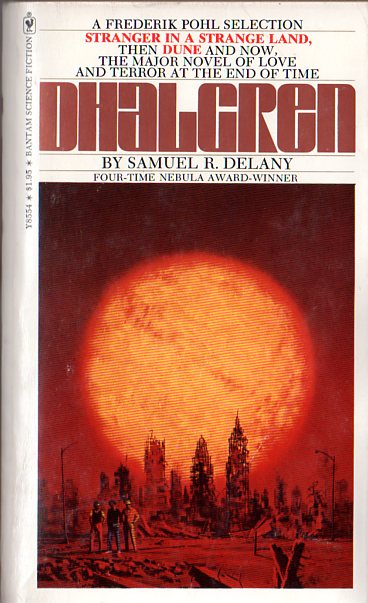
(Dhalgren. Cover by Dean Ellis. Bantam Books, 1975.)
Gravity’s Rainbow is… a lot of things. There’s something about a big mind-controlled octopus. Something about a young American having been trained from infancy to anticipate the locations of rocket strikes with his penis. Something about the end and immediate aftermath of World War II in Europe. Something about the extinction of the dodo. There’s a young witch (she says she’s a witch) in training. Totally mind-boggling novel, in that it’s a war novel, a kind of perverted nightmare, a stage musical, and also science fiction. It’s also 760 pages, published by The Viking Press, and was set to win (but was denied) the Pulitzer Prize. It was even nominated for the Nebula for Best Novel, but lost to Rendezvous with Rama. Then there’s Dhalgren, which in hindsight could be argued as the last big attempt at marrying genre SF with “high-brow” literary fiction. Delany pays homage to James Joyce pretty blatantly from the outset, to make it clear to us that this is a Serious™ novel. Well, it’s not that serious. Dhalgren is sort of a hangout novel, in which not much happens, but rather in which the isolated city of Bellona comes alive with quite a few memorable characters. As with Gravity’s Rainbow there’s a pornographic element to it. It’s also a goddamn beast in terms of length, clocking in at 879 pages in the original Bantam paperback edition. When Dhalgren came out in 1975, there wasn’t anything else quite like it in the field, and there also wouldn’t be anything like it thereafter. These two novels sold well, but got extremely mixed reactions, with Dhalgren also being up for a Nebula but losing to the relatively short and conventional (but very good, let’s be clear here) The Forever War.
Folks have typically considered the Nebula to be the writer’s award, which makes sense since it’s members of the SFWA basically voting on each other’s work, and professional authors are presumably more literarily knowledgable than readers. The Nebula going to Rendezvous with Rama and The Forever War over Gravity’s Rainbow and Dhalgren respectively however implies an aversion to works that might be considered too literary. Indeed, in the world of SF, much of the ’70s would be spent on doing away with much of both the good and bad parts of the New Wave while also co-opting just enough of it to give the pages of Analog a PG-13 and occasionally even an R-rated level of spiciness. The New Wave gave us some really bad literature; actually I would say 90% of New Wave SF was bad, but then, to paraphrase Theodore Sturgeon, 90% of everything is bad. At the same time, the New Wave years saw a collective sentiment that great SF that should also be Great Literature™, which is how we even got something like Stand on Zanzibar, or Delany’s earlier novels. The backlash to the New Wave caused SF to swerve in a retrograde direction. As Jonathan Lethem puts it in his article, “The Squandered Promise of Science Fiction”:
Fearing the loss of a distinctive oppositional identity, and bitter over a lack of access to the ivory tower, SF took a step backward, away from its broadest literary aspirations. Not that SF of brilliance wasn’t written in the years following [the ’60s], but with a few key exceptions it was overwhelmed on the shelves (and award ballots) by a reactionary SF as artistically dire as it was comfortingly familiar.
This is not to say great SF novels weren’t published after Dhalgren, obviously, or indeed after The Forever War, which may be the field’s equivalent of The Red Badge of Courage. But at least for a while after, it’d be hard to think of an SF novel that tries even inadvertently to be the Great Science Fiction Novel, which is to say a novel which is both unquestionably SFnal and which also depicts a fullness of human existence as seen in the likes of Stand on Zanzibar and even The Moon Is a Harsh Mistress. There’s Gene Wolfe’s The Book of the New Sun, although it’s a setting that can be easily confused for fantasy—a mix of SF and fantasy that Wolfe deliberately invokes. There’s Neuromancer, which is a sprawling mix of SF and detective fiction, but which nowadays strikes me and some other folks as pretty close to unreadable. There’s Cyteen, which is quite large and even won a Hugo, but I have to admit I’ve not gotten around to it yet. If there’s something like a modern candidate for the Great Science Fiction Novel the problem is that either the novel leans too heavily into SFnal territory or it’s simply a literary novel that happens to have a pinch of SF about it. I could be missing something, of course, and I’d be curious to see if anyone can bring up candidates for the Great Science Fiction Novel post-1975. I don’t read that much recent SF, and even for the sake of my blog I only tackle something like that occasionally; you could say I’m biased in favor of the classics.
(Cover by H. R. Van Dongen. Astounding, November 1955.)
So I had read Anne McCaffrey’s “The Weather on Welladays,” and I didn’t like it. I’ve read Dragonflight and The Ship Who Sang, plus one other novel and a few short stories now, and I’m still not really sure what McCaffrey’s appeal is (I say this as someone who jumps to defend A. E. van Vogt’s early work). “The Weather on Welladay” isn’t bad, but it’s seriously hampered by being a novelette where the perspective shifts several times so that we have a few protagonists, when ideally we should have only one. I also just don’t think McCaffrey is that good a writer when compared with some of her peers, who were (and still are) not as popular. It’s nice that McCaffrey was the first woman to win both a Hugo and Nebula for fiction, but I wish those honors had gone to better writers. That’s the gist of how I felt about it, in case you’re wondering where my review post for it is.
The funny thing is that I had too good a time during the couple of days I normally would’ve spent on reading and writing for this site, which is ironic. I struggle to write here either when my personal life is at a peak or when it’s deep in a valley. I have to admit to you, the five of you who actually read these posts, that I sometimes resent writing—well, really anything, but especially for SFF Remembrance. Sometimes I just don’t feel like writing anything, but the problem is that if you stop writing then it can be a real challenge to start again. Writing (if you’re “a writer”) is like brushing your teeth, in that ideally it should be a daily activity. But I also don’t like writing that much; yet at the same time I can barely do anything else that would be considered “productive.” I work a service job. I pay my bills and my rent and my taxes like a “good American,” but I feel like I don’t create anything. I have this urge, or maybe this sense of obligation, to create something that is of any value, but I can’t do it. I hate myself and this country I am forced to live in. The environment is hostile, for creativity but also just for human decency. It’s like that Godspeed You! Black Emperor song: “We are trapped in the belly of this horrible machine, and the machine is bleeding to death.” I hate being here, and yet I’m not sure where I could be that’s better. I hate that this is a culture that worships money and productivity. We must have infinite growth, even if the destination is oblivion.
Putting aside that I’m forced to live in this body, and in this third-rate backwater country called America, things are going well for me! Maybe that’s the problem: on a personal I’m doing well, for the most part, but I get the sense that this contentedness will not last, because the world around me is dying. My surroundings are transient. There will surely come a point where the workers of the world will have their revenge and the last politician is strangled with the entrails of the last capitalist; but I’m convinced that I will not live to see any of this happen. Not even the beginning of it. I will have made my way for the exit before this play called The Downfall of Capitalism will have even gotten to its prelude. The curtains will not have risen and we will not see the stage, let alone the actors. There is a future on the way, but something tells me I won’t take part in it.
…
This is getting to be a bit much.
What’s the holdup? After all, it’s a packed month, as far as my review schedule goes, and I’ve really been meaning to get to some of these works for a hot minute. I’m also taking advantage of the loophole I had made for myself and so I have a serial from Galaxy, on top of a novella. We’ve got one story from the 1920s, one from the 1940s, one from the 1950s, one from the 1960s, one from the 1970s, one from the 1980s, and one from the 2010s. This might be my most diverse roster yet, in terms of when the works were published. Well, let’s get to it.
For the serials:
A Time of Changes by Robert Silverberg. Serialized in Galaxy Science Fiction, March to May-June 1971. Nebula winner for Best Novel. When Galaxy changed editors in 1969, readers at the time as well as historians are prone to say the change was a downgrade. One major plus, however, of Ejler Jakobsson taking over was that we got several Silverberg novels in the magazine as serials in rather quick succession. Despite the acclaim he was earning, A Time of Changes was the only Silverberg novel from this period to win a major award.
Under Pressure by Frank Herbert. Serialized in Astounding Science Fiction, November 1955 to January 1956. Also titled The Dragon in the Sea, this was Herbert’s first novel, after he had been in the field for a few years already with now-forgotten short fiction. Herbert’s legacy pretty much solely rests on his Dune series, to the point where it might surprise the reader to find any Herbert that isn’t Dune-related in the wild. I’ve heard from a friend or two that this is actually supposed to be one of Herbert’s best, but we’ll see about that.
For the novellas:
“The Lady Who Plucked Red Flowers Beneath the Queen’s Window” by Rachel Swirsky. From the Summer 2010 issue of Subterranean Online. Nebula winner for Best Novella. More controversially Swirsky also won a Nebula for her story “If You Were a Dinosaur, My Love.” She was also the founding editor of PodCastle, which is crazy to me because she was like, 26? She’s written a good deal of short fiction and poetry over the years, plus one novel so far.
“A Tragedy of Errors” by Poul Anderson. From the February 1968 issue of Galaxy Science Fiction. It’s been a minute since we last covered Anderson, made more conspicuous because he wrote a truly staggering amount of fiction. Of Anderson’s several series the most ambitious might be his Technic History, a centuries-spanning saga tracing the rise and fall of a galactic empire. “A Tragedy of Errors” takes place toward the end of this future history’s timeline.
For the short stories:
“The Storm King” by Joan D. Vinge. From the April 1980 issue of Asimov’s Science Fiction. Not quite as well-known as her late ex-husband, Vernor, partly on account of the fact that she hasn’t written much over the past four decades, but Joan D. Vinge was one of the most promising new writers of the post-New Wave era. She’s more known for her SF, but “The Storm King” is fantasy.
“The Woman of the Wood” by A. Merritt. From the August 1926 issue of Weird Tales. In the ’20s and ’30s Merritt was one of the most popular pulp writers, even getting a magazine named after him. I was set to review one of Merritt’s novels a couple years ago, but I could not get far into it. Well, now it’s time to correct things a bit. Curiously Merritt didn’t write much short fiction.
For the complete novel:
The Sorcerer’s Ship by Hannes Bok. From the December 1942 issue of Unknown. Bok was known far more for his artwork than his fiction, which is understandable given that he was one of the most gifted and recognizable SFF artists of the ’40s and ’50s. You kinda know a certain magazine or book cover is a Bok work just from looking at it. That Bok died relatively young and in poverty, after having all but retired from illustrating, is tragic. Of course, we might not even know about Bok in the first place if not for Ray Bradbury acting as cheerleader for his early material. Bok was really one of the few mavericks of SFF from that era, being a semi-closeted gay man with some niche hobbies, who was also a perfectionist when it came to his art. The Sorcerer’s Ship was Bok’s debut novel and was published complete in Unknown, but would not see book publication until after his death.
(I wrote a lengthy Letterboxd review of Dune: Part Two when I first saw it, and since I figured I would make many of the same points here as there I could reuse that review—with some revisions. Needless to say I’ll be spoiling both parts of Denis Villeneuve’s Dune, as well as Frank Herbert’s Dune and Dune Messiah.)
You can’t seriously discuss Dune without spoiling it, but then Dune is kinda hard to spoil. If you’ve read the book or seen the ill-fated David Lynch adaptation then you already know the plot beats—up to a point. Even if you weren’t already familiar with the source material, the broad strokes of the plot aren’t hard to predict. Dune has been a sacred cow among genre fans for over half a century, and I’m pretty sure its success lies less in the story it tells (although I’m informed the series gets increasingly unhinged) and more in the manner of the telling. I’d argue Frank Herbert was not a great line-for-line writer, but he had a knack for worldbuilding, such that any adaptation of Dune has the unenviable task of making all this lore digestible. Dune: Part One (I’m calling it that now) was reasonably faithful to the book, albeit with some streamlining; but while, broadly speaking, Part Two does the same, there are some major deviations that have a ripple effect, resulting in an ending that feels profoundly different from the book’s, not to mention leads much more smoothly into Dune Messiah. Of course, there are changes that necessitate the inevitable Dune Messiah movie being quite different from its source material right out the gate.
Denis Villeneuve and his co-writer Jon Spaihts turn what was, on a casual reading, a very happy ending in Herbert’s book into something much more sinister. Paul Atreides transforms into a villain the likes of which even Baron Harkonnen could only dream of being. This has always been true, really, because the jihad Paul inspires kills billions through war and famine, and this has always been the case. The implications are very different, though. In the books the jihad grows into something far beyond Paul’s control, picking up an inertia that he’s blind to until it’s too late. Dune Messiah is Paul realizing he has inadvertently become Space Hitler™. (Have we mentioned this is basically a retelling of Oedipus Rex, minus the mother-fucking?) In Villeneuve’s Dune, Paul not only becomes Space Hitler™ by the point at which the first book ends (in the book he retains his heroism), but becomes Space Hitler™ knowing in advance that his actions will lead to mass death on an interplanetary scale. And he doesn’t seem to care anymore. He has given in completely to the “prophecy” which he and his mother Jessica actively played into, has given up Chani, and willingly becomes ruler of the known universe because, at the end, he is a bastard.
Dune: Part Two might be the most fatalistic blockbuster ever made. With Hollywood filmmaking there’s always a sense of the outcome being preordained, of the good guys winning and whatnot, but this movie turns such an expectation on its head by making it clear to the audience partway through that Paul, the hero of the story, will turn evil. Paul learning the ways of the Fremen takes about five years in the book; enough time passes that he and Chani have a son. But in the movie the timespan is crunched from five years to maybe five months. This time crunch is controversial among fans of the book, and I can see the argument, but ultimately I think it works in favor of the film’s sense of fatalism. The results of the time crunch are profound: Paul and Chani never have Leto (the first time), Paul’s sister Alia isn’t even born by the movie’s end, and the Fremen becoming violently militant becomes less something that happens without Paul even noticing at first and more a train coming right towards him at full speed. The jihad becomes a rocket that has not quite reached its target but is getting there, second by second, guaranteed to hit its mark.
This is not a perfect movie, but it is very interesting, especially for someone who has read the first two Dune books. I know Villeneuve wants to adapt Messiah but then stop there, and I suspect how he’s gonna wrap things up neatly there so as to make a trilogy out of this adaptation. It’s funny because by making Chani a denier of the prophecy, by not having her be all but married to Paul, indeed by having them break up at the end (she looks so dejected; it really is one of the most vivid depictions of heartbreak I’ve seen in a major Hollywood production), she seems to be set up as the real hero of Messiah. Which hey, might be good for her in the long run! If you’ve read Messiah then you know things do not turn out well for Chani, so her getting cucked here might be for the best. I will say, having Chani only show up at the end of Part One and having their relationship start from there means the romance in Part Two is a bit rushed. It’s a quibble, but I understand if people get bent out of shape over it.
Speaking of which, it boggles my mind that this is only about ten minutes longer than Part One, since way more happens. If people thought Part One was slow (I didn’t) then Part Two should be understood as course correction. This is a packed 166 minutes. This is still like 25 minutes shorter than Avatar: The Way of Water but feels about the same length (because nothing happens in that movie, for all its length). Incidentally, this is an anti-Avatar, thematically. You could like both movies, but understand that Avatar and its sequel play the white savior narrative completely straight while Dune very much subverts said narrative. Paul is the foreigner who will save the Fremen, fulfill their prophecy, and help them take back their home planet. Oh, he’ll save them alright—at the expense of much of life in the known universe. I know people have memed about it, but this is the most sinister character arc in a Hollywood Blockbuster since the Star Wars prequels; but ya know, with writing that doesn’t suck and without the audience already knowing the hero-turning-villain will ultimately redeem himself. I’m honestly unsure if Paul will reckon with the damage he’s done in the Dune Messiah movie.
What’s funny is that looking back on both parts, the most decent members of House Atreides are Duke Leto and Duncan Idaho, both of whom die in Part One (although I assume the latter will return in Dune Messiah). Leto dies about halfway through Part One, having been ambushed by the Harkonnens in the middle of the night. What’s interesting about Leto is that despite his position of authority he does seem like a genuinely good man: he loves Jessica as if she were his legal wife, he cares for his son deeply despite Paul technically being a bastard, he doesn’t seem to have any beef with the Fremen, and he really does wanna make the best of a bad situation by setting up a colony on Arrakis. He wants to colonize the planet “the right way,” and dies for it, his efforts getting wiped out literally overnight. The films posit there is no “right way” to colonize; if you fail then so much the worse for you, but if you succeed then mass death is virtually guaranteed. Westerners have been trying to colonize parts of the world since the 16th century, resulting in the eradication of indigenous peoples (we see one such example in progress with the Palestinian genocide), yet despite centuries of evidence to the contrary we still think there’s a “right” way.
Do I like Part Two more than Part One? Hmmmm. I still think my favorite stretch out of all of Villeneuve’s Dune is the first hour of Part One. Ya know, the stretch of that movie that has no fucking action to speak of and which people complain is too slow. I know, weird, but the best moments in these movies show Villeneuve as someone who keenly understands visual storytelling, worldbuilding, and also just science fiction as an ethos. He’s a genuine fan of the genre and you can feel it in each of his SF movies. I still think Arrival is his best (it’s arguably the best SF movie of the 2010s), but I’m also curious how he will try to make Rendezvous with Rama compelling for modern movie audiences. (I like the novel a lot, but modernizing it and giving it a sense of actual stakes will be a challenge.) He will get at least a Best Director nomination at the Oscars next year and I will eat a fucking shoe Werner Herzog-style if he doesn’t.



 Science Fiction & Fantasy Remembrance