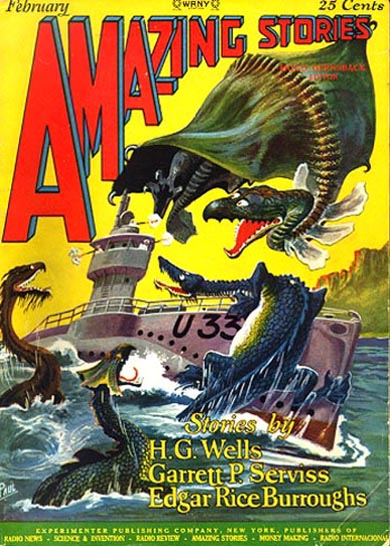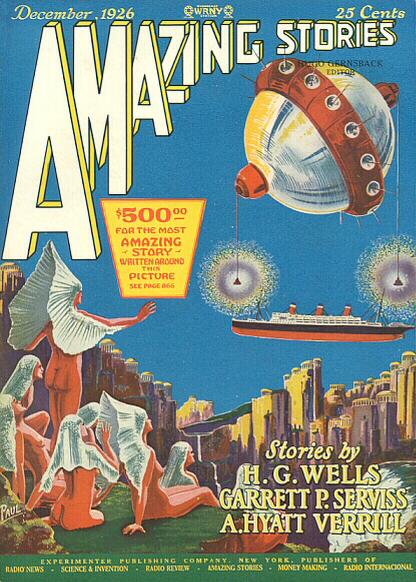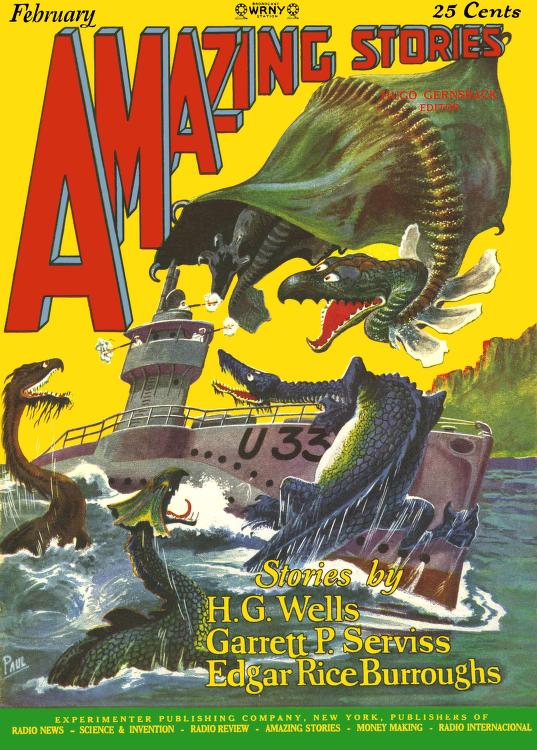
(Cover by Frank R. Paul. Amazing Stories, February 1927.)
Since it’s now the new year for everyone, it’s only natural that we have some new things to look forward to or new things to do. I have a few New Year’s resolutions myself: some movies on my watchlist, quite a few video games I hope to get around to playing. I have hundreds of games in my backlog and even more books to be read in my personal library. I have multiple hobbies, which is something I would recommend to everyone. Unfortunately another thing on my to-do list for 2026 is to either get a second job or to try my hand at writing professionally, which would take time away from this hobbies, including this here blog.
Truth be told, I’ve been winding down productivity here for a minute, so this shouldn’t come as a surprise. I’m seemingly incapable of uploading posts “on time” (but of course who’s keeping time except for myself), and I’ve been missing one or even two reviews every month for the past several months. I wouldn’t be too worried, for the few of you who read this, since I’m not gonna be shutting down this site—just lowering my productivity. Granted, for the first couple years I ran this site I was writing at a feverish pace; in hindsight I’ve not really sure how I did that while also having a day job. In 2023 and 2024 I wrote over 200,000 words a year, according to the stats, which is a lot for one person. There was less wordage for 2025, and now for 2026 you can expect fewer posts as well. But this is like being on a flight and going from 20,000 feet to 10,000 feet.
Now, as you may know, Amazing Stories turns 100 this year. It was revived (again) not too long ago as basically a fanzine, but I would like to celebrate Amazing Stories as a professional magazine, which still means going through material that spans seven decades or so. It’s a lot, not helped by the fact that it has a pretty messy history as far as changes in editorship and publisher go. Except for maybe the beginning of its life it always played second fiddle to competing magazines, but it survived (sometimes even thrived) for an impressive stretch of time, given the circumstances. So, every month (except for March, July, and October, where you can expect short-story marathons) I’ll be covering a serial, novella, or short story from the pages of Amazing Stories. This should be interesting.
With the exception of the aforementioned months we’ll be doing only one serial, one novella, and one short story every month from now on, plus at least one editorial. Anyway, we have one story from the 1900s, one from the 1930s, and one from the 1950s.
For the serial:
The First Men in the Moon by H. G. Wells. Serialized in Amazing Stories, December 1926 to February 1927. First published in 1901. Feel like it would be criminal to pay tribute to Amazing Stories without bringing up Wells at least once, possibly even twice, since he was heavily associated with the magazine in its first few years. Wells himself is arguably the most important SF writer to have ever lived, with his influence being felt to this day practically everywhere you look. Any given SFnal premise likely has its roots in something Wells did over a century ago. This is even more impressive when you consider that Wells at the height of his powers lasted only half a dozen years or so. The First Men in the Moon is one of the last of his classic novels.
For the novella:
“The Gulf Between” by Tom Godwin. From the October 1953 issue of Astounding Science Fiction. Godwin became somewhat famous in SF circles for exactly one story, “The Cold Equations,” which he wrote pretty much in collaboration in John W. Campbell. It might surprise some people that Godwin had in fact written other stuff, and I admit I’m part of the problem because I don’t think I’ve read any Godwin aside from “The Cold Equations.” But I’m gonna fix that. “The Gulf Between” was Godwin’s first story, and it’s notable, if for no other reason than that the cover it inspired would later be reworked as the iconic cover for a certain Queen album.
For the short story:
“The Cairn on the Headland” by Robert E. Howard. From the January 1933 issue of Strange Tales. Over the course of about a dozen years, Howard wrote nonstop for every outlet that would accept his work, and he was not just a fantasy writer, also writing horror, Westerns, sports stories, and non-supernatural adventure pulp. He wrote everything except for SF, which he didn’t seem to have an interest in. Conan the Cimmerian occupied much of Howard’s later years, to the point where he began to resent his creation, but this didn’t stop him from doing standalone yarns like this one.
(Cover by Frank R. Paul. Amazing Stories, May 1928.)
The Story So Far
London, circa 2100. The world has in some ways changed radically since Wells wrote this story in the 1890s, but in other ways it has not. Class division persists, and has somehow gotten even more pronounced. People, at least in the UK, have mostly abandoned the countryside and huddled together in cities, with the cities becoming more vertically oriented. The richest folks live on the top floors of skyscrapers while the poorest of the lot live on the ground. Denton, an attendant on a commercial flying machine, has love affair with the upper-class young lady Elizabeth, whose father very much disapproves of their courting. The father, Mwres (descended from a man named Morris, an upper-class twit like himself), would prefer his daughter go with Bindon, a colleague of his, and he even hires a hypnotist to wipe Elizbeth’s memory of Denton so that she forgets all about him. Denton eventually undoes the conditioning and the two lovers escape the city, in the hopes that making it in the countryside would be preferable. It’s not really. The end up chapter three, or the first installment, sees the lovers returning to the city, but without much means of enjoying even a middle-class existence. Life will continue to be grueling for a bit yet.
Enhancing Image
The fourth chapter, “Underneath,” sees the young lovers at the bottom of the socio-economic ladder, at least in London. I mean I suppose it could be worse: they could be immigrants, for one thing. Truth be told, my eyes glazed over for much of this chapter, if only because much of it is like a Socratic dialogue, and sad to say Wells’s dialogue is not very memorable here. The humor and wry observations on the future often come through in the narration, which is quite a different thing. More memorable is the final chapter, “Bindon Intervenes,” which introduces us to the failed suitor in earnest, after only really hearing about him up to this point. Despite only coming around near the story’s climax, Bindon stands as the most developed character here, which strikes me as backwards. It’s clear that Wells intended Bindon to serve as Denton’s dark reflection, a man who is similarly romantic in a world that has left romance to the wayside, but who lacks Denton’s working-class charm; in effect he is like Denton if he was a proto-incel. Despite ostensibly being the antagonist, having conspired with Elizabeth’s dad, there’s something pitiable about Bindon that makes him a somewhat tragic figure. Not helping matters is he finds out he terminally ill, with not long to live. It would’ve been nice had Wells given us insight into Bindon’s character much earlier in the story beyond hearsay. As it stands this gear-switching in the final chapter comes about too little, too late, and like other parts of the story it feels undercooked.
Oh, and the ending sucks. I understand that it’s supposed to be ironic, but it’s bad storytelling to have your heroes get what they want through no real action or effort of their own. Bindon dies and Elizabeth inherits his fortune, on account of the cucked man having a change of heart as he’s come to realize he would die soon anyway. The conflict basically takes care of itself and Our Heroes™ get their happily-ever-after. This is unspeakably lame; I almost always hate it when writers pull this shit, and in 1899 Wells would’ve known better than to end on such a note.
A Step Farther Out
Sad to say this is not a hidden masterpiece or a semi-forgotten classic in Wells’s body of work, although it does have its points. A Story of the Days to Come feels like a microcosm of Wells’s chief concerns as both a satirist and a genuine speculator on the future, but it’s too long to have the punch of his best short stories and too short to be given the same depth of ideas as his best novels, or even the similarly-lengthed The Time Machine. Wells was one of the few true pioneers of science fiction, in the sense that he wrote about things that had never actually been put to paper before and broadened people’s horizons more than most of his descendants; but being on the cutting edge also meant that sometimes he, well, got cut. It’s the price one must pay for innovation.
(Cover by Frank R. Paul. Amazing Stories, April 1928.)
Who Goes There?
Herbert George Wells was born in 1866 and died in 1946, just short of his 80th birthday but just long enough to have seen the end of World War II. Wells is one of the most important writers of SF to have ever lived—maybe the most important. To be an SF fan and not read at least a bit of H. G. Wells would be like being a horror fan and not having read any H. P. Lovecraft, or being an English major and not engaging with Shakespeare or the King James translation of the Bible at all: it’s basically unthinkable. Wells’s influence is made more remarkable when you consider that SF was by no means the only genre he wrote in, although his non-SF work has been thrown into the dustbin of history, and also that he wrote pretty much all of his most important work in the field in the span of about a decade, between 1895 and 1905. While he was still writing, albeit very little SF at this point, in the 1920s, Wells’s presence in the earliest genre magazines, namely Weird Tales and Amazing Stories, was entirely through reprints. Indeed he seemed to appear in nearly every issue of Amazing Stories while Hugo Gernsback had control of that magazine. A Story of the Days to Come was first published in 1899 as five related stories, which then became its chapters. This is a novella, about as long as The Time Machine, but it’s nowhere near as well-known as Wells’s most famous novels or even short stories, I suspect because while it’s certainly ambitious, it lacks the iconic characters, ideas, and even plot momentum of those other works. This is a story that will be rather hard to talk about in terms of plot beats, so that, combined with depression (it took me nearly an hour to get out of bed this morning), made writing about this story a bit of a challenge.
Placing Coordinates
First published as five stories in 1899, in Pall Mall Magazine. It was then serialized in the April and May 1928 issues of Amazing Stories. It’s also been reprinted in The Science Fiction Century (ed. David G. Hartwell) and the Wells collections Tales of Space and Time and The Complete Short Stories of H. G. Wells. Tales of Space and Time has been in the public domain since forever, so you can read it on Project Gutenberg.
Enhancing Image
We start with less of a character and more of an archetype, in the form of Mr. Morris, of the late Victorian era, and his distant descendant, Mwres, who are both perfectly conservative and upstanding men of their times and shared place—that being London of the 19th and 22nd centuries, respectively. Morris/Mwres is totally unconscious about class, cares nothing for the poor, attends church regularly but without passion, and can hardly be bothered to read anything. Indeed Mwres uses a “phonograph,” which here functions like a laptop or audiobook, to consume information, rather than reading the newspapers like his ancestor. Nobody reads anymore. Mwres meets with a hypnotist so that he might do something about his daughter Elizabeth, who is 18 at the story’s beginning and thus of marrying age. Mwres wants Elizabeth married off to a colleague of his, Bindon, a much older man, “plain little man, you know, and a bit unpleasant in some of his ways, but an excellent fellow really.” But Elizabeth, being a romantic and having indulged in many “romances” (tales of adventure), has set her sights on Denton, “a mere attendant upon the stage on which the flying-machines from Paris alight,” who like Elizabeth is a romantic in a future society which has all but abandoned things like poetry and romance of the lovey-dovey sort. Also, both Elizabeth and Denton can read and write, which bothers Mwres. The hypnotist thus messes with Elizabeth mind such that she forgets all about the young man she’s so smitten with, and it’s up to Denton to figure out why his girlfriend doesn’t recognize him the next time the two of them cross paths and how to undo the hypnotism.
As you can see, this is rather satirical. Morris/Mwres is a obviously dig at the conformist, or the “moderate conservative,” someone who might vote Labour but only so long as the party doesn’t get too woke. Wells was a socialist; more specifically he was a Fabian, or what we’d now call a democratic socialist. He was also a technophile, although his feelings on the possibility of technological progress bettering mankind soured as he grew older. Even in A Story of the Days to Come there’s an ambivalence about technology’s place in human progress, although as we’ll see, the “primitivist” option is also shown to be inadequate. If anything tech is shown to be more or less neutral here, more a tool that worsens an already-existing problem—that being the problem of capitalism and class division. This whole fucking plot gets going because the upper-class Mwres, who despite being rich is shown to be an ignoramus, sees the middle-to-lower-class Denton as unfitting for his daughter; and of course Elizabeth has no real say in the matter. Hypnotism, or mesmerism as it was also called at the time, was treated as a big deal in the 19th century, such that in Wells’s story it has become such an advanced practice as to render psychology obsolete. Mind you that psychology as one of the soft sciences was only in its infant stage when Wells wrote A Story of the Days to Come, such that Freud’s The Interpretation of Dreams hadn’t even been published yet. The automobile had also not yet become commercially viable enough at the time to be a common presence, and you can sort of feel its absence in this story. Conversely, “flying-machines” have become a preferred mode of commercial travel in-story, despite the first working airplane still being a few years off in the real world. Granted, people had speculated on flying-machines for literally centuries at this point, and Wells would even see the beginnings of commercial flying in his lifetime. My point is that while this story takes place circa 2100, it still reads as if written from the perspective of someone living in 1900—which may very well be the point. The narration, while ostensibly third-person, is very much targeted at a Victorian readership.
This is all intriguing, after the fact, but one issue I had while actually reading A Story of the Days to Come is that from a plotting standpoint this is far from Wells’s best work. A rule of thumb with writing short fiction is that you wanna stick to one perspective: it could be a first-person narrator, or a bird’s-eye-view third-person narrator, but the idea is we should stuck in the head of only one character. You can get away with changing perspectives in a novel, but for short fiction it’s a dangerous game. Wells violates this rule by switching us between at least three perspectives in these first three chapters (the first installment), between the omniscient third-person narrator, Mwres, and Denton. It makes scene and chapter breaks surprisingly confusing, made worse because Mwres and Denton meet the same hypnotist at different points. By the way, it is massively convenient that Denton, after having been dismayed by Elizabeth apparently forgetting all about him, goes to the same hypnotist that Mwres had consulted to brainwash Elizabeth in the first place. Of course Denton uses a little man-handling to get what he wants and make the hyptotist undo the conditioning on Elizabeth, so that the two can be together again—the new problem now being that there’s no going back. They’ve gone against Mwres’s wishes and will not have to live almost like fugitives, since Elizabeth only has as much as what her old man lets her and Denton doesn’t have many prospects of his own. They live at Denton’s place, for a bit, but having become disillusioned with city life, and also being very low on cash, they decide to hit the road and head out to a place very few people live in now: the countryside. It’s a shame Wells didn’t live long enough to have read Clifford Simak’s City, he probably would’ve been very keen on it. Then again, I’m not sure how much SF Wells actually had read, since he seemed irked by the newfangled label.
There Be Spoilers Here
The England of the future is somewhat dystopian, and one way Wells implies this is the fact that “countryside” has mostly been reclaimed by the natural world. Where once there were whole societies of peasantry in the English countryside, now there’s only the stray farmer or shepherd. As with Clifford Simak’s fiction, humanity is shown as being in decline by virtue of having cut itself off from the natural world; man seems to be degrade further the more “unnatural” he becomes. A shepherd meets Denton and Elizabeth as they start their new lives as would-be farmers, and tells them (correctly) that they won’t last long in the countryside; they simply weren’t raised to adapt to this kind of lifestyle. But they do give the whole thing the good old college try, as it were, and honestly the attempt could’ve turned out worse. They both could’ve died easily, between the elements and wild animals; but what finally pushes them to move back to the city is the issue of trespassing, and damn near getting killed by a pack of dogs. (Wells, given his politics, wasn’t keen on private property.) It’s at this point that the first installment ends, with Our Heroes™ having lost the battle, but maybe not the war. We’ll have to wait and see about that. I do wish I cared more about Denton and Elizabeth as people, although obviously I do wanna see them overcome a system that has been built up over generations to keep them apart. With Wells, his characters tend to serve his ideas, rather than the other way around, which is how SF has mostly been written for the past century.
A Step Farther Out
I’m a bit ambivalent about A Story of the Days to Come so far, although David G. Hartwell thought it enough of a hidden gem that he says so in his introduction for it in The Science Fiction Century. The problem is that it works better as almost a fictionalized essay rather than a “story.” Wells at his best is still no Shakespeare when it comes to style or developing characters, but he can be really good at plotting and hitting the reader with ideas that, at least in the last days of the Victorian era, they might not have ever considered before. Wells wrote with the primary purpose of opening people’s minds to a whole new realm of possibilities, which he believed in as both an SF writer and a socialist. That the politics of genre SF (we’re talking about the views of authors and editors) during its early years, from the 1920s to about 1950, would be a lot more reactionary than Wells, is beside the point. You could argue A Story of the Days to Come is SF in its purest form, that being it’s devoted to speculating on the future, and cannot be confused for any other genre. For better or worse.