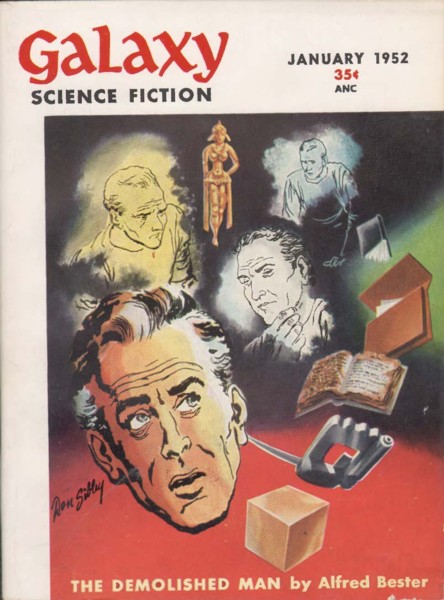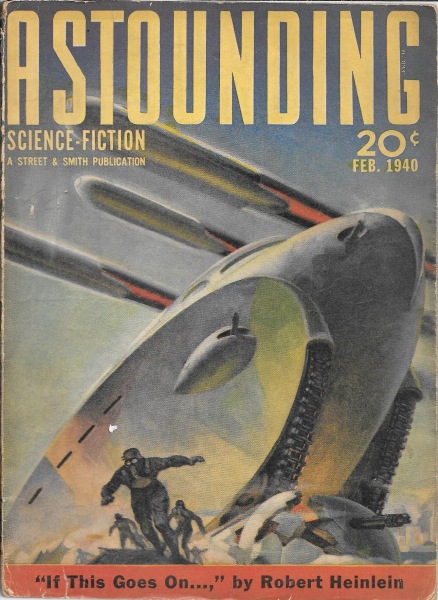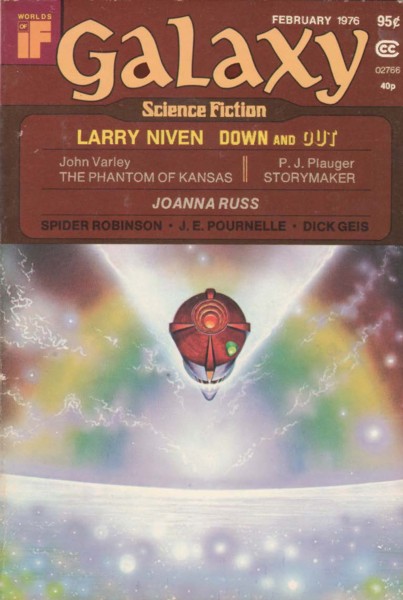
Now we’re back to our regularly scheduled programming! Only not quite, but I’ll save that for the end. We’ve come back to our novella and serial reviews, which I’m thankful for; as fitting as it is to focus only on short stories and novelettes for a month of horror, I found it weirdly draining to review all those short stories back to back. With serials and novellas we’ll have more variety, never mind the lack of a horror theme.
I must’ve gone back and forth on this schedule too many times to count, frankly. The thing is that I like having a schedule for my reviews, as I think it allows me to plan some silly stuff in advance, like the fact that I’ll be tackling Joanna Russ and Poul Anderson stories back-to-back (for those of you who don’t know, I recommend looking up a certain exchange those two reportedly had), not to mention stuff like last month’s review slate. But I’m not here to waste your time, let’s get to the meat of the matter!
For the serials:
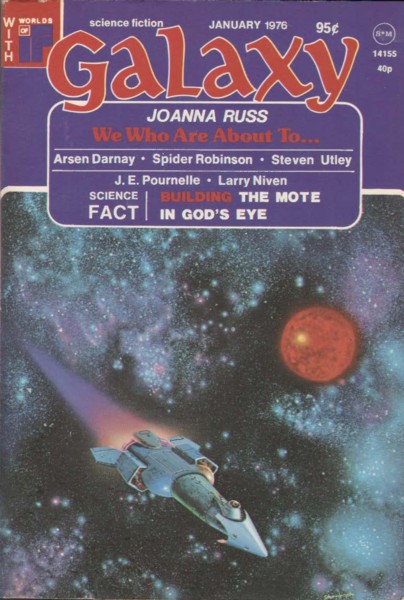
We Who Are About To… by Joanna Russ. Published in Galaxy Science Fiction, January to February 1976. Russ was a divisive figure in the field and We Who Are About To… in particular was not received well. Even so, it has its defenders, perhaps the biggest of them being Samuel R. Delany (who I always trust), and it also received a glowing review from Joachim Boaz over on his site. I have to admit my experiences with Russ have not been great up to this point, having found her Hugo-winning novella “Souls” underwhelming, but this could be a change of pace!
We Have Fed Our Sea by Poul Anderson. Published in Astounding Science Fiction, August to September 1958. It was nominated for the Hugo for Best Novel, and was published in book form as The Enemy Stars. Anderson was apparently a beloved figure when he was alive, but since his death his star power has faded somewhat, perhaps due to the scattered vairety of his fiction. He was a reliable and insanely prolific writer, and I often like (but rarely love) his work. We Have Fed Our Sea was one of THREE Anderson serials running in Astounding in 1958.
For the novellas:
“Another Orphan” by John Kessel. Published in the September 1982 issue of The Magazine of Fantasy and Science Fiction. Kessel can be thought of as adjacent to the cyberpunk movement of the ’80s, though it would be a mistake to consider Kessel himself one of the cyberpunks. Renowned for both his fiction and genre criticism, he’s also edited several anthologies, often in collaboration with James Patrick Kelly. “Another Orphan,” which won the Nebula for Best Novella, is apparently a riff on a classic work of American fiction…
“The Kragen” by Jack Vance. Published in the July 1964 issue of Fantastic. Like with Poul Anderson, Vance is a writer I often like but rarely find myself strongly attached to. Also like with Anderson, Vance represents to some extent SF writing typical of the pre-New Wave ’60s (i.e., relatively conservative), focusing less on literary experimentation and more on The Big Picture™. “The Kragen” may strike some readers as familiar because they had read it in a different form: it would be expanded into the novel The Blue World two years later.
For the short stories:
“Don’t Look Now” by Henry Kuttner. Published in the March 1948 issue of Startling Stories. You didn’t think I’d forget about Kuttner, right? Making his professional debut in 1936, Kuttner was not the instant success like hie future wife, C. L. Moore, was; actually he had a reputation as a hack writer for a while, and to this day his immense talent tends to be undervalued. Alongside Moore Kuttner would write some of the most beloved SFF of the ’40s, but he also remaimed prolific more or less on his own, “Don’t Look Now” being an example.
“Mountain Ways” by Ursula K. Le Guin. Published in the August 1996 issue of Asimov’s Science Fiction. Le Guin is one of those grandmasters of the field who really needs no introduction. She only appeared sporadically in the magazines from the ’60s to the ’80s, but the ’90s saw a major resurgance for Le Guin as a magazine presence, with her Hainish cycle especially getting more attention. “Mountain Ways” is a standalone Hainish story, and it won the James Triptree Jr. (now regrettably called the Otherwise) Award for gender-bending SF.
If you’re reading this post and it’s the first day of November then you’ll notice there are two new departments for my blog: one of them is simply a quality-of-life improvement while the other is more of a “I’m doing this for funzies” thing. Firstly we have an author index now! Reviews are organized by authors’ last names, and while this page may be small now, there will come a point when it will be massive, and since I don’t rate my reviews, this is probably the best way to help readers find what they’re looking for. The second is The Observatory, which like Things Beyond is an editorial department, but whereas Things Beyond is meant for forecasting reviews, The Observatory will be more like a conventional magazine editorial where I’ll spend a thousand words on whatever subject I feel like writing about—although, of course, it will be SFF-related.
Since Things Beyond happens at the beginning of every month, it seems only natural to have an Observatory editorial posted on the 15th of every month, so that it’ll never be skipped and it’ll fall exactly between two of my regular review posts. With these changes I feel like I’m one step closer to making my blog a “professional” (by that I really mean well-rounded) review site for magazine SFF.
We’ve come to the final part of Alfred Bester’s debut novel, The Demolished Man. Bester arrived to novel-writing late, already being deep in his 30s when his debut was serialized, and truth be told, he wasn’t much of a novelist; he only wrote a handful of novels in his lifetime, and his first two remain by far the most famous. Like some of his contemporaries, (Theodore Sturgeon, C. M. Kornbluth), Bester hit a remarkable stride in the ’50s, starting with “Oddy and Id” in 1950 and ending with “The Pi Man” in 1959. I have to assume the broadening of the SF market in the early ’50s, namely the premieres of Galaxy Science Fiction and The Magazine of Fantasy & Science Fiction, coaxed Bester back to genre writing, after a near-decade-long break from the field.
Placing Coordinates
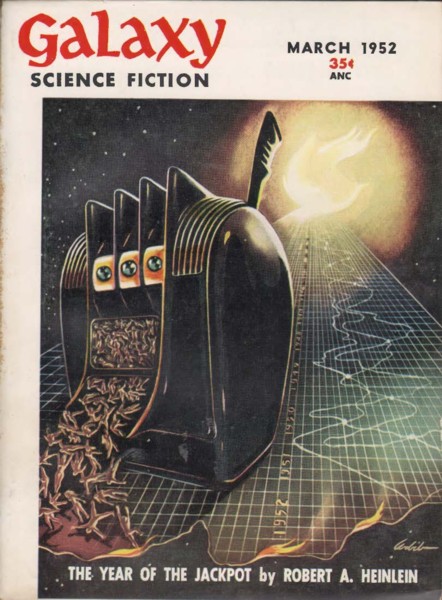
Do I really need to tell you? Part 3 of The Demolished Man was published in the March 1952 issue of Galaxy, and yes, it’s on the Archive.
What strikes me about this particular issue of Galaxy is that there are at least two stories here that not only come off stronger than the serial, but give a more accurate impression of what the newfangled magazine was all about. Yeah, I’m letting you know this early on that I wasn’t a big fan of the conclusion to Bester’s novel, but I would still recommend checking out the issue it appears in. We get a certified hood classic from Robert Heinlein with his novelette “The Year of the Jackpot” (the subject of one of Galaxy‘s first great covers imo) and we also get a pretty funny outing from Damon Knight with “Catch That Martian.” Early Galaxy is so good that it’s honestly hard to go wrong.
Enhancing Image
You may recall that last time on The Demolished Man, we get two twists for the price of one, one of them interesting, the other horrendous. When searching the depths of Barbara D’Courtney’s unconscious, once she’s taken into the safety of his home, Preston Powell discovers that not only are Barbara and Ben Reich related in some way (implicitly connected to the late Craye D’Courtney, whom Reich had murdered), but that Barbara (who, keep in mind, is consciously at the mental level of a toddler at this point) has a big crush on Powell—which Powell reciprocates.
The horror…
Much of Part 3 concerns Reich’s last-ditch attempt to evade Powell, who knows he had committed murder but can’t prove it objectively. To make a long story short, it’s not enough legally to have an Esper peep on a crime suspect’s deepest thoughts; presumably this is to prevent Espers from having too much power, but even so, the future society of the novel works such that it has become nigh-impossible to commit a crime and get away with it. Powell needs three things to bag Reich: motive, method, and opportunity. We know Reich was at Maria Beaumont’s party from the end of Part 1 (still the novel’s highlight imo), where Craye D’Courtney was hiding, and we know how he could’ve killed the old man.
The means are rather convoluted, but Reich had acquired an “ancient” 20th century pistol and removed the cartridges. Wouldn’t this mean Reich would be shooting blanks? Technically yes, but as Powell explains:
“With a powder charge, you can shoot an ounce of water with enough muzzle velocity to blow out the back of a head if you fire through the victim’s palate. That’s why Reich had to shoot through the mouth. That’s why Kr1/2t found that bit of gel and nothing else. The Projectile, of course, was gone.”
People forget (or don’t know) that even shooting blanks in an enclosed space can still be harmful; in the case of D’Courtney, firing the gun in his mouth was enough to kill him. Powell’s figured out the method.
The opportunity was easy enough to discern. The police team already knew Reich was at the party where D’Courtney had been killed, while everyone else was playing the Sardine game, and you may recall that in Part 2 Powell got a confession out of Gus T8 (Reich’s Esper accomplice) shortly before his death. Reich could’ve figured out where D’Courtney was by way of a peeper. There’s your opportunity.
The big problem Powell runs into is the motive. Now, I won’t give away the details in this section, but I’ll say that Reich’s motive for killing D’Courtney was not what we thought it was. Without a motive, they can’t connect Reich to the crime with objective evidence, and without that, Reich goes free. It looks like Reich is about to win, but Powell, being a top-level Esper (meaning he can fully read a person’s unconscious psyche), does have one last trick up his sleeve…
The cat-and-mouse game that took up much of Part 2 now comes to a head in the serial’s finale, and my feelings on it are quite mixed. The stuff with Powell and Reich is still great. Bester has a special talent for writing wiley and despicable characters, and few are more wiley or despicable than Ben Reich. Much like Gully Foyle, his marginally less evil counterpart in The Stars My Destination, Reich is relentless in his ruthlessness; there is nobody he won’t fuck over to get what he wants. Bester’s snappy style still retains its magic, too, with many passages being just dialogue exchanges with the bare minimum of description, yet rarely if ever is the reader lost in all this. Bester really is one of the writers of dialogue when it comes to ’50s SF.
When he’s good.
When he’s not, we get shit like this (yes it’s the Powell/Barbara subplot):
He kissed her forehead. “You’re growing up fast,” he smiled. “You were just baby-talking yesterday.”
“I’m growing up fast because you promised to wait for me.”
This is BULLSHIT.
I wonder if Piers Anthony is a fan of this novel. Just a thought. Much like Reich himself, the novel is half angel and half louse, and I’m trying to separate one from the other. When it’s good, it’s pretty great; it’s witty, inventive, and as I’ll elaborate on in a bit, the ending is a fair bit thought-provoking. But when it’s not good… it’s almost unreadable. I get the impression that writing at novel-length forced Bester to give into his worst impulses—stuff he wouldn’t normally indulge in at shorter lengths. Some authors, especially in SF, benefit from more succinct writing (opinion, sure, but I really do think SF works best in the novella mode), and Bester is one of those. Part 1 of The Demolished Man shows the novel at its best partly because it focuses the most on its two best assets: Ben Reich, and the way Espers contribute to this future interplanetary society.
There Be Spoilers Here
The problem with Reich’s motive for killing D’Courtney is that it doesn’t make sense. In Part 1, Reich offers to merge his company with D’Courtney’s, but D’Courtney refuses; this turns out to not be true. Upon interrogating Reich about the rejection, the teams finds that Reich had misinterpreted D’Courtney’s response. Now why would Reich take D’Courtney’s acceptance as a rejection? We know now that D’Courtney, when confronted by his killer, was not lying; he really did accept Reich’s offer to merge their companies. Reich’s true motive will have to be uncovered with some weapons-grade mundfuckery, and that’s what Powell does at the climax of Part 3.
The climax of Part 3 is a wild ride that almost rivals the climax of Part 1, even anticipating the mind games Philip K. Dick would play on us with his later novels. Just when Reich is convinced he’s gotten away with murder, his world starts to shrink—literally. People and places Reich knows start to disappear, even including entire planets, and he fears he may be losing his mind (sort of right) or that Powell’s pulling an epic prank on him (absolutely right). Even the sun, for no reason, disappears, and nobody he asks even knows what the sun is anymore. Even confessing to the murder of D’Courtney out of desparation does not release him.
The police looked at each other in surprise. One of them drifted to a corner and picked up an old-fashioned hand phone: “Captain? Got a character here. Calls himself Ben Reich of Sacrament. Claims he killed a party named Craye D’Courtney last month.” After a pause, he grunted and hung up. “A nut,” he said.
“Listen—” Reich began.
“Is he alright?” the policeman asked the doctor.
“Just shaken a little.”
“Listen!” Reich shouted.
The policeman yanked him to his feet and propelled him toward the door of the station. “There ain’t no Preston Powell on the force. There ain’t no D’Courtney killing on the books. Now, out!” And he hurled Reich into the street.
It’s a lot of fun. Eventually the world shrinks to the point where there’s only Reich left—and the one thing that’s scared him since the beginning, the Man With No Face. As it turns out, the Man With No Face is a representation of Reich’s guilt, just as we’ve suspected this whole time, though not quite for the reasons one would’ve assumed. You see, Reich and Barbara are half-siblings; their father is Craye D’Courtney. Through some convoluted backstory we learn that the Reich and D’Courtney family trees intertwined at one point, and not only is Barbara old man D’Courtney’s secret child, but so is Reich. D’Courntey didn’t resist Reich because he felt immense guilt about never acknowledging Reich as his son, and Reich tricked himself into wanting to kill D’Courtney because of some… Oedipal… thing…
So Reich is finished; it almost cost Powell his life, but it was worth it. Only at the very end do we find out what Demolition means, and it’s basically a memory wipe. The society of the novel hasn’t implemented the death penalty in decades, and correctly they regard such a practice as barbaric. Reich lives, in some way, but from now on he will be effectivelybecome a different person—the louse having been separated from the angel, or maybe the other way around. The novel makes an argument regarding criminals that I don’t think I’ve heard before, which is that someone who goes against societal norms must be at least of some value, therefore it’d be a waste to execute that person. It’s a curious argument against the death penalty, and I have to wonder how readers circa 1952 would’ve taken it.
A Step Farther Out
The Demolished Man could just as easily be titled The Diminishing Returns. Not to say it goes downhill exactly, but Part 2 introduces a certain subplot that I would consider the opposite of great; by Part 3 this same subplot was driving me up the fucking wall. I’m not even sure if the “romance” between Powell and Barbara is a product of the novel’s time as it is a quirk of what seems to be Bester’s actual honest-to-goodness worldview; he really did seem to believe in the legitimacy of Freudian psychology. Not to say Freud didn’t do much to advance how we as a species try to understand our own minds, our own desires, and so on, but The Demolished Man may be the most obnoxiously Freudian novel in existence, ultimately much to its detriment. I can see why, between Bester’s first two novels, The Stars My Destination has become the more popular one; the truth is that it holds up better to scrutiny.
I have yet to read the book version of The Demolished Man, but from what I’ve heard it might actually be an improvement over the serialized version, which doesn’t happen too often. Usually the differences between a novel’s serial run and its book incarnation are negligible, but Bester apparently revised his novel to a substantial degree between versions. The result is (from what I’ve heard anyway) a short novel that was made even more concise, even cutting out some of the stuff between Powell and Barbara that makes me feel all shitty inside. Even so, the serial is worth reading; historically it’s nothing short of essential, of course, but it’s still an ultimately statisfying experience, made more palpable by being split into smaller chunks.
Well, the next serial I cover is also something I’ve not read before, despite it being by one of my favorite authors, and like The Demolished Man it also won a Hugo—a Retro Hugo.
Alfred Bester is baaaaaack. He was early in the period of his career when he was at his best and most prolific (though in reality we only got two novels and little over a dozen short stories from him between 1950 and 1960), and nothing proved this more than the serialization of his debut novel The Demolished Man. This novel demonstrates what made Bester special at the time, and by extension what made Galaxy Science Fiction so different from its contemporaries. We’re talking about SF that’s witty, lurid, hardboiled, uncompromising, and generally more “mature” than what came before it. Interestingly, Bester would have his two novels from this era published in Galaxy while most of his short fiction would appear in The Magazine of Fantasy and Science Fiction.
Placing Coordinates
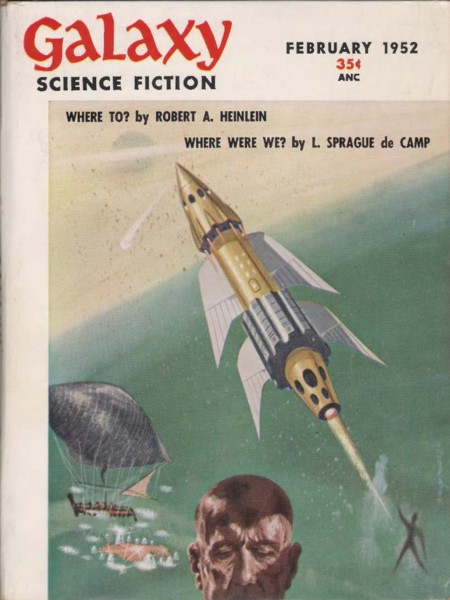
Part 2 of The Demolished Man appeared in the February 1952 issue of Galaxy. It’s on the Archive. If you REEEEEEALLY wanna read the book version (which I do hear is a fair bit different from the serial), you won’t have a hard time finding that at all.
Enhancing Image
How do you get away with murder in a society where a fraction of the populace can read not only your conscious thoughts but the darkest depths of your unconscious mind? Ben Reich has found a way—or at least he thinks he’s found a way.
Last time on The Demolished Man, Ben Reich has murdered Craye D’Courtney, his top business rival, with an “ancient” 20th century handgun that doesn’t leave a bullet hole or any markings. There is just one problem: there was a witness to the killing, and not only that, it’s D’Courtney’s secret daughter, Barbara. With Barbara having escaped the scene, Reich and his Esper accomplice Gus T8 are forced to remain at Maria Beaumont’s party so as to not look too suspicious. No matter, though, as soon police are called in—Esper police—with Police Prefect Preston Powell spearheading the invesitgation. It doesn’t take long for our villain protagonist and hero antagonist to start their game of cat and mouse.
A few things I want to make note of before I dive deeper into the plot, as Part 2 is not as long as the first installment, and I would say somehow the plot has become even more streamlined. Once The Demolished Man kicks into high gear it doesn’t stop. Now, I said in my review of Part 1 that certain Espers have symbols and Arabic numerals as part of their names, for reasons never given as far as I can tell. While I could at least see this arbitration as consistent, one of the mentioned characters, Duffy Wyg&, is not an Esper; this makes me wonder what the hell Bester could mean by this naming convention, and since apparently he drops the act for the book version, spelling characters’ names normally, I have to assume he did this for the serial version just to be QuIrKy.
I also brought up the weird Freudian symbolism that permeates the narrative, and indeed renders part of it incomprehensible otherwise, such as Reich’s recurring nightmares of the Man With No Face. I don’t even wanna get into how the Esper rankings work again, since they work on the basic assumption that the Freudian map of the human psyche (the ego, the id, etc.) is totally legitimate. A certain subplot involving Barbara D’Courtney fundamentally involves Freudian psychology in a way I won’t give away in this section, but needless to say I have some thoughts about it. It’s a story that only makes sense if you’re willing to be generous with its assumptions, and even then you might have a hard time after a certain point.
Part 2 is considerably more of a mixed bag than Part 1; while Part 1 has some pacing issues in the beginning, being frontloaded with exposition as it is, Part 2 develops the novel’s Freudian angle for the worse. I tend to be generous with this sort of thing, but there are certain passages here that make me wonder if they were ghostwritten by Robert Heinlein—not the good Heinlein either, but the embarrassing, somewhat creepy Heinlein. The creepiness is uncharacteristic even for ’50s SF; if anything it feels almost more like a byproduct of the late ’60s/early ’70s New Wave period. I have to assume H. L. Gold looked at the manuscript and thought, “Hmm, yes, this is very good indeed.” I don’t know about this one, chief.
It’s a shame, too, because the good parts of The Demolished Man are still really good, and now they have an extra good element added to the equation: the intense and totally not homoerotic rivalry between between Reich and Powell. It’s a classic case of the unstoppable force (Reich) against the immovable object (Powell), two psychotically determined men set to rip out each other’s throats. Powell knows, simply by contacting Sam Jordan, Reich’s lawyer, and by using a police lab map of the party-turned-crime-scene to trace Reich’s steps, that Reich is 99% likely to be the killer. However, Powell will need (thanks to convoluted legal restraints) more than just an Esper’s intuition, and Reich knows it.
When the two meet up during the investigation, there’s an intense butting of heads, yet Powell can’t help but admire Reich; it’s a curious dynamic. While obviously wanting Reich to be Demolished (we’re still not quite told what this means yet), Powell says this:
“You’re two men, Reich. One of them’s wonderful; the other’s rotten. If you were all killer, it wouldn’t be so bad. But there’s half louse and half saint in you, and that makes it worse.”
The game is afoot. The bulk of Part 2 is a chase wherein Reich and Powell try to find Barbara, the key witness, as without her Powell won’t be able to nab Reich, while Reich won’t be entirely sure of his own safety from Demolition. There is a remarkably fast-paced, if somewhat repetitive sequence where hero and villain play tricks on each other, Reich using T8’s powers and those of the criminal underworld to undermine Powell’s operation while Powell tries using T8 and Jerry Church (who you may remember as the exiled Esper who gave Reich the murder weapon) to push Reich into a corner. I would perhaps find this chase less repetitive if every scene didn’t end with each side going, “Well gosh dang it, where is that GURL?” This is an instance where Bester’s economy of description might have worked against him a bit.
We’re at the point where The Demolished Man truly has become an episode of Columbo, and Preston Powell is a fine not-Columbo—the big difference being that while he does play dumb in order to lure Reich into a false sense of security for a bit, his act is subtler than Columbo’s. Another big difference has less to do with Powell himself and more a certain subplot that I’ll be tearing apart discussing very soon. While we were technically introduced to Powell in Part 1, he only now actively takes a role in the story, and he sure is up to the task.
A shame all this other shit had to happen.
There Be Spoilers Here
Powell, T8, and Church are ambushed by Reich’s hired guns, with T8 dying in the process. It’s a curious scene in how it’s written, since not only is T8’s potential redemption cut short, but his death is described in a way that’s uncharacteristically indirect for Bester—and all the better for it. A rule of thumb with Part 2 at least is that when Powell is not with Barbara, things are going great. The problem is that the scenes where Powell is with Barbara make me hunger for death.
Basically, the trauma of seeing Reich killer old man D’Courtney caused Barbara’s conscious mind to regress to that of an infant; she barely even has any motor skills, never mind the ability to articulate. Powell has the idea to move Barbara from the hospital (which, to be fair, is a place where someone can easily kill or kidnap her) to his house, and that’s where things get weeeeird. A good portion of Part 2 is spent on Powell, along with fellow Esper Mary Noyes (who has a crush on Powell, which Powell is well aware of but refuses to reciprocate), helping Barbara “mature” from being mentally an infant to where she was just before the murder. It’s certainly a curious plot development, but it’s seriously hampered by some very off-color interactions Powell has with Barbara, and that’s before we get to the big twist involving her character.
The big twist is that whilst in the process of regaining her mental stability, as she “grows up” from infant to child, Barbara develops a crush on Powell—and no just any crush, noooo, no no no no. When peeping on Barbara, diving into the depths of her unconscious mind (or whatever the hell it’s called, I don’t care for it too much), Powell sees surreal images of the adult Barbara as well as the baby version of herself, and that’s where we find out how Barbara, in the wrecked state of her consciousness, sees Powell.
Get a load of this:
There was her picture of herself, pathetically caricatured, the blonde hair in strings, the dark eyes like blotches, the lovely figure drawn into flat, ungracious planes. It faded and the image of Powell-Powerful-Protective-Paternal rushed at him, torrentially destructive. The back of the head was D’Courtney’s face. He follows the Janus image down to a blazing channel of doubles, pairs, linkages and duplicates to—yes. Ben Reich and the caricature of Barbara, linked like Siamese twins. B linked to B. B & B. Benedictine & Brandy. Barbara & Ben.
That’s right, we’re venturing into Electra complex territory! In seeing Powell as her new father figure, connecting him with the deceased D’Courtney, Barbara now sees him not only as a daddy figure but as a Daddy figure, if you know what I mean. The implication of this final scene is also that Reich seems to be the subject of an Oedipus complex, being Barbara’s male counterpart in how he’s linked to D’Courtney’s murder, which is just—just—
It’s trash.
I’m trying to remember the last time I saw an otherwise good novel sink to such lows as this. Previously I was perplexed as to the Freudian angle Bester seemed keen on taking with this story, but now I’m deeply wary as to what he’s gonna do with it in the final installment. I said before that certain aspects of the plot will only make sense in a Freudian context, but now I think there are certain aspects here that can just be shot into the vacuum of space and the novel would be stronger for it. The worst part is that, assuming Part 2’s final revelation is followed up, corrupt business won’t be the “real” reason why Reich killed D’Courtney, as if we needed a “real” reason for it.
A Step Farther Out
I’m morbidly curious as to where The Demolished Man is going. Unless it pulls a 180 in the final installment, I can say with certainty The Stars My Destination will come out the better novel. Not that there aren’t problematic elements in Bester’s second novel, but I don’t remember anything as ridiculous as Barbara’s character development happening there. I would also argue the problematic parts of The Stars My Destination add to that novel’s sense of ruthlessness, but I can’t say the same for The Demolished Man. I’m still not sure why Bester, who was sharp-witted enough to make his novel a proto-cyberpunk reverse whodunnit in the first place, felt so compelled to root his story in Freudian psychology the way he did; I seriously doubt Gold requested the Freudian stuff.
This is a novel that, at least right now, is hard to call great. Part 1 was mostly pretty gripping, and I found myself hanging onto to pretty much every word of every passage, even if it dragged at first. With Part 2 I found myself wanting to get through the scenes with Barbara as fast as possible, and I simply didn’t find the scenes focusing on Reich to be as compelling as when we were almost completely tied to his perspective in Part 1. As short as this novel is, it’s already getting messy, but I’ll very well stick around for the end.
(Cover by Frank Kelly Freas. Astounding, October 1958.)
Who Goes There?
Clifford D. Simak is one of the most respected writers to come out of the so-called Golden Age of science fiction—this despite the fact that he was actually a pre-Golden Age practitioner of SF, having made his debut in 1931 with “The World of the Red Sun.” Simak became one of John W. Campbell’s regular authors in the ’40s, and then, without skipping a beat, he started submitting frequently to Galaxy Science Fiction in the ’50s onward. Unlike a lot of noted Golden Age writers, Simak was thoroughly a pastoralist, and also a humanist; his fiction often involves fundamentally decent rural types in plots which are rarely life-or-death scenarios. His obvious contempt for urbanity is counterbalanced by a gentleness uncharacteristic of most SF authors of his era, and at his best he can be deeply emotionally effective.
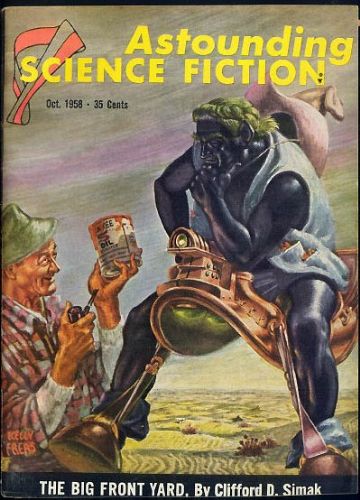
When Simak wrote “The Big Front Yard” in 1958, he had already been in the game for 27 years, and he would remain quietly yet consistently active for 27 more. According to David W. Wixon’s introduction to the story in the collection The Big Front Yard and Other Stories, Simak had originally submitted this piece to H. L. Gold over at Galaxy, but Gold rejected it; he then took it to Campbell, and Campbell bought it without hesitation. “The Big Front Yard” would go on to win the 1959 Hugo for Best Novelette (the Best Novella category had not yet been invented), and it would go down as one of Simak’s most famous stories.
Placing Coordinates
“The Big Front Yard” has been reprinted a fair number of times, so you’ll have no problem finding it. Assuming you don’t mind reading online or with a PDF, the October 1958 issue of Astounding in which it originally appeared is on the Archive. As far as book reprints go we have some easy-to-find options, including the aforementioned The Big Front Yard and Other Stories in ebook and paperback—though I must warn you that Open Road Media is, at best, a second-rate publisher, and I seriously lament the fact that so many books by authors I love have fallen into their hands. Typos and weird formatting decisions abound, such as the fact that FOR NO REASON the scene breaks were removed in their series of Simak’s collected short fiction. Chapter breaks are still intact, but scene breaks, which are arguably more important? Gone. How shitty.
If you want (in my opinion) more reputable reprints, I would recommend the anthology The Hugo Winners, Volumes One and Two; it’s super-duper out of print, but since this tome seemed to get around a lot back in the ’70s, used copies are pretty easy to find without breaking the bank. You also get the rest of the short fiction Hugo winners between 1955 and 1970, so that’s a big plus. Another great option is The Science Fiction Hall of Fame Volume Two B, the second half of (you guessed it) The Science Fiction Hall of Fame Volume Two. Unlike the former anthology, this one is very much in print, and seems to have remained so since its initial publication.
Enhancing Image
This is a first contact story, and maybe one of the most upbeat of its kind, though Simak misdirects us at first into thinking it won’t be.
We follow Hiram Taine, a handyman and trader of “antiques” (in reality just old junky furniture he cleans up and sells at a hefty price), just your average rural Wisconsin dude. He has a dog named Towser and he likes to chat with another local man named Beasly, who’s apparently not very bright but who likes to hang out with Taine and help him with his work. Random, but I couldn’t help but notice the dog has the same name as the protagonist’s dog in Simak’s earlier story, “Desertion.” Is this supposed to mean anything? How many Simak stories have dogs named Towser?
Anyway, Taine is hired to fix a TV set owned by the Hortons, Henry and Abbie, with Henry being boss man at a local plant (a computer plant, apparently). The TV is old and, according to Taine anyway, replacing it would probably be cheaper than repairing it, but it comes with a radio and a record player, and Abbie won’t replace it. Taine and Beasly move the bulky TV into the basement when this happens:
“Well, Hiram,” she said, excited, “you put a ceiling in the basement. It looks a whole lot better.”
“Huh?” asked Taine.
“The ceiling. I said you put in a ceiling.”
Taine jerked his head up and what she said was true. There was a ceiling there, but he’d never put it in.
Taine has one of those unfinished basements—only now it’s a little less unfinished. Not only does his basement have a ceiling that he didn’t have installed, but it seems to be of a metallic substance, except it’s not any kind of metal Taine recognizes. Later that day, he tests the ceiling and finds that a drill won’t penetrate it, or even leave so much as a scratch. Well that’s weird. At this early point in the story, Taine notices some things are different about his house, and normally this would be played for suspense, which is kind of is—but, as I said, this is misdirection.
Indeed the first stretch of “The Big Front Yard” feels almost like a subversion of what would, even in 1958, sound like the set-up for a spooky alien invasion story. You know how superstitious people will sometimes say dogs can see ghosts or some goofy shit like that? Towser spends much of the story trying to find a woodchuck that doesn’t exist, but we’ll get back to that in the spoilers section. Clearly something has started living in or around the property, and it doesn’t stop with Taine’s basement getting refurbished. Several of the junky odds and ends have been mysteriously repaired, even improved in some cases; the big TV set Taine got for repairs is now not only fixed without his help, but it now also plays in color (remember, 1958). You and I know, even going into this, that aliens are involved, yet the surprising part is that rather than hint ominously at a future attack on humanity, these aliens seem, if anything, to be pretty benign, if not outright friendly.
What I like about a lot of Simak’s work, and what he does to an almost perfect degree here, is he refuses to bend to the Golden Age cliché of aliens being depicted as evil outsiders, along with the xenophobic implications; aliens rarely play the villains in Simak’s fiction, but then Simak’s fiction tends to be light on conventional villains. Taine is also not your typical Golden Age protagonist: he’s not a scientist or a politician, he’s not what you’d call a genius, and he’s by no means the physical encapsulation of what Campbell would’ve considered the “ideal” man. Like a lot of Simak protagonists, Taine is a hard-working (if not entirely honest) Midwesterner who’s just looking to make a buck. Honestly I scratch my head as to why Gold rejected “The Big Front Yard” and Campbell bought it; it feels like the roles should’ve been reversed.
Before long, Towser, in his efforts to find the woodchuck, finds something else right by the house, and digs furiously for it. Already aware that something definitely strange has been going on, Taine and Beasly dig up whatever Towser sniffed out, and what they find is indeed strange: a large oval-shaped contraption buried in the ground, made of a glassy metal that Taine knows he’s never seen before. Fear runs through his veins, but he also experiences what we might call a conceptual breakthrough—a discovery of something beyond known human limits that counteracts the fear with a sense of wonder. “A sense of wonder” is a really old and cliched phrase in SF, especially Golden Age SF, but I think there are a few moments in “The Big Front Yard” alone which do it justice.
And the conviction grew: Whatever it was that had come to live with him undoubtedly had arrived in this same contraptions. From space or time, he thought, and was astonished that he thought it, for he’d never thought such a thing before.
Life on other planets? You bet. What else could it be? Like any first contact story there is at least some uncertainty involved, but as is typical of Simak, there’s also a gentle whimsy and that aforementioned sense of wonder which gives us the impression that Taine, Beasly, and the others aren’t in any real danger, despite the mysteriousness of the situation. If our boys thought the repaired junk and the large glassy contraption were weird, though, they’re about to have the sight of their lives, after they’ve finished with the digging and come back around to the front of the house.
He and Beasly went up the gravel driveway in the dark to put the tools away in the garage and there was something funny going on, for there was no garage.
There was no garage and there was no front on the house and the driveway was cut off abruptly and there was nothing but the curving wall of what apparently had been the end of the garage.
The front of the house is folded in on itself. The back is still good, though! But yeah, uhh, how did this happen? Why? Taine’s scared, but now he’s also utterly baffled. Our boys enter through the back door, and… the front of the house is still there. From the inside. Except whereas it had been nighttime outside the house, now there’s daylight breaking through the front windows which are no longer there from the outside.
“The Big Front Yard” can be more or less split into two halves, those being before and after the front of the house gets miraculously folded. If the first half of the novella has almost a magic realism feel about it, it becomes something more akin to a planetary romance in the latter half. I won’t say too much in the spoiler section, since the plot becomes more straightforward at this point, but it also becomes even more charming and readable. The whole thing can be described as “cute,” which is not a word I would use with the vast majority of Golden Age SF (FYI, I do consider the “Golden Age” to be the ’50s, not the ’40s), but “The Big Front Yard” is just a happy-go-lucky tale which refuses to take itself overly seriously.
There Be Spoilers Here
The front of the house, from the inside, opens to a different planet—a vast desert landscape with a sun different from ours. The front of Taine’s house, including his car and driveway, has been transported to this new world, in a way, and conversely the back of the house is now folded on itself. This is where we meet the aliens who have apparently taken up residence on Taine’s property: little ratlike creatures with humanoid-ish faces. These aliens pay Taine no mind and simply keep walking in a single file line through the desert. There’s also… du-dum… another house which serves the same function as Taine’s, except this one appears deserted, serving as a gateway between the desert world and a third world, this one being more jungle-like. Taine’s house seems to have become part of a network of houses which serve as portals for other worlds.
This was another world—there could be no doubt of that—another planet circling another star, and where it was in actual space no one on Earth could have the least idea. And yet, through some machination of those sixteen things walking straight in line, it also was lying just outside the front door of his house.
Soon we run into a different alien race, one which is decidedly more humanoid in appearance; these guys ride on what appear to be horseless saddles, though our boys gather that the humanoid aliens use some kind of anti-gravity device. Far more unfortunately, we also have to deal with the US government putting their filthy hands in things. It was a cliché, even at the time, for the government to get involved with ayy lmao affairs, though Simak’s irreverence for the soldiers and bureaucrats here is somewhat refreshing; they’re the closest thing the story has to villains, and while they are somewhat of the mustache-twirling variety, they’re not too harmful. Really the most tense thing to happen in the whole story is when Taine loses Towser in the desert world for a bit, but it’s okay, he finds him. Towser is such a good boy; there should be a Hugo for Best Dog.
What do these aliens want, though? And what will it take for the government to not take possession of Taine’s house? The solution ends up being a mighty convenient one: Beasly, while not being the sharpest tool in the shed, is able to communicate with the aliens, and as it turns out, the aliens are looking to start a trading relationship with mankind, as part of a network of interplanetary traders. Rather than wanting to trade top-secret info on weapons, the aliens want more practical things, like the very concept of paint, which is somehow foreign to them. The big twist of “The Big Front Yard” is that Beasly is telepathic; that’s right, he can communicate with others using his mind—even Towser, who’s a dog, and even the aliens, who are… aliens.
Suddenly I can see why Campbell would’ve liked this.
I do find this twist to be the least convincing part of the story. You could say it’s far-fetched that Taine is able to walk and breathe fine on an alien planet without any technological assistance, but I would also say you’re a killjoy who probably had a really boring childhood. I guess my problem is that the telepathy thing, even if it’s used to hand-wave communications between humans and the saddle-riding aliens (which it is), doesn’t cover for the fact that our languages would be completely different. That and while I feel like Towser sensing the aliens, including a giant woodchuck-looking alien, was foreshadowed well enough, I find Beasly’s secret power to be less convincing. People were just really into ESP at this time, huh?
Even so, all is well. The aliens want to become trading partners with mankind, with Taine as mankind’s ambassador and Beasly as his interpreter. The government will keep off their backs, at least for the time being, and anyhow, in the meantime they can learn some pretty valuable things from the aliens. It all looks like the beginning of a beautiful business relationship.
A Step Farther Out
Clifford D. Simak would win two more Hugos, and was the third person to be given the Grand Master Award by the Science Fiction and Fantasy Writers of America (after Robert Heinlein and Jack Williamson). Despite this immense honor, Simak now stands as a somewhat obscure figure (not unlike Williamson, actually), and I see that as a big shame, because his work has certainly aged better than a lot of Heinlein’s. Heinlein is one of my all-time favorite authors, maybe top five material, but he can be pretty embarrassing when he doesn’t have his eye on the prize. Simak, meanwhile, continued to produce respectable work well into the ’70s, after many of his contemporaries had either died, retired, or pulled a Heinlein.
Simak would win his third Hugo in 1981, and he would remain active until just a couple years before his death in 1988. The world of SF, and even genre fiction at large, would surely be worse off without him.
“The Big Front Yard” may not be Simak’s best story, but it might be the best example of what made Simak different from so many other SF authors in the ’40s and ’50s. While there is a bit of light misogyny with Abbie Horton’s characterization (she’s described as “bossy” at one point), it’s otherwise remarkably devoid of racism and jingoism. I also get the impression, just from reading this, that Simak was probably horrified and disgusted by the dropping of the atomic bombs on Hiroshima and Nagasaki; indeed his fix-up “novel” City partly feels like a cry against atrocities (be they Allied or Axis) committed during World War II. It would’ve been easy to initiate the partnership between mankind and the saddle-riding aliens for the purposes of exchanging weapons of mass destruction, but Simak did not seem keen on putting such an option on the table.
There’s a tenderness running through much of Simak’s fiction; you could say it’s an aversion to violence, and if Simak has any big weakness it’s that maybe he can be too much of a softy—a criticism one could aim at few, if any other Golden Age authors, I can assure you. “The Big Front Yard” has been held as a classic for decades, and while some classics of the field keep that title more for historical importance than enjoyability, this is a classic whose value very much persists. It’s a damn fine story, regardless of age.
My history with Alfred Bester is a bit complex. By all rights he should be one of my favorite SFF authors of the ’50s, given how strong his output from that period is. Bester started in the field in the late ’30s, and even submitted a few notable short works to John W. Campbell for Astounding and Unknown. Like a lot of authors during World War II, though, Bester would take a break from writing once the US joined the war effort—a break that lasted nearly a decade. From 1943 to 1949 we got jack shit from Bester, but once he returned in 1950, he quickly established himself as one of the leading voices of a new generation of authors, being more sophisticated, more experimental, and more cosmopolitan than what came before. He was perfect for Galaxy Science Fiction, H. L. Gold’s new magazine, which had claimed its throne with a speed and force unseen before or since in the field as the best SF magazine on the market.
While Bester’s short fiction, at its best, may stand as his top-to-bottom strongest work, he has become more known nowadays for his first two novels, both of them initially published in Galaxy. The Demolished Man, serialized from January to Marsh 1952, would later win the first ever Hugo for Best Novel, and no doubt contributed to Galaxy tying with Astounding for the Best Professional Magazine Hugo that year.
Placing Coordinates
The January 1952 issue of Galaxy is freely available on the Archive. Since this is a serial you can guess where you’d be able to find it. If you’re curious about reading the book version, though (which I hear is a fair bit different from the magazine version), it’s very much in print from iBooks. You can also find the SF Masterworks paperback for The Demolished Man at a pretty good price. This is a somewhat famous novel, so you won’t have too hard a time finding it.
Enhancing Image
We start with a lengthy prologue section where we meet with a series of characters in rapid succession—none of whom, at least directly, play a big part in the story. For instance we’re told about the invention of anti-gravity, called Nulgee, by a scientist named Edward Turnbul, a man who would be sort of credited with the invention but, as we’re told, screwed out of the patent for it.
It doesn’t matter. As the narrator tells us:
Forget Turnbul. He is not your protagonist. If you identify with him, you will be lost in this story, as Turnbul is lost in the shifting pattern that produced the Demolished Man.
We’re told about quite a few other things, both about the background of this world and about the circumstances leading to the Demolished Man. Who’s the Demolished Man? Stay tuned. We get the invention of anti-gravity, exploration of other planets in the solar system, the invention of an advanced sensory-intensive form of entertainment called a Panty (that’s right, these things are called Pantys), the bubbling of a generations-long business rivalry between two families, Reich and D’Courtney.
Most importantly for understanding the world of The Demolished Man, we’re introduced to the emerging existence of telepaths, called Espers in this novel. Much like the telepaths of A. E. van Vogt’s novel Slan, the Espers are a genetic anomaly, making up a small portion of the human population and sustained by mating within the group; unlike van Vogt’s slans, who are viciously persecuted by normal humans, the Espers are highly sought after in human society. Indeed, telepathy plays at least as much a role in how this society functions as space flight—probably more so.
Part of me wonders if Bester wrote this novel in response to van Vogt’s; it has a few of the same ingredients, but in most other ways it reads like a foil to that earlier novel. The slans, and especially their relationship with normal human society, very much read like a precursor to X-Men, whereas Bester’s novel shows what the world might look like if such mutants were still a minority, but highly respected, allowed to be themselves out in the open without fear of persecution.
Speaking of out in the open, Bester more or less gives the whole game away in this opening section, thus making the magazine version of The Demolished Man rather hard to spoil. I say the magazine version because even a cursory glance at the book version reveals that pretty much the entirety of the opening section had been thrown in the trash between versions. Usually there are revisions between a novel’s serialization and its book publication, but usually this means the author added material between versions, rather than deleted. I have to assume this is because, as entertaining as the prologue is in parts, it also frontloads the text with exposition—so much exposition you feel like your head’s about to burst, and some of it is irrelevant anyway.
I also have to assume the change was made because the prologue makes the rest of the events too easy to predict, to the point where we get to do little guessing ourselves. Even before we’re given our protagonist’s name, we’re basically told that he’s doomed.
We’re given the murder weapon, an item used to set up the murder, and presumably the murderer himself, the Demolished Man. At the end of this protracted sequence we’re introduced to Ben Reich, said protagonist and the latest in the Reich family line of pirates and scoundrels, himself the head of Sacrament, a firm which rivals the D’Courtney Cartel. Reich is not a good guy; in fact he’s going to commit a murder by the end of the first part. How do we figure this?
For Ben Reich is The Demolished Man.
What does it mean to be Demolished? Stay tuned. But once we get past the prologue, the plot hits the ground running, and it’s a deceptively simple plot, though Bester plays quite a few tricks on us to make us think otherwise. The short of it is that Reich finds his business in a bind, Sacrament being smeared aggressively by the D’Courtney Cartel in the public eye, and Reich finds he must either enter a merging agreement with his rival or stop the D’Courtney Cartel by any means necessary.
An exchange with Craye D’Courtney, the head of the Cartel, goes nowhere. Reich is a desperate man. Even before he contemplates murder he seeks help regarding night terrors he’s been having, about what he calls “the Man With No Face,” an apparition which haunts him, and whose meaning Espers in Rich’s company know about but are unwilling to tell the man himself. Okay, if you’re an even slightly astute reader then you can guess what the Man With No Face represents, but that’s part of the fun for me. Everyone seems at least somewhat aware of what’s about to happen except for Reich, who, as we’re about to find out, is not as savvy as he thinks he is.
Since Sacrament is on the brink of collapse and since D’Courtney apparently refuses to back down or meet Reich halfway, you know what that means: the prick must die. Given the premise you might think we’re about to get an episode of Columbo, a sort of reverse whodunnit—and we sort of do, but there’s an important twist which complicates things.
How do you get away with murder in a society where, due to the nigh-omnipotence of telepaths, getting away with such a crime is virtually impossible?
This is made even trickier by the fact that there is not just one type of telepath; nay, there are three. Early on, in a scene that seems humorously aware of how redundant (to the characters) the exposition it’s dishing out is, Sacrament’s chief of personnel reminds Reich of how Espers are ranked.
“The Esper 3 can peep the conscious level of a mind. The 3rd can discover what a subject is thinking at the moment of thought. The 3rd is the lowest class of telepaths.”
As for the second rank of Espers:
“They are experts like myself who can penetrate beneath the conscious level of the mind to the preconscious. Most 2nds are in the professional class… physicians, lawyers, engineers, educators, economists, architects and so on.”
And finally the top-ranking Espers:
“The 1sts are capable of deep peeping, through the conscious and preconscious layers down to the unconscious, the lowest levels of the mind. Primordial basic desires and so forth. These Espers, of course, hold premium positions.”
Now I know what you’re thinking: “This is a bunch of Freudian nonsense.” I mean, it is. What the hell does “preconscious” even mean? Maybe only a 1st or 2nd Esper could tell me that. Despite the fact that it takes place a few centuries into the future, the world of The Demolished Man is very much steeped in slang and cultural expectations that would’ve been prevalent in the early ’50s, including people’s fixation on Freud and mommy complexes and all that. How much fun you have with this story will partly depend on how much leeway you’re willing to give the pseudoscience.
What holds up much better is the way in which Bester tries to convey to us what living as a telepath might look like, including Espers usually thinking to each other instead of talking out loud, and also what several conversations between Epsers happening at the same time might look like. Spoilers: it looks like word salad, or like something out of House of Leaves. The experimental typography must’ve blown people’s minds in 1952, not to mention the references to pornography, prostitution, and the general nastiness of the characters. Even today, the scene where a bunch of Espers are thinking to each other at a cocktail party comes off as experimental, and it’s a trick Bester would pull again (with arguably even greater success) in his next novel, The Stars My Destination.
What makes The Demolished Man different from other SF novels of the period is not in its narrative complexity (which isn’t all that complex), or its depth of characterization (which is often flamboyant but not terribly deep), but rather how fucking lurid and hardboiled it is. While the prominence of telepathy and ESP in general would have appealed to Campbell, the luridness and typographical experiments would never have been allowed in the pages of Astounding, and which conversely help demonstrate why Galaxy was such a big deal at the time.
You probably have a general outline in your head as to what happens in Part 1, and you’d probably be right, but even so, the murder is in the details. How exactly does Reich plan to carry out his killing, and how does he plan on getting away with it?
There Be Spoilers Here
Ironically, in order to get away with murder in a society where a whole class of people can read (or “peep,” they call it) the deepest desires of everyone else, Reich will need the help of one of these telepaths. It’s not easy. An Esper who acts as an accomplice to a crime risks getting thrown out of the Guild, and what the Guild says is law for Espers. Thankfully, nobody’s perfect, and theoretically anyone can be… persuaded to do certain things. And an Esper who has no choice but to help Reich can be very useful.
Reich has something stashed away, ready to be called upon for situations such as this. He goes home and cracks open his safe, taking out a notebook and an envelope; the envelope reads, in all caps, “TO BE OPENED IN CASE OF MURDER.” As for the notebook, it might just have an answer as to what Esper he could catch in his spider web.
Reich flipped through the pages of the notebook… ABDUCTION… ABORTION… ANARCHISTS… ARSONISTS… BRIBERY AND CORRUPTION (ALREADY)… BRIBERY AND CORRUPTION (POSSIBLE)… Under POSSIBLE, he found the names of fifty-seven prominent people. One of them was Augustus T8, Esper Medical Doctor 1. He nodded with satisfaction.
Certain Espers have numbers and symbols as part of their names. God knows why. Gus T8, Duffy Wyg&, Sam @kins, etc. Feels like a proto-cyberpunk touch, but then The Demolished Man kind of anticipates cyberpunk by a good thirty years already. The film noir narrative, the oppressive urban setting, the prevalence of technology, it’s got a dash of what William Gibson and Pat Cadigan would do later.
So Reich has his man; convincing, or rather blackmailing T8 will come later. Normally I would complain about characters being entirely good or entirely evil, but I do think there’s a talent to writing a deliciously despicable villain, which Reich is an example of. It’s not every day you have the villain also be the protagonist, especially in a ’50s SF story. Anyway, he opens the envelope, then, and we get (for me, anyway) one of the most memorable passages in Part 1, written by one of Reich’s ancestors.
To those who come after me:
The test of intellect is the refusal to belabor the obvious. If you have opened this letter, we already understand each other. I have prepared four general murder plans which may help you. I bequeath them to you as part of the Reich inheritance. They are only outlines. The details must be filled in by yourself as your time and necessity require.
But remember this: The essence of murder never changes. It is always the conflict of the killer against society with the victim as the prize. And the ABC of conflict with society never changes. Be audacious, be brave, be confident and you will not fail. Against these qualities society has no defense.
Signed Geoffrey Reich. Villainy runs in the family.
Much of Part 1 is set-up, with Reich recruiting T8, buying the murder weapon (or rather bullying for it) from Jerry Church, an expelled Esper who had previously worked for Reich and paid the price for it. Reich also buys a very old beat-up copy of a party book titled Let’s Play Party, which will be important for the climax of Part 1.
Indeed, the climax of Part 1, the (mostly human-attended) cocktail party where Reich seeks out D’Courtney with T8’s help, is also the best sequence thus far. It’s genuinely tense, as the big house where the party’s happening goes black as part of a game of Sardines and Reich has to find his way to where D’Courtney is hiding. I will say, however, that there is a passage during this sequence that struck me as one of those rare instances where Bester shits the bed in the prose department.
See, the hostess of the climactic party, Maria Beaumont, is a real upper class New York type; this whole novel radiates that energy, but Beaumont is perhaps the character most telling of when and where this novel would’ve been written. A slight recurring element with The Demolished Man so far is that Bester is simply not as good at characterizing his women as the men, writing them as bitchy, incredibly vain, and weirdly slutty for material that would’ve been published in a relatively classic pulp zine. I’m not sure if that last part is progressive or regressive, given the context. Normally female characters written at this time would have barely any agency, more focused on being wives than autonomous people, but Bester’s women are unavashedly thirsty for some action.
Take this decription of Beaumont, though, you’ll see what I mean.
Maria Beaumont clove through the waters, arms outstretched, eyes outstretched, bosom outstretched… her body transformed by pneumatic surgery into an exaggerated East Indian figure with puffed hips, puffed calves and puffed gilt breasts.
What do you mean by this, Alfred?
Still, that awkward description is counterbalanced by when Reich finds D’Courtney, being invisible both physically because of the darkness and mentally because he’s blocking possible Esper intrusion with a jingle he keeps repeating. (As an aside, using pop songs and commercial jingles to block out conscious thoughts Espers’ peeping is clever.)
We had heard, in a previous scene, that D’Courtney is sick—possibly dying, which raises the question of why Reich doesn’t just wait for the old man to kick the bucket. We also know by now, though, that Reich is not what you’d call a reasonable man. Still, the scene where Reich finds D’Courtney is shocking, deeply evocative in its imagery, and even reminiscent of the moment in Joseph Conrad’s Heart of Darkness where Marlow meets the decrepit Kurtz.
Reich found himself in a spherical room that was the heart of a giant orchid. The walls were curling orchid petals, the pillars were stamens, the floor was a golden calyx; the chairs, tables and couches were orchid and gold. But the room was old… old… the petals faded and peeling, the golden tile floor ancient and the tessellations splitting. There was an old, old man stretched on the couch, musty and wilted, like a dried weed… like the dessication of a venomous mandrake root.
No, not even the misspelling of “desiccation” can ruin the moment. It’d be fair to say the novel has been “heightened” up to this point, but D’Courtney’s room being described as like a dying flower in conjunction with the man’s physical sickness comes as positively dreamlike—yet not necessarily running in contrast with everything else, which is knee-deep in Freudian lingo and symbolism. (As another aside, I was brutally reminded of how fucking awful the copy-editing for ’50s-era Galaxy was. That this magazine was hyped to hell and back despite having enough typos and misprints to make self-published authors blush is telling of the actual content’s quality.)
Despite D’Courtney’s protests, feebleness, and apparent denial of rejecting Reich’s request for a deal, the deed is done. For a split second it looks like Reich is about to execute his plan perfectly, only that there is one major problem: someone saw the killing.
A Step Farther Out
I do have to wonder why Bester trips over his own dick with Freudian psychology here; he didn’t exactly strike me as a Freudian type in his other stories. In fact, when Bester spoke once with Campbell and realized how fucking looney the latter was with his thoughts on ESP and Dianetics, he stopped contributing to Astounding. Not to say pseudoscience can’t be used in a compelling way for the sake of a story, as ESP plays a major part in The Demolished Man and largely informs its idiosyncrasies for the better, but the emphasis on Freud strikes me as both conspicuous and of-its-time.
I don’t want to say this novel is “dated,” because I think calling old SF dated is a worthless sentiment. Of course old SF is dated, this shit was written seventy years ago. Few things peeve me like readers dunking on classic works in the field because of their age, because let’s face it, everything is going show its age at some point. The real question is, how compelling is this thing in the current year? I would say it’s pretty good still. The pacing, once we get past the opening exposition dump, is lightning quick, and as is often true of novels from that time when paperback publishing hadn’t yet become in vogue for SF, it’s short; even if you don’t like it, you can’t be too mad about wasting your time on it.
Bester is an efficient writer, and while his economy combined with his artsy-fartsy sensibilities are demonstrated more succinctly with his short stories, he makes a good first impression at novel length with The Demolished Man. I feel like we’re just getting started with this, though; we haven’t even really met the not-Columbo who will inevitably bring Reich to justice. Because we know Reich has to fail, it’s just a question of how.
(Cover by Hubert Rogers. Astounding, February 1940.)
Picking stories to review can be pretty hard. Imagine simply reading fiction in your free time: novels, short stories, whatever. There are so many things you want to get to, things you’ve heard good things about, things you’ve been meaning to reread (because rereading is important), and yet there are only so many hours in the day.
Now I must, for August, limit myself to writing about three short stories, two novel serials, and two novellas. And not just anything; these will be the first to charge into battle, the first guinea pigs for me to test on and see what this site will be all about. The stories that will help me find my footing the most.
As such, all the stories this month will at least be Hugo nominees, if not winners—with one exception, and even then it’s by a two-time Hugo winner. Speaking of which, we have, for the serials:
The Demolished Man by Alfred Bester. Published in three parts in Galaxy Science Fiction, January to March 1952, and it would win the very first Hugo for Best Novel. I’m fond of Bester’s short fiction, and The Stars My Destination is still a delightfully hardboiled and experimental novel. Alas, I’ve yet to read The Demolished Man, his debut novel, but that’ll change pretty soon.
If This Goes On— by Robert Heinlein, published in two parts in Astounding Science Fiction, February to March 1940. An early and defining work by one of my absolute favorite authors, though I’m ashamed to say I haven’t read it before. It would win the Retro Hugo for Best Novella. I know, it’s technically a novella, but hey, if it’s serialized, it gets a serialized review.
Now for the novellas. I must confess, dear reader, I have a huge soft spot for novellas, especially when it comes to SFF. Hell, SFF is the only field of literature nowadays where novellas still get written and published regularly. Still, two novellas for this month. I had to choose wisely. Here they are:
“The Big Front Yard” by Clifford D. Simak. Astounding Science Fiction, October 1958. Winner of the 1959 Hugo for Best Novelette (the Best Novella category didn’t exist yet). Aside from his Hugo-winning novel Way Station this is probably the quintessential Simak story, so we’ll be giving it a deep dive and see how Simak works his magic.
“The Lineman” by Walter M. Miller Jr. The Magazine of Fantasy and Science Fiction, August 1957. You may know Miller as the author of A Canticle for Leibowitz, but did you know that he also wrote… OTHER STUFF? He even won another Hugo with “The Darfstellar,” but I’m more interested in checking out this one.
Finally, we have the short stories for this month. Two of these are rereads (one I’ve reread more times than I can count), but as you know, rereading is important. And the one I haven’t read before has me very curious. This month’s short stories are:
“Bears Discover Fire” by Terry Bission. Asimov’s Science Fiction, August 1990. Winner of the Hugo, Nebula, Locus, God knows what else, and I’ve read it about as many times as it’s been reprinted—which is a lot. A fine choice for the inaugural short story.
“Welcome to Your Authentic Indian Experience™” by Rebecca Roanhorse. Apex Magazine, August 2017. Hugo and Nebula winner. This will be my first time reading this short story, and by extension anything by Roanhorse. Very excited about it.
“With Morning Comes Mistfall” by George R. R. Martin. Analog Science Fiction, May 1973. Hugo and Nebula nominee. Martin is one of the most famous fantasy authors ever, but readers will be less familiar and thus pleasantly surprised with his SF.
I’ll be linking to the source magazine issues when available/convenient. I want my readers (all five of you) to be able to read these stories without going through much hassle, and besides, you get to discover or rediscover some stuff that’s really worth reading. I won’t always be able to provide a digital zine link—occasionally I’ll have to track down used print copies, like some kind of literary raccoon.