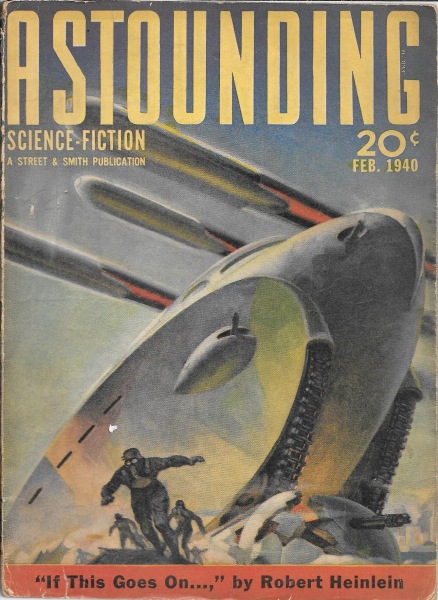
95 years ago, there was the publication of a horror anthology. The book was titled Creeps by Night, and the editor was none other than Dashiell Hammett. Now, Hammet was not a horror writer; rather he was arguably the finest crime writer of his generation, and maybe even when compared to the generation that followed. Hammett did, however, have an eye for good fiction, and moreover he respected what was then the burdgeoning pulp market, seeing as how his short stories and even a couple of his novels (most famously The Maltese Falcon) first saw print in those same pulp magazines. By and large the stories chosen for Creeps by Night were recent, published between 1910 and 1930, and by and large these stories were originally published in the pulps. Hammett is less concerned with the exact literary merit of the stories and more with their effectiveness as weird fiction. As he says so well in the introduction:
The effectiveness of [weird fiction] depends on the reader’s believing that certain things cannot happen and on the writer’s making him feel—if not actually believe—that they can but should not happen. If the reader does not feel that these things have happened, or does not care whether they have happened, then the author has been, in the first case, unconvincing, and in the second, uninteresting, literary faults by no means confined to our present field, and so of no especial interest to us here.
The “present field” in question is horror, and more specifically short horror as appearing in often cheap periodicals. Hammett, himself an accomplished author, recognized that there was a truckload of garbage when it comes to these periodicals, but he also recognized the merits of what was at the time a not very respected field of writing. The pulp horror story, or the weird tale in the vein of H. P. Lovecraft and his contemporaries, was not like the more mannered and openly appreciated supernatural horror by the likes of M. R. James, Henry James, Arthur Machen, etc. Weird Tales and its rivals patronized a small but passionate group of writers and readers, who in turn huddled around lurid and often violent weird stories like moths around a lantern. In a way this new breed of horror story took after the precedent set by the Jameses and their ilk, but they also pointed the way for a new and uniquely American kind of horror.
Creeps by Night was published right in the middle of that boom of pulp horror, and in the 95 years since there has been, if anything, more freedom afforded to writers who would prefer to specialize in the short story over the novel, even if the novel utterly dwarfs the short story in popularity. Short-form horror literature has also become a lot more sophisticated on average since the 1930s. For all the changes that have happened, though, the central conceit of the weird tale has remained steadfast, namely that a good weird tale ought to make the reader feel that something can but should not happen. There is also the emphasis on how the reader feels rather than thinks, which may be the key difference between weird fiction and, say, dystopian SF—not that the two are mutually exclusive. Whereas dystopian SF is meant to light a flame under one’s intellect, horror leans more towards the irrational. It doesn’t matter if you don’t believe in ghosts (as I don’t—at least not literal ones), a good ghost story should make you feel, if only temporarily, that such things can be. That’s the magic of it.
Obviously since October is here, we have all weird and strange stories for this month’s review forecast, spanning nearly a century in content but hopefully showing something of a continuity in the short-form horror tradition. Of course, it helps that I always get into this exact mood when October comes around, even though autumn seems to start a bit later with each passing year as the climate becomes more erratic.
Well, it can’t be helped.
We have one story from the 1930s, one from the 1940s, one from the 1970s, three from the 1980s, one from the 1990s, and one from the 2020s. I didn’t go in intending for there to be a focus on horror from the ’80s, it sort of just turned out that way.
Now, for the stories in question:
“The Opener of the Way” by Robert Bloch. From the October 1936 issue of Weird Tales. Bloch was born in 1917, and would’ve been all of 18 when he wrote this story—yet by this point he was already an established author in the pages of Weird Tales. He evntually became famous for writing Psycho, but he started out as one of Lovecraft’s many correspondents and imitators.
“In the Arcade” by Lisa Tuttle. From the May 1978 issue of Amazing Stories. Like Bloch, Tuttle was something of a prodigy, writing her first professional story when she was in her teens. She collaborated with George R. R. Martin on the SF novel Windhaven, but Tuttle’s true calling always seemed to be horror. While she’s written several novels, she’s far more prolific with short stories.
“Greenface” by James H. Schmitz. From the August 1943 issue of Unknown. Schmitz would forge a respectible career as an SF writer about a decade down the line, with maybe the most notable recurring feature of his stories being his sympathy for his female characters. “Greenface” is an unusual debut for him, being horror and printed in Unknown, and being his only story for six years.
“The Medusa” by Thomas Ligotti. From the Winter 1991 issue of Fantasy Tales. While he has not written a great deal over the past four decades or so, even seemingly having gone into hibernation as of late, Ligotti stands as one of the undisputed living masters of horror. He takes some cues from Lovecraft, no doubt, but the cadance of Ligotti’s prose style is very much his own.
“Family” by Joyce Carol Oates. From the December 1989 issue of Omni. Over her very long career, Oates has won multiple literary awards and is typically considered a literary author (and tweeter), but her fascination with horror goes back to pretty much the beginning. Most of Oates’s horror output has been through short stories and collections, and even then she’s been startlingly prolific.
“The Night of White Bhairab” by Lucius Shepard. From the October 1984 issue of The Magazine of Fantasy and Science Fiction. Shepard only started writing as an adult when he was pushing forty, so in that way he was a late bloomer; but when he did debut in 1983, he emerged in the field more or less fully formed. A lot of Shepard’s work blurs genre lines, and this is probably no exception.
“She Sheds Her Skin” by Raven Jakubowski. From the November 2023 issue of Nightmare Magazine. “A tailor by trade and writer by vocation,” Jakubowski is an NYC denizen who technically made her debut back in 2014, but she only started writing consistently again (after a false start) around 2021. According to an interveiew, “She Sheds Her Skin” was inspired by COVID lockdowns.
“Remembering Melody” by George R. R. Martin. From the April 1981 issue of Twilight Zone Magazine. Martin is one of our most famous living writers, although he’s far more known for his fantasy than his SF and horror. Despite this, Martin has remarked on more than one occasion that he considers himself instinctively a horror writer more than anything, and honestly it shows.
Now let’s get in the mood and read some spooky stories.
(Cover by Philippe Halsman. The 28 June, 1952 issue of Collier’s, where Ray Bradbury’s “A Sound of Thunder” first appeared.)
When Robert Heinlein’s “The Green Hills of Earth” appeared in the 8 February, 1947 issue of The Saturday Evening Post, there was cause for celebration. Heinlein had just returned from a four-year hiatus, having spent much of that time helping with the war effort, and when he got back to writing it was as if he had never left. In the years immediately following the war, in which the US immerged as a superpower, there was a burgeoning suburban middle class, and therefore a burgeoning suburban middle-class readership. The Saturday Evening Post was, for much of its existence, a weekly tabloid-format magazine that had already been around for over a century; but by the immediate post-war years it had reached the absolute height of its popularity. By 1948 something like 10% of American adults were reading the Post, which was and still is a ridiculous circulation. The Post was a “slick” magazine, although it didn’t use slick paper; rather it was slick in the sense that it paid well for articles and stories, and the lucky author would enjoy a wide readership. It was a mainstream magazine that occasionally printed genre fiction. When several of Heinlein’s stories appeared in the Post in the late ’40s, corresponding with a book deal he had made with Scribner’s, he knew he had hit the big time.
Heinlein’s experience with gaining mainstream traction was not totally unique to him. There were some other writers of his generation, and even more of the following generation, who started out writing pulp fiction before moving to the slicks. Ray Bradbury, Elmore Leonard, John D. MacDonald, Raymond Chandler, Harlan Ellison, and even Stephen King had their first stories published in pulp magazines. King, in the introduction to his story collection Night Shift, thanks (among others) Robert W. Lowndes, who was editor of the cheap and now-forgotten magazines Magazine of Horror and Startling Mystery Stories. Lowndes had also bought King’s first two stories, when the latter was barely out of his teens. Evidently the apple hasn’t fallen too far from the tree.
Science fiction has infested practically every facet of modern life, so it can be hard to appreciate the fact that it used to be quite a niche interest. We’re constantly being flooded with bestselling novels that are SF, and a disproportionate number of the highest grossing movies ever are SF. For better or worse (it’s easily for the worse) we’re at the mercy of technocrats who grew up reading SF. But going back to the 1940s and ’50s, SF was mostly constrained to magazines with ultimately low circulations, not to mention all the B-movies. Even before that, SF was steeped in the pulp tradition, which is to say being published in pulp magazines. While science fiction as a codified genre became a thing in 1926, with the launch of Amazing Stories, the pulps went back to the tail end of the 19th century, and some fiction from these older pulp magazines even found their way as reprints in Hugo Gernsback’s newfangled “scientifiction” magazine. The pulps started proliferating in the 1900s thanks to a few big publishers, maybe the most famous of them among old SF fans being Street & Smith, who would later print Astounding Stories. By the time Amazing Stories launched, you already had popular pulp magazines that sometimes printed science fiction and fantasy, including Argosy, Adventure, and Blue Book. Most famously there was Weird Tales, which while focused on horror and fantasy also regularly printed SF.
The “pulp” label is easy enough to understand, although it’s not totally consistent. As a rule of thumb, a pulp magazine in the early 20th century had such-and-such dimensions, but more importantly it had to do with the quality of the paper, which was rough and brittle. Sometimes the edges were untrimmed. These magazines were cheaper to buy than their slick counterparts, but correspondingly they also paid less by the word. Also, in terms of class politics and age demographics, it must be said that while the likes of The Saturday Evening Post and Harper’s Weekly appealed to bourgeois readers, adults who while part of the workforce weren’t exactly getting their hands dirty, the pulps appealed more to working-class adults and adolescents. Granted that it’s unwise to generalize a whole era of popular fiction like this, the stories in these magazines tended to be heavy on action and plotting, and with at least a tinge of wish fulfillment. As I said, these stories did not pay well on a word-by-word basis, but if one could crack the code of what a magazine’s editor is looking for, and how to write a reliably solid adventure story, there was some money in it. The luckiest of these pulpsters was Edgar Rice Burroughs, who had taken on writing relatively late in life, already being deep in his thirties and with some odd jobs behind him. In 1912 alone Burroughs cracked the code with such gusto that he basically changed the face of American pulp fiction, with the one-two punch of A Princess of Mars and Tarzan of the Apes, both appearing in the pulp magazine The All-Story (which later merged with Argosy, it’s confusing). Burrough’s literary reputation is up for contention, but the cultural impact he continues to have is hard to deny.
Most of the authors who appeared in these pulps are now totally forgotten, and in fact got tossed into the dust bin of history decades ago. At the same time, some of the most important American writers of the 20th century got their start writing for the pulps, be they SFF magazines or other genres. Black Mask, founded in 1920, was a crime-oriented pulp magazine that would publish works by such future giants of crime fiction as Dashiell Hammett and Raymond Chandler. The best of these authors eventually moved on from the pulps in favor of better-paying markets, such as getting into novel-writing, but the strictness of magazine protocol encouraged discipline over raw imagination. In the introduction for his collection Trouble Is My Business, Chandler recounts his experiences with writing stories for Black Mask and other pulps in the ’30s as follows:
If the formula had been a little less rigid, more of the writing of that time might have survived. Some of us tried pretty hard to break out of the formula, but we usually got caught and sent back. To exceed the limits of a formula without destroying it is the dream of every magazine writer who is not a hopeless hack.
Chandler describes a push-and-pull effect with writing for the pulps that’s by no means unique to crime fiction—in fact it applies to every other genre of magazine fiction, including what appears in the slicks. Editors have their biases, no matter how benign they appear, and there were restrictions regarding censorship in those days that made it so that the language could never be too salty or the sex appeal all that explicit. (The sexiest a fiction magazine could get was Weird Tales, which you have to admit had some pretty erotically charged covers in the ’30s, but even that came with some legal trouble. Pick a random issue of Weird Tales from the year 1935 and juxtapose it with a random issue from 1939 or 1940: you’ll see the difference.) These restrictions encouraged writers to develop formulae that could get their work accepted with more ease, depending on the market. The work itself might not be masterful, but these markets did serve as training grounds for promising writers.
The years between the world wars saw the height of the pulps, but America’s involvement in World War II demanded everyone tighten their figurative belts, including a need for paper. The paper shortage during the war saw the deaths of several pulp magazines, maybe the most lamented of them being Unknown, Astounding‘s fantasy-oriented sister magazine. Astounding itself barely survived the paper shortage, being the only one of Street & Smith’s genre magazines to have made it. Even the ones that did survive, including Weird Tales and Amazing Stories, fell on hard times during and immediately after the war, with the former eventually closing its doors (not for the last time) in 1954. This is not to say good fiction wasn’t being published in these magazines, especially in the case of Weird Tales which continued strong more or less until the end, but these were struggling magazines with small (if also devoted) readerships. By the early ’50s the pulp format was on its way out, with former pulps switching over to digest. It didn’t help that there were newfangled magazines at this time, including Galaxy Science Fiction and The Magazine of Fantasy and Science Fiction, which were printed in digest format from the beginning. These magazines were not quite slick, as they were still aimed at the small world of genre readers; but they had decent quality paper, they paid well enough, and they (namely F&SF) even sometimes reprinted material from the slicks.
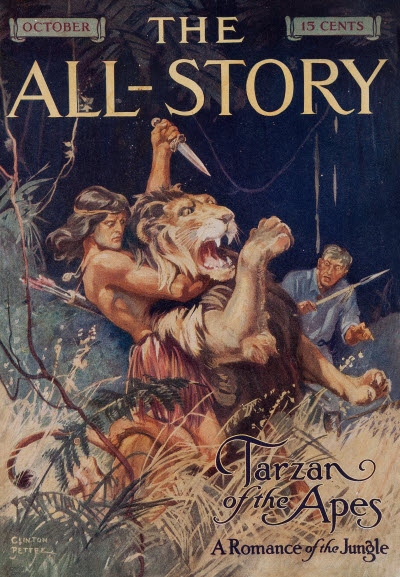
(Cover by Clinton Pettee. The All-Story, October 1928. This issue ran Tarzan of the Apes in its entirety.)
Of course, pulp writing, along with the format associated with it, is dead, and in fact has been dead since before my parents were even born. Analog Science Fiction, formerly Astounding, is now the only genre magazine still standing which had begun its life as a pulp magazine. What little remains of the pulp years has long since found its way into book form, as novels, story collections, anthologies, what have you. The 1950s saw the extinction of the pulp magazine, with the last of these to have stuck with the format, Science Fiction Quarterly, ending with its February 1958 issue. The digest format, a sort of happy medium between the unsophisticated pulps and the decidedly bourgeois slicks, continued. Now, while the pulps were gone, they were by no means forgotten. If you love Star Wars, Indiana Jones, Tarzan, or a good film noir, just know that these things have their roots in the pulps. Hell, H. P. Lovecraft had much of his fiction published in Weird Tales, and indeed that lurid magazine was often the only market that would take his work. Given that the rates were poor, the paper was brittle, and the readership either very young or not too thoroughly educated, pulp fiction left quite a legacy. And within a couple decades there would be a book counterpart to the digest magazines—that is to say, popular fiction in book form that’s sort of pulpy but also sort of slick. There soon came a mode of writing that would embody the best (and worst) qualities of both its parents, and in part is has to do with paperbacks outselling magazines.
The market for genre magazines has evolved radically over the decades, so that the most successful ones running today are online, subsisting on either Patreon subscriptions or simply donations. There’s no debate, however, that the book, and more specifically the paperback, enjoys a far wider readership than any magazine you can name in [the current year]. Go to any bookstore, be it a Barnes & Noble or that indie place you frequent just around the corner, and you will find rows upon rows of paperbacks and hardcovers; meanwhile there may be a couple stalls for magazines, if any, and only a fraction of those will be magazines focusing on fiction. Now, it’s not exactly cheap to buy a paperback novel, unless you have a publisher’s line of paperbacks, like Oxford World’s Classics or Barnes & Noble Classics, that focus on printing “classic literature” at very reasonable prices. But most paperbacks will cost you something. My paperback copy of R. F. Kuang’s Babel (to use an example of a recent novel that a lot of people have read and liked) ran me $20, which feels almost as if Kuang herself (or rather her publisher in this case, HarperCollins) had beaten me over the head with a stick and called me ugly. Kuang is independently wealthy, even if she weren’t a popular writer; surely she (or rather HarperCollins) didn’t need my $20. Still, she writes for a broad audience, as in she writes popular fiction, and evidently she’s doing something right.
You know who else writes popular fiction? George R. R. Martin. One of our most famous living writers, regardless of genre. I’ve covered a few of his short works on this very site, and will do so again eventually. Martin’s A Song of Ice and Fire series is very popular, both in how many people read these books as well as the demographic Martin writes (or wrote) with in mind. But was that always the case? Did you know that the Daenarys chapters of A Game of Thrones first appeared as a novella in an issue of Asimov’s Science Fiction, just a few months before A Game of Thrones found its way to bookstore shelves? If you were one of the relatively few people to have been subscribed to Asimov’s in 1996, you would’ve gotten a sneak peek at what has since become one of the most famous and controversial series in all of fantasy. Asimov’s is a digest magazine with, as I said, a healthy but ultimately modest readership. It’s not pulpy, but you also wouldn’t call it slick or popular. It’s sophisticated, but not that sophisticated. Martin himself has made no secret of being influenced by pulp fiction from the days of yore, namely SF published in Astounding before it became Analog. Indeed Martin’s biggest aspiration as a writer at the outset of his career was to get published in Analog, which he succeeded at. Nowadays people tend to overlook Martin’s pre-ASoIaF SFF, maybe because said fiction was not aimed at a general readership for the most part. I do suggest doing some digging and, for instance, reading the short fiction collected in Martin’s Dreamsongs.
Popular genre fiction takes the broad demographic and image of respectability from the slicks and combines that with the juvenile adventurousness of the pulps. The problem we’re now facing is that with the pulps long gone and the slick magazines not much more relevant, the options you have for reading some good SFF have narrowed. This is made worse by the phasing-out of the mass market paperback, which for a few decades served as like a book equivalent to a pulp magazine issue, in terms of paper quality, garishness, and affordability. The mass market paperback is smaller and cheaper than the trade paperback, but the latter has has finer and more flexible paper, not to mention an air of respectability. You can still find Martin’s old books as mass market paperbacks, but the same can’t be said for Kuang, or indeed other SFF authors of her age or even a generation older. Publishers used to get by on selling mass market paperbacks at $9 a pop, or magazine issues at the same price; but now they want your $20 for a trade paperback edition novel you might already have. Pulp and slick writing have merged, or maybe fallen together into a boiling pot, to create popular fiction, but this Frankenstein monster is itself a victim of capitalist greed. Clearly there’s a big audience for fancy trade paperbacks and even fancier hardcovers, but the problem (and I’m sort of paraphrasing Oscar Wilde here) is that audiences tend to be stupid.
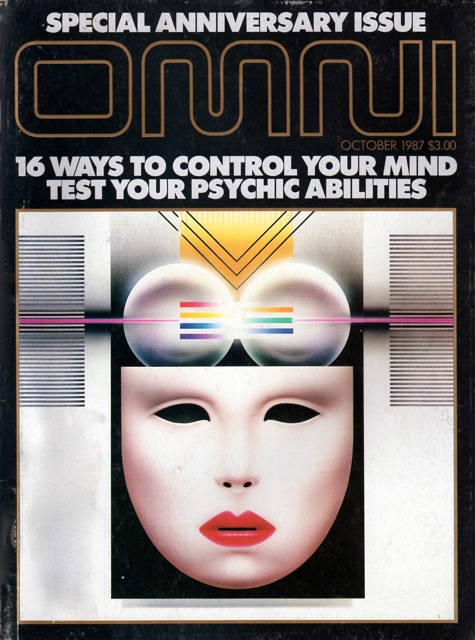
(Cover by Stanislaw Fernandes. Omni, October 1987.)
Who Goes There?
Happy Halloween, ghouls and gals!
George R. R. Martin is now one of the most famous American authors alive, but this was not always the case. When he made his professional debut in the early ’70s he was just another post-New Wave writer who wanted desperately to be published in Analog, as he idolized (and still idolizes, really) John W. Campbell. In a bit of a cruel twist of fate, Martin didn’t make his first sale to Analog until right after Campbell’s death, but that didn’t stop him from appearing in that magazine regularly throughout the ’70s and ’80s. Martin started his A Song of Ice and Fire fantasy series in 1996, but prior to that his career was a lot more winding—one might say directionless, but I prefer to think of the first couple decades of his career as showing Martin at his most versatile. He wrote science fiction, fantasy, and horror in more or less equal measure, although he’s admitted to being perhaps a horror writer by instinct. This is easy enough to believe, even for someone who only knows Martin for his big series, considering the monsters, zombies, ghouls, and remorseless killers which populate A Song of Ice and Fire. For better or worse (he has his reactionary/boomer moments), Martin is our biggest connection to an era of genre writing that is long past us, to the point where a lot of current readers have no personal memory of it and no passion to dig up its bones. He’s the one living author I know who has enough clout to make young readers check out the works of Jack Vance.
My experiences with Martin have been a bit mixed over the years, since I have to admit I’m not keen on his big fantasy series from what little I’ve read of it; but at the same time I do like his early SF and horror a lot more. This month has been kind of a wash for me, as far as getting my spooky shit on goes, with movies and also reads, even what I’ve been reviewing here as of late. The good news is that we’re going out on a high note, because “The Pear-Shaped Man” is a darn good tale of paranoia and suspense, being quite effective while also seeing Martin on his best behavior. Understandably it won the Stoker for Best Long Fiction that year, although at maybe 13,000 words it’s not that long.
Placing Coordinates
First published in the October 1987 issue of Omni. It’s been reprinted in The Year’s Best Fantasy: First Annual Collection (ed. Ellen Datlow and Terri Windling), Omni Best Science Fiction Two (ed. Ellen Datlow), The Horror Hall of Fame: The Stoker Winners (ed. Joe R. Landsdale), and the Martin collection Dreamsongs: Volume I.
Enhancing Image
Jessie is freelance book illustrator (the narrator jokes that this is not a “real” job) who’s moved into an apartment recently, and so far everything has been going about as expected. She has a few friends and she gets enough work that she won’t be homeless in a week. There is one problem, though, which has to do with the man who lives in the apartment building’s basement. The man, as far as anyone can tell, does not have a name, for even the tenants who have lived here for years don’t know what it is, despite all of them having interacted with him at some point or other. “All of them, every one, called him the Pear-shaped Man. That was who he was.” He’s a man of unusual proportions, being certainly chubby, but with his torso being (predictabtly) pear-shaped: narrow at the shoulders, yet with a real dump-truck of an ass. His head is described as like a small pear on top of the big pear that is his body. Nobody in the building really likes him, but he’s someone who generally keeps to himself, even with his strange habit of seeming to only eat cheese curls of a specific brand and drink Coke. This would be considered par for the course with YouTubers and Twitch streamers in the current year, but it would’ve been strange back in the days when people cared about balancing one’s diet. The Pear-shaped Man lives right below Jessie and her roommate Angela, but while the latter is chill about the man’s eccentricity, Jessie quickly finds a bone to pick.
“The Pear-Shaped Man” is example of what we would call apartment horror, which sounds specific but actually has some room for a variety of fun (or maybe not-so-fun) times. It could have to do with getting a roommate who turns out to be a psychopath, neighbors who are secretly murderous cultists, neglectful management (as if there’s any other kind), or some combination. Maybe there’s a Lovecraftian monstrosity lurking in the water pipes, or maybe (to take from a certain Lovecraft story) the air conditioning stops working on the worst of days. It’s a kind of horror that could’ve only sprouted in a post-industrial urban society, and the more people are packed together like sardines the better. Apartment horror stands on the diametrically opposite end of the spectrum from rural horror, since whereas rural horror often goes into a sense of isolation and what little human company there is being off, apartment horror tackles terrors that are unique to the urban experience. It’s also an example of another kind of horror story, albeit more a twist on it than a straight example: the tormented-woman story. I wish there was a better name for it, but it’s a very old and proud tradition in the genre, in which you have a woman (it’s usually a woman) of questionable mental stability who finds herself suffering at the hands of an antagonist, sometimes unseen but other times hiding in plain sight. Here, the supposed antagonist tormenting Jessie is a man whom everyone in the building already knows about, and who to all appearances hasn’t done anything except act in a way that doesn’t abide social norms; the worst thing he’s done is be kind of a weirdo.
Now, I say this is a twist on the tradition, because Jessie really ends up being her own worst enemy, to the point of being a Karen. She is clearly in the midst of a psychotic break, but she also acts entitled—not that the people around her are exactly innocent. She repeatedly has dreams about having a weirdly sexual encounter with the Pear-shaped Man, and her obsession gets to the point where she unconsciously paints his features in an illustration, which her boss doesn’t take too kindly. This is the kind of thing one would seek professional help for, but not only does Jessie fail to consider this, but her friends and acquaintances actively choose to make the situation worse once or twice. Martin walks a bit of a tightrope here, because on the one hand Jessie is not the most likable of protagonists, being bitchy, whiny, and something of a Greenwich Village-type hipster, but also she seems to be suffering from some undiagnosed mental illness. She talks with Selby, the apartment manager, in trying to persuade him to dig up the Pear-shaped Man’s lease so that he can be identified, which as Selby’s justified to point out is a big invasion of the man’s privacy; and yet the fact that he doesn’t seem to even have a lease should in itself be concerning, never mind that he only ever pays rent with cash, and single-dollar bills at that. (This feels like a plot point that could’ve only been plausible at least thirty years ago, since nowadays rent is fucking astronomical unless you live in the middle of bum-fuck nowhere.) It doesn’t help that even though he hasn’t done anything, the Pear-shaped Man stood outside watching Jessie’s place for an uncomfortable amount of time on one occasion, and during the few times they interact he wants her to come see his “things.” Nowadays this would be considered stalking and/or harassment.
There’s a sexism angle to “The Pear-Shaped Man” that goes unsaid, which is probably for the best since my experience with Martin has taught me that he can be unreliable on feminist issues. So much the better that Jessie’s plight being elevated by men who by and large don’t take her seriously is kept as subtext, then. Really, what’s impressive about this story, considering Martin’s habits as a writer the pop up now and again, is that’s both subtle in a psychological sense while also building tension at just the right pace. This is a novelette, like I said about 13,000 words, but it feels a bit shorter than that. Early in his career Martin was prone to writing mood pieces, stories in which not much actually happens and there’s a focus on character and vibes, but with “The Pear-Shaped Man” he found a right balance of character and action. Previously I’d only written about Martin early in his career, whereas this story shows someone who is both a seasoned professional and in his element. He can be as gory and erotic as he wants later, with A Song of Ice and Fire, but with his earlier fiction, mostly printed in magazines, he feels the need to restrain himself at least a little bit. The descriptions of the Pear-shaped Man as this grotesque figure, his skin unnaturally pale and his fingers like worms or maggots, spark one’s imagination and may even gross you out a bit, but Martin doesn’t overdo it.
There Be Spoilers Here
Not a negative criticism, but the ending is a very strange one. I was unnerved a bit, but also confused. I don’t even wanna give it away here, both because I’m not entirely sure what happened (it’s clearly meant to be taken as metaphorical rahter than literal, but that doesn’t help much), and because I do recommend this story quite a bit and I think a first-time reader should go into it blind up to a point.
A Step Farther Out
Recently I had read Martin’s Fevre Dream, which is one of his few standalone novels and certainly the most well-known novel of his that isn’t part of that series; and while I enjoyed it, I also kept wishing it was about a hundred pages shorter, with the third act being tightened up massively. Martin, like any writrr with two brain cells to rub together, writes for money, and the horror market in the ’80s called for novels that were unnecessarily large and horizontally challenged. With short fiction, though, one still had the restraints one needed to write something that could be frightening and chilling, sure, but also calculated. I very much recommend “The Pear-shaped Man” as an introduction to George R. R. Martin the horror writer, as opposed to George R. R. Martin the fantasist, assuming you haven’t already read “Sandkings,” which sees Martin in both horror and SF mode. I do love “Sandkings,” by the way.
There’s something about October that brings a change in me. It could be that autumn has now unambiguously started, as opposed to just going by the autumnal equinox. The weather is now colder and dryer. My hands and nose are getting dry, the latter occasionally resulting in a nosebleed. I now feel like I can put on a hoodie and jog around the city. The trees will start being stripped of their leaves. Overall it’s a time of changes, mostly for the better. October is also the month of Halloween, which is far and away my favorite holiday, to the point where it might the only one I really get festive about. Now is the time for watching horror movies, from the classices to some grade-A schlock. Time to catch up on some horror reads I’ve accumulated on my shelf. Time for pumpkin spice lattes, if you’re into that. In other words, this is for me what Christmastime is for some people—mind you that I tend to get depressed around Christmas.
For this month we’re back to reviews at regular intervals, all short stories, all featuring thrills, chills, and assorted horrors. For the first time in a while I’m actually excited with what I’m gonna be writing about. Hopefully you’ll be joining me in reading at least a few of these.
We have one story from the 1940s, three from the ’50s, three from the ’80s, one from the ’90s, and one from the 2020s.
For the short stories:
“The Hungry House” by Robert Bloch. From the April 1951 issue of Imagination. Bloch was correspondents with H. P. Lovecraft when the former was still in high school, and this friendship had an apparent influence on Bloch’s early fiction. While he’s most famous for writing Psycho, which is non-supernatural horror, most of Bloch’s work involves ghouls, cosmic horrors, and whatnot.
“Rabbit Test” by Samantha Mills. From the November-December 2022 issue of Uncanny Magazine. Winner of the Hugo, Nebula, and Theodore Sturgeon Memorial Award, being only the third story ever to win all three. Mills debuted in 2016, with her debut novel published in 2024. “Rabbit Test” was the last of a streak of short stories, as Mills stopped writing short fiction for three years.
“Punishment Without Crime” by Ray Bradbury. From the March 1950 issue of Other Worlds Science Fiction. Being one of the most famous American authors ever, it can be easy to forget that Bradbury started writing for the genre magazines, not all of them being of the first rate. He also wrote so much horror early in his career that only a fraction of it appeared in The October Country.
“Lost Memory” by Peter Phillips. From the May 1952 issue of Galaxy Science Fiction. I had ever heard of Peter Phillips before, which might be because he was only active for a short time, from about 1948 to 1958. He stopped writing SF for reasons I’m not sure of. He was also British, at a time when there weren’t too many active in the field, even appearing in the inaugural issue of New Worlds.
“Yellowjacket Summer” by Robert McCammon. From the October 1986 issue of Twilight Zone Magazine. McCammon made his debut in 1978, but it took him a bit to come to the forefront of contemporary horror fiction. His massive post-apocalyptic novel Swan Song tied for the inaugural Stoker for Best Novel. Disillusionment with the industry made him step away from writing for a decade.
“Bloodchild” by Octavia E. Butler. From the June 1984 issue of Asimov’s Science Fiction. Winner of the Hugo and Nebula for Best Novelette. This is a reread for me, but I’ve been meaning to return to it for a close read for a minute. Butler wrote only maybe a dozen short stories, but they’ve received a disproportinate amount of praise, with her winning Hugos for short fiction twice consecutively.
“Reckoning” by Kathe Koja. From the July 1990 issue of The Magazine of Fantasy and Science Fiction. Koja debuted in the late ’80s with a pretty strong string of short stories before her debut novel, The Cipher, hit stores in 1991. She was a formiddable horror talent in the ’90s, but in the 2000s onward took to writing novels aimed at young readers, and she hasn’t written much generally lately.
“Day of Judgment” by Edmond Hamilton. From the September 1946 issue of Weird Tales. While he’s most known as a pioneer of space opera, as well as his Captain Future series, Hamilton appeared frequently in Weird Tales from the beginning of his career, sometimes with SF but also sometimes with fantasy and horror. He was an old-school pulp writer in that he wrote for basically any market.
“The Pear-Shaped Man” by George R. R. Martin. From the October 1987 issue of Omni. Winner of the Stoker for Best Long Fiction. Martin is a case where a series (A Song of Ice and Fire) of his is so famous that it overshadows the rest of his work, which mind you is considerable. Martin’s gone on record as thinking of himself as instincively a horror writer, a fact which is on display here.
We have pretty much an all-star cast of authors here, so I hope this will help my recent writing slump. Of course, the most important thing is that we have fun with this. Happy Halloween.
Lisa Tuttle and George R. R. Martin were baby-faced new writers, part of the post-New Wave era, and were even nominated for the Astounding Award for Best New Writer (Tuttle won) the same year. The two were lovers in the early ’70s, and while I haven’t looked into this, I’m pretty sure they were still together when they were writing “The Storms of Windhaven” (although they had broken up, and Martin was on his way to getting married, by the time it was published). This was probably the first thing of Tuttle’s a lot of people had read, and this might still be the case given the Martin connection; but these people would be in for a nasty surprise, since Tuttle’s writing is much more in touch with horror than SF. As for Martin, I need not elaborate, only to say that the Martin of the ’70s and ’80s is quite a different beast from one of the most famous authors in the world. I can’t call myself a Martin fan (because I’ve been unimpressed by what little I’ve read of A Song of Ice and Fire), but I do like most of his early stuff.
Tuttle and Martin came up with the Windhaven setting and apparently wanted to turn it into a novel, but only after they had written this first novella, which is a self-contained narrative. And why not? It would take almost five years for a follow-up to “The Storms of Windhaven.” This was pretty popular too, getting nominated for the Hugo and Nebula and placing first in that year’s Locus poll for Best Novella. I like it a good deal myself, for the worldbuilding more than the actual plot, and because it lacks some of Martin’s less savory habits. I have a theory or two about who wrote what, but I’ll get to that in a minute. And rest assured we’ll eventually tackle One-Wing, the much-anticipated sequel to this story.
Placing Coordinates
First published in the May 1975 issue of Analog Science Fiction, which is on Luminist. Unsurprisingly most of its reprints predate Windhaven. We’ve got The Best Science Fiction of the Year 5 (ed. Terry Carr) and The 1976 Annual World’s Best SF (ed. Arthur W. Saha and Donald Wollheim). Windhaven itself is still in print, for obvious reasons.
Enhancing Image
The plot itself is rather simple, but some context is needed. A sloppy reading of this story might make one think it’s fantasy, and certainly without some pieces of backstory it could be construed for fantasy. I myself barely noticed the origin of the humans of Windhaven on my first reading, along with a couple other things. Windhaven is a livable but not totally hospitable planet, mostly covered with water and prone to fierce gales and some pretty nasty local wildlife. The humans are descendants of space colonists, who had crash landed on the planet and could no longer use their spaceship; and apparently as a result the descendants have most lost touch with their far-future past, having descended into barbarism. There are basically two types of people: flyers and “land-bound.” The flyers have constructed their wings out of metal from the crashed spaceship, so needless to say it’s a precious resource; losing wings is considered just as bad, if not worse, than losing a human life. I’m putting this all up at the front since Tuttle and Martin sort of sneak in this context in breadcrumbs of exposition, which can be easily missed, although you don’t need it to understand the plot.
Anyway. Our Heroine™, Maris, is a skilled flyer; the problem is that she’s not “supposed” to be a flyer. She’s the daughter of a fisherman (long dead) who got adopted by Russ, who really is a flyer, although having lost the use of one of his hands he can no longer fly, and at the time he was seemingly sterile. “He and his wife had taken her in when it seemed that he would never father a child of his own to inherit the wings.” Luckily for Russ but unluckily for Maris, a child was eventually born. Coll is Russ’s son and, having turned thirteen, Coll has now come of age to inherit his father’s wings. But Russ had previously told Maris that she would inherit his wings! Conflict is now well underway. This is made worse by the fact that flyer laws state that wings can only be passed on to family members (unless the flyer has no next of kin or gives up their wings), preferably blood-related. The Landsman, a local authority, sympathizes with Maris’s wish to become a flyer, but rules are rules and Russ is a traditionalist. To make things even worse, Coll doesn’t really want to become a flyer; he would rather be a balladeer, like Barrion, a mutual friend of theirs and sort of a rebel.
Maris is a bit of a mixed bag as a character, because on the one hand she seems to be one-note: she wants to become a flyer and doesn’t seem to have any other serious aspirations. She has a boyfriend in Dorrel, a flyer himself, but we only see them together in a few scenes and it’s not a relationship that’s made that important. She doesn’t seem to have any hobbies, although in fairness she lives in a world without movies, TV, video games, or even common literature. But, to give some credit, she is driven, has a clear goal in mind, and is not objectified at any point. I suspect that Maris’s assertive characterization came mostly from Tuttle, although I can’t prove this. There’s a bit of steaminess with Maris and Dorrel, but it’s tasteful. Unfortunately one or two of the characters are not written as delicately. Russ is your typical boomer dad who doesn’t approve of his daughter’s wild ways, and he also happens to be very angsty about his disability. Obviously Russ wants to do the sports parent thing and recapture his glory days as a flyer vicariously by forcing his son, who is a square peg, into a round hole. Corm, a senior flyer and the closest the novella has to a villain, is almost a cartoon character, so zealous is he about keeping with tradition.
Unsubtle and at times problematic character writing would dog Martin for the rest of his career (some people will challenge me on this, but I think those people are wrong), but one thing Martin and Tuttle both had nailed down from very early in their careers is a sense of location. “The Storms of Windhaven” is not hard SF, but it is a vivid and plausible (assuming you’re not a stickler for details) planetary adventure that gives us a plot that, yes, could work perfectly fine in a fantasy context, but whose SFnal background gives credibility to this far-future society that has descended somewhat into barbarism. It makes sense that the survivors of a crashed spaceship would scatter over a ton of small islands, traveling by glider or boat, and having to rebuilt society from the ground up. It makes sense that a few centuries later the descendants would remember these original explorers through myth and song, and that lineage would become very important. Balladeers like Barrion would hold an important place in society because they are entertainers, for one, but also they chronicle history—and rewrite it, if need be. Barrion says he’d like to write songs depicting Maris as a virtuous rebel after all has been said and done, and he has the power to do this.
Ultimately this is a story about tradition vs. progress, or more specifically, how we should handle the past. It’s unsubtle; it’s even more unsubtle than the character writing, not that I disagree with Tuttle and Martin’s obvious pro-progress stance. Russ and Corm are bound to tradition, even to the point of making Maris’s life worse, and they need to be shown the error of their ways. This is also a story about racism and classism, by way of metaphor, because it’s pretty clear that a) the people of the different tribes don’t get along too well, and b) flyers and land-bound don’t like each other. Understandable: flyers are rather up their own asses about their wings. Our Heroine™, of course, has no bad intentions and doesn’t even know what those are. She does briefly consider killing Corm when the latter confiscates her wings, but she quickly turns this down, and that’s as dark as her character gets. I’m not really complaining—just pointing out how much of a girlboss Maris is. I don’t remember a great deal from One-Wing but I do remember it focuses a bit less on her, which I might appreciate on a reread. “The Storms of Windhaven” technically has a sequel hook, but it would still feel like a flesh-out world even if we never got a sequel.
There Be Spoilers Here
Maris steals back her wings from Corm, and there’s a chase. Despite being younger and not a “true” flyer, Maris proves to be a better flyer than Corm, which lets her escape his wrath for the moment but also results in her being put on trial before a council. The back end of this novella is weird for me because I totally forgot about the stealing part (despite it being crucial to the plot) and also remembered the trial taking up more of the story than it does. Memory is flexible, and often tells us things that aren’t quite true. I also realized, looking at my notes again, then I occasionally misspelled Corm as “Corn.” Imagine being hunted down by some conservative zealot named Corn. Anyway, the trial is technically to judge whether Maris be exiled from her hometown (or I guess home… rock?), but really it’s supposed to be a kangaroo court of humiliation, as Maris thinks:
Corm is a proud man; I injured his pride. He is a good flyer and I, a fisherman’s daughter, stole his wings and outflew him when he pursued me. Now, to regain his pride, he must humble me in some very public, very grand way. Getting the wings back would not be enough for him. No, everyone, every flyer, must be present to see me humbled and declared an outlaw.
At first everyone is against the notion that wings should be earned in some way rather than just inherited, but naturally Maris is able to convince enough of the council that what has been done for generations isn’t the only correct way to do things. “The Storms of Windhaven” is not some deep “literary” achievement but a well-crafted planetary adventure that wears its thesis and emotions on its sleeve. Its point is obvious, but entertaining to read (there’s not a dull moment here), so unsurprisingly it was quite popular with readers. It’s just a shame that Windhaven, like Dying of the Light and Tuf Voyaging, is doomed to semi-obscurity by virtue of not being the thing that made Martin one of our most famous living authors. Of course, it’s totally possible these books wouldn’t even be in print if not for Martin’s name being attached to them. It’s also a shame that Windhaven would be Martin’s last SF novel if we’re not counting Tuf Voyaging as a novel.
A Step Farther Out
Obvious sequel hook aside, this is a nicely self-contained story that theoretically could’ve stopped here; but it’s a good thing they didn’t. This is a masterclass in worldbuilding, and it’s impressive especially given how young both authors were at the time. It’s vivid, if also old-fashioned even for 1975. It could’ve been published thirty years earlier in Planet Stories, but that’s not necessarily a bad thing. It’s justifiably a classic piece of SF adventure writing. We will return to Windhaven, in One-Wing, which was serialized in Analog in 1980. For some reason I remember very little of One-Wing despite having read it not that long ago. Ominous…?
(Cover by Edward Valigursky. Amazing Stories, May 1959.)
It’s February, and 29 days instead of the usual 28—not like that makes a difference for my review schedule. It’s the time of one of my least favorite holidays: Valentine’s Day. I just ignored it last year, but this time I figured I may as well have some fun with the timing of it. Originally I was gonna tackle all collaborative stories this month, as a gimmick. After all, it takes two to tango, and authors working together can sometimes bring out the best in each other. Indeed for the collaborations I decided to go for different types of collaborative relationship: mentor and apprentice (Brackett and Bradbury), siblings (the Strugatsky brothers), an emerging master and his idol (Ellison and van Vogt), young lovers (Tuttle and Martin), and an actual married couple (Kuttner and Moore). It’s a fun idea!
Unfortunately I did say “originally” because tragedy struck the field last month: we lost some our most talented writers. Within the span of a week Terry Bisson, Howard Waldrop, and Tom Purdom died. I was gonna wait until April to do this, but I realized that with the way things have been going we might lose a few more major talents in the interim. This may sound cynical, but I wanted to strike while the iron was hot. It also lets me not have to comb too hard for collaborative stories.
For the novellas:
“Lorelei of the Red Mist” by Leigh Brackett and Ray Bradbury. From the Summer 1946 issue of Planet Stories. The logical heir apparent to Edgar Rice Burroughs, Brackett’s influence on the planetary romance can’t be overlooked. I need not tell you about Bradbury. Despite being only five years his senior and debuting around the same time, Brackett acted as a mentor figure to Bradbury. It’s probably not a coincidence both were Planet Stories regulars in the late ’40s.
“The Storms of Windhaven” by Lisa Tuttle and George R. R. Martin. From the May 1975 issue of Analog Science Fiction. This is a reread, but you know how I feel about rereads. Tuttle is known for her horror, but she has also dabbled in SF, and I can guess how she contributed to the Windhaven stories. I don’t need to introduce Martin. They were lovers in the early ’70s, and were probably still together when they came up with the Windhaven setting.
For the short stories:
“The Human Operators” by Harlan Ellison and A. E. van Vogt. From the January 1971 issue of The Magazine of Fantasy and Science Fiction. The first of the two Ellison collaborations, although it was actually the last released, its magazine publication being pretty much simultaneous with Partners in Wonder. Ellison thought the world of van Vogt, even bullying the SFWA into making him a Grand Master.
“First Fire” by Terry Bisson. From the September 1998 issue of Science Fiction Age. Bion has the unique honor of being the first author whose work I reviewed on this site, that being his legendary story “Bears Discover Fire.” Bisson started out as a novelist but is probably now more remembered for his short fiction, with short but densely packed stories like “macs” and “They’re Made Out of Meat.”
“What You Need” by Henry Kuttner and C. L. Moore. From the October 1945 issue of Astounding Science Fiction. Retro Hugo nominee for Best Short Story. It’s hard to overstate how great Kuttner and Moore were together in the ’40s, and also how prolific. My quest to cover as many Twilight Zone stories as I can continues, as “What You Need” was turned into a classic TZ episode of the same name.
“Initiative” by Arkady and Boris Strugatsky. From the May 1959 issue of Amazing Stories. Translated by Harmon Rutley. The Strugatsky brothers were, aside from Yevgeny Zamyatin, the first Russian authors to leave an impression on American genre SF; mind you this was during the Cold War. Their novel Roadside Picnic is one of the most famous non-English SF novels, as well as the inspiration for Stalker.
“Do Ya, Do Ya, Wanna Dance?” by Howard Waldrop. From the August 1988 issue of Asimov’s Science Fiction. Unlike Bisson, Waldrop seemed to think himself much more keen on short fiction, with only one solo novel being published and at least one more supposed to have been written but never seeing print. He’s probably most known for his seminal alternate history story “The Ugly Chickens.”
“Reduction in Arms” by Tom Purdom. From the August 1967 issue of The Magazine of Fantasy and Science Fiction. Despite having debuted in the ’50s, Purdom was one of those writers who really came into his own in the ’60s, when the New Wave was in full bloom and the market for genre SF had become more permissive. Purdom remained active for over sixty years, and his absence is sorely felt.
Not much else to say. Next month, as I said not long ago, we’ll be covering all short stories, all from F&SF, and all from the ’50s. February is another roster of novellas and short stories, but with a twist.
The idea that George R. R. Martin, perhaps the most famous living fantasy writer (or the most famous to not be a raging transphobe) right now, used to be mostly a science fiction writer would strike a lot of people as odd, but that’s the truth. I recommend picking up both volumes of Dreamsongs, the retrospective collection that covers Martin’s essential short fiction up to the turn of the century. The stories themselves are worth it, but Martin also wrote lengthy autobiographical introductions for each section (the stories are divided into thematically appropriate sections), and keep in mind that this was back in 2003… two whole decades ago. In his intro for the section containing “The Lonely Songs of Laren Dorr” and a few other early fantasies, Martin gets weirdly defensive about what must’ve been a recurring criticism of him in fandom at the time: that he was a science fiction writer who “sold out” and started writing fantasy once market forces shifted.
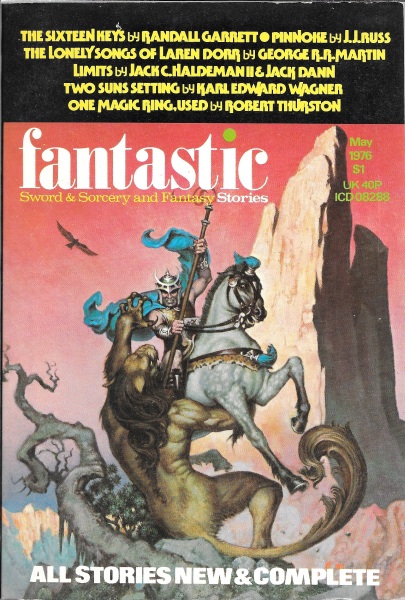
There’s no question that Martin’s priorities with genres changed radically by the time he started working on A Song of Ice and Fire, but the reality is that Martin was always more of a fantasist than a science-fictionist at heart. In the ’70s, when Martin started writing professionally, you had basically two options for getting short fantasy published: The Magazine of Fantasy and Science Fiction, which tended toward fantasy of the whimsical Lewis Carroll sort, and Fantastic, which welcomed adventure fantasy but sadly also paid considerably less than F&SF. Despite the pay gap, though, it was Fantastic and not F&SF where Martin cut his teeth on short fantasy, with him calling “The Lonely Songs of Laren Dorr” his first “pure fantasy” as a pro. Of course, by 1976 Martin was not just a pro but a Hugo winner.
Placing Coordinates
First published in the May 1976 issue of Fantastic, which is on the Archive. It was first collected in Songs of Stars and Shadows, but now you can easily find in the first volume of Dreamsongs. You can also read “The Lonely Songs of Laren Dorr” totally free and legit online as a reprint in Fantasy Magazine, which can be found here. Really you have no excuse.
Enhancing Image
Martin’s third-person narrator, not quite omniscient, gives us the immediate impression that this will play out like a fairy tale—or at leaat part of a fairy tale. Like your typical fairy tale we’re given a broad outline of the plot in advance, along with something like a message we’re supposed to take from it. The narration borders on childlike, but this is ultimately still a fantasy for adults, though I’ll say right now that certain Martin hallmarks like gore and sexual assault are nowhere to be found; you can rest easy on that. Anyway, the narrator tells us that this story is incomplete, like so:
We have only the middle, or rather a piece of that middle, the smallest part of the legend, a mere fragment of the quest. A small tale within the greater, of one world where Sharra paused, and of the lonely singer Laren Dorr and how they briefly touched.
I have to admit that I assumed going in that Laren Dorr would be a woman, even though thinking about it, Laren is not exactly a feminine name. Unconscious bias maybe? Doesn’t matter, because while he’s not strictly the protagonist Laren is very much the character of interest here; he is, after all, the one who changes. Hell, there are only only two onscreen characters, plus one who is mentioned but never seen, plus a group of villains who are also unseen but who still very much lurk just outside the confines of the page. The real protagonist is Sharra, “the girl who goes between the worlds,” a warrior lady whom sadly we find out very little about. We start with Sharra, who is in pretty rough shape, having just escaped a violent encounter into Laren’s world, with a dark crown on her head that apparently lets her use gates between worlds—an ability that the Seven do not approve.
Who are the Seven? We find out basically nothing about them, aside from the fact that they are supposed to be a pretty powerful bunch—perhaps a league of sorcerers—who can see across worlds. We know they’re evil and that also they wanna get their hands on Sharra, having already separated her from her lover (whose name I can’t remember).
I’ve struggled to write about this story, despite its length, because a) the plot is very abstract, and b) very little actually happens. Sharra is a refugee in Laren’s world, and Laren, being the sole keeper of his castle, takes her in as a guest. Laren doesn’t want Sharra to leave but Sharra has to find the gate to the next world at some point. Laren is not necessarily a sorcerer but he’s certainly a powerful being on this world where he’s the only human: he has magical healing powers, for one, and is also seemingly immortal. He’s also in contact with the Seven, and may be in cahoots with them. We get this lengthy explanation for how Laren knew Sharra before she came to his world and how her arrival did not strike him as a surprise, despite him having been by himself for—let’s say a stupidly long amoutn of time.
“You are Sharra, who moves between the worlds. Centuries ago, when the hills had a different shape and the violet sun burned scarlet at the very beginning of its cycle, they came to me and told me you would come. I hate them, all Seven, and I will always hate them, but that night I welcomed the vision they gave me. They told me only your name, and that you would come here, to my world. And one thing more, but that was enough. It was a promise. A promise of an ending or a start, of a change. And any change is welcome on this world.”
Somehow this does not concern Sharra too much—certainly not enough for her to go scrambling for a gate. A few other things I feel like noting, because to his credit Martin does try to generate intrigue with the setting while failing to do so with the characters. Like I said Laren’s world is barren as far as civilization goes, with his castle being stuck in the middle of endless forest; the castle itself also seems to be alive, acting of its own accord by, for example, turning its windows into stone at night as a security measure. During the daytime, though, Sharra and Laren are free to wander and hunt outside the castle as they please—so long as Sharra does not find the gate that is surely hidden around here.
Something I’ve noticed about early Martin is that he was preoccupied with capturing mood over plot and character, sometimes to his detriment. I don’t know what was going on in his personal life at the time that made him write several stories about isolation and feeling disconnected from other people, but then again, anyone who grows up in New Jersey seems to go through a social maladjustment phase. (I wanna point out that John W. Campbell, fellow New Jerseyan and someone Martin’s been open about admiring, had kind of a shitty childhood that no doubt impacted his capacity to get along with others in adulthood.) It could also be that it was simply an artistic thing of his—one that he’s never entirely gotten over. Consider how music is great at capturing emotions but not action (hence most rock operas are kinda lame from a narrative standpoint), and how some of Martin’s fiction is clearly meant to evoke music: “A Song for Lya,” “The Lonely Songs of Laren Dorr,” “Remembering Melody,” and of course A Song of Ice and Fire.
(I mean given that it’s a series of really long novels it should be called An Album of Ice and Fire, but I can see I’m getting distracted.)
Another Martin story I’m reminded of here is “Bitterblooms,” which has a somewhat similar premise, what with someone (a girl, again) being rescued by someone who might be a sorcerer/sorceress (only it’s a woman this time!), and there’s this wiff of Stockholm Syndrome you get from the pages. The difference is that there’s a tangible sense of danger in “Bitterblooms,” an actual conflict between characters that reveals their unsavory sides and puts them to the test. Sure, you could say there’s conflict in the story I’m reviewing here: Sharra wants to leave and Laren wants her to stay. The problem is that Sharra doesn’t wanna leave that badly; she’s not desperate to rescue her lover, nor does she ever come up with a scheme to get rid of Laren. Sharra thinks strongly about leaving for about a minute and then is easily convinced to stay for God knows how long; she may even think Laren worthy of a pity fuck or five. In other words, there’s no imminent threat and no reason to worry, with even the Seven apparently taking a nap through all this.
Much of the story’s 7,000+ words is speant on Laren monologuing about how lonely he is and how much he had been hoping for the day when he and Sharra would meet and he’d be, momentarily, relieved of his loneliness; this is the fantasy equivalent of writing about the tragic tale of a man who has not gotten his dick sucked since the days before 9/11.
There Be Spoilers Here
Zzzzzzzzzzzzzzz…
A Step Farther Out
It took me only a lunch break to read this, but much longer to come up with something to say about it. “The Lonely Songs of Laren Dorr” is almost as pure a mood piece as you can get—at the expense of plot and even basic conflict. When I reviewed Martin’s earlier story “With Morning Comes Mistfall” (review here), I was impressed at how much he was able to do in the span of a dozen pages; sure, it too was a mood piece, but it was rich in characters, themes, and even prose style. It could just be that I much prefer Martin when he’s writing SF over fantasy, as for some reason I rarely find the latter convincing. I’m reminded of when I read “Blood of the Dragon,” which was Daenerys’s chapters from A Game of Thrones edited into a novella, and I thought much of the dialogue was cringe-inducing. “The Lonely Songs of Laren Dorr” did not make me cringe, but it did bore me more than a little. I think Martin went too far in one direction in an effort to capture a specific mood, which strikes me more as play-acting than genuine feeling, which is actually a problem some of his other early fiction has.
It’s the first day of April… and I don’t have a prank in mind.
I’m just gonna do what I do with every one of these forecast blogs, which is to give you a quick update on things and then list off what I’ll be reviewing in the coming weeks. Hope you did your taxes well in advance and aren’t scrambling now! If you’re a filthy American, that is.
Anyway, the biggest thing to happen to this blog recently has been the opportunity to get interviewed by German warrior queen and Hugo winner Cora Buhlert (link here), which naturally gave me the warm fuzzies. This is a relatively young blog, but already I feel I’ve made major progress with it, and it’s been a reliable excuse for discovering new (to me) authors and returning to old favorites. My goal with this site has been to indulge my own quirky and admittedly retro-leaning love of genre fiction, with a literary if also highly colloquial bent, and on that front it’s been a success. Honestly there are too few active fanzines in the field right now, with a good number of them being one-man shows like myself, and goddamnit we deserve to get more notice among industry regulars.
Now, where was I?
Right. It’s been what, four months since I covered a so-called complete novel? And uhh, we still haven’t gotten there yet: April is thirty days, not 31. Sad. Just one more month, I promise. In the meantime we have a serial, two novellas, and two short stories. Admittedly we have more familiar faces in the lineup than I would normally prefer, but given my schedule as of late I’ve made an exception for myself. Let’s see what we have.
For the serial:
Camp Concentration by Thomas M. Disch. Published in New Worlds, July to October 1967. Disch is one of those American authors who appeared regularly in New Worlds during the height of the New Wave era, alongside Samuel R. Delany and Roger Zelazny. This is a four-part serial, but don’t be fooled! From what I can tell each installment is pretty short, which adds up because the novel in book form is like 180 pages. Short, but potent—or so I’ve heard. I’ve read a few short works from Disch before but this will be my first novel of his.
For the novellas:
“Forgiveness Day” by Ursula K. Le Guin. From the November 1994 issue of Asimov’s Science Fiction. Hugo and Nebula nominee for Best Novella, and winner of the Theodore Sturgeon Memorial Award. I hate to say this as someone who likes Le Guin a lot, but I’ve yet to read the linked collection Four Ways to Forgiveness—thought apparently now it’s titled Five Ways to Forgiveness (they found another one). Three of the stories in this collection were published in Asimov’s in fairly close succession, with “Forgiveness Day” being the first.
“Memorare” by Gene Wolfe. From the April 2007 issue of The Magazine of Fantasy and Science Fiction. This is one of those F&SF special author issues. Hugo and Nebula nominee for Best Novella. Wolfe made his first SFF sale in 1951, but he didn’t start writing regularly until the mid-’60s, where from then on he became one of the field’s most distinguished authors. He’s most famous for The Book of the New Sun and the fix-up novel The Fifth Head of Cerberus, but Wolfe did not shy away from short fiction, with “Memorare” as but one example.
For the short stories:
“The Big Night” by Henry Kuttner. From the June 1947 issue of Thrilling Wonder Stories. I covered C. L. Moore again last month, so I figure I ought to do Kuttner the same. The two are often treated as a package deal, forming like Voltron under their own names as well as a variety of pseudonyms, especially for the high-paying Astounding Science Fiction. Kuttner also appeared in several magazines apart from Moore. Take “The Big Night,” for example, which Kuttner had published under the pseudonym Hudson Hastings.
“The Lonely Songs of Laren Dorr” by George R. R. Martin. From the May 1976 issue of Fantastic. Martin has spent the past few decades so entrenched as a fantasist that it’s easy to forget there was a time when he mostly wrote science fiction instead, and that it was fantasy which was reserved for once in a blue moon. In 1976 you had two fantasy magazines: F&SF and Fantastic, and the latter paid worse. But Martin was good buddies with Ted White, Fantastic‘s editor, and this saw the publication of Martin’s first “pure” fantasy.
That’s it, that’s all I have. I take way too long to come up with these forecasts. I actually wrote this about a week ago; you’re only reading it now. Funny how time works. And as for those adventures in time and space…
Indeed who. George R. R. Martin is one of the most famous authors in the world today; even people who don’t read books at all (the poor devils) probably recognize him. In 1996 he began the series that would make him a household name, the A Song of Ice and Fire series of fantasy novels, a landmark title in low fantasy with five books so far and a sixth coming out… at some point. On top of being famous, Martin has also become infamous for, among other things, seemingly refusing to release the last two volumes of his series, and while Martin obviously isn’t obligated to finish his work for anyone else’s sake, one can’t help but get a sense that there’s a cynical motive at play here. Regardless, unless something disastrous happens—like, say, Martin coming out as a rabid homophobe or transphobe—this man’s legacy is more or less settled.
There’s just one problem, though: it’s not.
Martin’s uber-success with A Song of Ice and Fire has had the perverse effect of all but burying the fact that he was one of the most promising writers of science fiction to debut in the ’70s. Hitting the professional scene with “The Hero” in 1971, Martin would be nominated for the inaugural John W. Campbell Astounding Award for Best New Writer, losing to Jerry Pournelle, and the nomination was well-earned! By 1973 he showed himself to be a lyrical and emotional earnest author, not letting hard science get in the way of strong character writing and evocative imagery. “With Morning Comes Mistfall” was, according to the Thousand Worlds fandom wiki (more on that in a bit), written in the summer of 1971 before being published in the May 1973 issue of Analog Science Fiction. Despite appearing at first to be just another short story, “With Morning Comes Mistfall” would go on to earn Martin his first Hugo and Nebula nominations, and as we’re about to see those nominations are very much earned.
Now, ISFDB lists “If Morning Comes Mistfall” as a standalone story, which it functionally is. However, the aforementioned Thousand Worlds fandom wiki has an article on the story, listing it as part of that shared continuity. Does it make a difference if it’s part of the Thousand Worlds series? Not really. I just think it’s funny whenever the people who run ISFDB disagree with somebody. Get a load of this:
The Thousand Worlds wiki lists this as part of that series, although by their own admission it is “only a tenuous link” based on a planet name also referenced in a different story in that series.
You don’t see that kind of note on ISFDB a lot.
Placing Coordinates
This issue of Analog is…… NOT on the Archive.
I know, I’m sorry! If you want it you’re gonna have to get a used copy the old-fashioned way. I guess there’s also Luminist, but I don’t find their layout to be as intuitive, you can’t view an issue in-browser, and most importantly… their PDFs tend to be HUGE. Like we’re talking 100 megabytes or bigger, so big that you can’t even preview the file you’re about to download. It’s like I’ve entered an alternate timeline where file compression isn’t a thing.
On the bright side, it’s not like “With Morning Comes Mistfall” has only been reprinted two times. It showed up in the collection A Song for Lya, which covers a good deal of Martin’s ’70s output, and of course it appeared in some anthologies from that period, such as the third volume of Lester del Rey’s Best Science Fiction Stories of the Year. If you want a recent reprint, and assuming you don’t mind putting in a few more dollars, we have the first volume of Dreamsongs, which covers most of the material in A Song for Lya as well as additional stories.
Enhancing Image
Normally I don’t pay mind to story blurbs, but this one (not sure if it was written by Martin or editor Ben Bova) caught my attention:
Man’s curiosity drives him to seek the answer to every question. But it’s the unanswered questions which are the most exciting.
It’s about as succinct a mission statement as you can get, all while giving absolutely none of the plot away. Not that there’s much of a plot to begin with. “With Morning Comes Mistfall” is a hard story to spoil because it’s far more driven by characters and themes than by the movements of its narrative, which themselves are not hard to anticipate. It’s a very simple story, but it’s also Campbellian in the best way possible, in the sense that implies the existence of something great that was previously outside the realm of human knowledge; you could call it secular mysticism. “With Morning Comes Mistfall” could have very feasibly been printed in Campbell’s Analog, and this seems to be the mode in which Martin wrote his eariest professional-grade fiction. The result is a story which lacks characteristics we would now associate with Martin; there’s no foul language, nothing too violent happens, and female characters aren’t being forced into sexually degrading situations.
But more on that later.
With all that said, I’ll try my best to give you something of a plot summary, and for better or worse, the spoiler section will be pretty short this time around. So…
A journalist travels to the desolate planet of Wraithworld, a planet that remains almost entirely uninhabited. There’s only one human establishment on the whole planet, that being Castle Cloud, a hotel and casino owned by Paul Sanders. The journalist has come to talk to Sanders about the wraiths, a supposed mythical species lurking the depths of the mist-covered landscape. Nobody has ever gotten concrete evidence that that wraiths exist, but much like Bigfoot or the Jersey Devil, their mysteriousness makes them a magnet for tourism; while the sights of Wraithworld are nothing to sneeze at, people largely come for the wraiths. What I’m trying to say is that this story is about cryptids, which immediately makes it up my alley.
Sanders is a bit of a subversive character; despite being a business owner, and being described physically as rather rotund (something often attributed stereotypically to greedy businessmen), Sanders turns out to not be of that sort. The journalist quickly finds that Sanders is indeed taken by the mysterious beauty of Wraithworld. When the journalist notes the rising of the mists over the mountain range (Castle Cloud was built on the highest peak), we get this:
“Is it always like this?” I asked Sanders, after drinking it all in for a while.
“Every mistfall,” he replied, turning toward me with a wistful smile. He was a fat man, with a jovial red face. Not the sort who should smile wistfully. But he did.
He gestured toward the east, where Wraithworld’s sun rising above the mists made a crimson and orange spectacle of the dawn sky.
“The sun,” he said. “As it rises, the heat drives the mists back into the valleys, forces them to surrender the mountains they’ve conquered during the night. The mists sink, and one by one the peaks come into view. By noon the whole range is visible for miles and miles. There’s nothing like it on Earth, or anywhere else.”
The conflict comes in when Charles Dubowski, a renowned scienist, comes to Castle Cloud, and he too is here for the wraiths. More specifically Dubowski is here with a team to scan as far and as thoroughly as they can to see if the wraiths are real or a fabrication. We’re presented with a triangle of conflict—two sides ideologically opposed with a third as the more or less neutral presence. Dubowski wants to disprove the existence of the wraiths while Sanders wants to keep the wraiths’ existence ambiguous. Does it hurt that Sanders profits immensely off of people coming to Wraithworld to see if they can spot any wraiths? Of course not, but that’s not the point. It’s worth mentioning too that while Dubowski is written less sympathetically, he’s by no measn evil; his worldview simply conflicts with Sanders’s, whom the journalist takes more of a liking to.
Now, something that caught my eye reading the story this time around is the fact that not only is the journalist (who’s also the first-person narrator) nameless, but also genderless. There are only three principal characters in this thing and two of them are confirmed dudes, yet there’s nothing to indicate one way or another what gender the narrator is. This might be for the best. Personally I like to think the narrator is a woman, but I assume Martin wrote this voice with a man in mind. Otherwise there aren’t any female characters of any importance, which hey, it’s not like there’s any in-your-face sexism around here. I also like that the journalist, who’s a relatively passive character, is the narrator, since it focuses the action on the war of worldviews between Sanders and Dubowski.
We get to find out some more about Wraithworld, a setting which Martin chooses not to describe in excessive detail. That the narrator is a journalist (as was Martin before he got into writing SFF) helps explain the perfunctory style; we aren’t burdened with learning about anything that we don’t have to. We know Wraithworld is a failed colony. We know there was something called the Gregor expedition, in which some explorers were driven to madness, claiming they had come into contact with tall apelike creatures that were immune to bullets. There were a few deaths, and there’ve been more since then, often assumed to be due to the wraiths. What began as an anomaly soon turned into myth.
And the legend of the mist wraiths was born, and began to grow. Other ships came to Wraithworld, and a trickle of colonists came and went, and Paul Sanders landed one day and erected the Castle Cloud so the public might safely visit the mysterious planet of the wraiths.
Not that Wraithworld has much else going for it. The mists cover everything below the tops of the highest mountains by nightfall, and the soil is not good for farming. As a colony, Wraithworld’s potential would be pretty low. On the plus side, the air seems to be breathable; we never get an in-depth explanation for the world’s climate, but the atmosphere’s mix and density must be Earthlike enough for people to walk around without space suits. All the better. Martin doesn’t bog the story down with details that might distract us from what is ultimately a fable or a mood piece, and what a tightly structured fable it is. That the ending is easily predictable is a non-issue, since in order for Martin’s thesis to work, the story must end in a certain way.
There Be Spoilers Here
After accompanying Dubowski and his men through the forests and mountains in search of the wraiths, the journalist gets the creeping feeling that Dubowski is right, that the wraiths were a product of hysteria—a hunch that turns out to be correct. Shortly before Dubowski is about to give a press conference about his findings, he lets Sanders and the journalist in on the conclusion of his research: the wraiths aren’t real. They didn’t find any, no matter how much manpower and tech they used. Sanders is not a happy man as he tries, with hope fading, to convince Dubowski that there might be wraiths in the mists after all.
Sanders raised his eyes from his drink. They were bitter eyes. “Gregor,” he said stubbornly. “Gregor and the other classics.”
Dubowski’s smile became a smirk. “Ah, yes. We searched that area quite thoroughly. My theory was right. We found a tribe of apes nearby. Big brutes. Like giant baboons, with dirty white fur. Not a very successful species, either. We found only one small tribe, and they were dying out. But clearly, that was what Gregor’s man sighted. And exaggerated all out of proportion.”
The discovery ruins Sanders’s business, of course. People no longer come to Wraithworld looking for wraiths. It does, on the other hand, take off as a colony, albeit a minor one. More people come to the planet, but all three main characters go their separate ways, with the journalist leaving to cover other events, Dubowski continuing his studies elsewhere, and Sanders leaving Castle Cloud to be condemned; we never find out what becomes of him, ultimately. It’s a somber ending, but it’s not the end of the world by any means, as the journalist comes to find. Normally I don’t like to quote the endings of stories, but I have to do it with this one—I think it’s too lovely. The yearning in these final words is palpable.
“Otherwise the planet hasn’t changed much. The mists still rise at sunset, and fall at dawn. The Red Ghost is still stark and beautiful in the early morning light. The forests are still there, and the rockcats still prowl.
Only the wraiths are missing.
Only the wraiths.
Gets my emotions going, even more so the second time around. Martin knows what the perfect note to end on is and he goes with it. Like everything else it feels like the act of an artist who is totally in control of his faculties, and I just adore it.
A Step Farther Out
This is a very different kind of writing from Martin than what most people are used to. It’s poetic, but not over-encumbered with purple language. It’s retrained, coming in at about fifteen pages, exhibiting a very young writer (Martin would’ve only been 22 when he wrote it) who’s also trying his utmost to be disciplined with his craft. Apparently Martin wrote “With Morning Comes Mistfall” shortly before another great early outing of his, “The Second Kind of Loneliness,” though the latter would be published first. I would not have guessed, since while “The Second Kind of Loneliness” certainly does hone in on the mood it wants, the slightly older story here feels more like the work of a mature writer. On top of that, Martin comes through with a discernable statement here, about the nature of beauty and about a certain quality that something beautiful should ideally have—that is to say, an air of mystery about it.
Despite Paul Sanders being a bsuiness type, Martin clearly sympathizes with him because, in the context of the story, Sanders is also an artist, with Wraithworld as his piece or perhaps his muse. That Sanders never comes to understand totally how this planet works, and that we the readers are denied a lot of details (What does a rockcat look like, anyway?), reinforces this notion that in order for something to bewitch us with what seems to be an unspeakable beauty, we can only know so much about it. Indeed, there are things about a thing of beauty that we shouldn’t know; too much knowledge would take away the mystery of it, and after all, the most mysterious things are also the most alluring.
I think “With Morning Comes Mistfall” is Martin’s early masterpiece; it’s certainly the best of his ’70s output that I’ve read so far, or at least it’s my favorite of the bunch. It lost the Hugo that year to Ursula K. Le Guin’s “The Ones Who Walk Away from Omelas” and the Nebula to James Tiptree Jr.’s “Love Is the Plan the Plan Is Death.” Now that’s some pretty intimidating competition right there! “The Ones Who Walk Away from Omelas” is a stone-cold classic, one that’s still being much read and talked about today (God forbid if you’re forced to have a classroom discussion about it), and undeniably it’s more layered than Martin’s story. Still, if we’re talking about pure enjoyability in the act of reading a story, about reading something perfectly simple and yet poignant, about catching a young writer at the very moment when he becomes a serious artist, then I would have voted for Martin.
(Cover by Hubert Rogers. Astounding, February 1940.)
Picking stories to review can be pretty hard. Imagine simply reading fiction in your free time: novels, short stories, whatever. There are so many things you want to get to, things you’ve heard good things about, things you’ve been meaning to reread (because rereading is important), and yet there are only so many hours in the day.
Now I must, for August, limit myself to writing about three short stories, two novel serials, and two novellas. And not just anything; these will be the first to charge into battle, the first guinea pigs for me to test on and see what this site will be all about. The stories that will help me find my footing the most.
As such, all the stories this month will at least be Hugo nominees, if not winners—with one exception, and even then it’s by a two-time Hugo winner. Speaking of which, we have, for the serials:
The Demolished Man by Alfred Bester. Published in three parts in Galaxy Science Fiction, January to March 1952, and it would win the very first Hugo for Best Novel. I’m fond of Bester’s short fiction, and The Stars My Destination is still a delightfully hardboiled and experimental novel. Alas, I’ve yet to read The Demolished Man, his debut novel, but that’ll change pretty soon.
If This Goes On— by Robert Heinlein, published in two parts in Astounding Science Fiction, February to March 1940. An early and defining work by one of my absolute favorite authors, though I’m ashamed to say I haven’t read it before. It would win the Retro Hugo for Best Novella. I know, it’s technically a novella, but hey, if it’s serialized, it gets a serialized review.
Now for the novellas. I must confess, dear reader, I have a huge soft spot for novellas, especially when it comes to SFF. Hell, SFF is the only field of literature nowadays where novellas still get written and published regularly. Still, two novellas for this month. I had to choose wisely. Here they are:
“The Big Front Yard” by Clifford D. Simak. Astounding Science Fiction, October 1958. Winner of the 1959 Hugo for Best Novelette (the Best Novella category didn’t exist yet). Aside from his Hugo-winning novel Way Station this is probably the quintessential Simak story, so we’ll be giving it a deep dive and see how Simak works his magic.
“The Lineman” by Walter M. Miller Jr. The Magazine of Fantasy and Science Fiction, August 1957. You may know Miller as the author of A Canticle for Leibowitz, but did you know that he also wrote… OTHER STUFF? He even won another Hugo with “The Darfstellar,” but I’m more interested in checking out this one.
Finally, we have the short stories for this month. Two of these are rereads (one I’ve reread more times than I can count), but as you know, rereading is important. And the one I haven’t read before has me very curious. This month’s short stories are:
“Bears Discover Fire” by Terry Bission. Asimov’s Science Fiction, August 1990. Winner of the Hugo, Nebula, Locus, God knows what else, and I’ve read it about as many times as it’s been reprinted—which is a lot. A fine choice for the inaugural short story.
“Welcome to Your Authentic Indian Experience™” by Rebecca Roanhorse. Apex Magazine, August 2017. Hugo and Nebula winner. This will be my first time reading this short story, and by extension anything by Roanhorse. Very excited about it.
“With Morning Comes Mistfall” by George R. R. Martin. Analog Science Fiction, May 1973. Hugo and Nebula nominee. Martin is one of the most famous fantasy authors ever, but readers will be less familiar and thus pleasantly surprised with his SF.
I’ll be linking to the source magazine issues when available/convenient. I want my readers (all five of you) to be able to read these stories without going through much hassle, and besides, you get to discover or rediscover some stuff that’s really worth reading. I won’t always be able to provide a digital zine link—occasionally I’ll have to track down used print copies, like some kind of literary raccoon.