Who Goes There?
John Brunner would’ve turned 90 today, which is not an unreasonable age by modern standards. Unfortunately health problems piled on each other until he died just short of his 61st birthday, and by the time he died Brunner’s legacy was in danger of being totally lost to the abyss of history. Even his most famous novel, Stand on Zanzibar, can’t really be considered “famous” by any metric other than among SF connoisseurs; its Hugo win did not result in the sales figures Brunner was hoping for. Brunner started writing SF when he was a teenager, and given that his earliest work was published in the US first and also his use of at-the-time American genre conventions it’s easy enough to think he was an American writer; but no, he was a Briton, as today’s story makes clear enough. The conventional narrative with Brunner is that he wrote a handful of a truly good and ambitious novels, plus a smattering of very good short fiction, along with a whole lot of pulp trash. He took up writing full-time at a point when this was financially feasible—albeit only barely. While he tended to be more miss than hit with his novels, he had more luck at short lengths, such that even minor and long-forgotten excursions like “Some Lapse of Time” have points of interest. Also, incidentally, this is like the third hospital drama I’ve reviewed for this site in the past three months. Weird.
Placing Coordinates
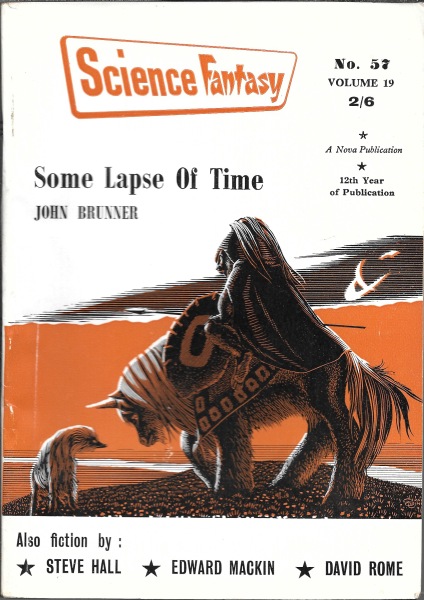
First published in the February 1963 issue of Science Fantasy. It’s been reprinted in English only once, in the Brunner collection Now Then!, which I have to tell you is super out of print.
Enhancing Image
Max Harrow has a dream, and it’s not a good one. He dreams of being in the wilderness somewhere, as if the apocalypse had happened and blown humanity back to the stone age. He sees, of all things, a man holding a human finger bone, which turns out to be a premonition—only he doesn’t know this yet. When he wakes he finds the real world to be about as strange as the dream realm. It’s nighttime and he gets a call from London police: a “tramp” has collapsed nearby and he’s in pretty bad shape, and Max is a doctor, one of the best. It’s a wonder the tramp is still alive when they get him to the hospital considering his jaundiced skin, bald patches, tattered clothes, and the fact that he’s unable to speak—at first. And when he does it’s clearly not English, nor is it any other language the hospital staff can recognize. “The last chance of determining what it was immediately vanished when they fetched Jones, the ambulance attendant, and he ruled out Welsh.” (Bit of a funny line there.) The strangest part is that the tramp is clearly afflicted with something, but his symptoms are not consistent with anything the hospital staff know about—nobody except Max. Years ago (it’s actually unclear how long ago this was) Max and Diana had a son named Jimmy, but Jimmy died in childhood from what Max would call “heterochyha,” something akin to radiation sickness. Jimmy was the only person, at least in London, to be afflicted with heterochyha, until this tramp walked into Max’s life. Now he has a patient and a mystery on his hands.
Gordon Faulkner, Max’s most trusted colleague, knows about the case with Max’s son but is otherwise unable to help much. A linguist named Laura is brought in to talk with the tramp, but she’s convinced at first that it’s a hoax, some mean trick set up, on account of the tramp speaking in what turns out to be some garbled form of English as it might develop in the future. So, we have a homeless guy who looks like he’s on the verge of death, yet if we were to even take a guess at his age (he’s in such bad shape that it’s hard for Max to discern his age and even his ethnicity), it’s a miracle that he’s lived this long with a disease that would turn lethal if one ate food with any fats in it—at least going off of what happened with Jimmy. There are thus two mysteries at the heart of this story: where did the tramp come from, and how has he lived this long with something that should by all rights be a dead sentence. There are a few smaller mysteries tucked within this sprawling narrative, such as how the tramp was able to kill a policeman’s dog whilst being as physically weak as he is. And then there’s the finger bone—a real human finger bone—the tramp was found with, reflecting Max’s own dream from the beginning. Whose bone is it, and how did the tramp get it? These are questions that will eventually be answered, although Brunner will take his sweet time getting around to them.
The chief problem with this story is that given the claustrophobia of the setting and the rather small cast, it’s too long, being at least 20,000 words when it could’ve been a novelette. (ISFDB calls it a novelette, but this is clearly wrong.) It doesn’t help that I’m trying pretty hard right now to not simply give away the twist with the tramp, because it’s obvious and you can figure it out well before Max does. A rule of thumb with writing mystery is that you wanna cover your tracks just well enough that the reader can follow along with the detective figure rather than come to the correct conclusion before the character does, for a few reasons, perhaps the biggest being that if the reader correctly guesses the solution in advance the rest of the story loses its sense of urgency. This would not be as big a problem if “Some Lapse of Time” was shorter, but it’s too lethargically paced for how simplistic its conclusion is. It’s a shame, because this is some of Brunner’s stronger character-writing that I’ve seen. Max is a tragic hero who clearly has not gotten over his son’s death, and we’re left to wonder if parts of the mystery are real or merely products of his trauma. Faulkner is sympathetic but can only do so much. Diana and Laura are a bit shrewish (the former more so, and we’ll get to her in a minute), but they clearly have interior lives that are not inextricably connected with the men around them. I know the bar is low, but Brunner can be unnecessarily unflattering with his female characters, so I’ll take what I can get.
There’s still the small problem of Diana. A complication that emerges is Diana, for some reason, suspects that Max is having an affair with Laura, despite the two having a very business-like relationship and having only met a few times up to this point; indeed she’s convinced enough that she threatens to divorce Max on those grounds, so… basically over nothing. It’s irrational, sure, but it also comes out of fucking nowhere. The two get into a fight and Diana slams the car door on Max’s hand hard enough that it actually chops one of his index fingers off. Brutal, but it also creates a surreal effect, something like the story gradually wrapping around itself like an ouroboros. Max saw a finger bone in his dream, then the tramp had one, and now he’s lost that same segment of his finger. The order of events is all wrong, but it’s like he had a traumatic memory of losing his own finger before it happened. A premonition? The future seems to be creeping backward into the present, yet we’re given no explanation for how this can be possible. The tramp’s condition is horrible, and yet he has gotten this far, even overpowering a police-trained dog. “The fact that Smiffershon [the name the tramp is given] was alive meant that the memory of how to hold heterochylia at bay had endured when knowledge of weaving was lost. The disease must be commonplace for that to happen.” Max senses some weird self-fulfilling prophecy unraveling before his eyes, and things only get more eerie when the country’s “Secretary for War” is due for an operation that could have dire consequences…
There Be Spoilers Here
You’re not getting a prize if you guessed the twist correctly.
Like yes, obviously the tramp is from the future, after a nuclear war has not only demolished civilization but stricken humanity with radiation burns. Most would die and the survivors, like the tramp, would be deformed. We never do get an explanation for how the tramp managed to jump back to the present day or what brought him here. It doesn’t matter too much, since the Bad Future™ Max becomes increasingly desperate to prevent is implied to happen anyway. Brunner is not an optimist and fittingly “Some Lapse of Time” ends on quite a bleak note.
A Step Farther Out
It’s not bad. Maybe a touch above mediocre. I can see why this one hasn’t been in print for over half a century. Brunner goes to considerable lengths to depict a “modern” world unknowingly on the brink of nuclear apocalypse, but also, you’ve seen this before. Even in 1963 this would not have been new, although its emphasis on character psychology and pessimism does place it as having anticipated the New Wave. Also strange that this was published in Science Fantasy, since it’s very much SF and not fantasy, but I get there was overlap between Science Fantasy and New Worlds at the time. Anyway, check this out only if you’re curious enough.
See you next time.

 Science Fiction & Fantasy Remembrance