Who Goes There?
Who was the first author to win two Hugos for fiction in the same year? George R. R. Martin. Which is wild to think about, because this was in 1980, and nobody outside SF fandom knew who Martin was at this point; nobody knew he would eventually become one of the most famous authors in living memory, and also that he would have possibly the most famous (or infamous) case of writer’s block for all the world to see. So who was the second person to win two Hugos for fiction in the same year? Believe it or not, it happened only one year after GRRM pulled this amazing feat, although nowadays far fewer people know who Gordon R. Dickson is. Dickson was born and raised in Canada (Alberta), but his family moved to the US when he was a teen and he stayed there for the rest of his life. I like Dickson in a similar way to how I like Clifford Simak, which is to say I see their works often as like comfort food. The same can be said for Poul Anderson. Incidentally Dickson and Anderson were besties, to the point where they had a long-running series, about the teddy bear alien race called the Hoka, that they wrote together. Dickson was less of a jingoist than Anderson; actually I’m not even sure if Dickson was of the pro-war sort, since reading some of his Dorsai series and other stories, including today’s story, he didn’t seem keen on warfare. I said at the beginning of the month that “The Man in the Mailbag” was a standalone, but this turned out to be a bit inaccurate, since it’s actually the first entry in a short series involving the Dilbians, a race of aliens that are sort of a cross between gorillas and bears. “The Man in the Mailbag” was much expanded into the short novel Spacial Delivery, which I haven’t read, although I did read Spacepaw, its sequel.
Placing Coordinates
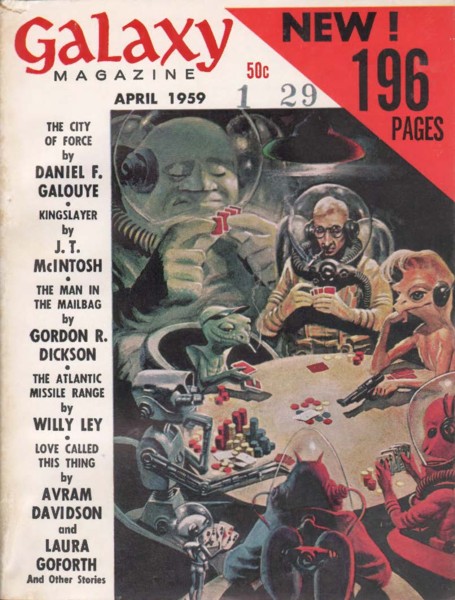
First published in the April 1959 issue of Galaxy Science Fiction. It could be because Dickson cannibalized it for a novel, but “The Man in the Mailbag” has only been reprinted three times: in The Good Old Stuff and by extension The Good Stuff (ed. Gardner Dozois), and the Dickson collection Steel Brother. These are all out of print.
Enhancing Image
John Tardy (yes, that’s his name) has been tasked with rescuing Ty Lamore, a human sociologist who’s been studying the Dilbians on their home planet and who has apparently been kidnapped by the Streamside Terror, one of said Dilbians. Humans on Dilbia have their own name, but also a Dilbian name, or rather a name the Dilbians give them: Lamore’s is Greasy Face. Tardy will get one of his own, but we’ll get to that in a bit. The Dilbians themselves are a curious race, in their customs but also how they look, being eight-to-ten-foot-all giants covered in fur, being, as I said, somewhere between a gorilla and a bear, albeit one that walks totally upright. There seems to be some disagreement with illustrators as to how gorilla- or bear-like the Dilbians are, since here Wallace Wood’s interiors paint them as akin to Bigfoot, whereas various book covers for Spacial Delivery and Spacepaw (and the omnibus collection The Right to Arm Bears) depict them as anywhere from uncannily human-like gorillas to just grizzly bears that always walk on their hind legs. The introduction for “The Man in the Mailbag” in Steel Brother says that the Dilbians were inspired by Dickson’s non-violent encounter with a bear while growing up in Alberta. Also, The Right to Arm Bears depicts the Dilbians as, well, carrying guns, but having read my fair share of this series by now I can say the Dilbians are not keen on using guns; if they resort to violence, which they do on occasion, they much prefer hand-to-hand—or rather paw-to-paw.
So, despite its length the plot is pretty straightforward, although how Tardy meets with the Terror (he’s usually just called that rather than by his full name) is a different question. Tardy, despite being an Olympian (“decathlon winner in the Olympics four years back”), is still a tiny human in a world whose dominant race is a bunch of hairy giants. The solution is for a friendly Dilbian, named the Hill Bluffer, whom we do meet again in Spacepaw, to carry Tardy in a mailbag, which is apparently big enough to carry an adult human—mind you it’s a Dilbian mailbag, and the Hill Bluffer himself is big enough that he’s able to carry Tardy with ease. Tardy has a wrist-phone (it’s basically a cell phone, although one then has to wonder how he gets cell service on a planet that’s almost entirely rural) that keeps him in touch with Joshua Guy, the human ambassador at HQ. The idea is that Tardy will rescue Lamore without having a physical confrontation with the Terror—for one because such a confrontation would almost surely result in Our Hero™ getting beaten to a pulp. Something I’ve noticed about Dickson is that for someone who gets labeled as vaguely conservative his work often comes off as anti-war, and even sympathetic to pacifism up to a point. In the stories featuring Dilbia, one of the recurring elements is the notion that it’s best for everybody to avoid violence. It’s also best to avoid making rash decisions, since the biggest points of conflict in this story are when characters made decisions that fall outside of “the plan.” There’s a female Dilbian named Boy-Is-She-Built (call me immature, but I think this name is funny) who ends up stealing Tardy’s wrist-phone, which cuts him off from HQ about halfway through the story.

The plot itself is rather minimal, I suspect so that Dickson gives himself a lot more space for worldbuilding. The Dilbians are about on par with humans and in some ways objectively superior (for one they’re physically stronger than humans on average), but they’re also a culture that’s rooted in honor and one’s own reputation, hence one’s name being assigned by an outside consensus rather than choosing your own name. There’s a Dilbian named Two Answers because he’s known for tending to come up with two answers to a problem. Joshua Guy, the ambassador, got the Dilbian name of Little Bite because of an embarrassing incident involving—well, you can guess. The Dilbians think of humans as cute, in a condescending way, calling them “Shorties,” which can rub the humans the wrong way, but mind you that the humans are here on the Dilbians’ home world and the Dilbians did not invite them. The series, while not all that serious (my big issue with “The Man in the Mailbag” [and by extension Spacial Delivery] and Spacespaw when taken together is that they’re similarly plotted), does deal with a few serious topics, namely colonialism and the clashing of cultures. When I started this story I thought maybe it would’ve fit better in Astounding than Galaxy, given its rather lighthearted and adventure-minded tone; but then it occurred to me that given how Dickson insists humans (white people) ought to treat the Dilbians’ (indigenous people’s) customs with respect, such a notion would’ve probably rubbed John W. Campbell the wrong way. The gender politics are not quite as forward-looking, as the only notable female characters, Ty Lamore and Boy-Is-She-Built, are mostly kept offscreen and are given to flights of fancy when in on the action; but still, they’re shown to be about as capable as their male counterparts.
On the one hand, even for 1959 this feels a bit old-fashioned in the sense that it harks back to an earlier era of planetary adventure SF, which only sometimes appeared in Galaxy under H. L. Gold’s editorship; but also Dickson is a decidedly more humane storyteller than some of his peers, including Poul Anderson and even Hal Clement, which from a modern perspective makes him seem like a breath of fresh air even if he’s not exactly an S-tier writer. I’ve been thinking about the good-but-not-great writer in SF a fair bit, recently, of the likes of Dickson and Simak; maybe I should write an editorial on the subject…
There Be Spoilers Here
Once Tardy finally does meet with the Terror, a court session happens, of a sort, since there’s a bit of a convoluted case of the Terror having stolen one of the “Shorties” but also Tardy having to fight for his right to rescue Lamore. If the humans had only their way then they could’ve left by this point, leaving the Terror with nothing, but that might’ve caused bigger problems by virtue of tarnishing the Terror’s reputation. A Dilbian’s honor is their livelihood. The humans, being outsiders, will have to play by the Dilbians’ rules. Tardy will have to earn his Dilbian name of Half Pint. One of the elders, named One Man, gives a short monologue near the end that proves pertinent to the situation, but it could also apply to any scenario involving a colonizing force and an indigenous population:
You just don’t come in and sit down at a man’s table and expect him to take your word for it that you’re one of the family. As I said to you once before,
who asked you Shorties to come here, anyway, in the first place? And what made you think we had to like you? What if, when you were a lad, some new kid moved into your village? He was half your size, but he had a whole lot of shiny new playthings you didn’t have, and he came up and tapped you on the shoulder and said, ‘C’mon, from now on we’ll play my sort of game!’ How’d you think you’d have felt?”
Of course, Tardy wins his fight with the Terror, through some ingenious means, and despite ostensibly being a battle to the death both men come out of it alive. The truth is that they weren’t supposed to kill each other anyway, as the mission to rescue Lamore was a big test to see if there was a human on the planet who could stand toe-to-toe with the Dilbians. There were a few hiccups, such as Tardy losing his wrist-phone, but he was not supposed to be in that much danger. See? Everybody gets a happy ending. With hindsight it’s easy to see Dickson’s view of colonial relations as being too optimistic, if anything, but he was looking in the right direction, which is more than can be said of a lot of old-timey SF.
A Step Farther Out
I was getting a bit of déjà vu reading “The Man in the Mailbag” since Spacepaw more or less follows the same plot trajectory, which I understand is not this story’s fault, although it is Dickson’s fault for reusing it. He had bills to pay, ya know. I would probably like Spacial Delivery more than its sequel, although I do have to wonder how, even given how short Spacial Delivery is, you’re supposed to make a novel out of a short story that already feels reasonably self-contained. Ah well, this has been a fun crash course in fiction from the pages of ’50s Galaxy; and incidentally the last stop on our tour foreshadows the more adventure-oriented turn the magazine would take once Frederik Pohl becomes its new editor. As to what that’s gonna look like exactly, I’ll find out in July.
See you next time.

 Science Fiction & Fantasy Remembrance