Roan’s time aboard the Warlock ends in disaster, although in fairness it wasn’t his fault. With Henry Dread, on the surface a pirate captain and in actuality an officer in the fledgling Imperial Terran Navy, now dead (by Roan’s hands) and the Warlock having gotten its ass blasted by a Niss ship’s automatic defense system, the survivors are left with Roan as their new leader. He’s not much of a “leading” type. The good news is that while the Niss ships are still about, lingering in the blackness of space, the Niss themselves seem to have gone out to lunch—via the grim reaper. The ship that destroyed the Warlock turned out to be a ghost ship: everybody, both the Niss crew and Terran captives, has long since died. Roan and his crew decide to take a diversion to Tambool, the planet where Roan was born and raised, to gather some info about Our Anti-Hero’s past. Some gaps remain in his backstory, though, and the quest to ITN HQ continues, with Roan impersonating a lieutenant who had died on the Niss ship. This move sounds smart in the short term, but will prove a problem for later.
With some deception and threats, Roan and three of his best men are taken to ITN HQ, a palace that had originally be constructed for some member of the ruling class, now the home of Terran military ghouls and their cronies. And also their slaves. Slavery is not unusual in parts of the galaxy, with some alien cultures treating it less as a means of cheap labor and more a give-and-take practice. Roan himself grew up with an alien slave who lost to Roan’s parents in battle, and thus became a sort of member of their family as dictated by his race’s customs. Commodore Quex and his buddies of the ITN are a lot less caring with their slaves, however, murdering them on sight if they become even so much as a slight inconvenience. Terrans, even though none of them be “purely” human, clearly look down on Gooks and especially Geeks as akin to dogs and horses. Maybe even less. So it’s hard to feel bad when, in the midst of a tense and violent dinner part, Roan kills Quex, even if he does give him an “honorable” death. With this violence, it looks like Roan’s time in the ITN will be short.
Enhancing Image
We finally get answers to the two biggest questions that have been haunting this novel, namely what the Niss have been doing this whole time and what has become of Earth, Roan’s ancestral homeworld. The answers are both interconnected and anticlimactic, maybe by design. It’s true that the Niss formed a blockade around Earth and supplanted the Terrans as the top dog in known space, but that was literally thousands of years ago. We have never seen a Niss prior to this final installment, and when we do finally meet one he is weak and at death’s door, with everyone else already dead. Having replaced humanity as rulers of the galaxy, the Niss apparently diluded themselves over time, to the point of a slow extinction; nowadays they’re treated as a myth, something to be talked about rather than seen. With the highest goals of galactic conquest achieved eons ago, the Niss, having found no greater cause in life, opted for a slow death. Humanity still exists on Earth, it turns out, maybe being better off than their former conquerors; but this too, came with its own price. As with the ITN ghouls, the people on Earth have at least partly fallen to decadence, with there being an “Upper” and “Lower” society. They also have their own form of slavery, keeping mutated “dogs” (which really are more like large and intelligent monkeys, or very hairy humans) as their servants. Like real-world dogs, these “dogs” are loyal to their masters; they enjoy being slaves. This is a fact that disturbs Roan, since, to paraphrase him, at least slaves in alien cultures knew enough to loathe their positions in life. This all feels very wrong.
The final quarter of Earthblood, in which Roan and two of his men (Poion having died in the interim) are on Earth, could’ve justified being a novel on its own, and maybe it should’ve been a novel. Something I’ve mentioned before in passing but which needs reiterating here is that Earthblood is fast as fuck; it’s one of the most lightning-quick SF novels I’ve read in a while, which is sometimes to its detriment. The pacing becomes almost manic at times, with how much Laumer and Brown try to fit in here. The Terran culture Roan comes quickly to hate is layered, in some ways disturbing, and yet we’re not given that much time with it. There are a few new characters introduced in this last stretch of the book, maybe the most memorable of them being Daryl, who serves as Roan’s (and by extension the reader’s) guide to how things work. Daryl is old enough to have birthed a daughter who herself at least appears to be an adult, and yet he’s youthful and rather feminine in appearance. He’s also, not very subtly, a queer man almost of the drag show variety. I’m not sure if Daryl’s effeminate nature and attempts to flirt with Roan are indicative of the authors’ homophobia, because truth be told he’s no worse than some of the human characters we’d met before, but it’s certainly hard to ignore. Speaking of ambiguous queerness, we also have Sostelle, the “dog” who accompanies Roan for much of his stay, who despite having a feminine-sounding name is supposedly male, and who also comes to have a submissive relationship with him. These are things the novel never elaborates on, because it’s already so fast and so much is happening that for better or worse we can’t dwell on them.
The good news is that the Niss blockade is no longer an issue for Earth interacting with the rest of known space, but the people on Earth aren’t even aware the blockade had ended a long time ago, due to humanity having become degraded and small-minded. Typically in an old-timey SF novel with this kind of plot, Roan would support the rebuilding of the Terran empire, but not only has he since given up on that, having hared his short time spent with the ITN, but he loves the rather large number of intelligent alien races in the galaxy too much to let mankind put the lot into servitude. He’s still a tough and murderous son of a bitch, but he does in fact have some morals, which Daryl and those like him run afoul of. There’s an unnerving scene in which a dancer named Desiranne, who reminds Roan of Stellaraire, tries to commit ritual suicide as the grand finale of her performance for him—an act she had been trained and even raised to carry out. She almost succeeds. Roan’s one-man rebellion against decadent Earth society is totally justified, if we’re being honest, and it feels earned because the whole novel had been building to this moment. The Terra Roan hoped to find wasn’t there after all; instead, it’s something he and the others will have to build themselves. You could say a kind of cultural revolution is needed, to break down the old way of living and create something new.
A Step Farther Out
I decided to read a couple contemporary reviews of Earthblood, including Algis Budrys’s review in Galaxy, who makes the connection that Laumer and Brown had probably taken inspiration from Robert Heinlein and L. Ron Hubbard. More specifically the brutality and paranoia of Earthblood remind me of Hubbard’s short novel To the Stars, one of the most brutal (and xenophobic—it is Hubbard, after all) SF stories I’ve ever read. I do mean that as a compliment, by the way. What Earthblood lacks in elegance, having a rather shoddy structure that makes it seem like Laumer and Brown wrote it with serialization in mind, it makes up for in a kind of “wow” factor. Like damn, I did not think an SF novel from the ’60s could be this grimy. At the same time it has more of a humanist angle than Heinlein or Hubbard, or at least it’s not as racist or sexist as it could’ve been. I recommend it as a rough but entertaining one-off, the kind of adventure novel that was soon to become outdated thanks to the New Wave. It is, as Baird Searles says in his review of the novel for Asimov’s, a relic from “the tail end of this jolly era” that included such pulpy SF.
Now it’s time for an unusual team-up, between two writers who wrote for the same magazines and at the same time, but who otherwise seemed to have little in common. Laumer was from New York (although not NYC} and had a respectable military career, which he retired from to focus on writing. He bought a tiny island in Florida where he could do his work in peace. He made his SF debut in 1959 and spent the next decade or so growing a following with a mix of standalones and a couple series, most famously the episodic Retief series. Laumer was a pioneer of military SF, although that label wouldn’t become “a thing” until later. Unfortunately, Laumer suffered a stroke in 1971, at just 46, which left him unable to write for a time; and when he did return to writing, his work was not of the quality or consistency of his pre-stroke output. It’s hard to blame him for this: such a calamity would’ve ended a lot of authors’ careers. Laumer died in 1993, at a reasonably old age, but it’s his work in the ’60s that’s most remembered, though he’s somewhat obscure now.
Rosel George Brown was from New Orleans, and as far as I can tell she mostly stayed in Louisiana for the rest of her life. She had earned a Master’s in Greek, and did work as a teacher while being married to a college professor, so it’s fair to say she was a highly learned woman. She, like Laumer, made her SF debut in 1959, although she wrote only a few novels and not that many short stories. She may have done more, had she not died from lymphoma at the tragically young age of 41, just one year after Earthblood was published. Despite the small output, Brown was one of the best writers to come about during those awkward years between the end of the ’50s SF boom and the New Wave era.
Placing Coordinates
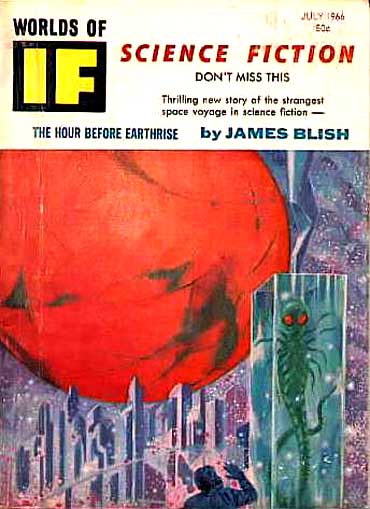
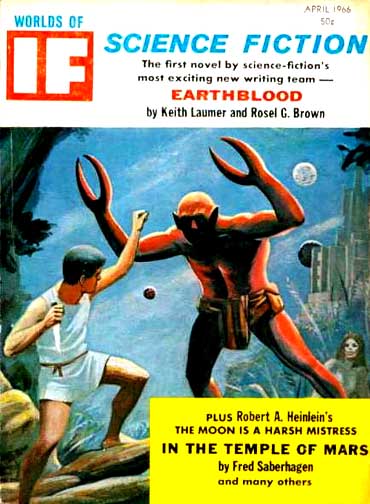
Serialized in If, April to July 1966. It was published in hardcover by Doubleday later that year. It’s been reprinted on occasion, but the best way to find it now would be the Baen omnibus Earthblood and Other Stories, which comes bundled with stories by Laumer and Brown each writing solo. Why they felt the need to bundle it I’m not sure, given it’s a longish novel by the standards of ’60s SF.
Enhancing Image
Earthblood reads in part like one of Robert Heinlein’s adventure-oriented ’50s novels, with the beginning seeming to pay homage to the memorable start of Citizen of the Galaxy. Raff and his wife Bella are looking to buy a human child, or rather a human embryo. Pure Terran. Raff is a mutant while Bella is a humanoid alien. This is a future in which there was once a human galactic empire, but the empire has long since crumbled, leaving little in the way of pureblood humans. However, mankind was prolific, and there being quite a few humanoid alien races, there are many mixed-race humanoids to be found. But like I said, pure Terrans without mutations are rare, so such an embryo would be expensive. Raff and Bella end up having to sell their passports to afford an embryo that was originally meant for “the Shah,” which makes me think this is a timeline where the Iranian revolution never happened. Now both poor and stranded on some backwater planet, the couple at least have their human boy to raise, although even then their troubles aren’t over. They’re attacked one day by a small gang of Yill, a race with a penchant for viciousness. Raff is wounded in the encounter to the point of being crippled, but since the couple technically win, by Yill custom they take in a survivor as a servant.
The embryo becomes a baby and the baby become a boy, named Roan, who in his childhood lives apart from mankind. He has his parents, the servant I mentioned, and some birdlike intelligent aliens called the gracyl. His first friend is a gracyl named Clanth, although sadly this friendship will not last too long. The gracyl are prone to cowardness, which is understandable given they’re physically weak and rather small in size. It’s clear (at least from the authors’ point of view) that Roan is meant for bigger and better things. A big part of Roan’s character arc, indeed what gets him started on his quest from a young age, is the notion that humans are in some way inherently superior to other intelligent races—that once upon a time, humanity ruled the whole known galaxy. Roan is a descendant, in biology if not exact bloodline, of rulers. (The sentiment of human supremacy is not helped in its unsavory implications by Roan being vaguely white, even being drawn as your typical square-jawed hero in the interiors.) The conflict is that he grows up in a world (or worlds) where friends are few and most people are either looking to take advantage of him or kill him outright. This is made apparent early on when he survives an attack by a predatory race called the Veed, which leaves several gracyl dead, including Clanth. It’ll be a hot minute before Roan befriends another living soul. His life, from then until the time he reaches adulthood, is an unhappy one.
Implicit racism aside, a quibble I have with this first installment is that we don’t get to spend much time with any one of the races, and there are a handful introduced here. The no-nonsense pacing is for the most part a positive, but it does leave characters who are not Roan on the side of underdeveloped. Granted, we’re only a quarter into the novel. It does seem like we gloss over the time between Roan as a young boy and when he decides to join the circus—and by “decide,” I mean he’s forced into it. He’s captured by a bipedal lobster-like alien named Ithc, but wounds one of Ithc’s hands (or claws) in the process. Gom Bulj, the owner of the “Extravaganzoo,” is mad at Roan for injuring one of his performers, but he makes a deal with Roan that the young man can’t refuse. Pure Terrans are a novelty, and years of living on a rough-and-tumble planet made Roan physically strong and agile. He’ll make a good high-wire performer—or else. Ithc is the villain of this first installment, being Roan’s nemesis, and as you can see with the front cover, their fight is one worth illustrating. Despite being a young adult, Roan has the vocabulary and stubbornness of a five-year-old, which seems to come from the lack of a proper education. He’s immature for his age, which doesn’t stop him from being both a capable fighter and clever in his own way. It also doesn’t stop him from getting a girlfriend, although it’s unclear how romantic their relationship is.
Up to this point Roan made it clear he wanted a romantic companion of his own, but he specifically wanted a human woman, or at least a humanoid alien who appears human enough. Maybe he is a bit of a racist. In Roan’s defense, the circumstances of his upbringing make it so that he has only an idea of what a human woman is like. In the first installment of Earthblood there’s the implicit question of nature versus nurture. The idea is that Roan’s “pure” genetics destine him for greatness, assuming he doesn’t get killed first, but his upbringing in a tough environment by a mixed-race couple who gave up their wealth to raise him means he has something of the scoundrel in him. He’s basically Tarzan IN SPAAAAAAACE, or to make another comparison, he’s like Superman. He was meant to be heir to royalty but ended up in the hands of loving but impoverished parents. Enter Stellaraire, a dancer and fellow “freak” at the circus, who appears human enough to Roan’s liking. Having never been involved with a woman like this before, Roan is curious rather than violently misogynistic like how you might expect—a curiosity Stella is happy to indulge. Something unusual for magazine SF of the time, at least in the US (New Worlds was spicing things up in the UK), is the unequivocal sexual component of Roan and Stella’s bond. One of the first things they do together is Stella teaching Roan how to bathe like a civilized person, involving the shedding of clothes.
There Be Spoilers
Roan discovers before he’s even taken on as a member of the crew that the Extravaganzoo is about as cutthroat as life on the outside, not least because he has to play nice with Ithc. Understandably the two hate each other. The only friends Roan is able to make are Stella and a gentle giant by the name of Iron Robert (well, he came up with the “Iron” part). Shit finally comes to a head when Roan finds Ithc torturing Stella after a show, the torture itself a kind of exhibition, and decides to take matters into his own hands—quite literally. The climax of the first installment is the bloodiest part, with Roan beating Ithc to a pulp, breaking his limbs and choking him before putting the asshole out of his misery. Roan can avoid the short-term consequences of killing a fellow performer, on account of the spectators promising to not rat out on him, but this still raises the question as to how he’s supposed to survive here, and if there’s even a way out. Presumably there is, because I can’t imagine the rest of the novel taking place at the circus. Roan is meant for bigger and better things than this.
A Step Farther Out
It’s problematic and a bit sleazy, but I’m also interested in where Earthblood goes from here. Of course, the mild sleaziness is a breath of fresh air for pre-New Wave SF. There’s sexuality, a good deal of violence, and even some mild swearing (wow). The Heinlein influence is apparent, but then Heinlein had just stopped writing novels of this sort. Also, I think it’s worth mentioning, and it’s probably because of Brown’s contributions (I’m unsure of Laumer’s skill with writing women), but this is not nearly as creepy or misogynistic as Heinlein in writing-for-adults mode. There are other issues, namely regarding race, but I’m willing to see the novel’s treatment of race (or speciesism, rather) unfold over the coming installments.
I know I’ve read at least one Keith Laumer story before, because he appeared in Dangerous Visions, but I could not tell you what “Test to Destruction” is about at all from memory. Laumer is one of those authors who is surprisingly easy to avoid, or rather to miss, considering how prolific he was in the ’60s. He made his debut in 1959, and spent the next decade or so writing at a feverish pace with a few series under his belt, most notably the episodic Retief series. I almost picked a Retief story for today, but it seems like that series was more associated with If in the ’60s; as such as we have a totally standalone story with “The Body Builders.” Laumer suffered a stroke in 1971, which put him off writing for a few years, and when he did return, he was not the same writer he once was, in both quality and quantity. This dip in quality is understandable, since even a minor stroke requires physical therapy to recover from, and for many authors the same incident would’ve outright meant the end of their careers. Laumer was also one of the pioneering voices of military SF, which makes sense given his military background. “The Body Builders” is a very curious story that I wish I liked more, not least because of how prescient it is.
Placing Coordinates
First published in the August 1966 issue of Galaxy Science Fiction. It’s been reprinted a fair number of times, including The Infinite Arena: Seven Science Fiction Stories About Sports (ed. Terry Carr) and the Laumer collections The Best of Keith Laumer and Keith Laumer: The Lighter Side.
Enhancing Image
Barney Ramm is our narrator as well as our guide to this strange new world, where it has become normal to all but give up one’s physical body in exchange for a more physically attractive robotic surrogate—provided one has the money for certain cosmetics. People’s bodies are kept in “the Files,” hooked up to tubes and physically trained unconsciously just enough so that they won’t be totally emaciated bags of bones. Laumer does not leave us to speculate as to how we got to such a future, because Ramm pretty much tells us outright what the deal is:
Our grandparents found out it was a lot safer and easier to sit in front of the TV screen with feely and smelly attachments than to be out bumping heads with a crowd. It wasn’t long after that that they developed the contact screens to fit your eyeballs, and the plug-in audio, so you began to get the real feel of audience participation. Then, with the big improvements in miniaturization and the new tight-channel transmitters, you could have your own private man-on-the-street pickup. It could roam, seeing the sights, while you racked out on the sofa.
One of the cultural landmarks that separated the ’50s from the ’40s was the rise of commercially viable TV, so that you too could have a TV set in the comfort of your living room. If you were rich then you might’ve even been able to buy two TV sets. Wow. Imagine the possibilities. By the end of the ’50s the TV had become a commonplace household item, at least for those with middle-class incomes or better, and by 1965 (about when Laumer would’ve written this story), TV in color was becoming the new norm. A sharper and more vivid image, closer to real life, or rather the real thing. People living vicariously through their TV sets was apparently on Laumer’s shit list, because he doesn’t even try to hide his fist-shaking sentiments at the medium. On the one hand this could’ve been trite and a little too cranky if done improperly, but to Laumer’s credit it’s how he extrapolates on the proliferation of TV that makes “The Body Builders” worth reading. People tend to walk around in lifelike android bodies that seem to be modeled after movie actors, or at least this is the case with some of them. There’s a John Wayne robot, and Lorena, Ramm’s date at the beginning, is also made to look like Marlene Dietrich.
Now you may be thinking to yourself: this sounds a bit like cyberpunk. And it does, about fifteen years in advance. Ramm being a first-person narrator makes the exposition-dumping more awkward than it should’ve been, in that it does hamper the story somewhat, but Ramm being a “light-heavy champ in the armed singles” (he’s basically a boxer, although it turns out to not be boxing quite as recognize it) with a detective’s intuition and an ear for slang lends the narrative voice a noir feel that would later also become a trope associated with cyberpunk. Of course, classic cyberpunk takes a lot of inspiration from old-school crime fiction a la Raymond Chandler, so this is a case of “The Body Builders” and the subgenre it anticipated both drinking from the same well. Cyberpunk became a codified subgenre by the mid-’80s, but there are quite a few examples of SF that predate it, including but not limited to Fritz Leiber’s “Coming Attraction,” Richard Matheson’s “Steel,” Samuel R. Delany’s Nova, and of course Philip K. Dick’s Do Androids Dream of Electric Sheep? Speaking of the Matheson story, I have a hunch that Laumer looked to “Steel” as an influence, or perhaps more likely he was thinking of the Twilight Zone adaptation, which would’ve been more recent when he wrote “The Body Builders.”
This all sounds great, but it’s in service of rather clunky storytelling. There’s really no room for environmental or passive worldbuilding here, since Ramm yaps in Expositionese and tells us upfront about every detail of this world that’s relative to the plot. For the most part Laumer chooses to tell rather than show, which hurts one’s attempts at getting immersed in what should be a memorable and somewhat dystopian future. It doesn’t help that the plot is really basic when you get down to it: Ramm gets ambushed into having an impromptu fight when he’s in the wrong robot body for it, with someone clearly having it out for him. He has, I think two girlfriends? There’s the aforementioned Lorena, who’s shown to be vain and high-class, and then there’s Julie, who believes the “Orggies” are an abomination. Can you guess which one he ends up with ultimately? I’m generally not a fan of how snarky and reliant on slang these characters are; if we’re to be invested in Ramm having his revenge then Laumer should’ve tried to conceive a more likable protagonist first. Despite being nearly thirty magazine pages, the tell-don’t-show method combined with the simplistic plot trajectory result in a story that feels undercooked somehow.
There Be Spoilers Here
If you’ve read “Steel” (and I’ve written about it twice now), then you may remember the ending, which is more or less ambiguous in its tone. Are we are supposed to take this as a victory or a defeat? What is to become of Our Hero™ after he has literally broken a few bones in the name of recapturing the glory days? No such ambiguity in “The Body Builders.” After having deliberately sabotages his robot body, Ramm winds up in his real body, in the Files, nearly dying “for real” in the process. I will say, this is a very good scene, when Ramm “wakes up.” It’s like that scene in The Matrix where Neo wakes up from the virtual world to find himself as a scrawny bald dude, with a big tube shoved down his throat and in what almost resembles a bee hive. It’s a great image, and in the case of “The Body Builders” it’s one of the few moments where Laumer’s craftsmanship really shines through. Of course, despite being a scrawny dude who does not resemble the prize fighter he often lives as, Ramm is still able to win the day by virtue of taking advantage of the fact that Orggies are designed to take on other Orggies—that is to say robots, as opposed to humans. This is Laumer’s way of telling you that you should turn the TV off and go for a jog or something. I know, it’s ironic that I’m instead typing this out, sitting in my comfy office chair in my air-conditioned apartment whose rent I can barely afford. To think when this story was written we didn’t have the internet, or even at-home video games. Laumer had a fine imagination, but he really could not have anticipated what the future would bring.
A Step Farther Out
I like thinking about “The Body Builders,” but I wish it was better as a story. Laumer is perhaps a decent writer who in this case punches above his weight class (sorry for the pun). This same premise and even broad plot structure may have worked better in the hands of someone like Philip K. Dick or Robert Sheckley, but in Laumer’s it lacks the sheer momentum as well as narrative fluidity to be compelling from start to finish. I do somewhat recommend checking it out, though, especially if you wanna read more examples of proto-cyberpunk.
Despite living to quite an old age, Sonya Dorman only wrote a couple dozen SF stories, probably because she was more a poet than a writer of short fiction. She appeared in the pre-New Wave ’60s when she was pushing forty, so for those of you who are unsure about trying your luck as a writer at such-and-such an age, don’t be. She was one of the few women to appear in Dangerous Visions, with the story “Go, Go, Go, Said the Bird,” although by far her most reprinted story is “When I Was Miss Dow.” Now, I have read “When I Was Miss Dow” before, and I know I have because it’s in one of the below-mentioned anthologies I’ve read from cover to cover; but if you pointed a gun to my head and told me to recap the plot of this story prior to rereading it, you would have blood on your hands. I was originally gonna review a different Dorman story, “Journey,” but upon reading it one-and-a-half times I found a problem: I had basically nothing to say about it. On the other hand, a reread of “When I Was Miss Dow” was certainly in order, and given that a decent amount has been written about it already, I figured I should throw my hat into the ring. Why not.
Placing Coordinates
First published in the June 1966 issue of Galaxy Science Fiction. It has been reprinted in Nebula Award Stories Number Two (ed. Brian Aldiss and Harry Harrison), SF 12 (ed. Judith Merril), Women of Wonder (ed. Pamela Sargent), The Norton Book of Science Fiction: North American Science Fiction, 1960-1990 (ed. Brian Attebery and Ursula K. Le Guin), and The Future Is Female!: 25 Classic Science Fiction Stories by Women, From Pulp Pioneers to Ursula K. Le Guin (ed. Lisa Yaszek).
Enhancing Image
When I read “Journey” I found myself stuck between a rock and a hard place for a couple days because, frankly, I didn’t know what I could say about it that would justify a whole review around it. Thankfully “When I Was Miss Dow” does not have this issue, being a brief but compact and multifaceted short story that has a few layers to it; that it came pretty close to getting a Nebula nomination is understandable, and actually given that only three stories made the cut that year (not sure why there were so few nominees), some extra space certainly could’ve been made for it. What is the plot, then? Humans have come to some remote planet to form a colony, encountering a sentient race that already lives there—the problem being that said race is a bunch of blobs, single-sexed (apparently all male), and also single-lobed, which is a strange detail. The narrator, who does not have a name, is a young scholar among his people who is given an assignment by his Uncle (with a capital U) and the “Warden of Mines and Seeds” to go undercover as a human woman by the name of Martha Dow. These blobs are not only quite intelligent but also Protean, able to morph into just about any shape one can imagine, which includes mimicking not only the look but even the internal organs of a human being. As Martha Dow the narrator is to work as an assistant to Dr. Arnold Proctor, a gruff middle-aged man and the human colony’s lead biologist. This is the narrator’s first time mimicking a human, which means first time mimicking the human brain’s two lobes. I’m sure that nothing dramatic will happen here.
For being present in only one short story which itself only runs about a dozen pages, the aliens in “When I Was Miss Dow” are lovingly realized. There are few cases, even during the New Wave ’60s, of alien races which are about as intelligent as humans and yet decidedly not humanoid, yet Dorman’s aliens are of a rare sort. Within those dozen pages we’re enlightened as to where they live, how they live, how they reproduce (or rather, how they do not), what social relations they have, what they do for leisure, and of course, how they think. The narrator, who henceforth I’ll refer to as Dow, is used to taking on the likenesses of others, but there’s something very different about this assignment, as it takes little time for the narrator and Dow’s personalities to start merging. This is obviously a story about gender and identity, which for SF in 1966 is actually a novelty; not that it was the first to ever explore these issues from an implicitly feminist perspective, but that its observations on gender and its relationship with one’s self-perception still read as true to the human condition. A lot of stories from the era, and indeed for a while after, that explore gender do so in ways that now read as dated, be it in ways that are misogynistic and/or transphobic. “When I Was Miss Dow” basically doesn’t have this issue. The narrator’s identity crisis is implied to sprout from mimicking Martha Dow’s second lobe, in which the two personalities have a silent tug-of-war match, but other than that the crisis comes down to psychology rather than biology. The biological essentialism that much old-school genderqueer fiction runs into is more or less absent here, as this is ultimately a character study about a “he” who finds that he may not be strictly a “he” after all, but perhaps genderfluid. By using a Protean alien as her case study, Dorman seems to be arguing that gender itself is Protean, in that it is not necessarily fixed in place.
Let’s talk about sexual orientation. Since the aliens seem to reproduce asexually, they aren’t heterosexual or homosexual (or even bisexual) by default, but instead their orientation seems to be influenced by the biological makeup of the beings they mimic. (This is mostly just speculation on my part, so don’t take my word for it.) Dow makes no mention of finding anyone of any sexuality attractive beforehand, but once they meet Dr. Proctor they become smitten with him rather quickly—an attraction that Dr. Proctor is about as quick to reciprocate. Dow, outside of the Martha Dow personality, is male, yet takes on the form of a human woman. Does Dow-the-alien, who is male, find Proctor attractive, or is that more the work of Dow-the-human? It would be hard to argue that this is not in some way a queer romance, although Proctor is blissfully unaware that the woman he’s become smitten with is actually a slimy alien in disguise. Dow themself is unsure about which side of their brain has more power, yet funnily enough they do not question if their attraction to Proctor would be considered gay or straight, or even if it’s taboo somehow. The real problem is that Dow doesn’t know how much control they have over themself, even down to their own thoughts. “I’m suffering from eclipses: one goes dark, the other lights up, that one goes dark, the other goes nova.” I should probably also mention that the prose here is stylish without becoming overbearing, such that it makes sense that Dow normally works as a scholar. There’s a sense of controlled expertise with the English language, which also makes sense since, as you may recall, Dorman seemed to think of herself as more of a poet. There’s a poet’s sensibility about “When I Was Miss Dow” that, unusually for the New Wave era, is balanced by a genuinely compelling narrative.
I do have a couple quibbles, because there is no such thing as a perfect story. (Just to prove my point, Herman Melville’s “Bartleby, the Scrivener” is pretty close to a perfect short story, although I always felt like that last scene at the very end was unnecessary.) For one, it’s awfully convenient that the planet the humans have landed on is pretty Earth-like, and also that the aliens have no issue learning human language. There’s an indigenous animal called a koota that may as well be somewhere between a dog and a horse; we’re only given scant descriptions of it, and I must confess I didn’t find the relationship Dow has with their aging koota to be that compelling. Dorman is of course drawing a parallel between the old koota’s fixed biology and Dow’s ability to shapeshift, along with the fact that Proctor himself is visibly aging; it’s not a subtle parallel, in a story that otherwise thrives on subtlety. I’m also not sure about Proctor having a relationship with Dow, since despite Dow called him a man of “perfect integrity” I’m pretty sure it would be considered sexual harassment (or at least morally dubious) for someone in Proctor’s position to have a romantic/sexual relationship with his assistant. The Warden gives Dow shit over the relationship, but more because of the lack of professionalism on Dow’s part than anything. I gotta tell ya, work culture has changed over the past sixty years.
There Be Spoilers Here
As Dow and Proctor’s relationship progresses, and as the latter teaches the former more about how to live as a human (although he isn’t aware of this), Dow becomes more detached from their original personality. The Martha Dow personality has taken such a strong hold that the narrator feels they might not ever be able to go back. They have long since taken to called Proctor “Arnie” rather than his last or even his first name. They like things as they are a little too much. “If I’m damaged or dead, you’ll put me into the cell banks, and you’ll be amazed, astonished, terrified, to discover that I come out complete, all Martha. I can’t be changed.” Of course, everything has to come to an end. Proctor dies one night, apparently from a heart attack. Natural causes. These things happen. Dow’s way of life is over. She tried bargaining for Proctor to be somehow resurrected with the aliens’ pattern-making chambers, but it’s not possible, and anyway even if it was the higher-ups wouldn’t approve of it. The Warden, who was due for “conjunction” (the aliens’ cycle of death and rebirth) anyway, “dies” and comes out a nephew. At the end, after everything that could be done had been, the narrator reflects that every lifeform, from the humans to the kootas to their own race, has such a cycle of death and rebirth. The narrator lets go of the Dow personality and reverts to their original state, but it’s ambiguous if they’ve totally shaken off what had been, if only temporarily, part of themself. As they say, “I’m becoming somber, and a brilliant student.” What they feel at the end could be considered gender dysphoria, with the reverting to their original state as being analogous to detransitioning. The sad part is that if we are really meant to take the narrator letting go of the Martha identity as detransitioning, then it was clearly a choice not made of their own volition; if they could they would probably stay in that form forever. Martha Dow was a part of them, but they couldn’t keep her.
A Step Farther Out
I didn’t like “Journey” very much partly because I felt like it didn’t give me much to chew on, but also I don’t think it worked as science fiction. Good SF, or at least what Theodore Sturgeon considered good SF (and Sturgeon, like Dorman, had a poet’s gentleness), should present an SFnal problem with a human solution. “Journey” could just as easily have been written as a Western (although the market for literary Westerns basically did not exist in the ’70s), but “When I Was Miss Dow” cannot work as anything other than science fiction. It has some big ideas but is also prone to introspection. It’s, simply put, one of the best SF short stories of the ’60s, and unlike some other favorites of mine from that era I don’t feel the need to put a “this is a bit problematic or outdated” asterisk next to it. I don’t know why it just went in one ear and out the other for me the first time I read it, that was my bad. Please check this one out.
In the latter half of the ’60s there were basically two factions among genre SF writers: the New Wavers and the old school. Lines were drawn along literary but also political lines, although it was by no means a clean split, since while the New Wave was considered generally left-wing there were a few notable right-wing New Wavers, including Gene Wolfe and R. A. Lafferty. But the old school was for the most part steadfastly right-wing, including among those who were actually not old enough to have been part of the “old” school. One of the best and brightest of these new recruits to the anti-New Wave side was Larry Niven, who is still very much alive and who had made his debut in 1964, being one of Frederik Pohl’s biggest discoveries. At a time when hard SF ran the risk of becoming irrelevant (Analog was easily the most anti-New Wave magazine, and while its sales numbers were good it was also the least relevant of the big SF magazines in the late ’60s.), Niven emerged and made it seem cool again. Early Niven was snappy, wondrous, had a knack for concocting strange alien beings and cultures, and was not afraid to mix and match different genres. “The Organleggers” is an SF-mystery hybrid, and the first entry in a series starring the ARM detective Gil Hamilton. Niven, who would’ve been barely out of his twenties at the time, gave himself the challenge of writing a compelling SF mystery that would work as both science fiction and a mystery.
Placing Coordinates
First published in the January 1969 issue of Galaxy Science Fiction. It would be titled “Death by Ecstasy” thereafter. For reprints we have World’s Best Science Fiction: 1970 (ed. Terry Carr and Donald Wollheim), Supermen (ed. Isaac Asimov, Martin H. Greenberg, and Charles G. Waugh), and several Niven collections, the most pertinent of these being The Long ARM of Gil Hamilton.
Enhancing Image
Gil Hamilton has been called in to investigate an unusual death—not as a detective, but as the deceased’s next of kin. He finds Owen Jennison in his apartment, sitting in his armchair, grinning, and very much dead. Starved to death. Jennison must have been in his apartment by himself for weeks, starving to death and smiling the whole time. Hamilton and Jennison are old friends; they used to be asteroid miners together, which, says Hamilton, would make two men about as close to each other as one can get while still being platonic. In a rather proto-cyberpunk move for the time, Jennison has an implant in his skull, that would explain the uncanny grin: at least in the last weeks of his life he’d become a “current” addict, which is to say the pleasure centers of his brain would’ve been stimulated until he couldn’t think straight, indeed couldn’t really do anything else. Some people get addicted to drugs or drinking (or, shit, you could get addicted to just about anything under the right circumstances), but in the year 2123 there are also those get a “droud,” a cylinder implanted in their skull that gets them addicted to current. The rule of thumb is that current addicts have only themselves to blame since they can’t get a droud installed without being aware of the inevitability of addiction. They become like zombies, that is to say barely functional human beings. But they asked for it. Addiction is what you’re signing up for. At the same time none of this sits right with Hamilton. Why would Jennison choose to end his own life in such a way? It’s strange, and very drawn out, although in fairness it would not have been painful from Jennison’s point of view.
So something fishy is going on, and there we have our mystery. Either Jennison killed himself (Hamilton sees this as unlikely), or someone had gotten him addicted to current and hooked him up such that he could not escape. Unsurprisingly somebody wanted Jennison dead. There are a few factors that make this case a science-fictional one, that both make Hamilton’s job easier and hinder him. Had this been a normal mystery set on the Earth of today it would’ve been half the length, but Niven spends a good deal of time establishing both Hamilton’s backstory and the world in which he works, because this is not the Earth of today. It’s here that I should bring up the issue of organlegging, since it forms the crux of the mystery. For reasons I don’t really understand Niven seemed to have a hyperfixation on organ transplants at this time, since as how he had just written another story about this topic, “The Jigsaw Man,” for Dangerous Visions. The first successful heart transplant happened in December 1967, several months after Dangerous Visions was published, and Niven probably wrote “The Organleggers” around the same time. He seemed to be concerned with the practical issue of where to get these organs, of how much demand there might be and who would be able to meet such a demand. In the world of “The Organleggers” demand has risen to what I have to admit sounds like a ludicrous degree, with people requesting organ transplants even when they don’t need them—often just wanting younger organs for themselves, presumably so they can live longer. The government’s response to this is to make the death penalty a sentence for rather minor offenses, so that you have more criminals whose organs can be harvested. Yet this is still not enough, as there’s also a fruitful black market for illicit organ-harvesting.
There’s quite a bit to unpack with the political implications of the world Niven has set up, not least because Niven himself is a conservative. I suspect he gave up on the Gil Hamilton series by the early ’80s because it must’ve become clear to him that the future he depicted, in which human life is valued based on the condition of one’s organs and that people would be scrambling to get organ transplants, did not and would not come to pass. I mean, that’s good news for real-world people, but I can see how that would knock the wind out of one’s sails as an SF writer. (Of course that doesn’t stop right-wing nutjobs from coming up with conspiracy theories about how Planned Parenthood harvests the body parts of aborted fetuses for some black market, or what have you.) So conditions are a bit dystopian. So what? Our conditions are about as dystopian. The right to own property and capital are held to a higher priority than, say, having breathable air. This is all complicated by Niven probably supporting some form of the death penalty, which is strange to me because, given Niven’s right-libertarian sentiments, the government being able to murder basically whoever it wants strikes me as very not libertarian. But, it’s not all bad. Psi powers have become somewhat commonplace, to the point where Hamlton and Julie, his connection to ARM HQ, have them, Hamilton having a limited but very useful telekensis while Julie is a wide-ranging telepath. Niven is funny about ESP; he seems to think it’s the cat’s meow. One of the small ironies of old-timey SF is that Niven never appeared in Campbell’s Analog, despite at least theoretically the two being perfect for each other. Apparently the reason Niven did not appear in Analog until after Campbell’s death is that the two just didn’t get along on a personal level, which is funny to me. So, ARM is an acronym, and it’s kind of a forced joke on Niven’s part because it also refers to Hamilton’s invisible third arm, which is telekinetic.
Niven gave himself the challenge of writing a murder mystery that could not be done in a realistic setting, and I do think he more or less succeeded, albeit with the caveat that at least with “The Organleggers,” the mystery itself is the least interesting part of the equation. This is a problem SF mysteries have had at least since the time of Asimov’s The Caves of Steel, where similarly the set-up and resolution of the mystery are the weakest links of that novel. Writing a good SF story and writing a good mystery are two different skills, and while there have been authors who were able to do both, they usually did so by writing the two genres totally separately. You may have noticed that up to this point I’ve mostly neglected to get into the actual plot of “The Organleggers,” and that’s partly because there isn’t as much of a plot in the strict sense as you would expect out of a novella, but also I have to confess I’ve been horribly depressed these past few days. I had a respiratory infection for about a week, which would’ve lasted longer had I not been proactive in seeing a doctor and getting prescriptions for it; but then, once I started to emerge from my sickness-and-meds-induced haze, I found that I’ve become even more susceptible to “the humors” than usual, which is saying a lot. I really had to coax myself into writing this review, which I wasn’t even sure I could hand in by the deadline (today) at first. The words simply would not come to me for a while. Even the experience of reading Niven’s story now feels to me like a haze, although that really couldn’t be pinned on the story, since I’ve been reading a lot recently and yet I’ve been getting little to no pleasure out of anything. Barely anything feels good to me at the moment. A dark cloud has been hanging over me.
So I’m sorry that this is not quite the review you were hoping for. In all fairness, even without the depression, I still would’ve focused more on the world-building than the plot, since I believe that’s what Niven gave priority, and anyway he does a pretty good job of it. I can poke fun at his politics, and if I really wanted to I could poke holes in the gender implications of this story (I mentioned Julie earlier, but she’s off-screen the whole time and otherwise it’s a bit of a sausage fest), or how it doesn’t hold up when taken as predictive; but science fiction doesn’t exist to be predictive. What matters most is that Niven, especially early in his career, had a formidable imagination, such that he could make things that are totally implausible when one steps back and thinks about them (his Known Space stories have quite a few goofy ideas, but they’re still “hard SF”) seem likely, or even inevitable. It’s a talent most SF writers don’t have. It helps also that Hamilton, while being a somewhat morally grey agent for the UN (ARM is a UN organization, not part of the US), fits the bill of the smooth-talking noir detective. Had Raymond Chandler lived long enough and tried his luck at writing SF he could’ve conceivably come up with the Gil Hamilton series. It’s a shame Niven has spent much of his career up to this point complaining about liberals and environmentalists.
There Be Spoilers Here
See the above.
A Step Farther Out
I could have gone into this with skewed expectations, for one because I had already read a later entry in the series, “ARM,” which I do think is stronger, namely for its heavier reliance on worldbuilding and its less obvious conclusion. There’s also the aforementioned problem of my depression, which has decided to creep more thoroughly into my life in the past couple days, for seemingly no other reason than to make up for the fact that I’m no longer feeling the worst of my respiratory infection. Physical sickness replaced by mental sickness; in most cases the former is preferable. At the same time it’s a shame Niven only wrote four Gil Hamilton stories; but then he also stopped the series around the same time people agree he jumped the shark (circa 1980), so maybe it was for the best. I’m sorry, I wish I had more to say on the story itself.
(Cover by Gray Morrow. Worlds of Tomorrow, February 1967.)
Who Goes There?
Of the SFF authors to have debuted in the ’60s, Samuel R. Delany may well be the best; it helps that his rise to prominence was swift, though it may not have seemed that way at first. Delany debuted with a novel (unlike most of his contemporaries he was a novelist first and foremost) titled The Jewels of Aptor, and quickly followed that up with a trilogy of novels known as the Fall of the Towers trilogy, which you can find as an omnibus. Perhaps the first big sign of Delany’s precocious genius (he was 19 when he wrote The Jewels of Aptor) was the 1965 novella “The Ballad of Beta-2,” which earned him his first Nebula nomination. 1966, however, would mark the beginning of a brief but intense streak which lasted until the end of 1968, as we got his first masterpiece, the Nebula-winning novel Babel-17, one of the few SF works of its time to be concerned chiefly with linguistics, as well as its companion novella “Empire Star.” Delany insisted the two be bundled together, but this did not happen for many years, with “Empire Star” instead being bundled with “The Ballad of Beta-2.”
1967 was the year Delany threw his hat into the ring of the short story, quickly showing that his daunting brilliance showed often just as much in the short form as with his novels and novellas, with “Driftglass,” “Corona,” and his Nebula-winning short story “Aye, and Gomorrah…” being nothing less than the work of an already-refined artist. We also got the Nebula-winning (see a pattern here?) novel The Einstein Intersection, and the following year we got perhaps the best novel from this first phase of his career, Nova, along with the Hugo- and Nebula-winning novelette “Time Considered as a Helix of Semi-Precious Stones.” By the time this streak ended, with Delany’s output suddenly screeching to a halt at the end of the ’60s, he was all of 27 years old, and had won a record-breaking four Nebulas in as many years (plus a Hugo), not to mention seven novels in as many years (eight if we count They Fly at Çiron, though it wouldn’t be published until decades later). With the exception of maybe Roger Zelazny, there was no American author to have debuted in the ’60s who shone brighter than Delany.
If we focus too much on the first phase of Delany’s career when in a retrospective mood, I would say it’s for two reasons: firstly, he was incredibly productive at this time, with nearly half of his novels being published between 1962 and 1968, and secondly, it’s hard to overstate how revolutionary Delany was from pretty much the outset. For one thing, he was the first black SFF author of any significance; not to say he was the first black author to have written SFF (W. E. B. Du Bois comes to mind), but he was the first to specialize in SFF, and the first to make his mark in the magazines. “The Star-Pit” (the hyphen would be removed for reprints) was in fact his first story to see magazine publication, and by this point he had already established himself as a formidable force as a novelist. That Delany would only become more ambitious (if also more polarizing) once he came back from his hiatus goes to show the depths of his artistry.
Delany celebrated his 80th birthday this past April. Let’s hope he gets to celebrate another one.
Placing Coordinates
“The Star-Pit” was first published in the February 1967 issue of Worlds of Tomorrow, which is on the Archive. A problem I often run into with novellas is that even the most famous of them don’t get reprinted as often as their short story counterparts (novella-focused anthologies have sadly never quite taken off), but you won’t have much of a problem finding this one. “The Star-Pit” has been reprinted a good number of times, in Judith Merril’s SF 12, in Robert Silverberg’s Alpha 5, in The Arbor House Treasury of Great Science Fiction Short Novels (co-edited by Silverberg and Martin H. Greenberg), in Gardner Dozois’s Modern Classic Short Novels of Science Fiction, and in Delany’s collection Driftglass. If you want a source that’s currently in print then look no further than Delany’s collection Aye, and Gomorrah: Stories, which, as far as I can tell, collects everything in Driftglass plus some later stories. Sadly, Delany was never that prolific in the short form, and it’s all too easy to get a one-volume collection of all of his non-series short works. While the man has been making a big difference by dedicating his time to academia for the past several decades, one has to shudder when thinking about how much more fiction he could’ve written.
Enhancing Image
The story opens with Vyme, our narrator, who at this early point is the father of several children and husbamd in a polygamous marriage. We find out quickly that in the culture Wyme took part in before coming to the Star-pit (more on that in a minute), plural marriage is the norm, and is basically codified for the purpose of producing and raising a myriad of children. The opening scene has Vyme with his oldest son, Antoni, and there’s an accident with a highly advanced terrarium, in which some “sloths” (they’re called that, but they’re described as being closer to small rodents) get loose. One of these sloths ventures too far from its enclosure, and it reacts violently when Wyme tries to retrieve it. The sloth appears to have gone crazy from being out in the sun too long. This whole scene, and the following conversation especially, may not strike us as plot-relevant, but it sets up an important thematic motif that Delany will return to later.
It snapped at me, and I jerked back. “Sun stroke, kid-boy. Yeah, it is crazy.”
Suddenly it opened its mouth wide, let out all its air, and didn’t take in any more. It’s all right now, I said.
Two more of the baby sloths were at the door, front cups over the sill, staring with bright, black eyes. I pushed them back with a piece of sea shell and closed the door. Antoni kept looking at the white fur ball on the sand. “Not crazy now?”
“It’s dead,” I told him.
“Dead because it went outside, da?”
I nodded.
The opening scene of “The Star-Pit” is a curious one, firstly because it’s something of a flashback (it takes place several years prior to most of the story), and also because it does not make Vyme look good, despite the fact that he’s the one narrating. First-person narrators, whether by design or through omission of detail, often come off as better than they probably were, which is not surprising; if you’re telling a story that involves you personally, you wanna make yourself look good—or at least not bad. Vyme reveals himself to be an unusually emotionally honest narrator, though, one who had made a serious mistake in the past which alienated him from the rest of his marriage group and prompted him to seek work off-planet. To make matters worse (this is not a spoiler, mind you), an unforeseen catastrophe takes Vyme’s partners and children from him; he can’t go home again, even if he wants to. Since then Vyme has basically started his life over as a mechanic at the Star-pit, a spaceport which oversees intergalactic ships as they bring back precious materials from distant worlds.
The big catch is that while space travel is common in this story’s universe, the vast majority of people can’t be space pilots; no, that position is reserved for only a tiny fraction of the population with very specific qualifications. The golden (as adjective and noun, singular and plural) are a set of people with a certain kind of psychosis and a certain hormonal imbalance which seemingly predisposes them to sociopathy (they’re often said to be stupid or mean, or both), but which also enables them to fly through deep space without going totally insane or dying. For most people, if you were to travel through space as such and such a speed for such and such a distance, you would lose your mind, then your life. The discovery of the golden was pure accident, and honestly it reminds me of the equally accidental discovery of jaunting in Alfred Bester’s The Stars My Destination. “The Star-Pit” and Nova are particularly reminiscent of Bester’s novel.
Through some freakish accident, two people had been discovered who didn’t crack up at twenty thousand light-years off the galactic rim, who didn’t die at twenty-five thousand.
They were both psychological freaks with some incredible hormone imbalance in their systems. One was a little oriental girl; the other was an older man, blond and big boned, from a cold planet circling Cygnus-beta: golden. They looked sullen as hell, both of them.
You may notice the one character being described as “oriental,” as is another character later on. I point this out because you may be taken aback slightly by Delany’s occasional outdated racial vocabulary (another character is described as “negroid”), which is nothing more than a product of its time. It’s also worth pointing out that Vyme is black, which is certainly a mundane details nowadays but would’ve been a rarity in SFF circa 1967. Not that such a thing was totally unheard of: Robert Heinlein and H. Beam Piper managed to sneak POC into their fiction, sometimes even all but stating a protagonist is non-white. Delany was the first, however, to write POC in magazine SFF from a non-white person’s perspective.
Anyway…
The golden are a different matter. I get strong Philip K. Dick vibes from this notion that in order to explore the vast reaches of space, it would be necessary to recruit slightly insane people who won’t go totally insane under the pressure. Golden are differentiated most apparently by the golden belts they’re required to wear, which does raise a question, and believe it or not it’s a question Delany answers: Wouldn’t it be a little too easy to pass off as a golden if you were to steal one of their belts? The thing of course is that a normal person would crack under the pressure, then die, if they were to take the role of a golden and head out for deep space—but suppose someone who’s more than a little suicidal were to do such a thing? By way of a dramatic action scene, we’re left early on with a golden’s ship without a golden to pilot it, and that’s where Ratlit comes in.
Ratlit may be the most interesting character in “The Star-Pit,” for his unusual traits and also for his ambiguity. Ratlit is a bestselling author, which is strange for two reasons: the first is that he was a literal child when he wrote it, only barely being in his teens when Vyme meets him, and the second is that he didn’t technically write it, on account of being illiterate. He had a novel dictated and it sold like crack, which I suppose makes him a child prodigy. Oh, and he really hates the golden—like really hates them, and yet he also wants to become a golden. I have to assume Ratlit just narrowly misses the qualifications for being deemed a golden, because he’s definitely an asshole, and he’s definitely an idiot. Admittedly, and I don’t think this is much of a spoiler to say, but every golden we come across in this novella is pretty much a moronic sociopath; they don’t care about other people, but they’re barely even functioning enough to take care of themselves.
Another character we’re introduced to who’s arguably even weirder than Ratlit, albeit relatively underdeveloped, is Alegra. Ratlit is a 13-year-old bestselling novelist while Alegra is a 15-year-old projecting telepath, meaning she can project her thoughts into other people’s minds. Oh, and she’s been a drug addict ever since she was an infant. Oh, and she worked as a psychiatrist (government backing and everything) when she was eight years old. Part of me has to wonder why Delany made the ages of some of his characters so goddamn low, to the point of maybe straining one’s suspension of disbelief. I have to assume he’s making a comment about child prodigies, being something of a child prodigy himself (he had read War & Peace when he was 12 or something), and the harmful ramifications of being such a young talent. Delany was 23 when he wrote “The Star-Pit,” and maybe at the time he feared he was already going to burn out as a writer. Maybe the age thing has to do with Vyme’s role as a former parent, as an adult who lost his children, though this angle doesn’t become pointed until later.
Ratlit and Alegra are both young and stupid, so naturally they hang out together a lot, and indeed their relationship may be more than just platonic. That neither of them is a golden when Vyme meets them is quite the coincidence, given their temperaments, and also quite a coincidence that they’re both child prodigies. But then, at least according to Vyme, having two such people in the same place may not be so coincidental, given the function of the Star-pit and the government’s mad scramble for more golden.
Fifteen-year-old ex-psychiatrist drug addict? Same sort of precocity that produces thirteen-year-old novelists. Get used to it.
It’s this remark (along with a few others) that makes me think Delany is trying to articulate his position as someone who was a highly precocious teenager, to the point of having a published novel by the time he was twenty. He could’ve been either an artist or a madman—or going back to Dick, he could’ve been both. It’s weird because the lectures and interviews I’ve seen of Delany make him come off as a very well-adjusted person, despite some of the drama that’s happened in his life. You see, on top of being black, growing up in an era where racial segregation was still the norm, Delany is also gay. Or maybe bisexual, there’s some debate as to what his orientation “really” is. Point being that Delany is pretty far from straight, and his queerness would not be made known to the SFF readership at large until quite a few years after his initial rise to prominence.
You can see there are a few threads going on here.
Delany’s chief concerns in this story seem to be with ethics—nay, the mere possibility of space travel—as well as parent-child relationships. I’ll talk about the former more because it holds a greater interest in an SF context. While Delany’s novella is by no means the first to deconstruct the typically gung ho attitude people have about space travel (I’m thinking of Edmond Hamilton’s masterful short story “What’s It Like Out There?”), it goes about the question in a way that probably would not have seen print a mere decade earlier. For reasons I’ll elaborate on in the spoilers section, the problem of intergalactic travel is particularly tricky here, because the only people qualified to pilot such ships must be mentally ill. Mental illness occupies the very core of “The Star-Pit,” and everything would fall apart if Delany’s exploration of the golden (who, make no mistake, are all people suffering from mental illness, with experienced golden also suffering from PTSD) didn’t ring true on some level. Thankfully, like everything else, Delany’s exploration is humane, thought-provoking, and has real human blood running in its veins.
There Be Spoilers Here
Tragedy strikes once again.
I had alluded earlier to how easy it would be to take a golden’s belt and pass off as one, and that’s what Ratlit does. Ratlit, who doesn’t quite make the cut to be a golden, takes someone’s golden belt—Alegra’s. In a revelation which admittedly doesn’t strike me as all that plausible, Alegra is diagnosed as a golden, at age 15 (golden are typically “found” when they’re in grade school), and she tells Ratlit and Vyme the “good news.” This is actually a very bad thing, though we don’t find out why until it’s far too late. See, the problem is that Alegra is a drug addict, and withdrawal is strong enough to kill her; she must be on the stuff, or else. There is another complication that, in practice, prevents her from going to space, and it’s the fact that she’s pregnant—apparently with Ratlit’s kid.
The more I think about this, the darker it sounds. Which it really is. It’s also fucked up that Ratlit and Alegra find themselves in a catch-22 where Alegra won’t survive space travel in the shape she’s in, and neither will Ratlit (for different reasons), yet Ratlit wants to go so badly and and he must’ve realized at some point that there will be no happy ending. Alegra goes through withdrawal, and Vyme isn’t able to get the drug for her in time. Ratlit goes out to space, with Alegra’s golden belt, never to be seen again. Two kids whom Vyme has gotten to know, sort of like surrogate children for him, are both taken away in what feels like the blink of an eye. An abortion would’ve saved Alegra maybe, but according to Vyme no such safe options are available on the Star-pit. It’s a horrific situation, but it only gets worse once we get all the details after the fact.
Maybe I’m old fashioned, but when someone runs off and abandons a sick girl like that, it gets me. That was the trip to Carlson’s, the one last little favor Ratlit never came back from. On the spot results, and formal confirmation in seven days. In her physical condition, pregnancy would have been as fatal as the withdrawal. And she was too ill for any abortive method I know of not to kill her. On the spot results. Ratlit must have known all that too when he got the results back, the results that Alegra was probably afraid of, the results she sent him to find. Ratlit knew Alegra was going to die anyway. And so he stole a golden belt. “Loving someone, I mean really loving someone—” Alegra had said. When someone runs off and leaves a sick girl like that, there’s got to be a reason. It came together for me like two fissionables. The explosion cut some moorings in my head I thought were pretty solidly fixed.
A gripe I do have with “The Star-Pit” is that the action reaches its climax with Alegra dying and Ratlit going on his suicide run, but when this all happens we’re not quite three quarters into the story. “The Star-Pit” is a 50-page story in its magazine publication, and the Ratlit/Alegra plot takes up maybe 30 pages, when really I wish it took up a larger chunk. Thematically we get a continuation with a new golden, a teenager nicknamed An, who brings things full circle, but the drama has deflated by this point, despite Delany’s best efforts to enfuse Vyme’s own personal drama with the right amount of pathos. We start and end with Vyme himself, who despite being reasonably good at his job is otherwise grief-stricken, a drunk, and objectively an irresponsible parent. Is he a drunk because he’s an irresponsible parent, or an irresponsible parent because he’s a drunk?
And what of the golden? The golden are the only people qualified to travel between galaxies, yet they’re qualified partly because they’re treated as pariahs by the rest of mankind, and their seeming incapability to get along with other people further reinforces their pariah status. A normal person will likely hate a golden, but will also likely be envious of them. The new golden in the story’s third act, An, has a tiny terrarium he takes around with him, and we’re taken back to the so-called sloth that went outside its enclosure and went mad. The golden venture outside their enclosure (the enclosure being the human family) and are thus crazy—only they do not necessarily die from it. Ratlit wants desperately to become a golden because he thinks his life on the Star-pit is constraining, claustrophobic, horrible, but the golden are not exactly free to do whatever they want.
Delany seems to be making an argument about the need for human interaction, and more importantly for human warmth. Vyme and his assistant Sandy (whom I didn’t even get to mention until now) are both exiles, having been permanently separated from their group marriages, trying to find redemption (or at least solace) in their work on the Star-pit, only to find that their characters have not grown stronger, their stars no brighter than before. While we don’t learn too much about the mechanics of these group marriages which have become commonplace (for instance, homosexuality is implied but never delved into), we get the strong impression that these men are worse off for having cut themselves off from their partners, Vyme because of a war which caught his family in the crossfire and Sandy because his former partners no longer want him to return. In practically every corner you look, there’s tragedy, and a yearning to transcend that tragedy—to break through the barrier, or the walls of one’s terrarium.
A Step Farther Out
I have a few small issues, mainly having to do with plausibility, but upon close inspection I think “The Star-Pit” stands out as one of Delany’s early masterworks, as well as a relatively accessible demonstration of his craft. Delany would get more experimental very shortly, but when he was writing “The Star-Pit” he must’ve been at a crossroads, at the bridge between a promising beginner and a refined craftsman. It helps that Delany’s ascension to the forefront of SFF was at a mile a minute, with him seemingly learning an important lesson with every project he finished. By the time he wrote Nova, a little over a year after he wrote “The Star-Pit,” Delany had all but perfectly balanced his penchant for flamboyance and lyricism with his immense talent as a writer of space opera—maybe the only great writer of space opera to come out of the ’60s. “The Star-Pit” is moody, deeply tragic, often filled to the brim with ideas, but it’s not rushed; it almost feels more like a compressed novel than a true novella, but it ultimately feels well-realized. Most importantly, it feels human in a way that a lot of New Wave-era science fiction doesn’t, only one thing of many that made Delany special.
1968 was the first year the Hugos had an award for Best Novella, which if you ask me was a long time coming, but better late than never. The inaugural Best Novella shortlist is also stacked, with Philip José Farmer’s “Riders of the Purple Wage” and Anne McCaffrey’s “Weyr Search” tying for the Hugo. “The Star-Pit” was also nominated, though weirdly it was not also nominated for the Nebula. I must admit I have a considerable soft spot for Farmer’s story (though most people seem to hate it), and I’m rather indifferent to McCaffrey’s, but I think at least from a modern perspective it’s fair to say Delany’s story should’ve won. “The Star-Pit” is a remarkable exploration of a question which especially occupied hard SF since at least the Campbell era, and which retains strong relevance thanks to a certain oligarch and his space program: Are we sure we ought to go to space? Not just the moon (we’ve already been there), or the other planets of our solar system, but beyond the Milky Way… beyond what our technology is currently capable of giving us, but which we may be able to reach in a few generations. We’ll have to sit on a hill, or at the top of a mountain, and we’ll have to look up at the stars and ask ourselves the question posed at the very end of Jack Vance’s The Dying Earth:


 Science Fiction & Fantasy Remembrance