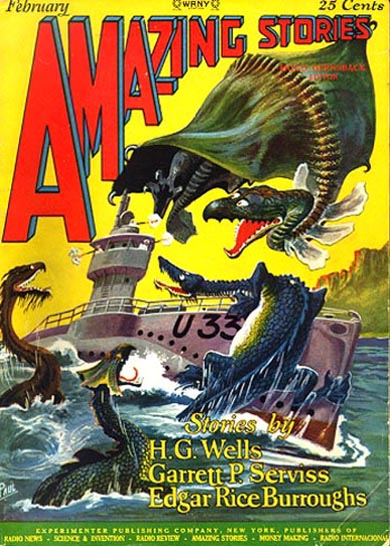
(Cover by Frank R. Paul. Amazing Stories, February 1927.)
The Story So Far
Bedford and Cavor are a failed businessman and an eccentric scientist respectively, who strike up an unlikely friendship and business partnership. Cavor, being the inventor, perfects a metal of his own design which he christens Cavorite, while Bedford orchestrates the construction (not the invention, of course) of a giant metal sphere which takes advantage of this anti-gravity metal called Cavorite. To test the viability of this new metal, after an accident gets nearly the both of them killed, Cavor and Bedford agree (reluctantly on Bedford’s part) to take this big metal ball to the moon. They pack some provisions, although strangely (from a modern standpoint) it doesn’t occur to them to build pressure suits for a world which very well might not even have an atmosphere. But of course, in the year 1899, it was speculated that the moon might not only have an atmosphere, but be home to life of its own. And so it does here.
Of course, nearly everything that could go wrong does, short of the two men dying straightaway. They lose track of the sphere, finding that it had been stolen or sunken into the landscape. They eventually battle hunger and thirst, although due to the lower gravity it takes longer for their bodily functions to call upon them. The biggest issue becomes the moon’s indigenous intelligent race, a bunch of “ant-men,” some of whom are man-sized, and somewhat humanoid, but otherwise have nothing in common with the men. These aliens, which Cavor comes to call Selenites, live in a complex network of underground caverns, and since the plant life on the moon isn’t useful for crafting wood-based equipment, Selenite civilization is metal-based, the moon apparently being rich in metals. At the end of the second installment Bedford and Cavor decide to split up in search of the sphere, leaving a handkerchief as a landmark.
Enhancing Image
The plan doesn’t go well at all, although the bright side is that Bedford finds the sphere and is able to leave the moon, albeit without Cavor. Unfortunately the two will never see each other again, although this is not the last time they hear from each other. In what I can only think of as a major contrivance, Bedford lands in the UK, in the seaside town of Littlestone, which is quite lucky for him. He loses the sphere again, for the last time it seems, but he’s able to make some money off of publishing the story of his and Cavort’s journey to the moon. (Funnily enough Bedford’s story appears in The Strand Magazine, which is also where The First Men in the Moon first appeared in the UK.) Normally this would be where the story (as in this novel) ends, but eventually a scientist by the name of Julius Wendigee, a Dutchman living in Britain, “who has been experimenting with certain apparatus akin to the apparatus used by Mr. Tesla in America, in the hope of discovering some method of communication with Mars,” picks up coded messages from the moon. Bedford gets in on this, having hitherto assumed Cavor was dead, seeing that his former buddy is not only alive but in contact with the Selenites. This is good news!
The back end of the novel is a series of transcripts of Cavor explaining Selenite culture and biology, among other things. Bedford effectively disappears as a character while Cavor takes control, relating his story to us like the unnamed protagonist does in The Time Machine. I must admit that these last few chapters are my favorite part of the book, which is a shame considering that, by Bedford’s own admission, the story had already come to an end in one sense, but also it feels like too little and too late. We learn important details about life for the Selenites that we really should’ve been given insight to earlier in the book, since up this point they came off as generic hostile aliens. The novel is at its best when it stops being an adventure narrative and instead swerves into territory Wells is better with, namely speculation on the future of human civilization. Cavor is led into an impossibly grand hall and introduced to the ruler of the Selenites, the Grand Lunar, an immobile mass of flesh whose brain is literally several yards across. (Intelligence among the Selenites is determined by the size of their heads, at the cost of body strength and mobility. This is something that became a cliche in pulp-era SF, but it was not so in Wells’s time.) It’s here that we finally get what the point of the book seems to be—a point that Wells had rather neglected to explore up till now.
There’s a big case of culture clash between the humans (or at least humanity as told by Cavor) and Selenites, indeed every facet of culture there is. The Selenites, in keeping with their insectoid appearance, are a race of specialized workers with a single absolute ruler, although the Grand Lunar represents supreme intelligence rather than supreme fertility like a queen bee. There’s no war here, nor does there seem to be poverty. Despite their reliance on metal, the Selenites are pre-industrials. The evil and filth of Victorian England has not reached them. Unfortunately, in trying to describe life on Earth, Cavor can’t help but yap about the nastier parts of human nature and act as if these are just things one ought to expect, namely the human tendency to wage war. This understandably concerns the Selenites, and Cavor’s fate is left ambiguous, although it doesn’t look good for him. Regardless, we never hear from Cavor again. There’s an anti-war slant crammed into the climax of the novel, which I can’t help but take as hypocritical on Wells’s part, considering he would later support British involvement in World War I. (Wells was, among other things, a hypocrite: he was a womanizer, even fathering a child out of wedlock, while at the same time being prudish about sex in literature, like the good Victorian gentleman he was.) The climax is good on its own, but if only the rest of the novel had properly built up to it.
A Step Farther Out
When C. S. Lewis wrote Out of the Silent Planet he intended it as a not-very-subtle rebuke of Wells’s writing, and The First Men in the Moon in particular. For what it’s worth, I’m not a fan of either novel. I don’t think The First Men in the Moon plays to Wells’s strengths, for the most part. It’s a weirdly structured thing that feels lopsided and at times bloated, despite coming to only about 200 pages in paperback. It’s a simple idea that could’ve worked better had it been the length of The Time Machine, or even The Invisible Man. Wells, who was never one to hide his beliefs, is less didactic here than in those other novels, but I wish he maybe didn’t bury the lede with what he wanted to say. The First Men in the Moon is actually less didactic than Lewis’s novel, but that’s not really a positive for the former. Maybe I would like it more had I read it as a book, in a short burst of time, rather than stretch it out over a few weeks, but I’m not sure.
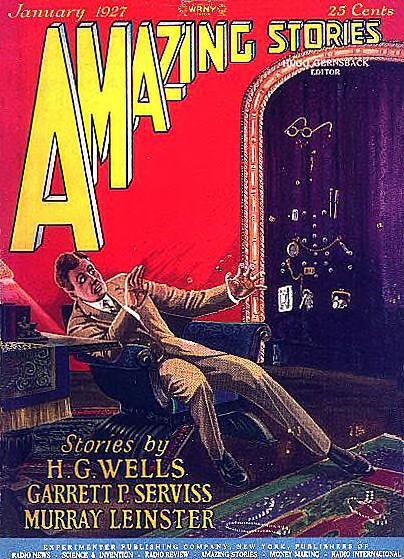
(Cover by Frank R. Paul. Amazing Stories, January 1927.)
The Story So Far
Bedford is an aspiring playwright and a failed businessman who strikes up an unlikely friendship with the scientist Cavor. Bedford is working on a play whilst licking some financial wounds and Cavor has been trying to perfect a metal of his own design, so that each man has been struggling with his own goals. Their friendship takes on a business aspect, with Bedford basically acting as Cavor’s manager while the latter messes around with the elements and God knows what. Because this novel is narrated from Bedford’s perspective and because Bedford himself is not a scientist at all, the details of how Cavorite is perfected are rather sketchy. It’s a combination of metals that works like helium, despite being solid, in that it has an anti-gravity effect. The accidental perfecting of this man-made element results in a cyclone that damn near kills Our Heroes™, but the good news is that it works. The question then becomes what to do with Cavorite. Mind you Wells wrote the novel around 1899, the years it takes place, so airplanes were just a little bit off in the future, with hot air balloons being up to this point the only practical way man could take flight.
Cavor gets the “brilliant” notion to not only construct a giant metal sphere made partly of Cavorite, but to test it by flying himself and Bedford to the moon. Thus our means of getting to the moon is not via rocket ship, or even like Jules Verne’s From the Earth to the Moon where we’re shot out of a cannon, but what amounts to an anti-gravity metal sphere. How these two Englishmen plan on getting back to Earth, let alone England, remains to be seen. When they land on the moon they find that the air is breathable, if also taking some getting used to, and that there is plant life here at the very least—albeit plant life of an exotic sort. The gravity is also only a fraction of Earth’s, which Bedford struggles with. And yet despite the breathable atmosphere there doesn’t seem to be any alien life possessing anything like human intelligence… at least so far.
Enhancing Image
The second installment opens with Bedford and Cavor actually stepping out of the sphere and getting a whiff of that comparatively thin moon air. I need not tell the reader (but I will) that aside from the lower gravity, the moon in Wells’s novel is completely different from the moon as we know it—so different that it may as well be a fantasy realm. What was scientifically plausible in 1901 was very much not so even a few decades later, never mind in 2026. If The First Men in the Moon suffers from anything, aside from being heavier on the adventure elements than Wells’s more iconic novels, it’s not being nearly as plausible as The Time Machine or The Island of Dr. Moreau. Granted that all science fiction is founded on at least one big lie (and more likely several lies in concert), The First Men in the Moon now almost reads more like fantasy than SF. It’s more scientifically grounded than Edgar Rice Burroughs’s Barsoom novels, but not by a whole lot. What’s interesting is how the atmosphere and gravity affect Bedford and Cavor’s sense of time and even hunger, with them realizing after a while that they’d not eaten in hours, yet don’t feel like they’re starving. It’s also easy (and fun) to traverse the moon by jumping around. The only problem (well, the first problem) is that they at some point lose track of the sphere.
It takes nearly halfway through the novel, but it does live up to its title. I said that the moon here is radically different from how it is in real life, another difference being that the moon here has a vast network of underground tunnels. Not only is the moon alive, with plants and “mooncalves” to serve as livestock, but there is indeed a race of intelligent beings here. The Selenites are about man-sized and bipedal, but insectoid. More to the point, there’s no overlap in language between the Englishmen and the aliens, except maybe basic body language. The Selenites don’t intend to kill them, at least not right away, instead taking them prisoner and holding them in this underground cavern. This isn’t quite as cool as it sounds. It could be because Bedford and Cavor, while being eccentric (especially the latter), are not natural-born adventurers like John Carter or Conan, but much of the conflict in this stretch of the novel comes down to Our Heroes™ bickering with each other rather than working together to fight their captors. Not that there’s anyone else around to converse with. Even the human cast of The Time Machine is bigger, by virtue of the framing narrative. Something I’ve just noticed about protagonists in Wells’s stories, be it his novels or short stories, is that a) they’re not given to introspection, b) they’re reacting to strange happening, rather than causing them, and c) they’re always dudes, without fail. When I say “protagonist” I also mean the narrator, since there tends to be a secondary character, the deuteroganist, who acts rather than reacts. Cavor is thus the deuteroganist to Bedford’s protagonist.
A Step Farther Out
Wells was not known for writing long novels, but even being about the same length as The War of the Worlds, The First Men in the Moon feels smaller in scale and less intellectual. We’re two thirds of the way in and the Selenites are still mostly a mystery. I can’t help but feel like this novel is missing something Wells’s best novels have, although I can’t quite put my finger on it. I’m gonna wait until the final stretch to pass judgment, but this is not looking to be one of my favorites of his. Oh well.
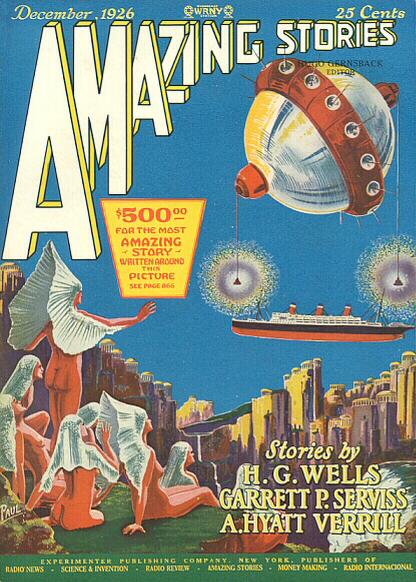
(Cover by Frank R. Paul. Amazing Stories, December 1926.)
Who Goes There?
Herbert George Wells was born in 1866 and died in 1946, meaning he lived to see both World Wars, as well as the dropping of the first nuclear bombs. By the end of his life he came to believe humanity was in a pretty sorry state, but for much of his career he could be considered an optimist. He was an early advocate for Darwin’s theory of evolution and was what we’d now call a democratic socialist, both of these beliefs playing major roles in his fiction writing. While he wrote essays and articles prolifically, and wrote quite a bit of non-genre fiction, it’s his SF that secured his legacy. Between 1895 and 1901 alone he either invented or codified multiple subgenres of SF, between a handful of novels and a fair number of short stories. That his output became increasingly sporadic and lacking in vitality after that point is a relatively small price to pay, given the heights of his major work. He’s arguably the most important SF writer to ever live, even taking into account authors who wrote SF before him, such as Jules Verne and Edgar Allan Poe. The First Men in the Moon was first published in book form in 1901 and is perhaps Wells’s last major novel, although he did write some very good short stories after this point.
Starting my Amazing Stories run with a reprint might seem odd for those who are not in the know, but reprints played a big role in the first years of that magazine’s history. Hugo Gernsback quickly became infamous for not paying his writers in a timely fashion, and the original work he received was often of pretty dire quality anyway. Therefore, reprints of classic (from the perspective of the 1920s) SF sounded like a logical choice. The relationship between Gernsback and Wells eventually soured, but it’s hard to come across an early issue that doesn’t feature a Wells short story or novel in serial form. There was a generation of young readers who, lacking in hardcover books, associated Wells with Amazing Stories and those colorful Frank R. Paul covers, and that’s not a bad thing.
Placing Coordinates
First serialized from 1900 to 1901 in The Cosmopolitan and The Strand Magazine, in the US and UK respectively. It was first published in book form in 1901. It was serialized in Amazing Stories from December 1926 to February 1927. Obviously it’s still very much in print, but because it’s public domain it’s also on Project Gutenberg.
Enhancing Image
Wells is famous for a lot of things, but his protagonists (except maybe the unnamed hero of The Time Machine) are not among them. Here we have Mr. Bedford, a businessman who’s recently come into hard times by way of bankruptcy. He’s the narrator of this story, but it’s hard to call him a hero; on the bright side, he’s at least affable. Bedford’s chosen to put his money issues aside for the moment and concentrate on writing a play. During this retreat he has a series of encounters with Mr. Cavor, who turns out to be an eccentric scientist. Cavor is mildly and passively annoying, and when Bedford makes this known to him Cavor threatens to buy his bungalow. The two men come to an understanding, though, and even start a business relationship that might evolve into friendship. It’s a case of how opposites might attract, since Bedford is “practical” and business-minded while Cavor, despite being highly intelligent, has yet to make much of a living off of his inventions. His latest invention might prove profitable, though, being an artificial element called Cavorite, which is missing an ingredient. The making of Cavorite is rather vague, with Bedford, himself far from being a scientist, not knowing “the particulars” of its final (and accidental() making. The basic idea is that Cavorite is an anti-gravity amalgamation of metals, in that it’s like helium but a solid rather than a gas. It’s worth mentioning that Wells wrote The First Men in the Moon just prior to the first modern plane taking flight, and the novel itself is set at the very end of the Victorian era. The only practical way a man could take flight in 1899 was with the hot air balloon, which of course is mentioned.
Also mentioned is Verne’s From the Earth to the Moon, which in case you don’t know involves a bunch of adventurers building a huge fucking gun and firing themselves out of it, their capsule being like a bullet. It’s pretty hard to take seriously nowadays, not that Wells’s solution to the moon problem is much better. Cavorite is a made-up element that may as well be magic, and the ship the two men (with the help of some laborers) build is a sphere made partly of this element. It’s not really a rocket ship, but rather an anti-gravity ship. Maybe the most unserious part is that Bedford and Cavor are not astronauts, which goes without saying, but also they don’t bring any equipment that even a child nowadays would understand as required for space travel. No pressure suits in this novel. The men also don’t experience the ill effects of low or zero gravity. We really didn’t know anything about our moon in 1899, did we? There’s speculation that the moon might have a breathable atmosphere (it doesn’t) and even life (not that either). Of course, since this is a Wells novel, the air is perfectly breathable and some of the first things we see are flowers indigenous to the moon.
But I’m getting ahead of myself a bit.
It’s hard to spoil this novel, since even having not read it before I’m aware of the general trajectory of its plot. We wait until nearly a third into it to witness the revelation of life on the moon, but this fact is made apparent even on the covers of some modern editions. Like with Wells’s other famous works, it suffers nowadays from seeming too familiar, although not to the level of, say, The War of the Worlds. It doesn’t help that Wells is big on using archetypes for his characters, so that Bedford and Covar are about one step above the level of cardboard. The stakes are also low, or at least so it appears at this point, since Our Heroes™ only decide to journey to the moon as a sensational way of testing the sphere. You may then be wondering what the appeal of reading Wells in [the current year] might be, if the science is laughably outdated and his characters lack the dimensions found in the works of Wells’s more literary contemporaries. The secret is that Wells, at his best or even just close to it, is a pretty engrossing storyteller. Wells is like his close contemporaries Arthur Conan Doyle and Rudyard Kipling, in that a) he wrote a fair amount of SF and horror, and b) he had a knack for titillating the reader’s imagination. Despite not much happening in terms of plot with this opening installment, I did read most of it with ease.
There Be Spoilers Here
Well, they do land in the moon, or rather on it.
A Step Farther Out
Funny thing about reading this novel and Wells generally is how one can see his influence on other authors pretty readily, be it on Robert Heinlein or Michael Crichton. (I wouldn’t be surprised if the anti-gravity sphere here was an influence on the reality-warping chamber in Crichton’s Sphere.) As with Wells’s other major novels it can also be better understood as adventure fiction than SF of the more serious/modern sort, even if those authors partly got their game from Wells. The question then is, what happens next? We’ve technically already made first contact, but surely there will be aliens that can converse with a couple of Englishmen.
(Cover by Frank R. Paul. Amazing Stories, February 1927.)
Since it’s now the new year for everyone, it’s only natural that we have some new things to look forward to or new things to do. I have a few New Year’s resolutions myself: some movies on my watchlist, quite a few video games I hope to get around to playing. I have hundreds of games in my backlog and even more books to be read in my personal library. I have multiple hobbies, which is something I would recommend to everyone. Unfortunately another thing on my to-do list for 2026 is to either get a second job or to try my hand at writing professionally, which would take time away from this hobbies, including this here blog.
Truth be told, I’ve been winding down productivity here for a minute, so this shouldn’t come as a surprise. I’m seemingly incapable of uploading posts “on time” (but of course who’s keeping time except for myself), and I’ve been missing one or even two reviews every month for the past several months. I wouldn’t be too worried, for the few of you who read this, since I’m not gonna be shutting down this site—just lowering my productivity. Granted, for the first couple years I ran this site I was writing at a feverish pace; in hindsight I’ve not really sure how I did that while also having a day job. In 2023 and 2024 I wrote over 200,000 words a year, according to the stats, which is a lot for one person. There was less wordage for 2025, and now for 2026 you can expect fewer posts as well. But this is like being on a flight and going from 20,000 feet to 10,000 feet.
Now, as you may know, Amazing Stories turns 100 this year. It was revived (again) not too long ago as basically a fanzine, but I would like to celebrate Amazing Stories as a professional magazine, which still means going through material that spans seven decades or so. It’s a lot, not helped by the fact that it has a pretty messy history as far as changes in editorship and publisher go. Except for maybe the beginning of its life it always played second fiddle to competing magazines, but it survived (sometimes even thrived) for an impressive stretch of time, given the circumstances. So, every month (except for March, July, and October, where you can expect short-story marathons) I’ll be covering a serial, novella, or short story from the pages of Amazing Stories. This should be interesting.
With the exception of the aforementioned months we’ll be doing only one serial, one novella, and one short story every month from now on, plus at least one editorial. Anyway, we have one story from the 1900s, one from the 1930s, and one from the 1950s.
For the serial:
The First Men in the Moon by H. G. Wells. Serialized in Amazing Stories, December 1926 to February 1927. First published in 1901. Feel like it would be criminal to pay tribute to Amazing Stories without bringing up Wells at least once, possibly even twice, since he was heavily associated with the magazine in its first few years. Wells himself is arguably the most important SF writer to have ever lived, with his influence being felt to this day practically everywhere you look. Any given SFnal premise likely has its roots in something Wells did over a century ago. This is even more impressive when you consider that Wells at the height of his powers lasted only half a dozen years or so. The First Men in the Moon is one of the last of his classic novels.
For the novella:
“The Gulf Between” by Tom Godwin. From the October 1953 issue of Astounding Science Fiction. Godwin became somewhat famous in SF circles for exactly one story, “The Cold Equations,” which he wrote pretty much in collaboration in John W. Campbell. It might surprise some people that Godwin had in fact written other stuff, and I admit I’m part of the problem because I don’t think I’ve read any Godwin aside from “The Cold Equations.” But I’m gonna fix that. “The Gulf Between” was Godwin’s first story, and it’s notable, if for no other reason than that the cover it inspired would later be reworked as the iconic cover for a certain Queen album.
For the short story:
“The Cairn on the Headland” by Robert E. Howard. From the January 1933 issue of Strange Tales. Over the course of about a dozen years, Howard wrote nonstop for every outlet that would accept his work, and he was not just a fantasy writer, also writing horror, Westerns, sports stories, and non-supernatural adventure pulp. He wrote everything except for SF, which he didn’t seem to have an interest in. Conan the Cimmerian occupied much of Howard’s later years, to the point where he began to resent his creation, but this didn’t stop him from doing standalone yarns like this one.
(Cover by Frank R. Paul. Amazing Stories, May 1928.)
The Story So Far
London, circa 2100. The world has in some ways changed radically since Wells wrote this story in the 1890s, but in other ways it has not. Class division persists, and has somehow gotten even more pronounced. People, at least in the UK, have mostly abandoned the countryside and huddled together in cities, with the cities becoming more vertically oriented. The richest folks live on the top floors of skyscrapers while the poorest of the lot live on the ground. Denton, an attendant on a commercial flying machine, has love affair with the upper-class young lady Elizabeth, whose father very much disapproves of their courting. The father, Mwres (descended from a man named Morris, an upper-class twit like himself), would prefer his daughter go with Bindon, a colleague of his, and he even hires a hypnotist to wipe Elizbeth’s memory of Denton so that she forgets all about him. Denton eventually undoes the conditioning and the two lovers escape the city, in the hopes that making it in the countryside would be preferable. It’s not really. The end up chapter three, or the first installment, sees the lovers returning to the city, but without much means of enjoying even a middle-class existence. Life will continue to be grueling for a bit yet.
Enhancing Image
The fourth chapter, “Underneath,” sees the young lovers at the bottom of the socio-economic ladder, at least in London. I mean I suppose it could be worse: they could be immigrants, for one thing. Truth be told, my eyes glazed over for much of this chapter, if only because much of it is like a Socratic dialogue, and sad to say Wells’s dialogue is not very memorable here. The humor and wry observations on the future often come through in the narration, which is quite a different thing. More memorable is the final chapter, “Bindon Intervenes,” which introduces us to the failed suitor in earnest, after only really hearing about him up to this point. Despite only coming around near the story’s climax, Bindon stands as the most developed character here, which strikes me as backwards. It’s clear that Wells intended Bindon to serve as Denton’s dark reflection, a man who is similarly romantic in a world that has left romance to the wayside, but who lacks Denton’s working-class charm; in effect he is like Denton if he was a proto-incel. Despite ostensibly being the antagonist, having conspired with Elizabeth’s dad, there’s something pitiable about Bindon that makes him a somewhat tragic figure. Not helping matters is he finds out he terminally ill, with not long to live. It would’ve been nice had Wells given us insight into Bindon’s character much earlier in the story beyond hearsay. As it stands this gear-switching in the final chapter comes about too little, too late, and like other parts of the story it feels undercooked.
Oh, and the ending sucks. I understand that it’s supposed to be ironic, but it’s bad storytelling to have your heroes get what they want through no real action or effort of their own. Bindon dies and Elizabeth inherits his fortune, on account of the cucked man having a change of heart as he’s come to realize he would die soon anyway. The conflict basically takes care of itself and Our Heroes™ get their happily-ever-after. This is unspeakably lame; I almost always hate it when writers pull this shit, and in 1899 Wells would’ve known better than to end on such a note.
A Step Farther Out
Sad to say this is not a hidden masterpiece or a semi-forgotten classic in Wells’s body of work, although it does have its points. A Story of the Days to Come feels like a microcosm of Wells’s chief concerns as both a satirist and a genuine speculator on the future, but it’s too long to have the punch of his best short stories and too short to be given the same depth of ideas as his best novels, or even the similarly-lengthed The Time Machine. Wells was one of the few true pioneers of science fiction, in the sense that he wrote about things that had never actually been put to paper before and broadened people’s horizons more than most of his descendants; but being on the cutting edge also meant that sometimes he, well, got cut. It’s the price one must pay for innovation.
(Cover by Frank R. Paul. Amazing Stories, April 1928.)
Who Goes There?
Herbert George Wells was born in 1866 and died in 1946, just short of his 80th birthday but just long enough to have seen the end of World War II. Wells is one of the most important writers of SF to have ever lived—maybe the most important. To be an SF fan and not read at least a bit of H. G. Wells would be like being a horror fan and not having read any H. P. Lovecraft, or being an English major and not engaging with Shakespeare or the King James translation of the Bible at all: it’s basically unthinkable. Wells’s influence is made more remarkable when you consider that SF was by no means the only genre he wrote in, although his non-SF work has been thrown into the dustbin of history, and also that he wrote pretty much all of his most important work in the field in the span of about a decade, between 1895 and 1905. While he was still writing, albeit very little SF at this point, in the 1920s, Wells’s presence in the earliest genre magazines, namely Weird Tales and Amazing Stories, was entirely through reprints. Indeed he seemed to appear in nearly every issue of Amazing Stories while Hugo Gernsback had control of that magazine. A Story of the Days to Come was first published in 1899 as five related stories, which then became its chapters. This is a novella, about as long as The Time Machine, but it’s nowhere near as well-known as Wells’s most famous novels or even short stories, I suspect because while it’s certainly ambitious, it lacks the iconic characters, ideas, and even plot momentum of those other works. This is a story that will be rather hard to talk about in terms of plot beats, so that, combined with depression (it took me nearly an hour to get out of bed this morning), made writing about this story a bit of a challenge.
Placing Coordinates
First published as five stories in 1899, in Pall Mall Magazine. It was then serialized in the April and May 1928 issues of Amazing Stories. It’s also been reprinted in The Science Fiction Century (ed. David G. Hartwell) and the Wells collections Tales of Space and Time and The Complete Short Stories of H. G. Wells. Tales of Space and Time has been in the public domain since forever, so you can read it on Project Gutenberg.
Enhancing Image
We start with less of a character and more of an archetype, in the form of Mr. Morris, of the late Victorian era, and his distant descendant, Mwres, who are both perfectly conservative and upstanding men of their times and shared place—that being London of the 19th and 22nd centuries, respectively. Morris/Mwres is totally unconscious about class, cares nothing for the poor, attends church regularly but without passion, and can hardly be bothered to read anything. Indeed Mwres uses a “phonograph,” which here functions like a laptop or audiobook, to consume information, rather than reading the newspapers like his ancestor. Nobody reads anymore. Mwres meets with a hypnotist so that he might do something about his daughter Elizabeth, who is 18 at the story’s beginning and thus of marrying age. Mwres wants Elizabeth married off to a colleague of his, Bindon, a much older man, “plain little man, you know, and a bit unpleasant in some of his ways, but an excellent fellow really.” But Elizabeth, being a romantic and having indulged in many “romances” (tales of adventure), has set her sights on Denton, “a mere attendant upon the stage on which the flying-machines from Paris alight,” who like Elizabeth is a romantic in a future society which has all but abandoned things like poetry and romance of the lovey-dovey sort. Also, both Elizabeth and Denton can read and write, which bothers Mwres. The hypnotist thus messes with Elizabeth mind such that she forgets all about the young man she’s so smitten with, and it’s up to Denton to figure out why his girlfriend doesn’t recognize him the next time the two of them cross paths and how to undo the hypnotism.
As you can see, this is rather satirical. Morris/Mwres is a obviously dig at the conformist, or the “moderate conservative,” someone who might vote Labour but only so long as the party doesn’t get too woke. Wells was a socialist; more specifically he was a Fabian, or what we’d now call a democratic socialist. He was also a technophile, although his feelings on the possibility of technological progress bettering mankind soured as he grew older. Even in A Story of the Days to Come there’s an ambivalence about technology’s place in human progress, although as we’ll see, the “primitivist” option is also shown to be inadequate. If anything tech is shown to be more or less neutral here, more a tool that worsens an already-existing problem—that being the problem of capitalism and class division. This whole fucking plot gets going because the upper-class Mwres, who despite being rich is shown to be an ignoramus, sees the middle-to-lower-class Denton as unfitting for his daughter; and of course Elizabeth has no real say in the matter. Hypnotism, or mesmerism as it was also called at the time, was treated as a big deal in the 19th century, such that in Wells’s story it has become such an advanced practice as to render psychology obsolete. Mind you that psychology as one of the soft sciences was only in its infant stage when Wells wrote A Story of the Days to Come, such that Freud’s The Interpretation of Dreams hadn’t even been published yet. The automobile had also not yet become commercially viable enough at the time to be a common presence, and you can sort of feel its absence in this story. Conversely, “flying-machines” have become a preferred mode of commercial travel in-story, despite the first working airplane still being a few years off in the real world. Granted, people had speculated on flying-machines for literally centuries at this point, and Wells would even see the beginnings of commercial flying in his lifetime. My point is that while this story takes place circa 2100, it still reads as if written from the perspective of someone living in 1900—which may very well be the point. The narration, while ostensibly third-person, is very much targeted at a Victorian readership.
This is all intriguing, after the fact, but one issue I had while actually reading A Story of the Days to Come is that from a plotting standpoint this is far from Wells’s best work. A rule of thumb with writing short fiction is that you wanna stick to one perspective: it could be a first-person narrator, or a bird’s-eye-view third-person narrator, but the idea is we should stuck in the head of only one character. You can get away with changing perspectives in a novel, but for short fiction it’s a dangerous game. Wells violates this rule by switching us between at least three perspectives in these first three chapters (the first installment), between the omniscient third-person narrator, Mwres, and Denton. It makes scene and chapter breaks surprisingly confusing, made worse because Mwres and Denton meet the same hypnotist at different points. By the way, it is massively convenient that Denton, after having been dismayed by Elizabeth apparently forgetting all about him, goes to the same hypnotist that Mwres had consulted to brainwash Elizabeth in the first place. Of course Denton uses a little man-handling to get what he wants and make the hyptotist undo the conditioning on Elizabeth, so that the two can be together again—the new problem now being that there’s no going back. They’ve gone against Mwres’s wishes and will not have to live almost like fugitives, since Elizabeth only has as much as what her old man lets her and Denton doesn’t have many prospects of his own. They live at Denton’s place, for a bit, but having become disillusioned with city life, and also being very low on cash, they decide to hit the road and head out to a place very few people live in now: the countryside. It’s a shame Wells didn’t live long enough to have read Clifford Simak’s City, he probably would’ve been very keen on it. Then again, I’m not sure how much SF Wells actually had read, since he seemed irked by the newfangled label.
There Be Spoilers Here
The England of the future is somewhat dystopian, and one way Wells implies this is the fact that “countryside” has mostly been reclaimed by the natural world. Where once there were whole societies of peasantry in the English countryside, now there’s only the stray farmer or shepherd. As with Clifford Simak’s fiction, humanity is shown as being in decline by virtue of having cut itself off from the natural world; man seems to be degrade further the more “unnatural” he becomes. A shepherd meets Denton and Elizabeth as they start their new lives as would-be farmers, and tells them (correctly) that they won’t last long in the countryside; they simply weren’t raised to adapt to this kind of lifestyle. But they do give the whole thing the good old college try, as it were, and honestly the attempt could’ve turned out worse. They both could’ve died easily, between the elements and wild animals; but what finally pushes them to move back to the city is the issue of trespassing, and damn near getting killed by a pack of dogs. (Wells, given his politics, wasn’t keen on private property.) It’s at this point that the first installment ends, with Our Heroes™ having lost the battle, but maybe not the war. We’ll have to wait and see about that. I do wish I cared more about Denton and Elizabeth as people, although obviously I do wanna see them overcome a system that has been built up over generations to keep them apart. With Wells, his characters tend to serve his ideas, rather than the other way around, which is how SF has mostly been written for the past century.
A Step Farther Out
I’m a bit ambivalent about A Story of the Days to Come so far, although David G. Hartwell thought it enough of a hidden gem that he says so in his introduction for it in The Science Fiction Century. The problem is that it works better as almost a fictionalized essay rather than a “story.” Wells at his best is still no Shakespeare when it comes to style or developing characters, but he can be really good at plotting and hitting the reader with ideas that, at least in the last days of the Victorian era, they might not have ever considered before. Wells wrote with the primary purpose of opening people’s minds to a whole new realm of possibilities, which he believed in as both an SF writer and a socialist. That the politics of genre SF (we’re talking about the views of authors and editors) during its early years, from the 1920s to about 1950, would be a lot more reactionary than Wells, is beside the point. You could argue A Story of the Days to Come is SF in its purest form, that being it’s devoted to speculating on the future, and cannot be confused for any other genre. For better or worse.
We seem to be living in a world of shit, or at least it’s easy to think that way. The irony is that the people who think this the most are also probably (being queer and disabled I’m actually not sure how I’m gonna turn out) the ones most likely to come out of all this bullshit unharmed—in body, if not in soul or mind. But, the show continues. I thought I had more to say for this month’s forecast, and at this point I think it’s fair to say my Things Beyond posts have become like actual weather forecasts (I predict, but that doesn’t mean the thing will 100% happen); but still, aside from a couple things I’m sure we all know about already, the past month has been uneventful. I got my purchases for Worldcon at basically the last minute, so I’ll be seeing what I can see of the con virtually if not in person, and with any luck I’ll even be on a couple panels, as one of those inside-a-computer people. I’ve been slowly but surely moving “up” in the world of fandom.
Anyway, for decades we’ve got two stories from the 1920s, one from the 1940s, one from the 1970s, one from the 1990s, and one from the 1890s. As for the stories themselves, we have…
For the serial:
Sunfire by Francis Stevens. Serialized in Weird Tales, July-August to September 1923. Francis Stevens is the androgynous-sounding pseudonym of one Gertrude Bennett, who for just a few years wrote prolifically for the pulp magazines, apparently to help pay the bills. Once her sickly mother died, she stopped writing fiction, with Sunfire being the last story of hers published. It would take more than seventy years for this story to appear in book form.
A Story of the Days to Come by H. G. Wells. Serialized in Amazing Stories, April to May 1928. First published in 1899. Wells is perhaps the most crucial pioneer of science fiction; aside from maybe Edgar Allan Poe he stands as arguably the genre’s nucleus. This is made more remarkable since Wells wrote his most famous work over the span of only about a decade. This story comes from said decade of greatness, but I guess due to its length it remains overlooked.
For the novellas:
“The Glowing Cloud” by Steven Utley. From the January 1992 issue of Asimov’s Science Fiction. Utley was born in Kentucky, at Fort Knox (he was a military brat), before moving to Texas (Austin), and then finally Tennessee. He wrote prolifically in the ’70s, all of it short fiction, as one of the post-New Wave generation. He then fell mostly silent in the ’80s before reemerging in the early ’90s.
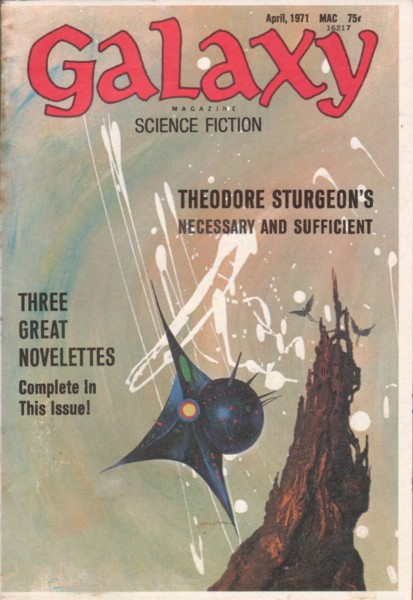
“To Fit the Crime” by Joe Haldeman. From the April 1971 issue of Galaxy Science Fiction. Haldeman, like Utley, came about during the post-New Wave era; he had spent the New Wave years in college, and then in Vietnam, where he got damn near killed. Once his wounds healed enough he got to work writing SF. This story here is the first in a loose series, starring Otto McGavin.
For the short stories:
“When the Bough Breaks” by Henry Kuttner and C. L. Moore. From the November 1944 issue of Astounding Science Fiction. Retro Hugo nominee for Best Novelette. I had missed the boat on reviewing Moore solo last month, and I can’t review Kuttner solo next month either; so together here they go. Kuttner and Moore were of course married, and they’re also two of my favorite writers.
“The End of the Party” by Graham Greene. From the December 1950 issue of Worlds Beyond. First published in 1932. Greene was famous in his day as both a serious novelist and a writer of espionage thrillers, although the two were not mutually exclusive. He also occasionally dabbled in supernatural horror, with this story being one of his own personal favorite works despite its age.
(Cover by Andrew Brosnatch. Weird Tales, November 1925.)
Who Goes There?
H. G. Wells is one of those authors who really needs no introduction. Of the forerunners to the great experiment we call science fiction, Wells was arguably the most influential and most talented; he was at least certainly the most direct ancestor to the likes of Heinlein and Asimov; he was also one of the first SF authors I remember reading with any enthusiasm. I picked up copies of The Time Machine and The Island of Dr. Moreau as a middle schooler and I was thus introduced to classic literature and classic science fiction in one swoop. Mind you that I—well, I didn’t like reading much up to that point in my life; I was a late bloomer when it came to the whole reading for fun thing. The Time Machine especially might’ve rewired my brain a bit, and I’ve gone back to it several times since then—which is easy, considering it’s really a novella. Point being, even though I don’t tend to think of him as one of my favorite authors, I owe quite a lot to Wells, as so do the rest of us who think of science fiction as our home turf.
Wells wrote a lot and lived a long time, but his legacy gets boiled down to a handful of novels that were written close together and a smattering of short stories and novellas that were written during that same period. This is fine, because with such pioneering works as The Time Machine and The War of the Worlds, Wells’s legacy was secured. It may seem odd to see him in the pages of Weird Tales, but consider both the story to follow and also how “weird” much of Wells’s fiction is. The Invisible Man would surely have been serialized in Weird Tales had it been published three decades later, and the beast men of The Island of Dr. Moreau are such grotesque creations as to make the average horror writer nod in gratitude. “The Remarkable Case of Davidson’s Eyes” is a mind-bending tale about seeing several places simultaneously, and actually “The Stolen Body” feels like a bit of a companion to that earlier short story.
Placing Coordinates
First published in the November 1898 issue of The Strand Magazine, but we’re reading “The Stolen Body” as it appeared in the November 1925 issue of Weird Tales, which is on the Archive. Curiously, despite being a reprint, it was made the cover story. In what has to be one of the faster magazine reprints it also appeared just over two years later in the January 1928 issue of Amazing Stories, which you can find here. Because this is Wells it’s not hard to find. It was included in the collection Twelve Stories and a Dream, which is on Project Gutenberg. If you want a paper copy then your best bet is probably Selected Stories of H. G. Wells from Modern Library, which seems to still be in print. You have options is all I’m saying.
Enhancing Image
We start with two friends, Mr. Bessel and Mr. Vincey, who have the crippling combination of being bored and also into paranormal shit. This is Victorian England; people did some wild shit just to pass the time. Bessel thinks he can separate his spirit from his body by sheer force of will—as in he can hypnotize himself and astral project into Vincey’s apartment. Hypnotism is a running thing in SF of this vintage, and would sometimes even show up in Campbellian SF a few decades later. The most famous example in old-timey fiction might be Poe’s “The Facts in the Case of M. Valdemar,” a horror yarn that, curiously, could also be considered science fiction; it certainly convinced Gernsback enough to print it in Amazing Stories, as would “The Stolen Body” be a few years later.
Bessel simply trying hard enough in order to achieve this supernatural end also reminds me of another Wells story, “The Man Who Could Work Miracles,” but whereas that story makes no attempt to explain itself in rational terms, we’ll find “The Stolen Body” to be couched in science fictional rationalism. Anyway, the idea is that the spirit of Bessel will appear to Vincey, then Vincey will take a picture of this spirit before Bessel returns to his body. Well, the first part of the experiment works. Bessel’s spirit does indeed appear to Vincey, but for one, Vincey is too slow to take a picture with what admittedly has to be a slow and clunky camera, and second, when Vincey heads over to Bessel’s place, he’s nowhere to be found. For reasons unknown, Bessel has all but vanished into thin air. To make things even weirder, Bessel seems to have trashed his own apartment before vanishing—but then maybe there was foul play involved?
The answer is “yes” and also “no.”
What follows is very strange. Vincey has a series of vivid dreams in which he’s confronted with Bessel’s spirit, but he also sees Bessel—the man, or at least the body of the man—go on a rampage through the streets at night, assaulting people with a cane and blabbering the word “Life!” over and over. When Vincey wakes up, he finds that the dream was not really a dream; Bessel really did go on a rampage during the night, and at the same time that Vincey was sleeping. Vincey and Mr. Hart, a mutual friend, take this information to the police, and are told that not only was Vincey’s vision a projection of what really happened, but that despite quite a few eye witnesses, Bessel has not been found since the rampage.
They confirmed Mr. Vincey’s overnight experiences and added fresh circumstances, some of an even graver character than those he knew—a list of smashed glass along the upper half of Tottenham Court Road, an attack upon a policeman in Hampstead Road, and an atrocious assault upon a woman. All these outrages were committed between half-past 12 and a quarter to 2 in the morning, and between those hours—and, indeed, from the very moment of Mr. Bessel’s first rush from his rooms at half-past 9 in the evening—they could trace the deepening violence of his fantastic career. For the last hour, at least from before 1, that is, until a quarter to 2, he had run amuck through London, eluding with amazing agility every effort to stop or capture him.
But after a quarter of 2 he had vanished. Up to that hour witnesses were multitudinous. Dozens of people had seen him, fled from him or pursued him, and then things suddenly came to an end. At a quarter to 2 he had been seen running down the Euston Road towards Baker Street, flourishing a can of burning colza oil and jerking splashes of flame therefrom at the windows of the houses he passed. But none of the policemen on Euston Road beyond the Waxwork Exhibition, nor any of those in the side streets down which he must have passed had he left the Euston Road, had seen anything of him. Abruptly he disappeared. Nothing of his subsequent doings came to light in spite of the keenest inquiry.
How Vincey was able to have a vision of something that happened simultaneously with his sleeping will be explained later, but it’s certainly hard to rationalize—thus an irrational explanation, never mind a solution, will have to do. Vincey gets in contact with a local medium, which strikes me as unusually dishonest for Wells since he depicts mediums as well-meaning people and not the con artists they actually are. Anyway, putting aside my intense ambivalence towards mediums and ghost hunters and whatnot, the visit pays off immensely, even if the message we get from what seems to be Bessel’s spirit is cryptic. The medium, as if hypnotized herself, writes down a message in what Vincey recognizes as Bessel’s handwriting, and with nothing else to go on the police use this clue to find Bessel, who following his deliriam from the previous night had apparently fallen down a shaft at a construction site and was unable to get out on his own.
A few broken bones aside, Bessel is in fine shape, and more importantly he acts like himself again. That’s basically the end of the story, if we were to map this whole thing out linearly, but there are still questions begging to be answered, such as “Why did Bessel go on that mad rampage?” and “How come Vincey was able to see said rampage in his dream as it was happening in the real world?” But those are spoilers…
Wells’s characters are not knowing for being all that colorful, with a few notable exceptions (Dr. Moreau and his henchman/boytoy Montgomery are far more memorable than the narrator), with “The Stolen Body” being an especially pronounced example. Bessel, Vincey, and the few other characters worth mentioning at all are very vanilla, and it struck me at some point while reading that there’s very little dialogue. We don’t even get Bessel and Vincey’s first names if I remember right. They serve their purpose, though; clearly Wells is far more interested in mapping out this strange sequence of events than having the characters act as the story’s anchor. We’re supposed to find these supernatural shenanigans as adequate compensation for the lack of actual character drama, and I think it worked out.
Anyway, we don’t go to Wells for the characters. It’d be like if you went to Hal Clement for characters, or Vernor Vinge; these writers are much more about the visionary potential of fiction than the potential of human drama. “The Stolen Body” isn’t scary, really, but it’s certainly perplexing, making us wonder what the hell is going on and where Bessel could have gone to during his astral projection. What makes “The Stolen Body” very much worth a recommendation is that it’s not simply a ghost story—it’s a ghost story as written by a real man of science, a man who refuses to let any substantial question go unanswered. It’s like when James Blish tried to rationalize werewolves in “There Shall Be No Darkness” (review here), except Wells’s rationalizing is a bit less labored, if also less eccentric.
There Be Spoilers Here
You may be thinking, “Brian, you handsome devil, why did you give away the end of the story in the non-spoiler section? What could you even have left to consider a spoiler?” Well that’s where you’d be mistaken, because we haven’t gotten Bessel’s side of the story up till now. While we know he more or less ended up fine, how we got to finding him in a shaft where he could’ve only been found with some supernatural assistance was not explained. Wells does something very peculiar here in that he rewinds the clock and retells most of the story, but from Bessel’s perspective.
So what happened when Bessel hypnotized himself and left his own body? Wasn’t he able to get back into it? How else could he have gone on that rampage, albeit seemingly in a state of shock? Well…
He enters a world that could be considered the shadow realm—a level of existence beyond the natural world. A world without sound, separated from the natural world by what seems like a glass pane. It’s uncanny and certainly intriguing, but Bessel finds that he can’t return to his body with ease; in fact, he soon finds that he’s not the only one looking for a body around here. While Bessel is currently apart from his body, he’s not technically dead, which I guess leaves it open to possession. (Is that how it works? I don’t think too hard about it.) There are spirits in this realm—people in limbo, between the living and the departed, neither alive nor totally dead. One of these spirits invades Bessel’s body and, after presumably being stuck in spirit form for a long time, immediately goes nuts with it.
A few problems Bessel must solve: the obvious is that he has to get back into his body, but he can’t do that if someone else has it; the second, arguably bigger problem is making contact with Vincey or someone who might help him get back itno his body; the third is hoping to God or whoever it is that the spirit that hijacked his body doesn’t kill it somehow. Indeed that second problem takes up most of the back end of the story, and goes a long way in explaining some earlier events that might seem inexplicable to us.
For instance, Vincey has the dream about Bessel going on his rampage because the real Bessel messes with his… pineal gland. Lovecraft fans may note that this peculiar little gland in the brain gets used as a plot device in that dude’s early story “From Beyond,” with similarly supernatural but far more negative results. Apparently writers in the 19th and early 20th century were fucking stoked about all the weird little things in the human body, like the appendix and all that. The pineal gland in old-timey (we’re talking pre-Campbellian SF, it’s that old) SF serves as basically one’s third eye, which Bessel opens for Vincey; he witnesses the rampage as it’s occurring, though he doesn’t realize that until later.
Confused slightly? Don’t worry, Wells catches us up:
And now the attentive reader begins to understand Mr. Bessel’s interpretation of the first part of this strange story. The being whose frantic rush through London had inflicted so much injury and disaster had indeed Mr. Bessel’s body, but it was not Mr. Bessel. It was an evil spirit out of that strange world beyond existence, into which Mr. Bessel had so rashly ventured. For twenty hours it held possession of him, and for all those twenty hours the dispossessed spirit-body of Mr. Bessel was going to and fro in that unheard-of middle world of shadows seeking help in vain. He spent many hours beating at the minds of Mr. Vincey and of his friend Mr. Hart. Each, as we know, he roused by his efforts. But the language that might convey his situation to these helpers across the gulf he did not know; his feeble fingers groped vainly and powerlessly in their brains. Once, indeed, as we have already told, he was able to turn Mr. Vincey aside from his path so that he encountered the stolen body in its career, but he could not make him understand the thing that had happened; he was unable to draw any help from that encounter…
Also, while Bessel isn’t allowed to talk to normal people, he can make indirect messages through people’s pineal glands if they’re juiced up enough, I guess, hence, the medium writing down Bessel’s cryptic message and even mimicking Bessel’s handwriting. Bessel has to fight other spirits for control of the medium’s body, but he gets in there just long enough to let Vincey know what happened to his body and where it is.
Meanwhile the spirit, having had an accident and fallen down the shaft, breaking a few bones in the process, is not happy to be in Bessel’s body anymore and eventually leaves it, allowing Bessel to return. He’s hurt badly and the whole experience has been pretty traumatic, never mind, outlandish, but he’s more or less fine at the end. What lingers far more than the physical pain is the knowledge that, for a relatively brief time, he experienced the afterlife—and it SUCKS.
A Step Farther Out
Is it science fiction? Is it supernatural horror? It’s kinda both. It’s interesting to look back at pre-Gernsbackian SF and see how these writers were playing with genre boundaries when they didn’t even know what that genre was yet. Wells was on to something, though, and it’s no wonder that “The Stolen Body” was reprinted in two genre magazines a few decades after initial publication—because no doubt Hugo Gernsback would have bought it even if it had never been published before. As it turns out, scientific (or often pseudo-scientific) concerns did not change much among those who were “in the know” between the tail end of the 19th century and around the time of the stock market crash. What makes an artifact like “The Stolen Body” especially interesting is that because our understanding of the human body has advanced so much since Wells’s time, Victorian superstition about ghosts and whatnot now sounds more fantastical than it would’ve at the time. Wells was a materialist, but even so he appealed to Victorian fears about damnation and voices from beyond the grave.
Wells would become a more frequent contributor to Amazing Stories, but “The Stolen Body” was not his last appearance in Weird Tales and if you know enough about his work it’s not hard to see why. It’s strange, considering how much he is known as an optimist and utopian socialist, that so much of Wells’s fiction could be classified as horror; indeed he is much more famous for crafting bad futures than good ones. Whereas The Time Machine shows a bad distant future, hundreds of thousands of years from now, “The Stolen Body” shows a much more immediate but still horrific (at least on a personal level) future: the life that comes after death.
(Cover by Margaret Brundage. Weird Tales, July 1933.)
Weird Tales, across incarnations, has been arguably the most important outlet for dark fantasy and horror in the American market for the past century now. Yes, it’s been that long. The first issue of Weird Tales is marked March 1923 and would have appeared on newsstands in February (I’m not splitting hairs), and while it wasn’t immediately impressive it would become the quintessential pulp horror magazine within a decade. Given the nature of my site and how important Weird Tales is, I thought it appropriate (not to mention a break away from tackling serials) to do a month-long tribute by reviewing entirely short stories from this magazine’s pages—but make no mistake, this is not an attempt to cover its incredibly wide-spanning history. What I’m doing rather is to cover the most famous period of Weird Tales: from the mid-1920s to the end of the 1930s.
In a way this is not so much a tribute to Weird Tales as to the man who, more than anyone, made it the legend it now is: Farnsworth Wright. Wright hopped on as editor with the November 1924 issue and stayed until failing health forced him to step down after the March 1940 issue; he died only a few months later. But in the decade and a half that Wright was editor there was a profound change in the magazine’s contents, as it went from focusing on unassuming ghost stories to encompassing a wider range of “weird” fiction, including but not limited to sword and sorcery, operatic science fiction, and of course, cosmic horror. Ghost stories remained a firm part of the magazine’s identity, but under Wright we saw several big forerunners to modern horror and fantasy, including H. P. Lovecraft and Robert E. Howard, and indeed Weird Tales was the birthplace of both Conan the Barbarian and the Cthulhu Mythos.
Weird Tales was not that friendly to novellas unless they were serialized, and anyway I figured it’d be more accurate a representation to review all short stories this month, which also allows for a more diverse set of authors. We’ve got some famous ones here, but also some deep cuts that I’m very much interested in exploring.
Anyway, here are the short stories:
“The Stolen Body” by H. G. Wells. From the November 1925 issue. This is the first true reprint I’ll be reviewing for Remembrance. “The Stolen Body” was first published in the November 1898 issue of The Strand Magazine, but we’re reading it as it appeared in Weird Tales, and apparently Wright (or somebody) deemed it major enough to make it the cover story despite its reprint status. Wells is someone who needs no introduction, and this is a story from his peak era.
“The Canal” by Everil Worrell. From the December 1927 issue. Not much is known about this author, but her vampire story “The Canal” has been reprinted several times over the years, including as a “classic” reprint in Weird Tales itself. Lovecraft was apparently a big admirer of this one, and he also didn’t seem immediately aware that Worrell was a woman. There’s a later revised version with a different ending, but we’re reading its first magazine appearance.
“The Star-Stealers” by Edmond Hamilton. From the February 1929 issue. Hamilton had made his debut in Weird Tales, and he soon proved to be the most prolific contributor of “weird-scientific stories,” or ya know, just science fiction. “The Star-Stealers” is the second entry in the episodic Interstellar Patrol series, which while not often read now was an early exmaple of space opera, which Hamilton helped codify alongside E. E. Smith and Jack Williamson.
“The Black Stone” by Robert E. Howard. From the November 1931 issue. This has to be the fastest I’ve returned to an author for my site, since only last month I finished covering Howard’s Conan serial The People of the Black Circle. “The Black Stone,” however, is not sword and sorcery but cosmic horror, and it’s supposed to be one of the best old-school Lovecraftian narratives, on top of being one of the first examples of someone taking cues from Lovecraft’s work.
“The Dreams in the Witch-House” by H. P. Lovecraft. From the July 1933 issue. Speaking of which, it’d be impossible to do a Weird Tales tribute without covering its most famous contributor, although Lovecraft was certainly not that at the time. Wright and Lovecraft did not get along, with Wright rejecting At the Mountains of Madness and “The Shadow Out of Time.” Still, this is one of his more famous short stories, and it even got adapted for TV recently.
“The Black God’s Kiss” by C. L. Moore. From the October 1934 issue. The only reread of the bunch, and that’s because I honestly did not give this one the attention I should have when I encountered it a couple years ago. Moore is now more known for collaborating with her husband Henry Kuttner, but she started as one of the more popular authors in Weird Tales. “The Black God’s Kiss” is the first in the Jirel of Jory series, featuring the titular sword-and-sorcery heroine.
“Vulthoom” by Clark Ashton Smith. From the September 1935 issue. The literary sorcerer returns! Smith was, for a brief time, one of the most prolific contributors to Weird Tales, although he mostly retired from writing fiction by the time Wright left. “Vulthoom” is a “late” Smith story, and you can tell because it was one of only a few he put out in 1935. It’s also a comparitibely rare example of Smith doing SF, with the setting being not Earth but a haunted Mars.
“Strange Orchids” by Dorothy Quick. From the March 1937 issue. As with Worrell we don’t know much about Quick, and unlike “The Canal” this has not been reprinted so often. I do remember first seeing Quick’s name in Unknown, the magazine that for a brief time usurped Weird Tales, but she appeared more in the latter; she basically stopped writing fiction once the first incarnation of Weird Tales shut down. Probably the most obscure pick of the bunch.
“Roads” by Seabury Quinn. From the January 1938 issue. Quinn was the most popular author to appear in Weird Tales during the Wright era, and yet his reputation dwindled enough since his death that he later “won” the Cordwainer Smith Rediscovery Award. The posthumous obscurity could be because a lot of what Quinn wrote was hackwork, but “Roads” is distinct for apparently being one of those pieces that Quinn wrote out of passion, being an earnestly told Christmas story.
I know Halloween was only like five months ago, but truth be told it’s always Halloween in my heart. If I could get away with just reading and reviewing spooky fiction I probably would; nothing warms my bones like a good horror yarn. The greatest hits from Weird Tales are still cited after nearly a century, but I suspect there are also deeper cuts (especially by female authors, as there would’ve been several) that are worth our attention. We have a healthy variety of authors and a good deal of diversity as to this magazine’s contents, ranging from the supernatural to the weird-scientific.
But enough buildup…
It’s time to venture into the eerie, the uncanny, and the WEIRD!




 Science Fiction & Fantasy Remembrance