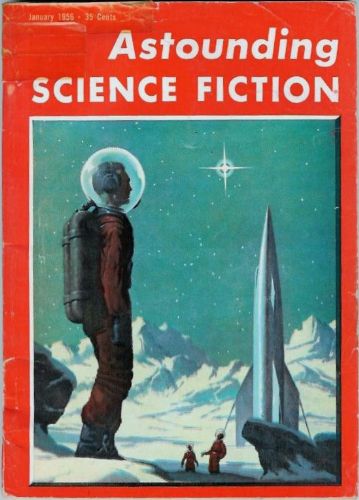
(Cover by H. R. Van Dongen. Astounding, January 1956.)
The Story So Far
John Ramsey is a gifted psychologist on an assignment from Bu-Psych, to play the role of the new electronics officer for the Fenian Ram, a subtug that’s out to raid oil in enemy territory, just off Siberia. This is the 21st century, and not only has the Cold War gotten a bit warmer, but oil has become an increasingly precious resource. The last twenty subtug missions have ended in failure, with the higher-ups suspecting there are “sleepers” aboard these submarines—spies who are sabotaging things from the inside. Ramsey’s job is twofold: to sniff out a possible spy among the Ram‘s small crew, and to evaluate Sparrow, the Ram‘s captain. Sparrow has been shown to be an incredible captain, but he also seems to have a bit of a screw loose, being a Bible-spouting borderline psychotic who expects nothing less than the utmost devotion from his crew. The other crew are Bonnett and Garcia, who’ve been on the Ram for many months by now. Ramsey is an outsider here, which already puts him at a disadvantage, never mind that he has to keep his real profession a secret.
Another problem is that being in a submarine means there’s no such thing as a minor accident, especially when it comes to dealing with enemy patrols. Of course the Ram is totally outmanned and outgunned against the wolf packs that are patrolling the Pacific, so the only option is evasive action. After a close call with the enemy, Sparrow falls ill from radiation sickness for a time, meanwhile the rest of the crew are unsure as to where they stand with each other. There’s the growing sense that somebody here is a spy, and the cards are stacked against Ramsey since he’s fresh meat. For better or worse Garcia has also figured out that Ramsey is a psychologist who has some ulterior motive for hopping aboard the Ram. The two have a kind of mutual respect, if also ambivalence mixed with paranoia. The last installment ended with Bonnett, having misconstrued Ramsey helping with the ship for planting a “spybeam,” jumping the gun and beating Ramsey within an inch of his life. Does this mean Bonnett is really the spy? Is everyone a little too tightly wound with this mission? I would know the answers, considering I’ve read the final installment or else I wouldn’t be here.
Enhancing Image
Surprise! Turns out Garcia is the spy, although how this is revealed is a bit odd; I don’t mean this in a bad way. Prior to the actual reveal Garcia implies, in a conversation with Ramsey, that he’s become tired of working for the Soviets, or more accurately he’s become tired of being a spy, but also knows that it’s too late to turn back now. If he’s caught then he would be tried and most likely executed for espionage. Interestingly, Herbert would’ve written Under Pressure in the wake of the Rosenbergs being tried and executed as spies, which in the age of McCarthyism was a major blow to civil liberties in the US. There was a crackdown on those suspected of having Soviet or generally leftist sentiments, and while Herbert was not a leftist at all, he held a long-standing disdain for government. Garcia is technically the closest thing the novel has to a villain, by virtue of being on the Soviets’ payroll, and yet Herbert writes him sympathetically. I’m not totally sure how this flew over John W. Campbell’s head, given that Campbell was a committed hawk during the Cold War and Under Pressure is evidently ambivalent about the conflict. It’s not unusual to find SF from the era that takes a rather neutral or ambivalent stance on the Cold War, but that’s usually reserved for stuff published in other magazines, and there’s a moral greyness here that is not often seen in SF published in Astounding at the time. I have to admit I didn’t expect that from Herbert.
Of course, stuck between either dying in the Ram or being taken back to the States for the gas chamber, Garcia opts for the former, dying from a heavy dose of radiation, with the wish that his family at least be provided for after his death. Sparrow, a man who prays for the souls of his enemies even as he goes up against them in battle, takes Garcia up on this, although we’re told at the end that the government killed two birds with one stone by giving Garcia’s widow a position so that they can keep an eye on her. There’s a touch of cynicism in what is otherwise a happy ending—just enough to satisfy Herbert’s own tendency toward cynicism, but not enough to scare Campbell. As for Sparrow, there’s a curious insight about how he’s psychologically unfit to live on land, but perfectly adapted to life in a submarine, in the sense that he’s married to the job. What counts as being mentally unfit? It’s a matter of perspective. Sparrow is so attached to the Ram that it’s like a second skin, or like his natural environment. I’ve noticed that in the years leading up to the space race escalating, there was some speculation in SF about the psychology of the astronaut, and how an astronaut might be changed mentally by life in a tin can, in zero gravity; but Herbert posits the same question about people who work in submarines, a question that has only become more pertinent with the invention of long-range nuclear subs. You don’t see this specific kind of speculation often in fiction.
A Step Farther Out
Only been, what, a couple weeks since I last posted here? Feels like it hasn’t been that long on my end. Then again, I was posting every few days here up until recently, and since I can look at the numbers, I can tell you that I’ve written a lot for this site. A fair bit of time and effort with relatively few returns, except of course the pleasure of (sometimes) reading fiction that is in itself enjoyable. I’m nothing if not a compulsive reader; in fact while I’ve mostly taken a break this month from writing, I never stopped reading, say, two or three books at a time.
Well, Under Pressure is a pretty decent serial, to the point where I can see how reviewers in 1956 saw it as an impressive debut from Herbert. For his part Herbert wouldn’t properly follow up Under Pressure (or The Dragon in the Sea as it’s also called) for nearly a decade, but when he did it would be the beginning of maybe the single most famous SF book series of all time. I do recommend Under Pressure if you’re into old-school hard SF that has also aged better than a lot of stuff from that time period, although your mileage may vary with regards to Herbert’s writing quirks, some of which are very much present here.
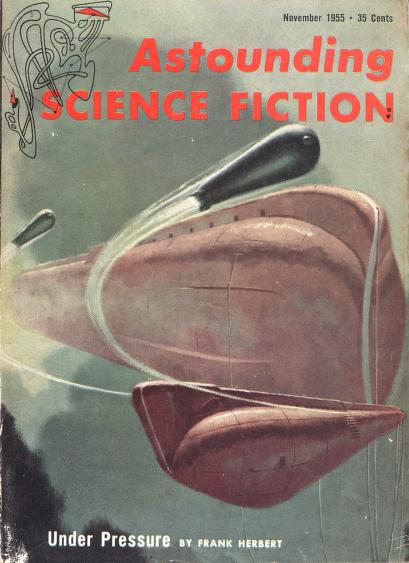
(Cover by H. R. Van Dongen. Astounding, November 1955.)
Who Goes There?
Frank Herbert is one of the most famous authors in the whole history of SF, despite the fact that most of his output continues to wallow in obscurity. How did this happen? He was born in 1920 in Washington State, raised Catholic but taking to Buddhism as an adult, served a brief stint (only six months) in the Navy during World War II, this last part being relevant to today’s story. He started out as a journalist and came to writing science fiction relatively late, already being in his thirties when his first SF story was published in 1952. A few years later and we got his first novel, serialized as Under Pressure and published in book form as The Dragon in the Sea. But that’s no what people know Herbert for. When it seemed like he was about to be another second-tier writer, doomed to be forgotten, Herbert struck gold with the serial Dune World, in Analog, which was very popular, along with its sequel serial Prophet of Dune. Both short novels, totaling eight installments, were then fused into one big novel, Dune, which became a bestseller overnight and which took home both the Hugo and the inaugural Nebula for Best Novel. The rest is history.
Of course, it’s not as simple as all that. Herbert had conducted an enormous amount of research for Dune, with this first novel in what would become a wide-spanning series taking years to gestate—unusual for genre SF at the time. Herbert wrote other novels over the next couple decades, but Dune was the thing that kept his name in the papers and on people’s minds, and indeed, even taking its faults into account, Dune was a revolutionary novel for the field. Herbert himself is a figure of some controversy, from his appropriating of Islamic culture to his well-documented homophobia to the question of whether or not he was even a good writer. Did he just happen to get lucky? I have to admit, being a third into Under Pressure, I do think there was at least some talent there.
Placing Coordinates
Serialized in Astounding Science Fiction, November 1955 to January 1956. It was published in book form later in 1956 as The Dragon in the Sea, revised somewhat (the language is a bit saltier, for one) but otherwise the same novel as its magazine counterpart. It’s still in print, I think, although truth be told I’ve never encountered anything Herbert that isn’t Dune-related in the wild. Has anyone seen a copy of this thing?
Enhancing Image
I assume most if not everyone reading this has already read Dune, which means we’re already aware of Herbert’s writing quirks, and you’ll be pleased (or maybe not) to know some of them have already manifested in Under Pressure. Well, the good news is that this is a much smaller novel than Dune, in both length and the scope of the action. We’re not given a whole world to play with, but instead the cramped and claustrophobic world of an atomic submarine—as envisioned in the 1950s, of course. Whereas it takes seemingly forever for Paul Atreides to emerge as the “hero” of Dune, we’re immediately met with our protagonist for Under Pressure in the form of John Ramsey. Ramsey is trained as an electronic officer, but his real job and profession is as a psychologist, an ensign from BuPsych (the Bureau of Psychology) assigned to the subtug whose crew is rated as the likeliest to succeed on an upcoming oil raid. This is important for two reasons: first is that in the 21st century (around what is now the present, actually), oil has become an increasingly precious resource, with the Western and Eastern (they never say “Soviets,” but we’re clearly meant to understand the East as the Soviets) fighting for control of this resource; the second is that of the last twenty Hell Diver missions, with these subtug oil raiders, all twenty missions ended in failure. A subtug crew is very small, only four men, and with the three men aboard this one BuPsych suspects there’s a “sleeper” among them—a spy who sabotages the submarine. So you have three highly qualified men, including their captain, but one of them is (probably) a traitor.
It’s here that we’re introduced to the crew, that being Captain Sparrow and his men Garcia and Bonnett. Sparrow is sort of an Ahab or maybe Nemo figure, whom BuPsych suspects of having a screw loose, but he’s also shown to be a highly capable skipper. Garcia is a Hispanic Catholic, which is curious because I would’ve expected the subtug’s crew to be all white Americans instead of mostly. Then there’s Bonnett, whom Ramsey nails as having an inferiority complex due to being raised in an orphanage. I should mention at this point that Ramsey is a psychologist of the sort you’d expect to see in pop culture in the post-war years, which is to say he’s clearly read a ton of Freud and Jung. Under Pressure is not nearly as aggressively Freudian as some other SF works from the era, at least not yet, although I’m not sure how much of that boils down to censorship from being printed in Astounding. Magazines at the time were generally more prudish than book publishers, but this was doubly the case with magazines John W. Campbell edited. Looking at the magazine and book texts of Under Pressure, there are immediately some small but still noticeable differences. For example, at the beginning in the magazine version, Ramsey calls a snooty secretary a snob, while in the book version he calls her a bitch. Maybe if Under Pressure had been serialized in Galaxy the mildly salty language would’ve stayed, but Herbert’s brand of SF is maybe a bit too hard-nosed for that magazine. Indeed the most impressive part of this novel, aside from Herbert’s estbablishing a setting that is suffocating both physically and mentally, it’s that Under Pressure reads more as speculative fiction than science fiction. Granted that I’m not even slightly an expert on submarines and have only an elementary knowledge of nautical terminology, it’s impressive that Herbert is able to make the reader feel as if they’re learning about subs while at the same time reading a psychologically gripping adventure story.
So Under Pressure is what might be called edutainment, which is a lable I don’t see used often nowadays, but back in the pre-internet days (and indeed in the early days of the internet, i.e., my childhood) there was a whole school of pop science that worked to educate the layman while also being entertainment. Hard SF is arguably a kind of edutainment, with the caviat that hard SF, being still a kind of SF, must out of necessity work on the basis of at least One Big Lie™. The author has to fudge the numbers or put their thumb on the scales to make something SFnal. Hal Clement admitted this much in an essay that accompanied the serialization of Mission of Gravity. Incidentally, a big reason Herbert’s novel works as edutainment is that Ramsey, who for much of this is our eyes and ears, has to learn about the minutia of the subtug at the same time as the reader. He’s given a five-week crash course in being an electronics officer aboard a sub with only four crewmen, all the while reading up on his shipmates so that he can better figure out if one of them is about to crack, or if one of them is the spy the government’s looking for. Not only does Ramsey have to sniff out the spy, but he’s keeping his job as psychologist a secret from the crew. Thus we’re introduced to a game of cat and mouse, made more intense because Sparrow and Garcia are religious men and Sparrow even more so is prone to episodes of Bible-quoting religious mania.
There Be Spoilers Here
The crew discover the tucked-away corpse of the former electronics officer, who may or may not have committed suicide, but otherwise there’s not too much action in this installment. The big realization Ramsey comes to by the end is that he is quite likely to die on this mission, either through sabotage with the subtug or one of the crew killing him outright. The problem with being in a submarine is that you’re hundreds of leagues below the ocean’s surface, so that there’s no such thing as a “small” mishap aboard ship. If you’ve watched Das Boot then you have an idea as to the mortality rates of submarine crews during WWII, and while the future war of Under Pressure is clearly based off the Cold War instead, the risk has not gone down much. This first installment ends with a kind of bewildering nightmare sequence, in which Ramsey’s fears of dying in the dephs of the ocean come to the surface. It’s a reminder that Herbert can be a creepy bastard, and also that despite his tendency to jump between characters’ heads, namely Ramsey and Sparrow’s he understands psychological drama.
A Step Farther Out
As someone who is a bit of a Herbert skeptic, I have to say I’ve been enjoying this quite a bit. We’ll see where it goes.
(Cover by H. R. Van Dongen. Astounding, November 1955.)
So I had read Anne McCaffrey’s “The Weather on Welladays,” and I didn’t like it. I’ve read Dragonflight and The Ship Who Sang, plus one other novel and a few short stories now, and I’m still not really sure what McCaffrey’s appeal is (I say this as someone who jumps to defend A. E. van Vogt’s early work). “The Weather on Welladay” isn’t bad, but it’s seriously hampered by being a novelette where the perspective shifts several times so that we have a few protagonists, when ideally we should have only one. I also just don’t think McCaffrey is that good a writer when compared with some of her peers, who were (and still are) not as popular. It’s nice that McCaffrey was the first woman to win both a Hugo and Nebula for fiction, but I wish those honors had gone to better writers. That’s the gist of how I felt about it, in case you’re wondering where my review post for it is.
The funny thing is that I had too good a time during the couple of days I normally would’ve spent on reading and writing for this site, which is ironic. I struggle to write here either when my personal life is at a peak or when it’s deep in a valley. I have to admit to you, the five of you who actually read these posts, that I sometimes resent writing—well, really anything, but especially for SFF Remembrance. Sometimes I just don’t feel like writing anything, but the problem is that if you stop writing then it can be a real challenge to start again. Writing (if you’re “a writer”) is like brushing your teeth, in that ideally it should be a daily activity. But I also don’t like writing that much; yet at the same time I can barely do anything else that would be considered “productive.” I work a service job. I pay my bills and my rent and my taxes like a “good American,” but I feel like I don’t create anything. I have this urge, or maybe this sense of obligation, to create something that is of any value, but I can’t do it. I hate myself and this country I am forced to live in. The environment is hostile, for creativity but also just for human decency. It’s like that Godspeed You! Black Emperor song: “We are trapped in the belly of this horrible machine, and the machine is bleeding to death.” I hate being here, and yet I’m not sure where I could be that’s better. I hate that this is a culture that worships money and productivity. We must have infinite growth, even if the destination is oblivion.
Putting aside that I’m forced to live in this body, and in this third-rate backwater country called America, things are going well for me! Maybe that’s the problem: on a personal I’m doing well, for the most part, but I get the sense that this contentedness will not last, because the world around me is dying. My surroundings are transient. There will surely come a point where the workers of the world will have their revenge and the last politician is strangled with the entrails of the last capitalist; but I’m convinced that I will not live to see any of this happen. Not even the beginning of it. I will have made my way for the exit before this play called The Downfall of Capitalism will have even gotten to its prelude. The curtains will not have risen and we will not see the stage, let alone the actors. There is a future on the way, but something tells me I won’t take part in it.
…
This is getting to be a bit much.
What’s the holdup? After all, it’s a packed month, as far as my review schedule goes, and I’ve really been meaning to get to some of these works for a hot minute. I’m also taking advantage of the loophole I had made for myself and so I have a serial from Galaxy, on top of a novella. We’ve got one story from the 1920s, one from the 1940s, one from the 1950s, one from the 1960s, one from the 1970s, one from the 1980s, and one from the 2010s. This might be my most diverse roster yet, in terms of when the works were published. Well, let’s get to it.
For the serials:
A Time of Changes by Robert Silverberg. Serialized in Galaxy Science Fiction, March to May-June 1971. Nebula winner for Best Novel. When Galaxy changed editors in 1969, readers at the time as well as historians are prone to say the change was a downgrade. One major plus, however, of Ejler Jakobsson taking over was that we got several Silverberg novels in the magazine as serials in rather quick succession. Despite the acclaim he was earning, A Time of Changes was the only Silverberg novel from this period to win a major award.
Under Pressure by Frank Herbert. Serialized in Astounding Science Fiction, November 1955 to January 1956. Also titled The Dragon in the Sea, this was Herbert’s first novel, after he had been in the field for a few years already with now-forgotten short fiction. Herbert’s legacy pretty much solely rests on his Dune series, to the point where it might surprise the reader to find any Herbert that isn’t Dune-related in the wild. I’ve heard from a friend or two that this is actually supposed to be one of Herbert’s best, but we’ll see about that.
For the novellas:
“The Lady Who Plucked Red Flowers Beneath the Queen’s Window” by Rachel Swirsky. From the Summer 2010 issue of Subterranean Online. Nebula winner for Best Novella. More controversially Swirsky also won a Nebula for her story “If You Were a Dinosaur, My Love.” She was also the founding editor of PodCastle, which is crazy to me because she was like, 26? She’s written a good deal of short fiction and poetry over the years, plus one novel so far.
“A Tragedy of Errors” by Poul Anderson. From the February 1968 issue of Galaxy Science Fiction. It’s been a minute since we last covered Anderson, made more conspicuous because he wrote a truly staggering amount of fiction. Of Anderson’s several series the most ambitious might be his Technic History, a centuries-spanning saga tracing the rise and fall of a galactic empire. “A Tragedy of Errors” takes place toward the end of this future history’s timeline.
For the short stories:
“The Storm King” by Joan D. Vinge. From the April 1980 issue of Asimov’s Science Fiction. Not quite as well-known as her late ex-husband, Vernor, partly on account of the fact that she hasn’t written much over the past four decades, but Joan D. Vinge was one of the most promising new writers of the post-New Wave era. She’s more known for her SF, but “The Storm King” is fantasy.
“The Woman of the Wood” by A. Merritt. From the August 1926 issue of Weird Tales. In the ’20s and ’30s Merritt was one of the most popular pulp writers, even getting a magazine named after him. I was set to review one of Merritt’s novels a couple years ago, but I could not get far into it. Well, now it’s time to correct things a bit. Curiously Merritt didn’t write much short fiction.
For the complete novel:
The Sorcerer’s Ship by Hannes Bok. From the December 1942 issue of Unknown. Bok was known far more for his artwork than his fiction, which is understandable given that he was one of the most gifted and recognizable SFF artists of the ’40s and ’50s. You kinda know a certain magazine or book cover is a Bok work just from looking at it. That Bok died relatively young and in poverty, after having all but retired from illustrating, is tragic. Of course, we might not even know about Bok in the first place if not for Ray Bradbury acting as cheerleader for his early material. Bok was really one of the few mavericks of SFF from that era, being a semi-closeted gay man with some niche hobbies, who was also a perfectionist when it came to his art. The Sorcerer’s Ship was Bok’s debut novel and was published complete in Unknown, but would not see book publication until after his death.
(Cover by H. R. Van Dongen. Astounding, September 1957.)
Who Goes There?
The story of how Robert Heinlein came to be one of the most important (and controversial) figures in American science fiction borders on mythology, not helped by the fact that Heinlein came pretty close to not pursuing a career as an SF writer. Born in 1907, in Missouri, Heinlein had a stint in the Navy for five years, during peacetime, although he would be relieved from duty due to chronic illness (such illness would torment him off and on pretty much for the rest of his life), then getting involved in democratic socialist politics in Califonia during the Great Depression. By the time he made his debut in 1939 it was on the eve of his 32nd birthday and he had already, unbeknownst to everyone, written a full novel, although it would go unpublished until after his death. While he was a true believer in SF and enjoyed reading it since before the term “science fiction” was even coined, Heinlein had to be coaxed into writing more by Astounding‘s young new editor at the time, John W. Campbell. Heinlein seemed to doubt the financial viability of writing for a living, let alone writing SF, but Campbell paid on acceptance rather than publication and the paychecks were good, all things considered. In some ways the two men were very different, Campbell being an authoritarian and a puritan while Heinlein was philosophically a libertarian at heart and, it must also be said, a bit of what we used to call a man-whore; but they were undoubtedly intelligent men who managed, if only for a limited time, to bring out the best in each other. This relationship would eventually turn sour, but that’s a story for another time—the point being that Heinlein was here to stay.
Heinlein’s rise to fame in what was admittedly a very insular field at the time was so fast that after only two years of being published he appeared as the guest of honor at the 1941 Worldcon, the last one held before Worldcon went on its World War II hiatus. Early Heinlein still reads well for the most part; not all of those stories were winners (for one I think “Waldo” is overrated and undeserving of its Retro Hugo win), but the best ones showed a talent not quite like anyone else. Heinlein arguably reached the height of his craft when, following the end of World War II, he signed a deal with Scribner’s wherein he would write a “juvenile” SF novel every year or so, aimed at teen boys. These constitute Heinlein’s most universally beloved work, and after reading a few of them I find it easy to see why: they combine plausible (which is not to say always accurate) scientific prompting with a surprising emotional dexterity, not to mention the restrictions Scribner’s imposed on Heinlein mean his worst habits are basically left off the table. Citizen of the Galaxy was one of the last of these juveniles, and is also one of those I’ve not been able to read before.
Placing Coordinates
Citizen of the Galaxy was serialized in Astounding Science Fiction, from September to December 1957, pretty much simultaneously with its book publication. This is one of Heinlein’s most popular juveniles, if Goodreads numbers are anything to go by, so it’s a bit strange to me that aside from an ebook edition it seems to be out of print. The last English paperback release was from Pocket Books, in 2005.
Enhancing Image
The opening stretch of this novel is both simple and not so much, in part because the very beginning is both masterly in its set-up and rather dense. The first line of Citizen of the Galaxy is one of the most famous of any Heinlein novel, with good reason, such that I won’t bother to repeat it here, only to say that Our Hero™ is Thorby, a frail and beaten youth who’s being sold at auction. In the future world (or worlds) of the novel, chattel slavery has apparently made a big comeback; and while some other writers may only have this serve as background flavor, or just as a way to kick off the plot, the topic of chattel slavery indeed seems to be what drives the whole plot. Thorby is an uncivilized young boy with no last name, who has gone through a few owners before, with scars on his back to show for it. He has quite the temper, and understandably has a hard time getting along with adults, seeing as how everyone he has known in his short life thus far has taken advantage of him. That all changes today when Baslim, a beggar with one eye and one leg, buys Thorby at a very low price; but while Baslim claims to be a beggar and looks the part, he soon reveals to Thorby that the act is simply that: an act. Sure, his disabilities are genuine, but Baslim is a lot more resourceful, along with having a lot more resources, than an actual poor man on the street. Having bought Thorby his freedom, Baslim takes the boy as his adopted son and wastes no time in a) teaching Thorby to be at least a bit civilized, and b) teaching him the ways of the “trade.” Thorby, while starting off much worse than other Heinlein juvenile protagonists, starts on an arc similar to those of his brethren in that he receives an education—only here it also involves being a runner for Baslim.
I should probably point out the elephant in the room and say that Heinlein was very much indebted to Rudyard Kipling, and that influence is especially transparent with Citizen of the Galaxy, which aims in part to be a riff on Kipling’s 1901 novel Kim. Now, it’s been a minute since I’ve read Kim, and truth be told when I did read it I found the dialogue a bit too impenetrable at the time, what with Kipling’s use of colloquialisms and cultural references to an India that would now be alien to all of us. Similarly the dialogue in Heinlein’s novel is more colloquial than is the norm for this author, in that while yes, Baslim is very much a mentor figure of the sort that Heinlein was a little too fond of writing, he’s shown to care genuinely about Thorby. Of course, the old man has both personal and political reasons for treating the boy as both a son and a pupil: he’s teaching Thorby to be street-smart, but it helps that Baslim turns out (unsurprisingly) to have anti-slavery connections. Heinlein, before he went off the deep end with later novels like Stranger in a Strange Land and Time Enough for Love, seemed content to present perfectly uncontroversial opinions in his work, especially his juveniles where his editor at Scribner’s would be watching him like a hawk. The previous Heinlein novel to run in Astounding, Double Star, was one of his “adult” novels (it also, incidentally, won him his first Hugo), but it had the unassuming message that racism is bad. Similarly Citizen of the Galaxy has the ice-cold take that chattel slavery is bad. (Of course, given how many politicians in US congress, both now and at the time of this novel’s publication, are Confederacy apologists, maybe it’s not that cold a take.) Mind you that this was written in the midst of Jim Crow and the Voting Rights Act was still a ways off. It may seem a little straightforward now, but the world of this novel is murky enough that I’m not too surprised it was basically marketed as both for teen readers in book form and for adults in Astounding.
But still this is, on top of being a space adventure (we start off on the planet Jubbul, which is clearly taking after a Kipling-esque India of the 19th century), a bildungsroman, or a novel of education. Baslim teaches Thorby to be a citizen of the galaxy in that he teaches Thorby multiple disciplines in a maybe implausibly short amount of time. This feeds into Heinlein’s idea of the competent man, an idea which has long since become a cliche in hard-nosed SF writing and I think justifiably derided in some circles. The idea goes that a man (it’s typically a man) should be a jack of all trades, or have competent (if not expert) knowledge in as many fields of study as he can muster. Heinlein’s competent man should know his multiplication tables, how to cook a meal, how to fish on the high seas, how to trade in the stock market, how to replace a flat tire, how to haggle, and so on. He should be able to name animals as if he were Adam in the garden. As he works with Thorby, though, Baslim seems acutely aware that, being a mentor figure in a Heinlein juvenile, his days are numbered. He not so subtly prepares Thorby for the worst, as if waving a big sign saying “I WILL DIE SOON,” but the boy tries not to take the hint. So, the old man comes up with an idea, which will turn out to be a final job he has for the boy, in which Thorby is to meet one of five contact, doesn’t really matter which one. Baslim, sensing that his death is imminent, basically puts down a bread crumb trail for Thorby wherein the boy meets one Captain Krausa, who, like Baslim, is secretly working against the slave trade in this part of the galaxy.
There Be Spoilers Here
I feel little like covering the back end of this installment, for one because a combination of my recent illness and my prescriptions for said illness have made it such that I’ve been struggling to think straight, truth be told; but also it’s not hard to figure out the roles of Thorby, Baslim, Captain Krausa, and even the bitchy old woman Thorby befriends before he leaves aboard the Sisu at the end. Baslim dies offscreen; he was to be “shortened,” or executed by police, but he had apparently opted to take Socrates’s lead and killed himself via poison before they could torture answers out of him. This is a fun read for the whole family. I would just like to take a moment and say that, going forward, both with this serialized review and generally covering Heinlein going forward, that while I still respect the man a ton, despite his many faults, I cannot stand to be around most of the people who claim to be his fans. It doesn’t help that the most famous of these right-wing Heinlein fans is also the richest man on the planet, a total rube who absorbs and then messily regurgitates every reactionary and outright fascist viewpoint that comes his way as if he were a human sponge. I think you pitiful fucking wastes of human flesh and bone ought to feel ashamed of yourselves—or maybe feel ashamed of something, if not necessarily your own character. Feel ashamed of the fact that nobody in your personal life really wants to spend time with you, because everyone you know at least secretly finds you repulsive. Maybe feel ashamed of the fact that you are one of the reasons why Heinlein is gradually being treated more and more like a black sheep, or that creepy uncle nobody likes to talk about, in SF fandom despite his monumental important. Consider for a moment that I don’t like you and that I would prefer you not keep reading this.
A Step Farther Out
Unfortunately I was not able to give this the deep-read treatment I wanted to, on account of a respiratory infection for close to a week now. Rest assured however that I’ll be good as new and looking forward to the next installment, which I should be able to write more about.
Most importantly, right-wing Heinlein fans can FUCK OFF.
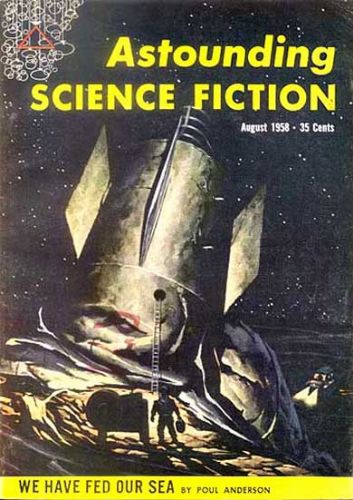
(Cover by H. R. Van Dongen. Astounding, August 1958.)
Who Goes There?
A big deal within the field from the ’50s until his death in 2001, Poul Anderson was a giant whose star power has lessened somewhat in recent years. You can easily find Anderson books (a seemingly endless supply of them) in used bookstores, but much of his work is currently out of print. This is all a little mystifying. Anderson has his quirks, but his range and productivity are impeccable, being one of those authors who, while he did write a lot more science fiction than fantasy, was comfortable with both. There is an Anderson book or series for every season; if you don’t like, say, the Nicholas van Rijin stories, then you might like the Time Patrol series. If you told me that Brain Wave and The Broken Sword, novels which came out the same year, were written by THE SAME GUY, I would shit myself. Curiosly, while he wrote many novels, many of which are acclaimed (I really like The High Crusade and Tau Zero myself), all of Anderson’s seven Hugos and three Nebulas belong to his short fiction.
We Have Fed Our Sea will strike a few people as familiar under its book title, The Enemy Stars. I picked this up for review because a) I’d been meaning to read it, and b) from what I could tell it sounded like a fitting counterpart to our previous serial, Joanna Russ’s We Who Are About To…, both literarily and philosophically. Not only is Anderson a generation older than Russ, but he’s also… well, a lot more conservative. Whereas Russ’s novel has an implicit but persistent layer of feminism in its thematic makeup, Anderson’s novel is much more typical of the hard-headed facts-and-figures SF that would’ve made the rounds in Astounding and later Analog.
Placing Coordinates
Part 1 was published in the August 1958 issue of Astounding Science Fiction. Anderson’s estate has been stingy about looking the other way for online reprints, so when seeing if an Anderson story has been archived it’s a real flip of the coin. I have to assume that something nefarious is going on since Anderson wrote a lot and a lot of it is out of print, and his estate isn’t keen on letting people actually discover his work without bending over backwards. Anyway, it looks like The Enemy Stars has not been in paperback since the ’80s; it has an ebook edition from Open Road Media, but Open Road Media is dogshit and I wouldn’t recommend giving them money unless you really have to. A reprint of particular interest would have to be The Best of Astounding: Classic Short Novels from the Golden Age of Science Fiction, edited by James E. Gunn (not to be confused with the other James Gunn), which collects The Enemy Stars along with a few other novels and novellas.
Enhancing Image
The opening passage of We Have Fed Our Sea is also perhaps the most memorable in Part 1, which is really unfair, because Anderson sets a standard for himself that he proceeds to not meet again; to be fair to him, that standard is pretty high. The launching and flight of the Southern Cross, the farthest traveling spaceship in human history, is described in almost Biblical terms, and Anderson wants us to know two things right away: that the universe is unfathonably big, and that the Southern Cross is nothing short of ancient. With this ship we’re not talking years but centuries, and while my gut reaction is to think that a spaceship would become outdated long before then, rendering the Southern Cross a metal coffin, this is a ship that seems specifically designed to be able to go the distance. Even so, its placement as a sort of generation ship where many people have died and even been killed gives the Southern Cross a slight haunted house vibe.
The effect is grand, yet ominous. Or maybe the other way around.
Get this:
After ten generations, the Southern Cross was not quite halfway to her own goal, though she was the farthest from Earth of any human work. She was showing a little wear, here a scratch, there a patch, and not all the graffiti of bored and lonely men rubbed out by their successors. But those fields and particles which served her for eye, brain, nerve still swept heaven; each man at the end of his watch took a box of microplates with him as he made the hundred light-year stride to Earth’s Moon. Much of this was lost, or gathered dust, in the century when Earthmen were busy surviving. But there came a time when a patient electrically seeing machine ran through many such plates from many ships. And so it condemned certain people to death.
The Southern Cross is on a voyage to rendezvous with a black star, what Part 1’s blurb calls a “burned-out supernova,” a thing blacker than space itself and which is possibly as old as the universe. The black star is the novel’s Big Dumb Object, although unlike most Big Dumb Objects it’s not an alien construction (as far as we know) but something completely natural. It’s just that the black hole is massive and, like the ship studying it, so old as to be practically ageless. Anderson is hunting big game with regards to visuals and a sense of wonder with this one, and he puts his best foot forward here. If the spectacle is spoiled by anything it’s the inevitability of human characters.
Speaking of which…
Before I started reading We Have Fed Our Sea I suspected that we would basically start on the ship with our principal characters already gathered together, and if not then there would be minimum setup. To my surprise, though, a good chunk of Part 1 is dedicated to seeing our main characters in their natural habitat before they get teleported aboard the ghost ship. I say “teleport” because teleporting is a central factor in the novel’s world; it’s called mattercasting, and it very well anticipates beaming individuals as seen in Star Trek. With modern technology teleporting Our Heroes™ onto the Southern Cross, despite it being light-years away from the closest human colony, is not a big deal, but teleporting off the ship may prove a problem.
Now for the players: We have Terangi Maclaren, a brilliant but lazy playboy scientist who signs up for the expedition as a way to prove his continuing worth in his field; David Ryerson, a dilligent and recently married young man who joins to appease his Christmongering father who happens to hold a death grip on his allowance; Seiichi Nakamura, a melancholy martial artist and devout Buddhist who joins because he wants to get away from the suffocating colony planet where he lives; and Chang Sverdlov, a would-be revolutionary who’s not very good at hiding the fact that he hates Earthlings and wants colonial independence.
Be aware that while Anderson’s novel is big on wonder, it’s not so big on women. There are two women in Part 1, one of whom I don’t even think is named, with both being satellites to two of our main characters. Ryerson’s wife exists to see him off and hope he comes back in one piece. At least the women are simply guided offstage quietly and aren’t stuffed in a fridge. Sexism is a bit of a problem with Anderson; he fairs a good deal better with regards to race. Unless I’m mistaken, Ryerson is the only white man in the crew, with the others being at least implied to be POC. There is a bit of a caviat with Nakamura, since he is, let’s face it, somewhat stereotyped: as said before, he’s into martial arts, he’s fixated on honorable behavior, and he’s the most timid of the crewmen. Yet Nakamura’s speech is not caricatured, he’s allowed to talk and act like a normal person, and as I’ll explain in the spoilers section, he’s arguably the most human of the bunch.
This is not to say that these introductory scenes with each of the characters gives us Henry James levels of psychological depth; the men are meant to fill roles, rather than act as individuals with inner lives. With maybe an exception or two every inner monologue anyone has has to do with either the plot or the worldbuilding, which is not necessarily a bad thing since worldbuilding is where We Have Fed Our Sea excels the most—not just the literal worldbuilding of the black star but a galaxy-spanning mankind. Since the days when Southern Cross flew into the depths of space, mankind has conquered quite a few colony worlds, united under the Protectorate (totally not the Federation from Star Trek), with Earth at the center. At it turns out, though, not everyone is happy to be living in a hostile environment, all while being farmed for resources by the heart of the Protectorate, hence the existence of rebels like Sverdlov.
Just going off of what has happened in the novel, I’m not sure where Anderson stands on the relationship Earth has with the colonies, which he depicts as being at least somewhat parasitic, while at the same time painting people like Sverdlov in a villainous light—not that this novel has (at least so far) an outright human villain. Anderson’s worldview changed considerably during the ’50s; he went from being a liberal who staunchly supported the UN to a hawkish Goldwater-era libertarian type. Actually, if anything, the reference to Rudyard Kipling with its magazine title (which, in my opinion, is easily superior to the oddly pulpier book title) suggests that by this point Anderson had become a Kiplingesque conservative. I wouldn’t be surprised, then, if he turns out to sympathize with the colonists while also thinking the Protectorate to be a necessary evil, if not benign.
There are a few questions Anderson doesn’t answer, such as: Where are all the robots? What about androids? If you have teleportation then surely you would have androids equal to if not better than humans. Why send such a small crew to the Southern Cross? What about backup? I suspect, however, that the government would see it as more costly to risk sending highly advanced robots on what almost amounts to a suicide mission than a bunch of ultimately expendable meat sacks. This is also very much an old-fashioned space adventure in the sense that there’s a surprising lack of computer technology onboard, what with stuff like the microchip not having been invented in the real world yet; but then this is also justifable given how fucking old the ship is. A few scratches and patches will prove to be the least of the crew’s problems.
There Be Spoilers Here
Like I said, Nakamura strikes me as the most human of the crew, which does lead to me feeling conflicted about him. On the one hand, making Nakamura Japanese was very much deliberate; it’s not like Anderson picked his race out of a hat. Nakamura’s backstory is a pretty tragic one: his family was killed in a natural dissaster, and this was after he had already been transplanted as a child, having moved from Japan to a colony world. Undoubtedly there’s meant to be an evocation of Japanese wartime trauma, reminding me specifically of the firebombing of Tokyo in 1945, though Anderson was probably thinking of Hiroshima. Of the four cremen, Nakamura’s backstory is easily the most death-haunted, and his fascination with space is made more peculiar by his fear of it.
I have to admit that Anderson’s novel subverted a few of my exepectations. Aside from the racially diverse cast I was surprised by the stance it took on space exploration, which is nowhere near as blindingly optimistic as I had assumed, especially given other Anderson works I’ve read. Joanna Russ’s novel We Who Are About To… is obviously a deconstruction of narratives in which mankind should and does seek out the corners of space, overcoming every obstacle, but Anderson’s novel is actually not too far removed from that viewpoint. While not as pessimistic as Russ’s novel, We Have Fed Our Sea, regardless of its title, alludes to the vastness and grand indifference of space which in practice comes off as malevolence; these are not the friendly stars, or the neutral stars, but the enemy stars. The cold dead star around which the Southern Cross orbits is an almost Lovecraftian presence, like Moby Dick, a great titan of nature which rejects human understanding. Yet like Moby Dick, there is a godlike magnetism with the dark star, and the same thing applies to space itself. In Moby Dick, Ishmael tells us he joins a ship and heads out to sea whenever a particular terrible bout of melancholy hits him, and Nakamura’s situation is not so different.
Metaphysical elements are not unknown to Anderson; he strikes me as a Christian, albeit a highly pragnatic one. Indeed the religiosity of his fantasy novel Three Hearts and Three Lions, which is topped with the protagonist even converting to Catholicism at the end (it’s not as preachy as it sounds), suggests a recurring conflict for any great religious writer: the conflict between science and God. Not science and organized religion, mind you, but science and the idea of a grand designer—an otherworldly force whose intentions are mysterious. As the crewmen find themselves in a precarious position at the end of Part 1, between technical issues and wanting to tear each other to pieces despite needing each other, it wouldn’t be a stretch to say their conflict is both physical and metaphysical.
A Step Farther Out
I suppose I was expecting a metaphysical angle, but I was not also expecting the political angle. It’s hard to tell with Anderson because depending on when a given story was written he can be pretty subtle or pretty cane-waving about it. The Protectorate and the colonies are not on the best of terms, and I’m not sure which side Anderson sympathizes with more, though I can chock that up to the characters all being sympathetic enough, or rather none of them is totally evil. Maclaren is a bit of an asshole, and Sverdlov is treacherous, but their viewpoints are not inexplicable; from the colonists’ view the “Earthlings” are callous and exploitative, while from the Earthlings’ view the colonists are ungrateful and reckless when it comes to the sheer vastness of the universe. Even with ‘casting, the universe is unfathomably huge, and my mind keeps going back to that introductory section with the Southern Cross and how it instantly conveys a foreboding sense of scale. The technobabble can be a bit much (I don’t understand half of it, and I suspect Anderson does it partly to distract less discerning readers), but this is looking to be enjoyable hard SF yarn.


 Science Fiction & Fantasy Remembrance