
Who Goes There?
To get the elephant in the room out of the way, sorry this is a day late, but I’ve been in the process of moving shit into my apartment and may have bit off more than I could chew with this one.
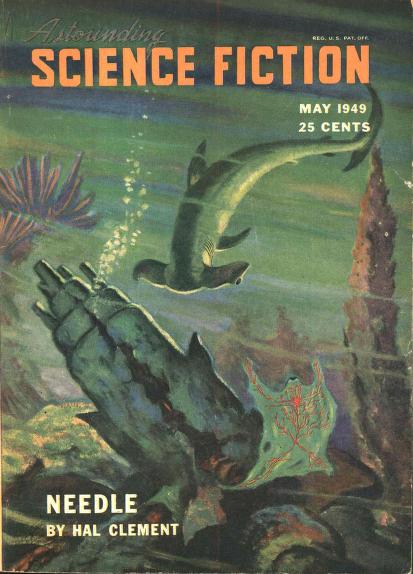
As for Hal Clement, the quasi-pseudonym of Harry Clement Stubbs, we’re talking about one of the codifiers of what we call “hard SF,” which is kind of a vague term, less a subgenre and more a way of understanding SF. If SF is the genre of ideas then Clement was one of its most loyal practitioners, and for six decades at that. He made his debut in 1942 with “Proof,” a story he wrote when he was but a sniveling teenager; but even at that early stage Clement’s work didn’t read quite like anyone else’s. Not to say he was a poet, at a time when genre SF writing could be pulpy or beige, because he really wasn’t; if anything his style is even more stripped back than what was then the standard. Rather what makes Clement different is that, for better or worse, his stories read like lectures—not in the sense that he’s wagging his finger at the reader, but more that his stories seek to instruct, while also being entertaining. You could call it edutainment. Despite being one of John W. Campbell’s discoveries, Clement’s work reads as more Gernsbackian than Campbellian, for reasons I’ll get into. “Attitude” is a very early Clement story, and yet, while it has a couple big issues, it also shows a barely-out-of-his-teens Clement doing what he does best.
Placing Coordinates
First published in the September 1943 issue of Astounding Science Fiction. It’s only been reprinted twice, in Travelers of Space (ed. Martin Greenberg) and the Clement collection Music of Many Spheres. I guess Clement or his estate let it fall out of copyright, because it’s on Project Gutenberg.
Enhancing Image
Dr. Little wakes up in an empty chamber that’s six-sided, “like the cells in a bee-hive,” with no memory of how he got here, only figuring the ship he was on, the Gomeisa, must’ve been attacked. He spends a few days by himself in this chamber, staving off hunger and boredom (how he goes to the bathroom is never answered), only subsisting on a tube that feeds him lime juice. Why lime juice? Question to be answered later. It shouldn’t come as a surprise that Little, along with the rest of the Gomeisa‘s crew, is being held captive by aliens. The alien ship had been on route to presumably their home world, with the human ship in tow, and before too long Little is reunited with the rest of the crew, nearly forty men all told. (Of course the ship’s crew is unisex, you’d have a hard time finding a spaceship crew in ’40s SF that wasn’t a sausage party.) Turns out they’re not the only ones being held captive, as there are also some Vegans (as opposed to vegans), sentient and rather furry aliens who are on friendly terms with the humans. It’s also a good thing the Vegans are here, too, as they’re able to communicate with the “pentapods” (as the humans take to calling them) up to a point. An unnamed Vegan acts as interpreter for Little and company.
It takes a minute just for us to meet up with the rest of the crew, which was an early indicator of my main issue with “Attitude,” which is to say its length borders on terminal. At 23,000 words it’s a decent-sized novellas, and honestly you could cut this down, say, a 15,000-word novelette without losing the meat of the story. There’s a lot of sitting around and chatting, with characters explaining things to each other (in fairness these are things that should be explained), to a point where it becomes a bit grating. Clement was not a “good” writer in the sense that we nowadays think of as good writing, at least for SF. Dialogue is not his strong suit, so it’s worrying that so much of “Attitude” is talking. This becomes a little ironic considering the pentapods (called that because they have five appendages and resemble starfish) never talk, and indeed the fact that they don’t or can’t talk to the humans is the main driving force behind the plot. If the humans were able to communicate with the pentapods then this would be a much shorter story, although curiously it would be no less violent. The pentapods had apparently taken the humans captive without physically harming any of them, doing this by restraining each man with their appendages. (The pentapods don’t seem to have heads or mouths, which makes one wonder how they eat, or indeed how they know what’s going on. Clement will explain their sensory capabilities to an extent, but some of it remains a mystery.) Little himself finds he had gotten both unlucky and lucky when the ship got taken over, as he should’ve died from sudden decompression, only being saved by a strange gas that puts one in suspended animation.
This will become important later.
Because “Attitude” is a Clement story, the characters (both human and alien) are basically reasonable beings, not prone to act on impulse. Clement’s fiction takes place in some weird alternate universe where people act in favor of their best interests. The downside of this is that because characters tend to not act irrationally, that greatly narrows the range with how you can write character interactions. For example, the Vegan interpreter is basically human, just with a different coat of paint, because the Vegans, while they are able to communicate with the pentapods, don’t seem to have anything culturally or linguistically unique about them. A Vegan thinks just like a person, which in Clement’s world is someone who thinks of everything as problems to be solved. This is like how in Mission of Gravity, the Mesklinites are like huge bugs, but otherwise they think and act like people. Then there are the humans themselves, who differentiate from each other very little. With the exception of the Dennis brothers we don’t even get first names for these people, which admittedly is not something we needed anyway. What’s more bothersome is just the fact that Little (who gets basically no backstory to speak of) spends a lot of time yapping with his fellow crewmen, especially after an escape attempt sends them to a partly underground fort, and a good deal of it could’ve been cut.
As for the positive side, those who assume ’40s SF to be all hard-nosed gun-toting tough guys will be pleased by the lack of machismo in Clement’s writing. Little and company are prisoners on this alien planet, but otherwise things are pretty chill; the pentapods don’t seem to have any intention of harming them, only trying to foil escape through non-lethal means, and the prisoners similarly are not too keen on resorting to violence. It’s telling that when the Gomeisa‘s captain talks about his men trying to defend their ship with brute force their “plan” did not work at all. This is a recurring thing with Clement’s fiction, that solutions are best sought through non-violent means, which is a bit strange considering Clement himself was by no means a pacifist: he was a bomber crewman during World War II and seemed to think back on his wartime service fondly, and he would later support the Vietnam War. But maybe it’s less about pacifism and more about non-aggression; this is, after all, about solving a problem, or a puzzle. If Campbellian SF can be loosely defined as problem-solving SF, then Clement fits the bill; but he’s also very much a continuation of Gernsbackian SF in that he’s trying to teach the reader something, sticking as close to the sciences as he understood—taking a few liberties into account, of course. Makes sense, considering he would later have a day job as a teacher.
There Be Spoilers Here
The Vegans have since figured out that the pentapods don’t have a verbal language, and as such they have an intricate sign language that would render something like radio useless—but television very useful. Mind you that TV really was a newfangled technology in the early ’40s, to the point where it would not have been commercially viable yet. Little suspects these aliens captured the humans and Vegans for the sake of studying their technology, to see if anything might be useful. The aliens ultimately are neither good nor evil, but simply different, and maybe more than a little curious. Of course, “gassing” the aliens (the aforementioned gas that does no physical harm) in the climax must’ve had a different ring to it in the wake of the Holocaust—ironic for a story in which nobody dies.
A Step Farther Out
I may have been in the wrong headspace to read this one, between the business of moving and now being on antidepressants, but while I found it intriguing in parts I also found it to be a bit of a slog overall. It’s overlong considering the conclusion Clement reaches, but I also have to admit I’m impressed that for how early it is in his career it seems like his “voice” was already more or less fully formed at this point. Given how young he was it’s surprising he already had the basics down, both in writing fiction generally and finding his own authorial voice.
See you next time.

 Science Fiction & Fantasy Remembrance