Who Goes There?
There have been power couples throughout the history of science fiction: Ed and Carol Emshwiller, Edmond Hamilton and Leigh Brackett, Damon Knight and Kate Wilhelm, and so on. These are creatives, be they writers, artists, editors, or what have you, who supported each other and fed into each other’s work. But the biggest power couple of the pre-New Wave years, even if it was laced with tragedy, had to be the marriage of Henry Kuttner and C. L. Moore. Kuttner and Moore both started in the ’30s, incidentally making their debuts in the same magazine (Weird Tales), and Kuttner even made contact with Moore as a fan of her work. They started as correspondents, but since they lived close together it didn’t take long for them to meet in person, and by 1940 they were married. They tried, and sadly failed, to have kids, but their bountiful output as writers would serve as their offspring. Each was prolific on their own (especially Kuttner, who was maybe one of the last of the old-school pulp writers), but together they formed a gestalt which called for a few pseudonyms. The ’40s saw the two contributing massively to Astounding, especially during the war years since several of John W. Campbell stable writers took a break from writing to join the war effort, with the ’50s seeing a downturn in productivity. It’s possible that Kuttner and Moore would’ve returned to writing full-time by the end of the ’50s, had Kuttner not died suddenly in 1958, just short of his 43rd birthday. Moore remarried, but she gave up the pen soon after.
A couple years ago I reviewed “Clash by Night,” written under Kuttner-Moore’s Lawrence O’Donnell pseudonym, which is an effective mood piece as well as one of the earliest examples of military SF I’ve encountered. SF historians tend to say that the O’Donnell name signaled a story in which Moore had primary creative input, which sounds accurate enough given that “Clash by Night” speaks to Moore’s style and emphasis on atmosphere over plotting. They eventually returned to the setting of that novella, it being a swampy and very much inhabited Venus. In stark contrast to Venus as we know it, the Venus of “Clash by Night” and Fury teems with alien life—much of it very hostile to humans. The human settlers, unable to take to land, built underwater cities known as the Keeps. But whereas “Clash by Night” is assumed to be Moore-driven, Fury was long thought to have been written by Kuttner alone, although Moore late in her life claimed to have been a minor collaborator on it. I’ve yet to find an edition of Fury that credits Moore as co-author, but I feel comfortable with crediting her here. Also, despite being marketed as the “sequel” to “Clash by Night,” Fury doesn’t share anything with that story aside from setting.
Placing Coordinates
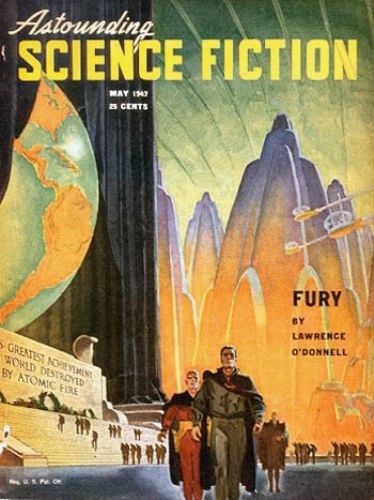
Serialized in Astounding Science Fiction, May to July 1947. It was published in hardcover in 1950 as by Kuttner alone, which has been the case with every subsequent reprinting (at least in English). It’s in print at least in the UK now, although it’s not hard to find used.
Enhancing Image
Similarly to “Clash by Night,” Fury begins with a fictionalized introduction which establishes the ensuing story as already having happened in some distant future. You could say it’s an attempt at a future history. Once we get past that section, though, Fury reveals itself to be quite a different beast from the earlier story, in subject matter and even in how it’s written. While “Clash by Night” has a more elegiac tone, Fury reads more like a pulpy detective novel. The protagonist, fittingly, is rather hardboiled. Of course, Sam Reed (born Sam Harker) has a good reason to be the way he is. But first, a bit of backstory, since Fury treats the reader as if they might not have read the earlier story, which is understandable considering it had been four years. About 600 years ago, humanity destroyed life on Earth in some nuclear castrophe, which meant that the only way humanity hadn’t gone extinct right then was a colony on Venus. The problem was that the flora and fauna on land would’ve had mankind for breakfast, so the settlers had constructed undersea domes called the Keeps. (How these cities would’ve been built in the first place, I’m not sure. Stories about man-made underwater cities tend to be vague about that part.) Life in the Keeps is hard knocks really no matter what your status is, but there has indeed come about an upper crust in this society, defined not so much by money as by genetics. “The Immortals” are not literally immortal, but they are extremely long-lived thanks to selective breeding. This was not a new idea, even in 1947 (see Robert Heinlein’s Methuselah’s Children from 1941), that eugenics may result in a group of people who can live, virtually without aging, for centuries. Eugenics comes up several times in Kuttner-Moore stories (more often, it must be said, when Kuttner is the one primarily in control), and its legitimacy is never really questioned, which is disquieting.
The Immortals are long-lived, and also conventionally attractive, in a world where the average person tends to be short and ugly, in keeping with the cramped environments of the Keeps. Sam would have enjoyed being handsome and long-lived himself, as a member of the Harker family, but his mother dying in childbirth compels his father to take revenge on baby Sam, which even Sam’s grandfather and great-grandfather (mind you that these people live for centuries at a time) think is a bad idea. The father not only gives up Sam but has him tinkered with before doing so, so that Sam grows up bald as an egg and decidedly unhandsome. Most importantly, Sam grows up without the knowledge of being a Harker, and without knowing he is himself an Immortal. As is typical among the Immortals, Sam’s parents were “hedonists,” which is to say they were basically drug addicts (sex being a big no-no in Astounding) who sat around doing nothing. The Immortals are generally given to being idle, as befits their status as the ruling class, although while they certainly are not in desperate need of money, what they really have over the rest of the Keeps is time. As for Sam, he grows up in the city’s underbelly, having been orphaned and denied his birthright. He thus comes to think of himself as Sam Reed. You may notice, if you’re reading Fury, that Sam’s a bit more unlikable (by design) than the standard SF protagonist of the day, which is saying something considering “heroes” in SF magazines at the time tended to be actually anti-heroes. Sam is an unrepentant criminal who has a strong resentment towards the Immortals (understandably), and he’s not above doing anything heinous in the name of getting his way. He’s also, ya know, rather ugly.
During Carnival, Sam, now forty years old and notorious in the underworld, meets Kedre Walton, a lovely woman and an Immortal, being some 220 years old, although she looks maybe middle-aged. There’s some romantic tension between the two, although it’s complicated by a) Sam (so they both think) not being an immortal, and b) Kedre being Zachariah’s mistress. Zachariah is Sam’s grandfather, although Sam doesn’t know this. So there’s a bit of an age gap between Sam and Kedre, but that turns out to be the least of their problems. (It’s also worth mentioning, at this point, that the Immortals seem to play fast and loose with regards to monogamy. This is similar to the Free Companions, defunct by the time of Fury, who in their day had so-called “free-marriages” which were basically open. This is a progressive view of relationships, all things considered.) The Immortals know Sam is hot shit in the underworld, and they want him to do some dirty work for them: to kill Robin Hale. Hale is a former Free Companion, which is to say he used to be a mercenary, waging naval warfare on Venus for hard cash, but the Free Companies have long been disbanded and Hale has become disillusioned with the Keeps’ complacency. Surely humanity has to conquer “landside” somehow or slowly perish underwater, if only from decadence. Kedre and the others think Hale’s plan to unify the Keeps for a colonization effort will fail, for one, but also it will jeopardize Immortal supremacy. If there’s anything the Immortals hate, it’s change. Sam agrees to the job, but realizes pretty quickly that he’s totally expendable in this affair, since as far as anyone knows he’s just one of the proletariat. There’s also the issue of Jim Sheffield, a rival of Sam’s in the underworld, although Sam forgets about this for a while once he takes on the Hale job.
Quite a few characters are introduced in this first installment, and unfortunately while Kuttner was good at many things, writing three-dimensional characters wasn’t really one of them. The women here, namely Kedre and the popular dancer Rosathe, are made to be temptresses who are as likely to lead Sam to his doom as anything. The men are better, but not by that much. Maybe the most curious character here, if only because his function and powers strains one’s suspension of disbelief, is the Logician, an oracle who disguises himself as a super-computer, for the sake of the people who converse with him. I mentioned that faith in eugenics is very much played straight here, and that includes the Logician having been selectively breed to (get this) predict future events with supernatural accuracy. I mean fuck, it may as well be magic. The Logician himself is aware that his ability is a tough pill to swallow, hence his wizard-of-Oz routine. Sam himself is more interesting as a symbol than as a character with a Shakespearean personality. It’s made clear from his genetics that Sam is meant to be highly intelligent and even charming, and that had he been raised among the Harkers he might’ve used these traits for good—or maybe not. It’s actually not clear at all that Sam’s positive qualities would’ve been better put to use as a patrician than as a member of the criminal class. As it is he’s totally amoral, a man who loathes the Immortal less out of moral conviction and more out of jealousy, and even his opting to help Hale instead of killing him is done more as a pragmatic maneuver than anything. Would Sam have become a better person had his dipshit father accepted him?
There Be Spoilers Here
At lot happens in the back half of this installment, so only twenty or so pages. This is a fast-moving novel, considerably more so than its prequel, and in book form it totals only about 180 pages. Now, Sam and Hale conspire to garner public approval for colonization of landside in record time, and they need to do it fast because “the Families” expect Hale to be dead within 48 hours, and then if he isn’t by then it’ll be both of their heads. Just when the Immortals will take their vengeance on Sam, he’s not sure of, because the Immortals understand time itself differently from everyone else. (As an aside, I still find it amusing that they use physical film reels. Technology in the Keeps is very analog, despite this being like the 27th century. Writers at the time could envision undersea cities on Venus, but they couldn’t envision the microprocessor.) The plans, miraculously, at least in the short term, and Sam is even able to make a ton of money off the situation. Unfortunately he forgot about Sheffield, and he’s also unaware that Rosathe has been scheming behind his back this whole time. They don’t kill him, however, instead drugging him and making him unconscious for forty years. Or at least he blacked out, as he doesn’t remember the past forty years at all. So he’s eighty now, and yet when he looks at himself he finds that he hasn’t aged, which should be impossible. Unless—?
A Step Farther Out
There’s a literary quality to “Clash by Night” which Fury noticeably lacks, although given the change in subject matter it’s easy to understand why the style here is pulpier. Kuttner was not as precise a writer as Moore, but here the ruggedness of Kuttner’s style fits with the grimy underbelly of the Keeps. We’re talking about a story that, even in its opening stretch, involves murder, backstabbing, and forced drugging. This is less proto-military SF and more consciously (it seems to me) taking after Heinlein’s ’40s work. It also, by sheer coincidence, has a twist at the end of the first installment which anticipates Heinlein’s The Door into Summer by a decade. If “Clash by Night” is somber then Fury is a lot more vicious.
See you next time.
 Science Fiction & Fantasy Remembrance