Who Goes There?
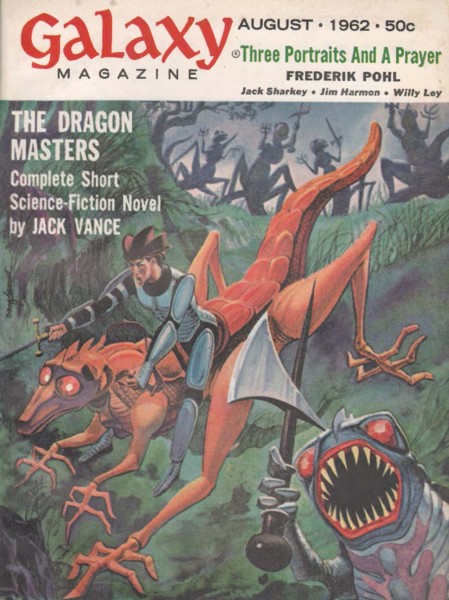
Jack Vance had one of the longest careers of any SFF writer, from his debut in 1945 to just before his death in 2013. For better or worse, Vance’s interests, along with his technique, didn’t evolve that much over the decades; the man’s work in, say, the ’80s, is recognizably akin to what he wrote in the ’50s. His importance to the field is certainly more dependant on his work as a whole than on any single book or story, even if The Dying Earth is one of the most innovative fantasy “novels” (it’s really a story cycle) of its era. He also wrote a lot, and consistently, to the point where he’s one of those authors I sometimes fall back on for material. But while he was prolific and respected in his time, he doesn’t seem much read today, which is maybe fine by him, since Vance always preferred to keep a low profile. Early in his career there was speculation among fans that he was actually a pseudonym for some other writer, namely Henry Kuttner, and it got to where at least one magazine editor had to dispel these rumors. Vance was indeed a real person, although even in his Hugo-winning memoir, This Is Me, Jack Vance! (or, More Properly, This Is “I”), he doesn’t talk much about his methods as a writer, or indeed much about his personal view of the world. Perhaps the idea is that his stories speak for themselves.
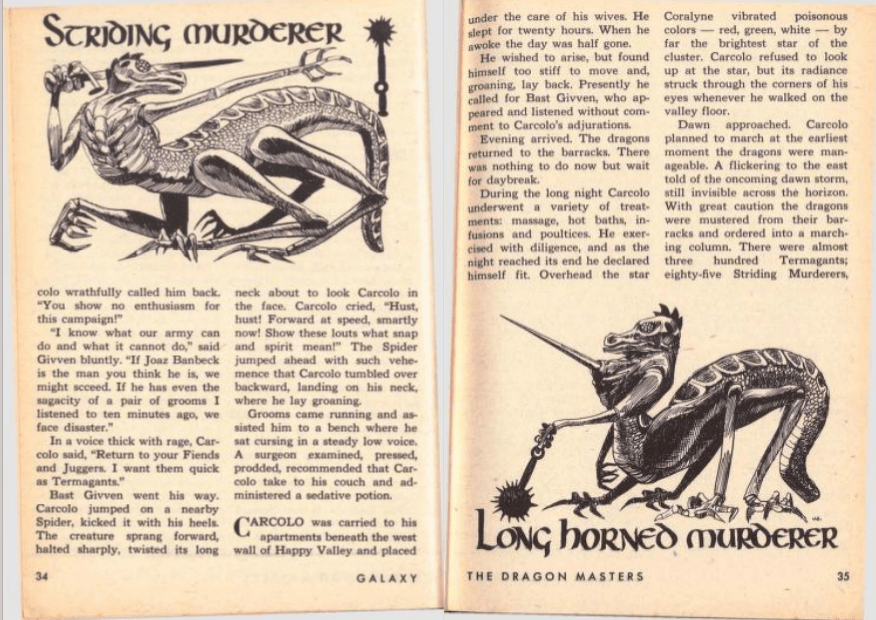
Reading enough of Vance’s work, one can ascertain certain parts of what makes the man tick, and somehow, despite not really being a “fan” of him (I like but have yet to really love any of his work), I’ve read my fair share of Vance. “The Dragon Masters” is a longish novella, just under 30,000 words maybe, which very much falls in line with some other Vance I’ve read, although taken on its own it’s a pretty compelling tale of far-future intrigue and swashbuckling action. Despite what the title would have you think, this is a work of pure science fiction, albeit one taking place on a distant planet wherein humanity has devolved into quasi-barbarism. By the way, if you read this I seriously recommend tracking down the copy of Galaxy it first appeared in, which comes with quite a few illustrations by Jack Gaughan. The interiors for “The Dragon Masters” show some of Gaughan’s best artwork from this period, and maybe singlehandedly earned him a Hugo nomination. I do feel like you lose a little something if you read Vance’s story on its own, which sadly goes for every reprint.
Placing Coordinates
First published in the August 1962 issue of Galaxy Science Fiction. This is one of Vance’s more famous stories, as well as acclaimed (it won a Hugo), so it’s no surprise to see it reprinted many times over the years. “The Dragon Masters” first appeared in book form as one half of an Ace Double, the other half being Vance’s earlier short novel The Five Gold Bands. The most convenient reprint nowadays would be The Dragon Masters and Other Stories, which comes with two of Vance’s strongest novellas, “The Last Castle” and “The Miracle Workers.”
Enhancing Image
Aerlith had, at some point, been colonized by humans, although while the colonization was basically a success, the human settlers are besieged, over and over again, by an advanced alien race called the grephs (now called Basics), who keep human slaves and kill the rest by bombarding their settlements from the air. The grephs are a strange mix of reptilian and insectoid, being vertebrates with scaley armor like reptiles but having more than four limbs and with the mobility of bugs. Of course, like most reptiles, they also lay eggs and spawn many at a time. They’re also big enough that a human can ride on one, which will come in handy for one daring human commander named Kergan Banbeck. Kergan and his troops manage to capture more than a dozen grephs, called “the Revered” by their brainwashed human soldiers. These slaves destroy the ship the grephs had come in on, leaving the settlers once again stranded; but the good news is that they’re able to take advantage of the imprisoned grephs, who serve as ground zero for generations of mutated grephs, hence why they’re called Basics in the present day. With the power of eugenics the humans are able to breed selectively quite a variety of beasts who come to be called dragons. Vance’s descriptions of the different subspecies of dragon are rather sparce, made more vivid by Gaughan’s interiors, so that’s another good reason to read the magazine version. Aerlith is a harsh environment, with long days and a rocky landscape, so naturally its inhabitants are also harsh.
There’s another party here, the sacerdotes, who don’t seem to be indigenous to the planet and who are, while humanoid, only somewhat related to homo sapiens. They’re a nomadic people who quite literally wander the earth, naked except for a torc each wears around their neck, and they’re also fiercely religious. The sacerdotes consider themselves to be both the first and last humanoids in the universe, the “Over-men” who maintain neutrality partly out of a sense of superiority over their human cousins. This becomes a problem in the present day, since Joaz Bandeck, Kergan’s descendant, hears of a sacerdote wandering into his laboratory when it was supposed to be guarded (the guard was taking a nap). Joaz has been studying the movements of the planets in Aerlith’s solar system and has come to the conclusion that, if prior visits from the Basics are any indication, another visit is due soon. Joaz is the head of Bandeck Vale, and despite being a military leader he’s also rather an intellectual, which is the opposite of his rival, Ervis Carcolo of Happy Valley. Ervis is ruthless, but also suffers from a case of Chronic Backstabbing Disorder, almost to the point of stupidity. So you have four parties in this mess, actually: Joaz, Ervis, the Basics, and the sacerdotes. Much of “The Dragon Masters” has to do with the years-long rivalry between Joaz and Ervis, and while neither of these men is all that heroic, Joaz is clearly the protagonist. In typical Vance fashion he’s sort of an anti-hero, but the parties he’s up against are much worse.
I had read this story a few years ago, but could barely remember anything about it. So, a reread was in order. I’m glad I did, although I have to put myself in the mindset of a Galaxy reader in 1962 and not someone who’s read a decent amount of what Vance wrote after this point. Reading too much Vance can give one a sense of déjà vu, since he does like to explore the same themes and character archetypes over and over. His virtues but also his limitations are on full display, albeit in a nicely self-contained novella here. For one, there is a single woman in-story, named Phade (no last name given), a “minstrel-maiden” who basically exists to act anxious about the stuff going on, and also to be a friendly face for Joaz. I mean, it could be a lot worse. There’s also intrigue as to what female sacerdotes might be like, since the only ones the humans have seen in the wild have been male, but nothing much comes of this. Vance also seems to be fixated on the idea that humanity, if gone astray from “civilized” life on Earth, will inevitably revert to a kind of medieval feudalism. The humans on Aerlith have lost touch with Earth to the point where that’s not even what they call it, but rather it’s often referred to as Eden—the sacred place from which humanity sprung. It’s worth mentioning that Vance was politically right-wing, although having read his memoir he doesn’t seem all that religious. This is not a Christian story so much as it’s an example (one of many) of Vance’s thesis that such a society might be the “natural state” of mankind. This is a bit of an odd thesis to have in a story that’s also ultimately about the so-called indominable spirit of man, with Joaz embodying that spirit.
Joaz is at a crossroads, because he can’t trust Ervis, the latter being convinced that the warning about the Basics is just a ploy, and at the same time he can’t get the sacerdotes to do anything to help the humans. He even suspects that the sacerdotes, who act unconcerned about the impending Basic threat, are secretly in possession of a super-weapon. He knocks out a sacerdote and dons a disguise as one of them (which yes, means walking about in the buff), but this doesn’t work out. The sacerdotes are not given to violence, but they have a knack for trolling, or playing word games with those trying to interrogate them. Joaz finds this out the hard way. One of my favorite scenes is a lengthy exchange between Joaz and the sacerdote we saw at the beginning of the story, in which getting straight answers out of the latter is like a puzzle for the former. For while the sacerdotes are not given to lying, they’re like an old-school text-based adventure game in that they require weirdly specific lines from the questioner in order to be useful. Vance has a habit (in his more fantasy-tinged works, not the really early stuff) of writing dialogue for his characters such that they sound stately and more than a little theatrical, which at times can be distracting, but that’s not so much a problem here. Anyway, turns out that the sacerdotes have a complex network of tunnels that would give them shelter in the event of attack, but also ways to sneak around the enemy, including a passage that leads to Joaz’s lab. It’s a good thing these nudists aren’t hostile.
While Ervis is functionally the villain of the story (at least for most of it), and is by all accounts a bastard, he’s not totally without redeeming qualities. Joaz has a friend in Phade, so similarly Ervis has a shoulder to lean on in the form of Bast Givven, his right-hand man and one of the titular dragon-masters (it has a hyphen in-story but not in the title, how strange). Bast is the Horatio to Ervis’s Hamlet, in that he doesn’t seem to exist outside of Ervis’s role in the story, but he also functions as the straight man to Ervis’s theatrical antics. Happy Valley would pose more of a threat to Bandeck Vale, except it’s not as well-armed and, frankly, it suffers from subpar leadership. It also doesn’t help that by the time Ervis realizes the Basics really are invading, it’s too late to make amends with Joaz. Fighting the Basics would’ve been easier, and presumably the story would’ve been a bit shorter, if the human forces were able to unite for longer than literally a day. It’s a good that these characters are a step above cardboard, because we do need something to anchor us while so much shit happens in the span of almost ninety magazine pages. (That number is rather deceptive, though, since I would say at least a dozen pages are dedicated to Gaughan’s interiors.) Vance could’ve reasonable expanded this into a full novel, given how many variations of dragon and human slave there are (so many that Vance barely has time to describe them all), but the plot itself is worth novella-length. By modern standards especially this would come as compressed almost to the point of fitting on the head of a pin, but then it doesn’t overstay its welcome.
There Be Spoilers Here
The back end of “The Dragon Masters” is a clusterfuck, truth be told, in that I felt like I was almost being read a transcript for a session of Dungeons & Dragons or Warhammer 40,000. (Of course, you have to remember Vance was a big influence on the former.) The idea is that victory against the Basics is hardfought, and rather bittersweet. Joaz takes Ervis prisoner and decides to have him executed immediately, although it’s not a decision he makes happily or in haste. So yes, Ervis gets killed off-screen at the very end, which I can’t help but feel is anti-climactic. As tleast Joaz spares Bast, and even appoints him as the new leader of Happy Valley. Even so, the battle and the aftermath have taken at least somewhat of a toll on Joaz, who now has to help rebuild with the others. We’re left wondering if what the sacerdotes are right and that the humans on Aerlith are some of the last of their kind in the whole universe, or if there really is an Eden they can return to someday. Vance ran several series, but “The Dragon Masters” is a one-off, which means we never really get an answer—not that we need one. Some other writers would’ve taken the wealth of material here and at least turned it into a full novel, but Vance was content with what he wrote.
A Step Farther Out
Merry Christmas, by the way.
It’s been a while, or at least it feels like it’s been a while by my standards. I’m way behind on reviews, and for no particular reason except that I’ve felt lethargic as of late with both reading and writing. I keep getting into these slumps and I’m not really sure how to get out. On the bright side, taking longer than usual does make sense with reviewing “The Dragon Masters,” given its length, quality, and reputation. When it comes to Vance I generally like him best when he writes novellas, although the best of his short stories are about on par with those. Not big on his novels unless you count The Dying Earth, which I don’t. But “The Dragon Masters” is long, dense, baroque but not too baroque, and filled with action and intrigue. I gotta say, though, I do prefer “The Miracle Workers.”
See you next time.



 Science Fiction & Fantasy Remembrance