(Cover by Frank Kelly Freas. Satellite, December 1956.)
Merry Christmas, happy birthday to me, and all that.
People who keep up with my posts may have noticed that I missed a couple things last month, including what was to be the start of the second serialized novel, Kuttner and Moore’s Fury. Let’s say I’ve been slow about it. Generally I’ve been slower about keeping up with this blog than I was a year ago, and there could be a few reasons for this, but the point is that I’ve come to understand I’m not as on top of my own blog as I once was. I’ve slowed down with the “required” reading, and I’ve been slower about writing, although (not to toot my own horn) I still write here more than some other fan writers I know. Maybe nowadays the load I give myself is just a bit too much, especially since I’ve also been wanting to get into writing professionally, for that bit of extra money, only I’ve not been able to find the time and/or motivation for it. So, I’ll lighten the load a bit. From now on I’ll only be covering one serial a month, regardless of length. Of course, if the serial is four parts or longer this won’t make a difference, but a lot of serials are three-parters, which should give me an extra day to myself. Other than that, it’s gonna be business as usual.
What do we have on our table? All science fiction, which isn’t very diverse, but when these stories were published is certainly more diverse. One story from the 1940s, one from the ’50s, one from the ’60s, one from the ’70s, one from the 2000s, and one from the 2020s.
For the serial:
Fury by Henry Kuttner and C. L. Moore. Serialized in Astounding Science Fiction, May to July 1947. Kuttner and Moore wrote so much, both together and each solo, that they resorted to a few pseudonyms, one of them being Lawrence O’Donnell. Fury takes place in the same universe as the earlier Kuttner-Moore story “Clash by Night.” Despite Fury historically being credited to Kuttner alone, Moore claimed years later to having been a minor collaborator.
For the novellas:
“Welcome to Olympus, Mr. Hearst” by Kage Baker. From the October-November 2003 issue of Asimov’s Science Fiction. Baker had spent much of her adult life working in insurance and with theatre as her primary hobby, before pivoting to writing SF in her forties. No doubt she would still be writing SF today, had she not died all too soon in 2010. Still, for about a dozen years she wrote furiously, with her big series following a team of time-traveling secret agents.
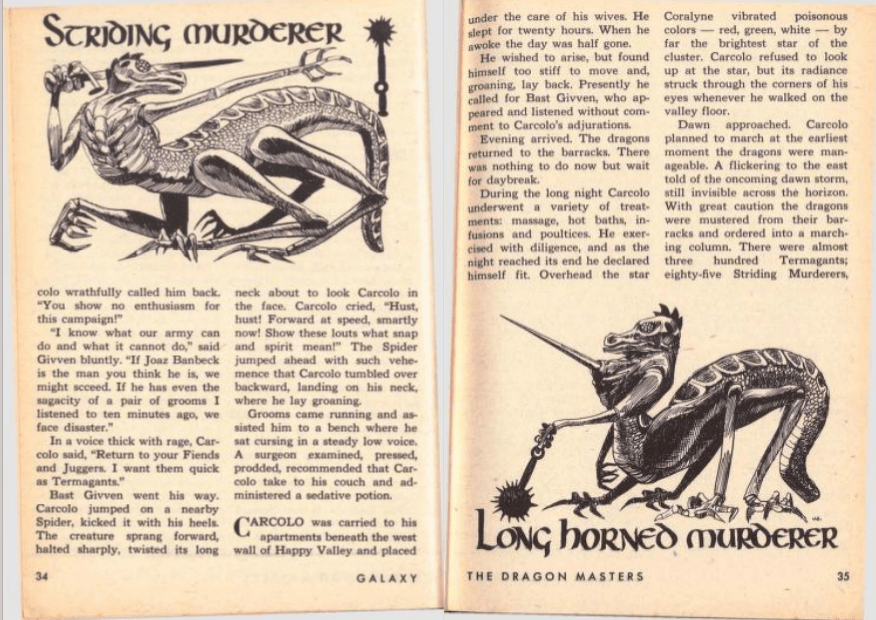
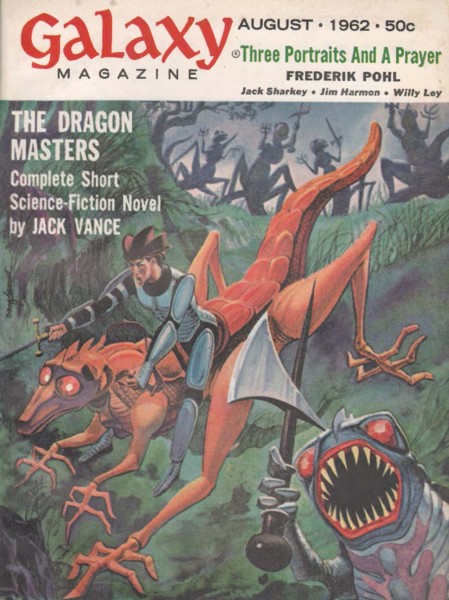
“The Dragon Masters” by Jack Vance. From the August 1962 issue of Galaxy Science Fiction. Winner of the Hugo for Best Short Fiction. This is a reread, although I only have a vague memory of having read it in the first place, and that was without Jack Gaughan’s accompanying artwork. Despite what the title might make you think, “The Dragon Masters” is pure planetary SF, albeit with fantasy-esque coloring that Vance had become known for at this point.
For the short stories:
“An Important Failure” by Rebecca Campbell. From the August 2020 issue of Clarkesworld. Winner of the Theodore Sturgeon Memorial Award. Born and raised in Canada but now living in the UK, Campbell has written only one novel so far, which in fact was her first SF writing of any sort. Good news is she’s been somewhat prolific in writing short stories and novellas over the past decade.
“The Earth Dwellers” by Nancy Kress. From the December 1976 issue of Galaxy Science Fiction. This is the third time now that I’ve come to Kress, and why not? Her career now spands nearly half a century, and her stories, if not always entertaining, often provide some food for thought. I know nothing about “The Earth Dwellers,” except it marked Kress’s very first appearance in the field.
For the complete novel:
A Glass of Darkness by Philip K. Dick. From the December 1956 issue of Satellite Science Fiction. This book sounds unfamiliar, even for seasoned Dick fans, although it may ring a bell under its book title: The Cosmic Puppets. Dick had burst onto the scene in the early ’50s as one of the most promising short-story writers at the time, in a generation that included such bright newcomers as Robert Sheckley, Algis Budrys, and Katherine MacLean. It only stood to reason, then, that while writing short stories nonstop was all well and good, writing a novel was the logical next step. A Glass of Darkness wasn’t the first novel Dick wrote, but it was the first to be published.
(Cover by Earle Bergey. Space Stories, December 1952.)
Who Goes There?
Jack Vance is one of the most influential 20th century SFF writers, and also not read nearly as much as you’d think. If the Goodreads numbers are to be believed. Vance debuted in 1945 but did not have his first major work published until 1950, with the novel (or collection of linked stories) The Dying Earth, one of the most important works of fantasy of all time. I do very much recommend The Dying Earth: it’s very short, and yet is packed with what would become Vance’s trademark baroque prose, his sarcastic sense of humor, and his seemingly limitless invention. Vance wrote the stories that make up The Dying Earth in the mid-’40s, but could not get them published for some time, and indeed these stories read like nothing else in American fantasy at the time—not even Vance’s SF from the same period. You may read, for instance, Big Planet and not suspect that the same guy wrote bejeweled far-future fantasy, if going off the prose style (or rather the lack of it) and nothing else. I had covered Big Planet last May, as a much-needed reread, but for this May I reached for one of Vance’s lesser known novels, one which is sort of a B-side to Big Planet.
Big Planet and Planet of the Damned were published mere months apart, and it’s likely they were also written in close succession. Unfortunately, as I had just implied, while Big Planet is the hit single, a real breakthrough for Vance as a world-builder, Planet of the Damned is the lower-effort B-side that smells of “second verse, same as the first.” But it’s not entirely lesser than its big (haha) brother, for there are a couple things Planet of the Damned at least tries to do better. Unfortunately this is not quite enough. Vance can either be pretty interesting or pretty dull (and honestly you have no way of knowing in advance), and this is a case of the latter.
Placing Coordinates
First published in the December 1952 issue of Space Stories, which is on the Archive. The publication of this novel is rather convoluted. The first book version is actually an abridgment, I assume so it could share one half of an Ace Double with Big Planet (that version of Big Planet was also shortened from the magazine version), and it was retitled Slaves of the Klau. We would eventually get a complete reprint of the magazine version, but it still kept the latter title. To make matters more confusing, Vance would revise it and retitle it again, this time as Gold and Iron, which is the version now in print. Have you lost track of it yet?
Enhancing Image
Humanity has come into contact with the Lekthwans, who have taken to sort of colonizing Earth benevolently, with the tradeoff being that humanity has gotten access to advanced Lekthwan technology. The Lekthwans themselves are basically humans but with golden skin, and by Earth standards are said to be conventionally attractive; it’s more their way of thinking that makes them alien, rather than their looks. The Lekthwans are sort of like proto-Vulcans, in that they see humans are lesser humanoids, given to irrationality and emotions and all those pesky things. At the very least the Lekthwans still have a sense of opulence, and they have their own conception of fun—which can’t be said for the other dominant humanoid race in the galaxy, the Klau. “The Klau are completely practical. Everything is planned for exact use, whether it makes people happy or not. There is no gaiety on the Klau worlds,” so a Lekthwan in the beginning tells us. Roy Barch is a grizzled tough guy working for Lekthwans on Earth who also happens to pine for his alien boss’s daughter, Komeitk Lelianr, who seems to take an interest in the human but who also makes it clear that said interest is not romantic. The opening section of the novel almost reads like a romance drama, and indeed bizarrely the novel could be considered a love story.
Barch and “Ellen” (the human name he gives Komeitk Lelianr) are the obligatory man-woman couple at the novel’s center, which on its own would’ve been pretty standard for early ’50s SF, but to Vance’s credit he does add a twist or two that doesn’t strictly have to do with the fact that Barch has a boner for a gold-skinned space babe. Vance is not known for his female characters, but while I’m on the side of listing positives, Ellen has to be one of Vance’s more clearly defined and assertive women, even if it shouldn’t come as a surprise how she’ll ultimately feel about Barch. Ellen is aloof and condescending in the manner typical of her race, but unlike a lot of ’50s SF women she isn’t given to screaming or shrewish rantings, nor is she a pulpy action heroine in the making; rather, uncharacteristically for the time, she comes off as the Eeyore to Barch’s Winnie the Pooh. (That’s a weird comparison, but I hope you get my meaning here.) She’s cold, even fatalistic—not because she’s cowardly but because she thinks that’s just the way the world works. When Barch takes Ellen on a “date” she more or less berates him for thinking of her as something to be gained, as opposed to someone he might share his life with. “You may feel passion, but you feel no love,” she says. And initially she might be right on that. Their relationship is one that evolves organically—or at least more so than most attempts at romance from this period of genre SF.
When the Klau raid Earth, killing most of the people around Our Heroes™ and taking the two as slaves to the labor planet Magarak, Ellen basically accepts it as her lot in life. The Klau hate the Lekthwans with a passion, but in their haste they seemed to confuse Ellen for a human, hence (probably) why she was taken prisoner. So Barch has to be the assertive one. Let’s talk about Roy Barch, or rather let’s not, since there isn’t much that can be said about him that doesn’t have to do with his relationship with Ellen or indeed his tenuous relationships with other aliens on Magarak. Barch is… more conventionally written, although that’s in the context of genre SF at the time; compared to some other Vance protagonists he’s rather unconventional. Vance’s heroes (or more often anti-heroes) tend to use their wit to get out of sticky situations, lacking the means to intimidate physically, whereas while Barch is by no means stupid, he’s certainly the brawn of the pair. He has suddenly found himself in a hostile environment, having escaped from a prison ship and taken refuge, along with Ellen, in a cave called Big Hole where other refugees hide out; and unlike someone like Cugel the Clever, Barch will have to twist some arms. And he has to deal with difference races with different cultural attitudes. “Thirteen different races, thirty-one different brains; thirteen basic mental patterns, thirty-one sub-varieties. An idea which aroused one would leave another indifferent.” Much of the novel will be concerned with this division.
I brought it up before, but unfortunately I’ll have to bring it up again since the two novels were written and published so close together, and are both planetary adventures; but Planet of the Damned sadly lacks what made Big Planet captivating, even given that novel’s flaws. In the slightly earlier novel we’re introduced to a planet with an eccentric gravitational pull, size, and geological makeup, and so we’re introduced to some eccentric locations, wildlife, and human societies. The locale is the point of the damn thing, never mind that the plot is just a string of events with a dwindling party of stock characters. Magarak is nowhere near as interesting as Big Planet, in part because Vance spends far less time describing it, which makes me wonder where much of the wordage for either novel goes. If Big Planet is maybe 60,000 words then Planet of the Damned is maybe 50,000 words or just under that. (I’m referring again to the magazine versions.) The shorter novel feels longer somehow. It took me a few days to get through Big Planet while I’d say it took me about a week to read Planet of the Damned, and I suspect it was more of a slog because there was less to chew on. Similarly to Big Planet, Planet of the Damned has a random-events plot in which there is not subplot to speak of and in which the end goal is pretty simple: get the hell back to Earth. I’ve noticed that Vance tends to structure his novels episodically, with a single overarching plot or a series of plots rather than the traditional plot-plus-subplots method.
Again, all the aliens are some flavor of humanoid, and there isn’t much in the way of encountering non-humanoid life. We get that Magarak is a shithole but we aren’t given much insight into its ecosystem or how humanoids have adapted to it. Now, you may recall there are side characters in Big Planet, some of whom are fairly memorable; the same can’t be said of the side characters in this novel. Vance implies depth and diversity with the ensemble, but we get next to no time with these characters as individuals. Clef presents himself as the closest the novel has to a flesh-and-blood antagonist, but he gets killed off rather early on. Consider that the motley crew of Big Hole at one point gets boiled down to a list:
There were the three Splangs, Tick, Chevrr, Chevrr’s small dark woman; there was Kerbol and his dour gray mate; Flatface and his two quarreling bald half-breeds; the Calbyssinians, whose sex still remained mysterious; Pedratz, taffy-colored and smelling like a bull; Sl, the double-goer; Lkandeli Szet, the musician; the six silent Modoks; five Byathids; Moses, the dwarf; the handsome youth Moranko; the cat-like Griffits, who had silently asserted rights to the first two of Clef’s women; there was [Roy Barch] and Komeitk Lelianr.
But to bring the positive vibes back, there is at least the hinting of diversity, which is something Vance can be quite good at. Vance himself was a conservative, a fact which can rear its head in his fiction at times, but he was open to depicting people and societies with values very different from his and with a minimum of judgment—or at least a minimum of sarcasm. Vance can be dryly funny, and while there are a few jokes I noticed here it’s still less humorous than more characteristic Vance material. Vance’s trademark ornate language is also absent here, as also happened with Big Planet, replaced with a much more unassuming and unadorned prose style that could be charitably called “standard ’50s SF prose.” Vance had already written The Dying Earth at this point, so it’d be inaccurate to call the blandness of style here the result of a young writer finding his voice; rather it seems like Vance is trying to pass off as a robust but disposable pulp writer.
There Be Spoilers Here
Big Planet takes place a few weeks if I remember right, whereas the plot of Planet of the Damned unravels over the course of months—and then years. The good news is that Barch and his comrades are able to construct a ship out of basically scrap metal that can get some of them off the planet, but the bad news is that at some point (I’m not sure when this would’ve happened) Barch and Ellen had sex and now she’s pregnant with his child. Apparently humans and Lekthwans are genetically similar enough that they can crossbreed; this is a bit of hand-waving, but at least it’s explained in-story as something that can happen. (At one point early on Ellen becomes a willing concubine for Clef, and it’s implied they also have sex, but due to Clef being Klau the child be his—so we’re told.) I wanna take a moment to applaud Vance for going just slightly past what would’ve been the norm with this, since it would’ve been uncommon for human characters to actually have sexual relations with aliens at this point in SF writing. There would’ve been a fair bit of titillation, but it was mostly a “look, but don’t touch” deal. This revelation pushes a wedge between Barch and Ellen and by the climax they have parted ways, and when Barch leaves the planet he doesn’t know where his not-quite-girlfriend is. Had the story ended at this point, with the slaves successfully rebelling against the Klau on Magarak, it would’ve been a perfectly bittersweet ending.
When Barch eventually returns to Earth he finds that he has become a sort of John Brown figure, a symbol of rebellion against the Klau; in that way he has become something of a celebrity. Unfortunately it’s also time now to reunite with Ellen, whom he has not seen in five years—and by extension his son, whom he has never seen before. “The child was a boy, and his skin was a pale clear gold. Komeitk Lelianr was quieter, thoughtful, though she looked a little older.” Barch and Ellen weren’t really a couple up to this point; there was always something in the way, either Ellen’s reluctance to treat Barch as an equal or simply bad circumstances. I would consider Planet of the Damned rather bland and depressingly average overall, but I do really like this ending. There’s this inversion where the main couple partake in what we think of as intimacy, but it’s only long after that initial encounter that they start to care enough about each other that they’re willing to take a big risk by raising their child together. It’s an interesting inversion of the traditional romance arc and it’s a good deal more mature than what most of the rest of the novel would lead you to believe. I would describe the ending as consciously optimistic, and that while he does phone it in for chunks of the novel, Vance does something kind of exceptional in the last handful of pages. I wonder if he had thought of the ending first and tried coming up with a serviceable plot that would get him from point A to point B.
A Step Farther Out
There’s some debate as to what counts as Vance’s first novel, since The Dying Earth is more of a short story collection, and The Five Gold Bands is more of a novella by modern standards (though for the sake of this site I’m counting it as a “complete novel”). Big Planet would then be Vance’s first “true” novel, in which case Planet of the Damned would be the sophomore slump. If you were a genre reader in the ’50s you could be reading much worse, but also there’s not much one can get from Planet of the Damned past a space adventure which even at the time must’ve seemed surface-level. It doesn’t show Vance as the unique voice that he was, nor does it build on the intricacies of Big Planet. A minor shame.
Not much to say with regards to updates here, other than I’m looking into a tutoring gig and I seem to be starting a polycule, the latter of which I’ve heard is kinda like starting a rock band. If anyone wants to join, please let me know. There are no gimmicks for this month’s review forecast, except that we have a complete novel on our hands for the first time in what feels like forever, and we’ve got a few familiar faces returning to the site. I may have also intentionally picked Lucius Shepard and Aliette de Bodard stories with similar titles. One thing I’ve been thinking about that I’ve decided to act on is reviewing more reprints of classic stories; one every couple months seems like a good deal. The reason for this is at least twofold: I have a soft spot for the classics, but I also wanna cover authors from the pre-pulp years who contributed to genre fiction. This month I’ll be reviewing an SF story by Jack London, who is not known primarily for his SF but who indeed wrote a lot of it. Once again Jack Vance will be providing the novel, which is unsurprising since quite a few of his novels first appeared in magazines, either as serials or all in one piece like this month’s novel.
Don’t wanna keep you long; just letting you know we have another month packed with fiction that looks to be at least interesting, although it’s mostly SF with a couple fantasy stories thrown in.
For the novellas:
“Birthright” by April Smith. From the August 1955 issue of If. Smith sadly is one of many women who wrote SF in the pre-New Wave days whom we know basically nothing about. We don’t know when she was born or when she died. She’s a ghost. She has one solo story, “Birthright,” to her credit, plus one collaboration. ISFDB classifies this story as a novelette, but running the Project Gutenberg text through a word processor shows it’s just over 17,500 words.
“Polyphemus” by Michael Shea. From the August 1981 issue of The Magazine of Fantasy and Science Fiction. Shea had a varied career, lasting from the ’70s until his death in 2014. His work ran the gamut from SF to high fantasy to the Cthulhu Mythos. He won the World Fantasy Award multiple times for his fantasy and horror. His most famous story, “The Autopsy,” is an SF-horror hybrid, and “Polyphemus” looks to be a similar blend of the two genres.
For the short stories:
“The Shadow and the Flash” by Jack London. From the June 1948 issue of Famous Fantastic Mysteries. First published in 1903. London was one of the most popular and prolific authors of the early 20th century, despite dying young. He’s best known for his adventure stories set in the Klondike, such as The Call of the Wild and White Fang, but he also wrote a surprising amount of science fiction.
“The Witch of Orion Waste and the Boy Knight” by E. Lily Yu. From the September-October 2016 issue of Uncanny Magazine. Yu burst onto the scene with her story “The Cartographer Wasps and the Anarchist Bees,” which nabbed her several award nominations. She won the Astounding Award for Best New Writer the same year she graduated from Princeton, which is no small feat.
“The Jaguar Hunter” by Lucius Shepard. From the May 1985 issue of The Magazine of Fantasy and Science Fiction. Speaking of late bloomers, Shepard didn’t start writing fiction as an adult until he was deep in his thirties, but he quickly emerged as one of the defining SFF writers of the ’80s. If you’ve read enough Shepard then you know he has a “type,” and this story looks to be typical Shepard.
“Descending” by Thomas M. Disch. From the July 1964 issue of Fantastic. Feels like it’s been a long time since I covered Disch, with his novel Camp Concentration. Disch was one of the daring young writers to kick off the New Wave in the ’60s, although despite being a regular at Michael Moorcock’s New Worlds he actually first appeared in Fantastic, under Cele Goldsmith-Lalli’s editorship.
“The Defenders” by Philip K. Dick. From the January 1953 issue of Galaxy Science Fiction. It’s been ten months since I last talked about Dick on here, which in my book is too long a wait. The thing about Dick is that he’s become frankly over-discussed in “serious” SF discussions, or at least his most famous novels. Thankfully this is not the case with many of his short stories, such as this one.
“The Jaguar House, in Shadow” by Aliette de Bodard. From the July 2010 issue of Asimov’s Science Fiction. Of Vietnamese heritage, living in France, and writing predominantly in English, de Bodard has a curious cultural background, so it makes sense she would concoct one of the most curious future histories in modern SF. Spacefaring humanity here is decidedly non-white and non-American.
For the complete novel:
Planet of the Damned by Jack Vance. From the December 1952 issue of Space Stories. The early ’50s were a formative period for Vance, who was showing himself to be one of the most imaginative talents at the time—albeit one whose efforts were mostly relegated to second-rate magazines. I’ve previously coveredBig Planet, which was a breakthrough title for Vance, and now we’re on Vance’s follow-up novel, published just a few months later. Planet of the Damned has a rather convoluted publication history: as with Big Planet, the magazine version and not the first book version served as the basis for future “definitive” reprints. It’s also been printed as Slaves of the Klau and Gold and Iron.
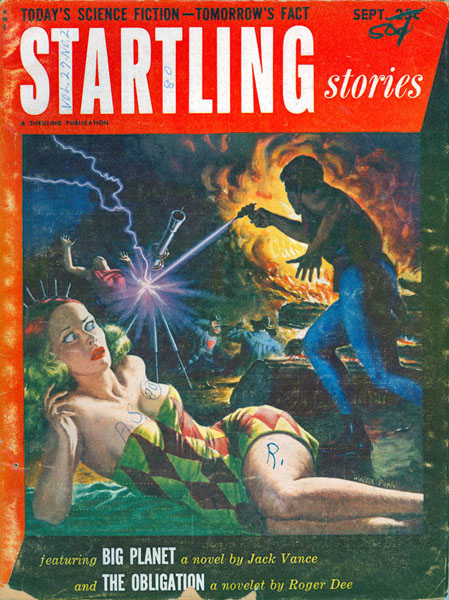
(Cover by Walter Popp. Startling Stories, September 1952.)
Who Goes There?
It’s been a while since I’ve reviewed a “complete” novel here, and unlike last time this one is actually complete. Today’s novel, Big Planet, is a rare case where the magazine version of the novel serves as the basis for the definitive text, as opposed to the first book publication. I’m not even sure what Jack Vance’s first novel would be. Wikipedia says Vance’s juvenile novel Vandals of the Void was his first, but this was published after the magazine versions of Big Planet, Slaves of the Klau (magazine version titled Planet of the Damned) and The Five Gold Bands; and then there’s The Dying Earth, which may or may not count as a novel (I personally don’t count it). Thing is, Vance wrote a lot, especially from the ’50s through the ’70s. If you read enough Vance you pick up on certain pet themes of his and certain quirks (we might say limitations) which can grate on one’s sensibilities. I like Vance because he’s convenient to mine for review material.
But Vance is arguably the most important American SFF writer of the 20th century that the fewest people have read; his most famous work, The Dying Earth, has fewer than 10,000 ratings on Goodreads as of this writing. To put this in perspective, The Shadow of the Torturer, the first part of Gene Wolfe’s The Book of the New Sun (ya know, that science-fantasy series nerds will tell you is criminally overlooked) has more than double the ratings. Wolfe fans ought to read Vance at some point, since the former clearly owes a debt to the latter; but this also applies to fans of tabletop RPGs, whose mechanics (particularly those of Dungeons & Dragons) take after Vance’s depiction of magic in the Dying Earth series. Especially for his fantasy, Vance has left a distinct mark on genre fiction in the latter half of the 20th century, although not many people are aware it’s his mark.
Big Planet is science fiction from start to end, though, and unlike The Dying Earth it did not inspire a future trend; rather, what makes Big Planet unique for its time is its dedication to mixing planetary adventure with scientific plausibility, with a strong dash of anthropology. This is a novel where the setting is the main character—that while we find out little to nothing about the human characters propelling the action, we do get many passages in which Vance fleshes out the many locales and societies on Big Planet (for that’s the planet’s name). Because this is a fairly episodic novel, without any real subplots, I won’t be doing a point-by-point rundown but instead will focus on the novel’s ambitions and flaws as an experiment—for it’s certainly an interesting novel, though not a perfect one.
Placing Coordinates
First published in the September 1952 issue of Startling Stories, which is on the Archive. Whereas Startling Stories tended to publish borderline novellas and abridged or easly versions of full novels, Big Planet appears complete here at about 60,000 words, and for a quarter-century (according to Wikipedia) this would be the best version of the novel you could find. The first several paperback editions, including the Avon edition in 1957, were abridged in some way, so keep that in mind if you’re into collecting vintage editions. Nowaodays, though, you can find a complete and in-print version of Big Planet easily, with the Spatterlight Press paperback being your best bet. The Spatterlight Presss edition also comes with an enlightening introduction by Michael Moorcock as he admires both Vance and Big Planet while recognizing the novel’s unusual place in Vance’s oeuvre.
Enhancing Image
We start with a ship that’s heading for Big Planet, a ship containing a commission team from Earth who are supposed to get info on a certain rascal named Charley Lysidder and bring him to justice. Why? Because Lysidder is becoming the biggest warlord on Big Planet, which is a high benchmark because Big Planet is filled with warlords and slave traders. The commission team is headed by Glystra, who will be our protagonist (he doesn’t seem like it in the first couple pages, but watch out), followed by Cloyville, Bishop, Pianza, and some redshirts. We spend about a minute on the ship before everything goes to hell; there’s a spy aboard. The skipper and first mate get their throats cut and the ship crash lands on Big Planet, 40,000 miles from Earth Enclave, basically an embassy and the only safe space for Earthmen. “To land anywhere on Big Planet except Earth Enclave meant tragedy, debacle, cataclysm.” Never mind literally halfway around the world. It turns out that Big Planet bears its name for a good reason.
We get casualties before we’ve even landed on the planet and there are more once we do, including the ship’s stewards and a nun who did not have any lines up to this point and whose body is not even recovered. (Be sure to put a pin in that last part.) It’s bad enough that Glystra and the survivors landed on the other side of the planet, but also they have no means of getting to Earth Enclave in a timely fashion; a trip, assuming they make it, will take weeks. The reason for this is that not only is there no electricity for Big Planet tech, there’s very little metal—to such an extent that metal is measured by the ounce. Big Planet has a wide diameter (yeah, duh), but it manages to have about the same gravity as Earth by virtue of being very poor in metals. Indeed the locals who discover the crashed ship waste no time in tearing it apart for scraps as the materials alone would make them rich.
There are no spaceships or cars on Big Planet—also no birds, for some reason. You’ll have to hoof it, or find a wagon or some alternate means of transport that doesn’t require metal or electricity. This is all pretty near, by the way. Vance goes out of his way to explain why Big Planet is an Earth-like setting, complete with gravity that doesn’t crush the human characters, by explaining that in some ways it is like Earth—only it lacks metals. The energy weapons Glystra and others carry are valuable because they’re powerful and accurate (there’s something called an ion-shine, which I don’t even know what the fuck that’s supposed to look like so I just think of it as a raygun), but they can also be traded for precious resources and information if need be simply becausse of the rarity of the materials. Importing metal to Big Planet is illegal (or rather the Earth federation has enforced a metal embargo on Big Planet) probably so as to not upset the balance—hence one of the reasons why Glystra wants to take Lysidder to Earth authorities.
There’s one other thing: the people on Big Planet don’t fuck around. Glystra and his team will come across bandits, cannibals, despots, and if they’re really unlucky, Republicans. For both better and worse, Big Planet is a sandbox wherein damn near anything is possible so long as you don’t need 20th century technology (or shit, even 19th century technology) to achieve your goals. Any pre-industrial system of government would be possible here. We don’t read about socialist collective farms, but it’s not hard to imagine those existing—successfully—on Big Planet. The whole thing has a whiff of pastoralism about it, not so much in the Clifford D. Simak tradition but in how Vance seems to think that people, if left to their own devices, will gravitate towards feudalism or agrarianism. If you read enough Vance you’ll get the impression that he a) hates cities, and b) is consistently wary about organized religion, which is curious for classic SF.
Oh, one more thing…
The team gets a recruit in the form of Nancy, a Big Planet native who apparently has nothing better to do with her time than accompany a bunch of soldiers and bureaucrats on what amounts to a suicide mission. Nancy is not this woman’s proper name but for the sake of my sanity, and because every other character calls her Nancy henceforth, I’m calling her that. She’s the token woman of the group, which sounds… a bit dubious. I guess it’s better than nothing, but don’t go to Nancy looking for a layered character with a rich interior life, because she will only disappoint you. Then again, Glystra is the most developed character here and that’s by virtue of being the guy who gets to call the shots; if he was in the position of say, Corbus (the ship’s chief engineer, now Glystra’s right-hand man) or Bishop then we would find out basically nothing about him.
Nancy joining the team is inexplicable, and even Glystra can’t help but notice this—though it doesn’t occur to him that Nancy knows something he doesn’t. It could also be that Nancy is attractive and Glystra is too busy getting bricked up in the middle of the mission to think about how this may not be a random encounter for long. Get this:
Something was out of place. Would a girl choose such a precarious life from pure wanderlust? Of course. Big Planet was not Earth; human psychology was unpredictable. And yet—he searched her face, was it a personal matter? Infatuation? She colored.
Is he projecting? Is he dense? Maybe.
Going back through my notes, it’s striking me how many characters show up and how many of them I’ve already forgotten about. There are episodes early in the novel that aren’t exactly Shakespearean; this could be explained by the team being a little overcrowded at first, although it does get whittled down as the novel progresses. Who the hell is Darrot? I don’t remember anything him except that he was on the ship, and then he gets killed off unceremoniously, “his dead face turned up.” There are run-ins with bandits and a very odd scheme involving river monsters that I couldn’t quite wrap my head around, only being able to surmise that it involves locals being tricked into thinking that these beasts are carnivorous. We meet so many people in the first half of the novel that it almost becomes like a joke. “If [Glystra] set about righting the wrongs of everyone they met, they would never arrive at Earth Enclave.” I guess this is a price one has to pay with an episodic structure, because it’s like we’re on a riverboat at a theme park and we’re watching all the sights on the river’s edges but we’re not allowed to wallow in them.
Something I noticed about Big Planet that makes it stick out from most Vance I’ve read is that it lacks the affected language of Vance’s Dying Earth stories—indeed, much of his work in the ’60s onward. This is not merely the result of Big Planet being an early work, because The Dying Earth precedes it and that “””novel””” has some of the most purple prose you’ll find in American fantasy fiction. No, it’s more, I suspect, that Big Planet was written with magazine publication in mind; and yes this was still early in Vance’s career, before he had garnered a reputation as one of genre fiction’s most baroque practitioners. Vance’s tendency to adorn his prose with fancy vocabulary and have his characters in a rather mannered fashion, lacking verisimilitude, can turn some readers off, so those same people might find the straightforward (to the point of curtness at times) language of Big Planet to be refreshing; personally I don’t like or dislike it.
It’s here that we reach the cutoff point, though, because about halfway through the novel we get to the best part and Vance’s purest bit of invention for the novel. We’ve come across a few villages and groups of scoundrels up to this point, but we have not encountered a city—which is where Kirstendale comes in, for the precious few chapters we spend there.
There Be Spoilers Here
The team comes across a trolley service that makes travel a bit less painful, though it’s still no match for cars back on Earth. It’s here that we enter the most memorable location in the novel: the decadent city of Kirstendale. The midpoint and indeed much of the back end of the novel is concerned with Kirstendale, either as a setting or as a carrot on a string for Our Heroes™ since it represents the height of culture and luxury on Big Planet—which naturally means it has a few caveats. Compared to what has been dealt with up to now, though, Kirstendale is a paradise. “It was the largest and most elaborate settlement the Earthmen had seen on Big Planet, but it was never a city which might have existed on Earth.” It’s no wonder that Cloyville decides to stay behind in Kirstendale once the team gets moving again.
The class system in Kirstendale is pretty weird; it’s hard to describe. Not only is metal a precious material here (as expected), but the city and its environs are barren as far as animals fit to be eaten goes. Meat is a luxury that has to be imported, and in a pre-industrial world, without planes or even steamships, you can guess how expensive bringing in meat would be. As such Kirsters (as they’re called) are generally vegetarian, although it’s implied that they will resort to eating bugs if they see it fit. Prestigue in the city is also pretty much entirely performative, in that it’s not your family line or even how much money you have that detemines your status as much as how you carry yourself, such that someone can act as both master and servant in the span of a single day depending on what clothes they’re wearing. As far as I can tell Vance was a conservative, but his playing with class barriers—poking fun at the tenuousness of class division—must’ve tickled Moorcock’s pickle. This is the most entertaining and inventive section of the novel.
If you read enough of this novel you may be wondering where that bastard Lysidder is. Like where he at? The fuck? The man does not even appear, let alone have a line of dialogue, until the final stretch the novel. Glystra meeting Lysidder face to face is one of those moments, like Charles Marlowe meeting Kurtz in Heart of Darkness, where the man has been shrowded in so much mystery as to become a mythological figure. This is made more stark by the fact that once we do get to Lysidder, Corbus and Nancy are the only fellow travelers in the party left—and Nancy turns out to have been working for Lysidder the whole time. Wow, the woman who’s been acting a little suspicious for dozens of pages is the spy! Indeed she was disguised as a nun at the beginning of the book, hence her secrecy and the fact that we never saw the body; she had faked her death, only to take on the role of a simple Big Planet girl once the team sets out.
Glystra takes it easy on Nancy because she’s a woman her partnership with Lysidder is framed as abusive… or so she says. Glystra and Corbus come up with a different plan for Lysidder and his henchmen, which on a reread surprised me more than it must’ve initially. Having hijacked Lysidder’s “air-car,” Glystra decides to drop the scoundrel off in the middle of nowhere, far out enough where going back to his hideout would probably be suicide—but technically it would be possible to survive in this new environment. “If you stay here, you’ll probably have to work for a living—the worst punishment I could devise,” Glystra tells Lysidder half-jokingly, and that’s the last we see of the novel’s villain. It’s not all a loss for Lysidder, though; if his final argument with Glystra is to make the case that forcing Big Planet under Earth rule would be a mistake then the villain wins, because Glystra and Corbus end up not going to Earth Enclave after all.
Precious commissions to Earth Enclave are said to have never returned, mostly probably because they meet a grisly end, but there’s the implication that those who survive don’t come back because they find Big Planet to be a sort of Eden—a garden untarnished by industrialism and imperialism. With the resources they already have, Glystra and Corbus would be rich enough to become landowners, maybe even return to Kirstendale and catch up with Cloyville, and ultimately they decide that’s better than to have Big Planet become yet another satellite for Earth. Sure, conditions are rough, and even at its most decadent it’s not a place for the weak, but Vance seems to be telling us that maybe it really is better to reign in Hell than serve in Heaven. A bit of an unconventional happy ending, but I like it.
A Step Farther Out
So there you have it. In some ways Big Planet is a simple novel; it reads almost like an escort mission in a video game, which if you play your fair share of games doesn’t sound like a good time. True enough it does threaten to get monotonous at times, partly because of the characters being little more rounded than cardboard and coming and going through the narrative as they please, but it also shows Vance refining his craft as a novelist. Its best parts, which could almost work as short stories in themselves, read like episodes in a larger narrative, though this is not a fix-up like The Eyes of the Overworld, the first real novel in the Dying Earth series. In hindsight the episodes blur together with the exception of the first stretch, the episode in Kirstendale, and the finale, which admittedly is a pretty good finale by Vance standards. This is an early work that shows Vance trying to write a conventional adventure SF novel of the period and failing to the degree, which makes it more memorable than some of its peers.
Given the intricacies of what we do see of Big Planet, this is the kind of setting that could serve as venue for a trilogy of novels, each one over 500 pages long; but because Vance came from a generation of SFF writers who believed in not wasting the reader’s time, we’re left with two slim novels. We did eventually get an indirect followup with Showboat World in 1975, but as far as I can tell it doesn’t share anything with its predecessor other than the planet itself—which is just as well. Vance loves exploring settings, but for better or worse he’s not much of a plotter, which would explain why I struggled to recall what happened in Big Planet prior to this reread. No doubt I’ll forget again, but I’ll remember Kirstendale.
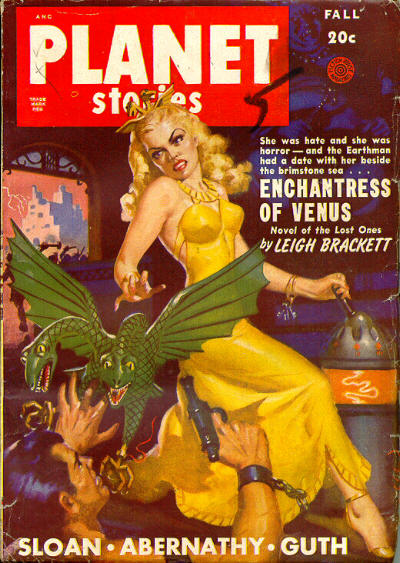
(Cover by Allen Anderson. Planet Stories, Fall 1949.)
This will turn out to be a busy month for me. I’m gonna be a guest on one or two podcasts/streams with some people I very much respect, and I’ll also be flying out of my Jersey/Pennsylvania bubble to visit some friends I rarely ever get to hang out with in person. On the one hand this is all more eventful than what I usually deal with, but also I’ll have a bit less time to manage this site—which won’t stop me from putting in as much effort as I usually do. It’s draining sometimes, but that is how passion works.
My personal life is gonna be busy, but also my review lineup is FILLED for May: we’ve got two serials, two novellas, two short stories, and finally a complete novel—our first one in six months. I know, the gap between novel reviews looks to be wide, but mind you that there aren’t too many of these “complete” novels in the magazines.
One more thing: I mentioned in a past editorial that I think very highly of 1953 as a year when SFF flourished, in general and especially in magazine publishing, which was experiencing a bubble we would not see again until… now, basically. Strangely, I haven’t before covered ANYTHING from that year, so to compensate we’ve got two stories from 1953 in the lineup. 1953 was such a banger that I could probably get five years out of just reviewing everything that was published then.
Enough wasting time, though, let’s see what we have.
For the serials:
All Judgment Fled by James White. Serialized in Worlds of If, December 1967 to February 1968. White is an author I’ve not read a single word of (or at least I think) up to this point, and given his philosophy with storytelling this feels a little criminal to me. When planning this post I flip-flopped between All Judgment Fled, Second Ending, and The Dream Millennium for my first White, since all three sound appealing, and ultimately went with this because I’ve also been meaning to tackle something—anything—that was published in If.
Sos the Rope by Piers Anthony. Serialized in The Magazine of Fantasy and Science Fiction, July to September 1968. Yes, that Piers Anthony. He actually appeared regularly in the genre magazines early in his career, when he was a promising young writer and people did not yet know the horrors he was about to unleash on the world. My only prior Anthony experience was the short story “In the Barn,” and let me tell you… that’s the kind of thing that puts you off an author for years. But maybe Sos the Rope, his second novel, will be good!
For the novellas:
“The Rose” by Charles L. Harness. From the March 1953 issue of Authentic Science Fiction. Retro Hugo nominee for Best Novella. Harness is one of those recent discoveries of mine that I’ve been meaning to explore further—made easier because Harness was not that prolific a writer; when he wrote he was fairly productive, but then he would vanish for several years. Harness apparently struggled to find a publisher for “The Rose” in the US, having to jump across the Atlantic and submit it to a filthy British magazine.
“Enchantress of Venus” by Leigh Brackett. From the Fall 1949 issue of Planet Stories. Brackett is now most known for her part in the messy scripting process for The Empire Strikes Back, for her collaborations with director Howard Hawks, and for the rather unchararcteristic novel The Long Tomorrow. Much of Brackett’s fiction, however, is planetary romance a la Edgar Rice Burroughs, complete with swashbuckling antics. “Enchantress of Venus” is one of several stories starring Eric John Stark, the barbarian hero for the space age.
For the short stories:
“Second Variety” by Philip K. Dick. From the May 1953 issue of Space Science Fiction. Retro Hugo nominee for Best Novelette. Not that I try to hide my biases anyway, but Philip K. Dick is one of my top five favorite authors—and he ain’t #5 on that list. But before he broke new ground as a novelist, Dick was one of the most talented and prolific SFF writers of the ’50s, with about thirty of his short stories being published in 1953 alone. “Second Variety” is one of Dick’s most famous short stories, and yet somehow I’ve not read it before.
“Black God’s Shadow” by C. L. Moore. From the December 1934 issue of Weird Tales. It’s been two months since I reviewed Moore’s “The Black God’s Kiss,” which was a reread, and true enough there was a two-month gap in publication between “The Black God’s Kiss” and its direct sequel. Only a year into her career and Moore had skyrocketed to being one of Weird Tales‘s most popular authors, with the adventures of Northwest Smith and Jirel of Joiry getting started during this period. Moore is a favorite of mine, naturally.
For the complete novel:
Big Planet by Jack Vance. From the September 1952 issue of Startling Stories. Believe it or not, this is a reread—actually one of the first stories I remember reading via magazine scan. As is often the case with me, though, there are surely many things about this novel that I didn’t pick up on a first reading. Vance is not an author I’m strongly attached to, but he does fill a certain niche, being a planet builder par excellence and a crafter of gnarly planetary adventures when he feels like it. Big Planet represents planetary romance shifting away from the Burroughs-Brackett model (which is really science-fantasy), and injecting the subgenre with some semblance of scientific plausibility. But how does this novel hold up on a reread? Let’s find out.
We have a nice mix of science fiction and fantasy, all of it vintage. We’ll get back to some more recent publications next month… maybe. You have to understand that I only cover so much in a given month and that there’s so much history behind the genre magazines. The roster, you may notice, leans toward adventure this month, between the Brackett, Moore, Vance, and probably the Anthony pieces; it just sort of turned out that way. Maybe given that I’ll be traveling soon I thought it appropriate to focus more on tales of high adventure for my site. Regardless, it won’t be a boring lot.
Jack Vance is a contender for the most influential mid-20th century SFF writer that relatively few people have read. He debuted in 1945, and unusually for a writer of that period his science fiction tended to read like fantasy—his fantasy, because nobody at that point wrote fantasy quite like Vance did. His 1950 collection (it’s a collection, I don’t CARE if some people call it a novel) The Dying Earth presents an Earth so far in the future that magic has not only emerged but overtaken technology; it influenced, among other things, Dungeons & Dragons. He would win two Hugos and a Nebula for the novellas “The Dragon Masters” and “The Last Castle,” which, despite sounding like they’d be fantasy, are in fact science fiction. He won a third Hugo in 2010 (this man lived a long time), this time for Best Related Work, with his autobiography This Is Me, Jack Vance! Even in his works that are not fantasy at all, there always seems to be a sense of magic with Vance.
Something to keep in mind is that Vance wrote a lot over a long span of time, and he has quirks that people will either accept or reject. If you really need your SFF to be colloquial or down to earth then you will probably not like Vance; his penchant for the flamboyant and the baroque has blocked off many would-be Vance fans. I have to admit that I wasn’t into Vance for a while, and even not I can’t say I love his work, but I do respect it and often enjoy it. Surely there’s something to like about a guy who will write a short story, set it on a planet that he’ll never write about again, and not only grant that setting a novel’s worth of detail, but even include footnotes. Vance is clearly a fan of planet-building, and it’s a niche talent he’s quite adept at, as we’ll see with today’s novella.
Placing Coordinates
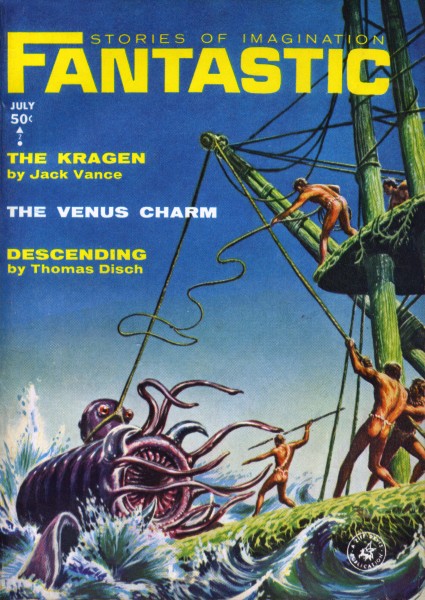
“The Kragen” was first published in the July 1964 issue of Fantastic, which is on the Archive. A bit of a long story with this one. It’s not unusual for novellas to be expanded into novels, or to be made into sections of novels like they’re pieces in a jigsaw puzzle; in my experience the novella usually doesn’t benefit by being inflated to novel-length. “The Kragen” was expanded into the novel The Blue World in 1966, with the novel version getting nominated for a Nebula and being up for the Prometheus Hall of Fame a few times (makes sense). I just assumed that since the novel version is more well-known that “The Kragen” would be one of those novellas to get reprinted maybe once. Not quite! It was reprinted in Robert Silverberg Presents the Great SF Stories: 1964, edited by… you guessed it, Robert Silverberg (and also Martin H. Greenberg). It got a chapbook release from Subterranean Press, which is weird, like who asked for this? We have at least one in-print edition with the Vance collection Wild Thyme and Violets and Other Unpublished Works, in both paperback and as an ebook.
Enhancing Image
Much of this review will be spent on the world-building of “The Kragen,” rather than the plot, since the actual plot is pretty simple when viewed with a wide lens; I suppose it has to be. Vance has about sixty pages to not only introduce a whole world to us but to make it comprehensible, so while there are a few twists and turns, this is not one of his more complex narratives. Take it as an adventure story that theoretically could be just as easily fantasy as SF, if not for background details.
The unnamed world of the novella is entirely covered with water, which when you think about it is not so different from our world, which is only mostly water. Several generations ago (the dates aren’t clear) a ship crash-landed on the planet—apparently a ship full of criminals (though given their ability to procreate it must’ve been co-ed), and surprisingly the survivors did not all kill each other within a month; instead they found ways to survive and even prosper on the blue planet. This is impressive, not only because civilization managed to rebuild itself out of a bunch of scraps, but because it did so with some things that we take fore granted, such as electricity and even metal. There is a bit of metal that lies in some people’s possession, but it’s not enough to be used for much of anything, and anyway, nobody knows what to do with it.
Not the first or last time Vance did a lost colony narrative; he arguably did it better in his 1958 novella “The Miracle Workers,” in which survivors of a crashed ship eventually devolve into warring pseudo-medieval factions. In both stories the content could be construed as fantasy while the reasoning behind that content is undeniably science-fictional.
Society works on a caste system, although even at the beginning of the story the system is loosening up, with inter-caste marriage and what have you. In a bit of humor from Vance the castes are named after species of criminal, so you have the Incendiaries, the Swindlers, the Hoodwinks, and so on, with Advertisermen at the bottom. I know, very funny. Hoodwinks actually don’t do what you would expect, as their job is basically to act as signal-men, communicating with people on other floats in a sort of morse code, quite literally winking hoods at the tops of towers. I’m not sure what Swindlers do here, since their occupation probably wouldn’t align with what their name implies. Anyway, the protagonist, Sklar Hast, is one such signal-man, although he spends much more time in-story being a thorn in some authorities’ sides than doing his job.
About those “floats.” Without metal, without even glass, society has to rely on other resources, and in this case they were very lucky, because while the ocean does indeed stretch from pole to pole, there are these vast swaths of sea-plant that are big enough to not only serve as pseudo-land but to be handy for lots of other purposes too. Whatever the plants don’t cover, human bones will sometimes do the trick; apparently the people of this seafaring society are not one to waste the bodies of their dead, though from what I can tell they don’t indulge in cannibalism. I wonder Donald Kingsbury read this (or more likely The Blue World), got to the part where a human rib is used as a hook, and thought, “Hmm, I could write a novel like this.”
Despite the lack of resources, life has been mostly good for Sklar Hast and his people. “On this water-world, which had no name, there were no seasons, no tides, no storms, no change, very little anxiety regarding time.” It’s one thing to have a single-biome planet, but it’s an extra strain on one’s suspension of disbelief that there be practically no harsh weather. Of course, had there been gales and hurricanes then the crash survivors surely would’ve died off, and thus we wouldn’t have a story. You gotta do what you gotta do. There are a few other things, which I’ll get to in the spoilers section, that don’t strike me as the most credible, but Vance (as usual) goes the distance with the mechanics of his newfangled world. A lot of time is spent on what the people of the floats eat and how they eat it, and stuff like that, and much of it is at least intriguing.
But wait, there’s trouble in paradise! The people do have one natural threat to their way of life: the kragen (plural), a race of sea monsters that act more as really large pests than as direct threats to human life. Still, an angry kragen has the bulk and weaponry (tentacles and mandibles) to fuck up a person, and unfortunately the people don’t have weaponry good enough to take on the kragen; instead they have to rely on the supposed goodwill of the largest kragen of them all, King Kragen, which the elders “””allegedly””” are able to communicate with. If King Kragen is appeased with gifts (i.e., food) then he’ll kill or drive off smaller kragen. This feels like solving a big problem with an even bigger problem, but who am I to judge.
A little aside…
We get illustrations of the kragen on both the issue’s cover and with the opening interior illustrations, both done by Ed Emshwiller. Now, Emshwiller is a legend, and I respect him, but while I would say his depictions of the kragen are accurate enough, they seem a little… goofy.
It’s not his best work is what I’m saying.
One day a kragen fucks up Sklar Hast’s abode and instead of waiting on King Kragen to maybe show up, Sklar Hast takes matters into his own hands and rounds up some likeminded fellows to kill the kragen themselves, which they actually come close to doing. The fallout is catastrophic, though, resulting in a schism headed by Sklar Hast with a particularly zealous elder named Barquan Blasdel on the other side. The question comes down to this: Do the elders have any control over King Kragen, or are King Kragen’s appearances merely serendipitous, with the monster’s “help” purely fueled by the prospect of food? This is a Jack Vance story so you know damn well it’s closer to the latter, and come to think of it, questioning and overcoming unjust hierarchies is also a Vance staple. Sklar Hast and his people vow to not only head out on their own, detatching their float from the rest of society, but to kill King Kragen, come hell or high water.
Forgive me, I’ve been spending a considerable amount of time trying not to misspell these weird character names. Not really a Vance story if there aren’t weird character names.
Sklar Hast has manpower on his side, but what he doesn’t heave is the weaponry. Not yet. How do you take down a giant sea monster without guns? Crossbows? Even decent harpoons? They have to figure out how to modernize—to rediscover metal on a planet that’s practically devoid of it, and in the process prove to the elders that they no longer need such an arbitrary quasi-religious order of living. From here on the narrative becomes two-pronged, jumping between Sklar Hast and Barquan Blasdel, the new and the old, as they seek to destroy and protect King Kragen respectively.
There Be Spoilers Here
Mostly I wanna talk about how Sklar Hast and company are able to overpower the Kragen, because it’s… complicated. And also maybe a leap in logic. I’m not a scientist, but I’m not sure if blood works this way. The climactic scene of the men from the renegade float, now with crossbows made of metal and powered with electrical tubes, taking down King Kragen almost made me think more about the logistics of getting all that goddamn metal from burned blood (blood being smoldered down to iron, yes really) than the coolness of the action. And the action can be pretty cool when it’s there! So that says something about how much the solution to the lack of metal makes me scratch my head. The ubiquitous nature of the plant life already threatened to make things too convenient, but this is a bit much. That’s about it. That’s all I felt like saying about that.
A Step Farther Out
I have conflicting feelings as to the length of this thing. The plot is simple enough that I don’t think an extra fifty to a hundred pages would benefit it (mind you that The Blue World itself is quite short), but also I can see that extra wordage benefitting depth, especially character depth but also the workings of Vance’s world. Sklar Hast is a bit of a flat character; he wants one thing for most of the story, which is to kill King Kragen, and we can’t say he matures since he’s shown to be right pretty much from the outset and thus he has no lesson to take from all this. I at least appreciate that the elders, while shown generally to be wrong, are pragmatic enough that they’re not cartoonishly evil, with the exception of Barquan Blasdel. Indeed the pragmatism of the elders becomes part of the novella’s sly humor, which is perhaps chuckle-worthy but never laught-out-loud funny. Even so, I do think Vance’s sense of humor is underrated, and his jokes lend flaor to what would risk becoming a droll and humorless adventure.
I wouldn’t consider “The Kragen” to be Vance’s finest hour, if only because I don’t think it reaches the same level of epicness as his best stories of similar length. Consider that “The Miracle Workers” and “The Last Castle” each fit not only a novel’s worth of world-building into sixty pages, but a novel’s sense of grandeur; these are wondrous tales of action that feel like they’re deserving of big-budget Peter Jackson adaptations. Meanwhile “The Kragen” feels weirdly insular, with even the kragen themselves never being fully allowed to act the part of giant movie monsters. Also, I’m not sure where else to say this, so I’ll say it here: Don’t read “The Kragen” (or most Vance, for that matter) if you absolutely must have women in your fiction. In other words, this is not Vance at his worst, but it’s certainly not his best.
Now we’re back to our regularly scheduled programming! Only not quite, but I’ll save that for the end. We’ve come back to our novella and serial reviews, which I’m thankful for; as fitting as it is to focus only on short stories and novelettes for a month of horror, I found it weirdly draining to review all those short stories back to back. With serials and novellas we’ll have more variety, never mind the lack of a horror theme.
I must’ve gone back and forth on this schedule too many times to count, frankly. The thing is that I like having a schedule for my reviews, as I think it allows me to plan some silly stuff in advance, like the fact that I’ll be tackling Joanna Russ and Poul Anderson stories back-to-back (for those of you who don’t know, I recommend looking up a certain exchange those two reportedly had), not to mention stuff like last month’s review slate. But I’m not here to waste your time, let’s get to the meat of the matter!
For the serials:
We Who Are About To… by Joanna Russ. Published in Galaxy Science Fiction, January to February 1976. Russ was a divisive figure in the field and We Who Are About To… in particular was not received well. Even so, it has its defenders, perhaps the biggest of them being Samuel R. Delany (who I always trust), and it also received a glowing review from Joachim Boaz over on his site. I have to admit my experiences with Russ have not been great up to this point, having found her Hugo-winning novella “Souls” underwhelming, but this could be a change of pace!
We Have Fed Our Sea by Poul Anderson. Published in Astounding Science Fiction, August to September 1958. It was nominated for the Hugo for Best Novel, and was published in book form as The Enemy Stars. Anderson was apparently a beloved figure when he was alive, but since his death his star power has faded somewhat, perhaps due to the scattered vairety of his fiction. He was a reliable and insanely prolific writer, and I often like (but rarely love) his work. We Have Fed Our Sea was one of THREE Anderson serials running in Astounding in 1958.
For the novellas:
“Another Orphan” by John Kessel. Published in the September 1982 issue of The Magazine of Fantasy and Science Fiction. Kessel can be thought of as adjacent to the cyberpunk movement of the ’80s, though it would be a mistake to consider Kessel himself one of the cyberpunks. Renowned for both his fiction and genre criticism, he’s also edited several anthologies, often in collaboration with James Patrick Kelly. “Another Orphan,” which won the Nebula for Best Novella, is apparently a riff on a classic work of American fiction…
“The Kragen” by Jack Vance. Published in the July 1964 issue of Fantastic. Like with Poul Anderson, Vance is a writer I often like but rarely find myself strongly attached to. Also like with Anderson, Vance represents to some extent SF writing typical of the pre-New Wave ’60s (i.e., relatively conservative), focusing less on literary experimentation and more on The Big Picture™. “The Kragen” may strike some readers as familiar because they had read it in a different form: it would be expanded into the novel The Blue World two years later.
For the short stories:
“Don’t Look Now” by Henry Kuttner. Published in the March 1948 issue of Startling Stories. You didn’t think I’d forget about Kuttner, right? Making his professional debut in 1936, Kuttner was not the instant success like hie future wife, C. L. Moore, was; actually he had a reputation as a hack writer for a while, and to this day his immense talent tends to be undervalued. Alongside Moore Kuttner would write some of the most beloved SFF of the ’40s, but he also remaimed prolific more or less on his own, “Don’t Look Now” being an example.
“Mountain Ways” by Ursula K. Le Guin. Published in the August 1996 issue of Asimov’s Science Fiction. Le Guin is one of those grandmasters of the field who really needs no introduction. She only appeared sporadically in the magazines from the ’60s to the ’80s, but the ’90s saw a major resurgance for Le Guin as a magazine presence, with her Hainish cycle especially getting more attention. “Mountain Ways” is a standalone Hainish story, and it won the James Triptree Jr. (now regrettably called the Otherwise) Award for gender-bending SF.
If you’re reading this post and it’s the first day of November then you’ll notice there are two new departments for my blog: one of them is simply a quality-of-life improvement while the other is more of a “I’m doing this for funzies” thing. Firstly we have an author index now! Reviews are organized by authors’ last names, and while this page may be small now, there will come a point when it will be massive, and since I don’t rate my reviews, this is probably the best way to help readers find what they’re looking for. The second is The Observatory, which like Things Beyond is an editorial department, but whereas Things Beyond is meant for forecasting reviews, The Observatory will be more like a conventional magazine editorial where I’ll spend a thousand words on whatever subject I feel like writing about—although, of course, it will be SFF-related.
Since Things Beyond happens at the beginning of every month, it seems only natural to have an Observatory editorial posted on the 15th of every month, so that it’ll never be skipped and it’ll fall exactly between two of my regular review posts. With these changes I feel like I’m one step closer to making my blog a “professional” (by that I really mean well-rounded) review site for magazine SFF.