
The Story So Far
John Devlin used to be a doctor on Earth, but now he’s a passenger aboard a ship in search of a planet fit for human colonization; the voyage is expected to take centuries, probably a thousand years or so. The people aboard this ship spend 99% of their time in cold sleep, experiencing surprisingly vivid dreams that leave them feeling both disturbed and weary when they awake. The ship’s computer handles almost everything, but occasionally it awakes a passenger to do some exercise, recall their dreams, and also handle ship malfunctions if needed. There’s a scare towards the end of the first installment in which some intelligent aliens try to destroy the ship, but Devlin, on being awakened, is able to take control and outmaneuver the aliens, whom we’ll not see again—for now. There’s another malfunction in which one of the other passengers, in trying to see her boyfriend who’s also onboard, doesn’t get back into her chamber correctly and so dies slowly, although thankfully she’s unaware of what’s happening to her. This sad scene shows us Devlin’s past as a medical professional and that he knows a bit more than he lets on, although not enough to know exactly why these vivid dreams are happening. Through lengthy flashbacks we’re introduced to Patricia Morley, who’s a fellow passenger and also Devlin’s love interest. We’re also introduced to Brother Howard, a religious fanatic who only appears in flashbacks but who ends up being kind of a mouthpiece for White’s opinions on human nature, not to mention he has quite a bit to do with Devlin and Patricia’s voyage.
The Earth that Devlin and Patricia came from has gone to shit, which is to say it’s only marginally worse than Earth as it is now. The question driving the whole novel comes down to this: “Is humanity worth saving?” Both Devlin and White have a tug-of-war between genuine pessimism and hope that humanity might be able to move on from its dark past. Over the course of the novel Devlin has dreams of being people and even non-humans from the past, from a sauropod in the Jurassic to a medieval warrior king, to memories of his own life. Every dream somehow involves violence and death, sometimes simply due to circumstance, sometimes because of human malice. To paraphrase Marx, history doesn’t repeat, but it does rhyme. Brother Howard was once an astronaut of sorts, and in flashbacks he tries to prepare Devlin and Patricia for the horrors that await them. One can easily go insane in space. A fellow passenger had at some point gamed the system so that he could walk about outside of his chamber, only to commit suicide, with his eyes taped open.
Enhancing Image
I was worried White would fumble the last installment, or make it so that the more tedious moments of previous installments would be in vain, but thankfully he sticks the landing. I’m not sure how White went about writing The Dream Millennium; it’s possible that aside from a basic outline he wrote by the seat of his pants, which would’ve been far from unusual at the time. I suspect, although I have nothing to back this up with, that White had a beginning and ending in mind, but improvised with the middle portion, hence why there are some stretches here that come off as flabby and perhaps unnecessary. The medieval sequence, which takes up a chunk of the second installment, has some thematic significance, but is too drawn out and without anything to make us invested in the action. There’s a sequence early in the last installment where Devlin dreams that he’s a pilot whose airplane has been taken over by a team of hijackers that’s both more involving, more memorable, and also having more directly to do with the novel’s ideas about humanity’s capacity for violence. White’s fascination with violence, or rather his profound distaste for it, comes up again and again, both in his work generally and also in The Dream Millennium where Devlin and Patricia are constantly haunted by it.
The ship had been future-proofed up to a point, but after centuries (quite literally a millennium by the end of the novel) the cracks in the armor are beginning to show, so to speak. Devlin at one point finds, to a mix of horror and wonderment, just how old and dilapidated the ship has become, despite only maybe a few weeks of subjective time passing for him. In old-timey SF space technology will be new and shiny seemingly forever, but this is not the case in White’s fiction. Also, a few of the human crew have died already and a malfunction with the others’ chambers leaves only Devlin and Patricia awake at the end, in charge of a bunch of people stuck in deep sleep who will no longer be able to sit back while centuries pass by around them. They have to find a habitable planet real soon, more out of necessity than anything; it’s either that or death for all of them. You may also recall that at the end of the first installment Devlin narrowly avoids trouble with some intelligent aliens, who are rather quickly forgotten about; the good news is that this scene was not for nothing after all, since this same alien race, several centuries later in their time, figure back into the plot. It’s a bit of a deus ex machina, with how both the humans and aliens get a happy ending, but White makes it work by virtue of having used time dilation to his advantage. Indeed the ending reminded me a bit of A. E. van Vogt’s “Far Centaurus,” which uses time dilation for similar effect.
Even the flashbacks featuring Brother Howard, which probably take as much time on the page as the A-plot aboard the ship, if not more, lead to a pretty satisfying conclusion. Brother Howard used to be insane (as opposed to how he is now, which is just a bit cooky), on account of PTSD from being an astronaut, but through years of therapy he was able to return somewhat to normalcy. (In the days before manned spaceflight, and even during the height of the Space Race, there was a lot of speculation that astronauts would experience PTSD [although it wasn’t called that at the time] much like how soldiers did. The image of the astronaut-as-soldier was a powerful one, although it’s gone out of fashion in recent decades.) Brother Howard has been testing Devlin and Patricia so that he might recruit them for this extraordinary space voyage—a trip that would take more mental fortitude than most things; of course he finds Devlin and Patricia fit for the job. I’m not sure if it was necessary for Devlin and Patricia to be a romantic item, since the latter basically exists so that Devlin has a flesh-and-blood person to talk to on the ship, but it’s not like she’s a one-dimensional character. Aside from his aversion to violence it seems like White also avoids really bad misogynistic tendencies that some of his contemporaries were guilty of (looking at you, Silverberg). Overall this is a read that I would describe as refreshing, if also B-tier in quality.
A Step Farther Out
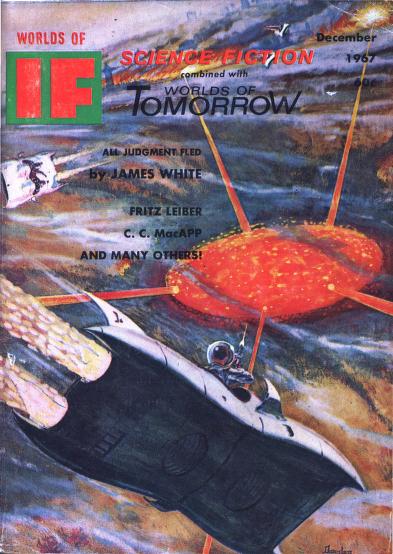
I think The Dream Millennium would’ve worked better as a novella, but given that I had read it sporadically over the span of a couple weeks, with digital scans of the magazine issues, it’s possible I won’t feel the same if I had a physical copy of the book version in my hands. White is kind of a unique and yet obscure talent in the context of when he wrote, especially in the ’50s through the ’70s, when casual violence still permeated genre SF and there was much undue optimism about mankind conquering the stars. White’s pacificism speaks to the latest generation of SF writers, even if his style is still on the workmanlike side.
See you next time.



 Science Fiction & Fantasy Remembrance