
Who Goes There?
For the past fifty-odd years, but especially from the ’70s to about the turn of the millennium, Joe Haldeman has been one of the most acclaimed “war” writers in SF, although war is far from the only topic he’s written about (see today’s story). He was one of those authors who, before he could even start his career as a writer, got drafted and thrown into the Vietnam War, where he saw action as a combat engineer. He got injured, damn near killed apparently, and sent home, and it was as he recovered from his wounds that he took up the pen (or probably typewriter) in earnest. His first story was published in 1969, but it wasn’t until the following year that multiple Haldeman stories saw print, and within a handful of years he made his way to the top of the totem pole. I need not tell you about his Hugo- and Nebula-winning 1974 novel The Forever War, which to this day remains one of the most beloved and widely read SF novels of its type—it might even be the most universally beloved military SF novel of all time. Haldeman would write a lot more novels and short fiction, including the fix-up “novel” All My Sins Remembered, which contains “To Fit the Crime.” This is an SF-detective hybrid with a rather strong trace of noir.
Placing Coordinates
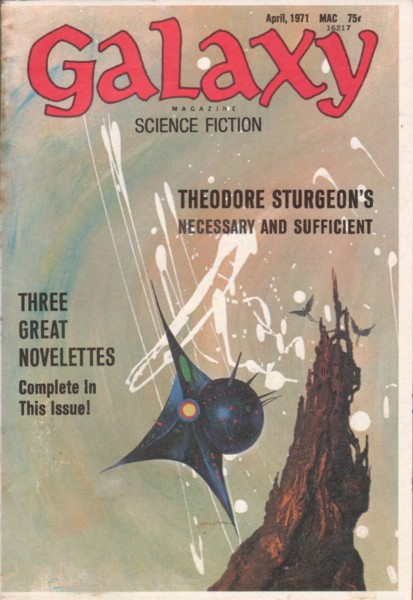
First published in the April 1971 issue of Galaxy Science Fiction. It has only been reprinted as part of All My Sins Remembered.
Enhancing Image
The stories that comprise All My Sins Remembered (it’s classified as either a novel or a collection, depending on the source) star Otto McGavin, an agent working for the TBII whose gimmick is that he goes under a variety of disguises, which require him to not only get covered in “plasti-flesh” but also adopt someone else’s personality via “hypnotraining.” We can now infer, with the gift of hindsight, that Otto will come out of the case of the week in one piece, although in fairness, readers would not have known this at the time. The case in question has to do with some mysterious deaths out of the indigenous population on Bruuch, a prospecting planet that’s basically run by a single company, and on which the natives are put to work either in the fields or mining in the planet’s depths. Otto is an operator, which is to say he’s a very special agent at the TBII, and two operators have already gone missing (presumed dead) on Bruuch, investigating the same case. No answers as to what’s going on as of yet. The idea, then, is to have Otto go undercover as Dr. Isaac Crowell, a renowned scientist who’s studied the Bruuchians enough to speak their language, to an extent. Crowell has not actually been on Bruuch in many years, though. Otto is 27 years old but playing a man in his sixties, with the biggest strain being the pounds of plasti-flesh and what have you, as well as the difference in gravity on Bruuch. He’s wearing a highly advanced fat suit, is what I’m saying.
There are really three mysteries in “To Fit the Crime,” which have to do with why the Bruuchian miners have been dying more often as of late, what happened to the other two operators, and less urgently but just as importantly, what “stillness” means for the Bruuchians. Mind you that Haldeman doesn’t describe the Bruuchians much, but they’re supposed to be at least humanoid enough, and that culturally they seem to have something in common with ancient Egypt and certain Native American peoples. In terms of alienness they barely count as such, clearly being stand-ins for real-world people of color who’ve had to live under European or American colonialism. Bruuch is a prospector planet, as I said, in that it’s like one of those company towns that’s run arguably more by a monopoly than the local government, or rather government and capital are most intimately in cahoots with each other. Again, because we now can figure that Otto survives and presumably solves the case of the week, spoiling this story borders on impossible. It doesn’t help that even without the foreknowledge of this being the first entry in a series it’s not exactly unpredictable. This is a problem the detective genre tends to run into anyway, but it’s compounded when combined with SF because SF gives you a nigh-infinite number of tools you could use to solve a crime that one can’t have in real life. You have the issue of the reader being able to foresee the solution well before the detective does, but you also have the issue of said detective being able to solve the case and get out of trouble any which way the author chooses. The only reason Otto even gets as far as he does is because he has technology available to him that we (both in the 1970s and now) don’t. Also, aside from Otto the only character who appears in maybe two scenes is Dr. Waldo Norman, who becomes his closest ally while on Bruuch. Conversely the villains (there’s more than one) only appear long enough so that the reader gets a good idea, right away, that these men have been doing something with the miners.
Not that “To Fit the Crime” is bad by any means; it’s a perfect decent detective story. It helps that it’s a rather short novella, maybe 19,000 words, and for that sort of story it doesn’t overstay its welcome. The third mystery I had mentioned is also the most intriguing, for its ambiguity and also it being the most SFnal element. See, as I was reading “To Fit the Crime” I was wondering if I had somehow pissed a passage as to what “stillness” means, because it’s a ritual the Bruuchians perform on their dying and it’s something Dr. Crowell (the real guy, not Otto) had studied before; yet Haldeman doesn’t give us an explanation until very late in the story. This is also an early example of a certain type of detective story, at least in SF, although it does have roots in earlier detective novels and film noirs. I’m thinking of the story wherein a white male detective investigates the murder or disappearance of a person of color. You may be thinking of The Last Wave, or Bad Day at Black Rock, or more recently Killers of the Flower Moon. It’s a progressive-minded narrative that has a hint of the white savior about it, and in the case of “To Fit the Crime” this is not helped by the Bruuchians being more human than alien. But fret not, because while the villains are exactly who you think they are (who can honestly be surprised that the evil money-grubbing white man turns out to be a murderer on top of being greedy), Otto is one of the good white people. It does its job, given the time period (I suspect also there may be subtext with how overt racism played into the then-ongoing Vietnam War, even towards the South Vietnamese, our “allies”), but there’s also a reason Martin Scorsese deconstructed this sort of narrative in Killers of the Flower Moon. Maybe it’s wishful thinking that one good man can save a whole village and punish the guilty in the process.
There Be Spoilers Here
There really isn’t much to give away here, except for what stillness actually is. So, one would think this is something biologically unique to Buuchians, but they can also perform it on humans, including the bad guys. It’s basically a state of half-life in which the person’s body freezes up and they enter a kind of cold sleep, except without the actual freezing. They may as well be dead, but they don’t technically die and they certainly don’t decay. It’s like a perfect embalming. It’s supposed to be a death ritual the Bruuchians typically reserve for members of their own community, although how they’re able to do it and what the evolutionary benefit of such an ability could be are not clearly stated. It’s fine, we don’t need to know.
A Step Farther Out
Mind you that this is very early Haldeman, so it’s fair to say he was still finding his legs as a writer. Still, not bad, if rather standard. I would be curious to see the other Otto McGavin stories in All My Sins Remembered, since that seems to be the only damn way you can read all of them. I also liked Haldeman enough already that no doubt I’ll be covering something much later of his… eventually.
See you next time.
 Science Fiction & Fantasy Remembrance