March was a bit of a marathon here at SFF Remembrance, but truth be told I had more fun writing about that very old and dusty science fiction than in the past few months. I had been suffering from fatigue, along with some real-life stuff that was getting to me and making it hard to sleep at night. Now I feel somewhat rejuvinated. I feel good enough about reviewing stuff here again, in fact, that I’m bringing back the two-short-stories two-novellas deal, although I’m still keeping it to one serial for the month. The serial in question is a three-parter, being the first appearance of one of the most important SF novels ever written—and yet one that has been totally lost to the sands of time. You might find references to The Skylark of Space if you’re a Star Wars fan, as a point of trivia, since it was this novel that in part invented the space opera subgenre. Edmond Hamilton was writing space opera at shorter lengths around the same time Smith made his debut, but there was nothing on the scale of Smith’s novel before it. Smith “revised” it for its eventual book publication, removing co-author Le Hawkins Garby’s contributions, but we’ll be reading it as it appeared in Amazing Stories. This was a long time coming for me.
For the dates of stories, we’re looking at one from the 1920s, two from the 1950s, one from the 1960s, and one from the 1990s. Both of the stories from the ’50s are from the first half of that decade, which was an incredibly productive period for magazine SF.
For the serial:
The Skylark of Space by E. E. Smith and Lee Hawkins Garby. Serialized in Amazing Stories, August to October 1928. When Smith studied chemistry at the University of Iowa, he didn’t think he would later become one of the pioneering authors of space opera. He didn’t even think he would write fiction, until he talked science fiction with Lee Hawkins Garby and her husband, who were friends from college. This was in 1915, before “science fiction” had even been coined as a label. The Skylark of Space took some years to gestate, but when it appeared in 1928 it made Smith a sensation among the then-niche SF readership. Garby’s contributions were later removed when the novel appeared belatedly in book form.
For the novellas:
“Half-Past Eternity” by John D. MacDonald. From the July 1950 issue of Super Science Stories. Fans of classic crime fiction will be familiar with MacDonald, at least by reputation. His Travis McGee series is one of the most prolific and widely read detective series ever. In 1972 he was given the Grand Master Award by the Mystery Writers of America. He also wrote a good deal of SF from the late ’40s through the early ’50s, along with nearly every other genre.
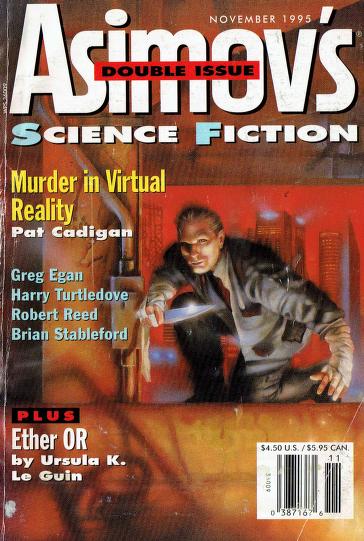
“Death in the Promised Land” by Pat Cadigan. From the November 1995 issue of Asimov’s Science Fiction. It was first published in the March 1995 issue of Omni, but that magazine had gone purely online by that point and the Asimov’s printing marked its first physical appearance. Cadigan is arguably the queen of cyberpunk, going back to the ’80s. She’s not as famous as William Gibson or Bruce Sterling, but she really should be more read than she is.
For the short stories:
“Dumb Martian” by John Wyndham. From the July 1952 issue of Galaxy Science Fiction. It’s surprising to think that Wyndham had made his SF debut in the early ’30s. His career peak came later than it does with most authors, since he was deep in his forties when The Day of the Triffids was published. The ’50s were a great time to be John Wyndham, between his novels and short stories.
“Timberline” by Brian W. Aldiss. From the September 1961 issue of The Magazine of Fantasy and Science Fiction. This is the fourth installment in Aldiss’s Hothouse series, which was then published as a novel. The series of stories, rather than the novel version, won Aldiss a Hugo, which was certainly a confusing move. It’s been almost a year since I reviewed the last Hothouse story, so here we go.
(Cover artist uncredited. Startling Stories, May 1950.)
Who Goes There?
Everyone who makes it big has had to start somewhere, and the same can be said for John D. MacDonald, who became famous for his crime novels, be it standalones like Cape Fear (originally titled The Executioners) or his long-running Travis McGee series, about a detective who lives on a house boat. But before all those novels, MacDonald wrote a fair amount of SF in the late ’40s and early ’50s—a past he did not seem to be ashamed of, considering he also authorized a collection of his short SF in the ’70s, well after he had made it as a crime writer. Wine of the Dreamers would be either MacDonald’s first or second novel, and it’s certainly the first of a few SF novels he wrote. Why he started out with SF before soon moving to crime is unclear, but I would have to guess it has something to do with the bubble that was the market for SF in the few years right before and after 1950. If you’re a young writer looking to cut your teeth, like MacDonald was at the time, you could do much worse than writing SF, even at short lengths, since there was no shortage of outlets that took short SF. Aside from maybe catching a short story or two of his in passing this is the first thing by MacDonald I’ve read, which is not a typical starting point.
Placing Coordinates
First published in the May 1950 issue of Startling Stories. I got a PDF of the book version, and skimming through some sections quickly reveals that the magazine and book versions are rather different, with the former being abridged, although ISFDB and the SF Encyclopedia make no mention of this difference. Aside from an ebook edition the book version has not seen print in a couple decades.
Enhancing Image
I don’t have that much to say about Wine of the Dreamers, so I’ll put down my thoughts in note form and see where that takes us. My thoughts were a bit scattered as I was reading it and unfortunately, now that I’ve technically finished reading it and the dust has settled, I’m still struggling to process fully what MacDonald did here.
The premise is simple enough, although it’s given a smokescreen of complexity by virtue of there being two sets of protagonists for the price of one. Firstly we have Dr. Bard Lane and the psychologist Sharan Inly on Earth, in a quasi-dystopian near future where the space race (which mind you we were only starting to see the first glimmers of in 1950) is still a matter of national concern. Sensational news media dominates print and radio, with horrors like murder, theft, and scandal seemingly around every corner. Gambling has also become more of a concern, which is prescient on MacDonald’s part considering we in the year 2025 have a huge gambling problem—albeit more in the form of sports betting and video game micro-transactions than casinos. Divorce is also on the rise, because of course it is.
MacDonald has things to say about what were then society’s ills, or rather middle-class white America’s ills, without actually taking much of a political position. Like I couldn’t tell you if he was a Republican or Democrat at the time, although given this was before the late ’60s switching of the parties it wouldn’t have been much help anyway. In fairness to him, America really was in a liminal point in its cultural development: World War II had recently ended, leaving the US and Russia as the only really functioning international powers as far as Europe was concerned. The Allies had partitioned Germany, and even split Berlin in two, which itself turned out to be a humanitarian crisis. When MacDonald wrote Wine of the Dreamers circa 1949 it also would’ve been before the Korean War. TV was also only just starting to become commercially viable. If the scenes set on Earth do a good job at anything it’s capturing the uncertainty and paranoia of the immediate post-war years, without much room for so-called prosperity. It’s an America not too unlike ours.
The secondary plot follows the titular dreamers, or the Watchers as they’re called, a small and closed-off society of humanity in the stars that can barely be considered a society, being on its last legs and so decadent. Raul Kinson and his sister Leesa are young and rebellious members of a culture that has long since given up on progress and excellence, with the Watchers spending much of their time in dream machines, where they imagine themselves as other intelligent beings on other planets—one of these planets being Earth. Of course, the problem is that the “dreams” the Watchers have are not dreams at all, but rather the Watchers telepathically take over the minds of unwilling and unsuspecting hosts, only the Watchers don’t know this. The novel’s central dilemma is what might happen to such a society if it became aware of the evils it casually indulges. Philip K. Dick could’ve done a mean job with such a premise, but MacDonald is a very different writer from Dick and so isn’t as interested in the philosophical or religious implications of the dream machines. MacDonald illustrates the loneliness and creepiness of the Watchers’ society well, but he doesn’t go far enough for my liking.
So, the big thing that dates this novel, aside from it being very post-WWII, is the fixation with mental illness, or more specifically a neurotypical person’s conception of mental illness. This is gonna sound like it was done in bad taste, but the idea (I’m not kidding) is that the reason there have been so many freak incidents throughout modern history, with people seemingly going postal at random or being “possessed by devils,” is because of the Watchers abusing their powers and having way too much fun with the bodies they possess. Obviously we know this to not be true, and MacDonald would’ve known as well, but that didn’t stop him from coming up with a nonsense SFnal explanation for severe mental illness that shifts the blame away from capitalist society’s consistent demonizing of those with mental illness and puts it on a made-up outside force. As someone with a history of depression, this is hard for me to take. In the years immediately following the end of WWII there was evidently a resurgence of interest in psychology in middle-class America, and how people with mental aberrations might be treated. Wine of the Dreamers sees MacDonald hopping on that bandwagon.
Of the two plots, which get more or less the same amount of attention, the one focusing on the Watchers is easily superior. This might be because I’m indifferent to the Earth plot involving a rocket launch that goes horribly wrong (because I’ve become increasingly indifferent to space flight and the prospect of colonizing other worlds), but I’m more interested in fictionalized societies that say something about our own, by way of allegory. From what little MacDonald had to say about this novel we know he intended it to have symbolic meaning. The Watchers are humans who have been away from Earth for thousands of years, and the culture they’ve built up has been mostly forgotten and degraded to the point where they’re basically a dying race. As MacDonald says, “when original purposes are forgotten, the uses of ritual can be destructive.” The dream machines were not meant for sadistic fun, but as a teaching mechanism for the isolated Watchers. It’s a shame then that at least in the magazine version we only get the bare-bones version of this conflict. I will say, at least as an advertisement for the book version (although that didn’t come out until a year later), the magazine version of Wine of the Dreamers does its job.
There Be Spoilers Here
Of course all’s well that ends well, although it was indeed the ending of the magazine version that made me raise an eyebrow and wonder if there was more to the story. Turns out I was right. There’s a kind of romantic square going on between our four main characters, with Raul and Leesa taking over Lane and Inly’s bodies respectively, with Raul falling for Inly and Leesa falling for Lane. This hint of romance is only that: a hint. (By the way, something we learn about the dream machines is that the “dreamer” can only occupy the mind of a host who’s of the same sex, which makes you wonder what would happen if a cisgender Watcher took over a trans person’s body. Just food for thought.) In the magazine version we’re told, as really an afterthought of an epilogue, that Our Heroes™ will be having a double wedding, which is incredible considering they haven’t known each other that long. Skimming through the book version this epilogue at least feels less thrown-together, since it gets a whole chapter to itself as opposed to a couple paragraphs. Either way the ending is weak, smacking of either MacDonald not knowing how else to end his story or of editorial interference that would not have been unusual for the time.
A Step Farther Out
It’s competent, although somehow I felt like I was only getting part of the picture with it. It could be that the book version, being longer, is the better experience, but that’s a question to ask the three living people who have read the book version of Wine of the Dreamers. What’s funny is that looking up reviews on Goodreads, at least one major review implied to have read the magazine version, which is considerably shorter. Had I known about the difference in advance I might not have chosen this novel for review. I’m not sure if MacDonald had written the magazine version first and then expanded it or what have you, since despite being a popular writer in mystery/crime circles we actually don’t have much in terms of interviews and essays from MacDonald; he was not that much of a public figure. At some point I’ll tackle his short SF, which might be more indicative of his talent. If you’re gonna read Wine of the Dreamers then I suggest seeking out the book version, although it’s very out of print.
At the beginning of the year I said that I would be covering one short story or novella from Galaxy each month—but I said nothing about serials. The truth is that Galaxy was, alongside Astounding/Analog, the most consistent market for serialized novels and novellas at the time, so it would feel wrong to never acknowledge that part of the magazine’s history. As such we’re getting a novella and a serial from Galaxy this month; that they’re both from authors I admire probably helps.
Last month I covered a horror story by the crime/mystery author Dorothy Salisbury Davis, which gave me the idea of finding more SFF by people who normally write crime/mystery, which while also a genre that has a history in pulp magazines, is “realistic” fiction rather than SFF. One curiosity that struck me ever since I saw it years ago was the fantasy story “The Bronze Door” by Raymond Chandler, which marked one of only two times he appeared in an SFF magazine. Someone who wrote a good deal more SFF than Chandler would be John D. MacDonald, who wrote prolifically for the genre magazines in the late ’40s and early ’50s before shifting to crime fiction and making a killing on that. So for this month’s complete novel we’ve got the early MacDonald novel Wine of the Dreamers. Rounding out the novel-length stuff is a relatively obscure standalone SF novel by Roger Zelazny, who nowadays is more known for his fantasy.
For the women we have two people who are a few generations apart and coming from different continents, but who still, each in her own way, have come to write science fiction. Kate Wilhelm is actually a bit hard to find in magazines after the late ’60s, once she found her voice as a writer, but the September 2001 issue of F&SF was a special issue dedicated to Wilhelm, complete with a new novella. As for the Greek writer Eugenia Triantafyllou, I picked just about the newest story I reasonably could’ve (an unofficial rule of mine is that a story must be at least a year old for me to consider it for review), with “Loneliness Universe” being a finalist in this year’s Hugos. I’m voting in the Hugos, by the way.
That makes one story from the 1930s, two from the 1950s, two from the 1970s, one from the 2000s, and one from the 2020s.
For the serial:
The Dream Millennium by James White. Serialized in Galaxy Science Fiction, October to December 1973. I’ve been meaning to read more James White, and thankfully several of his novels first appeared as serials. White first appeared in the UK, in New Worlds, before eventually finding some success in the US as well. Along with Bob Shaw he was one of the few Irish SF writers to appear regularly on both sides of the Atlantic back in those days.
Doorways in the Sand by Roger Zelazny. Serialized in Analog Science Fiction, June to August 1975. Zelazny is one of the most influential SFF writers of all time, his mark being apparent on the likes of George R. R. Martin and (God help us) Neil Gaiman; and yet despite a couple generations of writers (especially those of fantasy) owing a debt to Zelazny, much of his work remains obscure or simply out of print, including this standalone novel.
For the novellas:
“Yesterday’s Tomorrows” by Kate Wilhelm. From the September 2001 issue of The Magazine of Fantasy and Science Fiction. It’s easy to forget this, but Wilhelm started in the ’50s, only that she flew under the radar for about a decade. Like a caterpillar turning into a butterfly, though, Wilhelm seemed to metamorphize almost overnight into one of the most acclaimed SF authors from the late ’60s until her death in 2018. She was married to Damon Knight.
“The Other Man” by Theodore Sturgeon. From the September 1956 issue of Galaxy Science Fiction. Sturgeon is one of my favorite authors, especially of short fiction. Sturgeon had started to write professionally with “mainstream” fiction, although this went nowhere and he quickly pivoted to SFF, much to our benefit. His productivity was peaks and valleys so that he was writing either a lot or nothing at all. He was most consistently productive in the ’50s.
For the short stories:
“Loneliness Universe” by Eugenia Triantafyllou. From the May-June 2024 issue of Uncanny Magazine. Hugo and Nebula nominee for Best Novelette. Triantafyllou was born and raised in Greece, and continues to live abroad, but writes her fiction in English. She made her debut back in 2017, and has yet to write her first novel, although maybe she just much prefers writing short fiction.
“The Bronze Door” by Raymond Chandler. From the November 1939 issue of Unknown. Possibly the most acclaimed crime writer of the 20th century, seriously only rivaled by Agatha Christie, Chandler’s known for his series of novels starring Philip Marlowe. Chandler famously didn’t start writing crime fiction until he was in his forties, and didn’t write his first novel until he was pushing fifty.
For the complete novel:
Wine of the Dreamers by John D. MacDonald. From the May 1950 issue of Startling Stories. Fans of crime fiction would know MacDonald for his prolific (21 novels over a span of as many years) Travis McGee series, as well as the standalone novel Cape Fear (first titled The Executioners, but then retitled after the 1962 film adaptation), but he also wrote a good deal of science fiction in the late ’40s and early ’50s. It’s not unusual for authors to cut their teeth on working with one genre before moving to greener pastures, so that much like how Elmore Leonard started with Westerns before moving to crime fiction, the same happened with MacDonald. Wine of the Dreamers was either MacDonald’s first or second novel, it’s hard to say.


 Science Fiction & Fantasy Remembrance