Who Goes There?
James Patrick Kelly and John Kessel have been friends and collaborators for about forty years at this point, although they started very much apart, and each man when taken on his own is a very different beast from the other. They’ve also been at times associated with the cyberpunk movement, but neither can really be called a cyberpunk author—especially Kessel, who by 1984 had already won a Nebula for the existential nightmare (and tribute to Melville) that is “Another Orphan.” As for Kelly, I had written about his similarly anxiety-inducing cyberpunk fable “Rat” for Young People Read Old SFF. It’s been long enough since I’ve written about either. “Friend” was their first collaboration, and it would be quickly followed by the novel Freedom Beach. Kelly and Kessel gave themselves a challenge with today’s story, which was to write a personal drama aboard a luxury space cruiser with a first-person narrator. For reasons I’ll get into it’s surprising the story works as well as it does, and that Kelly and Kessel—still early in their careers—managed to bring out the best in each other.
Placing Coordinates
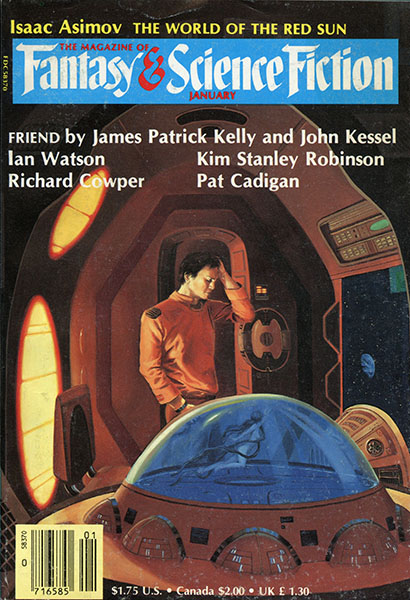
First published in the January 1984 issue of The Magazine of Fantasy and Science Fiction, which is on the Archive. To my shock it has been reprinted only once in English—in The Year’s Best Science Fiction, Second Annual Collection (ed. Gardner Dozois).
Enhancing Image
Jake is a Friend on the Le Corbusier, a space cruiser. A Friend is a bit of an odd job—an amalgamation of counselor and security. “During a starcrossing, a Friend has sole responsibility for the safety of his passengers; no one, not the ship’s crew, its captain, or even the president of IPT may interfere.” Which sounds like a disaster waiting to happen, and indeed Jake is telling his story with a good deal of hindsight, after his “great loss.” In the future, it has become commonplace to travel between the stars, although it still takes a lot of money and there are still risks involved. Some get to stay conscious onboard as the ship jumps through space, but others are put in cryosleep—sometimes as a form of punishment—and those in cryo are not guaranteed to survive the voyage. The following story could be considered something of a love triangle, between Jake, Leila Jahiz, and Phillip Goodson. Leila is an aspiring ballet dancer while Goodson is VP of IPT and, once upon a time, was Jake’s superior as a Friend. Mind you that being a higher-up at IPT is no joke, considering they have a monopoly on commercial space flight. Jake always hated Goodson, which may or may not color how Our Hero™ frames Goodson in his narration. Maybe it would be unfair to call Jake an unreliable narrator, but without getting into spoilers too soon it might be in his interest to make himself look less bad in his own story.
So there’s the problem of “hitchhiking” during a starcrossing, which is basically someone who doesn’t have the money to rent space on the ship hitching with someone who does. To be fair, cold sleep is somewhat dangerous, so it’s not an appetizing alternative. The dilemma here is simple: Leila wants to hitch with Goodson and use his position to help her get into the dance troupe of her choosing—which of course means the best of the best. Leila, according to Jake anyway, is not so conventionally attractive, nor does she have the magic touch expected of the top dancers; but she’s tenacious, and despite his comments on her appearance Jake still very much has a thing for her when they meet a second time. They had previously met about a decade prior, when Leila was a teen hopeful and Jake was just starting his work as a counselor, before he had even become a Friend. The two had an affair while Leila was Jake’s client, which is—bad. “I had no intention of falling in love with her,” but he did, and upon seeing each other again those feelings have returned. Now, it’s not unusual for a Friend to have sex with crossers, but it’s supposed to be done as a way to keep people happy on the ship and is done with those who aren’t looking to hitchhike. Jake even gets hit on by an underage dancer, although thankfully he seems to turn her down—or at least it looks that way.
On the night I read “Friend” I went to bed thinking randomly about what it had reminded me of, because initially I couldn’t put my finger on it. Then it occurred to me that, coincidental or not, it reads like early John Varley. I mean this in a good way. Varley was one of the best new SFF writers to debut in the ’70s and his Eight Worlds stories especially are still a lot of fun to read, although the catch is that his stuff could get a little too horny. Leila is sleeping her way up the ladder, which to her credit is a fact she makes no attempt to hide. (Something that just occurred to me as I’m writing this is that the phrase “to blow off” means “to fuck” basically, in the context of the story. Some future-history jargon?) Again, if the two hadn’t known each other beforehand it wouldn’t even be unusual for Jake to Leila to have sex on the ship. A rival dancer, Brenda, goes to Jake for a quick fuck more than once, in fact—not because she finds Jake attractive particularly but because she needs to “blow off” steam, having not gained Goodson’s favor. And Jake, seeing that this is probably for the best, goes along with her. “As I had expected, Brenda was not so much interested in me as in saving face, and a brief affair with the Friend offered her an acceptable means.” Brenda did this in the hopes of catching Goodson’s attention, maybe making him jealous; but the move doesn’t seem to have paid off, as neither Leila nor Goodson confronts her about it. It does stir gossip on the ship, which Jake was expecting. “The community of crossers is small, and boredom is its greatest enemy.” It’s a tricky situation, when you’re stuck babysitting a bunch of rich assholes and sometimes you’re called on to do things that would normally be considered very unprofessional.
Two things really struck me about this story: its pacing and the uniformity + believability of Jake’s voice as a narrator. F&SF and ISFDB count “Friend” as a novelette, but it must barely count because it’s only about fourteen magazine pages and feels even shorter than that. Even so, despite couching the drama in a far-off location and having to do some legwork to flesh out the world, it’s a neatly self-contained narrative. Despite the brevity the three main characters are written as being flawed, but not two-dimensional, although Goodson is written (or perhaps thought of) as without redeeming qualities: he’s a real asshole, despite his name. As for Jake, it’s a minor miracle Kelly and Kessel were able to not only imagine such a character but write him consistently. I have not collaborated with a fellow author in… let’s say a very long time. So I’m not sure how one would go about co-writing a story, especially in the late Cretaceous pre-internet age. I’m curious as to who wrote what, because despite his evident internal conflict Jake has a consistent voice and the other characters are vividly drawn. Did one focus on dialogue while the other on narration? It’s an effective character drama that shows both men in control of their abilities, which is not something that can often be said of collaborations. The tragedy of the situation is maybe predictable, but it’s still heartbreaking; this is not even lessened by the foreknowledge that Jake will lose—has, in fact, already lost.
There Be Spoilers Here
So, perhaps predictably, Jake and Leila have sex. “This was not the political coupling that I had had with Brenda,” he admits. This is personal. The two still want each other, but Leila wants to reach the top even more than she wants to be with Jake—not that Jake really minds that. The real problem is now he has a conflict of interest, because as a Friend he should report Leila for conspiring to hitchhike—only doing so would not only ruin her chances at success but likely ruin their friendship. Jake thinks Goodson must be putting him up to something, and he’s not totally wrong about this—only he ends up being wrong in a way he failed to expect. Goodson more or less tricks Jake into ratting out Leila, a fact he realizes too late. The truth is that Goodson doesn’t give a shit about Leila, both as a person and a dancer, and was only using her to get back at Jake. Jake was hoping to hurt Goodson but he ends up hurting someone he actually likes, although he tries his best to keep the fact that he’s the rat from Leila; whether or not she ever finds out is left ambiguous. So Jake quits his job after the voyage, in shame. It’s not a complete loss. Over the next ten years he starts his own company, becomes successful at that, and Leila even gets into the prestigious dance troupe she always wanted—even if it happened several years later than she had hoped. But the two have not spoken in years, and it’s only at the very end, when Jake goes to see one of Leila’s performances for the first time, that there’s a ray of hope for him. Now that’s a good bittersweet ending.
A Step Farther Out
“Friend” could’ve certainly been printed in Asimov’s; it might’ve been submitted there first, who’s to say. In a way you can sense this is a borderline space opera that was written following John Varley’s influence on the field, and during that era when Hollywood studios were still scrambling for the next Star Wars; but while it may strike some as retrograde now I’d actually say it has aged more gracefully than most. “Friend” works as well as it does, I suspect, because at heart Kelly and Kessel are humanists. The story is certainly SFnal enough, but ultimately it’s a story with human characters who are by no means cardboard cutouts. Given that this was considered major enough to be the cover story of the F&SF issue it first appeared in, I’m a little dismayed it hasn’t been reprinted more.
See you next time.


 Science Fiction & Fantasy Remembrance