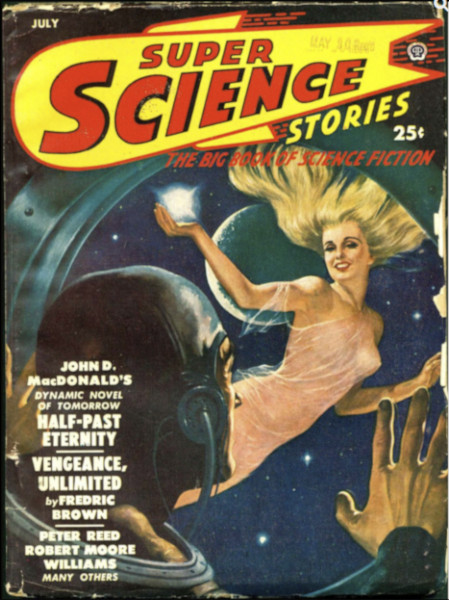
(Cover by Lawrence. Super Science Stories, July 1950.)
Who Goes There?
Did not think this post would get delayed by almost a week, but I got hit with the double whammy of being sick (some repiratory deal, like a chest cold), which I’m still dealing with, and more importantly being without internet at my apartment for four fucking days. This all happened over Easter weekend, so it felt like just bad luck. Apologies.
Fans of classic crime fiction will know John D. MacDonald for his prolific and popular Travis McGee series of novels, starring the titular detective, with some 21 novels published over a span of about as many years. MacDonald apparently wrote the first handful of Travis McGee novels in rapid succession, slowing down a bit after but still writing at an impressive speed. He’s also famous for his standalone crime novel The Executioners, which you would know better as Cape Fear. He earned the Grand Master Award for lifetime achievement from the Mystery Writers of America in 1972—by no means a small feat, especially given that he had only been writing crime fiction for not quite twenty years at that point. But before all this, before even Cape Fear, MacDonald cut his teeth by writing for various magazines from the late ’40s through much of the ’50s. He wasn’t very picky about what genres he would dabble in, although much of the fiction he wrote in these early years was sports stories, non-genre adventure stuff, and of course science fiction. The magazine market for SF was going through a renaissance at the time, which MacDonald capitalized on. “Half-Past Eternity” is one of MacDonald’s longer SF stories, being about 20,000 words, and in a way fitting for MacDonald it has a mix of SF, crime, and sports fiction. Like sure, why not combine all three?
Placing Coordinates
First published in the July 1950 issue of Super Science Stories. It’s only been reprinted twice, in The Human Equation (ed. William F. Nolan) and the MacDonald collection Other Times, Other Worlds.
Enhancing Image
Dr. Garfield Tomlinson goes to make a bet on a boxer, “the kid,” who in fact is in his early thirties and a loser with a soft swing. Tomlinson bets the kid will knock out his opponent in the first round, with an amount of money that surely would’ve been considered suicidal circa 1950. The bookie, Nat February, accepts the bet, but is really puzzled—both by how much money Tomlinson has put on the table and how confident the old doctor is that he’ll win. Which he does. The kid’s swings are unnaturally fast and swing, to the point of breaking his opponent’s jaw, on top of the first-round knockout. Despite the story starting with their perspectives, neither Tomlinson nor Nat is the protagonist (we never even see Nat again after this opening stretch), but instead Sam Banth, an ambitious and amoral con-man who makes it his mission to track down the doctor. He’s street smart, but he’s also smart enough to do some digging at the local library and find Tomlinson’s name, and even where he lives. The doctor had studied longevity in geriatrics, but his most recent research has to do with speeding up time for the young rather than slowing it down for the old. The short of it is that time is partly subjective, in that how each person understands the passing of time involves metabolism, reflexes, etc. For a swift boxer, time seems to move slowly, even if that’s not the case in reality. If you’re an athlete in the heat of the moment, time seems to stretch out like a rubber band, while conversely your reflexes are tuned as if every second counted.
More importantly, Sam realizes that athletes with such an enhancement could make him a fortune. But first, he has to get through to the doctor, along with Linda, Tomlinson’s daughter. Sam is quite a bastard; he would fit right in as the protagonist of a crime story of the sort that focuses on the criminal. He all but coerces Tomlinson into forming two companies with him: Research Laboratories, Inc and Champions, Inc.The idea is basically to “train” athletes who normally would have few prospects with the help of the old doctor’s method of time distortion, thus heightening reflexes and making these losers into stars. Of course, the angle for Sam is to scrape the profits off these athletes, along with having big shares in the company. You might say using such research to make superhuman athletes would be cheating and even rendering these demanding sports monotonous, and you’d be right! Not that Sam is all that concerned about what’s right or wrong. Meanwhile he’s getting smitten with Linda, who by her own admission wants enough money to “smother” herself with. Despite their initial hostility toward each other, since Linda’s well aware Sam wants to take advantage of her father, the two end up having a fair bit in common. While Sam already owns a large stage in the company, the ownership being split three ways, he gets the idea that maybe if something unfortunate were to happen to the old doctor, and also if Sam were to marry Linda, well…
The scheme at the center of “Half-Past Eternity” is a good deal of fun to read, even if we can guess that the whole thing will come crumbling down at some point and in some way. We don’t expect Sam to come out on top, nor do we want him to; but it’s the getting-to-that-point that’s fun. I’m reminded of one of the all-time quintessential noirs, Double Indemnity, that classic premise of a coniving woman and her lover plotting to get rich off her husband’s life insurance. This is all well and good, although the story does suffer a bit from MacDonald’s need to either pad out the word count or give us more of a perspective on the athletes being “trained.” There’s a B-plot involving Wally Christopher, a young man who has a passion for baseball but no future in it at the pro level, on account of not being very good at it. He starts having an affair with the much older Barbara Anson, a respected former tennis player who had quit the game on account of a leg injury. This plot thread ultimately doesn’t go anywhere much and sort of just fizzles out before the climax of the story proper, but we do at least get some insight on what it’s like to live day to day with these heightened reflexes. People who’ve gone through this treatment become so quick, in fact, that they become jittery, and have to train themselves to take things slow—for the sake of appearing normal to the outside world. The catch, like I said, is that the body is actually aging faster than it normally would, so that for someone like Wally time really go by quicker for them and slower for everyone else. I’m sure this will not factor into the story’s climax at all.
I don’t know how far back performance-enhancing drugs were treated as an issue in professional sports, but “Half-Past Eternity” deals with this subject in an SFnal manner, wherein instead of real-world drugs we’re given a vaguely explained time-distorting treatment. Of course, cheating has been a thing in sports for all recorded human history, or for as long as there have been sports with rules. I mentioned that MacDonald, very early in his career, wrote quite a few sports stories, although I’m not sure if you can find them in print anywhere. MacDonald’s short fiction is generally obscure compared to his novels. “Half-Past Eternity” is at an awkward spot where it’s too long to fit neatly in a short-story collection and too short to be honestly called a novel—despite what the front cover of Super Science Stories says. Certainly he could’ve shaved the word count down so that it fit more neatly as a novelette, namely by doing away with the aforementioned subplot. Even with the fat on it, though, this is a fast-moving yarn.
There Be Spoilers Here
Up this point the story has been nominally SFnal, but things are about to take a very Philip K. Dick direction, to the point where I wonder if by chance a young Dick had picked up this issue of Super Science Stories. Sam and Linda plot to kill the latter’s dad, and plan goes off without a hitch. If anything the plan succeeds a little too well. Sam, who himself has sociopathic tendencies, is disturbed by the ease with which Linda is able to get over having a part in her own father’s murder. Maybe it would be best to kill her as well, and take her stake in the company for himself. This plan both succeeds and fails. By the time of his death, Dr. Tomlinson had constructed an “iron maiden,” a portable chamber that would subject the lucky (or unlucky) person inside it to time distortion. If someone were to be trapped in this chamber, though, time for them would speed up such that they would die from a combination of thirst and old age—in just a matter of minutes. They had already seen this effect on animals, through testing, but a human being had never been put in the chamber and killed like this. Yet. Sam succeeds in killing Linda via the iron maiden, but is himself thrown inside and only narrowly avoids dying by breaking out. Having stripped himself of his clothes to escape, Sam is now alone, naked, and most strangely now, in a world where time has all but stopped for him. This is where “Half-Past Eternity” gets really fun. The final stretch of the novella sees Sam moving so fast that subjectively he’s stumbled into a world where everyone and everywhere has almost frozen solid. Even water has effectively turned into a solid, and MacDonald is happy to tell us the convoluted means by which Sam has to eat and drink anything. By this point the sports and crime tropes have fallen to the wayside, with the SF knob being turned all the way up.
In his introduction for this story in Other Times, Other Worlds, Martin H. Greenberg singles out the final chapter of “Half-Past Eternity” as impressive in its handling of “difficult material.” I thought this meant in the sense of graphic or “serious” stuff, but actually he meant something very different. Sam gets away with his crimes, in a sense, and he even lives to old age—all in the span of one day. By the end of his life, at which point mere hours have passed in the objective world, he’s become like Robinson Crusoe, a raggedy old man with long hair. This is a very strange punishment, but at the same time it’s not all bad for Sam, as he effectively becomes ruler of the world, being able to do whatever he wants—or at least anything that doesn’t get him killed. He even kills a man, by accident, early on and gets away with it. Even if the novella wasn’t exactly great up to now, I do think the final chapter is worth the price of admission.
A Step Farther Out
John D. MacDonald is the kind of author you’d think wouldn’t appear on a sci-fi/fantasy review blog more than once, but he wrote quite a bit of SF in just a handful of years, and I do like to cover SF by authors from outside the field sometimes. The last time I wrote about MacDonald was the magazine version of his novel Wine of the Dreamers, which I thought was middling. “Half-Past Eternity” is a marked improvement, in part because it plays more to MacDonald’s strengths. It’s hardboiled and no-nonsense, and the climax, while outlandish and maybe hard to believe if you think about it too long, is a lot of fun. It all goes by quickly, despite being a novella. Given that it’s not been reprinted ever in my lifetime, it’s safe to call this one a bit of a hidden gem. Just don’t take it too seriously.
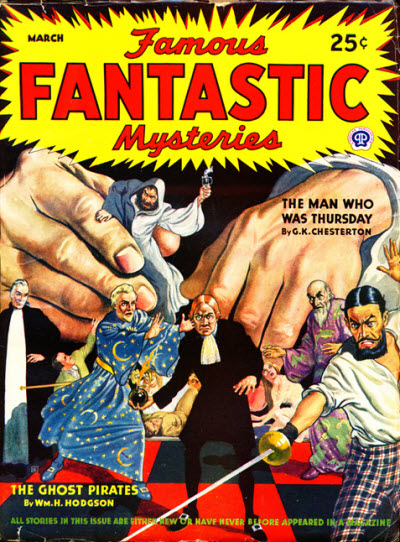
(Cover by Lawrence. Famous Fantastic Mysteries, March 1944.)
Who Goes There?
One of the most beloved Christian apologists of his era, G. K. Chesterton came to prominence in the Edwardian era as a kind of jack of all trades when it came to writing, being a prolific essayist, poet, and short-story writer. His Father Brown mysteries were pretty popular during Chesterton’s life and remain very much in print. (Curiously Chesterton came up with his Catholic priest detective character long before he himself converted to Catholicism.) His religious treatises Heretics and Orthodoxy were partly responses to avowed atheists of the era, such as George Bernard Shaw (Chesterton and Shaw were good friends, for the record), and partly to help those who considered themselves defenders of the faith in what was becoming a more secular England. You don’t have to be Catholic, or even Christian (as indeed I’m not), to enjoy Chesterton’s writing, since he tended to be very funny, and had kind of an Oscar Wilde-esque penchant for zingers. He’s a much finer prose stylist than H. G. Wells, his close contemporary, friend, and in some ways his foil. He also wrote his fair share of fantasy, including what is perhaps his single most famous work, The Man Who Was Thursday: A Nightmare, one of the great novels of the 20th century.
Of course, how The Man Who Was Thursday counts as fantasy can be a point of contention with people, to the point where folks in the Famous Fantastic Mysteries letters column were wondering if it might even qualify as fantastic enough—although they enjoyed the novel on the whole. 1908 would be a bit of an annus mirabilis for Chesterton, as it saw the publications of both The Man Who Was Thursday and Orthodoxy, and despite being on its face an espionage novel (an early example of that genre) The Man Who Was Thursday might be as concerned with Christianity as Chesterton’s religious tracts. This is a reread for me, although I have to admit I mostly just stuck to the complete text rather than its FFM publication. I said in an earlier post that the novel’s FFM printing seems to be unabridged, but doing a side-by-side comparison between the Project Gutenberg text and FFM version for random passages show that the novel has been subtly abridged, from about 57,000 words to maybe 55,000—a difference the casual reader might not notice. Chapters and scenes remain intact, but sentences and even parts of sentences are occasionally tossed out the window, I have to assume for length but also for little flourishes that the editor (Mary Gnaedinger) might’ve considered a little too verbose.
Placing Coordinates
First published in 1908 and reprinted in the March 1944 issue of Famous Fantastic Mysteries, which for some reason is not on Internet Archive. It is on Luminist at least, so there’s that. I will say, however, that aside from the novelty of Lawrence’s interiors (which are quite good) and a slightly altered text, I would simply read it on Project Gutenberg, it being in the public domain and all. Paperback copies are also not hard to find in the wild, this being a fairly well-known classic novel.
Enhancing Image
The Man Who Was Thursday is a masterpiece, and when it comes to novels as fine and yet weird as this one the question we have to ask ourselves is not “How did he do it?” but rather “How did he get away with it?” How did Chesterton get away with writing this? It’s what we would now call trippy, there’s certainly a hallucinatory effect that intensifies as the novel progresses; but it’s also a deeply Christian and at the same time political novel. Not only is anarchism mentioned but it’s the political ideology that takes center stage, at a time when anarchism in the US and England was gaining some very bad mainstream press, most infamously (at least for Americans) with Leon Czolgosz assassinating William McKinley in 1901. This novel was written in the 1900s, and presumably is set in that decade, what with there being “motor-cars” that predate the Ford Model T. So Chesterton introduces us to Saffron Park, a London suburb. These are not, however, the fog- and mud-covered streets of London as described at the beginning of Charles Dickens’s Bleak House; instead it’s a whimsical and implicitly fantastic introduction that hints at the madness to come. We’re introduced to Gabriel Syme, not as you would normally describe the protagonist in a narrative, but like the subjective viewpoint in a lucid dream—an angle Chesterton is going for quite deliberately. Between the novel’s subtitle and this opening passage about the people of Saffron Park it’s clear, at least with hindsight, that Chesterton is setting us up for something, only we’re not given to thinking anything is amiss at first. Not even Syme suspects what he’s in for, poor bastard. I could quote the whole passage, but I won’t.
We meet Syme and his friend/rival Lucian Gregory, who considers himself not only an earnest poet but a genuien anarchist—possibly the realest. Syme claims Gregory is full of shit, and so Gregory takes him on a journey to prove that he is, indeed, the realest. Gregory is quite the character, and I’m gonna frontload this review with discussion of him since once we get through the first few chapters we won’t see him again until the very end of the novel. It isn’t apparent at first, but Gregory will serve a major symbolic purpose, on top of being reponsible for kicking off the plot, being a tenacious red-haired man, someone who considers himself both a genuine creator (a poet, or an artist) and a genuine destroyer (anarchist) “a walking blasphemy, a blend of the angel and the ape.” He is contrasted with his sister Rosamond, who similarly has fiery red hair but whose demeanor is much kinder; she’s a minor character, and like Gregory she’s gonna be absent for most of the novel, but we’ll eventually get back to her. Indeed we have no choice but to remember Rosamond, as she will be the only female character of any importance. I said this is a great novel, I didn’t say it would be all that egalitarian. As for Syme and Gregory, whom Chesterton calls at one point “these two fantastics” (these are not realistic characters, or even actors on a stage, but water-colored figures in a fairy tale), the two take a trip to what turns out to be the entrance to a secret lair, with a password and everything. The password in question is “Mr. Joseph Chamberlain,” which is funny considering Gregory and other anarchists would have to recite the name of a notorious conservative politician of the time.
Political humor. Tehe.
Before we continue with the plot, I wanna stop for a moment to illustrate how the FFM printing occasionally removes sentences or sentence fragments, seemingly to achieve a punchier effect in places where Chesterton is being verbose, such that these passages would be considered the least necessary. Readers wouldn’t have missed out on much, but what they did miss would’ve often been little juicy nuggets of prose. Take this passage for example, in which Syme and Gregory are traversing the secret passage which leads to the Council’s hideout. I’ve bracketed the section which the FFM printing excludes:
They passed through several such passages, and came out at last into a queer steel chamber with curved walls, almost spherical in shape, but presenting, with its tiers of benches, something of the appearance of a scientific lecture-theatre. There were no rifles or pistols in this apartment, but round the walls of it were hung more dubious and dreadful shapes, things that looked like the bulbs of iron plants, or the eggs of iron birds. They were bombs[, and the very room itself seemed like the inside of a bomb. Syme knocked his cigar ash off against the wall, and went in.]
Sure, we don’t need to know that last fragment, as it doesn’t further the plot or action, but it sounds better than simply “They were bombs.” Anyway, Gregory is convinced he’s gonna be the new Thursday in the Council of the Days, a league of European anarchists, the best and most fiendish the movement has to offer. Each member of the Council takes on an alias after a day of the week, and the previous Thursday died recently. There’s gonna be a vote tonight. Syme and Gregory have each sworn a secret to each other, which each party is to keep to himself—a tragic development for Gregory, given Syme’s secret is that he’s actually an undercover cop. Gregory just led a cop into a den of anarchists. What a dumbass. But all is not lost, as Syme is not only here by himself, unable to call for backup, but he’s also sworn that he’d keep the hideout a secret. Since these men are English, their word turns out to be good enough. The Man Who Was Thursday is a uniquely British novel in several ways, not the least of them being that if this were an American story Syme wouldn’t give a fuck about keeping a secret with a man who evidently sees him as an adversary once he reveals his true identity. To make matters worse, while Gregory is poised to become the new Thursday, Syme comes in with an improvised speech that blows Gregory’s out of the water, and the despite the fact that surely nobody at the meeting would have seen Syme before he wins the vote and becomes the new Thursday. More or less on a whim, it sseems. Gregory is not happy about this, and it’s hard to blame him considering once Syme becomes Thursday Gregory will vanish from the narrative until the end.
Syme is the main character, so let’s talk about him. Syme is not your conventional hero, or even much of a heroic figure. I’m not just saying this because he’s a cop. Having descended from a line of eccentrics, Syme has become neurotic about his family of nonconformists and has gone in the total opposite direction—of being in favor of order to the point of lunacy. We’re treated to what I remember as being the only conventional flashback in the whole novel, in which we’re given Syme’s backstory, how he had a chance meeting with an unusually philosophically-minded policeman, and of his encounter with a mysterious man in “the dark room,” evidently not seeing the man’s face but being given the lofty job of policeman. His job thus was to go undercover and infiltrate the Council of the Days, to put a stop to the anarchist movement in England from the inside. This is a bit of an unusual scene since it breaks away from what is otherwise is a more or less linear narrative, but we do get an explanation for Syme’s strange obsession with the anarchists, not to mention we get some really good lines from the cop he talks to. A little quibble I have with this book, which I think comes close to perfect on the whole, is that the pacing does go kind of sideways. The first two chapters are a perfect setup-payoff affair, totally engrossing and with a promising of escalating tension, only for the narrative to jump backwards abruptly momentarily. I also have to admit that once Gregory leaves the novel and we’re introduced to the Council that the plot sort of funnels, or rather that there’s a snowball effect in which you have a straight shot to the climax over the course of about a hundred pages. Most of this novel can feel like one long chase sequence.
So we meet the Council, who will accompany Syme as main characters for the rest of the novel, although some members get more attention than others. It’s a bit of an ensemble effort, and Chesterton doesn’t give himself too much wordage. With how many ideas it throws at the reader The Man Who Was Thursday could’ve easily been double its length if published today, but Chesterton, being accustomed to short-length works like poems and essays, wasn’t much of a novelist, or rather he didn’t have the prolonged stamina expected of the writer who thinks themself a novelist first. Instead he hits the reader with a shotgun blast of symbols and characters. None of the members of the Council is very developed, individually, but they prove to be greater than the sum of their parts. There is, of course, Sunday, the head of the Council, an almost impossibly large man with a face that could take up the whole sky—a character not too dissimilar from Chesterton, for his physical largness but also his charima. There’s Monday, only otherwise known as the Secretary, who acts as Sunday’s right-hand man and most devoted follower, and who delivers one of the novel’s most memorable lines: “A man’s brain is a bomb.” There’s Gogol as Tuesday, a cartoonish Pole among mostly Englishmen—although it turns out that “Gogol” is, in fact, a Cockney policeman in disguise. There’s the Marquis de St. Eustache as Wednesday, a noble Frenchman who acts as if he jumped out of one of Alexandre Dumas’s novels. There’s my personal favorite, Professor de Worms as Friday, who’s so old and dicrepit that Syme wonders how he even made it to the Council meeting. Finally there’s Dr. Bull as Saturday, a young and mischievous yet enigmatic fellow whose “smoked spectacles” hide his eyes. These are basically cartoon characters, but whereas that would be considered shallow writing in realistic fiction, Chesterton uses the men’s broad-strokes characterizations for humor, as well as symbolic purposes.
Sunday outs Gogol as an undercover cop at the meeting, although despite Gogol being a cop Sunday doesn’t have him killed or anything; in what I have to admit is a confusing turn of events Sunday just… lets Gogol go free? The poor Cockney has a fall down the stairs by accident, but he’s fine, and we even see him much later in the novel safe and sound. But since Gogol is the first Council member to be outed as a cop he also gets the least time to shine; it’s a good thing, then, that his one scene where he’s the focus is pretty funny. I’m sorry, did I say “first” Council member to be outed as a cop? Well that’s because Syme and Gogol aren’t the only cops in the Council. It’s hard to say what counts as spoilers for this novel, since I’ve seen people argue that even the ending doesn’t really count as a spoiler, seeing as how the subtitle anticipates. It’s also easy to see, on a second reading, how Chesterton sets up his novel as a work of fantasy (albeit surreal rather than “high” or “low” fantasy) from the very beginning. Certainly the series of events here soon proves to be improbable, if not outright fantastic. What are the odds of there being multiple policement undercover in the Council of Days, and that these cops would be unaware of each other’s missions? Syme didn’t know who Gogol really was, and after some investigating he comes to find he didn’t know who Professor de Worms was either—not a horribly old nihilist but a relatively young actor who took on the role of a real man he once met named Professor de Worms. Wilks, the cop who has been impersonating de Worms, uses makeup and body language for the sake of a performance. Like Syme, Wilks is a man of order who has such a disdain for disorder (or, as he says, nihilism) that he comes out looking half insane for it. Chesterton seems to be saying that police and anarchist, both driven in their ideals to the point of mania, are two sides of the same coin. It goes to explain why Syme and Gregory are opposites, yet they have an affinity for each other that will come back into play at the very end.
Before we get waist-deep in the plot, or rather the prolonged chase sequence as I had mentioned, let’s talk a bit more about Chesterton’s faith and politics, and how they figure into what is a deeply religious and political novel. Chesterton is now known as a Catholic apologist, although he didn’t convert to Roman Catholicism until fairly late in life, a good 14 years after The Man Who Was Thursday was published; he was, however, already a devout Anglican who had written essays and books aimed at Christian readers, regardless of denomination. One reason I suspect this novel works with readers who may or may not share Chesterton’s faith is that while the dialogue and even character functions are laced rather strongly with Biblical meaning (Rosamond is a walking symbol of Christian grace), it’s not a work that gets stuck in the quagmire of church minutia. Just as an example, you have to admit that if you’re a secular (or even non-Catholic) fan of Gene Wolfe that his work can occasionally be stifling with its uniquely Catholic symbolism. Or to use another example, A Canticle for Leibowitz is a very good novel, but its dead give-aways as a pre-Vatican II novel meant it became dated just a few years after publications. The Man Who Was Thursday has no such issues, and while Chesterton’s both-sidesing of police and anarchists can come off a bit centrist in a way, the notion that police are not embodiments of good necessarily (Syme notes at one point, with dismay, that one of the police’s functions is to terrorize London’s working class) can actually be taken as a progressive stance. Granted, Chesterton’s framing of anarchism is unflattering (especially given Gregory’s symbolic purpose, which we’ll get to), but it could be a lot worse for 1908.
There Be Spoilers Here
Three, then four, and so on, Syme discovering that each man in the Council is an undercover cop, such that ultimately everyone in the Council (even the Secretary) who isn’t Sunday is secretly a cop—yet none of these knew any of the others were police. Each man admits to having been recruited into the service by a man in a dark room, a man none of them can identify. Each man has taken on a disguise, and each encounter has that disguise peeled back to reveal a man of nobility—if also eccentricity. Professor de Worms is shown to be a stage actor underneath his old-man makeup, the Marquis is shown to not be quite as statuesque a man as thought since much of his bulk turns out to be padding, Dr. Bull’s eerie spectacles come off to reveal a youthful innocence, and so on. Each man is not quite what he appears to be, which is fitting considering the climax of the novel takes place at a masquerade, whose unlikelihood by this point goes unopposed given how the action has escalated into unlikelier and unlikelier territory. I called much of this novel a chase sequence, but it could also be likened to tumbling down a rabbit hole. The Alice’s Adventures in Wonderland comparison is apt, and it’s one Chesterton all but explicitly makes.
I said I would refrain from quoting whole passages, indeed a hard task with such a quotable novel, but I’ll make an exception with perhaps the finest of Sunday’s monologues—or at least I feel justified in quoting most of it here. It’s a badass and memorable passage, not least because of its surrealism. Up to this point Sunday has come off as a larger-than-life figure, but as the novel approaches its final stretch it’s become clear that Sunday is no ordinary man—indeed that he might not be strictly human. What is Sunday, then? A common interpretation is that Sunday is God, although it must be said that if he’s meant to be God then he is not the merciful father figure of the gospels, but the somewhat conniving God who makes a bet with Satan over whether Job will give up his faith. Sunday is not an anarchist, but then he’s also not a cop; rather he seems to be playing both sides against each other, order against disorder, to see who will come out on top. In this light it’s hard to call him a villain, but then he’s certainly not heroic. Maybe he’s beyond human conception of good and evil?
Anyway, here it is:
“You want to know what I am, do you? Bull, you are a man of science. Grub in the roots of those trees and find out the truth about them. Syme, you are a poet. Stare at those morning clouds. But I tell you this, that you will have found out the truth of the last tree and the top-most cloud before the truth about me. You will understand the sea, and I shall be still a riddle; you shall know what the stars are, and not know what I am. Since the beginning of the world all men have hunted me like a wolf—kings and sages, and poets and lawgivers, all the churches, and all the philosophies. But I have never been caught yet, and the skies will fall in the time I turn to bay. I have given them a good run for their money, and I will now.”
Right before taking off in a hot air balloon (yes, there’s a chase involving a hot air balloon) Sunday finishes with perhaps the biggest revelation in the novel other than the ending: “I am the man in the dark room, who made you all policemen.” After the chase with the hot air balloon, plus another chase involving Sunday on an escaped elephant, the men of the Council finally meet their tormenter face-to-face at a masquerade, one in which each of the men has been given a suit whose design corresponds with a day of the creation in Genesis. (These colorful outfits are lovingly depicted on the FFM cover, by the way, with Syme and company on a chess board, with massive hands [presumably Sunday’s] manipulating them.) Then there’s Sunday, and most surprisingly (for Syme anyway) there’s Gregory, who reappears quite literally in these last few pages. If Monday through Saturday are days of the creation and Sunday is God, then Gregory, the one genuine anarchist, is shown to be analogous to Satan. (Remember the red hair?) The very fabric of reality seems to be tearing itself apart at this point, the action becoming so heightened that the novel threatens to break through some kind of wall, from the unlikely into the impossible.
Then Syme wakes up.
The subtitle, A Nightmare, turns out to be quite literal. Of course, if this novel is supposed to be a nightmare then it’s a weirdly funny one—not horror but surreal and maybe discomforting comedy. The “it was all a dream” ending tends to be disparaged, and for good reason, a major exception being the ending of this novel, which is perhaps the most befuddling part of the whole thing. Something I wanna point out is that to my recollection The Man Who Was Thursday has only one scene break, which happens at the very end, as Syme suddenly wakes up and finds that he’s been walking and in the middle of a conversation with Gregory—only this doesn’t seem to be the Gregory of the dream. The meaning behind this one scene break, which divides the nightmare from reality, is lost in the FFM printing, wherein for some reason the editors thought it necessary to provide more conventional scene breaks. This ending is very strange, not least because of how brief it is (only half a magazine page) and how there isn’t any dialogue here. It’s ambiguous how different Syme and Gregory are from their dream counterparts, but at the very least they’re good friends in the real world. We had been reading a fantasy novel this whole time, but we didn’t know it, and neither did Our Hero™. Despite the experience of having had such a vivid dream, and somehow in the middle of a conversation, Syme feels awoken in more ways than one, as if suddenly made aware of the performance of a miracle, or as if “in possession of some impossible good news.” Even if the whole adventure with the Council of Days didn’t happen in the real world, the Christian significance of it left its mark on Syme. We even meet Rosamond again, for the first time in over a hundred pages, that symbol of grace with the “gold-red” hair (compared with Gregory’s flaming redness) who, naturally, we see tending a garden—her little Eden.
A Step Farther Out
You could go on for a while about this novel, as despite its brevity Chesterton is playing with a few layers, not to mention that’s simply a very entertaining (and increasingly fucking wild) ride from start to finish. The Man Who Was Thursday is at once a spy novel involving a council of anarchists and also an Alice in Wonderland-esque journey backwards to the beginnings of Judeo-Christian theology. It works because even if you disagree with Chesterton’s religious views (as indeed I disagree), not to mention his not-totally-flattering depiction of anarchism, it still has the capacity to entertain and provoke thought. I’ve read it twice now and I can say it’s easily the best novel I’ve covered on this site, and was probably the best novel ever printed in Famous Fantastic Mysteries. It’s fairly accessible for an Edwardian novel, but it’s also very unusual in that it’s not a realistic novel at all. Reading The Man Who Was Thursday is like getting drunk and then taking an edible, and then an hour later some dude walks in and starts reading Bible passages aloud at you after the edible’s taken effect.
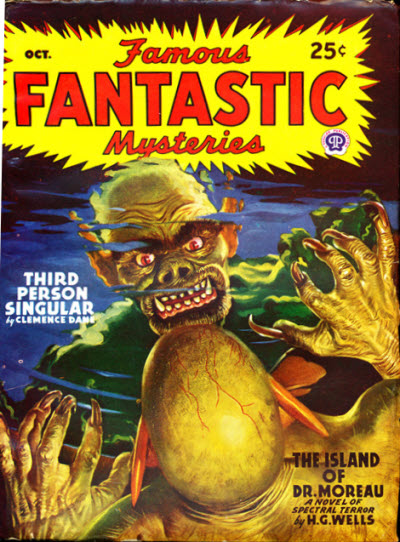
(Cover by Lawrence. Famous Fantastic Mysteries, October 1946.)
Who Goes There?
When I reviewed Clark Ashton Smith’s “Genius Loci” some days ago, I said that Smith, H. P. Lovecraft, and Robert E. Howard were the defining authors during the “classic” period of Weird Tales, in the ’30s. This is not entirely true. I omitted a fourth name because I knew I was gonna get to her very soon, and now she’s getting her own introduction. C. L. Moore was one of the great practicioners of SFF in the ’30s and ’40s, and her rise to prominence was swift in a way that most authors’ are not. Her first professional sale, “Shambleau,” was published in Weird Tales in 1933, and it instantly made her a big deal to that magazine’s readership. During this early period, Moore created two series, both set in the same continuity (though this was not immediately known), named after their protagonists: Northwest Smith and Jirel of Joiry. The former leans toward planetary romance while the latter leans toward heroic fantasy, and this duality was a line Moore would walk for the rest of her career.
Things get complicated when Moore marries a fellow author, Henry Kuttner, in 1940, after the two had already collaborated on a story or two. Kuttner was a few years younger than Moore, and was a big fan of her work, soon exhanging letters with her and assuming (erroneously) at first that she was a man. Once misunderstandings were out of the way, they formed inarguably the biggest power couple in old-timey SFF, collaborating prolifically throughout the ’40s and writing together so seamlessly that they could not tell apart each other’s writing, and neither can anyone else. To this day there’s no agreement as to who wrote what or how much one contributed to the other’s writing, even when a story is credited to only one of them. “Daemon” is credited to Moore solo, and for reasons I’ll get into I believe firmly enough that Kuttner had basically nothing to do with its creation.
Placing Coordinates
First printed in the October 1946 issue of Famous Fantastic Mysteries, which is on the Archive. FFM was primarily a reprint magazine without zeroing in on a specific genre, covering science fiction, fantasy, and even non-supernatural horror. In the October 1946 issue alone we have reprinted stories by H. G. Wells (a presumably abridged version of The Island of Dr. Moreau) and Bram Stoker, but “Daemon” was an original story. One need not look far to see why Moore would submit her fantasy-horror story to a reprint magazine: the magazine market for fantasy was quite small in the ’40s, with the only other notable outlet being a now past-its-prime Weird Tales. Now, why, when reading these stories for review, do I always try to read the original magazine version? Partly this is because sometimes there are revisions made between the magazine publication and the book publication, but also, there’s flavor when reading anything within the confines of a magazine issue. Take, for instance, Virgil Finlay’s interior illustration for “Daemon,” which as usual is stunning, and which we would not have gotten in a book reprint.
When it comes to reprints of “Daemon” we’re talking quality over quantity; none of the reprints seem to be, well, in print, but these volumes are both good collector’s items and easy enough to find. First we have The Best of C. L. Moore, part of a best-of series by Ballantine Books (Henry Kuttner also got one), and boy do I wanna get these two together. Then we have A Treasury of Modern Fantasy, edited by Terry Carr and Martin H. Greenberg, which might be the same book as Masters of Fantasy; it’s edited by the same people, and unless I’m missing something the contents are also the same. If you’re fond of Moore and Kuttner, at some point you have to get your hands on Two-Handed Engine: The Selected Stories of Henry Kuttner and C. L. Moore, a mammoth tome that collects all the essential short fiction by both authors, solo as well as in collaboration.
Enhancing Image
“Daemon” is a deathbed confession (not a spoiler, our narrator is upfront about this) told by Luiz o Bobo, his title apparently coming from his simplemindedness. Luiz, despite his own admitted lack of intelligence, has a special gift that may well be more of a curse: he sees these things that accompany other people, calling them daemons when they could just as easily be called ghosts. According to Luiz, everyone has a daemon on his shoulder—everyone except him. At the outset of the story we’re far more planted on the horror end of the horror-fantasy spectrum which “Daemon” plays with, and there’s some delicious eeriness at work here. “Do you know who stands beside you, padre, listening while I talk?” says Luiz at one point. The daemons themselves don’t seem to do anything exactly; they don’t have voices, they don’t talk, they can’t interact with the material world—at least not directly. As we’re to find out later, though, it’s maybe possible for a daemon to take possession of its host.
Luiz recalls the death of his grandmother, for a long time the only earthly person who treated with decency, and how her daemon changed as she was dying; it was an unusual event, as the daemon grew brighter, radiating a brightness that threatened to blind Luiz, before finally disappearing once his grandmother’s spirit has moved to—somewhere else. What this could signify, the daemon changing colors as its host nears the end of their life, we’re not given a clear answer on, but then Luiz is no rocket scientist. Actually, let me take a moment to talk about Luiz’s characterization, because this is easily the most interesting part of the story for me: Luiz is obviously neurodivergent. While “Daemon” is on its face a dark fantasy yarn about a man who gets shanghaied and then stranded on an island with a bunch of magical creatures, it’s more potently a tale of alienation, about a man who is unable to relate to other people in the conventional sense, who quite literally sees something “normal” people have that he lacks. Make sure to put a pin in this one.
Oh right, getting shanghaied. Luiz has a bad night at a saloon and finds himself an unwilling passenger on a trading vessel. As you do. The fact that Luiz is not very smart, and can’t even read, makes him an easy target. It’s here that we come across the closest the story has to a villain: the captain of the ship. The captain, who normally would not be the happiest or kindest of men, seems to have his violent urges heightened by a suitably evil-looking daemon which follows him around. The causal relationship between host and daemon is not clear, but it’s quite possible that a daemon’s disposition influences its host, with the captain’s daemon being a particularly nasty example. The captain’s daemon’s uncanniness is not helped by the fact that not only is it blood-red, it doesn’t seem to have eyes.
Now, most men have shapes that walk behind them, padre. Perhaps you know that, too. Some of them are dark, like the shapes I saw in the saloon. Some of them are bright, like that which followed my grandmother. Some of them are colored, pale colors like ashes or rainbows. But this man had a scarlet daemon. And it was a scarlet beside which blood itself is ashen. The color blinded me. And yet it drew me, too. I could not take my eyes away, nor could I look at it long without pain. I never saw a color more beautiful, nor more frightening. It made my heart shrink within me, and quiver like a dog that fears the whip. If I have a soul, perhaps it was my soul that quivered. And I feared the beauty of the color as much as I feared the terror it awoke in me. It is not good to see beauty in that which is evil.
Luiz does find one ally on the ship, called the Shaughnessy (we don’t get his actual name), a dying man from “a foreign land called Ireland” who apparently also comes from a very well-to-do family, and who stands as the only thing between Luiz and oblivion. The captain hates his guts and there will come a point when the Shaugnessy will not be around to protect him. This early-middle section of the narrative, with Luiz on the ship, is probably my favorite part; it’s atmospheric, exceptionally brutal, it’s set on the high seas (which I have a fondness for), and it elaborates on the disconnect Luiz feels with other people. It’s not so much that Luiz befriends the Shaughnessy as he sees the Shaughnessy as a guardian figure, since the most Luiz can hope for, realistically, is not be treated like garbage by others. This is not to say Luiz is a blank slate or a totally passive protagonist; nay, he’s quite active, even if he doesn’t articulate his internal anxieties vocally.
It’s here that Moore does something seemingly clever and really plants the seeds of doubt for us, as to whether Luiz is right or if he’s just delirious. The ship’s water gets tainted, which is pretty bad. “A man can pick the maggots out of his salt pork if he must, but bad water is a thing he cannot mend.” Not helping things is that a particularly brutal encounter with the captain results in Luiz getting what is probably a skull fracture (saying he heard his skull crack, which sounds horrific), and it’s amazing he doesn’t simply die on the ship. Hell, dying at this point might not be so bad. Luiz contemplates suicide, which in his predominantly Catholic homeland of Brazil would be deemed a mortal sin, but Luiz rationalizes that he can’t go to Hell if he doesn’t have a soul, but virtue of not having a daemon. Checkmate, Christians! But no, he does not kill himself, and it’s about here that things get very weird indeed.
Before we get to the spoilers section, I wanna return to something I said earlier, which is that “Daemon” is pretty discernibly a solo Moore effort and not a collaboration. Not that I want to downplay Kuttner’s talent (which happens too often, such as on ISFDB where works under just Kuttner’s name are far more likely to be listed as collaborations than with Moore), but I can’t find any Kuttner-esque elements here. More tellingly, this has the tone and polish of a Moore tale, in the sense that it’s deeply melancholy, even humorless, yet there is a real humanity to Luiz’s character that makes him relatable. I’m not sure why, but Moore tends to sympathize with the underdog, not in a self-congratulatory way, but in a genuinely empathetic way, where she manages to convey a character’s fears and aspirations. Kuttner was an excellent humorist, but Moore was almost like a poet, and “Daemon” reads in parts almost like a poem. Moore wears her emotions on her sleeves, which feels prescient given how often old-timey SFF authors are demeaned (sometimes rightly) as emotionally inept Tough Guys™.
There Be Spoilers Here
You may be thinking, what does that Virgil Finlay illustration have to do with the story? Well…
Luiz and the Shaughnessy get stranded on an island and it’s not some ordinary Robinson Crusoe island: it’s a magical island. The Shaughnessy kicks the bucket, but not before giving Luiz some instruction that he doesn’t do a good job explaining. That’s fine, since, probably unbeknownst to the Shaughnessy, Luiz is not left all lonesome after the fact; he quickly finds some friends. Luiz had aludded to nymphs, or as he called them, “ninfas” (I’m not joking when I say I had first misread it as ninjas), at the start of his confession, but now we’re actually getting to those. Finlay’s illustration shows one of these nymphs, called the orlead (who actually talks with Luiz), and a unicorn. Yeah, there’s a unicorn. This place fucking RULES. Admittedly, I don’t buy into the Eden-like nature of the island, as this pure place where there’s no pain (the Shaughnessy is pretty chill about dying), as it feels too idyllic, not to mention it casts doubt on Luiz’s story despite the fact that he’s telling the truth.
But soon there’s trouble in paradise, and the captain has landed in search of his castaways, most likely to do away with them. With the Shaughnessy already dead he need only worry about one now, but Luiz has the fantasy creatures of the island on his side. Okay, I should be a bit more specific here: these are, at least in part, Greek mythological creatures, hence the appearance of the humanoid goat-footed god Pan who comes in as a sort of deus ex machina. I have to admit the image of Pan chasing the captain (who can now see him, apparently) literally around the island until the captain, thoroughly exhausted, runs back to the place he started at, is funnier than it’s supposed to be. It’s weird, sure, and it’s not boring, but it’s a touch goofy.
I said before that a person’s daemon grows brighters as that person’s death nears, and while I’m not a fan of the turn towards action in the climax, I have to respect just how creepy the captain’s final moments are. We’re not totally sure what happens, because Luiz averts his eyes, but it’s clear that the captain, in the last moments of his life, becomes aware of the red-hot daemon that had been stalking him the whole time, and the way Moore writes his death is the closest the story comes to being genuinely scary, as opposed to just eerie.
Some knowledge deeper than any wisdom warned me to cover my eyes. For I saw its lids flicker, and I knew it would not be good to watch when that terrible gaze looked out at last upon a world it had never seen except through the captain’s eyes.
I fell to my knees and covered my face. And the captain, seeing that, must have known at long last what it was I saw behind him. I think now that in the hour of a man’s death, he knows. I think in that last moment he knows, and turns, and for the first time and the last, looks his daemon in the face.
I did not see him do it. I did not see anything. But I heard a great, resonant cry, like the mighty music that beats through paradise, a cry full of triumph and thanksgiving, and joy at the end of a long, long, weary road. There was mirth in it, and beauty, and all the evil the mind can compass.
After a detour into fantasy we’ve swung back around into horror, almost of the cosmic variety. There are things people are not supposed to see—like their own daemons. Weirdly, I find this aspect to be the least involving, as the scope of the story has by now thoroughly gone beyond Luiz’s psychology and grappled onto something that’s quite “spooky” by not very scary. For me “Daemon” works better as a horror-tinged character study than a straight horror yarn, and likewise I don’t find the stuff with Pan and the nymphs to be totally convincing, although Moore’s lyrical hand stays steady, and I have to admit there’s a bit of a sense of wonder with the island and its fantastical secrets. This isn’t pulp horror but rather something in the Unknown tradiction, and hell, “Daemon” could’ve been published there had it not gone bust in 1943. My point is that Moore can sure as hell write, even when she does something that conceptually I don’t think is the most interesting thing ever.
A Step Farther Out
After I finished “Daemon” I did something I’ve not done before for these reviews, and it’s really something I ought to do again: I looked up readers’ reactions. Not modern reviews of the story (I haven’t even checked if there are any), but FFM‘s letter column, which, as it turns out, was fairly active. Not on the same level as Planet Stories, mind you, but still, we’ve got some yays and nays from the peanut gallery! As far as I can tell reception to “Daemon” was pretty damn positive, although there is one comment that I found interesting, made by some bloke named R. I. Martini, in the February 1947 issue:
Miss Moore’s name is all too seldom in your table of contents, but when listed she inevitably brings forth a new and unique situation. “Daemon,” in that respect, held to standard, though somehow it didn’t have the scope or pimch anticipated. It was when she came to the “ninfas” that disillusionment as to its cIassic qualifications set in. Albeit the atmosphere was there, so saving whatever was left of the day.
I really loved the first half or so, when Luiz is on the ship, whereas I merely liked the second half, when he’s on the island. I think I get where Martini is coming from, because I can’t help but feel like something is lost once the nymphs come into play, and it’s basically spelled out that what happened to Luiz had to be fantastical and not a big hallucination as the result of, say, the brain damage he had undoubtedly suffered. Which is not to say my earlier evaluation of Luiz was rendered invalid by the second half, because I think his character still very much works on an allegorical level; I just wish the literal level was a bit more satisfying. Moore is still a strong writer on a sentence-by-sentence level, her penmanship bordering on the poetic—indeed I wouldn’t be surprised if her lyricism influenced George R. R. Martin’s early work. “Daemon” doesn’t feel like it comes from the ’40s, but rather feels a bit more timeless than that, like Moore is tapping into a study of human loneliness that remains relevant, and for that I admire it.