Who Goes There?
Today I’ll be tackling an SF story by Lin Carter, which might be a bit unfair since Carter wasn’t much of an SF writer. He started out as a fan when he was a teenager, and in the ’50s would start writing genre fiction at the semi-pro level, although he never went on to become an acclaimed writer; on the contrary, Carter would become notorious as one of the worst fantasy writers of the ’60s and ’70s. But then writing wasn’t where his talent lay anyway. While he would be derided for his writing, Carter became arguably the most important fantasy editor of the ’70s, between his role as consulting editor for the Ballantine Adult Fantasy series and his editing of original and reprint anthologies. “Uncollected Works” was Carter’s first solo professional story, and honestly you could’ve convinced me it was written by someone else, since it’s ostensibly SF and doesn’t have the same overbearing style of his later work. It’s also quite different from later Carter fiction in that it’s not half bad! I had a fun time with it, even if it’s not to be taken too seriously. It would earn Carter his first (and only) Nebula nomination, which itself is not too big an achievement considering every other writer active in 1965 got a nomination that first year of the Nebulas.
Placing Coordinates
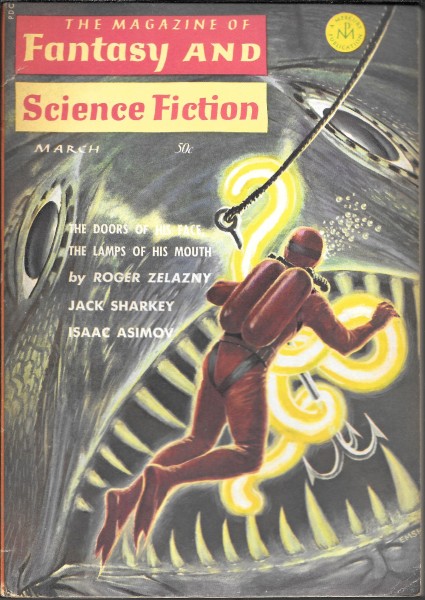
First published in the March 1965 issue of The Magazine of Fantasy and Science Fiction, which is on the Archive. “Uncollected Works” has only been collected (aha) twice, in World’s Best Science Fiction: 1966 (ed. Terry Carr and Donald A. Wollheim) and the Carter collection Beyond the Gates of Dream. I dare say it’s slightly underrated.
Enhancing Image
This story is technically told in the first person, although at times it reads like second-person since the narrator, an elderly literary critic, is being interviewed by some journalist, and you the reader are in the journalist’s position. So the unnamed narrator is talking directly at us. As someone who used to write short fiction (and may well do so again), I’ve been sort of conditioned to think about how a story is written, down to questions the average reader wouldn’t be asking, such as, “Who is this first-person narrator talking to?” This is all told as a one-sided conversation, with the journalist’s side of the interview being masked by ellipses; we can only infer what we as the reader/journalist are saying. This is the sort of thing you have to consider when writing a short story, and as the narrator admits, writing fiction is not easy work at all. “Pounding a typewriter is hard work, young man, I assure you! Ditch-digging, by comparison, demands far less of one, or so I have been told.” Carter is being a little cheeky here, since obviously he wrote fiction (among other things) for a living and knew perfectly well how grueling it was, even if his narrator claims to not have that experience. There’s also some bitter irony in that Carter’s narrator is an old and respected critic, who is considered at least important enough to be interviewed (consider how many genre SF writers were either never interviewed or were only interviewed very late in their careers), while Carter would die in semi-obscurity and as something of an outcast.
To make a long story short, Carter would not have a very happy life; he died relatively young of cancer, and by that point the fandom around fantasy which he helped build in the US had left him behind. It’s a bittersweet life which produced a bittersweet short story here, although I wanna make it clear the narrator is by no means Carter’s avatar; for one thing the narrator was very much involved in Modernist literature, in the first decades of the 20th century, while I can’t say with certainty that Carter cared for the Modernists at all. The narrator laments Ezra Pound not winning the Nobel, which is a curious sentiment considering Pound was a fascist and his reputation as a poet was and remains divisive. (I mean hey, William Butler Yeats was at the very least a fascist sympathizer and he won the Nobel, so I suppose why not.) On top of past regrets he mentions, the narrator brings up some literary works that sounds made-up, and indeed they’re works that won’t be published yet—the “great” literature of the future the old man won’t live to read. At first we’re led to believe this is all just a figure of speech, but it turns out the narrator is being much more literal. Soon he mentions a story from his youth, while he was staying in Paris—an encounter with a strange older man he only calls “The Gentleman in Green.” They have lunch together and the Gentleman, who has clearly made a good living for himself, considers himself an inventor; he’s been able to live off the royalties of more than a few patents. There is one invention the Gentleman is especially proud of, though, and it came from a new field of mechanics: “Bibliochanics.” The invention itself is called Bibliac, a kind of super-computer, and there is only one of it in the world—the first and last of its kind.
The Gentleman had built Bibliac as a kind of mechanical computer, which can generate letters free of human input, but whose ramblings can be scanned and read with a separate monitor. Bibliac could be thought of as a precursor to the likes of ChatGPT and other chatbots—not true AIs but programs with a prompt-reaction system. Prompt goes in, shit comes out. There are jobs now where you, as someone who can actually write coherent sentences, “work” with chatbots so that they can “learn” to write like actual humans—only now with stolen material. (Do you feel like we’re living in the best of all possible worlds?) Bibliac is less an automatic typewriter and more like a million automatic typewriters feeding into one system, which, ya know, there’s that old saying about how if you had a million monkeys with typewriters you would, at some point, get Shakespeare. The overwhelming majority of the writing would be gibberish, but eventually you would get coherent English and maybe even Shakespeare’s sonnets. Carter seems to have taken this old saying (although maybe it wasn’t so old in 1965) and run with it, since Bibliac similarly prints out gibberish—or at least what looks like gibberish. It takes some time for the Gentleman (this would’ve all happened in the past, mind you) to figure out what Bibliac is actually doing. Upon consulting a linguist friend in academia the Gentleman makes a huge discovery—that the first coherent words generated by Bibliac are Sumerian, one of the oldest known human languages.
“Of course,” says the Gentleman, “no one had ever bothered to work out the logical implications of the fifty-million-monkeys paradox. It would not begin with Montaigne, but with the very beginnings of written literature!” To be fair, neither does Carter totally. There are some logical problems here, which is why I call this story “ostensibly” SF, as it borders on fantasy. Really it’s too soft for most SF but still too rigorous and grounded in reality for fantasy, which you could say makes it perfect for F&SF. (Maybe also Fantastic, but F&SF would’ve paid more.) So, Bibliac progresses through literature, language by language (we’re talking written language), but how does it know to use which alphabet? There are almost as many different alphabets as there are languages. Is kanji included? How would the Gentleman be able to read 99% of this? He claims Bibliac even types out written works that are now lost media, such as the complete works of Sappho, but how would he know it’s Sappho? And would he even be able to read it? The Gentleman has devised a system to scan and sort coherent language from gibberish, but even with this filter it would surely be a nightmare and a half to read all this shit. Surely it’s not work for just one person, yet the Gentleman has been more or less working Bibliac by himself, in an experiment that has now lasted years. Holes like these are inevitable, since SF by its nature has to be founded on at least One Big Lie™, but you see how this can be distracting on reflection, and how “Uncollected Works” borders on fantasy.
There Be Spoilers Here
As for the Gentleman in Green, he was never to be seen again after this chance meeting, having gotten run over and probably killed by a bicyclist right after leaving the narrator. The narrator isn’t sure if he survived, but he never got a name and it’s been decades since that meeting. And yet, so the narrator claims, even without the Gentleman’s input, Bibliac continues to run; by now it will have gone many years ahead into the future of written language, printing out works that have yet to be written by human hands. At the beginning the narrator lists a few future works of literature, but it turns out these were not mere hypotheticals, but real works that the Gentleman had told him about, and which will be written at some point in “our” lifetime, if not the narrator’s. It’s a bittersweet ending, perhaps more sincere than to be expected from so patently ridiculous a story. Of course we don’t even know if what the Gentleman said was true, or even if the narrator is being truthful, but, in that strange convention unique to genre fiction, we have to take these characters at their word. (It’s funny: in “realistic” fiction we’ve become accustomed to unreliable narrators and the possibility of characters keeping secrets, but in genre fiction we’re expected to take everything at face value.) Of course the narrator doesn’t want us to repeat what he’s told us, about Bibliac and its borderline magical power. “…But, if you will, remember those names. Paxton. Chiminez. De Montaubon. Jones, Von Bremen. Sir Edward Marlinson. Tierney.” Some of the great writers of the future. Maybe that’s what Carter really cared about, even for someone who mostly didn’t write science fiction: the future.
A Step Farther Out
Maybe I liked “Uncollected Works” as much as I did because I wasn’t expecting it. I was expecting garbage, truth be told, and instead got a story that’s pretty likable and welcoming, even interesting, if not totally logical. I’ve recently become sort of a fan of Carter’s work as an editor, and obviously as a fan writer myself I feel I should give him some credit, but it must be said that not all of his fiction is bad—maybe just most of it.
See you next time.

 Science Fiction & Fantasy Remembrance