
The Story So Far
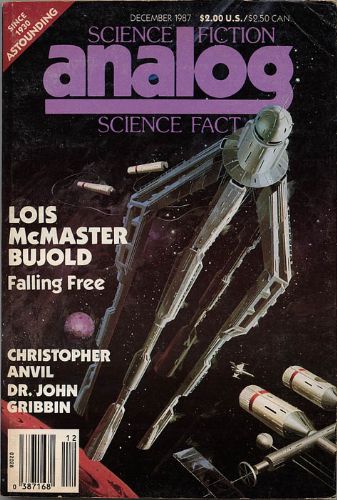
The Cay Habitat was constructed a few decades ago to house a race of special humans—ones that were made to work in zero gravity indefinitely, since such conditions are awkward for normal humans. With a second set of arms for legs, the quaddies are considered the property of GalacTech, who’re also the employers of Leo Graf, Our Hero™. Leo has a problem: How do you teach a group of people about exploitation when said people exist as slave labor? It’s a question that for better or worse will have to go unanswered, because word gets through that an anti-gravity device has not only been invented but deemed ready for market sale, thus rendering the quaddies obsolete. Of course this raises another problem: What do you do with outdated tech when the tech is people? At best GalacTech will have the quaddies sterilized and shipped off to a barracks—at worst have them terminated with extreme prejudice. If the quaddies can’t be allowed to live out their lives peacefully under GalacTech jurisdiction then the only solution is to get out of said jurisdiction—and then comes an idea.
The Habitat is small, when taken in its essentials; it was made to house a thousand quaddies and little more than that. If broken down, the Habitat could be made to piggyback on an interstellar ship as flies through the wormhole near Rodeo. What at first sounds like a moral problem then becomes an engineering problem. The quaddies are very young (the oldest are barely out of their teens), but the best of them, along with some help from sympathetic humans, could make the scheme a success. Sure, the other end of the wormhole falls under a different planet’s jurisdication, but they’ll cross that bridge when they get there.
Enhancing Image
Sorry this is a day late. Forces beyond my control kept me in a bind yesterday such that I couldn’t write this post in time. Oh well.
I’m not sure if I would get this same feeling if I read it all at once, but I’ve become less interested in Falling Free with each successive installment, and the big reason for this is that Bujold gives us a memorable premise and a memorable setting to go with it, but there also has to be a plot here. For the record, there’s a difference between conflict and plot; you could have a character-driven narrative that’s rife with conflict, but very little actually happens. We start with both external and internal conflict here. We have the conflict between Leo and Van Atta, Leo and Dr. Yei, Dr. Yei and the quaddies, Leo and the quaddies, and of course Leo conflicting with his own interests. A great deal is implied about what had led to the quaddies being created. We only learn about Dr. Cay through second-hand sources, since Cay died a year before the story’s beginning, but what we do learn about him is not flattering. Yei, Cay’s successor, is implied to be in conflict with herself, since she was hired basically to make the quaddies docile whilst being well aware of their slave status, but for most of the novel she has a “just doing my job” mentality that eventually gives way to guilt.
Bujold introduces us to some engrossing character conflicts, but they start taking a backseat as the plot starts being funneled into what amounts to a race against the clock. Van Atta was never a layered character (he is, I have to say, disappointingly one-dimensional), but his role gets eroded to the point where he becomes a walking plot device—a threat that Our Heroes™ have to evade, since he can’t be reasoned with. Since we’re never allowed into Dr. Yei’s head our ability to perceive her inner conflict is limited, and her redemption at the end in incapacitating Van Atta long enough to let the Habitat enter the wormhole is boiled down to a single action. The recurring problem with this novel as it progresses is that it starts out as rather chatty, with a lot of room for character depth, but rather than elaborate on that we’re instead forced down a corridor wherein characters, who once were well-defined and intelligent, are boiled down to their actions. Tony, who is the first quaddie we see, all but stops being a character after the first installment; now admittedly part of this is because he gets put on a bus, figuratively speaking, but when we do meet up with him again he is reduced to something Our Heroes™ have to rescue.
What’s frustrating is that, at least going by Theodore Sturgeon’s definition of what makes a good science fiction story, Falling Free is good SF. Paraphrasing Sturgeon here, a good SF story is a human story with a human problem that must be solved in a human way, but which hinges on a scientific aspect. In Falling Free we’re given a premise which (at least with existing technology) can only be made possible in a science-fictional universe; but at the same time sounds logical enough that it could happen. We’re given a problem centered around human rights and this problem is resolved in a human way, albeit with a dose of that old-school hard SF hardheadedness. There comes a point, however, when Bujold’s economy of style turns against her and the novel, which starts out as seemingly open-ended, turns into a series of Things Happening™. I can see what people mean when they say this is minor Bujold, despite the Nebula win. I would be less disappointed if the novel’s opening stretch wasn’t so promising.
Oh, and the romance between Leo and Silver is both unnecessary and unconvincing, never mind that Silver is half Leo’s age.
A Step Farther Out
I’m unsure how to feel about this novel, although having finished it I can say its winning the Nebula is totally baffling. Was there really no better choice that year? C. J. Cherryh’s Cyteen won the Hugo that year, and while I haven’t read it I have this hunch it would’ve at least been the more fitting winner; but to make things more baffling Cyteen wasn’t even nominated for the Nebula! What were people on back in the day? It’s shit like this that my borderline zoomer brain struggles to comprehend. I’m also not sure if Bujold wrote Falling Free with serialization in mind or if maybe her agent recommended it, but I don’t think the serial model works great for her. Admittedly there’s a reason serialization has basically become extinct, because a) not many people read magazine anymore, and b) it incentivizes a certain type of writing that puts higher priority on plot than character. Looking at this novel as a whole, I’m mixed. Getting kinda tired of serials.
See you next time.


 Science Fiction & Fantasy Remembrance