(Cover by Margaret Brundage. Weird Tales, Aug-Sept 1936.)
The Story So Far
Valeria of the Red Brotherhood is a pirate-turned-mercenary who abandoned her ship to avoid an unwanted marriage proposal, only then to also desert the band of mercenaries she had joined, after killing one of the officers. She’s currently a fugitive, but she’s not alone, for it turns out Conan, who was in the same army as Valeria, also deserted and followed her trail—partly out of curiosity but also because he makes no secret of having the hots for the female warrior. (You gotta give Conan credit: the man is upfront about what he wants.) Valeria is not so smitten with the legendary Cimmerian. At the same time the two are probably better off together than each going their separate ways, for the moment. Their bickering is interrupted when a dragon of the forest they’ve taken refuge in devours their horses off-screen, with Our Heroes™ looking to be another meal. The dragon is not the fire-breathing dragon of medieval folklore, nor the slim serpent with wings of ancient China, but a dinosaur-like beast whose belly drags on the ground and who’s got more teeth than a dentist could possibly hope to count. With the help of a makeshift spear and the juice of a poison fruit, Conan incapacitates the dragon and Our Heroes™ flee the forest, into a wide plain and then into a massive interior city. Xuchotl is an ancient city that’s partly underground and totally encased by a dome, and at first it looks to be abandoned. When Conan splits from Valeria to do some investigating, the latter stumbles onto a couple of the city’s inhabitants and gets herself into a battle she really did not anticipate. The first installment ends with Valeria and Techotl, a member of the Tecuhltli, fending off some ravenous dogs. This first installment actually ends in the middle of the second chapter; I’m not sure if this is a criticism, I just wanted to point that out. The question then is: Where could Conan be?
Enhancing Image
Of course this had to be unintended, but I find it interesting that the first installment started and ended without Conan, only for the second installment (which is actually just the second chapter continued) to reintroduce him as fast as possible. Also, aside from the action scene at the beginning, this middle chunk of Red Nails will be much more focused on building character and the world of Xuchotl. There’s a lot less fighting and a lot more dialogue. This is not really a bad thing, since Xuchotl is one of the more imaginatively realized settings for a Conan story. Right after Howard wrote Red Nails, about a year before its publication, he admitted in letters that it would not only be his last Conan story but also probably the last fantasy story he ever wrote—mind you he was only 29 when he said this. The notion that someone so young could feel that they’ve said all they could say about a character, never mind a whole genre, might strike us as crazy, but I do believe that even had Howard lived to a nice old age it’s unlikely he at the very least would’ve written more Conan stories. Red Nails was the grand finale of the series, even if it doesn’t exactly feel like one; but also Howard really pulled out all the stops with the action, worldbuilding, and character moments. It’s also, it must be said, possibly the sexiest of the Conan stories, but that’s for me to give the details of in just a moment. For now we must be content with being introduced to the rest of the Tecuhltli, who stand opposed to the clan on the other end of the city, the Xotalancas. Turns out the city had already been built and had its own indigenous population when the founders of these clans had arrived. Given that said indigenous population is not longer here, you can guess what happened, although curiously the original people of Xuchotl are also said to have been brutal and decadent in their own right.
Thus Conan and Valeria find themselves caught in the middle of a war between dying clans (there are no children among the Tecuhltli and presumably the same goes for the enemy) that has been going on for fifty years, so that basically nobody alive now was around to witness how it had all started. When we meet the rulers of the Tecuhltli, Olmec and his wife Tascela, we get the feeling that something is very off, not least because Tascela looks to be young and beautiful but is, in fact, at least in her seventies, given that she was an adult when the war started and indeed the big reason for why it had started in the first place. How she has retained her youth is a mystery—for now. During Olmec’s big exposition dump about the history of the clans, Tascela also seems weirdly focused on Valeria, as if transfixed by her beauty. (It’s worth mentioning that while homosexuality was sometimes mentioned in mainstream fiction of the time, it was sort of taboo in the genre magazines, so that even the implication of it here is Howard teasing the reader.) Now, my dumb ass thought going in that the story’s title referred to red fingernails, but actually it’s referring to red nails impaled in the Tecuhltlis’ headquarters, each representing a slain enemy. Granted, the red nails could also refer, if only metaphorically, to Valeria, who after all is of the Red Brotherhood. For better or worse Conan is rendered the secondary protagonist while Valeria is the real hero(ine) of Red Nails; and in case there was any doubt of this she once again takes hold of the narrative in the fourth chapter, which is where the second installment ends and which is short but pretty memorable. Red Nails could be considered a logical successor as well as a companion piece to Beyond the Black River, which in some ways it’s very different from but also in other ways similar. We go from the frontier to what is basically a buried city, and the POV character who follows Conan is female instead of male, but their premises are similar enough.
Now, let’s talk about the torture scene, although it’s actually not the torture scene that provided the cover for the previous issue of Weird Tales. After their meeting with Olmec and Tascela, Conan and Valeria once again part ways for the moment, with the latter going to take a nice post-battle nap. She wakes suddenly, however, to find that Yasala, Tascela’s servant girl, had tried to pull a Bill Cosby on her with the help of a black lotus, a blossom “whose scent brings deep sleep.” Valeria is very cross about this, especially because Yasala refuses to explain herself. Valeria then does what any normal person would do and decides to strip Yasala naked and tie her down, for the purposes of strangely erotic torture with a lash. Now, as somebody who is not particularly into BDSM (although I’m not opposed to it), I have to admit that what follows is pretty hot, to the point where I would be surprised how it made its way into Weird Tales in the ’30s if not for the fact that paying kink lip service was actually far from uncommon for the magazine at this time. (There are, in fact, multiple Robert E. Howard stories that made the cover for this very reason, courtesy of Margaret Brundage.) Indeed, I can imagine that reading Weird Tales in the early-to-mid-’30s (the magazine cleaned up its act towards the end of the decade, at least when it came to the covers) and being introduced to BDSM this way. Shit must’ve blown some minds. Anyway, Valeria gives Yasala a good thrashing until the latter finally gives in, saying the Bill Cosby routine was part of Tascela’s scheme. Once Valeria unstraps her she throws some wine in Valeria’s face for her troubles and runs off the catacombs, where it’s implied she meets her death off-screen. Meanwhile Valeria hears the clashing of swords in another direction, implying that the Xotalancas are at the gates.
A Step Farther Out
Sorry for the delay, but I hope the wait was worth it. Red Nails is shaping up to be yet another top-tier Conan story, but we still have a good chunk of it to go. I’ve read enough Conan at this point, a lot of it outside the confines of this site, to separate the mediocre (because there are a few Conan stories where Howard was clearly phoning it in) from the good stuff. It helps a lot that Valeria herself is a very fun character, who in some alternate timeline probably could’ve gotten her own spinoff series. I’ve read into the possible inspirations behind Valeria, with the most likely contenders being C. L. Moore’s Jirel of Joiry, whose first couple stories Howard had very likely read by the time he wrote Red Nails; and then there’s Novalyne Price, Howard’s girlfriend at the time. The details of Howard and Price’s relationship are unspeakably depressing, so I won’t go into it, but it seems he had based Valeria’s tenacity on Price. (I’ve been reading Mark Finn’s Blood & Thunder: The Life and Art of Robert E. Howard, and there’s a good chance I’ll be done with it by the time I finish reviewing Red Nails.) My point is that I was looking for a palate cleanser after the dismaying experience that was reading the first installment of E. E. Smith’s Triplanetary, and I’m happy to say Red Nails is meeting my expectations.
(Cover by Margaret Brundage. Weird Tales, July 1936.)
Who Goes There?
E. E. Smith has I guess the distinction of having the first serial I started to review but simply could not finish. I’m already a couple days behind in my schedule as it is. It would’ve been one thing if I did not enjoy reading Triplanetary (which is certainly the case, mind you), but Smith was also maybe a victim of bad timing. We are cursed to live in interesting times. Both in my personal life and in the outside world there have been some, let’s say disturbances. My question then is, if I’m not gonna continue my review of Triplanetary, what could I use as a substitute for the rest of the month? There were many options; as you probably know, a lot of novels and novellas were serialized in three installments. But for me the answer was obvious: I’d be returning to Robert E. Howard.
Despite the fact that he committed suicide when he was only thirty, Robert E. Howard can lay claim to being the most influential American fantasy writer of all time, not to mention being arguably the greatest of the pulp writers who never broke into mainstream or “slick” fiction. He began writing with the hopes of being published when he was 15, although he wouldn’t actually make his first fiction sale until he was 17 or 18; little did he know, when he started writing at 15, that his life was already halfway over. But once Howard started getting published, he never stopped—not even when he died. Almost too many short stories and poems to count were published, either complete or as fragments, in the decades following Howard’s death in 1936. He wrote nonstop for about a dozen years, and for practically every pulp and genre market, except, weirdly enough, science fiction, which he didn’t seem to have much if any interest in. He wrote fantasy, horror, Westerns, historical adventures, and even sports stories (Howard was especially fond of boxing). He also ran several different series focusing on a colorful roster of courageous and quite masculine heroes, from Solomon Kane and the sailor Steve Costigan to, of course, Conan the Barbarian. Conan is one of the most iconic characters in fiction, and he was also Howard’s final fantasy hero, being a culmination of themes and tropes Howard had developed. Red Nails was the last Conan story Howard had completed; the first installment would’ve been on newsstands around the time of Howard’s death. I had been meaning to get to this one for a while.
Placing Coordinates
Serialized in Weird Tales, July to October (the August and September issues were combined) 1936. Since this is Conan it’s been reprinted quite a few times, including 13 Short Fantasy Novels (ed. Isaac Asimov, Martin H. Greenberg, and Charles G. Waugh) and too many Howard collections to count. It’s also on Project Gutenberg.
Enhancing Image
Valeria of the Red Brotherhood is a pirate-turned-mercenary who’s currently a fugitive, having killed an officer in Zarallo’s Free Companions, an army of mercenaries and, ironically from what we hear about it, not free at all. Another member of that army was Conan, and like Valeria he too deserted, albeit for different reasons. Since this is the third Conan story I’ve reviewed, I think acknowledging formula is in order. Howard wrote a lot, and like anyone who writes enough for long enough he fell back on formula and certain turns of phrase, and even how he would structure his plots. With the Conan series the idea is that the “real” protagonist is not Conan, but some third party who has their own adventure, including their own personal stakes, and who sees Conan’s exploits from the outside. There are some exceptions, but most of the Conan stories do not start with Conan as the focus characters. Valeria herself is by no means the only female main character in a Conan story, but she’s certainly a contender for the feistiest, alongside Bêlit from “Queen of the Black Coast.” But whereas readers might recall Conan’s relationship with Bêlit being genuinely romantic (if also ill-fated), his interest in Valeria is more purely carnal. Indeed Conan and Valeria’s relationship is about as explicitly sexual as one could’ve gotten in ’30s pulp magazines without the characters having actual sex (at least not yet). Valeria compares Conan to a stallion and at one point Conan threatens to spank Valeria in a way that is clearly more meant to be taken as kinky teasing rather than punishment.
Of course, Valeria is a tsundere who is not so taken with Conan’s teasing and raw machismo, although there’s the sense that she can’t help but admire him as a fellow warrior. I’ve read up a bit on Red Nails and one criticism I’ve seen repeated is that for someone who is described as a bad bitch, and who takes a lot of pride in her supposed abilities as a fighter, Valeria is not as strong as she appears. This may prove more valid than it seems to me initially, but I like the idea of a pirate lady who is perhaps a little out of her depth when fighting on land—you could say like a fish out of water. She also clearly resents being on the receiving end of misogyny and mockery from her male colleagues, saying, “Why won’t men let me live a man’s life?” at one point. (Obviously such a sentiment reads different nowadays, what with our understanding of genderqueerness, although Valeria is at the very least gender-nonconforming.) Due to the episodic nature of the Conan series it can be hard to lay out some internal chronology, but I’m pretty sure Red Nails takes place after “Queen of the Black Coast” since Conan has already lived as a pirate by the time of the former, although he makes no mention of Bêlit. I like how these two are former pirates who’ve come to land under different circumstances, with Conan’s last ship getting sunk in battle and Valeria quite literally jumping ship to avoid an unwanted marriage proposal. Also it’s worth mentioning that despite being written after some of the darkest entries in the series (“Queen of the Black Coast” and Beyond the Black River especially), Red Nails starts off considerably lighter in tone, insofar as it reads like a more typical pulp adventure.
But of course, there’s trouble afoot. As Conan and Valeria leave their horses and really get down to bickering with each other, they realize too late that they really should’ve kept a better eye on those horses. A dragon ate them both, somehow, making such short work of the animals that their bones made a distinctive crunching sound. Our Heroes™ have come face-to-face with a dragon, a beast about as large as an elephant with “huge eyes, like those of a python a thousand times magnified,” a head larger than a crocodile’s, a belly that drags on the ground, “absurdly short legs,” and a long and flexible tail. It’s basically a walking tank with a trash compactor for a mouth. Much of the first installment of Red Nails has to do with getting around this dragon, which was not quite what I was expecting, since what I had heard most about this novella was the main setting—but we’ll get to that in a moment. It looks like Our Heroes™ are cooked, but Conan comes up with an ingenious tactic that might (just maybe) kill the dragon. He makes a spear and covers the tip with the juice of a poisonous fruit, then aiming for a spot on the dragon that isn’t totally covered with scaly armor. It works, or at least it works well enough, with Conan and Valeria running off, leaving the poisoned dragon to die a slow death—maybe. I have a feeling this will not be the last we see of it. Finally we come upon a city on the plain, although it’s no ordinary city but one that seems at least partly underground, being totally kept indoors as if under a dome. Being on the run, and with no other signs of civilization in sight, Conan and Valeria enter the interior and probably abandoned city. It took long enough, but in the back end of this installment we do finally enter Xuchotl.
There Be Spoilers Here
This first installment starts and ends with Valeria by herself, since she and Conan are separated for a time once they’ve entered the city. Conan goes off to investigate by himself and leaves Valeria by herself, which turns out to have been a bad move. Valeria finds herself caught in the midst of a battle between two clans that lurk in the city, those of Tecuhltli and those of Xotalanc, having been rescued by a scarred man named Techotl, who comes from the former clan. The builders of the city seem to have died or fled, but they’ve left a great deal in their wake. People reading Red Nails expecting Conan to have more time on the page than he does will be surprised and probably disappointed. The idea, I suppose, is that Conan is simply too powerful a character to be consistently in the midst of the action, so Howard came up with reasons for his to be somewhere else. (Tolkien had a habit of doing this with Gandalf, as another example.) Conversely, if Valeria was out of her depth before then she’s almost useless by the end of this installment. So there’s that.
A Step Farther Out
Ah, it feels good to be back. It’s been over a year since I last got to write about Conan, and Howard’s fiction generally. I’m sure someone out there will blame more for pussying out with Triplanetary, but life is short and I will not, at least for the moment, waste it on trudging through terrible writing. It’s not even like I get paid for any of this. It could also be that I returned to Howard because I’m turning thirty in eight months and I can’t say I’m happy about that. It got me thinking about Howard again, for his life story is surely one of the most tragic in the history of genre writing; but, on the plus side, while he never married or had children, anyone who loves fantasy of the blood-and-thunder variety has a least a bit of Robert E. Howard in their heritage. It’s like how some white Europeans have, to this day, a sliver of neanderthal in their DNA. A relic from an ancient time. Modern fantasy writing, it seems to me, plays things too safe and sanitary, so that we could really use a darker, bloodier, sexier fantasy—albeit not that much of it. You don’t wanna have too much of a good thing, after all.
(Cover by Margaret Brundage. Weird Tales, July 1935.)
Happy New Year. Blow confetti. Get drunk. Maybe kiss and cuddle a friend or significant other of yours. Although of course you would’ve done that last night. A lot of stores are closed today, because work sucks and the reality is that with a few notable exceptions nobody really wants to work. I hope this message finds you well. There will be a couple changes to this site, which mind you does not mean bad news at all. Frankly those of you who frequent here might not even notice the one “negative” change, that being the fact that given my current life circumstances I can no longer guarantee that a post will be finished on the date I expect it to be. For two years I kept to a pretty strict release schedule with my posts, but after moving into my own place, with all the pros and cons that come with that, I would expect more posts to get delayed by, say, a day, if I were in your position. Occasionally I might not even be able to post a review that I said I would; this happened a few times actually, since November, and I think it’s time to acknowledge that while I try to be prolific, I can only do so much, from a mix of life changes and depression. Also that’s why I’m reviewing a story I was supposed to write about in November, but never got around to even reading it, that being Eleanor Arnason’s “Checkerboard Planet.”
Now, in good news…
The serials department is back, after I had announced at the start of last year that I would only be covering short stories, novellas, and complete novels in 2024. I had thought about what would be the first serial to commemorate the department’s coming back from hiatus, and ultimately I figured it had to be something big. Thus I went with a Robert Heinlein novel I’ve not read before, and truth be told Heinlein’s juveniles are a bit of a blind spot for me in my knowledge of his work; I’ve read a few of them, my favorite probably being Between Planets, but I should certainly read more. It’s also been too long since I last covered Heinlein here.
In other good news, we have another magazine to pay tribute to this year, albeit not on quite the same scale as what I did with F&SF. As you may or may not know, Galaxy Science Fiction launched with the October 1950 issue, making October (or September, depending on how you look at it) of this year its 75th anniversary. Along with F&SF, Galaxy played a pivotal role in reshaping who and what got published in genre SF following Astounding‘s near-stranglehold on the field the previous decade. Especially in the ’50s, a disproportionate number of now-classic stories and novels first saw print in the pages of Galaxy, under the ingenious (if also tyrannical) editorship of H. L. Gold. Unfortunately Galaxy had a bit of a rough history after its first decade, going through a few editors and experiencing declining sales before finally being put out of its misery in 1980. It only lasted thirty years, which admittedly is still better than what most SFF magazines get, but during that time it was arguably the finest magazine of its kind. So, in March, July, and October, as with last year, I’ll be reviewing only short stories, this time from the ’50s, ’60s, and ’70s respectively, and all from Galaxy. I’ll also be reviewing one short story, novella, or serial from Galaxy every month apart from that. This should be a good deal of fun.
Now what do we have on our plate?
For the serial:
Citizen of the Galaxy by Robert Heinlein. Serialized in Astounding Science Fiction, September to December 1957. Heinlein is that rare author who really needs no introduction, but who no doubt deserves one. He made his debut in 1939, at the fine age of 32 but having already entered the field more or less fully formed as a writer; it helps that he had already written a novel, albeit one that had initially gone unpublished, at this point. From the late ’40s to the end of the ’50s he wrote a series of “juveniles,” which helped lay the groundwork for we would now call YA SF. Citizen of the Galaxy was one of the last of these juveniles, and as far as I can tell its serialization occurred more or less simultaneously with its book publication.
For the novellas:
“The Organleggers” by Larry Niven. From the January 1969 issue of Galaxy Science Fiction. Reprinted thereafter as “Death by Ecstasy.” One of those old-fashioned planet-builders who appeared just as the New Wave was getting started, Niven very much follows in the footsteps of Poul Anderson and Jack Vance. “The Organleggers” is the first in a series of SF-detective stories starring Gil Hamilton.
“In the Problem Pit” by Frederik Pohl. From the September 1973 issue of The Magazine of Fantasy and Science Fiction. Pohl is one of those people who can claim to have taken part in pretty much every aspect of SF publication, from author and editor to literary agent. He edited Galaxy and If in the ’60s, to much acclaim, but in the early ’70s he gave up editing returned to writing fiction regularly.
For the short stories:
“Checkerboard Planet” by Eleanor Arnason. From the December 2016 issue of Clarkesworld. Judging from her rate of output you might think Arnason a more recent author, but in fact she was born in 1942 and made her debut back in 1973. She’s been an activist for left-liberal causes since the ’60s but did not start writing full-time until 2009, hence her recent uptick in productivity.
“Jirel Meets Magic” by C. L. Moore. From the July 1935 issue of Weird Tales. Moore might not be a mainstream figure in genre fiction, but she and her first husband, Henry Kuttner, have a strongly passionate following among older readers. With justification. She’s a favorite of mine. It’s been almost two years since I reviewed the first two Jirel of Joiry stories, which is far too long a wait.
(Cover by Margaret Brundage. Weird Tales, September 1941.)
I was supposed to write my review of “Beyond the Threshold” by August Derleth for today, but I could not find it in myself to do so. For one I have to admit I’ve been feeling horribly drained from the business of moving into my apartment, which I still haven’t totally finished with yet. I’ve barely slept for the past few weeks, hence the lack of a mid-month editorial post in October. Anyway, this isn’t a review. If you want my opinion on the story, it’s middling. Derleth was a pretty good editor but a second-rate writer, from the weird fiction of his that I’ve read, and “Beyond the Threshold” explicitly tips its hat to Lovecraft and the Cthulhu Mythos (a name Lovecraft himself did not use) without doing anything meaningfully extra. It has a bit of that rural Wisconsin atmosphere, but mostly does away with it in favor of a typical old-dark-house-has-dark-secrets narrative. If you want a take that’s a bit more in-depth you’ll have to wait a couple weeks, as I am really doing a proper (albeit short) review of this story for Galactic Journey, as part of the chunky anthology Tales of the Cthulhu Mythos. I’ll be reviewing more than half the stories in that book, so keep an eye out for that. Hopefully I will have also regained my writing energy by then.
Unfortunately I’m not here to talk about fiction, really. In the morning, today, November 6th, Americans woke up to find that the improbable (not the impossible, because I think we all understood the chance of this happening was very real) had happened. Now, I don’t make my politics a secret on here; after all it’s my blog and nobody else’s. Over the past couple years my views have shifted farther left: back in August 2022, when I posted my first review here, I think I considered myself a fellow traveler, but now I would say I’m a libertarian socialist. I used to be a libertarian of the American sort (we all make mistakes, huh), but now I’m a libertarian in the tradition of Ursula K. Le Guin, William Morris, and Oscar Wilde. I’m ambivalent about the state’s capacity to help marginalized groups and I’m even more ambivalent about marginalized people’s rights being secured through electoral means. Yesterday we had the chance to prove that we are above electing the king of the yuppies (that he’s also very likely a rapist is pretty significant, but which mainstream news media has treated as almost incidental) back into office, but we failed. The Democratic establishment failed its voter base and its voter base in turn failed the most vulnerable people in this country. Indeed it’s a collective failure of liberalism in the US that we have not seen since—well, the 2016 election. We’ve been told (accurately) that Trumpism is an American blue-collar sort of fascism, yet if this is true then liberalism has failed to stop fascism—again.
To be clear, and I shouldn’t have to say this given what I had just said but I’ll do it anyway, I don’t like Kamala Harris, as both a politician and person. I think she’s a weasel, a centrist with a few progressive sympathies but ultimately someone who tried really hard to cater to “moderate” conservatives, a plan which literally did not work. It was a huge gamble, because calling Dick Cheney brat (how do I even explain to people of the future what “being brat” means) alienated a lot of left-liberal people, understandably. Who the actual fuck voted for Trump in 2016 and 2020 but then Harris in 2024? Who of that demographic was persuaded? Cuddling up with neo-conservatives while also ignoring (at best it was ignoring) the concerns of Palestinian-Americans and Arab-Americans at large was not a good move! I know, this may seem like a controversial opinion, but as someone who basically was radicalized by Israel’s siege of Gaza, I think the Biden (later Harris) campaign leaving Arab-Americans in the dust was very bad. Islamophobia has been a major problem in this country since at least 9/11, and it has not really gotten better. Sure, we have a few Muslim members of congress, but look at how the Biden administration has defended them against harassment, or rather how the Biden administration has not: it’s disgraceful. I say this as someone who, back when I was a right-libertarian and edgy atheist (I’m much softer on religion nowadays), also had Islamophobic tendencies; so I know very well what it looks like. Large swaths of the population see Muslims as subhuman, and unfortunately those people will be totally without shame about it.
We have failed queer people (so that includes me), we have failed people with disabilities (also includes me), we have failed the working class, we have failed black Americans, we have failed Muslim Americans, we have failed the women of this country, and of course we have failed ourselves. What do we do with this information? How does it relate to this blog, which is after all a genre fiction review fan site? Because I’m not here to write political tracts, I’m generally someone who reads for the pleasure of it. As a leftist I still enjoy right-leaning writers like Robert Heinlein, Poul Anderson, Larry Niven, and so on. I don’t believe in abstaining from reading fiction by authors with very different political views, or at least I try to hold myself to that belief; obviously there’s a limit for everything. But, I’m queer, and my partners are all queer, and so are quite a few of my friends. I had to talk one of my partners through a panic attack over the phone last night. We live in a country that basically wants us dead, because most of the American population is homophobic and/or transphobic. This has been the case since forever, but it’s impossible to ignore now, with social media and the little slivers of mainstream visibility queer people get. It’s not even about resisting the incoming Trump administration, it’s simply about coping, and finding ways to support marginalized people, even if these are small things like donating to someone’s GoFundMe. God knows I’ve been supporting some of the fellow queer people in my life for a minute now. I’ve said before that I use this blog as a coping mechanism, because I have a history of depression and anxiety, and that hasn’t changed.
Here’s the thing, and this happened after Trump won in 2016 as well: the people who voted him in, who are really fucking stoked about him winning, are not gonna be any happier in the long run. If anything, with the exception of the rich (because the rich will evade basically any kind of retribution, even climate disaster [for now]), these Trumpists are gonna be made more miserable, if for no other reason than that Trump is such a toxic personality that mere exposure to him and his fucking yapping for long enough will do something horrid to one’s psyche, even if that person is pro-Trump. I’ve seen it happen first-hand, it’s a very creepy phenomenon, but Trumpists also don’t wanna admit that their own guy, whom they treat like a demi-god, makes them feel miserable. And we’re not even getting into his “economic plan” to combat inflation, because assuming that actually happens we’re all gonna be feeling that a year from now. In a way I’m morbidly curious about the future, with how bleak and yet how cloudy it is. I talk about the past all the time here because the past is never dead, and like a shambling corpse that has risen from the grave it terrorizes us despite not having a pulse. If the past is a zombie then the future is a horror that has not yet been birthed, and I’m not sure which is worse. The only thing I can say is that I hope to stay alive, despite my own thoughts of suicide.
(Cover by Margaret Brundage. Weird Tales, June 1935.)
The Story So Far
There’s a frontier war going on the between the Aquilonians and the Picts, the former trying to expand westward and the latter trying to keep their territory by any means necessary. The Aquilonians have better weapons and fortification, but the Picts in the area have a secret weapon in the sorcerer Zogar Sag, who incidentally is out for revenge against Fort Tuscelan. We follow Balthus, a young Aquilonian warrior set to be at Fort Tuscelan, and Conan, a Cimmerian who is currently working as a mercenary for the Aquilonian government. The first believes that expansion is both possible and good for humanity; the latter does not. As far as Conan’s concerned he’s doing it for the paycheck, but that doesn’t stop him from wanting Zogar Sag’s head on a platter—for the sorcerer’s treacherousness if not to defend the fort. Indeed this Pictish sorcerer has been collecting human heads for the purposes of blood sacrifices.
Regrouping at the fort, Conan assembles a crack team of warriors to cross Black River and take out Zogar Sag on the down-low, so as to hopefully prevent an all-out skermish between the Picts and the fort. It goes about as well as you’d expect: all the men get killed off, either right away or in the sorcerer’s hideout, and Balthus only lives because Conan rescues him. They discover, perhaps too late, that the sorcerer is not fucking around, as he’s able to conjure (among other things) a giant snake and a shadowy beast that stalks the woods. Killing Zogar Sag becomes secondary to making it out of Pict territory alive, but also warning the fort.
Enhancing Image
What began now as an assassination attempt has now turned into a losing battle. Conan expressed doubts that the Aquilonians could hold the frontier earlier, and these doubts are proved valid when Zogar Sag’s forces cross Black River in search of the fort, where they will be sure to give no quarter. It’s here that Conan and Balthus split up, and it’s also here that we’re introduced to our last major character: Slasher, a mangy dog who was orphaned when his settler owners got killed. Depending on your politics Howard might be doing too much to humanize the settlers, despite also thinking that their cause is a fatally misguided one, not helped by the Picts being written as mindless brutes. Still, this is more nuance than one would expect from a pulpy sword-and-sorcery tale with lots of delicious gore that was written in the ’30s. One has to wonder what Howard would’ve done had he lived to contribute to the more “socially aware” Unknown a few years hence.
Howard is not known for his delicateness with language (despite writing a fair amount of poetry), and true enough his writing is often at its best with either dialogue or visceral action. He does, however, sometimes plop a bomb in the reader’s lap in the form of a really juicy passage. He crystalizes what makes Conan special, both in the context of his world (as a future barbarian king), and as a seminal figure in heroic fantasy. There was, to my knowledge, not a single character in the annals of heroic fantasy prior to Conan who stood so boldly against everything “polite society” in Howard’s day stood for, nor illustrated so clearly. Observe:
He felt lonely, in spite of his companion. Conan was as much a part of this wilderness as Balthus was alien to it. The Cimmerian might have spent years among the great cities of the world; he might have walked with the rulers of civilization; he might even achieve his wild whim some day and rule as king of a civilized nation; stranger things had happened. But he was no less a barbarian. He was concerned only with the naked fundamentals of life. The warm intimacies of small, kindly things, the sentiments and delicious trivialities that make up so much of civilized men’s lives were meaningless to him. A wolf was no less a wolf because a whim of chance caused him to run with the watchdogs. Bloodshed and violence and savagery were the natural elements of the life Conan knew; he could not, and would never, understand the little things that are so dear to civilized men and women.
One gripe I have with this story is that Zogar Sag is not a character; he doesn’t really have a personality, nor do anything that immediately distinguishes him from other Conan villains. He’s almost unnecessary for the story to even work, but admittedly how Conan disposes of him does offer the one little ray of light in what is otherwise a gloomy ending. Sure, Conan kills the demon Zogar Sag is linked with (the latter dying at the fort from seemingly nothing), and the sorcerer’s death demoralizes the Picts enough to make them retreat, but it’s a pyrrhic victory. All the men who stood to defend the fort have been killed with a single exception. The loss of the fort is so big that the border will be pushed back. Balthus and Slasher die in battle, fighting off Picts just so the women and children have enough time to evacuate, otherwise there would’ve been no survivors. Conan is literally one of only two survivors by story’s end.
A certain colleague of mine said that when she had first read this story many moons ago that Slasher’s death made her cry. It didn’t get that reaction out of me on either reading, but a) it speaks to Howard’s skills as a storyteller that we can feel for an animal that only shows up in the last quarter of the story, and b) on this second read I did feel sort of overwhelmed by the sheer gloominess of this story’s climax. Not that the Conan series is known for being uplifting (Conan himself is a pessimist and characters, be they heroic or villainous, are likely to meet bad ends), but even by those standards Beyond the Black River stands out as probably the gloomiest in the whole series. We’re told at the end that civilization “is a whim of circumstance,” and curiously this final line is not spoken by Conan but by an unnamed woodsman, who nonetheless shares Conan’s worldview. Appeal-to-nature fallacy aside, Howard seems to be saying that civilization, no matter how great, is only temporary; once it inevitably gives way, barbarism will take its seat on the throne, just as it had done previously.
A Step Farther Out
Beyond the Black River is arguably the best Conan story done by Howard’s pen, but I wouldn’t recommend it as one’s first Conan story. Aside from the genre mixing, this is an especially dark tale that lacks some of what had become hallmarks in the series, like Conan saving a scantily clad damsel in distress, and indeed there’s no romance plot nor any named female characters to speak of. This is not necessarily a bad thing. This was not the last Conan story written or even published in Howard’s lifetime, but it feels like a culimination of what Howard was trying to say with the character. This is the most vivid thesis statement on what Conan represents and what Howard was trying to do with the series. As such I would recommend reading it only after getting at least a few prior Conan stories under your belt; it becomes more rewarding the more you put into it.
And that’s it—my last serial review until 2025. 2024 will be focused on short stories, novellas, and the occasional novel. Reviewing serials takes a certain amount of energy out of me, and as I’m looking for a new job (yes, I’m back on the job hunt), I don’t wanna become fatigued on this blog. I love writing about mostly old-timey SFF and it would be a shame if personal issues got in the way of this specific hobby of mine. This is not my last review for 2023 (there’s one more in the oven), but still it marks the beginning of a hiatus I’m taking from reviewing a mode of fiction.
(Cover by Margaret Brundage. Weird Tales, March 1937.)
Who Goes There?
Dorothy Quick is a name I recognize but prior to today’s story have not read anything by; specifically I know her as a contributor to Unknown, wherein her most prominent work would be a series of short stories called the Patchwork Quilt series, which sadly only has three entries and which Quick apparently abandoned by the time Unknown died. We don’t know a lot about Quick: we know she started writing SFF in the early days of genre pulp and that she basically stopped once the first incarnation of Weird Tales went under. She seems to be one of those authors whose genre output positively correlates with the state of magazine fantasy, in that once Unknown closed that was a market gone for her, and Weird Tales later closing must’ve been the last straw. She did, however, continue to write fiction in mainstream outlets. Anyway, I feel bad because I don’t have much to say about today’s story and I can’t say reading it filled me with confidence about covering Quick in the future, though I do wanna get to those Patchwork Quilt stories.
Placing Coordinates
First published in the March 1937 issue of Weird Tales, which is on the Archive. Judging Margaret Brundage covers, on a scale from 1 to 10 with 1 being chaste and 10 being “Is this pornographic?,” I would give this one a 2 or a 3; it’s pretty tame. I didn’t even notice the naked girl with the orchid on her body at first. Anyway, sad reality with most pulp-era lady authors is that their stuff doesn’t get reprinted often, and “Strange Orchids” is no exception. As far as I can tell there’s only one reprint, that being Sisters of Tomorrow: The First Women of Science Fiction (ed. Patrick B. Sharp and Lisa Yaszek), which thankfully looks to be in print in hardcover and paperback. But yep, looks like those are all your options.
Enhancing Image
We start with Louise, the narrator/protagonist, telling us that everything basically turned out fine in the end: oh sure, her hair is white now from getting spooked so hard, but she came out of whatever ordeal it was fine and she even ended up with this guy she really likes. This might be the fastest way possible to defuse tension, and I don’t know why Quick informs us of the bittersweet ending so far in advance. Within just a few sentences we get one of my biggest issues with this story, which is that Louise is not in any real danger; at most she has a tough time for a bit, we already know she gets better, and thus this is a hard story to spoil.
Whilst at a friend’s party, Louise meets the other two corners of what amounts to a love triangle: Rex, who is obviously a Good Guy™ and the aforementioned handsome fella Louise gets together with; and Angus, who is so obviously the villain that it’s actually not funny. (Never trust a guy named Angus.) Just how obvious is Angus’s villainy? Well, there have been several girls who’ve gone missing as of late, under similar circumstances, and Angus over here is acting incredibly suspicious—to the point where, if not for the plot that unfolds, Angus would probably be the first white man in history to get arrested simply for acting like someone who ought to be arrested. That Angus acts creepy towards Louise, simultaneously insulting her and trying to seduce her, should already make him a suspect.
Hmmmmmm.
To make things slightly more complicated, Rex is a G-man who’s part of a task force looking for these missing girls; already this story strains my suspension of disbelief by depicting a federal agent as a good guy who will not do anything morally dubious. I’m getting ahead of myself, as you may guess, but there’s really not much of intrigue here. I will, however, list off a couple things—really little more than references themselves—that I found at least memorable, if not very substantive.
The first is that there are several references to homosexuality sprinkled in the text that ultimately don’t amount to anything, but which are still work mentioning considering this is the ’30s and it was uncouth to mention homosexuality in pulp fiction. Right away, during the party in the opening stretch, we have a reference to “female impersonators,” whom we’re to take as transvestites (probably the word that would’ve been used at the time, or something even less flattering). Any queer man who’s lived in the past century will be at least a little familiar with the term “female impersonator,” which seems to cover anyone from drag queens or just gay men who dress in feminine-leaning attire. Again, not flattering, but Quick even mentioning this at all is above what we’d normally expect from ’30s pulp fiction.
The other thing is the coded homosexuality of Angus, who despite seeking to own Louise (as a wife but also maybe as something else), comes off as a bitchy and effeminate gay man, even being called “Oscar Wildish” at one point. He dresses well and Louise can’t help but notice the soft whiteness of his hands, “the hands of an artist or a dreamer,” which indicate that a) he’s not used to doing menial labor, and b) he pays more attention to grooming himself more than the average man. He’s also obsessed with flowers, especially orchids (I wonder why), with flowers typically being taken as symbolically feminine. There’s another reason why Angus’s heterosexuality is rather hard to take at face value, but I’ll get to that (briefly) in the spoilers section; it’s not like I can talk about much else.
Finally, we get a reference to contemporary cinema here, which does not happen often in genre fiction from any era, let alone one where sound film was still a recent phenomenon. There’s a movie starring Lionel Barrymore (yes, related to Drew Barrymore) wherein a mad scientist “reduced people to dolls” and made them do his bidding. I’m pretty sure this is supposed to be The Devil-Doll, but it goes unnamed in the story—point being it’s almost certainly a real movie. Now isn’t that fun?
Easy to forget I’m a movie buff, but whatever.
There Be Spoilers Here
Zzzzzzzzzzzzzzzzzz…
Okay, I do wanna talk about the ending a bit, if only because it kinda pisses me off; not because the ending on its own is bad, but because it wastes the last chance this story had to become really interesting.
Louise and Rex hatch a plan to nab Angus, since Rex already suspects Angus (as would anyone with more than two brain cells) but lacks hard evidence with which to book him. The plan goes amiss since for some reason Angus is telepathic and can read Louise’s intentions, thus kidnapping her and having a rather protracted James Bond villain moment wherein he explains (at length) what he plans to do: namely he wants to turn Louise into another slave, hypnotized via a special kind of orchid Angus has been breeding, to go along with the other girls he has kidnapped.
But all is well! Well Rex and the other feds are unable to save the other girls, who by this point have become humanoid abominations with orchids sprouting out of their chests, they’re able to save Louise in the nick of time. They uhh, gas Angus’s mansion? I wonder how that would read to a post-World War II audience. Anyway, my main problem here is that Louise is never in real danger, in that she does basically nothing in order to save the day since Rex is at her beck and call and the feds managed to break in without her input. Despite being the narrator, and you’d think the protagonist, Louise is ultimately little more than a damsel in need of rescuing, and I have to say I expected better.
How disappointing.
A Step Farther Out
In covering exclusively Weird Tales stories this month I’ve run the spectrum of genres that saw print in that magazine, but also a spectrum of how I feel about these stories, from the sublime (“The Black God’s Kiss”) to the putrid (“The Dreams in the Witch-House”) and everything in between, and “Strange Orchids” is certainly in that nebulous “in between” spot. This is about as middle of the road as you can get for me, in that I don’t dislike it exactly but I also don’t have anything strongly positive to say about it. If this story has committed a crime it’s the crime of being totally predictable, to the point where I was anticipating some kind of twist or catch to what seemed to me like a strictly formula affair, only to find out that no, this is not really a creative story but something that would’ve struck readers even at the time as nothing to write home about. I almost prefer something memorably bad like “The Dreams in the Witch-House” over a story so forgettable.
(Cover by Margaret Brundage. Weird Tales, September 1935.)
Who Goes There?
Clark Ashton Smith was the third of the big three contributors to Weird Tales during the height of that magazine’s first incarnation—at least with hindsight; Lovecraft or Smith would be replaced with Seabury Quinn if we’re judging by initial popularity. Smith, Lovecraft, and Robert E. Howard were part of a circle who frequently exchanged letters, and there’s little doubt that this association allowed Smith any sort of exposure after he mostly stopped writing fiction; that he outlived Lovecraft and Howard by a couple decades and was able to provide commentary on this period in pulp history certainly helped. A strange thing about Smith is that he has to be one of the best writers, at least of the pulp era, who wrote fiction largely for the sake of profit: he found, early in life, that he loathed menial labor too much while also struggling to envision himself hunched over in an office—thus he turned to fiction. Smith’s initial artistic love was poetry, and by the end of his life he had turned to sculpting, but it’s his short fiction (he never wrote a novel in adulthood) that maintains his legacy.
Over a period of about five years (1930 to 1935) Smith wrote the vast majority of his 100+ short stories, amassing a body of work that’s quite big (despite the lack of anything approaching even novella length) and surprisingly varied, ranging from sword and sorcery to science fiction of the ’30s super-science variety; and it’s this latter category that today’s story very much falls into. I like Smith quite a bit, but sadly I’m gonna have to rag on him at points during this review because “Vulthoom” is… not very good. It’s not terrible, it certainly has points of interest which I’ll discuss, but Smith fails to capitalize on his talents with this outing, namely his knack as a highly lyrical prose stylist. Some people give Smith shit because his prose is highly baroque, but when Smith is on the ball there’s a distinct rhythm to his style that, aside from Lord Dunsany and maybe a couple others, is very hard to find elsewhere. In other words, the style is the substance.
Placing Coordinates
First published in the September 1935 issue of Weird Tales, which is on the Archive. This is one of the more overtly lurid Brundage covers; there’s even a nipple outline! I don’t know how one would feel buying a copy of Weird Tales with a Brundage cover at a newsstand. “Vulthoom” first saw book publication in Genius Loci and Other Tales, from Arkham House, and later saw print as part of Ballantine’s Adult Fantasy series, in the Clark collection Xiccarph. You’d think the Smith collections from Ballantine would go for a reasonable price, but these little mass market paperbacks now go for at least $30 used. As for in-print options we have The Maze of the Enchanter: Volume Four of the Collected Fantasies of Clark Ashton Smith, part of a series that collects all of Smith’s short fiction.
Enhancing Image
We start right off with what will sound like an assbackwards criticism, but hear me out: the first stretch of “Vulthoom” is too fast. Right away we’re introduced to Our Heroes™, two guys who are down on their luck and whose misfortunes have made them become friends. Haines got kicked off his former ship and is now struggling to find a new crew, while Chanler is “a professional writer of interplanetary fiction” whose money has run low. Rather than give us a scene or two where Smith shows these characters interact and grant us insight into their daily troubles, Smith instead opts to tell us outright what their problems are, which is unusually direct and unpoetic for him. We learn everything we need to about Our Heroes™ in not even half a page, but the problem is that we proceed to learn nothing more about them; they remain basically the same at the end as they do the beginning, despite the mind-bending second act.
We do at least learn some about this version of Mars, which sadly is not very imaginative either: it’s a dying planet with a somewhat feudal system of governance, and the Martians themselves are humanoid. And of course there are canals, because this is old-timey SF and Mars has to have canals. Smith’s version of the red planet is undoubtedly informed by Edgar Rice Burroughs and the pulp writers who immediately followed in his wake; what makes its saminess less excusable is that “Vulthoom” came out more than a year after Stanley G. Weinbaum’s “A Martian Odyssey,” which revolutionized SF depictions of Mars by introducing aliens that are truly alien and not just humans with differences in height and skin tone. Smith was fairly inventive with his fantasy, but less so with his SF is what I’m saying.
Anyway, Haines and Chanler come across one of these Martians one night, an unusually tall guy who, apropos of nothing, informs Our Heroes™ that his master (the tall Martian is a servant) is aware of their plight and wants to make a deal with them. The men, who really should say no to strangers but who have indeed fallen on hard times, reluctantly agree to the proposition—a reluctance that will only grow once they enter a secret underground cavern. The cavern is populated by Martians who are unusually tall like the servant (so we’re told, since we never get to meet a “normal” Martian), with these Martians working for someone called Vulthoom. (This is all in the first five pages, by the way.) Vulthoom is apparently the ancient Martian equivalent of Satan, but the men theorize that the underground Martians work for an anti-government revolutionary who simply has taken on the name of Vulthoom as an alias, which is a curious theory but whose political questions come to nothing since the conflict becomes something totally different.
Even so there’s a sense of wonder to be had during this discovery of the vast cavern, with Smith allowing himself to put the plot on hold for a second to describe this new world, telling us “the improbable was verified, the fabulous had become the factual.” It’s just frustrating to me that Smith fails to play to his strengths here. As someone who often likes Smith’s fiction, I’ve gotten enough experience with him that I can point out his Achilles’ heel, namely his lack of inventiveness as a plotter. Consider his relatively grounded ghost story “Genius Loci” (review here), which is memorable not for its plot, which is pretty simple, but for its psychological intensity, atmosphere, and the rhythmic if also dense structuring of Smith’s prose. At the risk of making myself sound like a moron, “Vulthoom,” in comparison with Smith’s best like “Genius Loci” and “The Dark Eidolon,” is too readable. Characters and plot beats are laid out plainly with little to no poetic digressions, with only the setting and a certain something later on getting the full Clark Ashton Smith treatment, which ultimately makes it read like Smith is imitating a less talented and more conventional writer.
Things do spice up, though, when we meet Vulthoom—or at least hear the voice of Vulthoom, since we never actually see him. Haines and Chanler are taken to what I can only call a giant flower, which seems at first to be Vulthoom’s form but is in fact merely a tool for Vulthoom, who is… somewhere else. It’s hard to separate spoilers from non-spoilers with this one, what with how future developments are easily telegraphed, but I think it’s safe to say here that Vulthoom is a Lovecraftian creation in that it’s impossible for the human characters to comprehend him fully. What we do understand early on is that Vulthoom is leading these Martians to one day leave the red planet and eventually head for Earth, having planned all this for centuries and even putting himself and his minions through thousand-year-long periods of hybernation. I have serious questions about the chronology of the hybernation periods and Smith’s understanding of time, but I think I’ll just head to the spoilers section.
There Be Spoilers Here
Vulthoom wants Our Heroes™ to act as human ambassadors for when they make the trip for Earth, which turns out to be not as innocuous a mission as it sounds… rather predictably, I might add. The flowers release a perfume with a strong hallucinogenic effect, not to mention the capacity to control minds, and for a bit the story becomes something of an anti-drug screed. Look, I love doing some drugs myself, so I’m predisposed to roll my eyes at Smith’s finger-wagging, but I also have to admit that the scene where Haines and Chanler trip some massive balls because of the perfume is pretty entertaining, even if Smith wants to have his cake and eat it too. Oh sure, say drugs are bad while also pulling out all the stops for what equates to an acid trip sequence, whatever you say. Even when it comes to what is undoubtedly the high point of the story, my feelings are mixed.
Something about Vulthoom that I found interesting but which went underdeveloped (like basically everything else) is his androgyny. One of the men sees what he deems an attractive figure inside one of the flowers, but Smith is vague about attributing a gender to said figure, though Vulthoom himself goes by male pronouns. There’s a feminine quality to Vulthoom as both a seducer and how he’s associated with flowers and perfume, but I don’t know what Smith is trying to say here and honestly I’m not convinced he’s actually trying to say anything. It’s a shame because there’s a subtle eroticism and ambiguity with the hallucinated figure in the flower, described as “elfin” and of “symmetrical” beauty, yet Smith refrains from attributing a gender or even a sex to this figure. Vulthoom is effectively the evil temptress often found in pulp fiction of the era, only he’s said to be male…
Rather than continue to dwell on this I’ll just bring up the solution to the problem Our Heroes™ face, or rather how they hope to stall it since they can’t escape and can’t even get word back to the surface that there’s an underground plot to invade Earth. Early on we’re introduced to giant glass bottles that store a vapor which apparently causes everything to go into the aforementioned hybernation for a thousand years, which struck me as obvious, like yes of course we’ll get back to these bottles for the climax. And so we do. The victory however is arguably pyrrhic, as Vulthoom points out, since not only are the humans sacrificing themselves, but Vulthoom and his minions are merely entering a period of deep sleep prematurely; eventually they’ll be back to their usual business.
Of course, while a thousand years will pass by like the blink of an eye for Vulthoom subjectively, it’s still a long time for anything not in hybernation. A lot can change in the span of a thousand years, but perhaps wisely Smith leaves this final question unanswered.
A Step Farther Out
Smith has written well on the topics of obsession and cultish behavior, but this is not really one of those good examples. I’m more disappointed than anything. Vulthoom himself (itself?) is a fine creation, but it’s wasted on human characters who are dull as dishwater, such that Smith gives us their backstories upfront and then refuses to elaborate. One is a writer who occasionally says a stereotypical writer thing and the other doesn’t have any distinguishing features to speak of. The setting is also sadly underdeveloped; we start on the Martian surface and we’re there for about two pages before going underground. See, the thing is that Smith’s science fiction is mostly glossed over because he wasn’t a very good science-fictionist: he was a poet first, then a fantasist, and then whatever came after that. “Vulthoom” seems to be Smith deliberately writing in what was the standard super-science mode, and I have to wonder if he considered submitting it to Astounding Science Fiction before going to his regular outlet, Weird Tales. Regardless, this is far from what I consider essential Smith.
(Cover by Margaret Brundage. Weird Tales, October 1934.)
Who Goes There?
C. L. Moore is remembered by certain readers as one half of an immensely talented writing duo, the other half being her first husband, Henry Kuttner. Moore and Kuttner, from about 1940 to Kuttner’s untimely death in 1958, wrote seamlessly and prolifically together in just about every corner of SFF that was conceivable at the time. The two were actually unsure as to who wrote exactly what in their collaborations, and to this day speculations on who did what largely remain just that: speculations. Before their coming together, though, Moore was one of the most respected authors to contribute regularly to the peak era of Weird Tales, and unlike most authors her success started with her first story. “Shambleau,” Moore’s first professional sale and the first to feature spacefaring himbo Northwest Smith, made a splash when it came out in late 1933, with Farnsworth Wright being pretty open about wanting to buy whatever Moore was selling.
In the ’30s, most of Moore’s output was comprised of two series: the aforementioned Northwest Smith adventures, and also Jirel of Joiry, sword and sorcery’s first heroine. The first entry in the latter series, “The Black God’s Kiss” (definite article removed for most reprints), is a reread for me, but I now like it much more since I’ve gotten to a) read it more carefully, and b) read it in what I consider the proper context. I had first read it as part of The Future Is Female! (ed. Lisa Yaszek), which collects science fiction stories by women published prior to 1970, and with all due respect to Yaszek and a few people I know, it’s a fatal error to classify “The Black God’s Kiss” as SF. The logic seems to be that because Jirel of Joiry shares continuity with Northwest Smith, thanks to some time travel fuckery in a later entry, that means Jirel of Joiry must be, at least retroactively, considered SF as well.
The problem is that, at least in “The Black God’s Kiss,” there’s virtually nothing to support this argument in the text itself. At best the argument is misleading: when I first read “The Black God’s Kiss” I was distracted by this sword-and-sorcery story being erroneously included in an SF anthology and thus struggled to enjoy it for what it actually was. Now I’ve rectified the issue by reading this story as it was originally published, wherein it’s clearly framed as fantasy—albeit with a remarkably dark tinge, being a mix of heroic fantasy, cosmic horror, and psycho-sexual mania.
Before I enter plot synopsis mode I wanna issue a sort of content warning. Despite its vintage “The Black God’s Kiss” overflows with eroticism and sexual angst, especially in its subtext. Sexual assault is what kicks off the plot and things only get murkier from there, just so you know.
Placing Coordinates
First published in the October 1934 issue of Weird Tales, which is on the Archive. Didn’t I cover something from this issue just last month? Why yes; and eventually I’ll be sure to cover Clark Ashton Smith’s “The Seven Geases.” Anyway, “The Black God’s Kiss” has been collected and anthologized quite a few times over the years. On top of the aforementioned The Future Is Female! we have The Best of C. L. Moore, part of the fabulous Ballantine best-of series, and also Black God’s Kiss, which collects all of the Jirel of Joiry stories—not that there are too many of them. One place where you won’t find this story is Two-Handed Engine, which is irritating because it’s one of the few actually essential Moore/Kuttner stories not in that collection; meanwhile there are a couple more minor stories that could’ve been replaced with “The Black God’s Kiss,” if space was a concern. Point being, you won’t have a hard time finding this one.
Enhancing Image
Moore is not fucking around, because we start in media res with a battle at the castle of Joiry having already taken place, Joiry having been invaded and with the outcome being disastrous—for the castle. Guillaume is a haughty Frenchman (as if there’s any other kind) and leader of marauders who demands the commander of the fallen troops of Joiry be brought to him, presumably for a flashy execution. However, when the commander is brought forth, Guillaume demands the commander’s helmet be removed, and this is where we get what has to be one of the first instances of the “Samus is a girl” trope—if not the first. Admittedly this tiny twist is spoiled if you know literally anything about Jirel of Joiry in advance, and also are reading a copy without any illustrations, but it’s the thought that counts. Because he is a hetereosexual man with functioning eyeballs, Guillaume’s intent with Jirel makes a 180 and turns from murder to lust.
It’s here that we get a forced kiss, the first of three kisses in the story actually, and a very pissed-off redhead. Guillaume forces a kiss on Jirel, which doesn’t go well for either of them: for Jirel for the obvious reason, and for Guillaume became he damn near gets his throat torn out when Jirel maneuvers to bite his neck. “She missed the jugular by a fraction of an inch.” Like anyone upset that his would-be rape victim would dare fight back, Guillaume knocks Jirel out, but rather than kill her he locks her up in the dungeon of her own castle—a show of mercy he’ll ultimately regret. Because this world apparently operates on Metal Gear Solid logic, Jirel knocks out the guard for her cell pretty easily and has the opportunity to sneak out of the castle, only she doesn’t do that; for one, in her defense, it’d be cowardly, but also there’s clearly something to be done about the guy who thinks he can have his way with her. The result is a rape-revenge plot with a few twists contained therein, and that’s what we’re here for.
“The Black God’s Kiss” is a novelette that very easily could’ve been a novella, had Moore wanted to flesh out the setting and background behind Joiry—only she deprives us of that backstory because really it’s not necessary to us understanding Jirel’s character. Jirel is an impressive creation, partly because she’s a Woman™, but also because this was still pretty early in the formation of sword and sorcery as a subgenre; hell, Conan had only debuted two years prior to this. Even in this first entry in the series we see multiple facets of Jirel’s character, her virtues and flaws, and there’s ambiguity about her that, at least in this story, does not sharpen into clarity. Being the heroine of a heroic fantasy plot would be enough, but Jirel is also in several ways a subversion of what was expected of female characters in pulp fiction at the time. After having escaped, she meets up with Ricky Father Gervase, the castle chaplain, who I guess was not fed to pigs when Guillaume took over, and it’s here we find out a few things of interest…
For one, it’s implied that we’re in an alternate medieval France—a world where ancient Rome was still a thing, but also the fantastic has intruded upon the normal human world. Jirel is shown to be a practicing Catholic, but she sure is not a pious one; she is French, after all. She makes it clear that Guillaume’s forced kiss was not her first; she is not the waifish virgin of most pulp fiction women, being neither waifish nor virginal. Sex and religion are not uncommon sights in the pages of Weird Tales, in that their imagery makes it in for the sake of titilation and shock value, but they’re rarely discussed by characters within those stories. “The Black God’s Kiss” is unusual for several reasons, but what struck me the most is its willingness to tackle the complex web of emotions involved in sex—and this is way before we even get to the ending! Anyway, Jirel is looking for a specific weapon she might use to wreak her vengeance on Guillaume; she doesn’t know what the weapon is, but she knows where it is.
There’s a level of the castle beneath it that goes down—far further below ground than the dungeon, a place so horrid that Jirel’s only gone there once before, and she got too spooked before she could venture that far. Gervase was with Jirel during that earlier venture to the realm below, and perhaps wisely he tries to convince Jirel to not go (for the sake of her immortal soul more than anything), only Jirel will not be convinced. As the following dialogue shows, Jirel is thinking about her immortal soul, but she’s thinking about doing terrible things to Guillaume way more:
“To wreak my vengeance upon Guillaume I would go if I knew I should burn in hell for ever.”
“But Jirel, I do not think you understand. This is a worse fate than the deepest depths of hell-fire. This is—this is beyond all the bounds of the hells we know. And I think Satan’s hottest flames were the breath of paradise, compared to what may befall there.”
“I know. Do you think I’d venture down if I could not be sure? Where else would I find such a weapon as I need, save outside God’s dominion?”
“Jirel, you shall not!”
“Gervase, I go! Will you shrive me?” The hot yellow eyes blazed into his, lambent in the starlight.
After a moment he dropped his head. “You are my lady. I will give you God’s blessing, but it will not avail you—there.”
Savor this, because with one exception this is the last bit of dialogue we get in the whole story and we’re only about five pages into it. Something I realized is that once Jirel starts making her way to the lower depths the writing becomes entirely either action or the narrator trying to capture Jirel’s mindset. Anyway, Gervae reluctantly gives Jirel his blessing and she heads off on her own to make her way to the lower depths. There’s a bit of subtle fanservice with Jirel’s getup for the journey: at the beginning of the story she wore armor bulky enough that Guillaume at first assumed she was a man, but now her attire is more flexible and revealing, wearing “a fresh shirt of doeskin” and “a brief tunic of link-mail.” She’s able to carry a sword and a dagger in her belt, but can’t bring a torch—a hindrance that may ultimately prove to be an asset.
As she finds the trap door leading to the lower depths and begins her descent, Jirel is reminded, to her horror, that the spiraling staircase going down was almost certainly not built by humans—rather the architecture seems more fit for a giant snake. I have a couple questions such as, “Who built this castle anyway?” and “If the lower depths were built by something non-human, would it have preceded the castle’s construction? How much did the builders know about this place?” Questions which go unanswered, but really we need not worry about those things. The castle of Joiry, much like an onion or an ogre, has layers, which are peeled back once the revenge plot kicks into gear. Because she doesn’t have a torch Jirel is unable to see SHIT, but it turns out there could be another reason for the unfathomable darkness of these depths—a reason that can only be deemed supernatural rather than super-scientific, at least without serious retconning.
We get what might be called a demented sense-of-wonder bit when Jirel realizes what has been causing her to be unable to see anything in the depths, and it’s here that the story switches gears from medieval fantasy to something much harder to classify, though I think “heroic Lovecraftian fantasy” might do the trick. Jirel came to this unholy place with a crucifix, a holy object, round her neck, which she finds may be preventing her from taking in her surroundings. Get this:
She lifted her hand and found the chain of her crucifix taut and vibrant around her neck. At that she smiled a little grimly, for she began to understand. The crucifix. She found her hand shaking despite herself, but she unfastened the chain and dropped the cross to the ground. Then she gasped.
All about her, as suddenly as the awakening from a dream, the nothingness had opened out into undreamed-of distances. She stood high on a hilltop under a sky spangled with strange stars. Below she caught glimpses of misty plains and valleys with mountain peaks rising far away. And at her feet a ravening circle of small, slavering, blind things leaped with clashing teeth.
They were obscene and hard to distinguish against the darkness of the hillside, and the noise they made was revolting. Her sword swung up of itself, almost, and slashed furiously at the little dark horrors leaping up around her legs. They died squashily, splattering her bare thighs with unpleasantness, and after a few had gone silent under the blade the rest fled into the dark with quick, frightened pantings, their feet making a queer splashing noise on the stones.
From here on, Jirel is on her own in her surreal nightmare adventures, the last conversation in the whole story happening between her and a ghoulish doppelganger, which tries to trick her at first but then points her towards what she wants: a temple on an small island, in the middle of a lake of stars. Here the plot gets rather hard to summarize, since it’s basically an episodic adventure wherein Jirel sees or fights off some weird thing in the midst of this vast underground realm—a realm which, given the appearance of a sky, cannot possibly be underground unless it’s an elaborate optical illusion. I’ll discuss one or two of these highlights, plus the ending in the spoilers section, but I’ll say for now that if this episodic style of fantasy storytelling is up your alley then you’ll have a lot of fun with this. The loose narrative might’ve turned me off on my initial reading, but now I can see more clearly what Moore is going for, and it must be said she’s quite good at it.
There Be Spoilers Here
The temple on the island, connected to the rest of the realm via an invisible bridge, houses a black Buddha-esque statue with one eye, “and its mouth was pursed for a kiss.” Jirel is unable to explain in words how she feels about this statue, something perhaps beyond human comprehension compels her to kiss the statue, hence the title and Margaret Brundage’s cover for the issue. After having fought off indescribable little horrors and seen some rather disconcerting stuff (the most evocative of these being a herd of blind and insane white horses, galloping through the dark fields), there’s a peculiar sense of relief—almost ecstacy—when Jirel kisses the black statue and gains what she deduces to be a poison kiss—a kiss she’ll then pass on Guillaume. Very strange, that of all the weapons she could be given a kiss of deah is what will satisfy her bloodlust.
Firstly, the kiss is clearly meant to be a stand-in for sex, as a kind of very thin metaphor; and not just one of the three kisses but all of them. Guillaume forces a kiss on Jirel, but we’re to understand that, at least subtextual, this was more than “just” a kiss; and Jirel kissing the black statue strikes me as a variation on the deal-with-the-devil plot turn (I’m thinking specifically of the film Belladonna of Sadness wherein the heroine has sex with the devil and becomes a powerful witch), even though the statue is inanimate. The black god’s kiss itself is mystifying, but it’s also a sexual experience. It may seem assbackwards that the weapon Jirel has sought requires such close content with her would-be victim, but the intimacy is deliberate since Jirel wants not only vengeance on Guillaume but also to dominate him—to have that kiss again, but on her terms this time.
This brings us to the ending, which is divisive and rather hard to explain since it’s here that the psycho-sexual angle kicks into high gear, and indeed it’s hard to rationalize what happens at the end without psychoanalysis. When Jirel hurries back to the surface (being made suddenly afraid to see the horrors of the depths with full clarity), she finds Guillaume with his men, and also Gervase, who may or may not have ratted on Jirel. The confrontation here is made all the more bewildering because there’s not even a word of dialogue in this scene, and while the narrator does a little explaining we do not get a play-by-play of Jirel’s mind. Rather than have Jirel killed on the spot, Guillaume does the heterosexual male thing and seems pretty happy to see her again, for some reason expecting a consensual kiss from her this time—which in a way he does get.
It’s not hard to imagine an alternate version of this story where Jirel and Guillaume have sex and it’s her lips down there that deliver the poison, and the strangest thing of all is that the outcome would basically be the same; more importantly, despite sex being far more overtly erotic than a kiss, the erotic power of the kiss is still perfectly intact and comprehensive. The moment of the kill is almost orgasmic for Jirel, but this is immediately followed by the lowest of lows—the realization, too late, that Guillaume living rent free in Jirel’s head this whole time was not simple due to hatred: it was also all-consuming lust which manifested as murderous obsession. Maybe not love, as the text hints at, but certainly there’s an attraction between the warrior maid and the conqueror that, under different circumstances, could have led to a wonderful partnership.
They knew he was dead. That was unmistakable in the way he lay. Jirel stood very still, looking down upon him, and strangely it seemed to her that all the lights in the world had gone out. A moment before he had been so big and vital, so magnificent in the torchlight—she could still feel his kiss upon her mouth, and the hard warmth of his arms…
Suddenly and blindingly it came upon her what she had done. She knew now why such heady violence had flooded her whenever she thought of him—knew why the light-devil in her own form had laughed so derisively—knew the price she must pay for taking a gift from a demon. She knew that there was no light anywhere in the world, now that Guillaume was gone.
Jirel regretting killing Guillaume is a character choice that some will find hard to swallow: this is, after all, akin to a rape victim falling in love with her rapist after the fact. Another way of looking at it is that Jirel, having been obsessed with Guillaume, suddenly finds her existence devoid of meaning once she’s gotten rid of the object of her obsession. Another way of looking at all this is that Moore may be suggesting that the relationship between Jirel and Guillaume is tragic, as they are (in some ways anyway) kindred spirits who have the misfortune of being on opposite sides of the battlefield. Certainly Moore did not understand consent in 1934 as we understand it now, but I can’t help but feel like she’s trying to say something about the occasional blurriness of consent, and how sexual desire may manifest in ways people can’t predict. I can speculate all I want, but it’s still impressive that the actual meaning behind “The Black God’s Kiss” remains, after nearly a century, elusive.
Oh, and to complicate thing further, we get notice at the very end of a direct sequel in the wings, “Black God’s Shadow,” which will be available in the December 1934 issue of Weird Tales. Well, I guess I know what the next Moore story I cover will be!
A Step Farther Out
I’ll be honest, when I read “Shambleau” I enjoyed it enough but didn’t think it was all that special—though it was certainly well-written considering Moore was barely out of her teens at the time. However, on a deeper reading, “The Black God’s Kiss” strikes me as easily the more impressive venture, and it’s a shame that she basically gave up sword and sorcery once she started teaming up regularly with Kuttner given her obvious knack for it. The premise is simple, with as little context for the conflict being given as possible, and there are a few logical questions left unanswered, but this is a disturbed and deeply evocative piece that showed Moore (who, mind you, was still very early in her career) as a force to be reckoned with. The ending is not for everyone, but I’m convinced Moore knew what she was doing, especially considering she seems to have written “Black God’s Shadow” before the first story was even published. Speaking of which, there’s only a two-month gap in publication between these stories…
(Cover by Margaret Brundage. Weird Tales, June 1933.)
Who Goes There?
Clark Ashton Smith was, along with H. P. Lovecraft and Robert E. Howard, one of the defining contributors to Weird Tales during its “classic” period. Smith and Lovecraft had come into contact early on, circa 1922, when both were little more than amateurs with regards to their short fiction craft; the difference is that Smith had already been a published author for a decade, having a book of poetry published while still in his teens. Indeed, Smith was a poet first and foremost, although the subject matter of his poetry (often fantastical and cosmic) was by no means unconnected with his short fiction. Like Lovecraft, Smith was a bookworm who was also often plagued by illness, and like Lovecraft he resented being published in pulp magazines like Weird Tales and Wonder Stories, thinking of himself as more of a serious artist. Still, Smith turned to writing short stories as a way of pilling the bills—and he would need that money too, taking care of two elderly parents without a stable income. As such, Smith’s short fiction output between 1930 and 1937 is staggering, a real meteor shower of stories that dwarfed what came before and after.
In the early to mid-’30s Smith wrote prolifically, running the gamut from high fantasy to horror-tinged science fiction; his output was, it must be said, more varied than Lovecraft’s. Whereas Lovecraft loved to return to his pet themes over and over again, a Smith story cannot be tied down so easily. Sadly, once both of his parents were dead, the financial burden lifted, Smith would virtually stop writing short stories; by 1937 he had become once again what he had started as: a poet. Having been in touch with Lovecraft for so many years and having contributed to the newfangled Cthulhu Mythos, it’s possible that Lovecraft’s death that same year also demoralized Smith. A shame. While he would continue to write poetry (and venture into sculpting), it’s Smith’s short fiction that keeps his legacy alive today.
Placing Coordinates
First published in the June 1933 issue of Weird Tales, which is on the Archive. Incidentally this was also the first issue to don what might be the most famous logo design in SFF magazine history, and hey, you gotta love that lurid M. Brundage cover artwork. “Genius Loci” was first reprinted in Genius Loci and Other Tales, and for a long time would not be reprinted often. The past decade or so has been a pretty good time for this story, though, as it’s been reprinted in three major collections. We have American Fantastic Tales: Terror and the Uncanny from Poe to the Pulps, edited by the late Peter Straub; it’s a Library of America hardcover, so that’s how you know it’s important. We have The Weird: A Compendium of Strange and Dark Stories, a monstrously big anthology edited by Ann and Jeff VanderMeer. Finally, we have the most recent of the single-author collections for Smith, The Dark Eidolon and Other Fantasies, edited by S. T. Joshi. The latter two are well in print and you can get The Eidolon and Other Fantasies pretty easily; hell, I accidentally got two copies of that one, long story.
Enhancing Image
We have two lead characters, Murray and Amberville, a writer and a painter respectively. Murray owns a ranch and invites his friend Amberville over, with Amberville working on his paintings while Murray works on his novel. We have a classic horror trope with the narrator/protagonist being a writer, although Murray being a writer doesn’t really matter outside the fact that he’s an artist; he could be a sculptor or musician and nothing else would change really. Not a problem! Amberville is the more interesting character anyway, in no small part because we’re not allowed to completely understand what his deal is. If the narration was in third person then I would complain about the lack of streams of consciousness, but given that Murray is just some guy and that he himself is trying to make sense of events as he recounts them, I would say less is more here.
Indeed, the thing that makes “Genius Loci” work most is that we’re unable to understand fully what is happening. We don’t get to know much about old Chapman, a neighboring rancher whose death prior to the story’s beginning is left mysterious in its circumstances. We aren’t given a history of the Chapman ranch or much explanation for the meadow Chapman kept, or the kind of power it seems to hold over people who gaze upon it. Certain other writers would spend several pages dishing out Expositionese regarding the setting and some spooky events that had happened previously, but Clark Ashton Smith is not one of them. Amberville wanders the landscape and soon becomes obsessed with Chapman’s meadow, producing several paintings based on it, and at first we’re not sure why he would do this.
A little warning about Smith’s writing. You know I like to quote whole lines from stories I’m reviewing; I think these quotes give something of a proper taste as to an author’s style, on top of illustrating plot beats. Smith is a hard writer to quote without slicing and dicing his lines because he’s about as fond of long winding paragraphs as I am of parenthetical asides (which is to say he’s very fond of them). Even in a piece as low-key (by Smith’s standards) as “Genius Loci” one gets the impression that, like Lovecraft, Smith has a penchant for the flamboyant, which, also like Lovecraft, makes his style easy to poke fun at. Personally I think it works, at least here, partly because our leads are artists, and thus probably used to articulating their thoughts, and partly because their efforts to make sense of the meadow only reinforce its elusive nature—the strange notion that it might be somehow alive.
Take this bit, for example, when Murray confronts Amberville about his fascination with Chapman’s meadow and the pond especially:
“What’s wrong?” I ventured to inquire. “Have you struck a snag? Or is old Chapman’s meadow getting on your nerves with its ghostly influences?”
He seemed, for once, to make an effort to throw off his gloom, his taciturnity and ill humor.
“It’s the infernal mystery of the thing,” he declared. “I’ve simply got to solve it, in one way or another. The place has an entity of its own—an indwelling personality. It’s there, like the soul in a human body, but I can’t pin it down or touch it. You know that I’m not superstitious— but, on the other hand, I’m not a bigoted materialist, either; and I’ve run across some odd phenomena in my time. That meadow, perhaps, is inhabited by what the ancients called a Genius Loci. More than once, before this, I have suspected that such things might exist—might reside, inherent, in some particular spot. But this is the first time that I’ve had reason to suspect anything of an actively malignant or inimical nature. The other influences, whose presence I have felt, were benign in some large, vague, impersonal way—or were else wholly indifferent to human welfare—perhaps oblivious of human existence. This thing, however, is hatefully aware and watchful: I feel that the meadow itself—or the force embodied in the meadow—is scrutinizing me all the time. The place has the air of a thirsty vampire, waiting to drink me in somehow, if it can. It is a cul-de-sac of everything evil, in which an unwary soul might well be caught and absorbed. But I tell you, Murray, I can’t keep away from it.”
Something I like about “Genius Loci” is that the supernatural potential of the meadow is left ambiguous for most of it; actually, for a while you could be made to think that nothing supernatural is going on at all. There’s a quote from Smith himself that I’ll get to later, regarding the kind of story he was writing and how different it must’ve been for him, but while he doesn’t cite the dude by name, I can’t help but wonder if Smith was inspired more by Henry James than his usual inspiration, Lord Dunsany, when writing “Genius Loci.” James isn’t often known for his ghost stories, despite “The Turn of the Screw” being his most famous story at any length, but James’s other (also more concise) ghost stories similarly play on the notion that a ghost may or may not be pulling an epic prank on our protagonist. Maybe supernatural, maybe psychological. Maybe both! Something about the meadow draws Amberville to it, compelling him to try to capture its essence in his art, like it’s a kind of dark muse.
I’m talking about Amberville more because despite being the one recounting events, Murray’s kind of a passive character; he doesn’t do much. This is not necessarily a bad thing, since the crux of the conflict is Amberville. Would the story have been improved by Amberville being the narrator and not Murray? I would say no, simply because if we were stuck in Amberville’s head the whole time, we would know too much. With horror my philosophy is that usually (NOT ALWAYS), one’s imagination is scarier than the things that are revealed. Lake Mungo is not a perfect movie, but it might be the scariest fucking movie I’ve ever seen because while it’s a simple ghost story on paper, we’re only allowed to see little slivers of the ghost that seems to be haunting the family at that movie’s center. So with “Genius Loci” we have a ghostly meanace whose intentions (if it has intentions) and boundaries are ill-defined. The scary part is that Murray doesn’t know how to help his friend because he’s not totally sure of what is happening.
In a slow, somnambulistic manner, without giving me a second glance, he began to work at his painting, and I watched him for a while, hardly knowing what to do or say. For long intervals he would stop and peer with dreamy intentness at some feature of the landscape. I conceived the bizarre idea of a growing kinship, a mysterious rapport between Amberville and the meadow. In some intangible way, it seemed as if the place had taken something from his very soul—and had given something of itself in exchange. He wore the air of one who participates in some unholy secret, who has become the acolyte of an unhuman knowledge. In a flash of horrible definitude, I saw the place as an actual vampire, and Amberville as its willing victim.
Admittedly when I saw Murray comparing the meadow to a vampire, I felt like tearing my hair out. I had already reviewed three vampire stories (in a row!) before this, and I was under the impression “Genius Loci” would break the streak—which in a way it does. I wouldn’t consider it to be a vampire narrative exactly, although “vampire” and “vampiric” being attributed to the meadow makes sense; it’s like a siren, seducing Amberville into a place of no return. You know something bad is gonna come from all this, but you’re not sure how, because the meadow is ultimately just a meadow; it can’t suddenly grow hands and strangle Our Heroes™ as far as we know.
But more on that in a minute.
On the one hand I find it hard to be spooked by Smith’s indulgences in typical Weird Tales-style pulp writing, talking of unholy secrets and dark rituals and all that, yet I also find what he chooses not to write about to be pretty effective—namely that none of the things he writes about are alien per se. Normally Smith writes about places he had invented, be they fantasy settings or other planets, but there’s almost a pastoral angle to “Genius Loci” with its rural locale. While Murray is concerned about his friend, he also admits that there is a desolate beauty to the Chapman ranch and the meadow especially, something about it that may even draw him into its clutches…
There Be Spoilers Here
So Murray invites Avis, who is apparently Amberville’s fiancée, to his ranch in the hopes that Avis will be able to convince him to leave. Unfortunately, both for the characters and for Smith (as he dabbles in some light misogyny when characterizing Avis here), it doesn’t work. The final scene is, while eerie and horrible, also tragic. I’ll just have Smith, or rather Murray, do the talking for me here.
Avis and Amberville were floating together in the shallow pool, with their bodies half hidden by the mantling masses of alga. The girl was clasped tightly in the painter’s arms, as if he had carried her with him, against her will, to that noisome death. Her face was covered by the evil, greenish scum; and I could not see the face of Amberville, which was averted against her shoulder. It seemed that there had been a struggle; but both were quiet now, and had yielded supinely to their doom.
It was not this spectacle alone, however, that drove me in mad and shuddering flight from the meadow, without making even the most tentative attempt to retrieve the drowned bodies. The true horror lay in the thing, which, from a little distance, I had taken for the coils of a slowly moving and rising mist. It was not vapor, nor anything else that could conceivably exist—that malign, luminous, pallid Emanation that enfolded the entire scene before me like a restless and hungrily wavering extension of its outlines—a phantom projection of the pale and death-like willow, the dying alders, the reeds, the stagnant pool and its suicidal victims. The landscape was visible through it, as through a film; but it seemed to curdle and thicken gradually in places, with some unholy, terrifying activity. Out of these curdlings, as if disgorged by the ambient exhalation, I saw the emergence of three human faces that partook of the same nebulous matter, neither mist nor plasm. One of these faces seemed to detach itself from the bole of the ghostly willow; the second and third swirled upward from the seething of the phantom pool, with their bodies trailing formlessly among the tenuous boughs. The faces were those of old Chapman, of Francis Amberville, and Avis Olcott.
We then end on this foreboding note of Murray contemplating returning to the meadow someday, despite him being aware of the risks. It’s foreboding because again, the story ends on this elusive note; we’re not sure what’s to become of Murray, but things are not looking good. It was typical for horror writers of the period to have their narrators write about their stories in an insane asylum or something, having gone mad from some revelation and being the only one to survive and tell the awful tale of the week. Not here. Murray is an effective (or at least refreshing) narrator for this type of thing because despite the terrible things that happen to people he cares about, he remains lucid enough to not go insane. Is still finding the cursed meadow alluring itself a kind of insanity, though? Hmmm.
A Step Farther Out
Given the restraint and discipline of his vision here, it’s weird to think Smith didn’t have much faith in “Genius Loci.” Smith was used to writing far-out tales on other worlds, whereas this was a comparatively “realistic” haunted house-type narrative that could happen in someone’s backyard. In a letter to August Derleth regarding the story’s publication, Smith wrote:
“It was all damnably hard to do, and I am not certain of my success. I am even less certain of being able to sell it to any editor—it will be too subtle for the pulps, and the highbrows won’t like the supernatural element.”
Of course Smith’s concern was unwarranted; Farnsworth Wright, the veteran editor over at Weird Tales, bought it without asking for revisions. It’s a damn good starting point for Smith, though I had read a few Smith stories beforehand and I wouldn’t say it’s totally characteristic of his writing. But then what is? “Genius Loci” feels like a classic ghost story—feeling less like 1933 and more like 1893, but I mean that in a good way. While Murray refers to the cursed pond as vampiric several times, this is not really a vampire story except maybe in the abstract sense, being about an artist who gets pulled in by an eerily beautiful location with a ghostly allure. That Murray ultimately becomes obsessed with the pond, albeit not the extent that Amberville is (though the ending hints at the obsession becoming just as deadly), could also reflect Smith’s lifelong fascination with the weird. The story itself has a haunting quality to it, and shows an artist normally known for his flamboyance zeroing in on a delicious little slice of atmosphere. It’s definitely spooky, and even a touch scary. I approve.
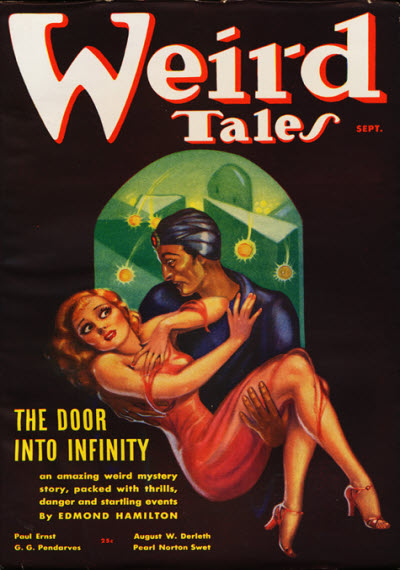

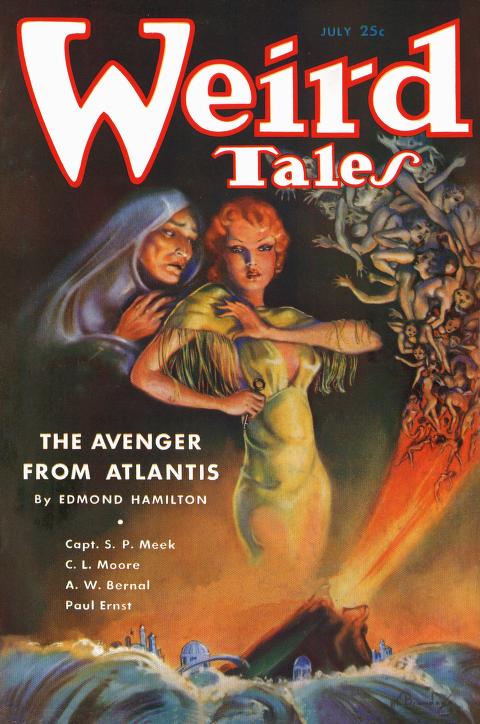


 Science Fiction & Fantasy Remembrance