Who Goes There?
The recent reprint of Maureen McHugh’s debut novel China Mountain Zhang may have raised awareness of this not-too-prolific writer for young readers like myself. McHugh has only written four novels across her 35-year career, and at least one of these, Nekropolis, is a major expansion of her short story of the same name. (Mission Child might also be an expansion of “The Missionary’s Child” but I’m not sure about the connection there.) Despite this, and her short fiction output being sporadic, she’s one of the more respected SFF writers of recent times. China Mountain Zhang was a Hugo and Nebula finalist and is considered one of the unsung classics of ’90s SF, which means a rediscovery may be on its way. “The Naturalist” is sort of a horror story but is more an SF narrative that tackles horror tropes in a rationalistic manner, even if its language is unusually salty. We’re gonna be talking about zombies today.
Placing Coordinates
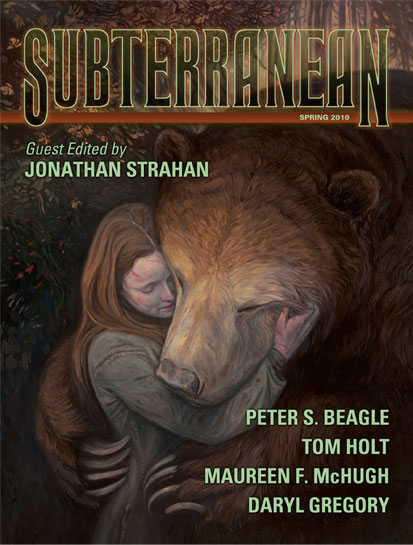
First published in the Spring 2010 issue of Subterranean Online. Subterranean Press shut down their online magazine nearly a decade ago and so now it’s inaccessible—in the present tense. With the power of the Wayback Machine we can read these issues online and for free, so no excuses! “The Naturalist” was then reprinted in The Best Science Fiction and Fantasy of the Year Volume Five (ed. Jonathan Strahan) and The Year’s Best Dark Fantasy and Horror: 2011 Edition (ed. Paula Guran). It’s also in the McHugh collections After the Apocalypse: Stories.
Enhancing Image
The zombie apocalypse has happened—and been contained, sort of. Unlike most zombie apocalypse scenarios the American government is still around, which is how you know upfront that this will be a very pessimistic narrative. Rather than be allowed to roam the whole country, the monsters have been quarantined and put in “zombie preserves,” where criminals can also be sent; at least that’s my understanding of the situation, since while there is a bit of worldbuilding the machinations of the outside world are a little outside our protagonist’s comprehension. Cahill is our guy and by no means is he a hero, being “too stupid to live, and probably a liability.” He starts out in one of these zombie preserves, with a pack of men who are largely even bigger pieces of shit than he is. Life on the reservation is not good but things get worse when there’s in-fighting one day, capped off with an air strike implied to have been made by the military that sends Cahill off by his lonesome, stuck with zombies and without anyone to rely on.
A few questions. Are thee zombies shamblers or runners? Shamblers! I prefer the former, even though it does strain one’s suspension of disbelief that creatures this fucking slow could take over the world. When they’re not attacking humans the zombies in this story are even slower than the ones in George Romero’s movies, since rather than walk around passively they often just… stay there. Or lie down, like they’re tired. Again I’m not sure how we’re supposed to lose so many people to creatures that are positively glacial in their movement, but also remember that the zombie outbreak has more or less been contained—at least in the US. We’re not really told about what’s happening in other countries. I don’t even remember what city this is supposed to be taking place in; it’s sort of abstract like that. The stakes are also rather low because it’s not like we’re trying to escape the apocalypse or meet up with loved ones here. Cahill doesn’t know anybody and he basically stays in the preserve by choice.
I don’t have too much to say about this story, but I’m not sure if that’s because of the story itself or because I’m extremely jaded with zombie media. “The Naturalist” was published right before zombie media was to reach critical mass and become seriously oversaturated, which is not exactly its fault but it reads like McHugh was riding a trend at the time. We still get zombie media, but it’s hard to overstate how in the latter half of the 2000s through much of the 2010s there was this seemingly infinite barrage of zombie stories across every narrative form possible—except music I guess. The Walking Dead premiered in 2010 and the original comics were already popular. We had just gotten Left 4 Dead and its sequel. World War Z was super-popular and I remember reading it in like 7th or 8th grade; then there was the movie, which had fucking nothing to do with the book. Of all the stock monsters, the zombie must’ve suffered the most from trends and oversaturation in a relatively short period of time. Even the runner, as popularized in 28 Days Later (there were also running zombies in Return of the Living Dead, and maybe there’s an older example I’m forgetting), seemed fresh compared to Romero’s shamblers, but those too grew stale.
Much of the narrative can be thought of as like a road trip, with Cahill making observations during his travels and even coming across a few humans along the way—although those interactions never turn out well, and it’s not clear how much of that is Cahill’s fault. He’s not evil, but he’s certainly a grotesque and a bit of an uncanny figure; the narrator even compares him to Charles Manson at one point, in looks if not behavior. He’s like a mountain man, except his environment is urban decay instead of actual wilderness. I don’t think it’s a coincidence that when describing what Cahill is carrying that McHugh focuses first on the essentials that one would need for surviving in the wild, plus a couple very small luxuries, with the weaponry coming second. Get a load of this:
He had a back pack [sic] now with water, a couple of cans of Campbell’s Chunky soups—including his favorite, chicken and sausage gumbo, because if he got stuck somewhere like the last time, he figured he’d need something to look forward to—a tub of Duncan Hines Creamy Homestyle Chocolate Buttercream frosting for dessert, a can opener, a flashlight with batteries that worked, and his prize find, binoculars. Besides his length of pipe, he carried a Molotov cocktail; a wine bottle three-fourths filled with gasoline mixed with sugar, corked, with a gasoline soaked rag rubber-banded to the top and covered with a sandwich bag so it wouldn’t dry out.
What’s curious is that McHugh did not title this story “The Survivalist,” even though that’s a word that’s likelier to come to people’s minds. Sure, Cahill is a survivalist, but he mainly takes pleasure in observing the behavior of the zombies around him—almost like he’s studying them. Right-wing survivalist narratives have been a thing since at least the ’70s, but the zombie story tends to be the most consistently and outwardly left-leaning out of the stock monsters, showing the failings of capitalism and government and often focusing on the destructive potential of human greed. Indeed, while Cahill does some rephrensible things later, every human he comes across is shown to be untrustworthy at the very least. You’d think the government still being cohesive and active would be a good sign, but we’re also shown quickly that the government has no qualms with killing its own citizens without provocation. This is one of those downbeat narratives where the protagonist is shitty, but the people around them are worse.
There Be Spoilers Here
Some stuff happens.
Okay, there’s more to it than that. The plot is rather episodic; you could cut it done some without removing context for the ending. The third-person narrator is highly colloquial (by that I mean they curse slightly more often than me), but at the same time is tight-lipped about what Cahill could be thinking—assuming he has thoughts. As such it’s ambiguous when Cahill runs into a few people and, with some degree of aggression, traps them and offers them as food for the zombie mob. Cahill is a murderer, objectively, but we’re not sure why he’s doing this since it’s not like he gets a sort of perverted thrill out of these ordeals. What he’s doing does make more sense if you take on the mindset of humans becoming little more “human” than the zombies—or that the zombies aren’t monsters but very dumb animals. Too uneducated and maybe too alienated from everything to work as a scientist, Cahill studies zombie behavior, using other people (who presumably are fellow criminals, since this is a reserve still) as bait.
But then, when he wasn’t asking for it, he gets rescued. “There’d been some big government scandal. The Supreme Court had closed the reserves, the President had been impeached, elections were coming.” These little pockets of disorder are being evacuated and the zombies are now to be killed off in earnest. On a macro scale this is a victory for humanity, and would be a conventional happy ending if it didn’t also mean Cahill’s way of life was coming to an end. It’s doubtful if he can ever return to normal society, and again that pessimism creeps up one last time.
A Step Farther Out
I’ve read very little McHugh before, my main exposure being her Hugo-winning alternate history story “The Lincoln Train.” For what it’s worth, these are very different stories and I’ll probably read China Mountain Zhang next month or in December. I didn’t enjoy “The Naturalist” very much but that may have to do with how extremely tired I am with zombie narratives. We don’t normally judge a story harshly for not breaking new ground, but despite some details that hint at McHugh’s talent for psychology and worldbuilding I got a sense of déjà vu with this one. It doesn’t help that I just don’t think zombies are scary, especially those of the Romero variety (I love Dawn of the Dead, but I wouldn’t call it a scary movie), and this is more effective as science fiction than as horror.
See you next time.
 Science Fiction & Fantasy Remembrance