Who Goes There?
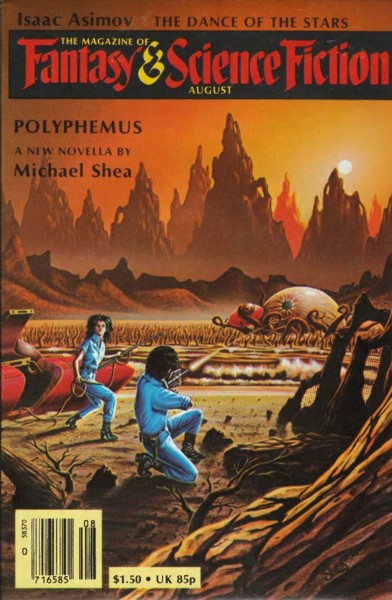
Michael Shea had a pretty interesting career, being one of those authors who started out writing novels before branching out to short fiction; his first novel, A Quest for Simbilis, preceded his first short story by a few years. The result is that by the time of his first short stories he was already a seasoned writer, although I’m still surprised that his most famous story, “The Autopsy,” was only his third published. Today’s story is his fourth. I have to admit I feel bad, because I don’t have a great deal to say about “Polyphemus.” Not to say it’s a bad story—it’s a curious throwback that tries to combine Golden Age planetary adventure with scientific plausibility, plus a generis dose of symbolism and literary references. It can be thought of as almost a companion piece to “The Autopsy,” being concerned with alien biology and, to some extent, an SF-horror hybrid, although “Polyphemus” leans much more on the Sf side of the equation.
Placing Coordinates
First published in the August 1981 issue of The Magazine of Fantasy and Science Fiction, which is on the Archive. It’s been reprinted only a few times, in The 1982 Annual World’s Best SF (ed. Arthur W. Saha and Donald A. Wollheim), and the Shea collections Polyphemus and The Autopsy and Other Stories. The former has gotten a very recent reprint from Valancourt Books—so recent ISFDB hasn’t consistently listed yet.
Enhancing Image
Humans have begun colonizing the planet Firebairn, which is technically hospitable but not exactly welcoming, what with the volcanic activity and the sea life. We have a “sand-hog,” a ship with a few smaller scout boats attached, along with a crew of people hunting “delphs,” which are the native food of choice for the colonists. It’s here we run into our first problem with the story, which is that within the first few pages we’re introduced to over half a dozen characters, a few of whom have no personality to speak of. We have Captain Helion, technically the leader of the expedition although he ends up not being the protagonist. We have Nemo Jones, who does end up being the closest this story has to a protagonist, along with his love interest Sarissa Wayne. We have Japhet Sparks, the ship’s cartographer. We have Orson Waverly, a biologist who will come to be the story’s leading expert on that language we avid readers know: Expositionese. And there are several other named characters I don’t care to dwell on.
Mind you that this is a short novella, and we’re expected to become familiar with at least a few of these characters. Obviously the same can’t be said for some others, since early on we lose a couple redshirts to the monster Waverly comes to call Polyphemus—after the cyclops. It’s fitting, considering the giant tentacled alien the colonists face off with also has one eye, and turns out to be not a very intelligent creature, instead basing its power on size and a complex sensory network. Polyphemus is a carnivore and a competitor for the delph food supply, on top of seeing the humans as potential prey. Thus we have a basic conflict of those who want to kill the alien juxtaposed with Waverly, who wants to study Polyphemus more than kill it. Of course, trying to understand how the monster works on the inside may be the key to killing it, which is how we get into lengthy passages of scientific jargon, most of which (it shames me to say) flew over my head. It would be inaccurate to call this story “hard” SF, but it takes a modern (for the time) approach to what would’ve been an old-fashioned premise even in the early ’80s. Funny thing is that is “Polyphemus” is an update of an Campbellian space adventure published in 1941, there’s now more of a time gap between “Polyphemus” and now than “Polyphemus” and that hypothetical story. The “modernized” update now seems to be old-fashioned itself.
Let’s talk references. Polyphemus itself is named after a cyclops in Greek mythology; and speaking of Greek mythology, we have a piece of equipment called a medusa, which contributes to the climax. Nemo Jones is presumably named after Captain Nemo of 20,000 Leagues Under the Sea, although he has very little in common with his namesake. And of course any story of this nature is gonna invoke comparisons with Moby-Dick and, more recently (indeed it would’ve been recent when Shea wrote the story), Jaws. Here’s the problem: the actual whale-hunting in Moby-Dick takes up maybe a third of the novel. If you were to cut Moby-Dick down to “the essentials” you would be left with a brisk 250-page adventure on the high seas—and also a far less interesting novel. There’s so much character and world depth (never mind the beauty of Melville’s language) you would be missing out on that you may as well be reading a different novel. And at the same time “Polyphemus” is too long for having such a simple plot and such thinly drawn characters, which I understand sounds like a contradiction to what I had just said. Take for instance the romance subplot between Nemo and Sarissa: we know basically nothing about either of these characters, the result being that we aren’t allowed to care much if they live to reunite at the end. This could be fixed by either removing the subplot, if we were to shorten “Polyphemus” by several thousand words, or we could flesh it out if we expanded the story into a full novel—only that would raise more problems.
My point is that Shea was ambitious with this one, and yet somehow he also didn’t go far enough. It lacks the perfect self-containment (never mind the layers) of “The Autopsy,” but it’s also possible I’m just saying that now and might feel different later. It’s possible I’m underestimating this story and as such am not putting the necessary work into it.
There Be Spoilers Here
I wish I had more to say…
A Step Farther Out
A criticism I often throw at modern SF novels is that they could’ve been shorter; we don’t necessarily need something to be 500 pages. This also sometimes applies to novellas, such as “Polyphemus,” which is about 20,000 to 22,000 words but could’ve been finessed with to have been turned into a novelette, or about the same length as “The Autopsy.” There are a few too many characters and ultimately there’s not enough of a plot to chew on. Shea’s attempt at making the movie monster at the heart of the story seem scientifically plausible is worth commending, but ultimately Prometheus is still that—a movie monster. Similarly the characters are a case of spreading too little peanut butter over too wide a slice of bread, so that the humans at times also seem like their B-movie counterparts. It’s possible I’ll come away feeling different on an eventual future reread, but my first impression left me sort of at a loss. Sorry to say.
See you next time.
 Science Fiction & Fantasy Remembrance