You’re very likely reading this after December 31, 2025, in which case “Happy New Year” is not so relevant.
But still, Happy New Year!
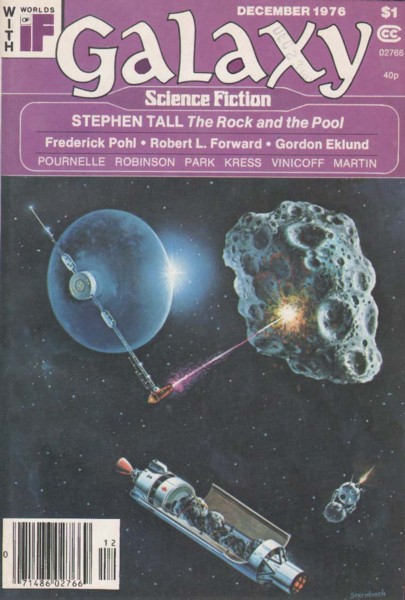
Nancy Kress has had a pretty long career, even just a bit longer than people would think. It’s easy to think of her as one of many authors who came about in the ’80s, and indeed her first novel was published in 1981; but like with William Gibson and Bruce Sterling, she made her debut in the ’70s. “The Earth Dwellers” was her first story, published when she was 28, and it would take some years for her to come into her own as a writer. This is not unusual; if anything it was much weirder at this time to see someone like the late John Varley, who pretty much hit the ground running. Of course, decades later and with multiple Hugos and Nebulas under her belt, it’s easy to see that Kress was wise to hone her craft. Her debut story over here ain’t half bad either, being a short mood piece that feels just a little off-brand for Galaxy under Jim Baen’s editorship. It’s competently constructed, but unfortunately there’s not a whole lot too it either. This is similarly a short and not very demanding review for New Year’s Eve.
Placing Coordinates
First published in the December 1976 issue of Galaxy Science Fiction. It has never been reprinted.
Enhancing Image
Rachel has just said farewell to her daughter Susan, along with Susan’s husband and small child. Susan, at this point in her twenties, went to college to study astrophysics, and now she and her family are on the spaceship Oregon as colonists, heading for Sirius V. It’s a one-way trip, and the trip alone will take 16 years in objective time, while the passengers aboard will be in cold sleep. Rachel and her husband Duncan knew this day was coming, but still these just-past-middle-aged parents are each handling the situation quite differently. The launch of the Oregon itself is anticlimactic, going off without a hitch and without much ceremony, with the “ugly utilitarian structures” of the spacefield around them. They go home together as if they had just sent their girl off to college, and not to a planet where they will never hear from her (or their grandson, it must be said) again. The treatment of space travel in this story is generally ambivalent, although Rachel is biased considering she herself has no interest in it. The topic would’ve appealed to Jim Baen and a certain type of space-colonization-now freak, but Kress’s treatment of it is more as a “necessary” evil than anything. I personally don’t see space travel as necessary, or even desirable, but if I went on a rant about that on a day like this then I’d feel like an asshole.
As for Rachel, she’s an environmentalist of sorts, being concerned with the ailanthus (misspelled in-story as “alianthus”), which unlike in real life has become endangered. Dodderson’s blight, seemingly of Kress’s invention, is threatening the species. “[Rachel] wasn’t usually a Joiner of Causes, but this one was different.” What little we’re told about the world of this future implies that environmental collapse on Earth is perhaps imminent, which really is not much different from how things are going in our world. Something I now appreciate about “The Earth Dwellers” that I did not in the heat of the moment is that this feels like a believable future setting. While published in 1976, it doesn’t have that burnt-out post-hippie stink a lot of ’70s SF has; there are no clear indicators that this was written from the perspective of just four out from the last moon landing. If there’s any indication of when it was written, it’s the sense that the Space Race was winding down and that NASA was at risk of losing funding. This is something quite a few SF people, including Baen and Jerry Pournelle, were concerned about. Whether Kress herself thought much of it at the time is hard to say. At the end of the day this is only nominally an SF story, since this is a character study where technology only plays a peripheral part. Rachel lives in a world that doesn’t seem all that futuristic, and Rachel herself turns inward and retrospective.
Something that’s struck me after having read “The Earth Dwellers” is what could’ve compelled Kress to center a story on a woman who is at least deep in her fifties, given Kress’s age at the time. Kress was about the same age as Susan, and she was also married (her first marriage) at the time, and may or may not have had her first kid by this point. Yet she seems to identify more with Rachel than Susan, the latter coming off as selfish and reckless. Having read my fair share of Kress’s more recent SF, from the ’80s onward, I assumed her sympathizing with middle-aged characters was an indicator of her own age, but it turns out this was a hallmark of hers from the very beginning. Also evident here is a style that borders on purple, but at the very least it’s more pleasant to read than much SF then being written. Kress’s style would fit well in the pages of Asimov’s and F&SF, but we see a rougher and less ambitious version of here in Galaxy.
There Be Spoilers Here
Really not much I can say here, given that there’s hardly even the skeleton of a plot to begin with and “The Earth Dwellers” more stops rather than ends. Like I said, it’s a mood piece.
A Step Farther Out
I have a couple announcements to make regarding this site tomorrow, which sounds vaguely ominous, but it’s really not all that. It’s also the end of the year and naturally I’ve been in a sort of retrospective mood. I like Kress, and I was curious about her no-doubt modest beginnings as a writer. “The Earth Dwellers” is not something I would seek out unless you’re a Kress fan or completionist, but it’s perfectly decent.
(Cover by Frank Kelly Freas. Satellite, December 1956.)
Merry Christmas, happy birthday to me, and all that.
People who keep up with my posts may have noticed that I missed a couple things last month, including what was to be the start of the second serialized novel, Kuttner and Moore’s Fury. Let’s say I’ve been slow about it. Generally I’ve been slower about keeping up with this blog than I was a year ago, and there could be a few reasons for this, but the point is that I’ve come to understand I’m not as on top of my own blog as I once was. I’ve slowed down with the “required” reading, and I’ve been slower about writing, although (not to toot my own horn) I still write here more than some other fan writers I know. Maybe nowadays the load I give myself is just a bit too much, especially since I’ve also been wanting to get into writing professionally, for that bit of extra money, only I’ve not been able to find the time and/or motivation for it. So, I’ll lighten the load a bit. From now on I’ll only be covering one serial a month, regardless of length. Of course, if the serial is four parts or longer this won’t make a difference, but a lot of serials are three-parters, which should give me an extra day to myself. Other than that, it’s gonna be business as usual.
What do we have on our table? All science fiction, which isn’t very diverse, but when these stories were published is certainly more diverse. One story from the 1940s, one from the ’50s, one from the ’60s, one from the ’70s, one from the 2000s, and one from the 2020s.
For the serial:
Fury by Henry Kuttner and C. L. Moore. Serialized in Astounding Science Fiction, May to July 1947. Kuttner and Moore wrote so much, both together and each solo, that they resorted to a few pseudonyms, one of them being Lawrence O’Donnell. Fury takes place in the same universe as the earlier Kuttner-Moore story “Clash by Night.” Despite Fury historically being credited to Kuttner alone, Moore claimed years later to having been a minor collaborator.
For the novellas:
“Welcome to Olympus, Mr. Hearst” by Kage Baker. From the October-November 2003 issue of Asimov’s Science Fiction. Baker had spent much of her adult life working in insurance and with theatre as her primary hobby, before pivoting to writing SF in her forties. No doubt she would still be writing SF today, had she not died all too soon in 2010. Still, for about a dozen years she wrote furiously, with her big series following a team of time-traveling secret agents.
“The Dragon Masters” by Jack Vance. From the August 1962 issue of Galaxy Science Fiction. Winner of the Hugo for Best Short Fiction. This is a reread, although I only have a vague memory of having read it in the first place, and that was without Jack Gaughan’s accompanying artwork. Despite what the title might make you think, “The Dragon Masters” is pure planetary SF, albeit with fantasy-esque coloring that Vance had become known for at this point.
For the short stories:
“An Important Failure” by Rebecca Campbell. From the August 2020 issue of Clarkesworld. Winner of the Theodore Sturgeon Memorial Award. Born and raised in Canada but now living in the UK, Campbell has written only one novel so far, which in fact was her first SF writing of any sort. Good news is she’s been somewhat prolific in writing short stories and novellas over the past decade.
“The Earth Dwellers” by Nancy Kress. From the December 1976 issue of Galaxy Science Fiction. This is the third time now that I’ve come to Kress, and why not? Her career now spands nearly half a century, and her stories, if not always entertaining, often provide some food for thought. I know nothing about “The Earth Dwellers,” except it marked Kress’s very first appearance in the field.
For the complete novel:
A Glass of Darkness by Philip K. Dick. From the December 1956 issue of Satellite Science Fiction. This book sounds unfamiliar, even for seasoned Dick fans, although it may ring a bell under its book title: The Cosmic Puppets. Dick had burst onto the scene in the early ’50s as one of the most promising short-story writers at the time, in a generation that included such bright newcomers as Robert Sheckley, Algis Budrys, and Katherine MacLean. It only stood to reason, then, that while writing short stories nonstop was all well and good, writing a novel was the logical next step. A Glass of Darkness wasn’t the first novel Dick wrote, but it was the first to be published.
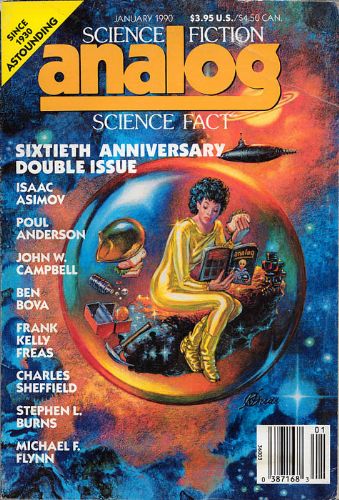
(Cover by Frank Kelly Freas. Analog, January 1990.)
Who Goes There?
Nancy Kress debuted in the ’70s, and became a big deal in the ’80s mostly on the back of some very good short fiction. Her 1991 novella “Beggars in Spain” (then expanded into a novel) is one of the most decorated of its kind in SF history. Her 1985 aliens-on-Earth vignette “Out of All Them Bright Stars” won a Nebula. She, along with Connie Willis, has been one of the most frequent and popular contributors to Asimov’s Science Fiction, and incidentally both women are very fond of writing at novella length. So today we’re looking at a Kress story that’s neither a novella nor published in Asimov’s. “Inertia” might be the best Kress story I’ve read so far; it’s certainly the complete package, containing thought-out speculation and human drama that struck a chord with me. That this story only got away with a Locus poll spot feels more than a little criminal.
Placing Coordinates
First published in the January 1990 issue of Analog Science Fiction, which you cannot find anywhere at the moment. I’m sure it’ll be added to Luminist at some point, but thankfully I had bought a used copy of this issue some months ago. Gardner Dozois tended to overlook Analog stories, but he recognized this one’s quality enough to include in The Year’s Best Science Fiction: Eighth Annual Collection. “Inertia” was also reprinted in A Woman’s Liberation: A Choice of Futures by and About Women (ed. Sheila Williams and Connie Willis) and Wastelands: Stories of the Apocalypse (ed. John Joseph Adams). This last one, I’d argue, is a little misleading.
Enhancing Image
A note to put upfront is that “Inertia” discusses the lives of people with disabilities, with mental illness, and more subliminally works as a reaction to what was then the worst years of the AIDS epidemic. This is not light reading; indeed its dark hues stand out in a magazine that’s more known for rigorous but not emotionally intense fiction.
It’s the future (not too distant a future), and the US has mostly gone to shit. Riots have become a frequent occurrence and the country has basically devolved into a police state; but that’s only the case for “Outside.” There are sealed-off internment camps across the country containing those infected with a disease that at first glance sounds like Leprosy; it’s a skin disease in which the infected is scarred with ropy patches of skin, but without getting ahead of myself there’s more to it than that. The disease is communicable and so the infected are walled off in “blocks,” basically left to die since the government is no longer looking for a cure. It’s here that we’re introduced to the elderly narrator, her daughter Mamie, her teen granddaughter Rachel, and her in-law Jennie. “Jennie, the daughter of Mamie’s dead husband’s brother, is Rachel’s cousin, and technically Mamie is her guardian.” We start with two announcements in this little family unit: that Mamie is getting engaged to some guy named Peter, and that Jennie is bringing in someone from Outside—a doctor named Tom McHabe. The latter will turn out to have a profound effect on these characters.
“Inertia” both is and is not a dense read. The plot, if one were to recite to someone, is not complicated. It starts out as a slice-of-life narrative in what is admittedly a dreary setting before someone from Outside comes in and changes everything, and the story picks up inertia. There is, however, a lot of scarily plausible speculation, and these characters are never anything less than human. AIDS had been public knowledge for no quite five years when Kress wrote this story: the Reagan administration had deliberately ignored HIV/AIDS until it became literally impossible to do so, the result being that people were dying of a virus nobody knew anything about, and once it was made public there was a tidal wave of misinformation that would have long-term ramifications. Nowadays conservatives wanna downplay this, but the reality is that the Reagan administration had condemned a swath of the American population to death for the non-crime of homosexuality, and there were many politicians and pundits who came up with some truly monstrous ideas as to what ought to be done with AIDS victims. Putting thousands of people in internment camps is not even the worst thing that could’ve happened. In case you doubt me about the connection, we get a reference to AIDS in-story, although not by name, it being called “that other earlier one” that was sexually transmitted. Of course we know you could contract AIDS via blood transfusion, but in the ’80s it was typically known as something that happened between queer men.
Life in the camps is far from ideal, but it’s surprisingly functional. There are no riots. There’s no huge wealth disparity. There’s no war, naturally. People are able to provide for each other, even if they have to work every day for it. This is not an anarcho-communist paradise, mind you, because these people live in poverty and with an infection that might prove fatal, but as McHabe soon makes it clear, life Outside is often worse. You may recall that “Inertia” was reprinted in an anthology focused on stories about the apocalypse, and honestly I don’t think it qualifies. At the most you could say society in the story is on the brink of total collapse, but that the apocalypse has not happened—at least not yet. Journalists and pundits speculated that the camps would soon descend into total mayhem, but to their disappointment this has not happened. Obviously something is different about the people living in the camps, something that compels them to cooperate rather than start fighting in the streets (Kress does not seem to think people are inherently good), which is why McHabe is here. The government stopped finding a cure years ago, after several people in the camps were tested on and killed as a result (Mamie’s husband had died “of an experimental cure being tested by government doctors”), but that doesn’t stop people from coming in to conduct their own research illegally.
About the characters. I don’t think we ever get the narrator’s first name, but she’s as vividly drawn a protagonist as any you’ll find in the best short fiction, with bonus points for being an SF protagonist who’s both a woman and probably in her sixties. Rachel and Jennie, despite their age, are not the rebellious sort, and this pleasing demeanor will have plot importance. The big outlier among the women in the story is Mamie, who unlike her mother and daughter is far from content. For one, she finds out almost as soon as they’re engaged that Peter is cheating on her, although this doesn’t stop her from soon making up with him—probably more from her fear of being abandoned than anything Peter did to make it up to her. Given her outbursts and her fear of abandonment it’s quite possible Mamie has what we’d now call Borderline Personality Disorder. It’s unclear if she was always like this, whether it was being forced Inside, the death of her husband, or something that has always afflicted her; but then if a revelation later in the story is anything to go by it’s implied that Mamie always lived with mental illness, only that something exasperated her condition. Then there’s McHabe, who in a typical Analog story would be the protagonist, but here he’s a supporting character whose aims are noble but tragic.
Something odd I noticed is that Kress wrote this story in first-person present tense, which is uncommon and honestly hard to justify; you need a rather specific reason to write with this combination, otherwise it reads awkwardly and raises unnecessary questions. I suspect it’s because, given the context, it raises the emotional intensity of the narrative, but it also reinforces the notion that what Kress is talking about is happening in the now—that her future story is firmly rooted in what were then current events. The inhumane treatment of AIDS victims was a part of the background the story was written against, and this would be the case for many more years. It still holds true because homosexuality is still demonized in many pockets of the country, and those who suffer chronic illness are often denied proper accommodations. It’s funny because there is no homosexual activity in the story itself (the characters are drearily straight), but it’s something those who didn’t live under a rock would’ve picked up. Don’t get the wrong idea, though, “Inertia” has aged depressingly little; it actually holds up better than some of the award-winners from this period.
There Be Spoilers Here
The reason McHabe went Inside is to tudy the neurology of those with the infection, because it turns out this infects the brain as well as the skin. The people in the camps have not descended into anarchy because (assuming McHabe is correct) they’re constantly depressed—not clinically depressed, as he puts it, but mildly enough that they’re not quick to take action on anything. The infected are able to maintain a society with minimal resources because the infection messed with their brain chemicals such that by and large they’ve become docile. Curiously, this applies to neurotypical people, and the longer someone has had the infection the more chill they are; but again, this is assuming they would’ve been “balanced” before. Mamie probably had mental illness prior to getting infected, which seems to have thrown her more off-balance, and the consequences of this will prove to be disastrous for our characters. McHabe’s idea is to cure people of the skin disease part of the infection, but to leave the brain alteration as is, such that these people can hopefully rejoin “normal” society and “infect” as many people as possible. He thinks the infection, if rid of its harmful aspect, can be useful. The narrator is doubtful about this.
Mamie, in one of her manic episodes, betrays McHabe to the authorities, resulting in his execution. It speaks to the savagery of government authority at this point that McHabe is killed pretty much on the spot. It’s traumatic, but it’s also the push that compels Rachel and the narrator to escape to Outside, or die trying. There’s a passage at the end that really struck me, as someone who very likely has BPD myself, and it might speak truer than even Kress had intended—to those with mental illness, but also those who feel trapped by their conscience, by the tug-of-war between their thoughts and what they feel they ought to do. “[Rachel] is sixteen years old, and she believes—even growing up Inside, she believes this—that she must do something. Even if it is the wrong thing. To do the wrong thing, she has decided, is better than to do nothing.” It’s a spin on Le Guin’s “The Ones Who Walk Away from Omelas,” and in my opinion it’s at least as emotionally compelling, at least as thought-provoking, in no small part because unlike Le Guin’s story Kress’s has plot and characters. There’s a concreteness that pushes it out of the realm of pure allegory, and emerges arguably stronger for it. This is a deeply bittersweet ending.
A Step Farther Out
Theodore Sturgeon argued that a great SF story should ideally have both compelling human drama and a thoughtful speculative element. The reality is that a lot of good and even great SF stories only have one or the other, and Sturgeon’s own “A Saucer of Loneliness” is an iconic story despite its SFnal element being tangential. “Inertia” meets this ideal, though; it’s a deeply felt and rather angry story that was written in response to one of the American government’s biggest failures in living memory. While you can make an educated guess as to when this story was written, though, it remains relevant and gut-punching because the American government does not value the lives of its own people, especially people who live marginalized lifestyles and those who live with disabilities. This will continue to be true so long as the government only puts stock in people of a certain income, skin complexion, and balance of brain chemicals. Kress repeatedly shows herself to be a friend of the downtrodden, and “Inertia” is one of her most effective and overt studies of the people we leave behind.
Happy New Year, ya screwheads. I said last month I would be taking a year off from covering serials, which means the field has very much opened up for tackling short fiction. The schedule I keep has changed in a sense, except not really; the only difference is that the spots that would normally be held for serial installments are now for short stories. So we’re looking at six or seven short stories a month, which if you ask me is for the best. There are so many short stories across the long history of the biz that I couldn’t stay content with only three or four a month. Think about how much ground there is to cover. Thus we have two novellas and seven short stories for this month, with as many authors being pulled.
There is one other thing I wanna mention, since it will be affecting what I cover for this year. As you know, The Magazine of Fantasy and Science Fiction is celebrating its 75th anniversary; it had premiered way back in 1949, and was initially called The Magazine of Fantasy. F&SF is such a prestigious outlet, with such a long history and with so much good material gathered in its pages over the decades, that a year-long tribute is in order. The question I then had tumbling around in my head was: How do I go about this? The solution I came to was twofold: first, as with last year, I’ll be covering all short stories in March, July, and October, only this time it will be all fiction from F&SF‘s pages; and the second is that outside of those months I’ll be covering two pieces (a short story and novella, or two of either) from F&SF each month. For example, you may notice we have two novellas from F&SF for January, which I think is a fine idea.
How March, July, and October will work is that I’ll be covering the first thirty years of F&SF across these months, so one decade for each. I’ll be grabbing stories from the ’50s, ’60s, and ’70s respectively, with the ’70s—falling on October—leaning more towards spooky stuff. F&SF‘s history is so rich that I won’t be able to give an adequate impression of its contents across 75 years, even with the methods I’ve created.
Lastly, in more solemn news, I’ll be reviewing works this month by some notable authors who sadly passed away recently. Michael F. Flynn died in September last year; Michael Bishop died in November; and David Drake died only last month. I’ve tackled Drake before, but while I wasn’t exactly a fan of “Time Safari” I did say I was curious to read more of his work. These are writers who are well-respected in the community and whom sadly I had read very little of when they were alive. If we’re to do right by the dead then we can’t afford to forget them.
For the novellas:
“Project Nursemaid” by Judith Merril. From the October 1955 issue of The Magazine of Fantasy and Science Fiction. She became known as an important critic and editor, but she started out as a member of the Futurians. Her story “That Only a Mother” is probably one of the most frequently reprinted classic SF stories, to the point that it’s now a little overexposed. I have to admit that aside from being force-fed “That Only a Mother” across multiple anthologies I’ve not read any of Merril’s other fiction, but I’m about to correct that!
“The Samurai and the Willows” by Michael Bishop. From the February 1976 issue of The Magazine of Fantasy and Science Fiction. Placed first in that year’s Locus poll for Best Novella. Speaking of writers I’ve been meaning to read more of, Bishop’s been on my radar for a minute now, but prior to his death I had only read a couple of his short stories. As with some other works of his, Bishop would revise “The Samurai and the Willows” extensively many years after the fact, but we’re reading it as it had originally appeared in F&SF.
For the short stories:
“Inertia” by Nancy Kress. From the January 1990 issue of Analog Science Fiction. I’ve covered Kress before, and while it’s always tempting to go for one of her novellas (given her fondness for that mode), I opted for something different—both in length and where the story was published. Kress has been a regular at Asimov’s for years, but “Inertia” is a rare appearance from her in Analog.
“Wall of Crystal, Eye of Night” by Algis Budrys. From the December 1961 issue of Galaxy Science Fiction. In some ways diametrically opposed to Judith Merril as a critic, and with as vicious an intellect, Budrys started as one of ’50s SF’s most promising writers. After a decade of heated activity he would turn away from fiction for the most part to focus on criticism and editing.
“Apartness” by Vernor Vinge. From the June 1965 issue of New Worlds. Vinge is one of the most important living SF writers, although sadly he retired from writing fiction about a decade ago. Despite being in some ways a prototypical Analog-type writer, Vinge made his debut in the Moorcock-run New Worlds with this story here. He would’ve been all of 19 years old when he wrote “Apartness.”
“House of Dreams” by Michael F. Flynn. From the October-November 1997 issue of Asimov’s Science Fiction. Theodore Sturgeon Memorial Award winner. I actually live one town over from Flynn, but sadly we never got to meet. “House of Dreams” is a rare case of Flynn appearing outside of Analog, and despite the Sturgeon win it has apparently never been reprinted in English, which is weird.
“The Valley Was Still” by Manly Wade Wellman. From the August 1939 issue of Weird Tales. Wellman started out during the Gernsback years, and was one of the few SFF authors of that era to maintain his street cred after Campbell took over Astounding—if only because he was more of a fantasy writer. I picked this one for the nerdy reason that it became the basis for a Twilight Zone episode.
“The Automatic Rifleman” by David Drake. From the Fall 1980 issue of Destinies. (Yes I’m still counting Destinies and its ilk as magazines.) David Drake was one of the codifying writers of military SF, but his range was a lot wider than that, having also written sword-and-sorcery fantasy and horror, on top of work that’s not so easy to classify. The following story seems to be an exercise in terror.
“The Agony of the Leaves” by Evelyn E. Smith. From the July 1954 issue of Beyond Fantasy Fiction. I only discovered this one as part of a very recent SF anthology edited by a certain colleague, and I’m pretty sure it’s not SF. As with too many female SFF writers in the ’50s, Smith moved away from the short fiction market once new avenues opened up; after 1960 she mostly stuck to novels.
Ncany Kress debuted nearly half a century ago (you can actually find her first short stories in Baen-era Galaxy), but despite her longevity she continues to feel like a “modern” author. She’s been a mainstay of Asimov’s Science Fiction for almost as long, being evidently one of Gardner Dozois’s favorites. She was, for a short time, married to fellow SF author Charles Sheffield. My first encounter with Kress was some years back, with her 1984 novella “Trinity,” with combines the SF premise of cloning with a believable and slightly demented human drama. Much more recently I read her Nebula-winning short story “Out of All Them Bright Stars,” which I have to admit I was less impressed with. Ah, but today’s story is a good ‘un.
What I like about Kress is that she seems fond of writing in the novella mode, which (warm take) I would say is the ideal length for SF. Not too long, but just long enough to give a few major characters their due and also give the reader a neat idea. Quite a few of Kress’s novellas have been up for awards, with her 1991 novella “Beggars in Spain” (later turned into a novel) being one of the most acclaimed SF novellas of the ’90s. “Dancing on Air” was itself up for the Hugo and Nebula, and even placed #1 in the Asimov’s Readers’ poll for Best Novella. There’s a good reason for this.
Placing Coordinates
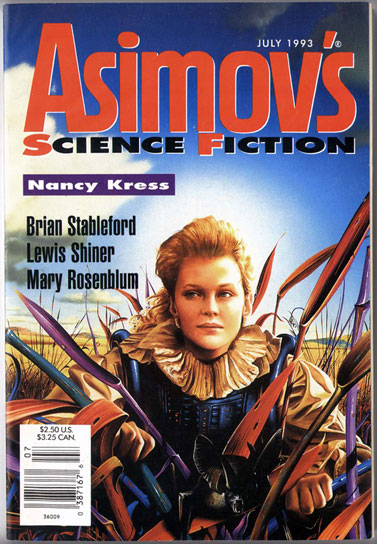
From the July 1993 issue of Asimov’s Science Fiction, which is on the Archive. It’s been reprinted a decent number of times. It appeared in the 1994 edition of Gardner Dozois’s The Year’s Best Science Fiction. It got a chapbook edition at one point from Tachyon Publications. Then there’s the Nancy Kress collection Beaker’s Dozen. If you’re in a collecting mood there’s The Best of Nancy Kress from Subterrainean Press, a fancy hardcover that goes for, hmm, over $60 on average used. Have fun!
Enhancing Image
We begin with a murder myster of sorts. Two ballet dancers in New York have been found dead in the past month; both cases seemed to be foul play. Aside from being dancers, both women were discovered to have been bioenhanced—their bodies modified artificially (and illegally) so as to make them sturdier and more refined performers, with the latter dancer she had apparently gotten bioenhanced shortly before her death. The head of the New York City Ballet, Anton Privitera, is staunchly anti-bioenhancement; he has a reputation to uphold, which immediately makes him a suspect. I’ll say here and now, though, that if you’re reading “Dancing on Air” with the specific expectation of it being a murder mystery, you’ll probably be disappointed. Luckily for the rest of us, Kress has different aims in mind.
The plot is split in two. First we have a first-person narrative by Susan, a reporter whose teen daughter Deborah is a hopeful in the School of American Ballet, “the juvenile province of Anton Privitera’s kingdom.” Susan is worried about Deborah for a few reasons: she’s been hanging out with Susan’s deadbeat ex-husband, and of more urgent importance, she’s been curious about bioenhancement. The other half of the story is about Caroline, one of the top dancers at the New York City Ballet, practically a living legend in her field, and already looking to be washed out at 26. Caroline, being a star in the dance world and a possible target for these recent murders, is given a bodyguard in the form of Angel, an uplifted dog. Yes, Angel can talk, and it freaks everyone out whenever he does that. Angel is of course bioenhanced, but people don’t think as much about engineering an animal like this. Bioenhancement for humans is a good deal riskier, both in the legality of it and possible unknown effects.
There were several kinds of bioenhancement. All of them were experimental, all of them were illegal in the United States, all of them were constantly in flux as new discoveries were made and rushed onto the European, South American, and Japanese markets. It was a new science, chaotic and contradictory, like physics at the start of the last century, or cancer cures at the start of this one. No bioenhancements had been developed specifically for ballet dancers, who were an insignificant portion of the population. But European dancers submitted to experimental versions, as did American dancers who could travel to Berlin or Copenhagen or Rio for the very expensive privilege of injecting their bodies with tiny, unproven biological “machines.”
Something odd about the Carolina thread is that it’s narrated from Angel’s perspective. Like with Susan it’s first-person narration, but it’s in the present tense, presumably because while he is smarter than the average dog, Angel doesn’t seem to have the concept of time nailed down. He’s also hardwired to only respond to certain commands from Caroline, which Caroline finds out much to her own dismay. Anton and his business manager John Cole, who had Angel uplifted in the first place, are a shady pair.
Anyway…
It’s the ’90s, and while “Dancing on Air” isn’t cyberpunk it does happen to cover one of the hallmarks of that movement. We’re at the point where we’re a good deal past Greg Bear’s “Blood Music” but Neal Stephenson’s The Diamond Age was still two years off. The technological breakthrough of the story is nanotechnology, and you know what that means…
At first glance it reads like Suspiria but with nanomachines, but while there’s a good amount of suspense for most of the story, it’s far from horror. Rather the suspense comes less from the murder mystery and more from uneasy parental relationships on both ends. Susan tries and fails to reason with Deborah, who seems too caught up in her own childish ambition to see the danger; meanwhile, as Susan investigates the dance academy, and finds out more about Caroline, things don’t look so good for that woman’s personal life. Of course what Susan doesn’t find out is then revealed to us via Angel’s narration, and it’s in these scenes where Caroline is at her most candid. There’s some dramatic irony at play, since we get to know things about each of the two leads that one does not know about the other.
This two-pronged narrative would be more difficult to pull off with a short story, and as a novel there would be the temptation to add an extra subplot, but at about 20,000 words “Dancing on Air” feels just right in terms of how it’s structured. Each thread has what the other lacks, basically. Susan’s plot reads almost like what you’d see in a film noir or police procedural, while Caroline’s plot is more akin to a character study; the scenes with Caroline and Angel are shorter and punchier than Susan’s.
Now, about those nanomachines. Bioenhancement in the story is more or less replacing one’s own cells with these tiny little weirdos. If you’ve read “Blood Music” where, SPOILERS, the scientist who experiments on himself with the nanomachines gets taken over by them, then you can sort of predict the downside of nanotechnology in this story. I won’t get into specifics right now, though, because how exactly Kress decides to show the monkey’s paw curling with the nanomachines is interesting in the context of what amounts to a family drama. Susan’s relationship with her daughter and Caroline’s with her mother are the focal points of the story, not so much the nanomachines; the science-fictional element exists in service of a human narrative that could potentially happen even without anything science-fictional.
One last thing to mention before we get to spoilers (because I don’t think this is much of a spoiler) is that Caroline’s mother, Anna, is terrible. She and Caroline don’t interact for nearly all of the latter’s plot thread, but we run into her from Susan’s perspective and she’s a nasty piece of work. While Anton comes off the most suspicious, Anna is shown to be a crass, selfish, insensitive old woman who doesn’t seem to care about her daughter’s wellbeing. You might be thinking, “Well she can’t be that bad, right?” Oh, just you wait! You’re gonna “love” what happens in the climax.
There Be Spoilers Here
I wish more stories introduced a murder mystery only to use the mystery itself as a red herring. Anton is introduced as an obvious suspect and by extension an obvious red herring, but not only is it not Anton who killed those women, it’s not anyone among the cast that we know either; it’s just some guy. It’s like Kress was misdirecting us with that thread, and I think she did that pretty well, because the mystery was interesting enough, the thread of familial turmoil is not only more interesting but also ultimately more relevant with regards to the technology Kress has given us.
Caroline may have been saved by a crazy murderer, but her dancing career is coming to an end regardless: for reasons she can’t grasp she has been underperforming horribly as of late, with critics taking note. Unbeknownst to herself (at first), Caroline is an experiment. Dancers are routinely tested for bioenhancement (bioenhancement seeming having replaced steroids for dancers and other athletic types in-story), and it’d be easy enough to do because you could compare the original cells to the nanomachines. It’s here that Kress brings in a rather scary question: What if there were no original cells to compare the nanomachines to? Adults have been known to get bioenhanced, but what about children? Or, even scarier, what about fetuses? It would be possible to experiment on fetuses meant to be aborted anyway, but what if these fetuses… weren’t?
Am I the only one who’s reminded of Greg Egan right now?
Upon attending a science conference in Paris that’s supposed to reveal some crucial info about bioenhancement, Susan finds out two things: bioenhancement is basically a death sentence, and also that there were fetuses some three decades ago who were subjected to bioenhancement in vitro, with some still walking around as adults. One of the scientists who was set to make this public announcement killed himself right before the conference, apparently out of guilt.
Caroline Olson, Deborah said, had been fired because she missed rehearsals and performances. The Times had called her last performance “a travesty.” Because her body was eating itself at a genetic level, undetectable by the City Ballet bioscans that assumed you could compare new DNA patterns to the body’s original, which no procedure completely erased. But for Caroline, the original itself had carried the hidden blueprint for destruction. For twenty-six years.
The reason why Carolina tested negative for bioenhancement is because her whole body has been replaced by nanomachines—probably before she had even left the womb. She’s kind of a cyborg if you think about it. It would also explain why her body has become conspicuously fragile as of late despite her age; the nanomachines are slowly eating her body from the inside. Caroline has an expiration date, although when that is exactly is unknown. Her mother, in wanting to create the perfect dancer that she herself could not be, used her daughter like a guinea pig and, unbeknownst to Caroline, gave her a short lifespan. Which sounds monstrous, because it is. Caroline is not happy to hear that her mother has used her like some tool her whole life, so in the climax she orders Angel to KILL THAT BITCH! YEAH! FUCKIN’ GET HER ASS! Which, look, I know it’s supposed to be tragic, but it’s pretty hard to feel sorry for Anna when Angel goes after her.
The ending is bittersweet, although it leans more on being simply a downer. Sure, the murderer had been caught and the world now knows about the risks with bioenhancement. Angel even lives at the end! Albeit minus a leg, on account of Susan’s intervention. But Caroline is institutionalized and Deborah, being too young and ambitious, throws caution to the wind and gets herself bioenhanced. It’s a dumb risk to take, but as Susan points out, in her bitterness, ballet dancers tend to wreck their bodies in pursuit of their art—only not as dramatically as this. Withered knees. Hip replacements. Arthritis. Why not bioenhancement, the new cancer of the digital age? The pain may be worth it, if it means being perfect for a few years…
A Step Farther Out
“Dancing on Air” is a two-pronged family drama, and pretty good family drama at that. The nanotechnology at the heart of the story causes issues, but ultimately the problem is a people problem. The technology is science fiction but the human anguish is not. Ultimately it’s a story about abuse; it’s about parents forcing their wills on their children, with cruel and horrible results. Susan, Caroline, and the others aren’t perfect, but they (except for Caroline’s mother) remain sympathetic because their desires are sympathetic. The narrative of parental abuse may hit home for some people, but for others (like me) it’s an effective allegory about the uneasy partnership between science and artistry. The ending is more bitter than sweet, but Kress is never less than humane with this outing.
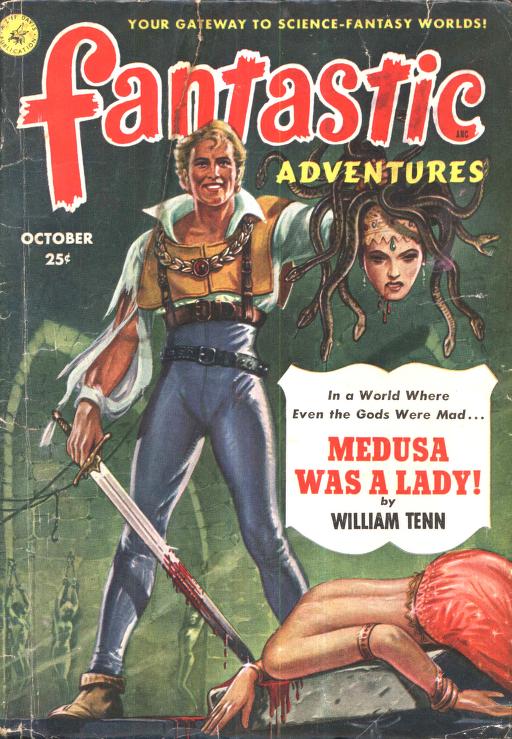
(Cover by Joe Tillotson. Fantastic Adventures, October 1951.)
I have to admit I take really niche pleasure in writing these forecast editorials. I suspect reviewers have a to-read list and just tackle shit when they feel like it, but I myself prefer to plan things out. Funny thing is that aside from these forecasts I don’t have a to-read list, anywhere. All this stuff is either in my noggin or it’s not shown up on my radar yet. Hell, I only started keeping a list of things I did read this year. I’m mostly a spontaneous reader, so let me have this one little bit of scheduled activity.
No gimmicks this month. Well, there is one, but you wouldn’t know it at first glance and I’m not even sure it counts. You see, I have a major soft spot for SF-horror; I love SF, and believe it or not I love horror too with almost equal passion, so what happens when you combine the two? This month’s short stories are crossbreeds of horror and science fiction, one by the most famous horror author of all time, the other by someone whose name probably doesn’t ring a bell but who really deserves more recognition.
Anyway…
No more wasting time, let’s see what’ll be on my plate!
For the serials:
The People of the Black Circle by Robert E. Howard. Published in Weird Tales, September to November 1934. Started this last month and now we’re gonna finish it. It’s been a fun ride so far. Howard only wrote about Conan the Cimmerian in the last four years of his life, but like with everything else he wrote a lot of it, and this is one of the longer Conan tales. Due to the episodic nature of the series it’s not necessary to have read previous Conan stories to enjoy this one.
Needle by Hal Clement. Published in Astounding Science Fiction, May to June 1949. Clement had already been active for several years, but Needle was his debut novel, and it would be published in book form in 1950. Clement is one of the founding fathers of what we’d call hard SF, with Mission of Gravity especially geing a genre-defining novel, but Needle seems to not fall into that mold; rather it’s one of the earliest known attempts at mixing SF with the mystery genre.
For the novellas:
“Dancing on Air” by Nancy Kress. From in the July 1993 issue of Asimov’s Science Fiction. Hugo and Nebula nominee for Best Novella (well, Best Novelette for the Hugo, I guess voters were confused). Kress is one of those authors I’ve been meaning to read more of, and I’ve been making progress… slowly. Like all great authors Kress seems very fond of the novella mode, but rather than go for one of her award-winners I’m going for a slightly deeper cut. Just slightly.
“Medusa Was a Lady!” by William Tenn. From the October 1951 issue of Fantastic Adventures. Tenn is supposedly one of the great comedians in SF from the late ’40s to his semi-retirement from the field in the late ’60s. Unusually for Tenn, “Medusa Was a Lady!” (also reprinted as the lamer-sounding “A Lamp for Medusa”) ventures into fantasy adventure territory. And look, I’m weak for a good cover, and the Joe Tillotson cover shown above convinced me.
For the short stories:
“Let Me Live in a House” by Chad Oliver. From the March 1954 issue of Universe Science Fiction. Oliver is one of those forgotten authors who popped up on my radar recently, with this story especially catching my interest. Oliver started young and was one of many authors who rode the wave of ’50s magazine saturation before quieting down circa 1960. While Ursula K. Le Guin is rightly praised for her anthropological SF, Oliver was a major forerunner in that vein.
“The Jaunt” by Stephen King. From the June 1981 issue of Twilight Zone Magazine. Does King need an introduction? Not really. Anyway, an SF Discord (shoutout to Media Death Cult, by the way) I’m in has “The Jaunt” on a list of short stories the group’s covering this month, and it’s one of the few on the list I had not read before in all honesty. Rather than just read and make a few remarks on it, I do believe I’ll give it the fancy long review treatment…
So it’s a short month. Only two serials, two novellas, and two shorts. I have something special in mind for March, but for now I’ll enjoy this calm before the storm. Nothing too gimmicky this month! Just catching up with some authors I’ve been meaning to do that with, plus some horror thrown into the mix—which may or may not be foreshadowing.


 Science Fiction & Fantasy Remembrance