Who Goes There?
Norman Spinrad has had a long and winding career over the past sixty-odd years; in fact he’s the only author we’re covering this month who’s still alive, at least last time I checked. Spinrad was born in 1940, in NYC, and he made his debut in 1963, just before the New Wave kicked into high gear. He’s one of the few prominent New Wavers who did not already have a career by the end of the ’50s. He stirred up controversy a few times, most notably with the novel Bug Jack Baron, which was serialized in New Worlds and which the UK parliament took an issue with on grounds of obscenity. They say all publicity is good publicity, but in the case of Bug Jack Baron the controversy actually contributed to New Worlds (already a small operation under Michael Moorcock) downsizing and ultimately evaporating by the early ’70s. There’s also his novel The Iron Dream, a kind of fictional novel as written by Adolf Hitler in an alternate timeline where Hitler became a hack genre writer instead of, ya know. Spinrad’s later outings are less incendiary. Star Trek fans might recognize his name because he wrote one of the better episodes of the original series, “The Doomsday Machine.” 1964 was Spinrad’s first big year as it saw multiple short stories of his in print, with “The Rules of the Road” sadly being minor Spinrad, being competent but otherwise unindicative of the career he would have.
Placing Coordinates
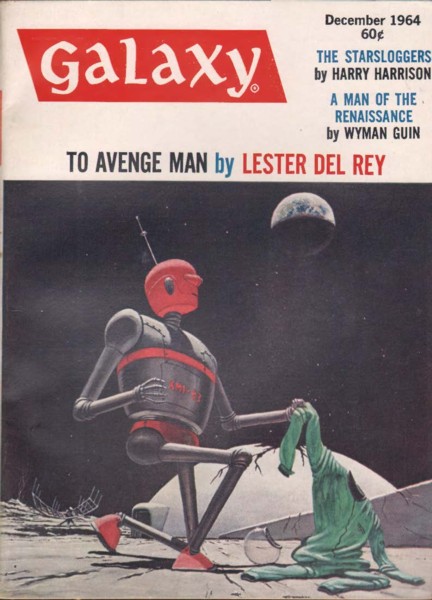
First published in the December 1964 issue of Galaxy Science Fiction. It’s been reprinted in First Step Outward (ed. Robert Hoskins) and the Spinrad collection The Last Hurrah of the Golden Horde.
Enhancing Image
Sorry that this will be a shorter review than usual. The story itself is quite short and I didn’t have much to say about it. Sometimes a short story can be densely packed with nuance and flavor so that I’d have more to write about, but this is not the case here.
A giant silver dome has appeared in Yucca Flats, which you may recall has a long history of US military involvement of the nuclear variety. (Its name is also associated with a certain infamously bad ’60s sci-fi movie, but putting that aside…) The dome appeared seemingly overnight and is obviously alien in origin, or else how could it be here. The top brass suspect the dome is some kind of ship, or maybe a “giant mousetrap” for human visitors, being perhaps a deadly labyrinth on the inside. Ten men have already been sent into the dome, and none have come out. The military begrudgingly concludes that it’ll take more than just a soldier or a normal civilian for the job, hence we’re introduced to Bert Lindstrom, a mercenary who’s gotten by on being very lucky—or rather Lindstrom has a borderline supernatural capacity to calculate risk. Risk, for Lindstrom, is indeed the name of the game. He’s a daredevil, but he’s an unusually rational kind of daredevil. Measuring risk is what gives Lindstrom’s life a sense of purpose, and pretty quickly we get that he’s a kind of anti-hero; other than that we find out nothing else about him.
“The Rules of the Road” feels both really short and somehow also protracted, because the premise is so simple and because most of it is effectively a one-man show, albeit with a voice from offscreen talking to Lindstrom, like the stage director hollering at the actors from just outside of the audience’s peripheral vision. It’s an adventure narrative, sure, but there’s actually not that much action, with Spinrad spending more time on Lindstrom’s state of mind as he enters the dome and tries to figure out what traps could be hidden inside it. There’s a bit of scenery porn, and also we do get the sense that something is at stake, although exactly what is not made clear at first. Now, if you’ve read your fair share of pre-New Wave ’60s SF then you may be thinking that this sounds a bit like Algis Budrys’s Rogue Moon, albeit without the melodramatic human drama that propels that novel’s plot, which Spinrad absolutely would have read by this point. I’ve seen people complain about Rogue Moon being far more about the people outside of the deadly labyrinth on the moon than about the labyrinth itself, but “The Rules of the Road” is what that same basic plot might look like if you removed the human element. This is to say that Spinrad’s story has the bones of what should be a compelling little adventure story, but lacks the warmth and intellectual stamina of Budrys’s novel. Mind you that Budrys was not the only author whose footsteps Spinrad seemed to follow, but in order to get to that we’ll be talking about the climax…
There Be Spoilers Here
That the dome is an alien construction is obvious, but what’s less obvious is the nature of the aliens who had constructed it. Are they here to put humanity through some kind of rite of passage, or are they here merely to toy with humanity as a kind of plaything? It turns out to be the former. As the alien host, who we hear but do not see, explains, the universe as we see it is actually an illusion, with our three-dimensional perception being a smokescreen for a universe whose “true” nature would turn the average person’s brain to mush. The true universe is “the road” the humanity will have to learn to navigate if it wants to be on par with the aliens, who clearly are supposed to be far more advanced than us. This is a reveal that would not have been out of place in the pages of Astounding a couple decades earlier, to the point where I feel like A. E. van Vogt had written just the same kind of story as this, with more pyrotechnics and a real sense of hallucinogenic wonder at the vastness of the universe. The big problem with Spinrad’s story, aside from its uneven pacing, is that it’s maybe too sober and rational, too casual about the cosmic potential of its premise. It’s “far out” on paper, but Spinrad did not write it as such. When Lindstrom returns from the dome, having apparently been transformed into “something other than human,” we don’t feel much of anything about it.
A Step Farther Out
Reading very early Spinrad you probably wouldn’t get the impression that he would write something decidedly transgressive like Bug Jack Baron a handful of years later, or that he would be one of the more accomplished New Wavers generally. When read the early stuff of, say, R. A. Lafferty or Roger Zelazny, you could see how they would later rub shoulders with the New Wave, but this is not so with Spinrad. “The Rules of the Road” reads like A. E. van Vogt at a discount, albeit if van Vogt also had a firmer grasp of English. It’s clearly magazine filler, which is a shame.
See you next time.

 Science Fiction & Fantasy Remembrance