(Cover by Gerard Quinn. Science Fantasy, February 1963.)
Sometimes I get confused by my own schedule, which is to say the rotation method I used is one I’m not sure I always abide. Do I do eight reviews this month, or nine? How many days are in September? Thirty. But that doesn’t matter now. August was a pain and a half for me, for a few reasons. I went on vacation with family, which wasn’t all sunshine and rainbows (although I at least got PTO from that), not helped by there being I guess you could say a changing of the guard in my polycule. One of my partners dumped me. We’d been together about three months, and it was a pretty intense pairing. They (I say that because they’re non-binary) ultimately didn’t feel comfortable being with someone who is polyamorous. That’s the short of it. It sucks, and I’m still feeling sore from it, although I suppose this is the kind of loss you have to accept with a polycule. But it hasn’t been all bad! We did also welcome a new member recently, and she’s very cute. She’s not used to polyamory (the last polycule she was in didn’t work out), but she’s patient and so far things have been going pretty well for us.
On to shit that matters more, the Hugos happened this past month, and I actually got to vote in them—not that it mattered too much. I only felt qualified to vote in about half a dozen categories, although I did vote in Best Short Story (the #1 on my slate didn’t win :/), and I think this was also the first time I was poised to review a Hugo nominee which then went on to win by the time my review was published (Naomi Kritzer’s “The Year Without Sunshine,” a very fine pick). Next year’s Worldcon is to be held in Seattle, which hey, that’s only on the other side of the country for me. I should get to work on attending, since I can feasibly do that. Worldcon 2026 is also gonna be held in LA, so that’s… two American Worldcons in a row. That’s a bit weird. But I can’t complain too much.
As for this months reviews, we have a few birthdays! John Brunner would be celebrating his 90th birthday on the 24th (had he not died in 1995), which is crazy considering one would think he was maybe a decade older. Stephen King (who is very much alive) is celebrating his 77th birthday on the 21st. Something I’ve started to think about is the decades I’m pulling from with my story choices, because given how the magazine market has ebbed and flowed over the years there are a few boom periods that would get more attention than others. It shouldn’t come as a surprise that I’ve had to try to not pick material from the ’50s too often, and indeed there are no ’50s stories this month! We have three from the ’60s, two from the ’80s, two from the ’90s, and one from the 2020s. A couple these would be horror outings, as a prelude to next month’s shenanigans.
Now let’s see…
For the novellas:
“Green Mars” by Kim Stanley Robinson. From the September 1985 issue of Asimov’s Science Fiction. Robinson is one of the most respected living SF writers, for his hard-science credentials but also for being one of the few openly leftist writers in the field over the age of sixty. Worth mentioning that this novella has nothing to do with Robinson’s award-winning Mars trilogy, although it does apparently share continuity with a few other stories set on Mars—just not the Mars of that trilogy. And also I heard Robinson would take some ideas from this early Mars story and reuse them for the trilogy.
“Some Lapse of Time” by John Brunner. From the February 1963 issue of Science Fantasy. Low-key one of the more tragic figures in classic SF, Brunner was something of a prodigy, making his debut while still a teenager. He also wrote full-time in the ’50s and ’60s, at a time when that wasn’t considered all too viable for genre writers, and money was an issue. Brunner wrote so much that a lot of his short fiction hasn’t been collected more than once, or at least not in my lifetime. “Some Lapse of Time” has not seen print since Lyndon B. Johnson was in office, so let’s see if it’s a hidden gem or not.
For the short stories:
“The Transcendent Tigers” by R. A. Lafferty. From the February 1964 issue of Worlds of Tomorrow. Lafferty has a reputation as something of a writer’s writer, and there’s a reason for this: nobody writes quite like Lafferty. I’m not a fan of him, because I often find him overly quirky, but I’m all for giving authors another chance. I went out of my way to pick a relatively obscure Lafferty story.
“Angels in Love” by Kathe Koja. From the July 1991 issue of The Magazine of Fantasy and Science Fiction. I’ve only read short stories by her so far (I do have The Cipher, her first novel, on my shelf), but I can already say Koja is becoming one of my favorite horror writers. She’s turned more to YA in recent years, but her early stuff is vicious, snarky, and at times genuinely disturbing.
“Craphound” by Cory Doctorow. From the March 1998 issue of Science Fiction Age. Acclaimed as both a writer and commentator on the state of tech and surveillance, Doctorow has probably kept a thumb on the pulse of the post-internet zeitgeist more than any other living SF writer. “Craphound” is a very early story, but Doctorow thinks fondly enough of it to have named his blog after it.
“Crazy Beautiful” by Cat Rambo. From the March-April 2021 issue of The Magazine of Fantasy and Science Fiction. Rambo is a no-nonsense Texan who’s been active in the field for the past twenty years, more or less. They’ve been most prolific as a short story writer and editor, but have also recently taken to writing novels. Their latest novel, Rumor Has It, is due out from Tor later this month.
“Beachworld” by Stephen King. From the Fall 1984 issue of Weird Tales. Really needs no introduction, but let’s do it. King started writing in the ’60s, a fact people tend to forget because Carrie, his first novel, didn’t come out until 1974. Then the rest was history. He’s known firstly as a horror writer, but he’s also ventured into basically every genre under the sun, “Beachworld” being SF-horror.
“David’s Daddy” by Rosel George Brown. From the June 1960 issue of Fantastic. Brown made her debut in 1958 and quickly established herself as a short fiction writer; a large portion of her fiction would be published between 1958 and 1963. In one of SF’s many lost futures, Brown could’ve gone on to fit in with the New Wave feminists, had she not died in 1967, at only 41 years old.
Not much to update on for this month, although I did decide to shake things up for slightly for what I’ll be covering. See, for a while I was gonna do a whole tribute month for Clifford Simak, like I did for Fritz Leiber almost two years ago; but truth be told I’m not sure if I’ll do a whole month of reviews for one author like that again. It can be fatiguing to read a ton from one author, even one as diverse in his output as Leiber; and I can tell you Simak is not as diverse. I do have a compromise, though, since it’s gonna be the man’s 120th birthday in two days and I wanted to do something special. So instead of one Simak story we’re getting two. Not only that, but I’m making an exception for my “one story per magazine a month” rule (excepting F&SF this year, as you know) so as to pick two Simak stories from the pages of Galaxy Science Fiction. Simak was such a prolific contributor to Galaxy that I feel it’s only right to double dip here.
Another quirky choice I decided to pull was this month’s complete novel, which is not only a certified classic of “literary” fiction but a fantasy novel that people tend to not think of as such. Whether The Man Who Was Thursday “really” counts as fantasy was a point of contention even when it was printed in Famous Fantastic Mysteries, with people in the letters column loving the novel but questioning its fantasy credentials. But fuck you, I’m counting it. Aside from Simak we have a fairly diverse roster of writers, none of whom I’ve previously covered on here. We also have a few stories I would consider appropriate for summer reading, in that they take place in warm climates and/or involve aquatic life.
Let’s see here…
For the novellas:
“No Life of Their Own” by Clifford D. Simak. From the August 1959 issue of Galaxy Science Fiction. For the story I picked to cover on Simak’s birthday I figured I may as well pick a story that also had an August release date. When Simak restarted his writing career in the late ’30s he would be a regular at Astounding Science Fiction for the next decade, but in the ’50s it quickly became apparent Galaxy would be his new go-to outlet. Incidentally the ’50s also saw Simak’s most prolific period as a short fiction writer.
“Surfacing” by Walter Jon Williams. From the April 1988 issue of Asimov’s Science Fiction. Williams had started out as a “mainstream” writer in the early ’80s, but by the latter half of that decade he had moved to writing SF. His rise to prominence happened to coincide with the cyberpunk movement. Bit of a funny story: this is a semi-reread for me, since I got about halfway through “Surfacing” a year or so ago, but due to circumstances outside of my control I wasn’t able to finish it at the time. I’m correcting that now.
For the short stories:
“Retrograde Summer” by John Varley. From the February 1975 issue of The Magazine of Fantasy and Science Fiction. Varley debuted in 1974 and within just a couple years rose as arguably the most imaginative and exhilarating new writer in the field. His Eight Worlds stories especially (of which “Retrograde Summer” is one) pointed towards a writer who was a breath of fresh air at the time.
“The Voices of Time” by J. G. Ballard. From the October 1960 issue of New Worlds. Ballard would later see mainstream recognition, of a sort, with his highly controversial novel Crash and the semi-autobiographical Empire of the Sun. In the ’60s, however, Ballard was known as one of the quintessential figures in the New Wave. This story is an example of early Ballard, from before the New Wave.
“The Evening and the Morning and the Night” by Octavia E. Butler. From the May 1987 issue of Omni. Butler was a respected author in her lifetime, winning multiple awards, but her reputation seems to have gotten a second wind in the years following her death. She was a somewhat prolific novelist, but she wrote very few short stories—which didn’t mean there was a dip in quality.
“Dusty Zebra” by Clifford D. Simak. From the September 1954 issue of Galaxy Science Fiction. Simak had been with Galaxy from literally that magazine’s first issue, with the serialization of his novel Time Quarry (or Time and Again), and from there he was a constant presence. Given the subject matter, “Dusty Zebra” may or may not be a precursor to Simak’s more famous “The Big Front Yard.”
“The Year Without Sunshine” by Naomi Kritzer. From the November-December 2023 issue of Uncanny Magazine. Kritzer has been around for a while—actually way longer than you’d think, considering she only started getting real awards attention in the 2010s. This story here just won the Nebula, and is currently a finalist for the Hugo, making it the most recent story I’ll have covered.
“There Used to Be Olive Trees” by Rich Larson. From the January-February 2017 issue of The Magazine of Fantasy and Science Fiction. I remember reading a few Larson stories in the past and assuming he was older than he really was, which says something about his skill. Larson made his debut in the early 2010s while still a teenager, and has been writing at a mile a minute ever since.
For the complete novel:
The Man Who Was Thursday by G. K. Chesterton. From the March 1944 issue of Famous Fantastic Mysteries. First published in 1908. This is kind of a treat for myself, since not only is this a reread but The Man Who Was Thursday is also one of my favorite novels. Chesterton is known for his Father Brown detective series, and for being a celebrated Catholic apologist; but before his conversion he wrote one of the pioneering (and still one of the weirdest) espionage novels with this month’s pick. Interestingly this seems to be one of the rare cases of a “complete” novel in FFM actually being unabridged, the only omission being a poem at the beginning dedicated to a friend of Chesterson’s which is not part of the novel itself.
Nothing unusual for this month, although we do have a couple authors who are not normally associated with SFF, let alone magazine SFF. One of the reasons I decided to make this year more focused on The Magazine of Fantasy and Science Fiction for its 75th anniversary is that, easily more than any of its contemporaries (and F&SF has outlived most of its competitors), is that it has managed to snag authors who otherwise would probably never appear in SFF magazines. It’s quite possible Jonathan Lethem would’ve tried his hand in the magazines regardless of whether F&SF ever existed, but the same can’t be said for Joyce Carol Oates.
I’ve recently been going through another mental health struggle (my bipolar episodes thankfully last hours at a time instead of days or weeks), but that’s not something to be elaborated on—at least not for this post. I may have something in mind having to do with mental illness in certain SF writers that you may or may not see later in the month.
Let’s see what we do have.
For the novellas:
“Oceanic” by Greg Egan. From the August 1998 issue of Asimov’s Science Fiction. Hugo winner for Best Novella. Egan is one of the leading voices of post-cyberpunk, and while mixing SF with detective fiction was a thing pretty much since cyberpunk became a codified subgenre, Egan has gone farther than most in mixing hard science with film noir tropes. Last time we met Egan it was with his mind-bending novella about quantum physics, “Singleton,” but “Oceanic” seems to catch Egan in a very different mode.
“Autubon in Atlantis” by Harry Turtledove. From the December 2005 issue of Analog Science Fiction. Prolific tweeter Harry Turtledove is known as a possibly even more prolific novelist, and while by no means did he invent the alternate history novel he has undoubtedly worked to define that subgenre more than anyone in recent years, especially regarding the American Civil War. “Autubon” is not a misspelling of “autobahn” but refers to the real-life naturalist John James Autubon, who stars in this alternate history story.
For the short stories:
“Friend” by James Patrick Kelly and John Kessel. From the January 1984 issue of The Magazine of Fantasy and Science Fiction. Long-time friends and collaborators, brilliant both solo and together, Kelly and Kessel got their starts around the same time and happened to get involved in the cyberpunk movement, although it would be inaccurate to call either of them cyberpunk writers.
“Drunkboat” by Cordwainer Smith. From the October 1963 issue of Amazing Stories. One of the most unique voices of his day, Smith, as you probably know, is the pseudonym of Paul Linebarger, a respected writer on psychological warfare and consultant on Asian geopolitics. He spent some of his childhood in China. Most of his stories, including this one here, are set in the same future history.
“Mood Bender” by Jonathan Lethem. From the Spring 1994 issue of Crank!. A “literary” author who has never forgotten his roots, Lethem started out in the late ’80s as a genre writer, and indeed his first four novels were all SF before he gained mainstream attention with Motherless Brooklyn in 1999. As with Greg Egan, Lethem has a knack for combining SF with film noir elements.
“Pictures Don’t Lie” by Katherine MacLean. From the August 1951 issue of Galaxy Science Fiction. MacLean debuted just in time for the magazine boom of the ’50s and the first great era for female SF writers. She lived an extraordinarily long time and her career is a distinguished one. “Pictures Don’t Lie” is one of MacLean’s most reprinted stories, and has even been adapted multiple times.
“In Shock” by Joyce Carol Oates. From the June 2000 issue of The Magazine of Fantasy and Science Fiction. Noted tweetsmith Joyce Carol Oates also happens to be one of the most acclaimed living American authors, having won the National Book Award, the Bram Stoker Award, among others. Most of her work is “literary,” but she’s also a somewhat prolific (and quite skilled) writer of horror.
“The Secret Life of Bots” by Suzanne Palmer. From the September 2017 issue of Clarkesworld. Hugo winner for Best Novelette. Palmer was born in 1968 but didn’t make her genre debut until 2012; despite this she has quickly built a reputation as one of the leading authors in the field. She’s been a prolific contributor to Asimov’s especially, but this story marked her first appearance in Clarkesworld.
As you can see this nearly all SF, except for the Oates which is horror, but it’ll also be the last “normal” forecast until September. In July we’re doing all F&SF stories, this time from the ’60s (I covered the ’50s in March), and for August I have a special author tribute in mind.
Not much to say with regards to updates here, other than I’m looking into a tutoring gig and I seem to be starting a polycule, the latter of which I’ve heard is kinda like starting a rock band. If anyone wants to join, please let me know. There are no gimmicks for this month’s review forecast, except that we have a complete novel on our hands for the first time in what feels like forever, and we’ve got a few familiar faces returning to the site. I may have also intentionally picked Lucius Shepard and Aliette de Bodard stories with similar titles. One thing I’ve been thinking about that I’ve decided to act on is reviewing more reprints of classic stories; one every couple months seems like a good deal. The reason for this is at least twofold: I have a soft spot for the classics, but I also wanna cover authors from the pre-pulp years who contributed to genre fiction. This month I’ll be reviewing an SF story by Jack London, who is not known primarily for his SF but who indeed wrote a lot of it. Once again Jack Vance will be providing the novel, which is unsurprising since quite a few of his novels first appeared in magazines, either as serials or all in one piece like this month’s novel.
Don’t wanna keep you long; just letting you know we have another month packed with fiction that looks to be at least interesting, although it’s mostly SF with a couple fantasy stories thrown in.
For the novellas:
“Birthright” by April Smith. From the August 1955 issue of If. Smith sadly is one of many women who wrote SF in the pre-New Wave days whom we know basically nothing about. We don’t know when she was born or when she died. She’s a ghost. She has one solo story, “Birthright,” to her credit, plus one collaboration. ISFDB classifies this story as a novelette, but running the Project Gutenberg text through a word processor shows it’s just over 17,500 words.
“Polyphemus” by Michael Shea. From the August 1981 issue of The Magazine of Fantasy and Science Fiction. Shea had a varied career, lasting from the ’70s until his death in 2014. His work ran the gamut from SF to high fantasy to the Cthulhu Mythos. He won the World Fantasy Award multiple times for his fantasy and horror. His most famous story, “The Autopsy,” is an SF-horror hybrid, and “Polyphemus” looks to be a similar blend of the two genres.
For the short stories:
“The Shadow and the Flash” by Jack London. From the June 1948 issue of Famous Fantastic Mysteries. First published in 1903. London was one of the most popular and prolific authors of the early 20th century, despite dying young. He’s best known for his adventure stories set in the Klondike, such as The Call of the Wild and White Fang, but he also wrote a surprising amount of science fiction.
“The Witch of Orion Waste and the Boy Knight” by E. Lily Yu. From the September-October 2016 issue of Uncanny Magazine. Yu burst onto the scene with her story “The Cartographer Wasps and the Anarchist Bees,” which nabbed her several award nominations. She won the Astounding Award for Best New Writer the same year she graduated from Princeton, which is no small feat.
“The Jaguar Hunter” by Lucius Shepard. From the May 1985 issue of The Magazine of Fantasy and Science Fiction. Speaking of late bloomers, Shepard didn’t start writing fiction as an adult until he was deep in his thirties, but he quickly emerged as one of the defining SFF writers of the ’80s. If you’ve read enough Shepard then you know he has a “type,” and this story looks to be typical Shepard.
“Descending” by Thomas M. Disch. From the July 1964 issue of Fantastic. Feels like it’s been a long time since I covered Disch, with his novel Camp Concentration. Disch was one of the daring young writers to kick off the New Wave in the ’60s, although despite being a regular at Michael Moorcock’s New Worlds he actually first appeared in Fantastic, under Cele Goldsmith-Lalli’s editorship.
“The Defenders” by Philip K. Dick. From the January 1953 issue of Galaxy Science Fiction. It’s been ten months since I last talked about Dick on here, which in my book is too long a wait. The thing about Dick is that he’s become frankly over-discussed in “serious” SF discussions, or at least his most famous novels. Thankfully this is not the case with many of his short stories, such as this one.
“The Jaguar House, in Shadow” by Aliette de Bodard. From the July 2010 issue of Asimov’s Science Fiction. Of Vietnamese heritage, living in France, and writing predominantly in English, de Bodard has a curious cultural background, so it makes sense she would concoct one of the most curious future histories in modern SF. Spacefaring humanity here is decidedly non-white and non-American.
For the complete novel:
Planet of the Damned by Jack Vance. From the December 1952 issue of Space Stories. The early ’50s were a formative period for Vance, who was showing himself to be one of the most imaginative talents at the time—albeit one whose efforts were mostly relegated to second-rate magazines. I’ve previously coveredBig Planet, which was a breakthrough title for Vance, and now we’re on Vance’s follow-up novel, published just a few months later. Planet of the Damned has a rather convoluted publication history: as with Big Planet, the magazine version and not the first book version served as the basis for future “definitive” reprints. It’s also been printed as Slaves of the Klau and Gold and Iron.
(Cover by Chester Martin. Planet Stories, Summer 1946.)
Who Goes There?
Leigh Brackett debuted in 1940, with her first couple stories being printed in Astounding, but quickly she found other magazines more enticing despite the smaller paycheck. She stopped submitting to John W. Campbell for the same reason her future husband Edmond Hamilton did: creative differences. Campbell wanted science fiction of a new, more technical, more cerebral sort, while Bracket and Hamilton were devotees of a school of adventure fiction that predates Campbellian SF. Brackett, by her own admission, was also pretty indifferent to keeping up with real-world scientific discoveries. It might be considered strange, then, that nowadays Brackett is most known for her post-nuclear novel The Long Tomorrow and her work as a screenwriter. She also wrote a fair amount of detective fiction, which does show its influence in her SF somewhat. She wrote the first draft of the screenplay for The Empire Strikes Back in the last months of her life, which saw her return to her planetary romance roots.
Ray Bradbury is one of the most famous writers in all American literature, especially for his novel Fahrenheit 451 and his fix-up “novel” The Martian Chronicles. Bradbury didn’t think of himself as an SF writer and it’s probably best, if anything, to understand much of his fiction with a horror lends; indeed his first collection, Dark Carnival, was horror-focused. In the ’50s Bradbury would gain mainstream recognition, but in the ’40s he was a fledgling short story writer and fan, with Brackett and Henry Kuttner (who were only five years older than Bradbury) acting as mentors. “Lorelei of the Red Mist” is a Brackett story at heart, but for better or worse Brackett was unable to finish it before trying her luck at screenwriting, leaving Bradbury to write the second half of the novella by himself. For what it’s worth I think Bradbury did a good job paying respect to Brackett’s style, although even without the latter’s word on who did what it’s not hard to figure out where the Bradbury part of the story begins.
Placing Coordinates
First published in the Summer 1946 issue of Planet Stories, which is on the Archive. It’s been reprinted a fair number of times, including in Three Times Infinity (ed. Leo Margulies), The Best of Planet Stories #1 (ed. Leigh Brackett), The Great SF Stories Volume 8 (ed. Isaac Asimov and Martin H. Greenberg), Echoes of Valor II (ed. Karl Edward Wagner), and the Brackett collection Lorelei of the Red Mist: Planetary Romances. This is all for collecting’s sake since you can read the story for free on Project Gutenberg. Sadly there was never a sequel to that Planet Stories anthology.
Enhancing Image
Hugh Mongous Starke is a space robber who has made off with the biggest pile of money he’ll probably ever see in his life—only he’s on the run from authorities and it looks like he won’t live much longer. Indeed it doesn’t take long for a mishap with his ship to send his body packing, although his mind proves to be much more resilient. Left dying on Venus, Starke is confronted by a strange woman named Rann, who has the power to spare Starke and give him a new body if only he would hold up his end of a certain deal. Rann is a sorceress, the Lorelei of the title (I thought for a while it was the name of a character, but it’s referring to Rann and her role as a sort of temptress), who has powers beyond Starke’s understanding. Starke gets his new body, but he quickly finds he’s been thrown into a conflict he can scarcely fathom, among people who want him dead.
A while ago I reviewed Brackett’s “Enchantress of Venus,” one in a series starring the futuristic barbarian Eric John Stark (Starke and Stark are very different characters, I might add), and Brackett’s Venus in both stories very much takes after early 20th century depictions of the planet. Even in 1946 the Venus of this story must’ve seemed a little far-fetched. Think Zelazny’s “The Doors of His Face, the Lamps of His Mouth.” It’s not exactly hospitable, but it’s livable for humans who are tough enough; there’s local wildlife, and as expected this Venus is swampy, with the Red Sea (the red mist of the title) being home to a very dense gas as opposed to water. The gas is dense enough to buoy ships but breathable enough that a human could traverse the bottom for several hours without scuba gear. This is all stuff Starke will learn much later but which will be familiar to those of us who have read one or two of Brackett’s Venus stories before.
Starke’s mind has been transplanted to the body of Conan, a warrior who has been kept in chains (“Starke’s new body wore a collar, like a vicious dog.”) and tortured in the dark corridors of Crom Dhu, an island surrounded by the Red Sea and connected to the mainland only with a jetty. Crom Dhu is home to the Rovers, a group of humans (like Starke) who, unlike Our Anti-Hero™, have stuck to a borderline medieval way of living. There’s Romna, the local bard, and Faolan, the leader of the pack who has been rendered blind, both literally and with hatred for Conan. Then there’s Beudag, Faolan’s sister and, as it turns out, Conan’s lover—or rather former lover. Conan, despite being one of the Rovers, has been tortured because he betrayed his own people in a recent battle: he was set to marry Beudag but turned his back on her in favor of Rann. It’s unclear if Conan had planned this from the start or if Rann had put some kind of spell on him. He would’ve run off with the sorceress had he not been captured, and apparently Conan’s mind broke under the torture (possibly also combined with guilt), making his body an ideal vessel for Rann to slip Starke’s mind into it.
To get the obvious out of the way, this is in part a Conan homage. The fact that the Rover hideout is called Crom Dhu doesn’t help. Something clever Brackett does is that she makes the protagonist a typical space opera character (a lovable rogue in the mode of Han Solo, you could say) and puts him in the body of a sword-and-sorcery hero. Eric John Stark takes after Conan (not to mention Tarzan) while Hugh Starke is basically a civilized man (albeit a remorseless criminal), only he’s been thrown into a scenario that would not be unusual for Robert E. Howard to conceive. We also don’t get to know much about the Conan of Brackett’s story, since his consciousness is MIA (although not as absent as was first thought, as we’ll discover later) and he can’t get a word in edgewise. The other characters tell us what sort of man Conan was like and it’s up to Starke to fill in the blanks; he’ll have to do his homework pretty quick, after all, or else he might get killed by one of the Rovers who are out for vengeance. Faolan suspects Starke might be an agent for Rann—a rational concern, considering Rann does want Starke to destroy the Rovers from the inside.
To complicate things further, Beudag clearly misses her former lover, and seeing him returned to a somewhat normal state (or rather seeing his body again inhabited by a working mind) immediately draws her to Starke. Starke is similarly taken with Beudag, who is a warrior lady who could probably crush his head with her thighs. Romance is not exactly Brackett’s strong suit (I remember criticizing the romantic aspect of her Eric John Stark stories that I’ve read), but the off-the-cuff romance in “Lorelei of the Red Mist” feels more justified since Starke is in the body of a man who was in love with Beudag, and he eventually finds that his memories are actually becoming intertwined with Conan’s, on top of Rann’s power over him. This story apparently drew some controversy among the Planet Stories readership for its overt (for 1946 pulp fiction) sexuality, and true enough Brackett and Bradbury are eager to describe human nudity (both male and female) in as much detail as was possible under the circumstances. It’s also unambiguous that both Beudag and Rann find Conan (or rather his body) very attractive. This is not just titilation. There’s some irony in the fact that Starke has a strong mind but originally had a weak body, while Conan has a strong body (even under torture) but a relatively weak mind.
But wait, there’s more! There’s a threeway conflict going on. There’s the humans, the sea-people who dwell in the Red Sea (they’re humanoid but they have gills and thin webbing between their fingers and such), and Rann’s people, who are descended from the sea-people and are apparently racist toward their own ancestors. All three sides hate each other, but right now shit is not looking good for the humans, as Crom Dhu has been under siege and there’s no way of getting off the island. The island is fortified such that Rann’s people will have a hard time getting in, but Faolan’s people can’t get out, and if Faolan dies then the humans will have no choice but to surrender. All Starke would have to do is kill Faolan and Rann will get what she wants and Starke will get his million credits. Rann is held up in the city of Falga, and there was a battle there recently that left the humans retreating and Conan becoming a traitor. There’s a whole backstory that’s partly given to us through exposition but which remains partly up to the reader’s imagination, the result being that Brackett (and I say her specifically since she wrote the first half and thus did most of the legwork with world-building) makes the world of the story feel bigger than it is.
There Be Spoilers Here
Starke, under the influence of Rann, nearly kills Faolan, Romna, and Beudag before being “rescued” by Rann’s people. The deal was that if Starke did what he was supposed to then he would get a million credits, but obviously Rann has no intent of actually following through on this, resulting in Starke narrowly surviving the double-cross and retreating into the Red Sea. It’s at this point that the story takes an unusual turn, and this is because Bradbury is now in control. Brackett said she didn’t know where the story was heading when she passed the torch to Bradbury, and admittedly you can still predict the rest in broad strokes. The details are what matter, though. The story doesn’t descend into horror exactly but it does get noticeably spookier, and the language becomes a bit more poetic as well. (I don’t see Brackett using “ebon” as frequently as Bradbury does here.) Bradbury does his best to mesh with Brackett’s style, but still there’s a switching of gears that you’d probably notice even if you didn’t know the nature of this collaboration. The SFnal part of the story was already tenuous, but by the time Bradbury takes over it has all but evaporated. I do like the idea, however, that within the bast universe of this distant future, with his spaceships and laser beams, that there are pockets of civilization that lag centuries behind that future. The Rovers, for example, have no issue with slavery, nor do they seem to have any weaponry that’s on par with even 20th century American standards. Jack Vance would basically make a whole career on such far-future medievalism.
At the bottom of the Red Sea, Starke comes across a pack of hounds, and a shepherd, one of the sea-people who apparently has the power to bring the dead back to life—not to their full selves, but as zombies. This is something that was not alluded to at all previously. The sea-people wanna use an army of the undead to take both Crom Dhu and Falga, which naturally doesn’t please Starke. Using a nigh invincible army would be nice, but Beudag has been taken hostage by Rann and Starke does feel that he ought to redeem himself in the eyes of the Rovers. It could also be that his personality has meshed with that of Conan’s to the point where he’s seeing himself in Conan’s shoes. “That part of him that was Conan cried out. Conan was so much of him and he so much of Conan it was impossible for a cleavage.” He manages to convince the shepherd to at least have the sea-people strike Falga first, to buy the Rovers time and maybe convince the sea-people that they have a common enemy! Which works! Although the ensuing battle at Falga—really a massacre more than a real battle—is depicted as horribly grotesque. “It was very simple and very unpleasant.” Still, he convinces the sea-people to spare Crom Dhu the same fate. The climax of “Lorelei of the Red Mist” has Starke do the typical heroic things, like rescuing Beudag, saving Crom Dhu, and killing Rann, but it’s also about him coming to terms with the fact that he is no longer entirely Hugh Starke, but “Hugh-Starke-Called-Conan,” host to that second personality and vicariously offering Conan the chance to redeem himself. Starke eventually finds his old body and gives it a proper burial, saying goodbye to his old self literally but metaphorically also saying goodbye to his former life as a rogue. He will work to become an honorable warrior now, with Beudag (who is in love with both Starke and Conan) at his side.
A Step Farther Out
This is a very interesting story, even if it is structurally wonky. It doesn’t help also that I was very tired (from work and a sprained ankle denying me much-wanted sleep) when I was reading it. It does seem a bit long in the tooth, not helped by the obvious divide between the Brackett and Bradbury material. At the same time this is exactly the sort of story that would never see print in Astounding, because it’s a little too fun-loving, a little too horror-inflected, a little too unscientific, and a little too erotically charged. Despite taking place on the same version of Venus as the aforementioned “Enchantress of Venus” this feels less like Edgar Rice Burroughs and more like Robert E. Howard, which of course is not a bad thing! (Makes me wonder what might’ve happened had Howard lived to see the sword-and-planet boom of the ’40s and early ’50s.) If you’re interested in old-school planetary romance, something which predates Dune and which is a lot less sophisticated but also less heady than Herbert’s take, this is a good start.
He was not the most prolific writer, but Michael Bishop was one of the most eye-catching new authors to come out of the post-New Wave period, debuting in 1970 and spending the rest of that decade making a name for himself. I had been meaning to get more into him, but unfortunately I did not get much of a chance while he was alive. Bishop died in November last year, leaving the field just slightly emptier. “The Samurai and the Willows” is one of Bishop’s most acclaimed stories, having solidified this by placing first in the Locus poll for Best Novella. It’s part of a series—a fact I genuinely had forgotten about prior to reading it, which would go to explain my confusion with some details in the world he constructs. Bishop is clearly hunting big game here, intellectually, and while I have a few qualms with this story I have to admit it also left me with a lot to think about.
Placing Coordinates
First published in the February 1976 issue of The Magazine of Fantasy and Science Fiction, which is on the Archive. It was anthologized by Best Science Fiction Stories of the Year, Sixth Annual Collection (ed. Gardner Dozois), and… that’s it? It was collected in the fix-up “novel” Catacomb Years, which has all the stories in that series along with interludes. I know it was reprinted in a couple more recent Bishop collections, but Bishop had the tendency to revise his works decades after the fact and “The Samurai and the Willows” was no eception. We’re reading the magazine version.
Enhancing Image
First, about the worldbuilding, because context is important and if you’re going into this story then you should know a little about the future Bishop creates here first. “The Samurai and the Willows” is one entry in an episodic series about a future Atlanta that, for some reason, is domed “surfaceside” and has several underground levels. This story here is set on Level 9, which as you can imagine is a good deal underground. Simon Fowler is a 38-year-old man of at least half Japanese descent (on his mother’s side), a “samurai without a sword” who runs a floral shop, and is cubical mates with Georgia Cawthorn, an 18-year-old black “Amazon” who clearly has ambitions that involve moving out of the catacombs. They have nicknames for each other: Simon is Basenji and Georgia is Queequeg. If you know your Moby Dick then congratulations, Bishop has already planted an idea in your head in the first couple pages. I’ll be calling these characters by their nicknames henceforth since it’s clear to me Bishop wants us to understand them on a symbolic level. There’s a good deal of symbolism at work in “The Samurai and the Willows,” and not all of it is obvious.
This is a short novella, only about 19,000 words, so in the threeway tug-of-war between plot, character, and worldbuilding, something has to give; in this case it’s plot that draws the short stick, but that’s not necessarily a bad thing. Bishop drops us off at the deep end of what already seems like a fully developed Atlanta of 2046 (and no, there’s no way major cities across the US would become domed go partly underground within seventy years of the story’s publication), with characters who usually do not explain the obvious to each other for the reader’s benefit. There’s some blatant exposition thrown in, but this is pretty much all through the third-person narration as opposed to what characters are saying. Basenji has been living like this for many years and Georgia doesn’t even really have memories of life before the dome. It’s never said explicitly why cities have become “Urban Nuclei,” with the honeycomb structure, but it’s implied that an environmental catastrophe has rendered much of the world unwelcoming to human habitation; at least that’s what I assume is happening. There are several questions about the background of this story that go unanswered.
(You may be wondering why I bothered mention Basenji and Queequeg’s ages at the start. All I can say is get ready for a tangent in the spoilers section, it’s gonna be awesome I promise.)
So what’s the plot? Kind of a trick question. Basenji is a florist who also happens to keep a diary, plus a lot of guilt over something that is not revealed to us until very deep into the story. There’s clearly some unspoken sexual tension between Our Heroes™, but this is put aside momentarily as a third wheel enters the picture: Ty, who happens to be around the same age as Queequeg (I think a year or two older) and has the same job as her. (I find it curious that Basenji, or rather Bishop, gives a black woman the name of a Polynesian man, even calling her a harpooner. There’s something to be said about the racial and cultural politics here, but I’m putting a pin in all that for a second. [Yes, I understand the possible symbolism of naming her Georgia, given the setting.]) There’s evidently a generation gap at play: Basenji has memories—or at least a dconnection via his parents—of life before everything changed, and now he has to play nice with people two decades his junior, who were born and raised to understand a city that has changed radically even from our understanding of it in 2024. The point is that this is not an action narrative; the world is not at stake; rather this is the story of one man coming to terms with his personal demons.
Like I said, Basenji keeps a diary, where he does what you normally do in a diary, but he also dabbles in poetry. Early on we get a telling note in said diary about Yukio Mishima, who of course was probably the most famous Japanese author in the west at the time. I’m not gonna tell you the whole story, because you can look it up yourself and anyway he was quite the character, but Mishima was something of a paradox: he was a hardcore conservative, to the point where he wanted Japan to its pre-World War II imperial era, but he was also gay, never mind an artist in the truest sense. Was Mishima a samurai who wanted to be an artist, or an artist who wanted to be a samurai? A similar question could be asked of Basenji. As you know, if you know his story at all, Mishima committed seppuku—ritual suicide—and this is actually something that preoccupies Basenji’s mind: the idea of giving up one’s life for the sake of honor. His beliefs, we come to find, are a sort of Christian-inflected Shintoism; not cleanly falling into either camp, but if you’ve read the story then you know what I mean. Basenji has an albatross around his neck, so to speak, and his relationship with Queequeg and Ty will involve him throwing off that albatross.
Now, as for the whole fact that this is a narrative with three main characters, none of whom are white, and one of whom explicitly takes after a non-Anglo culture. Would it have been preferable if “The Samurai and the Willows” had been written by someone with actual Japanese heritage? Probably. The problem is that whenever we say this about a work of art we basically make up a hypothetical instead of criticizing the thing itself. “What if this story had been written by a completely different person?” It doesn’t really solve anything. What matters is the question of whether Bishop handled the material with delicacy. I’m not an expert on Japanese culture, no matter how many hours of anime I’ve watched, so I can’t say with certainty. I will say that Basenji’s characterization didn’t make me cringe, although I have to admit Queequeg did, if only because her accent is laid on rather thick; there were times where I struggled to understand what she was saying. There is one other thing about Queequeg that bothers me, but it has less to do with cultural sensitivity and more certain decisions made late in the story that I can’t readily make sense of.
There Be Spoilers Here
Basenji and Queequeg have an almost-encounter one night, but nothing happens—for the moment. After Banenji has passed out Queequeg decides to take a peek at his diary, as you do. This incident, weirdly enough, does not come up later: Queequeg never admits to going through his belongings and so Basenji never finds out about it. It does serve the function of making Queequeg respect her cubical mate more, since it had been established earlier that the two were kind of on uneasy terms. She likes his poetry, even if she doesn’t understand all of it. It’s quite possible that it’s this incident that makes her care for him, at least in a way. We soon learn that Queequeg and Ty are gonna get married, although it’s ambiguous how much they actually care for each other. They’re clearly sexually into each other, but the shotgun wedding routine might be more for financial reasons than anything. Given Ty’s status, marrying and moving in with him would give Queequeg a good reason to leave the catacombs. As for Basenji, he would have to find a new cubical mate within a time limit or else get evicted. Well that sucks. Queequeg is screwing over Basenji a little bit, but it’s for a totally understandable reason, and anyway Basenji is happy for her.
Then, right before the wedding day, Basenji and Queequeg have a one-night stand. This is pretty strange. I assume Queequeg is cheating on Ty, but neither party acts like adultery is being committed, so that despite his overactive conscience Basenji doesn’t seem to mind it. Maybe they’re in an open relationship; it’s not made clear. Of course, social norms have to have changed a great deal in this bizarro 2046 where Atlanta is basically a police state (even classic rock music is prohibited), but Bishop leaves something to the imagination with how human relationships work here. And then there’s the age gap. It could be worse; I’m just saying that in the ‘70s there was this period of loosened censorship on genre SF writing, which overall was to good effect but which sometimes also resulted in authors being a little too permissive in some ways. You’d think the new freedom writers had would mean more positive depictions of, say, homosexuality and non-monogamous relationships, and we did see some of that; but we also got one too many stories where people in the thirties and forties are having sexual relationships with high schoolers. (I love John Varley’s early work, but he was a little too fond of putting full-grown adults in precarious situations with teenagers.) I’m not sure of this, but I imagine if one were to revise this story decades later changing the sex scene between Basenji and Queequeg would be a high priority. After all, it’s not even necessary for the story’s climax.
It has to do with Basenji’s mom. Remember that Basenji takes a lot of pride in his Japanese heritage; he associates the beforetimes with his mom’s home country. Basenji seems to have a case of post-nut clarity, because after having sex with Queequeg he makes a confession—that he had put his ailing mother in an experimental nursing home, as part of a deal. She was aging prematurely, and she would die there. It’s not the worst thing a person could do (although putting one’s parents in a nursing home never sits right with me), but it’s been dogging Basenji’s mind for years now, and once he confesses to Queequeg he finds a kind of tranquility. Having articulated what he sees as his greatest failure, and with the possibility of losing his cubicle on the horizon, he has given himself permission to commit suicide. He passes on his floral shop to Queequeg and Ty, as newlyweds, in a passing-of-the-torch moment. We aren’t told directly Basenji kills himself, but context clues at the very end imply he did, after having come to terms with himself. Honor kills the samurai. It’s a good ending, even if I wish Bishop hadn’t used an unearned sex scene to get to this point.
A Step Farther Out
I like novellas. A lot. I like them as a length because you can fit a whole world into fifty to a hundred pages, with some room left for character development. “The Samurai and the Willows” is light on plot but heavy on worldbuilding, character, and themes. It’s a dense fifty pages that somehow feels incomplete, possibly because Bishop had by this point already written a few stories in the same setting. There are some questions raised in the story itself that go unanswered, and these might be resolved in other stories. The setting could use some filling out, is what I’m saying. But if your story makes me hungry for more in the same series then surely you must’ve done something right. We’ll be returning to the domed and semi-underground Atlanta at some point not too far into the future, rest assured.
(Cover by Michael Carroll. Asimov’s, December 2007.)
Who Goes There?
It’s the holidays, Santa Claus is coming to town, Christmas cheer, all that. But before I pay that jolly son of a bitch a visit I’ve got some work to do, which in this case is to write about a seasonally appropriate story from perhaps the jolliest author currently working in the biz. Connie Willis made her debut back in the ’70s (which is wild, because I suspect people think of her as one of the fresh new talents of the ’80s), and has since collected Hugo awards like they’re Infinity stones. She currently holds the record for most Hugo wins for Best Novella (with “All Seated on the Ground” being the fourth and most recent), and I do love me ssome novellas. Willis has basically two modes: serious and comical. With serious Willis you get Doomsday Book and “The Last of the Winnebagos”; with comical Willis you get “Even the Queen” and today’s story, which is a Christmas comedy.
Placing Coordinates
First published in the December (appropriate) 2007 issue of Asimov’s Science Fiction, which is on the Archive. It was published pretty much simultaneously with a chapbook release from Subterranean Press, although given the nature of magazine publication the version in Asimov’s would’ve been available first. Despite the Hugo win it has never been anthologized. It was collected in The Best of Connie Willis and later A Lot Like Christmas, which as you can guess collects Willis’s Christmas stories.
Enhancing Image
In first contact stories the aliens might land in Washington, DC, or in some crop field in the Midwest; in this case they landed in Denver. The good news is that the Altairi are not hostile, but the bad news is they’re not talkative either, opting, in fact, to not say anything at all. A few meeting-the-aliens commissions are formed but fall through, which is where Meg, our narrator and protagonist, comes in. Meg is a small-time journalist who caught the government’s attention by having writing about aliens before, which doesn’t mean as much as they think it does, as she admits, “I’d also written columns on tourists, driving-with-cellphones, the traffic on I-70, the difficulty of finding any nice men to date, and my Aunt Judith.” That last part will figure majorly into the plot. Also on the commission are Dr. Morthman, “who as far as I could see, wasn’t an expert in anything,” and Reverend Thresher, your stereotypical Evangelical priest who (I don’t think I’m spoiling here) will be the story’s closest thing to a villain.
The Altairi aren’t communicative, but at least they don’t resist being driven around Colorado, to see some of humanity’s cultural touchstones—including the shopping mall. It’s the holidays, and it’s been long enough since the aliens came down that people in the mall don’t instantly swarm them. We’re talking about a group of six Altairi, none of whom say anything, the only method of communication they’re keen on being a constant and dismaying glare that, incidentally, is a look that reminds Meg of her aunt. The Altairi can be pushed around and herded, but they can’t be told to do anything, which is what makes what happens next pretty unusual. For reasons not known at first, since nobody had been observing them closely, the Altairi sit down in the middle of the mall; they had never been seen to sit down before, in the weeks they’ve been watched. There are shoppers, there’s Muzak on the intercom, and a group of carolers led by one Calvin Ledbetter. This is where we’re introduced to the central conflict of the story, or rather than central question: What made the Altairi sit down?
The question of what made the Altairi sit down all in unison is not as easy to answer as it may seem at firt, although (not to toot my own horn) I basically guessed the answer well in advance. “All Seated on the Ground” is a “problem” story in the classic Analog sense, which makes me think that, if not for the fact that I don’t think Willis ever sold to Analog (I could be wrong), this story could’ve fit better there than in Asimov’s. Not really a criticism, but I wanted to get out of the way just how dated this story is—not in its message or politics, but in how you could guess, without looking at the issue date, when it was published just from the cultural references. We get references to Paris Hilton, Men in Black II (not even the first movie), and this unbearably pungent stench of Bush-era humor. Comedy during the Bush years was like gazing into the abyss. Thresher himself is a caricature of a conservative clergyman, not that those people aren’t already deeply unserious. It’s all very tongue-in-cheek. I know Willis herself is a practicing Christian who really gets into the spirit of the holidays, so of course the commentary on religious intolerance is more playful ribbing than anything. Don’t expect any serious points from this if what I’m saying.
This is a story about Christmas, and more specifically about Christmas music; it’s about caroling and the classics. Again, not really a criticism, but it’s telling by what’s cited that there haven’t been any songs added to the Christmas music “canon” since this story was published—so 16 years now. I think the most recent song cited here is Mariah Carey’s “All I Want for Christmas Is You,” which itself is older than me. But this is a story that has a lot of fun picking apart the lyrics of old Christmas songs, seeing what makes them tick, and seeing what makes the Altairi sit down in universion; hell, if that’s even the only command they’re susceptible to via lyrics. Of course it can’t just be the lyrics, as Meg says; it could be “the voices singing them,” “the particular configuration of notes,” “the rhythm,” and/or “the frequencies of the notes.” It’s a problem or puzzle, depending on your viewpoint. Running parallel to the question of what the Altairi respond to is the budding romance between Meg and Calvin, which I’m not getting into other than a) to acknowledge it exists, and b) to point out that people in the cartoon world of the story seem very nosy about other people’s relationship status, because Our Heroes™ get asked repeatedly.
How much you enjoy “All Seated on the Ground” will depend on two things: on how much you care for Christmastime festivities (I don’t much), and on whether or not you find Willis’s humor to be more hit than miss. After having read some of Willis’s comedic fiction (To Say Nothing of the Dog, “Time Out,” “Blued Moon,” “Even the Queen,” and now this) I’ve come to find, via scientific analysis, that I don’t find her that funny. This is not a slight against Willis as a person, obviously; humor is maybe the only thing that rivals sexual attraction in terms of sheer subjectivity. I can hardly rationalize a joke I like or dislike any more than I can rationalize my immense attraction to Legoshi from Beastars. What’s more damning in the case of “All Seated on the Ground” is that while Willis does explore (as a good SF writer should) the implications of the question she poses, said question is not fit to sustain a work of novella length, for my money. I don’t expect there to be three subplots tag-teaming for wordage here, as a novella is short enough that you can have one plotline through the whole thing, but the plot here—really a driving question—could be more succinct about finding its answer. It could also be that this story is a bit constipated because Willis thought it necessary to add some third-act tension on top of the driving question, which is how we get such an overlong and misshapen thing.
There Be Spoilers Here
Thresher, who through misunderstanding and his own idiocy thinks the Altairi have become born-again Christians, goes on a broadcasted crusade that gets a whole lot of unwanted attention. It’s this idiocy that seems to prompt the Altairi to leave Earth (it’s later said that they were unsure if humans were sentient, in what must’ve been a lame joke even in 2007), only narrowly stopped because Meg and Calvin are able to solve the puzzle in time. This is done because, of all things, Meg is able to remember why her grumpy aunt always gave her the same look the Altairi had been giving for months on end. (I wanna point out that about nine months pass over the course of the story, but despite telling us this Willis does not show it in the writing itself, such that the time frame feels a lot more compressed than it is. Meg and Calvin’s relationship forms over the course of months, but you would think they fell for each other almost overnight without compressed the chain of events feels.) To give Willis some credit she does do a good job of making us wanna put a muzzle on Thresher, although it’s more that we’re supposed to think him a fool than to actually hate him; making him too despicable would not be very Christmas-y I suppose. I hate this man, but then I also think homophobes can eat shit.
Predicably we get a happy ending.
I wanna talk about something being “dated” some more. I’ve been thinking that the criterion for what makes a work of SF “modern” has become increasingly fuzzy, as if we’re approaching a singularity. Consider that a random genre SF story published in 1965 probably could not have gotten published in 1945 without substantial tinkering, namely changing the prose style and subject matter. Even a deliberately retrograde piece like Roger Zelazny’s “The Door of His Face, the Lamps of His Mouth” probably could not have seen print in 1945 without basically removing all the Zelazny-isms—in other words the thing which makes that story special. Conversely, it’s comparatively hard to find a genre SF story published in 2007 that, with few to no changes, could not have been printed in 1987. Change the pop culture references and a few technology points, like mentions of cell phones that can record video, and you could’ve printed “All Seated on the Ground” in 1987; incidentially this was another hyper-conservative era in American history. 2007 was not that long ago, and yet when reading Willis’s story I felt like I had traveled back considerably farther in time. I’ve actually read all the fiction Hugo winners from that year and while I was not keen on Chabon’s novel, the Willis piece impresses me less.
A Step Farther Out
Despite being a 23,000-word story I couldn’t find too much to say about this one. I think one sign of a great novella is that you get a great deal to chew on in a small amount of wordage, and by that metric “All Seated on the Ground” is definitely not one of the greats. Mind you, its slightness is by design, but I also think it was totally possible for Willis to cut it down to a long novelette. I’m also not exactly a fan of her sense of humor. It’s entertaining in fits and starts, but a joke was just as likely to make me cringe as make me chuckle; there’s a real doozy of a joke towards the end that made me wanna throw my virtual copy of the magazine at a wall. This is one of those cases where the stereotype that Hugo voters are frivolous applies, because I’m not surprised it was popular with readers, but also not surprised it didn’t get a Nebula nod, nor surprised that it’s never been anthologized.
(Cover by Michael Carroll. Asimov’s, December 2007.)
Christmas is coming up, and my birthday before that. Not incidentally we have a birthday among the authors covered, namely Connie Willis, whose birthday is the 31st. Willis is also very fond of Christmas stories so there’s that. Last December we did a month-long tribute to Fritz Leiber, who sadly will not be featured this time. (Don’t feel too bad, he’s already one of our most frequent “visitors.”) Since we’re closing out the first full year of this site, I figure it’s time to introduce one more major change (not permanent, don’t worry), not for this month but for January. December will be the last month probably until 2025 that I’ll be doing serial reviews; for 2024 I’ll be taking a break from serials and focusing on short stories and novellas, although I’ll still squeeze a few complete novels into the schedule.
The way it’ll work is, the days I would be reviewing sserial installments will instead be relegated to short stories, but otherwise the alternating slot method will not change, only starting in January you can expect to see two short stories for every novella. The space given to complete novels will remain the same: if a novella slot were to fall on the 31st of the month then I’ll at least try to tackle a complete novel. Why no serials for a year? For a few reasons. For one, I’m tired, and also I’ve come to find that my serial reviews are the least popular of my reviews, or rather they get the least feedback. Also, I’m a devotee of the short story at heart, and the reality is that there are way more short stories in the magazine market than serials, by at least a factor of ten; so for one year I think short stories deserve more of the glory. We do, of course, get two short serials to tackle before the hiatus, both of which are actually rereads for me.
There is one other thing I have in mind, a rather special thing, but you’ll have to wait until January to hear about it. It’s a secret. :3
For the serial:
Three Hearts and Three Lions by Poul Anderson. Serialized in The Magazine of Fantasy and Science Fiction, September to October 1953. Retro Hugo nominee for Best Novella. This is the first serial I’ll be covering where I’ve not only read the book version but also the serial version, so this is sort of my third go-around with it. It’s worth it, though; this is one of the more influential works in the history of American fantasy, having partly inspired Dungeons & Dragons. It also makes me wish Anderson wrote more fantasy.
Beyond the Black River by Robert E. Howard. Serialized in Weird Tales, May to June 1935. Despite committing suicide at the age of thirty, Howard wrote a truly staggering amount of fiction and created several series in the process, with his most famous creation being Conan the Cimmerian. Howard did not invent sword-and-sorcery fantasy but he had unquestionably the most influence on proceeding American fantasists. This right here was one of the first Conan stories I had read, and it still reads as one of the more unusual.
For the novellas:
“Pursuit” by Lester del Rey. From the May 1952 issue of Space Science Fiction. Del Rey started out as a sentimentalist at a time when genre SF was markedly unsentimental, filling a niche that had gone untapped such that early stories like “Helen O’Loy” and “The Day Is Done” were very popular. He would move away from that style, and in the ’50s he even edited several (very short-lived) SFF magazines, Space Science Fiction being one. Thus the first story in the first issue of this magazine is by del Rey’s favorite writer: himself.
“All Seated on the Ground” by Connie Willis. From the December 2007 issue of Asimov’s Science Fiction. Hugo winner for Best Novella. In the ’90s and 2000s Connie Willis could lay claim to being the most popular writer to appear regularly in Asimov’s, and that’s on top of her novels, a few of which are certified classics. Her novel Doomsday Book especially is excellent, although it does not indicate her penchant for humor. She holds the record for most Hugo wins for Best Novella, with “All Seated on the Ground” being her fourth.
For the short stories:
“The Keys to December” by Roger Zelazny. From the August 1966 issue of New Worlds. Zelazny looks like he might see a much deserved renaissance soon, with a TV adaptation of his Amber serie being in the works. This is good news, because for a couple decades Zelazny has been threatened with the dark cloud of obscurity, despite being one of the most acclaimed SFF writers to come out of the ’60s. I picked “The Keys to December” because, well, look at the title.
“Genesis” by H. Beam Piper. From the September 1951 issue of Future Science Fiction. Piper is surely one of the most tragic figures in old-timey SF, having started his writing career very late (he was in his forties) and committing suicide at the age of sixty, believing himself to be a failure, such that despite not dying young his career was short-lived. It’s a shame, because Piper was in some ways an unusual writer for the time; he was a bit of a character, one could say.
For the complete novel:
Lest Darkness Fall by L. Sprague de Camp. From the December 1939 issue of Unknown. From 1937 to 1942 (he took a break to support the war effort), de Camp was one of the designated court jesters in John W. Campbell’s Astounding, and perhaps more importantly in Unknown. It was here that de Camp got to show off his range as a fantasist (most famously in his collaborations with Fletcher Pratt), although ironically his two longest solo efforts in Unknown in its first year, Divide and Rule and Lest Darkness Fall, are science fiction, not fantasy. Lest Darkness Fall was de Camp’s solo debut novel, an early example of a modern person being sent back to an ancient time period, and according to a lot of people it’s also his best. It was expanded (although I can’t imagine by much, since the magazine version looks to be a solid 50,000 words) for book publication in 1941.
You may think it a weak move for me to have my last two serial reviews before the hiatus be of ones I’ve already read, but as I’ve said before and always hope to make clear, rereading is arguably more important than reading in the first place. So it goes.
(Cover by William Timmins. Astounding, March 1943.)
Who Goes There?
Henry Kuttner and C. L. Moore each started out as talented writers by themselves, both of them first appearing in Weird Tales and indeed they began as writers of weird fiction. Kuttner was younger, less refined, more cheeky, but also more productive; he employed so many pseudonyms that even Jack Vance was suspected of being a Kuttner pseudonym early in his career. Moore was never that prolific on her own, but what fiction she put out really caught people’s attention, with its poetry, its tonal intensity, and its psychological depth. During World War II, after the two had gotten married, John W. Campbell needed a few authors to fill the pages of Astounding and Unknown while a good portion of his stable went off to support the war effort, and Kuttner and Moore were up to the challenge. From 1942 to 1946, a truly absurd amount of work from the two, both separately and in collaboration, appeared across several magazines, but most notably in Astounding. Naturally, because they wrote more than their own names could carry, they employed new pseudonyms.
“Clash by Night” is one of many stories the two wrote in a white heat, during those war years, this one being first published under Lawrence O’Donnell, which is typically considered a Moore-leaning name. It’s appropriate because “Clash by Night” is a somber, lyrical, rather ponderous novella that stands as a very early example of military SF but which does not fall into what would later be a lot of tropes of the subgenre. It’s imperfect, but it’s conceptually lively and prescient in its own way. Initially a standalone, it would be set in the same universe as the novel Fury, which returns to the misty underwater world of the Keeps—dome-covered colonies on a swampy Venus (not anachronistic in 1943) in the distant future.
Placing Coordinates
First published in the March 1943 issue of Astounding Science Fiction, which is on the Archive. It was then reprinted in The Astounding Science Fiction Anthology (ed. John W. Campbell), The Great SF Stories Volume 5, 1943 (ed. Isaac Asimov and Martin H. Greenberg), and, as always, Two-Handed Engine: The Selected Stories of Henry Kuttner and C. L. Moore. It speaks to both the quality and quantity of their output in the ’40s that the Asimov/Greenberg volume contains FIVE stories by Kuttner and/or Moore. I would say that’s a bit much, but they had enough firepower for five writers.
Enhancing Image
The average writer would’ve plopped us right into the action, which would’ve been serviceable enough, certainly nothing inherently wrong with that, but Kuttner and Moore are very much above average. We’re instead given a fictional introduction, as if it were a foreword to a history on the Keeps, with the narrator even telling us that the protagonist, Brian Scott, may not have even existed, so long ago were the exploits of the Free Companies. I know I’m just throwing these names at you, so let me give you some context. The Keeps are underwater city-states—dome structures that are kept away from the cloudy and toxic surface of the planet Venus. As was typical of the time, Venus is not only habitable but teeming with life, being home to volcanic islands and swampy forests, not to mention a vast undersea world. The Keeps, like in feudal Japan, or China prior to the unification, are perpetually at war with each other—not for ideological reasons but for resources. “It is fairly well known that only one factor saved the Keeps from annihilating one another—the gentlemen’s agreement that left war to the warriors, and allowed the undersea cities to develop their science and social cultures.” Rather than fight each other with their own armies, the Keeps hire the Free Companies, which are mercenary groups—bands of outsiders who are not native to Venus and who have no patriotic bone to pick.
The story is set in the far future, but is framed as being told from an even more distant future point; Brian Scott, had he been alive in the first place, would’ve been dead for centuries by the time of the introduction. Indeed we’re told upfront that the Free Companies have been defunct for ages, and this fatalism will permeate the rest of the narrative; we’re also about to find out, however, that this foregone conclusion for the mercenaries is not necessarily a bad thing. A little word of warning first: I’m always a little weirded out when a character in a story has my name. I think that applies to a lot of people. It doesn’t help that Scott is also my dad’s name, so it’s like Our Hero™ here is some amalgamation. To make matters worse, Scott (the character) has a similar disposition to me, as we’ll see: he’s not fond of thinking, and yet he can’t help it, just as he’s not fond of talking and yet when he gets going he waxes philosophical. Even when we first meet him it’s clear that blue (depression, yet also eroticism) is his color. He’s a captain of the Doonemen, one of the Free Companies, and he’s enjoying some off-time when he’s called in by his superior, Cine Rhys, to serve as mentor for a young patriot of Montana Keep (all the Keeps, at least the ones we see, are named after American states), Norman Kane.
The novella is frontloaded with exposition, which normally would be a problem, but I would argue this opening stretch is the best part, since the plot itself is—let’s not say threadbare, but the backstory is more intriguing than the story proper. I can see why Kuttner and Moore would later return to this setting; there’s a lot of room for elaboration. The good news of this future is that humans have colonized Venus and Mars; the bad news is that Earth has apparently been turned into a hollow shell of a planet, following nuclear catastrophe on a planet-wide scale, referred to here rather uncannily as “the Holocaust.” (It had been known internationally since the ’30s that the Nazis were violently persecuting Jews and other minority groups deemed as undesirable, but it would not be until a few years after “Clash by Night” was written that we would know the sheer lengths to which the Nazis would go to eradicate these groups. Allied forces had not yet discovered the death camps.) As a sign of collective guilt, the Keep-dwellers keep signs reminding them of the destroyed home of their ancestors, and the one taboo never to be broken among Free Companions is the use of nuclear weapons. You might’ve also guessed this was written following the dropping of the atomic bomb, but it’s one of those preemptive tales of nuclear fear.
One more thing to establish here, because it plays into Scott’s ensuing relationship with Norman’s sister Ilene and it’s also rather curious to note from a modern perspective. The Free Companions are, not strictly speaking, monogamous; for them it’s customary to have to something of an open marriage, here called a “free-marriage,” in which the partners, since they’re separated for long stretches due to the Free Companions’ travels, are not prohibited from having squeezes on the side. Unusual to read about this not only from a story published in 1943 but one published in Astounding, a publication that was famously puritanical. The love triangle between Scott, his wife Jeana, and Ilene is erotically charged. Ilene herself is an interesting character in concept who sadly goes underutilized, as she considers herself a hedonist—someone who devotes her life to seeking pleasure. Norman and Ilene seem to be opposites but they also might be two sides of the same coin, since Norman wants to join the Doonemen for reasons that appear to be frivolous while Ilene is, by her own admission, given to frivolous ventures all the time. They both contrast with Scott, who is self-serious but also at this point becoming sick of his job as a gun for hire.
Now, I should probably bring up here that the story quotes Rudyard Kipling a couple times—it might be the first American genre SF story to quote Kipling, although I could be wrong about that. It’s a move that anticipates Robert Heinlein and Poul Anderson doing the same some years later; what’s different is that unlike Kipling, Heinlein, and Anderson, Kuttner and Moore as far as I can tell were not warmongers. Indeed the quotes do not refer to the virtuousness of battle but to the passing of an age, which makes sense because Kipling lamented the decline of the British empire following World War I and “Clash by Night” is about the twilight hours of the age of the Free Companies. We know in advance these mercenaries won’t be around much longer and Scott himself is keenly aware that the Keeps, once they get over their petty squabbles and unify, will not longer need people like him. War, in the story, is framed as a necessary evil—a stepping stone for a civilization that will at some point no longer need it. Even the phrase “clash by night” refers to the futility and blindness of battle—the fog of war. Thus the upcoming battle between the Free Companions of Montana Keep and Virginia Keep looks to be one last job for Scott.
There Be Spoilers Here
”Clash by Night” runs into a bit of a problem with the plotting, because at some point, naturally, we have to put the moody writing aside and get to the military action. A question you may have asked by now is, “How do the Free Companies fight each other if it’s impractical to fight on land?” By sea, of course! Battleships, submarines, and “flitterboats” which are smaller vessels. An engine failure on one such flitterboat sends Scott and Norman on a detour, and for a stretch the story it becomes something that wouldn’t be out of place in Planet Stories; it also becomes less interesting, in my opinion. I’ve said this before, but sometimes my bias against action writing rears its head. The back end of “Clash by Night” is a planetary adventure followed by a naval battle, and neither gripped me all that much. I get the impression that someone out there, who’s more into pulpy adventure writing, would like the back half more than I did. I just feel like it’s a 20,000-word novella that could’ve been cut down to a novelette. I heard from someone that this is essentially a Moore story, and I have to sort of disagree because I can see Kuttner’s knack for action prose here.
A Step Farther Out
I liked it, I just wish I had more to say. I had been hyping up this particular story in my head for a few months now; it had been on my radar for review for that long. I wouldn’t call the payoff underwhelming, because this would’ve been pretty memorable especially if you were reading it in 1943 and not used to SF about soldiers. It would’ve been written in 1942, so after the Pearl Harbor attack, and following that there were plenty of pro-war stories about (explicitly or subliminally) about letting the Germans or Japanese have it. This is a different type of war narrative and I’m not sure what Kuttner and Moore were responding to here exactly. I would recommend it, but if you’ve never read Kuttner and Moore together than I first recommend checking out “Mimsy Were the Borogoves,” “The Twonky,” “Vintage Season,” and for a more overlooked gem, “A Wild Surmise.” I just hope I can get out of this funk I’ve been in so that I can enjoy writing more.
Ursula K. Le Guin made her genre debut in 1962, and for the next 55 years would stand as one of SFF’s most universally beloved writers. By 1970 she had started the two series that would cement her legacy: the Earthsea series and the Hainish cycle. The latter, when taken collectively, might be Le Guin’s crowning achievement, giving us such memorable novels as The Left Hand of Darkness and The Dispossessed, as well as some of her best short fiction, including “Vaster Than Empires and More Slow.” Le Guin put the series on hold in the latter half of the ’70s, and generally the ’80s saw her write only sporadically; but then in the ’90s she made a grand return, not just to the Hainish cycle but to Earthsea as well. “A Man of the People” is part of a quartet (or quintet, as I’ll explain in a moment) of stories set in the Hainish universe, and more specifically around two planets.
Placing Coordinates
First published in the April 1995 issue of Asimov’s Science Fiction, which is on the Archive. Has never been anthologized. It was then reprinted in the collection Four Ways to Forgiveness, which also includes the previously reviewed “Forgiveness Day,” although “A Man of the People” is not a direct sequel to that story. The Library of America, apparently with Le Guin’s approval, would expand the collection to make it Five Ways to Forgiveness, as part of the two-volume Hainish cycle box set. The expanded collection includes the novella “Old Music and the Slave Women,” which was published several years after the other stories.
Enhancing Image
The protagonist has a name that’s too long, so from now on let’s call him Havzhiva. Havzhiva grew up on Hain, in a town on a quasi-island called Stse, which is sort of isolated from the rest of the world both geographically and culturally. The local customs are a bit odd. One’s “father” is actually one’s uncle, while the biological father has nothing to do with the child’s upbringing by default, and in Havzhiva’s case his mother is also often absent, “always fasting or dancing or traveling.” Sexuality plays a big part in Stse life and people are put through a sort of rite of passage at a young age, with pairings between teenagers being the norm. Havzhiva’s first love interest is Iyan Iyan, a childhood friend, although their relationship doesn’t last too long. Growing up, it’s pretty clear that Havzhiva is a restless youth, one of those characters who can’t wait to come of age.
Coming-of-age narratives like this tend to have a scene early on where the protagonist’s eyes, through some chance encounter, are suddenly opened to the wonders (and perils) of the larger world. In this case the key that unlocks Havzhiva’s ambition is a female historian who comes to Stse on business, who informs Our Hero™ that there is even such a thing as a historian—indeed that there is such a thing as history. While the customs of Stse may be the be-all-end-all for the people who live there, these customs have no meaning for the larger world. As the historian says, “There are two kinds of knowledge, local and universal. There are two kinds of time, local and historical.” It’s here that Havzhiva realizes that everywhere you look there’s history, and for Le Guin, history is both past and present; or to quote William Faulkner, “The past is never dead.” All this inspired Havzhiva to leave his hometown—to leave behind his mother, his friends, Iyan Iyan, all of it.
Havzhiva flies off to the planet Ve to study, to follow the historian’s footsteps, which ends up being another eye-opening experience. It doesn’t take long for him for take on another partner, this time Tiu, who is kind and in many ways a good partner; they have a mutual understanding. This doesn’t last either. Last time it was because Havzhiva moved out of town, but this time it’s because Tiu wants to go to Earth, or Terra as they call it. Time dilation dictates that by the time Tiu gets to Earth Havzhiva (and indeed everyone she knew then) will have turned to dust. Something I like about this story, which covers a couple decades in someone’s life, is that relationships come and go, sort of fading in and out of focus, like how relationships in real life tend to be. You might be friends, or even lovers with someone, only for you to drift apart, sometimes not talking for years, sometimes never saying another word to each other. More than in most other short works I’ve read of hers, Le Guin focuses on the relationships between people here, making up for the lack of an urgent plot.
Something I’ve noticed about Le Guin in the ’90s is that she’s sort of like how Henry James was in the 1900s. Both writers, having long since proved their mastery of conventional narrative forms, reach a stage where they become less concerned with plot and with being “concise” in favor of exploring vast thematic and psychological landscapes through language; they also both took on a penchant for complicated sentence structures and paragraphs that take up entire pages. Read one of the stories in Five Ways to Forgiveness and then go back to The Left Hand of Darkness or The Word for World Is Forest. A few things have changed, in how Le Guin tackles storytelling, but also with what concerns her. Le Guin, in ’60s and ’70s, wasn’t what you’d call a Feminist™ writer in the sense that her stories were not, with a few exceptions, chiefly concerned with women’s liberation; rather she put forth a utopian anarchist egalitarianism that some deemed inadequate. “A Man of the People,” by contrast, is overtly a feminist narrative.
Having a man as the protagonist for such a narrative is a bit odd, but it does complement the other two novellas that were published in Asimov’s and which make up the collection, given the dual male and female protagonists of “Forgiveness Day” and the apparent female protagonist of “A Woman’s Liberation.” It’s also worth mentioning that while he is undoubtedly the hero, Havzhiva’s life, with only one or two exceptions, is shaped by the women he knows, from his mother to his partners to the historian who inspired him in the first place to, finally, Yeron, a nurse on the planet Yeowe, which itself had recently gone through a slave revolt. Right, some backstory is in order. The stories in Five Ways to Forgiveness focus on the planets Werel and Yeowe, the former having until recently owned the latter as a slave planet. There’s a lot to touch on, but to avoid repeating myself I suggest reading my review of “Forgiveness Day” to get more filled in on the details.
Speaking of which, if you’ve read “Forgiveness Day” then you may notice a recurring character in Old Music, the enigmatic Hainish man who acts as Havzhiva’s contact once the latter becomes an envoy. For a second it looks like we might get a repeat of that story, what with the protagonist also being an envoy (although in “Forgiveness Day” it was on Werel), but Le Guin takes Havzhiva’s story in a different direction. The action of the slave revolt was kept offscreen in that story and is kept equally so here, this time because Havzhiva space-jumps past it. “At the time he left Ve, Werel’s colony planet Yeowe had been a slave world, a huge work camp. By the time he arrived on Werel, the War of Liberation was over, Yeowe had declared its independence, and the institution of slavery on Werel itself was beginning to disintegrate.” Now, when he takes a flight to Yeowe, a planet where the war has been fought and won, Havzhiva will surely get a warm welcome as a peaceful employee of the Ekumen from the recently freed natives, right?
Wrong.
There Be Spoilers Here
So how does an envoy meet a nurse? By getting knifed in the gut by some xenophobic cretin and left to bleed out, of course. It tooks all of two minutes upon landin on Yeowe for Havzhiva to be subjected to an assassination attempt, which is the closest this story has to a high-tension; otherwise it’s mostly people talking. It’s how we’re introduced to Yeon, a nurse but formerly a doctor who laments living as a second-class citizen, despite having been freed from slavery. The brutal reality Havzhiva discovers on the planet is that even thought the men are free, the women are still treated as little more than animals. There’s a rather lengthy reason given for this (Le Guin the social anthropologist coming out), involving the history of the culture and how, due to the slave colony being male-exclusive at first, there’s a deep-rooted patriarchy that has to be overcome.
Latter day Le Guin knows how to deliver real walls of text while often making such a style work, and my favorite instance of this in “A Man of the People” comes when Yeon throws a behemoth of a monologue at Our Hero™, basically telling him what work is to be done. It’s thought-provoking, in no small part because of how it ties into what must’ve been an increasing concern for Le Guin, which is the autonomy of women in society and how even rebels can be slaves to misogyny. This isn’t even the whole paragraph, by the way, just the dialogue:
“I am your nurse, Mr. Envoy, but also a messenger. When I heard you’d been hurt, forgive me, but I said, ‘Praise the Lord Kamye and the Lady of Mercy!’ Because I had not known how to bring my message to you, and now I knew how. […] I ran this hospital for fifteen years. During the war. I can still pull a few strings here. […] I’m a messenger to the Ekumen, […] from the women. Women here. Women all over Yeowe. We want to make an alliance with you… I know, the government already did that. Yeowe is a member of the Ekumen of the Worlds. We know that. But what does it mean? To us? It means nothing. Do you know what women are, here, in this world? They are nothing. They are not part of the government. Women made the Liberation. They worked and they died for it just like the men. But they weren’t generals, they aren’t chiefs. They are nobody. In the villages they are less than nobody, they are work animals, breeding stock. Here it’s some better. But not good. I was trained in the Medical School at Besso. I am a doctor, not a nurse. Under the Bosses, I ran this hospital. Now a man runs it. Our men are the owners now. And we’re what we always were. Property. I don’t think that’s what we fought the long war for. Do you, Mr. Envoy? I think what we have is a new liberation to make. We have to finish the job.”
Back to Le Guin’s beliefs, because having at least a cursory knowledge of them is important to understand her work and how it retains its cohesion across half a century. Le Guin is a lot of things. She’s an anthropologist, a feminist, a humanist, a compulsive storyteller, and a utopian anarcho-pacifist. Her anti-capitalist sentiments are more pronounced at some times than others, but with the Five Ways to Forgiveness stories these sentiments are at the forefront, alongside feminism. But let’s not forget that pacifist aspect. Violence, in a Le Guin story, is always something to be avoided. Arguably the only irredeemable character in a Le Guin story, Don Davidson in The Word for World Is Forest, is a man who subsists on seemingly nothing but violence and conquest. Thus, while the work of a revolution has been done, there’s another—much quieter—revolution that’s to take place. This second revolution will not involve guerilla warfare but the changing of men’s minds, a project that will of course take many years.
And that’s where Havzhiva comes in.
Having accepted the people of Yeowe, even with their faults, Havzhiva becomes a hero by understanding the people he wants to help without condescending to them. Although he may be revolted by the rabid misogyny of those in charge, he doesn’t write them off as lost causes. As we meet a middle-aged Havzhiva and an elderly Yeon at the end of the story, we’re reminded that Yeowe, culturally, remains a work in progress—but there’s hope. For Le Guin there’s almost always hope, but even more so than usual this story presents a ray of hope for the future.
A Step Farther Out
I liked “A Man of the People” as I was reading it, which didn’t take long since it’s a short novella (only about 18,500 words), but reflecting on it for a day has made me like it considerably more. Whereas “Forgiveness Day” struck me as being a bit at odds with itself, a bit undisciplined for a novella, “A Man of the People” reads more like a compressed novel, with only the most important scenes kept in. Structurally I think this is a tighter venture, no doubt partly benefitting from having one protagonist instead of two, and ultimately I found there was more to chew on. Of the three novellas that originally made up Four Ways to Forgiveness, “A Man of the People” got the least amount of awards attention and got reprinted the fewest times—which isn’t saying much, as these are all acclaimed stories. But I dare say this one might be a touch underrated.


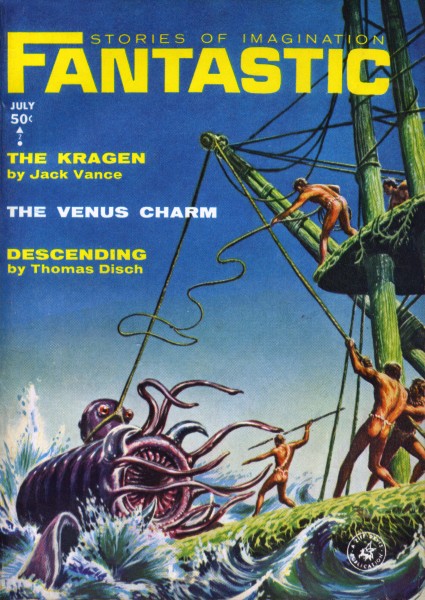


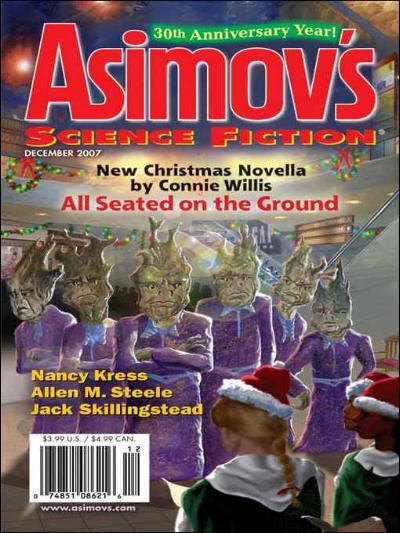
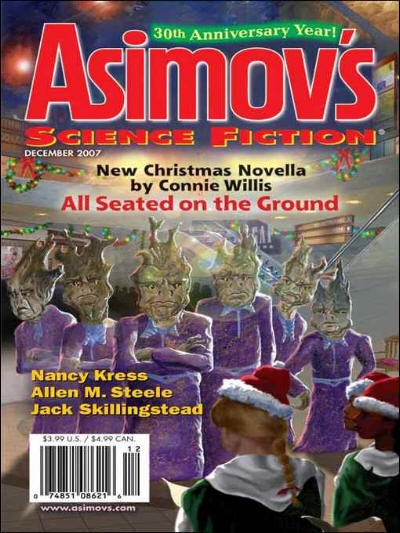
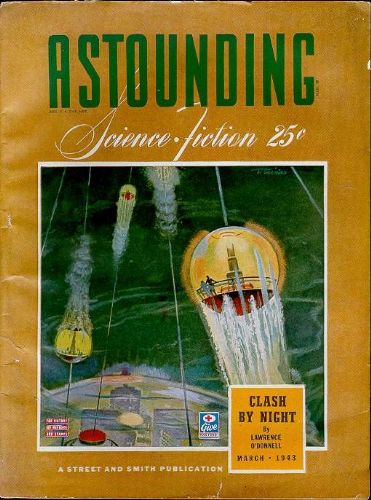

 Science Fiction & Fantasy Remembrance