(Cover by William Timmins. Astounding, March 1943.)
How’ve you been? I’ve been not great. Long story short, October was a rough patch for me; there were a couple weeks in there where I didn’t even enjoy working on this blog. It sucks, because one of the reaons I started SFF Remembrance was I thought it would be therapeutic, and it usually is! But it’s not 100% guaranteed to work. Now, despite not having to write about any longer works, October was also a busy month for me, partly because of work but also it was my own fault. For the past several years I’ve done a month-long movie marathon in October and I’ve been continuing that tradition, even with the extra workload of this blog.
I ended up getting a sleep med prescription, since I had a really awful bout of insomnia combined with depression there. Anyway, good news is we’re back to our regularly scheduled programming. Last month was focused on horror and weird fiction, but for November we’re returning to pure uncut science fiction from start to finish. I like to write about short fantasy since it’s a field that my colleagues are not prone to covering, but science fiction is my home turf. We’ve got a mix of names I’ve covered before with a few newcomers, and in one case someone who has only been active for the past decade. I know my tastes skew towards the classics, but I do like to go out of my way to cover new voices in the field at timess.
Let’s see what’s on my plate.
For the serial:
Falling Free by Lois McMaster Bujold. Serialized in Analog Science Fiction, December 1987 to February 1988. Bujold is tied for the most Hugo wins for Best Novel (although Heinlein has the lead if we count Retro Hugos), and she also won a Nebula for Falling Free. Aside from the award-winning novella “The Mountains of Mourning” I’ve not read any Bujold, which shames me because I can tell she’s not your average writer of space opera and military SF. This novel, a fairly early effort from Bujold, is set in her incredibly vast Vorkosigan universe, which includes the aforementioned novella as well as the Hugo-winning novels The Vor Game, Barrayar, and Mirror Dance.
For the novellas:
“A Man of the People” by Ursula K. Le Guin. From the April 1995 issue of Asimov’s Science Fiction. Possibly the most universally respected of all modern SF writers, Le Guin emerged in the ’60s as a writer of immense depth and humanity. Her crowning achievement, at least when taken collectively, is the Hainish cycle, which includes The Left Hand of Darkness and The Dispossessed. Le Guin put the series on hold in the mid ’70s but made a grand return to it in the ’90s, with “A Man of the People” being set in that universe.
“Clash by Night” by Henry Kuttner and C. L. Moore. From the March 1943 issue of Astounding Science Fiction. Retro Hugo nominee for Best Novella. The power couple of old-timey SF, Kuttner and Moore started out alone (both, incidentally, debuting in Weird Tales) before meeting up, marrying, and writing prolifically together. They were so prolific in the ‘40s that they employed a few pseudonyms, with Lewis Padgett and Lawrence O’Donnell being the most popular. With some exceptions it’s up to guessing as to who wrote what.
For the short stories:
“Everquest” by Naomi Kanakia. From the October 2020 issue of Lightspeed. This has the honor of being the most recent story I will have covered for my blog so far. When it comes to literature I prefer to wait at least a couple years for something to ripen, don’t know why. Anyway, Kanakia is a trans Indian-American writer, one of many colorful new talents to have come about in the 2010s. And yes, the title is very much a shoutout to the MMORPG of the same name.
“Angel’s Egg” by Edgar Pangborn. From the June 1951 issue of Galaxy Science Fiction. I’ve read a couple of Pangborn’s novels, each showing a unique and warm-hearted writer who would’ve stuck out in the ‘50s. A Mirror for Observers won the International Fantasy Award while Davy was up for the Hugo (losing to Fritz Leiber’s The Wanderer, ugh). “Angel’s Egg” was Pangborn’s first short story, which is fitting because it’s also my first time reading him at short length.
I recommend checking out the short stories in advance since it’s pretty easy to do so; they’re both readily available online.
When you think of cyberpunk the first author to come to mind is almost certainly William Gibson, who didn’t invent the subgenre but very much codified it with Neuromancer; after that it becomes a bit of a free-for-all. Cyberpunk goes back to the ’70s, before Gibson started writing in earnest, and you can even see inklings of it in the late ’60s, perhaps most profoundly in Samuel R. Delany’s Nova and Philip K. Dick’s Do Androids Dream of Electric Sheep?, which both have cyberpunk-y elements. But as far as the heyday of cyberpunk goes the author maybe most cited who is not Gibson would be Bruce Sterling—despite the fact that much of what Sterling has written has not been cyberpunk. It could be that Sterling is not as popular as he should be because he’s such a versatile writer, covering seemingly every subgenre under the sun and even ssometimess venturing into fantasy, all while retaining a certain attitude you’d expect from someone who grew up in Austin. He’s a bit of a punk like that.
1985 was a pretty good year for Sterling that also showed off his range, with the vicious short story “Dinner in Audoghast” (alternate history), probably his most popular novel with Schismatrix (space opera), and today’s story, which is………. arguably cyberpunk. “Green Days in Brunei” has a few hallmarks of the subgenre but would nowadays be more likely classified as solarpunk than straight cyberpunk. The “green” of the title refers to money but also green energy. I’ve been on a streak with the past few novellas I’ve covered (not counting serials) and the streak continues here, as this story is pretty cool. It has naught but the skeleton of a plot but it’s a story that much more hinges on characters and speculations about the future.
Placing Coordinates
First published in the October 1985 issue of Asimov’s Science Fiction, which is on the Archive. I actually have a physical copy of this issue, but it’s easier to copy lines of text off a PDF. I ended up with six pages of “notes” for the damn thing, because Sterling packs a lot into this novella. It was then reprinted in Gardner Dozois’s The Year’s Best Science Fiction: Third Annual Collection, which unlike a few of the other early volumes you can find for reasonable pricess online. (Don’t try to collect the first volume unless you have money to burn.) It was later reprinted in the Sterling collections Crystal Express and Ascendancies: The Best of Bruce Sterling.
Enhancing Image
Turner Choi is a Chinese-Canadian twenty-something working officially as an engineer in what is set to be a robot shipyard in Brunei, a very small country on the island of Borneo; unofficially he’s also a computer hacker, although given the limited means he’s not able to do anything fancy. The shipyard in question is supposed to become fully automated, bringing industry back to Brunei with minimal human labor. Brunei is smaller than a lot of American cities, with Brunei Town itself housing only a hundred thousand people, with basically nothing to indicate it as standing in the 21st century. “No cars. No airport. No television.” It’s circa 2020 and a second oil crisis in the ’90s sucked out what little industry the country had before. Now it’s kept afloat with a very small pocket of money—an aristocracy that can almost fit on the head of a pin.
Said aristocracy, however, made a deal with Kyocera, a Japanese corporation (it’s not the ’80s if the Japanese aren’t depicted as economic juggernauts), and that’s where Turner comes in. It’s Turner’s first big job and it might be the toughest he’ll ever deal with, as he and his crew are basically expected to turn shit into sugar. The robot factory for the shipyard is condemned and has been untouched for two decades. This would not be such a problem if not for Brunei’s lacking in metals, never mind that Turner has to do some hacking on the sly to access what we might now call the internet—although here it’s basically just email and chat rooms. His Bruneian contact is also someone not easy to get along with—that being Jimmy Brooke, a former British rockstar, a “deaf, white-haired eccentric,” who came to Brunei years ago and never left. Brooke is curious, as for one he’s the only white character of importance in the narrative, but we’ll elaborate on him later.
There are only a few main characters, the last of these being Seria, a young woman who piggybacks off Brooke’s antics and who is, as it turns out, the sultan’s (rebellious) daughter. Turner hits on Seria one night and it does not occur to him fast enough that getting in with a literal princess might not be the best idea. In terms of personality Seria might be the best character, despite only existing in relation to the men in her life, including Turner, Brooke, her brother (who is mostly offscreen), and her rich dad (who is kept entirely offscreen). Turner and Seria hit it off despite the former looking a little ridiculous with his lumberjack jacket and knee-high boots that his mom bought for him. If not for his Chinese heritage, Turner would look like the typical white Canadian, perpetually gloomy from having lived in Vancouver—which hey, at least it’s not Toronto. In fairness to Turner, his personal life before coming to Brunei was a bit of a mess.
Where to start?
The shadow hanging over Turner throughout the story, aside from the stress of satisfying his employer, is the fact that he and his brother Georgie are kin to a real bastard: Grandpa Choi, now elderly but who back in the ’70s gained infamy as a corrupt cop in Hong Kong. The combined financial success and public scandal of Grandpa Choi seemed to have disastrous results for Turner’s dad, who sank into alcoholism and met an untimely death prior to the story’s beginning. We also find out that Turner’s old college girlfriend (having been separated for a few years now) is a barely functioning drug addict, and the one time we get an interaction between them is pretty uncomfortable. Turner is a classic rebellious hero, especially in the context of cyberpunk, being a romantic who is also trying to escape his past. The little computer shenanigans we see are framed romantically, both in how Turner’s l33t haxing powers are romanticized and how the romance between Turner and Seria is intensified through online messaging.
Something that caught my eye was how Sterling seemed to understand, even in this early period, how online messaging affects relationships differently from in-person talking, be they romantic or otherwise. When communicating via text you open a door to your inner consciousness that would normally be closed when talking with your mouth. Get a load of this passage describing the escalation of Turner’s relationship with Seria and how their texting only heightens their sense of intimacy:
Turner realized now that no woman had ever known and understood him as Seria did, for the simple reason that he had never had to talk to one so much. If things had gone as they were meant to in the West, he thought, they would have chased their attraction into bed and killed it there. Their two worlds would have collided bruisingly, and they would have smiled over the orange juice next morning and mumbled tactful goodbyes.
I need to read up more on what would’ve been computer culture when it was in its infancy. Sterling is known for his fiction, but he has also written extensively on the history of computing and the hacker subculture that spawned from it. 1985 sounds almost impossibly old for discussing such a topic, but remember that Steven Levy’s Hackers: Heroess of the Computer Revolution was published in 1984 and Sterling certainly would have known about it. One of the few quibbles I have with “Green Days in Brunei” is that it falls for what was then the common trap of framing hackers as heroic, noble figures—a pill that would be harder to swallow nowadays. While Turner is written as flawed, with his pride certainly getting in the way, Sterling doesn’t question the nobility of his illicit hacking in contrast with the shadowy bureaucracy of the Bruneian government. That Turner’s antics ultimately do much good might stretch the modern reader’s suspension of disbelief, but then its optimism is overall well-founded.
Turner has fallen in love, which dramatic purposes usually is something that results in disaster—or at the very least conflict. Which it does, as it should. It started as a job he would do before returning to Canada, but now he has a reason to stay in Brunei; mind you, it won’t be the only reason. Sterling makes the most of tropes that nowadays might read as predictable, even going to some lengths to justify the contrivances in the plot. Turner and Seria meeting is highly unlikely, sure, but given the small population it’s not as unlikely as if they were to meet in New York. Even the laughably outdated technology is justified by the fact that Brunei is a backwater, both from lack of industry and deliberate political choices. The Green Party (no, not that one), while kneecapped by the aristocracy, has worked to turn the country into almost one big greenhouse.
Turner, Seria, Brooke, and later Dr. Moratuwa (more on him in a minute) fit into archetypes that will be familiar to cyberpunk fans, but who are elevated above their archetypes through some pretty sharp dialogue. Would “Green Days in Brunei” have benefited from being written by a Chinese or Malaysian author? Maybe. The problem is that Sterling manages to be (somehow) both idiosyncratic and a bit of a chameleon. You can discern a Sterling story by how it’s written, but his willingness to tackle different zones of interest with ease makes it so that while you can try to emulate Sterling’s style, you would be hard-pressed to actually pull it off. I would would say the novella shows its age, given how easy it is to indulge in exoticism with former colonies (this is, after all, a post-colonial narrative), Sterling manages to be sensitive and forward-looking enough that it doesn’t read as exploitative; rather it reads as coming from someone early enough in their career that they’ve honed their skills and have not yet turned reactionary.
There Be Spoilers Here
Despite his appearance and rock-and-roll lifestyle, Brooke knows more about the workings of Brunei than he lets on—even saving Turning when the latter stumbles upon a political prison. It’s here that we meet Dr. Moratuwa, a decrepit former activist who still has some fighting spirit in him; being a devout Buddhist probably helps. It’s also here that we find out the true purpose of the robot shipyard, which is to construct primitive but robust rowboats that can cross the seas without need for electricity. In a way, although Turner’s employer isn’t aware of it, the purpose of the robot shipyard is to bring back the age of sailing—using modern technology to produce ships that are made of simple materials and which anyone with at least one arm can work. And the plan will work, so long as Turner does his job.
But then a wrench gets thrown into the whole thing: Grandpa Choi is on his deathbed. Not that Turner and Georgie have any love for the old man, and indeed in the one scene where Grandpa Choi talks she shows himself to be a real asshole, but it’s during this argument between Turner and his elder that Grandpa Choi, in a moment of devilish joy, reveals that Turner is set to inherit the old man’s considerable (and blood-drenched) fortune. Our romantic leads have now both come to a crossroads, wherein Turner wants to abandon his inheritance and Seria wants to give up her title. The rich suffering a case of conscience and giving up their wealth for the good of the world is a major point here, even given metaphysical significance when Moratuwa says, “Buddha was a prince also, but he left his palace when the world called out.” If only the rich in the real world were capable of feeling remorse or empathy. It thematically ties things together, but our leads’ decision to abandon their wealth in favor of the Green movement is probably not a conclusion a more jaded writer would read—which doesn’t stop the ending from feeling genuinely triumphant.
Sterling makes a few points by way of characters clearly speaking for him, and if I were to go over then one by one we would be here all day. This is a tightly packed narrative that feasibly could’ve been expanded into a novel (add a couple subplots and you’re set), but I much prefer single-minded works like this that are easier to reread. No doubt I’ll only enjoy it more when I eventually get around to it a second time.
A Step Farther Out
I’m not sure if the ending rings as true now as it did back then; at the same time, with the growing prominence of hopeful SF (specifically narratives which speculate on alternatives to capitalism in the future), said optimism may be prescient. I don’t know if the Sterling of today would’ve written this story, because it strikes me as being written by someone who wasn’t much older than the main characters, and who hadn’t yet been broken down by the harsh reality of genre publishing—never mind that it was written before the horrific consequences of the Reagan years fully sank in. “Green Days in Brunei” reads more like a reaction to the oil crisis of the ’70s than the austerity politics of the ’80s, but its attempt to reconcile modern technology with green energy is admirable. It helps that this is about as sincere as Sterling gets, rivaling only that great “romantic gesture” of his, “Dori Bangs,” which might still be my favorite.
While he didn’t write bestsellers, Damon Knight had a pretty substantial impact on the direction American SF would take in the ‘60s, as author, critic, and especially editor. He started out as a critic in the ‘40s—one of the first serious book reviewers in the field—before trying his luck at short fiction. After all, a critic who can practice the art he criticizes has more legitimacy—at least to cranky writers who can’t take criticism. But Knight was pretty good at the short story thing, and nowadays that might be what he’s most known for, although his Orbit series of original anthologies was seminal in promoting the New Wave.
In the ‘40s and start of thr ‘50s Knight wrote some memorable shorts that very much operated in the O. Henry mode (see “To Serve Man”), but as the ‘50s progressed he grew more ambitious. “The Earth Quarter” struck me as maybe being a more substantial effort from Knight—an assumption that proved correct. This is one of the best SF novellas from the ‘50s that I’ve read, not just from the ingenuity of its plot but its depth of character and subtlety of implication. Knight gets a remarkable amount of work done in just under 20,000 words while also giving us one of the few truly anti-Campbellian narratives at a time when readers still treated John W. Campbell like he worked miracles. It’s a subversive and nasty little piece of work, but it reflects a humanism that was not too common in magazine SF then.
Despite its outstanding quality “The Earth Quarter” is a fairly obscure novella, which is why I was stunned to find that I’m not even the first person this month to have reviewed it. James Wallace Harris covered “The Earth Quarter” exactly a week ago for his site, in succinct and enlightening fashion. With that said, he did call it an immensely cynical work and I don’t think “cynical” is the right word here. I do think Knight wants to believe in the good of humanity, but, at least in this story, humanity’s optics are quite bad. It’s a story about the futility of racial supremacy—explicitly human supremacy and, more implicitly, white supremacy.
Placing Coordinates
First published in the January 1955 issue of If, which is on the Archive. Knight later expanded “The Earth Quarter” into a longer novella, “The Sun Saboteurs,” and you’re more likely to find that longer version in book form—made more confusing because that longer version would also be printed under the original (and better) title. Good news is that if you wanna read the original you can do it free and easy on Project Gutenberg, since apparently Knight cared little enough for the original version to let it fall out of copyright. “The Earth Quarter” being in the public domain actually gives me a fun idea, as I will eventually explain.
Enhancing Image
First a word about the circumstances under which this review is being written. It’s Saturday the 9th as I’m writing this and my laptop is still at the repair shop; therefore I’ve had to work on this site via suboptimal means. Unfortunately I don’t have the leisure to write to my heart’s content here, which is a shame because a lot can be said about “The Earth Quarter” and I’ll have to keep things concise—by my standards. I know that won’t mean much if you know me.
Anyway…
Good news: Mankind has not only voyaged out to the stars but come into contact with multiple intelligent alien races. Bad news: Earth itself is now little more than a dustbowl, with those left on the planet living almost like cavemen. Those who journeyed out to space aren’t doing a whole lot better, with little pockets of humanity scattered across planets owned by more advanced alien races and relegated to ghettos. Man has come to find that he is, in fact, at the bottom of the galactic food chain, more being allowed to live on other planets than to own that right.
This brings us to one of these ghettos, the Earth Quarter, “sixteen square blocks, about the size of those of an Earth city, two thousand three hundred human beings of three races, four religions, eighteen nationalities,” under the supervision of the Niori, a docile and bug-like race who nonetheless hold a metaphorical sword over the human refugees. We only see the Niori once and they’re not directly involved in the plot really, but Knight uses them as an example of how alien life can be akin to angels in relation to humanity. This is a story about humans, but I don’t think the point would quite get across if aliens were kept totally offscreen.
We’re introduced to Laszlo Cudyk, a local trader, thoroughly middle-aged and not one to take action himself; actually he’s almost as passive a protagonist as you can get, which normally would be a negative except that Cudyk’s passiveness is very much part of his character—his internal conflict. Cudyk claims to be neutral in a deeply political situation, between those who want to continue living in the Quarter, those who want to return to Earth, and those who want war with the Galactics, but he is ultimately a man at war with himself.
As for taking sides, we have two passionate and charismatic figures, both of whom have radical visions but with very different goals. On one side we have Harkway, who wants to gather people together and rebuild a fragment of civilization on Earth, “a liberal fanatic” as Cudyk calls him—I have to suspect with a bit of irony. In the opposite corner we have “Captain” Rack, a military veteran who clings to his rank despite Earth’s Space Navy having been defunct for two decades. Rack is the story’s villain, and he and his devoted underlings wanna rebuild Earth’s capacity for war—in this case war with the aliens. Not just galactic war but, Rack hopes, extermination of what he repeatedly calls “vermin.”
Let’s stop and think about how we actually don’t have a lot of great villains in old-timey SF. Sure, you have the Mule in Foundation and Empire and Baron Harkonnen in Dune, and if you want a more recent example we have Tomas Nau in A Deepness in the Sky; but pre-2000 SF doesn’t offer much in the way of great individual baddies. SF is more keen on abstractions and systemic terrors, such as tyrannical governments (consider that Big Brother is an iconic idea, but not an actual character), than flesh-and-blood people as antagonists. Had “The Earth Quarter” been a novel I think people would recall Rack as one of the great SF villains, because he such a delicious piece of shit.
Rack is a Jack London-esque figure in that he is charismatic, courageous, larger-than-life, a stone-cold adventurer—and also a violent racist. (London himself thought it a swell idea if whites could exterminate the Chinese and take their land.) Had Rack been in a story written for Astounding he would very likely be the protagonist, but here Knight shows us what a mad bastard like Rack would sound like from an outsider’s perspective. And yet, as Cudyk notes, Rack is technically not without redeeming qualities, for while he is several things, he is certainly not a coward. What makes him an effective villain is that while he is delusional and a genocidal maniac, he can also convince people to do his bidding—even murder those he deems his enemies.
Not that Knight was opposed to submitting to Astounding, as he did just that several times, but it’s clear that it was far from his go-to outlet and that this likely had to do with his ideological opposition to Campbell, who by the ‘50s had only become more of a reactionary. Astounding sort of leaned conservative really since its inception, but that conservatism became more pronounced when left-leaning alternatives (namely Galaxy and F&SF) entered the field, so that with exceptions it gained a reputation as a right-wing stronghold. “The Earth Quarter” reads like a reaction to a specific brand of SF that appealed to Campbell, that being SF which was overtly pro-human and/or pro-military. This reads as obvious now, but it must’ve been doubly so for those in the know at the time. The meaning behind Rack’s characterization is hard to misconstrue.
So the inciting incident of “The Earth Quarter” is Harkway making a speech about his vision for the future at what amounts to a town hall meeting, with Rack and his goons waiting in the wings. Cudyk and Seu, the “mayor” of the Quarter, try to keep Harkway from putting himself at risk, but it’s implied that Harkway has a death wish—that he wants to become a martyr for his cause. He almost gets what he wants, but one of Rack’s goons, in a moment of conflicting loyalties, spares him—if only tenporarily. Hours letter, Cudyk finds Harkway, slain, his face literally in the gutter. Denied a public death, Harkway’s absence allows Rack to make his move.
Before I get to spoilers I do have a few more notes to make, including a couple negative criticisms. Just some quibbles. At one point early on Knight describes one of the Chinese characters in racist language, which is a little puzzling since Knight was not a racist and he would’ve been well aware of how East-Asians have historically been denigrated as akin to rats, never mind that it slightly muddies the story’s anti-racism message. There are also no active female characters, with the single woman of any plot relevance, Kathy Burgess, only getting a line or two in and more acting as symbolism than as a character. This is a far-future tale, but gender relations are still very much of the ‘50s and the men are the people who get to do things.
On a more positive note, while descriptions of the Quarter are sparse, Knight crams in a few telling details, such as signs being in both English and Mandarin since the first humans to live in the Quarter were Chinese. While the main characters are mostly white, Knight makes it clear that this is a multi-ethnic community where people are stuck in the same boat. You could expand this short novella into something longer, as Knight would do eventually, but aside from fleshing out side characters I don’t think expansion would improve it much. This is a tightly packed narrative that knows its limitations and works almost like a stage play, which got me thinking…
Harris said that “The Earth Quarter” could work as an old-school film noir, and on a moderate budget since we stay in more or less the same location the whole time and there’s very little action. I agree, but I would go one step farther and say “The Earth Quarter” could be very feasibly adapted for the stage, to such an extent the novella as-is almost reads like a play written in prose already. Aside from Cudyk’s internal monologuing (which admittedly does add a lot to the narrative, but that can be worked around) you would lose nothing substantial by setting the action on a stage.
There Be Spoilers Here
I’m not a fan of the title “The Sun Saboteurs,” for one because it gives the vague impression that this is an action narrative, which it’s not; but it also hints at a plot development that becomes the story’s crisis point. Rack, having gathered enough followers and off-world connections via the black market, hopes to sneak off-planet and lead a fleet of human ships on what would surely amount to a suicide run. That Rack wants ti do battle with the Galactics is not even the worst part—it’s the fact that he has a nuclear weapon, a “hydrogen-lithium” bomb that, if thrown into a sun, would spark a chain reaction and kill a whole solar system.
The sun-bombing plot is the closest the novella gets to pulpy, and yeah, it’s a bit silly, but as a takedown of Campbellian militarism it makes sense. There’s realistically no way that Rack can restore humanity’s supposed former glory by doing this, but that’s not gonna stop him from taking down billions of intelligent beings with him. Luckily the plot is foiled as not only is the human fleet outgunned, but the Galactics have deployed nonlethal means which the humans could not have anticipated. We’re told all this after the fact, in a rather lengthy expository monologue from Rack. It’s clumsy, but if taken as part of a dramatic play it makes more sense to have us told about this far-off action than to be shown it.
The defeated and battered Rack will not stay down for long, though, and in a last ditch effort he tries recruiting men in the Quarter. The men have none of it. Rack almost gets away, but in a moment of stark conscience Cudyk finally makes a firm decisions and throws himself in Rack’s way, preventing his escape from the mob—and guaranteeing a violent death.
Upon regaining consciousness, Cudyk gets updated by Seu on the mob quite literally tearing Rack apart, and it’s implied that despite his civil demeanor Seu was one of those who played a direct part in Rack’s lynching. “There was a thin film of blood on the skin, and a dark line of it around each finger-nail.” Now isn’t that a lovely little nugget of show-don’t-tell? But the victory is a Pyrrhic one, as the Niori are evidently disgusted by the lynching and order the Quarter shut down, putting the humans on ships back to their ruined home world.
The ending is pretty bittersweet. Cudyk considers the irony of how, had he not been struck by conscience and stuck to his vow of neutrality, Rack would’ve very likely been taken in by the Galactics and the Quarter would’ve been allowed to persist. But then maybe this was a necessary push, for while life was possible in the Quarter, change was not. Life on Earth will be hell, but then maybe… Harkway will get what he wanted. Of course that’s an optimistic reading of the ending; it’s possible Knight intended the lights going out in the Quarter to represent a spiritual defeat for humanity.
But one can hope.
A Step Farther Out
A claim has often been made, even by people who know better, that SF was lacking in social awareness prior to a certain point in history (when that point would be is anyone’s guess), and this is obviously hyperbolic. Sure, SF—especially magazine SF—was not constantly turning out think pieces about racism and labor rights in the ‘50s, but the lack of social commentary only hits one’s nostrils if one takes everything literally; on an allegorical level there was quite a bit of social commentary going on, with a lot of left-liberal authors making their points under thin veils of symbolism and implication. With that in mind, “The Earth Quarter” succeeds as a gripping narrative, but it’s also a success as social commentary.
It’s now September, or as I like to think of it, the month before October. Yeah, I don’t have anything special in mind for this. Summer is about to end, the kids have gone back to school, and I’m about to head back to work as I’m finishing up this post. As has become typical I’ve toyed around with what I’m gonna review repeatedly, right up to the last minute, because I cannot make up my damn mind sometimes. There’s so much fiction, especially short stories, to cover that I’m constantly going, “Hmm, I wanna check this out. But ohhh, what about THIS?” Much as I want to at times I can’t do everything I want in a day. I’m a slow reader and I don’t give myself the heavy loads of someone who gets paid for review columns.
Speaking of making a good use of your time, I recommend subscribing to a few SFF ‘zines; doesn’t matter too much which ones, although I’m biased and I think Uncanny Magazine and Lightspeed are very much worth supporting. Even buying the latest issues of The Big Three™ (Analog, Asimov’s, and F&SF) would be a much better use of your time and money than a no-good piece-of-shit (HBO) Max subscription.
Apparently Analog and Asimov’s now have their own digital subscription services, to compensate for the Amazon bullshit, so that’s great honestly. Not sure what F&SF is gonna do since, with all due respect, of The Big Three™ they’re the ones most “behind” with regards to adjusting to changing market forces. We’ll see what happens there.
So what reading materials do we have?
For the serials:
The Reign of Wizardry by Jack Williamson. Serialized in Unknown, March to May 1940. From a historical perspective, Williamson has to be one of the most intriguing figures in American SFF, debuting in 1928 and more or less remaining active until his death in 2006. At his best he also proves to be one of the most gripping and thoughtful “Golden Age” authors. The Reign of Wizardry was Williamson’s first attempt at writing fantasy that was not in the Weird Tales mode.
The Chronicler by A. E. van Vogt. Serialized in Astounding Science Fiction, October to November 1946. In the ’40s and early ’50s van Vogt was a star among genre readers, about on par with Robert Heinlein and Isaac Asimov—only since then his popularity has waned massively, for several reasons. A direct precursor to Philip K. Dick (by Dick’s own admission), van Vogt’s influence on the field is still discernable but now understated. He remains a divisive figure.
For the novellas:
“The Earth Quarter” by Damon Knight. From the January 1955 issue of If. As author, editor, and critic, Knight did much to bridge the gap between ’50s SF and the New Wave, with his Orbit series proving the viability of original anthologies. But in the ’50s he was one of the finer short story writers, with such classics as “Four in One” and “To Serve Man.” “The Earth Quarter” was later revised for book publication, but we’ll be reading the magazine version.
“Green Days in Brunei” by Bruce Sterling. From the October 1985 issue of Asimov’s Science Fiction. Probably the most important writer of cyberpunk whose name is not William Gibson, much of Sterling’s work is actually not cyberpunk—at least in content. If Gibson codified the tropes that would define the movement, Sterling codified the attitude of cyberpunk, emphasizing the “punk” half of that word. Will be one of two Sterling stories I review this month.
For the short stories:
“Forever to a Hudson Bay Blanket” by James Tiptree, Jr. From the August 1972 issue of Fantastic. Real name Alice Sheldon, Tiptree was one of the thorniest authors to come out of the New Wave, being much discussed for the outward feminism (and pessimism) of her work, the mystery of her true identity, and the tragic circumstances of her death. Tiptree made waves in the early ’70s, but I’m going for a relatively obscure story from that period.
“Wong’s Lost and Found Emporium” by William F. Wu. From the May 1983 issue of Amazing Stories. Surprisingly, given how obscure a name he is, this is not my first time reading or even reviewing Wu. He must’ve been one of the first Asian-American authors to partake in magazine SFF, and yet he remains to be rediscovered. This story, for one, was up for the Hugo, Nebula, and World Fantasy Award, and it even got turned into a Twilight Zone episode.
Next month is when we’ll be doing all short stories and all spooky shit, so be on the lookout for that. In the meantime my review schedule is pretty normal and I assume nothing will be replaced last-minute.
Well, we’ve been bamboozled again. I was gonna write a review of A. Merritt’s 1932 novel The Dwellers in the Mirage, but I basically fizzled out halfway through reading that novel; not that it was a bad read, it was more that somehow the timing did not seem right. I was struggling with Jack Williamson’s The Reign of Wizardry at the same time, a novel whose opening stretch is rather tough going, and reading both at the same time with a deadline in mind wearied me. Whereas the Williamson serial did pick up steam in its second half, giving me the energy to persist, I kept putting Merritt’s novel off and on, until I realized I probably wouldn’t have it finished in time. I’ll cover Merritt someday (considering his influence on other writers and how nearly everything he wrote appeared in the magazines), but I found out first-hand that sadly today will not be that day. Thus a shorter alternative was needed.
One thing I said in my review forecast was that only the novellas covered this month would be science fiction, and that remains true because we’re talking about a novella today that is very much science fiction. “Beyond Bedlam” had been in the back of my mind for a minute, because it apparently encapsulates what made the early years of Galaxy so unique and so ahead of the competition. Truth be told I thought “Wyman Guin” was a pseudonym at first, because it sounds like one. Guin did debut in the field under a pseudonym, but then started using his real name; maybe he was hesitant to do that as he already had a respectable day job. Anyway, he didn’t write much, but it was enough to earn him the Cordwainer Smith Rediscovery Award. “Beyond Bedlam” marked Guin’s first story under his own name and it remains his most well known.
Placing Coordinates
First published in the August 1951 issue of Galaxy Science Fiction. It’s been anthologized a few times, as well as collected in Beyond Bedlam, which has all of Guin’s short fiction; sadly these are all out of print, although the latter has an e-book edition. Good news is that you don’t even have to pay to read it in an unambiguously legitimate fashion, as it fell out of copyright and is available on Project Gutenberg.
Enhancing Image
(Before we get into the thick of it, be aware that “Beyond Bedlam” discusses mental illness at length in terms that are outdated; not that the language Guin uses is insensitive, but rather that our understanding of mental illness has, like everything else about ourselves, advanced massively since 1950. For the sake of staying consistent with the story, and for my own sanity, I’ll be referring to the condition described in-story as schizophrenia, even though it’s actually recognized as a different condition today.)
Sharpen your pencils, because class is in session.
It’s the 29th century, and things are… a little different. Sure, we have some future tech that one would expect in old-timey science fiction about “the future,” but the technology is not the focus of the story. No, the people have changed far more radically than the tech. We start out in a classroom, with Mary Walden, who is not the protagonist but who will eventually figure profoundly into the central conflict. Thing is, Mary is only half a person—or rather she’s a whole person, but only gets to use the body she’s in half the time. She shares her body with a filthy brat named Susan Shorrs, whom Mary knows nothing about other than she leaves the body shared with Mary in rough shape whenever the “shift” happens. The problem is that Mary is a schizophrenic, which is actually not a problem because so is everybody else. Schizophrenia, a mental illness that was very much frowned upon by “the ancient Moderns” (i.e., us), became more acceptable in the 20th century once psychiatric drugs started developing and became more accessible, not only treating schizophrenics but ushering them into normal society. “The drugs worked so well that the ancients had to let millions of schizophrenic people out from behind the bars of ‘crazy’ houses. That was the Great Emancipation of the 1990s.” After several generations schizophrenics were so entrenched in normal society that they actually started to outbreed non-schizophrenics, and because the Medicorps (mind the “the”) developed a monopoly on psychiatric drugs, and because said drugs became so accessible, schizophrenics soon had to take their drugs as mandated by law. Cut to 900 years later and you have a society (at least in the US, as we learn shockingly little about life outside of it) where everybody (with exceptions, who are themselves now pariahs) is a functioning schizophrenic. The “normal” person is now a body housing two totally separated and autonomous personalities, each in effect a whole person.
I mentioned earlier that Guin had a respectable day job that did not incentivize him to write fiction prolifically; more specifically he was a pharmacologist and advertising executive, so you bet he knew a thing or two about the latest in psychiatric medicine. The strange result is that the premise of “Beyond Bedlam” is patently ridiculous and whose foundations are a little shaky if you go asking too many questions, but for what the story asks of itself it is remarkably internally consistent. Basically, it works off assumptions made in 1950 (so when Guin wrote the story) about how people suffering from mental illnesses like schizophrenia seem to be growing in relation to the general populace. We know of course that as psychiatry has advanced by leaps and bounds that people with mental illness do not necessarily take up a greater percentage of the population, but that doctors have been able to diagnose people with greater understanding, never mind empathy. It’s a fallacy, but it’s necessary in presenting a distant future society wherein the “lunatics” have literally taken over the asylum.
(I could go on for a long fucking while about how this story’s setup clearly anticipates some of Philip K. Dick’s works regarding mental illness [Clans of the Alphane Moon, Martian Time-Slip, and A Scanner Darkly especially], but I won’t, becaue believe it or not I do value your time. I would just be shocked if Dick didn’t read “Beyond Bedlam” when it was first published as it very much reads as proto-Dickian, and also it’s great.)
So how does this work? You have, say, 10,000 bodies in a town but effectively 20,000 people running it. We’re told that historically there have been bodies with three or even four personalities, but while the word “eugenics” isn’t used, it’s made clear that these abnormal schizophrenics have been weeded out, or at best incentivized to not reproduce. A society wherein you have two personalities for every body would present enough of a problem, so it only stands to reason that more would be worse. People are forced into five-day shifts wherein each personality takes over for that duration, followed by a day of rest, between a “hyperalter” and “hypoalter.” The hyperalter is the so-called dominant personality that can, if they really want, interfere with the hypoalter’s consciousness, even invading their dreams. As such, on top of the drugs taken for compartmentalizing personalities, people are also required to take a “sleeping compound” that’ll prevent hypoalters from dreaming and thus risk invasion from their hyperalters.
The system in place to keep people’s lives in order is regimented and also imperfect, which is where the plot comes in; but we’re not quite there yet. “Aren’t you gonna get the plot already?” Soon. The thing about “Beyond Bedlam” is that the plot itself is straightforward, at least when put up against worldbuilding this dense. It’s like when people talk about Stand on Zanzibar but rarely discuss its main storyline; it’s because we all know the real meat of both of these works is in the background, and I do think “Beyond Bedlam” approaches that level of density. H. L. Gold’s editorial for this issue of Galaxy focuses pretty much entirely on “Beyond Bedlam” and how Guin went about writing it, and with good reason. Not only is this a first-rate story, but it probably could not have materialized in the way it did without the intense back-and-forth between Gold and Guin in refining it. Gold is unclear if Guin always intended this to be a novella, but he says that, with his help, Guin revised and rewrote “Beyond Bedlam” a couple times each, going through 80,000 words of drafts. The effort was worth it; this is a three-dimensional depiction of possible life in the future.
Now for the plot…
Mary is the “assigned” child (as people are not raised by their birth parents) of Bill and Helen Walden, who seem to lead a decent middle-class life, except for a couple things. For one, Bill and Helen’s alters, Conrad and Clara Manz, are also married to each other, which it turns out is very much out of the norm. “Such rare marriages in which the same bodies lived together on both halves of a shift were something to snicker about.” Conrad, being the hypoalter, knows that Bill has been “cheating” by messing with Conrad’s shifts for a few hours, but what Conrad does not know is that Bill has been having an affair with Clara, whom as you know is Helen’s hypoalter. Now, monogamy is not taken too seriously in this future society; people have affairs pretty casually, and the Waldens and Manzs are chill about messing around behind each other’s backs. The problem is that Bill is not only messing with a hypoalter (hypers and hypos are kept strictly apart, and never the twain shall meet) but his own alter’s spouse.
What starts as Bill and Clara worming their way around regulations to have their meet-and-fuck sessions soon snowballs into Bill jeopardizing both his own “life” and Conrad’s, both physically and by tempting the wrath of the Medicorps. This is all made worse by Mary becoming depressed and fed up with being neglected by her parents, causing her to break a different taboo by tracking down Conrad and Clara. Having the story start with Mary is sort of misleading since she only appears sporadically, but the classroom setting at the beginning gives us a healthy dose of exposition while also establishing how people in this future might want to break out of their regimented relationships with their alters. Since this is a strictly drug-induced culture, it’s also emotionally stifled, with the positives being that war is apparently a thing of the past (again, at least for the US) and crime seems to have gone down massively. The result is a more peaceful but also less free society where even one’s emotional spectrum is narrowed.
There Be Spoilers Here
The outcome is not surprising. Bill gets caught and put on trial by the Medicorps for a gross breach of conduct, with a guilty verdict resulting in either hospitalization for life or “mnemonic erasure,” i.e., death of the personality. If you’ve read a few dystopian narratives in your time then you’ve been here before, and you also know that Bill has to lose—to play the role of Winston Smith and John Savage. Yet even during what would normally be a been-here-done-that sequence in a dystopian narrative (the third-act breakdown of the rebellious hero), Guin once again shows off the wonderful density of the world he’s made. Mnemonic erasure will affect Conrad’s life almost as profoundly as Bill’s, as, being a single persona in a body, Conrad can’t just go around like one of the ancient Moderns. He still has his five-day shift, but during what would be Bill’s shift he gets put in deep freeze, so as to not interfere with the world of his late hyperalter. (Again, never the twain shall meet.) While Conrad is sort of pleased to see his alter put to death, since Bill’s been a huge recurring pain to him, there’s a cost to all this. With Bill gone, Conrad will now be sort of an outcast, and he will not be any freer than he was before.
So it goes.
A Step Farther Out
I have a two-part argument about SF and novellas. The first part is that SF is imaginative literature, in that it’s a literature chiefly concerned with ideas; the second is that the novella is the ideal mode for a literature of ideas, and by extension ideal for SF. “Beyond Bedlam” has enough meat on its bones to justify a novel, but it gets its point across in 21,000 words. It’s a densely packed depiction of a future society that, while absurd if considered too closely, does what it ought to do, in that it makes the reader think about how this society may be a distant descendent of ours. Guin does what most SF writers don’t in that he envisions a future that is mostly unrecognizable and yet just recognizable enough that we have context. The result is a nuanced dystopian narrative that does not provide easy answers, nor even an easily discernable perspective. If Orwell clearly sides with the individual in 1984, Guin seems unsure about the seesaw balance between individual freedom and public safety. It’s a haunting and mind-bending story, being one of the finest miniature gems of ’50s science fiction.
He made his debut in the ’80s, but Greg Egan is one of the quintessential voices of ’90s SF—a bridge connecting cyberpunk and transhumanist SF, sometimes wandering well outside the boundaries of either. Egan’s fiction is notorious for its incorporating of biology, computer science, quantum physics, and what have you. Egan started out as a programmer and his work often reads like the product of someone from that profession who also happens to read a lot of detective fiction. The typical Egan narrator, including the one for today’s story, is a rather melancholy white man who struggles with emotional honesty, and as such, depending on your frame of reference, it’s easier to understand Egan’s stories as detective narratives with cybernetics involved, rather than hard science fiction.
Placing Coordinates
First published in the February 2002 issue of Interzone, which is on the Archive. If you have qualms with reading a scan of a 21-year-old back issue of a magazine that you would have to buy used anyway, rest assured you can read this story perfectly legit on Greg Egan’s site, found here. You can also find “Singleton” in The Best of Greg Egan.
Enhancing Image
We start in the now-ancient year of 2003, with Ben, the narrator, a snot-nosed college geek, being witness to what is likely a gang-related beatdown in an alley, with a ton of other people watching. A kitchen hand is getting his ass beat by two guys who don’t seem to be carrying guns but do seem to mean to kill this man with their bare hands. Nobody intends to interrupt the killing. “Keeping your distance from something like that was just common sense.” Something, however, snaps in Ben—maybe a jolt of guilt. He steps in and gets beat for his troubles, but the kitchen hand comes out the situation alive and Ben gets to feel like not just another bystander. Now, for most people an act of heroism like this would be a shining moment in their lives, maybe a fond memory, but the prossibility of not helping the kitchen hand will haunt Ben for the rest of his years.
The details of this first section are the foggiest in the story. We never learn exactly why those goons wanted to beat this man to a pulp, nor do we even learn the man’s name. We’ll never get the full context for some things—even the most important days of our lives. This haziness makes sense when you consider Ben is narrating this many years down the road, reflecting on when he was a teenager and the world seemed a fundamentally different place. Not unlike Marcel Proust in his search for lost time, there details of the past that time has simply devoured.
Ben, while still an undergrad, kicks it off with Francine, who will turn out to be his college sweetheart and life partner. The incident with the kitchen hand had, in the short term, given Ben a confidence that normally would be absent in young scientists, and he’s well aware that it was that incident which probably motivated him to pursue Francine. “There was no denying that if I’d walked away from the alley, and the kitchen hand had died, I would have felt like shit for a long time afterwards. I would not have felt entitled to much out of my own life.” But why shouldn’t they get together? They’re both scientists, albeit in different fields of study. Much of their relationshio will be long-distance due to work, but that will not be unusual in the coming years (as indeed it’s not out of the ordinary now); it may even strengthen their bond, that distance. “Singleton” is, among other things, a love story, and the romance is believable because there’s so little of it.
(A note here: There are several time-skips throughout the novella. We start in 2003 but creep across decades, well into even our own future. “Singleton” was published in early 2002 but it would’ve been written probably a whole year prior, which means Egan did not, for instance, take 9/11 and the War on Terror into account. This is like publishing an SF story in 1946 that was written, evidently, pre-Hiroshima.)
Some years go by and unfortunately the two hit a major speed bump in their relationship when Francine suffers a miscarriage that’s painful both physically and psychologically, possibly caused by Ben handling radioactive dust in a previous job but never confirmed. Regardless the two are not confident about the prospect of producing a child, and while adoption is on the table, their relationship is in enough of a rough patch that they don’t agree right away on the proper course of action. Not to say the romance aspect of “Singleton” is great, because that’s not its main purpose, but I do like how Egan shows the often banal (from the outside, anyway) downside of relationships. Ben and Francine love each other, but there are real-life issues standing in the way of an Eden-like existence, which of course also applies to a lot of real-life couples. Never mind that the idea of becoming a parent, as to be expected, fills Ben with an anxiety that’s both terrible and exhilarating. “I wasn’t ready,” he admits at one point, but for better or worse he would have to wait some more to become a parent after all.
Before we get into the actual science-fictional aspect of “Singleton,” I wanna take a moment to talk about how short fiction may be structured so as to resemble a novel; this is not exclusive to novellas as I’ve also seen it done with shorter works. The time skips and the conservation of detail (achieved via first-person narration, which you may notice is easier to do in that mode than in the third person) give the impression of a story being longer than it is, since it covers enough time and events to fit into a novel. We cover a lot of ground here in the development of Ben and Francine’s relationship, but there’s still plenty of room for Egan to explain, in language that is mostly beyond my dumb-dumb brain, quantum mechanics, the Many Worlds Interpretation, and how they relate to the major action of the narrative—which, to boil it down, is the raising of an AI.
Putting it as basically as I can, Ben builds a device, the Qusp, “the quantum singleton processor,” which basically acts as a funnel for a quantum computer. What separates a quantum computer from a normal or “classical” computer, you may ask? As a layman my explanation would be that while a classical computer can make decisions with incredible speed, it can only make one decision at a time, in other words being a linear thought processor. A classical computer, no matter how intelligent, even if it were sentient as with a true AI, would only be able to comprehend one decision at a time. A quantum computer, meanwhile, is able to see, with the naked eye so to speak, dozens or even hundreds of possible decisions simultaneously. Imagine you’re in a maze and you’re wondering which way to go; if you were a classical computer you would consider each direction one at a time, but as a quantum computer you would have all these decisions superimposed on top of each other, like cutting into a cake and seeing all the layers on the inside. I’ll let Egan explain more in his own words:
The Qusp would employ all the techniques designed to shield the latest generation of quantum computers from entanglement with their environment, but it would use them to a very different end. A quantum computer was shielded so it could perform a multitude of parallel calculations, without each one spawning a separate history of its own, in which only one answer was accessible. The Qusp would perform just a single calculation at a time, but on its way to the unique result it would be able to pass safely through superpositions that included any number of alternatives, without those alternatives being made real. Cut off from the outside world during each computational step, it would keep its temporary quantum ambivalence as private and inconsequential as a daydream, never being forced to act out every possibility it dared to entertain.
As such, a quantum computer that passes the Turing test could, with the Qusp installed, consider decisions simultaneously whilst being able to come to a single result and without being overwhelmed with information. Or so that’s the idea. The Many Worlds Interpretation is of course tied to quantum mechanics, wherein basically (I’m saying that word a lot, I know, but bear with me) every decision has its own branch, resulting in what would probably be billions (or functionally an infinite amount) of alternate universes—many of them very similar, but some very different. Ben and Francine eventually agree to try again at having a child—only this time they won’t make or adopt, but build a child. The result will be a quantum computer with the Qusp as its anchor, wrapped in a plastic human body. A ghost in a shell. Such a child would be tapped into many worlds, being able to consider decisions at a speed and complexity incomprehensible to humans.
What could possibly go wrong?
There Be Spoilers Here
In some robot/AI narratives the intelligence in question would turn out to be malicious, or perhaps too smart to relate to its human creators. Thanks to the Qusp, however, the resulting child, Helen, is not much more intelligent than a smartypants like Ben or Francine. There are certain things that are uncanny about her, such as the variety of plastic shells she can inhabit, but she is by no means an evil AI run amok. It does turn out, though, that of course there would be several issues that are not Helen’s fault. Our Heroes™ have functionally created a synthetic person or android, although it’s made clear that Helen only has her human body for the sake of her “parents.” The introduction of true AI in human form naturally causes a major stir throughout the world, with cultists both pro- and anti-AI popping out of the woodwork to make our characters’ lives worse.
(Another note: I appreciate that the future world Egan conjures is still very much recognizable as our own, albeit with a couple changes. We don’t get rayguns and flying cars, but we do get to see how an invention—in this case adais, or “Autonomously Developing Artificial Intelligences”—would interact with the known world. Aside from the whole pre-9/11 thing this is a plausible depiction of the near future.)
The back end of “Singleton” is concerned with raising Helen and how such a “unique” child poses a problem for Our Heroes™, who after all are doing this more so out of personal trauma than a need to do good. Ben eventually admits that he took on this extended project because he had become consumed by the implications of the Many Worlds Interpretation, with it all going back to that fateful day in the alley when he was but a teenager. The results are somewhat tragic, with Ben’s relationships with Helen and Francine eroding over time, but there is a ray-of-hope ending that hints at something which may bring an understanding between human and AI. If you’ve read enough Egan then you know that he’s in sympathy with transhumanism—more specifically the notion that consciousness can be totally divorced from organic biology. While there are several questions raied about Helen’s inner workings and how she may survive in the human world, what’s not questioned is that she is a thinking creature who deserves to be treated as such, and indeed the story ends with Helen caught in an act of contemplation. For better or worse, the machine is alive.
A Step Farther Out
“Singleton” is a curious novella (or, as I said before, a compressed novel) that would probably hit stronger on a reread—preferably after I’ve done more research on computing. I’ve read several Egan short stories throughout this year in preparation for reviewing a longer work of his, and yet—maybe it’s because I had read short stories from early in his career—”Singleton” is still a more demanding read than I had expected. I recommend it, because I’ve sat on it for a couple days now and it’s left an impression on me that’s hard to articulate (usually a good sign for a work of art), but it’s not what I would recommend for someone just starting to get into Egan; either shorter works or his most famous novels (so I’m told) would do the trick.
My Egan journey has been progressing at a pace where I’ll be getting to his novels, particularly Permutation City and Diaspora, soon enough. I hear the former is the best thing since sliced bread.
What the hell, a whole month went by and nothing crazy happened that wasn’t work-related. Well, the SFF magazines are being choked out by big daddy Bezos and Twitter is now no longer Twitter, but aside from that, everything has been pretty normal!
I’m being sarcastic.
To keep your mind off the fact that the short story within the context of genre publishing is an endangered species and that readers can hardly be bothered to support the lifeblood of the field, let’s read some stories! We have a curious set this month, focusing more on fantasy, which is not normally my thing; indeed the only science fiction stories covered this month are the novellas. Much like pushing myself just a little bit when trying a new food, fantasy is a genre I treat, paradoxically, with both caution and enthusiasm. Enough wasting time, though…
For the serials:
Skull-Face by Robert E. Howard. Serialized in Weird Tales, October to December 1929. Howard wrote for only twelve years, debuting in 1924 and stopping with his suicide in 1936—at age thirty. Most writers barely get their feet off the ground by the time they’re thirty, but not only was Howard a natural-born storyteller, he wrote at a blistering pace such that he still accumulated a vast body of work. Skull-Face is a standalone fantasy, predating Conan by a few years.
The Reign of Wizardry by Jack Williamson. Serialized in Unknown, March to May 1940. Retro Hugo nominee for Best Novel. This was not published in book form until 1964, a 24-year gap that normally would imply the author had died in the interim—only Williamson was not only alive but had another 42 years left in him. Was not Williamson’s first go at fantasy, but it marked his first appearance in Unknown, a new fantasy magazine with more exacting standards.
For the novellas:
“Immigrant” by Clifford D. Simak. From the March 1954 issue of Astounding Science Fiction. The review for this will be posted on Simak’s 119th birthday, which is the least we can do for the man. With the wave of “empathetic” and pastoral SF in recent years, especially the works of Becky Chambers, some have looked back to Simak (rightfully) as a direct ancestor. “Immigrant” hopefully will see Golden Age SF’s most compassionate writer in good form.
“Singleton” by Greg Egan. From the February 2002 issue of Interzone. I was gonna tackle “Oceanic” originally, but that seemed too obvious and maybe not characteristic of Egan’s work. I’ve been quasi-binging Egan’s short fiction as of late, because he interests me. Egan’s one of the major voices in transhumanist science fiction, as well as one of the first Aussie writers to leave a mark on the field. He’s also notoriously aloof; there are no pictures of him on the internet.
For the short stories:
“The Dreaming City” by Michael Moorcock. From the June 1961 issue of Science Fantasy. I’ve read a couple Moorcock stories before, but truth be told he’s one of those authors I’ve been slow to get around to because of a bad first impression. Let’s just say I’m not a fan of his essay “Starship Stormtroopers.” But still Moorcock has been an earnest chronicler of fantasy for the past six decades, and to celebrate we’re going back 62 years to the start of his Elric saga.
“Travels with My Cats” by Mike Resnick. From the February 2004 issue of Asimov’s Science Fiction. Hugo winner for Best Short Story. Resnick was one of the most popular and frequent contributors to Asimov’s in the ’90s and 2000s, winning three of his five Hugos there, with his Kirinyaga series being one of the most decorated in genre fiction. I intentionally picked a standalone story because the Kirinyaga stories kinda bug me, and also I like cats. 🙂
For the complete novel:
The Dwellers in the Mirage by A. Merritt. From the April 1941 issue of Fantastic Novels. During his life and in the years immediately following his death, Merritt was one of the most beloved American fantasists, at least among pulp readers; he even got a magazine named after him with A. Merritt’s Fantasy Magazine. Nowadays Merritt is obscure enough to have “won” the Cordwainer Smith Rediscovery Award. The Dwellers in the Mirage was first published in 1932, but its printing in Fantastic Novels was the first time Merritt’s preferred ending was incorporated, making it the preferred version.
One last thing I wanna mention is that I’ll be revamping my method for reviewing serials. I’ll be writing about the first installment in the same way as usual, but I’ve come to realize that for subsequent installments there are a couple sections of my review formula that are really unnecessary; for example we don’t need an introductory section where I give context to the author if we’re already in the middle of a work by said author. As such you can expect a more streamlined reading experience when we get to the second installment of Howard’s Skull-Face. Things will look a bit different, but this is less a radical change and more like tweaking. Other than that, my review schedule should be back to normal.
(Cover by Robert Gibson Jones. Science Stories, April 1954.)
Who Goes There?
It’s become unofficially a mission of mine to cover every recipient (all are, as of right now, eligible for review) of the Cordwainer Smith Rediscovery Award for this site. The idea behind the Redicovery Award is that it’s given (nearly always posthumously) to genre authors who have, for one reason or another, been left behind by fandom’s (admittedly fickle) collective memory. Time is ruthless to pretty much all of us. A few authors who were active half a century ago still get talked about in fandom discussions, but most do not. The Rediscovery Award is for those who deserve to be, well, rediscovered. Frank M. Robinson received the Rediscovery Award in 2018, and while I had not read even a word of his prior to this review, his life and varied career are well worth considering. You see, Robinson was one of the first queer authors of magazine SFF, at least in the US.
Like a lot of genre writers round his age, Robinson got his start in the field during the height of the magazine boom in the first of the ’50s; he debuted in 1951. In the case of Robinson this period seemed to serve as a training ground, where he would work his craft at short lengths before (much later, mind you) writing novels in the “technothriller” mode. In between these points in his career as a genre writer he got involved rather profoundly in the blooming gay rights movement in the ’70s, to the point where he was associated with Harvey Milk. The book of his that most interests me has to be Robinson’s memoir, Not So Good a Gay Man, published a few years after his death. Despite not putting himself out there as a public figure he clearly worked to better the lives of his brethren, and for his efforts he was inducted into the Chicago LGBT Hall of Fame in 2009.
Placing Coordinates
First published in the April 1954 issue of Science Stories, which is on the Archive. Not to be confused with Science Fiction Stories. I also wish more magazines from the time had rough word counts in the table of contents. The most recent printing was in 1995. The two most recent anthologies this was in were edited by the same people; okay, but it’s three people. We have Starships and The Mammoth Book of Vintage Science Fiction: Short Novels of the 1950s, both edited by Isaac Asimov, Martin H. Greenberg, and Charles G. Waugh. A fresh reprinting may be in order.
Enhancing Image
Some stories would have the fact that we’re on a generation ship be the twist, but here that’s the name of the game. We’re onboard the Astra, in a search of a habitable planet after a few centuries of being stuck in a huge tin can. We meet Matty, who at the story’s beginning is a whimsical ten-year-old who hangs out by his lonesome and listens to his “sound box” for fun; too bad for Matty that he happens to be the protagonist of this story. Matty’s father is the Director, the leader (perhaps in name only) of the ship, and the Director is on his death bed. Because the Director’s position is inherited, like that of a monarch, Matty is next in line despite being a scrawny kid. Even more unfortunately it takes all of five minutes for Matt’s immediate family, including his uncle Seth, aunt Reba, and cousin Jeremiah, to start plotting his demise once his old man kicks the bucket.
Matty’s nurse recues him while there’s a manhunt going on and points him in the direction of the Predict, a mysterious but supposedly powerful figure who lurks in the forward section of the ship, an “immortal man whom nobody had seen—the stories went—for the last twenty-five years.” Matt will need to survive, and also need to be trained, and the Predict can provide this—at a bit of a price, it will turn out. The opening section of “The Oceans Are Wide” is paced a bit oddly, as I expected there to be more time spent in finding the Predict, but Matty finds his whereabouts so easily that I started to wonder why this mysteriouss man didn’t get more visitors. Oh well. The Predict is the man Matty is looking for, and more. With characters in this story I’ll normally only refer to them by their first names, but in the case of the Predict I’ll make an exception, as his name is Joseph Smith. Hmmm. Be sure to put a pin in this one.
Try not to take this out of context, but Joseph Smith is a bit of an ASSHOLE. Normally in these situations where there’s a wise mentor and a child protagonist the mentor, while sometimes harsh, has the child’s best interests in mind. Not Joseph Smith. “The Oceans Are Wide” is a coming-of-age narrative on its face, but as we’ll see it entails what amounts to the destruction of the individual’s happiness in the name of the greater good. Matty may be safe from his murderous family, but over the years he’ll learn to become a real bastard of a political maneuverer. Something else that’s curious is that much of the narrative sees Matty going under a different identity, being taken in by a foster family and spending the rest of his youth as a supposed nobody, with Matty the Director-to-be being presumed MIA by everyone else. The rightful heir to the throne evades said throne for his safety, only to return when the time is right—except…
I’ve heard elsewhere that Matty, despite rather tenuously having a female love interest (it goes nowhere, don’t think about it) here, is coded as a queer youth who has to hide his true identity for the sake of survivor; but of course it’s not just that. Robinson takes what must’ve been even at the time the standard procedure for politics in generation ship narratives (namely that these stories tend to endorse, actively or unwittingly, authoritarian models of government) and not only paints it a darker shade of grey but also uses the ensuing personal tragedy as a metaphor for growing up as a gay man in a time and place where being that was immensely dangerous. We queer people find that we have to, at some point, betray our own values and even our own sense of self for the sake of survival. Matty has to sacrifice pretty much any chance at personal happiness so that he could take to the throne in the future, which would be bad enough except Joseph Smith is not ambiguous about what kind of leader he wants Matty to be. Smith opposes democracy on the Astra, preferring a more… hands-on leader.
Of course Smith is the one really running the show here; like his father before him Matty will serve as little more than a puppet for the Predict, although according to Smith his late father was a shitty puppet who would not follow orders. Smith is, in most ways, a scoundrel. “Matty realized with sudden insight that he hated the Predict. He hated the remorseless logic, the constant denial of self for ship.” It’s not totally clear if we’re supposed to think of Joseph Smith as a heroic figure or a villain who happens to have a decent goal in mind, but Matty’s occasional thoughts on the man and Matty’s position as a queer surrogate suggest that at best Smith is to be understood as an anti-hero. If this was a Robert Heinlein or Poul Anderson story Smith would probably be rewritten to be more snarky, more outwardly “intelligent,” and framed more as a fine fellow—only that Robinson has other plans in mind. Indeed we get a quote from Machiavelli at one point, which suggests that Joseph Smith’s vision of leadership on the Astra is tyrannical. The creepy part is that Smith believes, all but explicitly, that tyranny is necessary in order to preserve “civilization,” for the greater good.
In fairness to Smith, life on the Astra was already a struggle. The population is strictly regulated, with families being allowed children only if there’s room available and with everyone being forcebly euthanized when they reach the age of sixty (I assume in Earth years). Introducing democracy, even if Smith supported the idea, would probably take generations, as there’s a violently reactionary monarchal system in place, hence the Game of Thrones antics at the beginning. The Astra used to be one of several generation ships coming out of a ruined Earth, but for several reasons the other ships were destroyed or were lost. Smith knows all this due to his incredibly advanced age, despite looking like a thirty-year-old man, a question that will not get answered till much later. While he’s a shady figure, to say the least, it’s not hard to understand why Smith would be preoccupied with saving the Astra, even if it meant breaking a few eggs. Speaking of which…
There Be Spoilers Here
When Matty finally becomes Director, with Seth relinquishing the position on the basis of age, he introduces some radical changes to the ship as it heads to what looks to be a habitable planet. The maximum age of sixty is removed, with the logic being that the shipmates-turned-colonists will need elders to help form civilization on the ground. Sound enough. Despite all the shit he’s gone through and the authoritarian politics Joseph Smith crammed into his head, Matty still shows a capacity for mercy. When they get to this first planet they find it’s… actually pretty welcoming to humans. Not only is there life on the planet but there’s plenty of food and, as far as the colonists can tell, no animals that would prevent a serious threat. Matty has a schedule set for the colonists, since there’s work to be done—only nobody wants to work. Nobody has to work here. “But they didn’t get back to the schedule that week. Nor that month. In six weeks, the schedule was forgotten.” If this was a Ray Bradbury story there might be some secret mischievous alien race at work, but the catch with this planet is that there is no catch.
Joseph Smith suggests to Matty that the planet is no good for colonizing—not for a sensible reason, like how suddenly introducing a thousand alien lifeforms to a lush and defenseless ecosystem would likely destroy it, but because the lack of incentive to work would result in the colonists devolving to savagery. Smith’s argument is simple, if draconian: that a struggle for survivle is necessary to maintain civilization. If the colonists don’t work then they’ll turn into pastoral commies or something. I know a few people who would have a word to say about what Smith posits here, but in the context of a queer allegory this is a very curious point. This become even more curious when we think about the gay rights movement as a movement of people and how it could be connected with other historical movements, such as (here it comes) the early days of Mormonism—although Smith strikes me more as a Brigham Young figure than the real Joseph Smith. Still, Robinson makes his point; he alludes rather heavily to the story being about the survival of a social movement and, more cleverly, how the individual can suffer when trying to support said movement.
Make no mistake, Matty is a tragic figure. As a child he’s stuck with having to choose between death and tyranny, and of course without being able to understand the implications of his future he picks the latter. From the time he chooses to be taken under Smith’s wing to the story’s climax he does not have, as far as we can tell, a single day of happiness; there may be fleeting moments, but no more. Even when nobody can hurt him anymore (so it seems) and he has accomplished his goal of saving as many people on the ship as possible, there’s a darkness that shrouds him. At the end, having served his purpose and after being ostracized by the colonists (with his consent, it turns out), Smith leaves the position of Predict to Matty. The colonists, Smith supposes, will no longer need a dictator with an iron fist but instead a philosopher-king. Smith gives Matty the equipment he uses to maintain his unnatural longevity: the equipment in question is a mysterious drug, complete with a needle. The story ends on a bleak note as Matty takes the drug and “pushe[s] the plunger home.” That the Predict is implied to be a drug addict is only the tip of the iceberg.
A Step Farther Out
The biggest problem I have with “The Oceans Are Wide” is its length, as I think it would’ve been stronger as either a novelette or a full novel; certainly there’s enough material here to supply a story that’s double the length. It also pains me to say this, as I’ve said before that I think science fiction often works best in the novella mode. Robinson probably wrote at the length he did (some 27,500 words) because he was still a fairly new writer and/or because he wrote with magazine publication in mind. “The Oceans Are Wide” is a thematically juicy affair that shows a somewhat rough but very promising talent, especially given that Robinson was one of the very few queer writers working in the field at the time. I have to say I was also impressed that I found this novella a bit disturbing, namely for its implications as an allegory, given its vintage. It’s not a masterpiece, but it’s very much a work of old-timey SF that’s worth being brought back into print. I’ll be keeping an eye on Robinson from hereon.
(Cover artist uncredited. Destinies, August 1981.)
Who Goes There?
I don’t know much about David Drake, although if you browse enough of Baen Books you’ll find him a familiar name before long. Drake was one of the original Baen regulars, appearing in the ’70s when Jim Baen was editor of Galaxy Science Fiction, then later became a regular author and editor at Baen Books. As you can guess, Drake is a Vietnam war veteran (he was in the army, specifically) and this experience, like with certain other SF authors of his generation (looking at you, Joe Haldeman), very much informed his writing. Historically Drake is of fine importance as he was one of the pioneers of military SF as we now recognize it. “Time Safari,” while not military SF exactly, does evoke imagery from a certain war.
Placing Coordinates
First published in the August 1981 issue of Destinies, which is on the Archive. You may notice a discrepancy: the people over at the Archive have it listed as the Spring 1981 issue. Truth is that this, the last issue of Destinies, is undated, but the people at ISFDB have it listed as August and, given that’s the month of publication inside the issue itself, I’m going with that; mind you, ISFDB classifies Destinies as an anthology series when really it’s a magazine that simply has an unusual format. Destinies was Baen’s first (and apparently most successful) attempt at a “paperback magazine,” a mass market paperback that has the contents of a magazine, including an editorial, a science department, a book review column, etc., and it even has issue numbers. Anyway, you can find “Time Safari” in the collection of the same name, as well as a few others, most recently the Drake collection Dinosaurs & a Dirigible; and yes, that last one is a Baen publication.
Enhancing Image
The cast of “Time Safari” is a bit crowded, so I’ll get names out of the way first before we get into the action. You basically have the safari staff and the tourists, with the important members of the former being Henry Vickers, Our Hero™, and Don Washman, a helicopter pilot; for the tourists we have the McPhersons, who are siblings and whose first names I don’t think we even get, and then the big ones, Jonathan and Adrienne Salmes, one of the bitterest married couples in all of fiction. The Salmes are a double-edged sword in that they’re more or less responsible for the plot (no Salmes, no story), but I also have issues with how Drake writes them. There’s a lot to say about some of these characters, good and bad.
The premise of “Time Safari” was not new, even in 1981; certain readers may recall L. Sprague de Camp’s “A Gun for Dinosaur” and Brian Aldiss’s “Poor Little Warrior!” from the ’50s, and there are probably examples from even earlier that I can’t think of right now. The idea of going back in time to hunt dinosaurs is basic, arguably problematic, and yet it’s a well that has been returned to again and again over the decades—I suspect because, while it doesn’t challenge the mind, it does lend itself to entertainment. The time travel project at the heart of “Time Safari” is backed by the Israeli government, and I can at least appreciate the move to make said government come off as a little shady. Totally unrelated, but I have to wonder if Vickers (who, mind you, is an American expat) would be as comfortable to work under a more overtly fascist Ben Netanyahu.
Vickers himself is a bit of an anti-hero. By his own admission he would’ve been trading ivory in darkest Africa had he lived in the 19th century, and surely the phantom of imperialism goes a way to explain his contentment to deal with whiny upper-class customers in the jungles of the Cretaceous. Of course, basically working in customer service myself, I’m inclined to sympathize with Vickers despite some rather questionable decisions he makes later in the story. Sad the same can’t be said for literally any other character. The McPhersons are fine I guess, but they’re a two-for-one deal and frankly it’s easy to get the two confused. The gunners (there are, if I remember right, two guides, two pilots, and two gunners on the staff) are mostly there to act as boisterous assholes, and the guides and pilots are there to act as Clement-esque figures of reason.
There’s a whole lot of explaining in this novella.
But then there are the Salmes. Jonathan is bad news for everybody pretty much every time he shows up, and he almost certainly suffers from some unnamed mental illness; his wife is not a whole lot better. Adrienne, who unlike her husband seems in total control of her mental faculties, gets the ball rolling by humiliating her husband in front of the whole safari group, being pretty open about the fact that she’s an adulterer. Now, I’m by no means one of those puritans who thinks adultery is a crime, but it’s more that Adrienne’s treatment of her husband is so obviously abusive that the fact that she never gets held accountable for this is a bit troubling. I’m getting ahead of myself here, but Adrienne is the closest the story has to a villain, although strangely Drake does not frame her as being thus.
I guess the more immediate problem is that Jonathan is a cuck with a screw loose who is both a coward and desperate to prove his wife wrong. “But Vickers was irritated to realize that it also bothered him that Don Washman and Mrs. Salmes seemed to be getting along very well together.” Maybe you can see where this is going. The interpersonal drama is the heart of “Time Safari,” which I guess makes sense since this is a 30,000-word novella and we can’t just have dinosaur-hunting action (although that does take up a good portion of the word count), but what holds me back from enjoying it more is that the characters are, by and large, both unlikable and unrelatable. No, I’m not saying every character in a work of fiction has to be a beacon of morality or that a character’s motives have to be totally understandable; it’s more that if you want readers to get invested in your love pentagon or whatever that they ought to get invested in the characters first.
A word on the mechanics of time travel as presented here. This is a case of being able to travel into the past but not into the future; there are no encounters with Eloi and Morlocks, sadly. The safari enters the Cretaceous via an insersion vehicle, a convoluted setup involving a helicopter for airborne shooting plus a couple of “ponies,” which are basically small tanks that can also serve as watercraft. Why the Cretaceous? My guess is that it was the period home to the biggest land carnivores the world has ever seen, plus sauropods in certain part of the world; and yes, we have a tyrannosaur. I say “tyrannosaur” because I don’t think we get a T. rex proper here, but rather a “gorgosaur,” a smaller cousin to the T. rex. Drake uses certain names for dinosaurs which probably referred to specific species circa 1980 but which now read as confusing, due to advances in our undertanding of dinosaurs. As is often the case with dinosaur media, carnivores (especially large theropods) are overrepresented, to the point where there seems to be a carnivore-herbivore imbalance. We have a few tyrannosaurs (which is more than I was expecting) but we also have a pack of “dromaeosaurs,” which we know to be raptors—although they’re not Velociraptors, of course.
Being that this piece of dinosaur media is now four decades old, be prepares for some rather gross inaccuracies. The interiors (the illustrator for “Time Safari” is sadly uncredited) give very much the impression of dinosaurs in the pre-Jurassic Park mode, i.e., as swamp creatures, with theropods being drawn as having upright statures as opposed to the far more practical horizontal orientation of the spine that would become mainstream with Jurassic Park. At the very least Drake does depict the tyrannosaur as a carnivore that would recognize, and probably get most of its nutrition from, carrion. We also get ceratopsians, although not the Triceratops specifically (it’s a Torosaurus if I remember right). We even get a prehistoric crocodile, which like everything else is fucking massive, althoughin terms of physiology it’s very similar to modern crocodiles; be sure to put a pin in this last one.
There Be Spoilers Here
Everything goes to shit when Jonathan Salmes sabotages the helicopter, upon discovering Adrienne’s affair with Washman, and later steals the insersion vehicle—at the cost of his own life. The back end of the story sees Vickers, Adrienne, and Washman separated from the rest of the team as they have to deal with a wrecked chopper, a pissed tyrannosaur, and a good deal of FIRE. Adrienne doesn’t find out about Jonathan’s death until later and it’s not even directly brought up in the short epilogue, which I thought was conspicuous. Vickers and Adrienne have to drag around an injured Washman as they get back to base, where along the way the two get into a weird and not totally convincing affair of their own—not helped by the fact that Washman is RIGHT THERE (albeit unconscious) the whole time. That Adrienne is a terrible person gives Vickers some pause but he relents on the grounds that, despite her bitchery, Adrienne is shockingly good at taking care of herself in the wild. I can’t say I buy Drake’s attempt at making Adrienne appear to be less of a shitty person than she really is.
We actually get two deus ex machinas for the price of one in the climax, as the tyrannosaur that’s been going after the trio gets fucking wrecked by a crocodile that nearly dwarfs it in size. (Well you know what they say, there’s always a bigger fish…) The second and slightly more ludicrous deus ex machina comes when the insersion vehicle gets returned to where it was before, despite Vickers being convinced that you can’t return exactly to the time and place where you last jumped off—something that was vaguely alluded to early in the story but which more feels like a rabbit that Drake has pulled out of a hat. By this point Vickers and Adrienne have taken a liking to each other; if I was in Vickers’s position I would decline, if only because Adrienne’s late husband met a very bad end and, truth be told, I get black widow vibes from her. Still, despite a couple deaths (which I feel like would involve a lot of red tape, but Drake bypasses this), the safari team is rescued and Vickers and Adrienne volunteer to be guinea pigs for the Israeli government’s time travel shenanigans—which I assume is what turns this into an episodic series, but I’m not sure.
A Step Farther Out
I’m curious about reading more Drake, but weirdly I’m not so curious about checking out more of this series in particular. True, the kid in me goes apeshit for anything dinosaur-related by default (even bad and/or woefully outdated dinosaur media), but “Time Safari” is not how I would’ve handled the material personally. If Drake had written his human characters with more empathy I think it would’ve improved the story considerably. If you want dinosaur-hunting action then chunks of the novella will scratch that itch, but it’s also lacking in that sense-of-wonder touch that defines so much of dinosaur media—I suspect intentionally, except that it doesn’t quite venture into the nihilism of, say, Aldiss’s “Poor Little Warrior!” Speaking of which, Aldiss’s story got its point across in half a dozen pages, whereas I do think Drake could’ve streamlined “Time Safari,” namely its cast of characters, and made it a shorter, punchier novella.
(Cover by Jeff Jones. Amazing Stories, October 1973.)
Ladies and gentlemen? I love monster movies. I know, it’s not very classy or literate to say so, but I love movies about monsters—big and small. I love Godzilla, Mothra, Rodan, King Kong, Frankenstein’s monster, the blob, the werewolf, the creature from the black lagoon, the shape-shifting alien of John Carpenter’s The Thing, and of course the many creatures brought to life by Ray Harryhausen. Among those movie monsters are the dinosaurs and prehistoric reptiles which roamed the earth long before man came along—real-life monsters that were ultimately animals, trying to live their lives like the elephants and giraffes of today. Jurassic Park was probably the first monster movie I ever saw, and as such it was my first dose of what would turn out to be a lifelong addiction. Jurassic Park hit theaters in June 1993, and even now its effects, mostly practical contrary to its place as an innovator in CGI, are mostly seamless and dazzling.
Since now is the time of the film’s 30th anniversary, I figured it’s time to put a couple prehistoric-themed stories on the roster, a short story and novella which predate Jurassic Park but which hopefully will evoke a similar sense of wonder and amazement for Earth’s distant past. Aside from that we’ll be continuing a serial we had started last month, and we have a reliable workhorse in Henry Kuttner returning to the site once again. There is not a whole lot else to say, frankly—except for one thing.
As a young and earnest fan I was stoked to appear as a guest on my first SFF podcast, which actually was uploaded earlier today. I wanna thank Seth over at Hugos There Podcast for giving me the opportunity to embarrass myself to discuss a certain obscure and scoffed-at book that I would be unable to review for my own site. I believe I also mentioned a second podcast I’d be guesting on, which sadly was a bust, but depending on when it’ll be rescheduled (I’m really hoping it will be that and not simply trashed for good) it may be uploaded by the end of June.
Now it’s time for the stories!
For the serials:
Sos the Rope by Piers Anthony. Serialized in The Magazine of Fantasy and Science Fiction, July to September 1968. I’m still stunned that we’re covering Piers Anthony—because of his reputation, but also because he was not much of a magazine contributor. Strange as it may sound, however, Anthony wrote much of his early fiction for the ‘zines, with his second novel, Sos the Rope, being written for a contest and first seeing print in F&SF. Anthony was already a Hugo nominee by then, though everyone I know loathes Chthon, the nominee in question.
The Stone That Never Came Down by John Brunner. Serialized in Amazing Stories, October to December 1973. Brunner was one of the most prolific SF writers of the era, in no small part because he wrote full-time and he had bills to pay. While he wrote a handful of classic novels, most famously Stand on Zanzibar, he seemingly wrote three times as many novels that were much shorter and less demanding than his major ones, The Stone That Never Came Down being one of those minor novels. I picked it because I liked the title.
For the novellas:
“Time Safari” by David Drake. From the August 1981 issue of Destinies. I’ve said this before, but for the purposes of my site I’m counting Destinies and its ilk as magazines; don’t @ me about this. All I really know about Drake is that he’s a Baen regular as author and editor, being one of many military SF authors to write for Jim Baen and later become a mainstay at Baen Books. “Time Safari” itself ia apparently part of a series, but given that these were published out of order I think it’s safe to assume this is functionally a standalone work.
“The Oceans Are Wide” by Frank M. Robinson. From the April 1954 issue of Science Stories. I know little about Robinson, but what I do know has my attention firmly held. Like a lot of SF authors of his generation Robinson got started around 1950, during the height of the SFF magazine boom, and wrote a good deal of his SF in the ’50s. More importantly, Robinson was one of the first unequivocally queer SF writers, even being associated with Harvey Milk and later being inducted into the Chicago LGBT Hall of Fame.
For the short stories:
“Exit the Professor” by Henry Kuttner. From the October 1947 issue of Thrilling Wonder Stories. ISFDB lists this as a collaboration with C. L. Moore, but with all due respect I doubt that very much. Kuttner has the rare misfortune of being overshadowed by his equally (many would say more) talented wife, apparently to the point where Kuttner made jokes about Moore secretly writing stories attributed to him. True, he’s not as refined as Moore, but Kuttner’s humor and pessimism make him prescient, never mind that he was seriously prolific.
“The Wings of a Bat” by Pauline Ashwell. From the May 1966 issue of Analog Science Fiction. Ashwell is an author I’ve discovered recently in large part thanks to the anthology Rediscovery: Science Fiction by Women (1958-1963) and its related fanzine Galactic Journey. Sadly Ashwell did not write a lot; “The Wings of a Bat” would be her last story for 16 years. Equally peculiar is that she wrote exclusively for Astounding/Analog, being loyal to John W. Campbell and later Stanley Schmidt (for some reason). This one has pterosaurs I think…
Enjoy the serials while you can, because in July we’ll be going without them again. I have a certain idea in mind that may or may not pan out. Hopefully June will not see any dents in my schedule like last month.


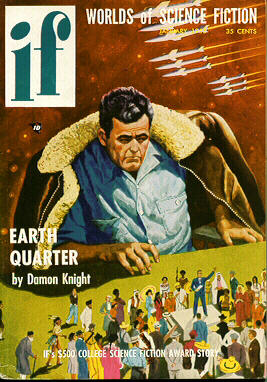
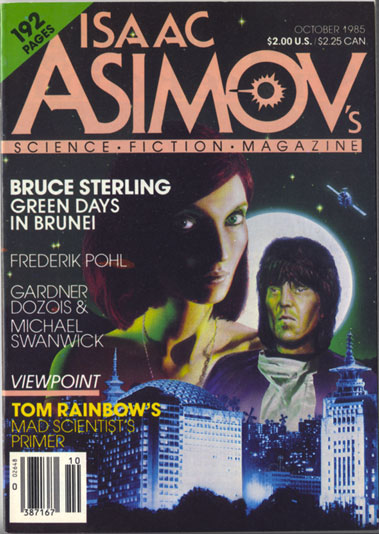

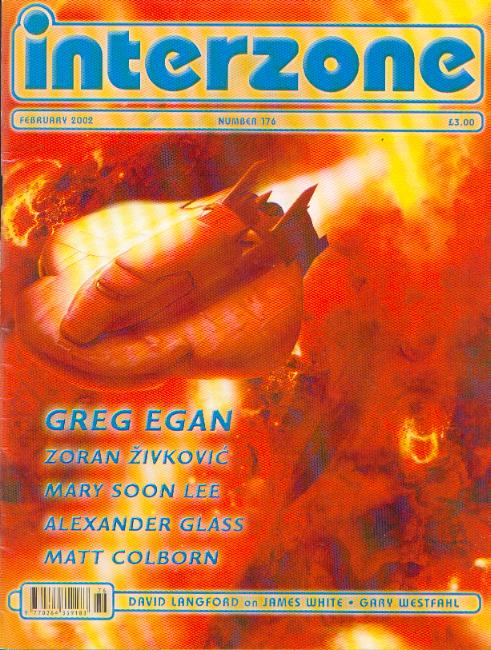
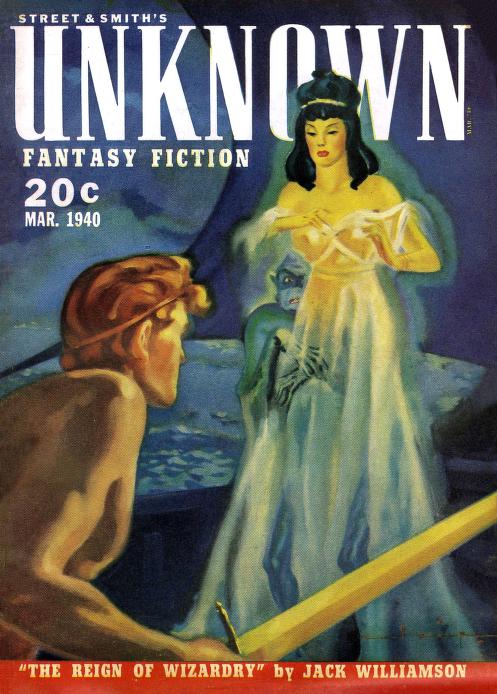


 Science Fiction & Fantasy Remembrance