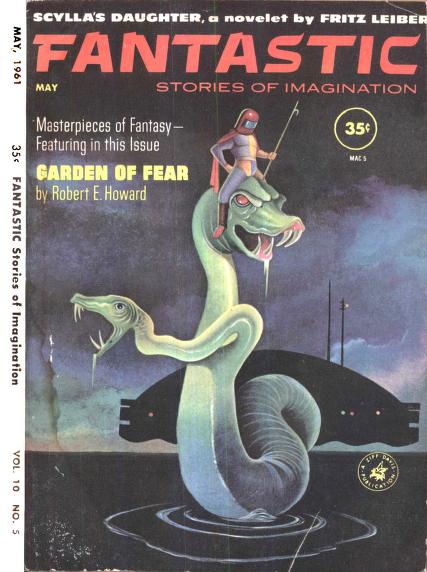
It’s that special time of year, and I’m not just saying that because it’s Christmastime. Truth be told, I’m not crazy about Christmas; I certainly don’t go nuts over it like I do with Halloween—which is why my review roster for this month is not Christmas-themed. My birthday is also this month (it’s the 9th, if you’d like to know), but that’s not why I’m here. Some months thing will be totally normal, but then there are times like this. Oh, we still have the usual rotation, albeit with a little twist (in fact it’s a new department), which I’ll get to in a minute. The real twist is that this will be a single-author lineup, and the guest of honor is Fritz Leiber.
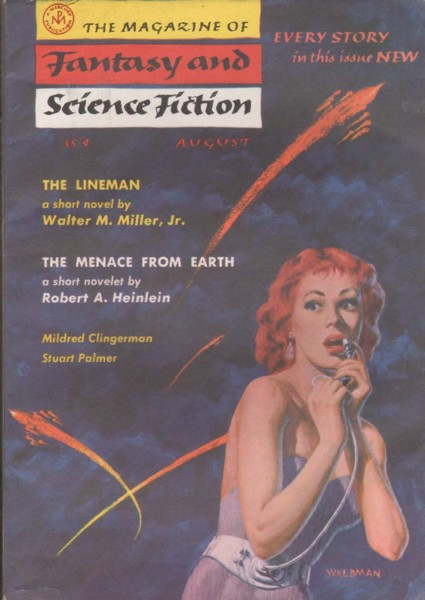
Fritz Leiber was born on Christmas Eve, 1910, and when he made his professional genre debut in 1939, he was about to mark a new era in fantasy writing—although people were not aware of this at the time. His most lasting achievement is the grand episodic narrative of Fafhrd and the Gray Mouser, one of fantasy’s most daring duos and a landmark in what is now called Sword and Sorcery (the same subgenre which contains Robert E. Howard’s Conan, among other things). Leiber’s tales of Fafhrd and the Gray Mouser are by no means his only contribution to the genre, and indeed his turf goes far beyond just fantasy. You know, I really like Leiber, but even with most of my favorite authors I would not dedicate a whole month to reviewing works of theirs; what makes Leiber different from most is his ability to dabble in basically everything, from fantasy to horror to science fiction. Across the half-century of his career, Leiber shfited from genre to genre, mood to mood, not being as easy to pin down as most of his contemporaries.
Since this is a bit of an unusual month for reviews, I decided to go an extra step and introduce another new department—albeit an irregular one. There aren’t too many of them, but there are in fact “complete” novels in the magazines, especially in the ’40s and ’50s. Or rather were, because magazines running novels was basically an attempt to keep paperbacks (which were gaining traction) from biting their heels, an attempt which ultimately and inevitably proved a failure. A lot of “complete” novels being run in magazineare also just novellas, but there are exceptions! Leiber’s 1950 novel You’re All Alone is one such exception, and while it is technically an abridged version of The Sinful Ones (long story), at 40,000 words it’s a bit too long to be comfortably called a novella, at least for my blog. I’ll explain how this new thing will work at the end.
So, we get two serials, two novellas, two short stories, and a complete novel in honoring this bastard. Not the last time I’ll be doing this single-author month deal, but obviously it’s something I’ll only do maybe once a year. But enough! It’s time to reveal what we’ll be reading.
The serials:
Destiny Times Three, first published in the March to April 1945 issues of Astounding Science Fiction. Retro Hugo nominee for Best Novel. Not one of Leiber’s more famous works, if the number of times it’s been reprinted says anything, but then it is quite a short novel—probably too short to sell on its own but also too long to be anthologized easily. One of Leiber’s earliest attempts at depicting alternate timelines, a premise that he would return to fruitfully much later.
Rime Isle, first published in the May to July 1977 issues of Cosmos Science Fiction and Fantasy. Never heard of Cosmos? Don’t worry, it only lasted four issues. Rime Isle is part of the Fafhrd and Gray Mouser series, being a later entry, as well as one of Leiber’s final appearances in the magazines; thereafter he stuck to original anthologies. Whereas some other Fafhrd and Gray Mouser stories are often cited, this is not one of them. I know basically nothing about it.
The novellas:
“Scylla’s Daughter,” from the May 1961 issue of Fantastic. The late ’50s saw a major revival for the Fafhrd and Gray Mouser series, which was not coincidental considering Fantastic‘s new editor, Cele Goldsmith, clearly sympathized with Leiber and wanted to buy what he was selling, with Fafhrd and the Gray Mouser getting at least one story a year in that magazine until Goldsmith left. “Scylla’s Daughter” would later be expanded into The Swords of Lankhmar.
“Ship of Shadows,” from the July 1969 issue of The Magazine of Fantasy and Science Fiction. This is a special issue of F&SF, being one of its author tribute issues, with “Ship of Shadows” as the lead novella. Technically a reread, but it’s been long enough that I could use a refresher, and hell, I remember liking it quite a bit. Leiber stories tend to fall into SF, fantasy, or horror, but “Ship of Shadows” ticks all three boxes, and it won a Hugo while it was at it!
The short stories:
“The Hound,” from the November 1942 issue of Weird Tales. The first several years of Leiber’s career saw him dwell primarily in Weird Tales and Unknown, the top fantasy-horror magazines of the early ’40s. Not being the most comfortable with SF, Leiber distinguished himself at first as a young master of terror and the supernatural. “The Hound” is one such early horror effort from Leiber, and hey, it’s apparently a werewolf story, and I love me some werewolves.
“The Moon Is Green,” from the April 1952 issue of Galaxy Science Fiction. After being relatively inative in the late ’40s, Leiber came back strong early the next decade, and his return to the field coincided with those explosive first years of Galaxy, the new SF magazine on the market. Leiber became one of Galaxy‘s leading writers in the early ’50s, and “The Moon Is Green” is one of those Galaxy-Leiber tales to get adapted for the legendary X Minus One.
Now, finally, the complete novel:
You’re All Alone, from the July 1950 issue of Fantastic Adventures. Apparently the magazine version is an earlier draft that Leiber had tried but failed to get published, since the fantasy market in the latter half of the ’40s was in the dumps, but luckily Fantastic Adventures, previously a second-rate pulp outlet, was under new management. Leiber would then “expand” the novel for book publication under the title The Sinful Ones, but from what I’ve heard the magazine version is better.
About how these complete novel reviews will work. My review schedule is on a rotation basis, switching between short stories, novellas, and serials; depending on how many days there are in a month I would cram in a third novella or short story. The way I have it figured is, if a month has 31 days, and if I’m set to review a novella on the 31st day, I’ll switch that would-be novella out for a complete novel. After all, I wanna save the biggest single review project for last, and I wanna give myself enough time to really digest the extra long material. The resulting review will itself of course be longer than average. Now, how do I separate a complete novel from a novella? How does one tell the difference, especially since magazines, while usually two-columned, have different type sizes and therefore some can pack more wordage into each page? Sometimes magazines give rough word counts, but much of this, admittedly, will come down to my own discretion.
Not making promises, but complete novel reviews will probably be the last department I add to my blog. This is a one-man show, ya know, and I do have a day job to contend with. Still, I wouldn’t be doing this if it wasn’t out of passive, and you also know that I’m a compulsive reader. The more the merrier! Just hope I can do someone as great as Leiber justice with this.
Jack Vance is a contender for the most influential mid-20th century SFF writer that relatively few people have read. He debuted in 1945, and unusually for a writer of that period his science fiction tended to read like fantasy—his fantasy, because nobody at that point wrote fantasy quite like Vance did. His 1950 collection (it’s a collection, I don’t CARE if some people call it a novel) The Dying Earth presents an Earth so far in the future that magic has not only emerged but overtaken technology; it influenced, among other things, Dungeons & Dragons. He would win two Hugos and a Nebula for the novellas “The Dragon Masters” and “The Last Castle,” which, despite sounding like they’d be fantasy, are in fact science fiction. He won a third Hugo in 2010 (this man lived a long time), this time for Best Related Work, with his autobiography This Is Me, Jack Vance! Even in his works that are not fantasy at all, there always seems to be a sense of magic with Vance.
Something to keep in mind is that Vance wrote a lot over a long span of time, and he has quirks that people will either accept or reject. If you really need your SFF to be colloquial or down to earth then you will probably not like Vance; his penchant for the flamboyant and the baroque has blocked off many would-be Vance fans. I have to admit that I wasn’t into Vance for a while, and even not I can’t say I love his work, but I do respect it and often enjoy it. Surely there’s something to like about a guy who will write a short story, set it on a planet that he’ll never write about again, and not only grant that setting a novel’s worth of detail, but even include footnotes. Vance is clearly a fan of planet-building, and it’s a niche talent he’s quite adept at, as we’ll see with today’s novella.
Placing Coordinates
“The Kragen” was first published in the July 1964 issue of Fantastic, which is on the Archive. A bit of a long story with this one. It’s not unusual for novellas to be expanded into novels, or to be made into sections of novels like they’re pieces in a jigsaw puzzle; in my experience the novella usually doesn’t benefit by being inflated to novel-length. “The Kragen” was expanded into the novel The Blue World in 1966, with the novel version getting nominated for a Nebula and being up for the Prometheus Hall of Fame a few times (makes sense). I just assumed that since the novel version is more well-known that “The Kragen” would be one of those novellas to get reprinted maybe once. Not quite! It was reprinted in Robert Silverberg Presents the Great SF Stories: 1964, edited by… you guessed it, Robert Silverberg (and also Martin H. Greenberg). It got a chapbook release from Subterranean Press, which is weird, like who asked for this? We have at least one in-print edition with the Vance collection Wild Thyme and Violets and Other Unpublished Works, in both paperback and as an ebook.
Enhancing Image
Much of this review will be spent on the world-building of “The Kragen,” rather than the plot, since the actual plot is pretty simple when viewed with a wide lens; I suppose it has to be. Vance has about sixty pages to not only introduce a whole world to us but to make it comprehensible, so while there are a few twists and turns, this is not one of his more complex narratives. Take it as an adventure story that theoretically could be just as easily fantasy as SF, if not for background details.
The unnamed world of the novella is entirely covered with water, which when you think about it is not so different from our world, which is only mostly water. Several generations ago (the dates aren’t clear) a ship crash-landed on the planet—apparently a ship full of criminals (though given their ability to procreate it must’ve been co-ed), and surprisingly the survivors did not all kill each other within a month; instead they found ways to survive and even prosper on the blue planet. This is impressive, not only because civilization managed to rebuild itself out of a bunch of scraps, but because it did so with some things that we take fore granted, such as electricity and even metal. There is a bit of metal that lies in some people’s possession, but it’s not enough to be used for much of anything, and anyway, nobody knows what to do with it.
Not the first or last time Vance did a lost colony narrative; he arguably did it better in his 1958 novella “The Miracle Workers,” in which survivors of a crashed ship eventually devolve into warring pseudo-medieval factions. In both stories the content could be construed as fantasy while the reasoning behind that content is undeniably science-fictional.
Society works on a caste system, although even at the beginning of the story the system is loosening up, with inter-caste marriage and what have you. In a bit of humor from Vance the castes are named after species of criminal, so you have the Incendiaries, the Swindlers, the Hoodwinks, and so on, with Advertisermen at the bottom. I know, very funny. Hoodwinks actually don’t do what you would expect, as their job is basically to act as signal-men, communicating with people on other floats in a sort of morse code, quite literally winking hoods at the tops of towers. I’m not sure what Swindlers do here, since their occupation probably wouldn’t align with what their name implies. Anyway, the protagonist, Sklar Hast, is one such signal-man, although he spends much more time in-story being a thorn in some authorities’ sides than doing his job.
About those “floats.” Without metal, without even glass, society has to rely on other resources, and in this case they were very lucky, because while the ocean does indeed stretch from pole to pole, there are these vast swaths of sea-plant that are big enough to not only serve as pseudo-land but to be handy for lots of other purposes too. Whatever the plants don’t cover, human bones will sometimes do the trick; apparently the people of this seafaring society are not one to waste the bodies of their dead, though from what I can tell they don’t indulge in cannibalism. I wonder Donald Kingsbury read this (or more likely The Blue World), got to the part where a human rib is used as a hook, and thought, “Hmm, I could write a novel like this.”
Despite the lack of resources, life has been mostly good for Sklar Hast and his people. “On this water-world, which had no name, there were no seasons, no tides, no storms, no change, very little anxiety regarding time.” It’s one thing to have a single-biome planet, but it’s an extra strain on one’s suspension of disbelief that there be practically no harsh weather. Of course, had there been gales and hurricanes then the crash survivors surely would’ve died off, and thus we wouldn’t have a story. You gotta do what you gotta do. There are a few other things, which I’ll get to in the spoilers section, that don’t strike me as the most credible, but Vance (as usual) goes the distance with the mechanics of his newfangled world. A lot of time is spent on what the people of the floats eat and how they eat it, and stuff like that, and much of it is at least intriguing.
But wait, there’s trouble in paradise! The people do have one natural threat to their way of life: the kragen (plural), a race of sea monsters that act more as really large pests than as direct threats to human life. Still, an angry kragen has the bulk and weaponry (tentacles and mandibles) to fuck up a person, and unfortunately the people don’t have weaponry good enough to take on the kragen; instead they have to rely on the supposed goodwill of the largest kragen of them all, King Kragen, which the elders “””allegedly””” are able to communicate with. If King Kragen is appeased with gifts (i.e., food) then he’ll kill or drive off smaller kragen. This feels like solving a big problem with an even bigger problem, but who am I to judge.
A little aside…
We get illustrations of the kragen on both the issue’s cover and with the opening interior illustrations, both done by Ed Emshwiller. Now, Emshwiller is a legend, and I respect him, but while I would say his depictions of the kragen are accurate enough, they seem a little… goofy.
It’s not his best work is what I’m saying.
One day a kragen fucks up Sklar Hast’s abode and instead of waiting on King Kragen to maybe show up, Sklar Hast takes matters into his own hands and rounds up some likeminded fellows to kill the kragen themselves, which they actually come close to doing. The fallout is catastrophic, though, resulting in a schism headed by Sklar Hast with a particularly zealous elder named Barquan Blasdel on the other side. The question comes down to this: Do the elders have any control over King Kragen, or are King Kragen’s appearances merely serendipitous, with the monster’s “help” purely fueled by the prospect of food? This is a Jack Vance story so you know damn well it’s closer to the latter, and come to think of it, questioning and overcoming unjust hierarchies is also a Vance staple. Sklar Hast and his people vow to not only head out on their own, detatching their float from the rest of society, but to kill King Kragen, come hell or high water.
Forgive me, I’ve been spending a considerable amount of time trying not to misspell these weird character names. Not really a Vance story if there aren’t weird character names.
Sklar Hast has manpower on his side, but what he doesn’t heave is the weaponry. Not yet. How do you take down a giant sea monster without guns? Crossbows? Even decent harpoons? They have to figure out how to modernize—to rediscover metal on a planet that’s practically devoid of it, and in the process prove to the elders that they no longer need such an arbitrary quasi-religious order of living. From here on the narrative becomes two-pronged, jumping between Sklar Hast and Barquan Blasdel, the new and the old, as they seek to destroy and protect King Kragen respectively.
There Be Spoilers Here
Mostly I wanna talk about how Sklar Hast and company are able to overpower the Kragen, because it’s… complicated. And also maybe a leap in logic. I’m not a scientist, but I’m not sure if blood works this way. The climactic scene of the men from the renegade float, now with crossbows made of metal and powered with electrical tubes, taking down King Kragen almost made me think more about the logistics of getting all that goddamn metal from burned blood (blood being smoldered down to iron, yes really) than the coolness of the action. And the action can be pretty cool when it’s there! So that says something about how much the solution to the lack of metal makes me scratch my head. The ubiquitous nature of the plant life already threatened to make things too convenient, but this is a bit much. That’s about it. That’s all I felt like saying about that.
A Step Farther Out
I have conflicting feelings as to the length of this thing. The plot is simple enough that I don’t think an extra fifty to a hundred pages would benefit it (mind you that The Blue World itself is quite short), but also I can see that extra wordage benefitting depth, especially character depth but also the workings of Vance’s world. Sklar Hast is a bit of a flat character; he wants one thing for most of the story, which is to kill King Kragen, and we can’t say he matures since he’s shown to be right pretty much from the outset and thus he has no lesson to take from all this. I at least appreciate that the elders, while shown generally to be wrong, are pragmatic enough that they’re not cartoonishly evil, with the exception of Barquan Blasdel. Indeed the pragmatism of the elders becomes part of the novella’s sly humor, which is perhaps chuckle-worthy but never laught-out-loud funny. Even so, I do think Vance’s sense of humor is underrated, and his jokes lend flaor to what would risk becoming a droll and humorless adventure.
I wouldn’t consider “The Kragen” to be Vance’s finest hour, if only because I don’t think it reaches the same level of epicness as his best stories of similar length. Consider that “The Miracle Workers” and “The Last Castle” each fit not only a novel’s worth of world-building into sixty pages, but a novel’s sense of grandeur; these are wondrous tales of action that feel like they’re deserving of big-budget Peter Jackson adaptations. Meanwhile “The Kragen” feels weirdly insular, with even the kragen themselves never being fully allowed to act the part of giant movie monsters. Also, I’m not sure where else to say this, so I’ll say it here: Don’t read “The Kragen” (or most Vance, for that matter) if you absolutely must have women in your fiction. In other words, this is not Vance at his worst, but it’s certainly not his best.
John Kessel is one of the defining SFF authors of the ’80s, although like many of his contemporaries he had debuted in the ’70s, in the likes of Galileo and Galaxy Science Fiction. Adjacent to the newfangled cyberpunk movement of the period but decidedly not a cyberpunk writer himself, Kessel, like close contemporary Bruce Sterling, is startlingly diverse in his output. His 1986 story “The Pure Product” is one of the more haunting explorations of time travel in modern SFF, and his slightly autobiographhical story “Buffalo” could lay claim to being one of the best short stories (inside or outside of SFF) of the ’90s. On top of his fiction, Kessel is an active genre critic and anthologist, the latter often in collaboration with James Patrick Kelly. While he has a few novels to his credit, Kessel has reserved most of his writing energy to short fiction and genre commentary.
“Another Orphan” is a relatively early outing from Kessel, but as we’ll see, it reads like the work of a stone-cold master. I should say it now so that I won’t have to ease you into it in some coy fashion: this is Moby Dick fanfiction. You may be thinking, “Now Brian, this is obviously not fanfiction!” I guess you’re right; it was, after all, published professionally, and so technically it doesn’t count. But “Another Orphan” is about an original character being plopped into a story that was first written by a different author, a premise which has since become an old and tired chestnut for fanfic writers. It’s what Kessel does with such a premise, though, that makes the result special.
Placing Coordinates
First published in the September 1982 issue of The Magazine of Fantasy and Science Fiction, which is on the Archive. Despite winning a Nebula, and being regarded as one of Kessel’s most major works, “Another Orphan” has not been reprinted often. Still, we have two options that I would consider major. The first is The Best Fantasy Stories from the Magazine of Fantasy & Science Fiction, edited by Edward L. Ferman, which is a bulky hardcover that you can find used pretty cheaply, and it also has a lot of stories that I consider of strong interest. More recently (so recent it came out THIS YEAR!) we have The Dark Ride: The Best Short Fiction of John Kessel, a fancy hardcover from Subterranean Press, which I would recommend if you’re already a fan of Kessel and/or you wanna play this game on Hard Mode. Limited edition with copies signed by Kessel himself, so you’re looking at at least $30, and that price will only go up with time.
Enhancing Image
A bit of context, because while it’s not necessary to have read Moby Dick in order to enjoy “Another Orphan,” the latter is very much in conversation with the former. Herman Melville is one of the great eccentrics in American literature, and especiallty 19th century American literally; his magnum opus, Moby Dick, is a bizarre, freewheeling, often meandering novel that alienates a lot of readers because at face value it seems to fail as an adventure narrative, when the reality is that Moby Dick, if anything, is a grand subversion of the seafaring adventure narrative. If you go in expecting what you imagine a canonical work to read like, or if you’re expecting an action-packed romp on the high seas, you’ll be disappointed, but if you’re expecting one of the weirdest and most enigmatic novels in American literature then you might come out of it with a new perspective on what is possible with the written word.
I say all this because our protagonist, Patrick Fallon, is someone who, once he realizes where he is and what he’s in, does not initially give the world of Moby Dick the respect it deserves. Patrick is a commodities analyst for some firm (let’s just call him a yuppie and be done with it) who, after a fight and an apology fuck with his girlfriend (I don’t think they’re married) one night, inexplicably finds himself awaking in the crew’s quarters on a whaling vessel—and not just any whaling vessel! He doesn’t immediately figure it out (he at first thinks it’s a dream, or that he got shanghaied), but he soon realizes that he’s on the Pequod, the doomed ship in Moby Dick that hunts the white whale for three days before being smashed to smitheroons, with only one survivor. Which is a bit of a problem.
Oh right, spoilers for Moby Dick, which is now over 170 years old and whose plot beats a lot of (at least American) readers are familiar with. I know some people are very sensitive about spoilers, but you have to draw a line somewhere. It’s like telling a grad student that Santa Claus isn’t real.
They had been compelled to read Moby Dick in the junior-year American Renaissance class he’d taken to fulfill the last of his Humanities requirements. Fallon remembered being bored to tears by most of Melville’s book, struggling with his interminable sentences, his wooly speculations that had no bearing on the story; he remembered being caught up by parts of that story. He had seen the movie with Gregory Peck. Richard Basehart, king of the sci-fi flicks, had played Ishmael. Fallon had not seen anyone who looked like Richard Basehart on this ship. The mate, Flask—he remembered that name now. He remembered that all the harpooners were savages. Queequeg.
He remembered that in the end, everyone but Ishmael died.
I appreciate the shoutout to the John Huston movie, which, by the way, was written by Ray Bradbury. The more you know…
The first thing I thought of when reading “Another Orphan” was actually L. Ron Hubbard’s Typewriter in the Sky, in which a musician somehow gets sucked into the world of his hack writer friend’s latest novel, in which he’s given the role of the villain. The thing is, of course, that said hack writer always kills off his villains at the end, which means our guy has to find some way to get (or at least alter events so as to avoid his doom) before it’s too late, and there’s a similar ticking-clock element in “Another Orphan.” Just know, though, that while there’s a bit of snarky humor at work, Kessel’s story is a good deal more serious than Hubbard’s, and a lot more thematically ambitious despite having half the word count.
Patrick, interestingly, is not put in the place of Ishmael, but he’s not in the place of some other preexisting character either; he’s known to the whalemen as Patrick Fallon, as if he had always been on the ship, although he’s treated like a bit of an outsider. He’s also not very strong, physically, which presents a problem when trying to fit in as a sailor on a ship full of sweaty hardened whalers. (I wanna go on a slight tangent about the homosexuality or rather the lasck of it. Moby Dick is infamously a pretty homoerotic novel, unintentionally or by design, but Patrick is straight as an arrow and he doesn’t speculate even slightly about homoerotic activity that might sprout between men who go out on a sailing vessel for months on end. Kessel’s story comments on or challenges a lot of things about Moby Dick, but that’s not one of them.) The situation only gets worse when he inevitably encounters the captain of the ship: Ahab.
And boy, Ahab’s flamboyance (really his campiness) does not disappoint. Patrick assumes, though (incorrectly, as it turns out), that Ahab is a caricature because of his maniacal rants. More generally he writes off the heightened atmosphere of the Pequod as unrealistic and silly, partly based on his murky remembrance of the novel and partly because he underestimates Melville’s intentions. A mistake Patrick makes repeatedly is that he fails to respect the artistry and intricacy of the fictional world he’s been thrown into; he thinks that because Ahab is subject to manic episodes and that the sea seemingly conforms to the energy of these episodes (a thunderstorm rages during one of Ahab’s monologues, which Patrick considers on-the-nose) it means these experiences can’t possibly be real. Or can they? Does Ahab’s mania, which to some extent reflects Melville’s own, count as a real experience, and not just scenes of heightened emotion concocted by a writer?
Ahab as represented in Kessel’s story is a pretty interesting character, but I’ll save him for spoilers since his “big scene” is saved for the climax. For now there is the question of Ishmael, and who he is, where he is, and who the hell Patrick is in all this. If you’ve read Moby Dick then you may recall that while Ishmael is the narrator, it would be misleading to call him the protagonist. While the first hundred pages or so have Ishmael as an active presence, once he boards the Pequod he becomes less and less a flesh-and-blood character until, for a good portion of the novel, he basically disappears into vapor. I don’t think there’s a single time while on the Pequod that another character calls Ishmael by his name; he’s a bit of a spook. It takes a minute for the realization that Ishmael is effectively a nonentity, and that he could be anyone on the ship, to hit Patrick.
Then an unsettling realization smothered the hope before it could come fully to bloom: there was not necessarily an Ishmael in the book. “Call me Ishmael,’: it started. Ishmael was a pseudonym for some other man, and there would be no one by that name on the Pequod. Fallon congratulated himself on a clever bit of literary detective work.
Yet the hope refused to remain dead. Yes, there was no Ishmael on the Pequod; or anyone on the ship not specifically named in the book might be Ishmael, any one of the anonymous sailors, within certain broad parameters of age and character—and Fallon wracked his brain trying to remember what the narrator said of himself—might be Ishmael. He grabbed at that; he breathed in the possibility and tried on the suit for size. Why not? If absurdity were to rule to the extent that he had to be there in the first place, then why couldn’t he be the one who lived? More than that, why couldn’t he make himself that man? No one else knew what Fallon knew. He had the advantage over them. Do the things that Ishmael did, and you may be him. If you have to be a character in a book, why not be the hero?
Ishmael is definitely not “the hero,” but that’s beside the point.
Patrick basically has two choices: he can take on the role of Ishmael and hope for the best, or he can find some way to prevent Ahab from going on the three-day hunt for Moby Dick that will doom the ship. Sparking a mutiny would be a high-rick high-reward option, not helped by the fact that with one or two exceptions nobody can stand to be around Patrick, let alone persuaded by him. However, if anyone can be persuaded to go “off script,” then it would be Starbuck, the first mate and the bottom to Ahab’s top. Readers of Moby Dick will remember Starbuck as the well-meaning but ineffectual right-hand man who considers overthrowing Ahab at one point, being well aware of the captain’s mania, but chooses not to through with it. Unfortunately Patrick’s efforts to stoke the fires of rebellion in Starbuck prove unsuccessful, but it seems like these “characters” are ultimately capable of making their own decisions.
At first I was wondering if Kessel genuinely disliked Moby Dick or if it was just Patrick’s snarky narration, but eventually I had to conclude it was the latter. I mean sure, it would make little sense to spill so much ink just to rag on a 170-year-old book, but occasionally it was hard to tell. There’s a scene where Patrick observes the harpooneers (Queequeg, Dagoo, etc.) and how they’re all POC, chocking their roles up to racism—although he’s not clear if it would be due to the ship owners’ racism or Melville’s, though it’s probably the former; Melville, it must be said, was considerably less racist than the average 19th century writer. Unfortunately, in what feels like a bit of a missed opportunity on Kessel’s part, we get practically zero dialogue from the harpooneers, and despite being a modern man with presumably modern-ish sensibilities, Patrick makes no attempt to befriend the harpooneers.
These are criticisms, sure, but they’re really just quibbles, especially in light of the back end of the novella, which is so masterfully done that it made me look back on the rest of the story in awe. The lengths Kessel goes to subvert one’s expectations do not reveal themselves until a good ways in.
There Be Spoilers Here
Normally in this kind of narrative, there’s an explanation for why the protagonist was suddenly taken out of their normal enviornment and plopped into something else; it doesn’t have to be a good explanation, but we would at least get an answer. No such relief for Patrick Fallon. Not only has he so far been unable to avert the ship’s course, but the source of his predicament remains completely mysterious. Is this a Schrodinger’s butterfly scenario? Is the world of the book a horribly elaborate dream, or was his prior life in the “real world” the dream? Which one is real? Could they possibly coexist? Why Moby Dick, a book Patrick had read years ago and wasn’t fond of, of all things? Kessel knowingly piles question upon question and refuses to answer, because to give answers would be to undermine the story’s aura as an existential nightmare.
Why should he not have a choice? Why should that God give him the feeling of freedom if in fact He was directing Fallon’s every breath? Did the Fates weave this trance-like calm blue day to lead Fallon to these particular conclusions, so that not even his thoughts in the end were his own, but only the promptings of some force beyond him? And what force could that be if not the force that created this world, and who created this world but Herman Melville, a man who had been dead for a very long time, a man who had no possible connection with Fallon? And what could be the reason for the motion? If this was the real world, then why had Fallon been given the life he had lived before, tangled himself in, felt trapped within, only to be snatched away and clumsily inserted into a different fantasy? What purpose did it serve? Whose satisfaction was being sought?
What had started out as a whacky misadventure has gradually turned into something more ominous and mysterious, but because of that sense of mystery it also becomes more enthralling. There’s a brief scene where Patrick, inexplicably, wakes up back in his old life, with his girlfriend and his yuppie job and all that, but even at the beginning of that scene something feels off. Before long the world of Moby Dick bleeds into the “real world” and Patrick awakens back on the Pequod, as if the reality of Patrick prior life were waning, giving into the growing reality of Melville’s fiction. The growing disparity between worlds, the diminishing hope of finding a way home, is almost of cosmic proportions. At first Patrick found the operatics of the novel to be unconvincing, but now he thinks them perfectly logical. The fading star of his prior life has become his own white whale.
People don’t realize that Moby Dick is a cosmic horror narrative—possibly the first (and to this day the most experimental) of its kind.
The final scene involves a one-on-one confrontation with Ahab, who while very much a character has not been much of a direct presence thus far. They get into something like an existential debate before a fight breaks out, with Ahab victorious—not just physically the winner, but also spiritually. After all he’s been through, Patrick has come no closer to returning home, indeed now with the Pequod appearing to be where he’s truly supposed to be. The final lines of the story echo those of the novel prior to the epilogue, and some of you might recall that Ishmael reveals himself to have been the ship’s sole survivor in that closing chapter. But no such epilogue exists here. I would say this is an anticlimax, and you could say it is, but it’s too deliberately written to feel like that; the lack of proper closure is necessary to nail home the feeling of existential dread. To cop the final words from the SF Encyclopedia’s entry on Melville (which is surprisingly detailed, given that Melville basically didn’t write any SF), Patrick ultimately finds himself “with no surcease in view, no escape from prison.”
A Step Farther Out
Is it fair to compare a 20,000-word novella to a 200,000-word novel? No, of course not, and I’m not gonna do that. “Another Orphan” is effectively a standalone deal; you’ll miss out on some of the juicy details if you’ve not read Moby Dick, but Patrick provides enough context for things that you probably won’t be confused. But as someone who loves Moby Dick I have to admit I was predisposed to either loving or hating “Another Orphan,” and I’m not sure how one would go about hating it. Kessel, incidentally, was about the same age as Melville (early 30s, which is insane when you consider the intricacies of Moby Dick) when he wrote “Another Orphan,” and part of me wonders if he saw the long-dead author as a kindred spirit. Patrick, on the other hand, while not a villainous character by any means, is what we would call a sellout; he repeatedly says he’s not a hypocrite (which is kind of a weird thing to say about yourself), but clearly he’s lacking in integrity. Maybe it makes sense, then, that a work of pure artistry like Moby Dick would serve as the playground for Patrick’s new purgatorial existence.
Very simple evaluation here. If you want your high seas adventures to be a little more thematically substantive, you’ll like this. If you want an ingeniously constructed fantasy narrative, you’ll like this. If you like Moby Dick, you’ll get a lot out of this. And if you’re a Kessel fan then you’ve probably already read “Another Orphan,” because this is essential reading.
Now we’re back to our regularly scheduled programming! Only not quite, but I’ll save that for the end. We’ve come back to our novella and serial reviews, which I’m thankful for; as fitting as it is to focus only on short stories and novelettes for a month of horror, I found it weirdly draining to review all those short stories back to back. With serials and novellas we’ll have more variety, never mind the lack of a horror theme.
I must’ve gone back and forth on this schedule too many times to count, frankly. The thing is that I like having a schedule for my reviews, as I think it allows me to plan some silly stuff in advance, like the fact that I’ll be tackling Joanna Russ and Poul Anderson stories back-to-back (for those of you who don’t know, I recommend looking up a certain exchange those two reportedly had), not to mention stuff like last month’s review slate. But I’m not here to waste your time, let’s get to the meat of the matter!
For the serials:
We Who Are About To… by Joanna Russ. Published in Galaxy Science Fiction, January to February 1976. Russ was a divisive figure in the field and We Who Are About To… in particular was not received well. Even so, it has its defenders, perhaps the biggest of them being Samuel R. Delany (who I always trust), and it also received a glowing review from Joachim Boaz over on his site. I have to admit my experiences with Russ have not been great up to this point, having found her Hugo-winning novella “Souls” underwhelming, but this could be a change of pace!
We Have Fed Our Sea by Poul Anderson. Published in Astounding Science Fiction, August to September 1958. It was nominated for the Hugo for Best Novel, and was published in book form as The Enemy Stars. Anderson was apparently a beloved figure when he was alive, but since his death his star power has faded somewhat, perhaps due to the scattered vairety of his fiction. He was a reliable and insanely prolific writer, and I often like (but rarely love) his work. We Have Fed Our Sea was one of THREE Anderson serials running in Astounding in 1958.
For the novellas:
“Another Orphan” by John Kessel. Published in the September 1982 issue of The Magazine of Fantasy and Science Fiction. Kessel can be thought of as adjacent to the cyberpunk movement of the ’80s, though it would be a mistake to consider Kessel himself one of the cyberpunks. Renowned for both his fiction and genre criticism, he’s also edited several anthologies, often in collaboration with James Patrick Kelly. “Another Orphan,” which won the Nebula for Best Novella, is apparently a riff on a classic work of American fiction…
“The Kragen” by Jack Vance. Published in the July 1964 issue of Fantastic. Like with Poul Anderson, Vance is a writer I often like but rarely find myself strongly attached to. Also like with Anderson, Vance represents to some extent SF writing typical of the pre-New Wave ’60s (i.e., relatively conservative), focusing less on literary experimentation and more on The Big Picture™. “The Kragen” may strike some readers as familiar because they had read it in a different form: it would be expanded into the novel The Blue World two years later.
For the short stories:
“Don’t Look Now” by Henry Kuttner. Published in the March 1948 issue of Startling Stories. You didn’t think I’d forget about Kuttner, right? Making his professional debut in 1936, Kuttner was not the instant success like hie future wife, C. L. Moore, was; actually he had a reputation as a hack writer for a while, and to this day his immense talent tends to be undervalued. Alongside Moore Kuttner would write some of the most beloved SFF of the ’40s, but he also remaimed prolific more or less on his own, “Don’t Look Now” being an example.
“Mountain Ways” by Ursula K. Le Guin. Published in the August 1996 issue of Asimov’s Science Fiction. Le Guin is one of those grandmasters of the field who really needs no introduction. She only appeared sporadically in the magazines from the ’60s to the ’80s, but the ’90s saw a major resurgance for Le Guin as a magazine presence, with her Hainish cycle especially getting more attention. “Mountain Ways” is a standalone Hainish story, and it won the James Triptree Jr. (now regrettably called the Otherwise) Award for gender-bending SF.
If you’re reading this post and it’s the first day of November then you’ll notice there are two new departments for my blog: one of them is simply a quality-of-life improvement while the other is more of a “I’m doing this for funzies” thing. Firstly we have an author index now! Reviews are organized by authors’ last names, and while this page may be small now, there will come a point when it will be massive, and since I don’t rate my reviews, this is probably the best way to help readers find what they’re looking for. The second is The Observatory, which like Things Beyond is an editorial department, but whereas Things Beyond is meant for forecasting reviews, The Observatory will be more like a conventional magazine editorial where I’ll spend a thousand words on whatever subject I feel like writing about—although, of course, it will be SFF-related.
Since Things Beyond happens at the beginning of every month, it seems only natural to have an Observatory editorial posted on the 15th of every month, so that it’ll never be skipped and it’ll fall exactly between two of my regular review posts. With these changes I feel like I’m one step closer to making my blog a “professional” (by that I really mean well-rounded) review site for magazine SFF.
(Cover by Gray Morrow. Worlds of Tomorrow, February 1967.)
Who Goes There?
Of the SFF authors to have debuted in the ’60s, Samuel R. Delany may well be the best; it helps that his rise to prominence was swift, though it may not have seemed that way at first. Delany debuted with a novel (unlike most of his contemporaries he was a novelist first and foremost) titled The Jewels of Aptor, and quickly followed that up with a trilogy of novels known as the Fall of the Towers trilogy, which you can find as an omnibus. Perhaps the first big sign of Delany’s precocious genius (he was 19 when he wrote The Jewels of Aptor) was the 1965 novella “The Ballad of Beta-2,” which earned him his first Nebula nomination. 1966, however, would mark the beginning of a brief but intense streak which lasted until the end of 1968, as we got his first masterpiece, the Nebula-winning novel Babel-17, one of the few SF works of its time to be concerned chiefly with linguistics, as well as its companion novella “Empire Star.” Delany insisted the two be bundled together, but this did not happen for many years, with “Empire Star” instead being bundled with “The Ballad of Beta-2.”
1967 was the year Delany threw his hat into the ring of the short story, quickly showing that his daunting brilliance showed often just as much in the short form as with his novels and novellas, with “Driftglass,” “Corona,” and his Nebula-winning short story “Aye, and Gomorrah…” being nothing less than the work of an already-refined artist. We also got the Nebula-winning (see a pattern here?) novel The Einstein Intersection, and the following year we got perhaps the best novel from this first phase of his career, Nova, along with the Hugo- and Nebula-winning novelette “Time Considered as a Helix of Semi-Precious Stones.” By the time this streak ended, with Delany’s output suddenly screeching to a halt at the end of the ’60s, he was all of 27 years old, and had won a record-breaking four Nebulas in as many years (plus a Hugo), not to mention seven novels in as many years (eight if we count They Fly at Çiron, though it wouldn’t be published until decades later). With the exception of maybe Roger Zelazny, there was no American author to have debuted in the ’60s who shone brighter than Delany.
If we focus too much on the first phase of Delany’s career when in a retrospective mood, I would say it’s for two reasons: firstly, he was incredibly productive at this time, with nearly half of his novels being published between 1962 and 1968, and secondly, it’s hard to overstate how revolutionary Delany was from pretty much the outset. For one thing, he was the first black SFF author of any significance; not to say he was the first black author to have written SFF (W. E. B. Du Bois comes to mind), but he was the first to specialize in SFF, and the first to make his mark in the magazines. “The Star-Pit” (the hyphen would be removed for reprints) was in fact his first story to see magazine publication, and by this point he had already established himself as a formidable force as a novelist. That Delany would only become more ambitious (if also more polarizing) once he came back from his hiatus goes to show the depths of his artistry.
Delany celebrated his 80th birthday this past April. Let’s hope he gets to celebrate another one.
Placing Coordinates
“The Star-Pit” was first published in the February 1967 issue of Worlds of Tomorrow, which is on the Archive. A problem I often run into with novellas is that even the most famous of them don’t get reprinted as often as their short story counterparts (novella-focused anthologies have sadly never quite taken off), but you won’t have much of a problem finding this one. “The Star-Pit” has been reprinted a good number of times, in Judith Merril’s SF 12, in Robert Silverberg’s Alpha 5, in The Arbor House Treasury of Great Science Fiction Short Novels (co-edited by Silverberg and Martin H. Greenberg), in Gardner Dozois’s Modern Classic Short Novels of Science Fiction, and in Delany’s collection Driftglass. If you want a source that’s currently in print then look no further than Delany’s collection Aye, and Gomorrah: Stories, which, as far as I can tell, collects everything in Driftglass plus some later stories. Sadly, Delany was never that prolific in the short form, and it’s all too easy to get a one-volume collection of all of his non-series short works. While the man has been making a big difference by dedicating his time to academia for the past several decades, one has to shudder when thinking about how much more fiction he could’ve written.
Enhancing Image
The story opens with Vyme, our narrator, who at this early point is the father of several children and husbamd in a polygamous marriage. We find out quickly that in the culture Wyme took part in before coming to the Star-pit (more on that in a minute), plural marriage is the norm, and is basically codified for the purpose of producing and raising a myriad of children. The opening scene has Vyme with his oldest son, Antoni, and there’s an accident with a highly advanced terrarium, in which some “sloths” (they’re called that, but they’re described as being closer to small rodents) get loose. One of these sloths ventures too far from its enclosure, and it reacts violently when Wyme tries to retrieve it. The sloth appears to have gone crazy from being out in the sun too long. This whole scene, and the following conversation especially, may not strike us as plot-relevant, but it sets up an important thematic motif that Delany will return to later.
It snapped at me, and I jerked back. “Sun stroke, kid-boy. Yeah, it is crazy.”
Suddenly it opened its mouth wide, let out all its air, and didn’t take in any more. It’s all right now, I said.
Two more of the baby sloths were at the door, front cups over the sill, staring with bright, black eyes. I pushed them back with a piece of sea shell and closed the door. Antoni kept looking at the white fur ball on the sand. “Not crazy now?”
“It’s dead,” I told him.
“Dead because it went outside, da?”
I nodded.
The opening scene of “The Star-Pit” is a curious one, firstly because it’s something of a flashback (it takes place several years prior to most of the story), and also because it does not make Vyme look good, despite the fact that he’s the one narrating. First-person narrators, whether by design or through omission of detail, often come off as better than they probably were, which is not surprising; if you’re telling a story that involves you personally, you wanna make yourself look good—or at least not bad. Vyme reveals himself to be an unusually emotionally honest narrator, though, one who had made a serious mistake in the past which alienated him from the rest of his marriage group and prompted him to seek work off-planet. To make matters worse (this is not a spoiler, mind you), an unforeseen catastrophe takes Vyme’s partners and children from him; he can’t go home again, even if he wants to. Since then Vyme has basically started his life over as a mechanic at the Star-pit, a spaceport which oversees intergalactic ships as they bring back precious materials from distant worlds.
The big catch is that while space travel is common in this story’s universe, the vast majority of people can’t be space pilots; no, that position is reserved for only a tiny fraction of the population with very specific qualifications. The golden (as adjective and noun, singular and plural) are a set of people with a certain kind of psychosis and a certain hormonal imbalance which seemingly predisposes them to sociopathy (they’re often said to be stupid or mean, or both), but which also enables them to fly through deep space without going totally insane or dying. For most people, if you were to travel through space as such and such a speed for such and such a distance, you would lose your mind, then your life. The discovery of the golden was pure accident, and honestly it reminds me of the equally accidental discovery of jaunting in Alfred Bester’s The Stars My Destination. “The Star-Pit” and Nova are particularly reminiscent of Bester’s novel.
Through some freakish accident, two people had been discovered who didn’t crack up at twenty thousand light-years off the galactic rim, who didn’t die at twenty-five thousand.
They were both psychological freaks with some incredible hormone imbalance in their systems. One was a little oriental girl; the other was an older man, blond and big boned, from a cold planet circling Cygnus-beta: golden. They looked sullen as hell, both of them.
You may notice the one character being described as “oriental,” as is another character later on. I point this out because you may be taken aback slightly by Delany’s occasional outdated racial vocabulary (another character is described as “negroid”), which is nothing more than a product of its time. It’s also worth pointing out that Vyme is black, which is certainly a mundane details nowadays but would’ve been a rarity in SFF circa 1967. Not that such a thing was totally unheard of: Robert Heinlein and H. Beam Piper managed to sneak POC into their fiction, sometimes even all but stating a protagonist is non-white. Delany was the first, however, to write POC in magazine SFF from a non-white person’s perspective.
Anyway…
The golden are a different matter. I get strong Philip K. Dick vibes from this notion that in order to explore the vast reaches of space, it would be necessary to recruit slightly insane people who won’t go totally insane under the pressure. Golden are differentiated most apparently by the golden belts they’re required to wear, which does raise a question, and believe it or not it’s a question Delany answers: Wouldn’t it be a little too easy to pass off as a golden if you were to steal one of their belts? The thing of course is that a normal person would crack under the pressure, then die, if they were to take the role of a golden and head out for deep space—but suppose someone who’s more than a little suicidal were to do such a thing? By way of a dramatic action scene, we’re left early on with a golden’s ship without a golden to pilot it, and that’s where Ratlit comes in.
Ratlit may be the most interesting character in “The Star-Pit,” for his unusual traits and also for his ambiguity. Ratlit is a bestselling author, which is strange for two reasons: the first is that he was a literal child when he wrote it, only barely being in his teens when Vyme meets him, and the second is that he didn’t technically write it, on account of being illiterate. He had a novel dictated and it sold like crack, which I suppose makes him a child prodigy. Oh, and he really hates the golden—like really hates them, and yet he also wants to become a golden. I have to assume Ratlit just narrowly misses the qualifications for being deemed a golden, because he’s definitely an asshole, and he’s definitely an idiot. Admittedly, and I don’t think this is much of a spoiler to say, but every golden we come across in this novella is pretty much a moronic sociopath; they don’t care about other people, but they’re barely even functioning enough to take care of themselves.
Another character we’re introduced to who’s arguably even weirder than Ratlit, albeit relatively underdeveloped, is Alegra. Ratlit is a 13-year-old bestselling novelist while Alegra is a 15-year-old projecting telepath, meaning she can project her thoughts into other people’s minds. Oh, and she’s been a drug addict ever since she was an infant. Oh, and she worked as a psychiatrist (government backing and everything) when she was eight years old. Part of me has to wonder why Delany made the ages of some of his characters so goddamn low, to the point of maybe straining one’s suspension of disbelief. I have to assume he’s making a comment about child prodigies, being something of a child prodigy himself (he had read War & Peace when he was 12 or something), and the harmful ramifications of being such a young talent. Delany was 23 when he wrote “The Star-Pit,” and maybe at the time he feared he was already going to burn out as a writer. Maybe the age thing has to do with Vyme’s role as a former parent, as an adult who lost his children, though this angle doesn’t become pointed until later.
Ratlit and Alegra are both young and stupid, so naturally they hang out together a lot, and indeed their relationship may be more than just platonic. That neither of them is a golden when Vyme meets them is quite the coincidence, given their temperaments, and also quite a coincidence that they’re both child prodigies. But then, at least according to Vyme, having two such people in the same place may not be so coincidental, given the function of the Star-pit and the government’s mad scramble for more golden.
Fifteen-year-old ex-psychiatrist drug addict? Same sort of precocity that produces thirteen-year-old novelists. Get used to it.
It’s this remark (along with a few others) that makes me think Delany is trying to articulate his position as someone who was a highly precocious teenager, to the point of having a published novel by the time he was twenty. He could’ve been either an artist or a madman—or going back to Dick, he could’ve been both. It’s weird because the lectures and interviews I’ve seen of Delany make him come off as a very well-adjusted person, despite some of the drama that’s happened in his life. You see, on top of being black, growing up in an era where racial segregation was still the norm, Delany is also gay. Or maybe bisexual, there’s some debate as to what his orientation “really” is. Point being that Delany is pretty far from straight, and his queerness would not be made known to the SFF readership at large until quite a few years after his initial rise to prominence.
You can see there are a few threads going on here.
Delany’s chief concerns in this story seem to be with ethics—nay, the mere possibility of space travel—as well as parent-child relationships. I’ll talk about the former more because it holds a greater interest in an SF context. While Delany’s novella is by no means the first to deconstruct the typically gung ho attitude people have about space travel (I’m thinking of Edmond Hamilton’s masterful short story “What’s It Like Out There?”), it goes about the question in a way that probably would not have seen print a mere decade earlier. For reasons I’ll elaborate on in the spoilers section, the problem of intergalactic travel is particularly tricky here, because the only people qualified to pilot such ships must be mentally ill. Mental illness occupies the very core of “The Star-Pit,” and everything would fall apart if Delany’s exploration of the golden (who, make no mistake, are all people suffering from mental illness, with experienced golden also suffering from PTSD) didn’t ring true on some level. Thankfully, like everything else, Delany’s exploration is humane, thought-provoking, and has real human blood running in its veins.
There Be Spoilers Here
Tragedy strikes once again.
I had alluded earlier to how easy it would be to take a golden’s belt and pass off as one, and that’s what Ratlit does. Ratlit, who doesn’t quite make the cut to be a golden, takes someone’s golden belt—Alegra’s. In a revelation which admittedly doesn’t strike me as all that plausible, Alegra is diagnosed as a golden, at age 15 (golden are typically “found” when they’re in grade school), and she tells Ratlit and Vyme the “good news.” This is actually a very bad thing, though we don’t find out why until it’s far too late. See, the problem is that Alegra is a drug addict, and withdrawal is strong enough to kill her; she must be on the stuff, or else. There is another complication that, in practice, prevents her from going to space, and it’s the fact that she’s pregnant—apparently with Ratlit’s kid.
The more I think about this, the darker it sounds. Which it really is. It’s also fucked up that Ratlit and Alegra find themselves in a catch-22 where Alegra won’t survive space travel in the shape she’s in, and neither will Ratlit (for different reasons), yet Ratlit wants to go so badly and and he must’ve realized at some point that there will be no happy ending. Alegra goes through withdrawal, and Vyme isn’t able to get the drug for her in time. Ratlit goes out to space, with Alegra’s golden belt, never to be seen again. Two kids whom Vyme has gotten to know, sort of like surrogate children for him, are both taken away in what feels like the blink of an eye. An abortion would’ve saved Alegra maybe, but according to Vyme no such safe options are available on the Star-pit. It’s a horrific situation, but it only gets worse once we get all the details after the fact.
Maybe I’m old fashioned, but when someone runs off and abandons a sick girl like that, it gets me. That was the trip to Carlson’s, the one last little favor Ratlit never came back from. On the spot results, and formal confirmation in seven days. In her physical condition, pregnancy would have been as fatal as the withdrawal. And she was too ill for any abortive method I know of not to kill her. On the spot results. Ratlit must have known all that too when he got the results back, the results that Alegra was probably afraid of, the results she sent him to find. Ratlit knew Alegra was going to die anyway. And so he stole a golden belt. “Loving someone, I mean really loving someone—” Alegra had said. When someone runs off and leaves a sick girl like that, there’s got to be a reason. It came together for me like two fissionables. The explosion cut some moorings in my head I thought were pretty solidly fixed.
A gripe I do have with “The Star-Pit” is that the action reaches its climax with Alegra dying and Ratlit going on his suicide run, but when this all happens we’re not quite three quarters into the story. “The Star-Pit” is a 50-page story in its magazine publication, and the Ratlit/Alegra plot takes up maybe 30 pages, when really I wish it took up a larger chunk. Thematically we get a continuation with a new golden, a teenager nicknamed An, who brings things full circle, but the drama has deflated by this point, despite Delany’s best efforts to enfuse Vyme’s own personal drama with the right amount of pathos. We start and end with Vyme himself, who despite being reasonably good at his job is otherwise grief-stricken, a drunk, and objectively an irresponsible parent. Is he a drunk because he’s an irresponsible parent, or an irresponsible parent because he’s a drunk?
And what of the golden? The golden are the only people qualified to travel between galaxies, yet they’re qualified partly because they’re treated as pariahs by the rest of mankind, and their seeming incapability to get along with other people further reinforces their pariah status. A normal person will likely hate a golden, but will also likely be envious of them. The new golden in the story’s third act, An, has a tiny terrarium he takes around with him, and we’re taken back to the so-called sloth that went outside its enclosure and went mad. The golden venture outside their enclosure (the enclosure being the human family) and are thus crazy—only they do not necessarily die from it. Ratlit wants desperately to become a golden because he thinks his life on the Star-pit is constraining, claustrophobic, horrible, but the golden are not exactly free to do whatever they want.
Delany seems to be making an argument about the need for human interaction, and more importantly for human warmth. Vyme and his assistant Sandy (whom I didn’t even get to mention until now) are both exiles, having been permanently separated from their group marriages, trying to find redemption (or at least solace) in their work on the Star-pit, only to find that their characters have not grown stronger, their stars no brighter than before. While we don’t learn too much about the mechanics of these group marriages which have become commonplace (for instance, homosexuality is implied but never delved into), we get the strong impression that these men are worse off for having cut themselves off from their partners, Vyme because of a war which caught his family in the crossfire and Sandy because his former partners no longer want him to return. In practically every corner you look, there’s tragedy, and a yearning to transcend that tragedy—to break through the barrier, or the walls of one’s terrarium.
A Step Farther Out
I have a few small issues, mainly having to do with plausibility, but upon close inspection I think “The Star-Pit” stands out as one of Delany’s early masterworks, as well as a relatively accessible demonstration of his craft. Delany would get more experimental very shortly, but when he was writing “The Star-Pit” he must’ve been at a crossroads, at the bridge between a promising beginner and a refined craftsman. It helps that Delany’s ascension to the forefront of SFF was at a mile a minute, with him seemingly learning an important lesson with every project he finished. By the time he wrote Nova, a little over a year after he wrote “The Star-Pit,” Delany had all but perfectly balanced his penchant for flamboyance and lyricism with his immense talent as a writer of space opera—maybe the only great writer of space opera to come out of the ’60s. “The Star-Pit” is moody, deeply tragic, often filled to the brim with ideas, but it’s not rushed; it almost feels more like a compressed novel than a true novella, but it ultimately feels well-realized. Most importantly, it feels human in a way that a lot of New Wave-era science fiction doesn’t, only one thing of many that made Delany special.
1968 was the first year the Hugos had an award for Best Novella, which if you ask me was a long time coming, but better late than never. The inaugural Best Novella shortlist is also stacked, with Philip José Farmer’s “Riders of the Purple Wage” and Anne McCaffrey’s “Weyr Search” tying for the Hugo. “The Star-Pit” was also nominated, though weirdly it was not also nominated for the Nebula. I must admit I have a considerable soft spot for Farmer’s story (though most people seem to hate it), and I’m rather indifferent to McCaffrey’s, but I think at least from a modern perspective it’s fair to say Delany’s story should’ve won. “The Star-Pit” is a remarkable exploration of a question which especially occupied hard SF since at least the Campbell era, and which retains strong relevance thanks to a certain oligarch and his space program: Are we sure we ought to go to space? Not just the moon (we’ve already been there), or the other planets of our solar system, but beyond the Milky Way… beyond what our technology is currently capable of giving us, but which we may be able to reach in a few generations. We’ll have to sit on a hill, or at the top of a mountain, and we’ll have to look up at the stars and ask ourselves the question posed at the very end of Jack Vance’s The Dying Earth:
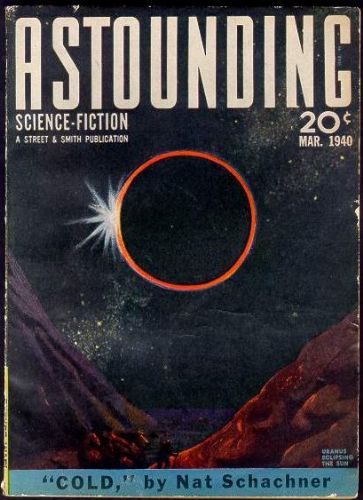
Need I introduce you to Robert Heinlein again? You probably know him already, either by reputation or because you’ve read a portion of his considerable body of work. Heinlein debuted in 1939 and became the most popular writer of SF in just a couple years; he remains the only person aside from John W. Campbell to have been made Guest of Honor at Worldcon three times. People love and hate him—occasionally at the same time! Yet he remains a seminal figure, most of his work remains very much in print, and at his best he continues to teach us. If This Goes On— was Heinlein’s longest story up to that point, and when it was serialized in February and March 1940, it was revolutionary in both its content and its impact.
Curiously, despite its themes, If This Goes On— has never been so much as nominated for induction in the Prometheus Hall of Fame, although its sequel, “Coventry,” is an inductee. I have to assume this is because the libertarian revolution thing was already well-covered with The Moon Is a Harsh Mistress, which is, after all, far more advanced, more complicated, and more enjoyable than its precursor. It did, however, win the Retro Hugo for Best Novella of 1940, beating out no less than two other Heinlein novellas (the aforementioned “Coventry” along with “Magic, Inc.”) along with the first two Harold Shea stories by L. Sprague de Camp and Fletcher Pratt, “The Roaring Trumpet” and “The Mathematics of Magic.” Did it deserve the win? I’m gonna say no. For one thing, even if we’re comparing the Heinlein novellas, “Magic, Inc.” is no less inventive while also packing a tighter narrative thrust, and a good sense of humor to boot. Really the whole shortlist could’ve been from Unknown, as its contents have aged more gracefully by and large than what came out of Astounding.
There are a couple Heinlein biographies out there, but if you want more insight into the man’s early career then I highly recommend Alexei and Cory Panshin’s unrivaled tome on the Golden Age of SF, The World Beyond the Hill, which focuses more on Heinlein’s artistic evolution, and also Alec Nevala-Lee’s much more recent book Astounding, which focuses more on Heinlein as a person. The former especially illuminates us about the place If This Goes On— holds in SF’s history, it being the first of Heinlein’s great experiments, not only cementing what would be known as his Future History but also paving the way for a kind of SF which genuinely anticipates future possibilities based on current trends. In other words, it would serve as a foundational document for Campbellian SF.
Placing Coordinates
The March 1940 issue of Astounding is on the Archive. I’m not sure where else the magazine version of If This Goes On— appears. I know Heinlein went back and revised it a decade or so later for inclusion in the collection Revolt in 2100, and if what I’m reading here is correct, the changes were indeed substantial. Still, it was the magazine version which won the Retro Hugo (though it wouldn’t surprise me if voters were going off the Revolt in 2100 version), and if you can believe it, Part 2 is even shorter than Part 1. I would have to guess that, when the parts are combined, we have a longish novella of about 35,000 words. Two-part serials are a tricky thing, because depending on the magazine (we’re talking type size, margins, overall dimensions), a two-part serial could total anywhere from as low as 20,000 words (a novella, but barely) to 50,000 words or more (a full novel). If only there was an easy way to calculate all this.
Enhancing Image
You may recall that at the end of Part 1, John Lyle, our brave hero, had gone undergone with someone else’s identity—a ruse that lasted all of about five minutes. Soon enough he’s on the run again! The opening stretch of Part 2 is an extended chase scene, with John hijacking a ship and blazing through several states in the west and midwest.
Provo is not a particularly large town and might not be expected to have a particularly alert police force, but Utah has been a center of heresy and schism ever since the Mormon Church was suppressed, during the lifetime of the First Prophet.
Once again we come across maybe the most interesting part of If This Goes On—, and it’s actually not territory that Heinlein would return to for many years (although he had started working on Stranger in a Strange Land in the ’40s), which is the topic of religion. I was surprised to find an overt reference to Mormonism here, for one because it’s a pretty divisive sect, and also because it’s a pretty obscure sect, very few people would know anything factually correct about it, let alone anyone who was a practicing Mormon (though it must be noted that contemporary SF author Raymond F. Jones, who we might cover eventually, was a Mormon). It also further establishes a link between the future world of the story and the current reality, or you know, what would’ve been the current reality in 1940.
Part 2 of If This Goes On— is hard to summarize, not because so much happens, but because not enough happens. Let’s look at this another way: in Part 1, we have a quartet of characters, with John, Judith, Zebadiah, and Magdalene, and while the plot was moving at a mile a minute, we at least got some character growth, never mind interactions. In Part 2, Zebadiah is barely here, and I hope you weren’t invested in John and Judith’s romance, because I don’t think Judith has even a single line of dialogue here. Even John himself becomes somehow less of a character; not unlike Ishmael, who basically evaporates midway through Moby Dick, John takes a back seat as an active character while also giving us details on events he probably wouldn’t know about firsthand. When I finished Part 1, I was worried that the super-fast pacing of that first part would, at some point, result in the narrative having to stop dead in its tracks from sheer exhaustion, and my fears were proven right. Part 2 is far less entertaining, far less interesting, and ultimately feels less finished than what came before it.
You see, once John meets up with his favorite weed dealer a fellow member of the Cabal, his direct role in the narrative is basically over; he can sit back, relax, and watch the fireworks. Well, he does get to do one more thing, but I’ll save that for spoilers. Point being, the narrative turns mostly third-person from then on, and all the character stuff from Part 1 has been thrown at the window. Now, if Part 1 was about Our Hero™ getting introduced to the revolution, then Part 2 is about the revolution actually happening, and in this case the setup is better than the payoff. As it turns out, when you try to capture a whole goddamn socio-political movement from a first-person perspective, and in the span of as a short a novel as this one, you’re probably gonna lose something there, like basic fucking character. Heinlein would try this again much later with The Moon Is a Harsh Mistress, and a good deal more successfully; that novel is a real chef’s kiss, in part because it’s mostly dialogue and not much action.
The Cabal, which John had theorized in Part 1 as being an ancient underground society with its own traditions, turns out to be just that. Indeed, the Cabal is all but said to have descended from the Freemasons, that old chestnut of conspiracy theories. Shocking, and yet not shocking at all, is the realization that the Cabal, while not having millions of people in its employ, is highly organized, to the point of having its own military.
The system of gigantic caverns called General Headquarters is located southeast of Phoenix, about thirty miles from the Mexican border. It had been in use for more than twenty years and had grown from a hideaway for fugitive brethren into a complete, modern military base. It had a dozen different entrances separated by miles of desert terrain, each entrance carefully concealed and protected by sensitive eye and ear devices and by automatic mines capable of destroying all trace of the tunnels that led to GHQ.
Even so, with hundreds of people in on this, and with some ex-military in the resistance, the Cabal would not be able to take on the Prophet’s forces in a one-on-one battle. As it turns out, this is only a mild inconvenience, but more on that later; admittedly the Cabal’s solution here is kind of ingenious. Anyway, we have the beginnings of an all-out war, or at least a curb stomp on a nationwide scale, but don’t get too excited since this is, after all, written from John’s now-ghostly perspective, after everything’s been said and done. Not very tense, is it? You could say The Moon Is a Harsh Mistress runs into this problem as well, but at least with that novel there’s a lot more to chew on other than the revolution itself. The worldbuilding so prevalent in Part 1 has now largely been put aside, in favor of action, except it’s action that’s not particularly appetizing to read, simply for the fact that John is now removed from it, and we’re given what amounts to half a novel’s worth of combat in about 15 pages. It’s very short, to the point of feeling emaciated.
There Be Spoilers Here
How does the Cabal plan to gather enough people to take on the Prophet? By tricking people across the country into thinking the Prophet sitting in New Jerusalem is an impostor, of course! The process of doing this is a bit convoluted in how it’s explained, and reading this is a post-Trump post-truth era definitely makes this all seem a little implausible, but I do like the idea of tricking people into thinking the fake Prophet is the real Prophet and vice versa. If only it were this easy to convince people to wear masks in HOSPITALS. I’m digressing, though. People across the country rebel against what they see as a false idol, indirectly doing the Cabal’s bidding while the Cabal itself is putting what troops it has into action. The way the revolution works out in this story feels weirdly truncated and multi-faceted at the same time, since it’s not so simple as the Cabal telling people the Prophet is a corrupt asshole and everyone just buying into it, but I also find it hard to believe people would get bamboozled by the Cabal this easily.
Aside from the revolution itself, there’s also the problem (which I suppose I should credit Heinlein for considering in the first place) of what to do about the millions of people who are loyal followers of the Prophet. This is where we get to a passage that really bothers me, and I guess it just goes to show that no matter where you land in Heinlein’s long and winding career you’re bound to find something that’s problematic. In this case it’s something so stupid and backwards on its face that even Heinlein himself, when he went back to revise If This Goes On— for Revolt in 2100 over a decade later, felt the need to rebut it. Get a load of this:
You can see that we had our work cut out for us, and that we did not dare hurry. More than a hundred million persons had to be examined to see if they could stand up under quick re-orientation, then re-examined after treatment to see if they had sufficiently readjusted. Until a man passed the second examination we could not afford to enfranchise him as a free citizen of a democratic state. We had to teach them to think for themselves, reject dogma, be suspicious of authority, tolerate difference of opinion, and make their own decisions—types of mental processes almost unknown in the United States for many generations.
Keep in mind that Heinlein, in 1939, was a flaming liberal, to the point where he was arguably a fellow traveler to the leftist movement of the period (he had worked on Upton Sinclair’s campaign for governor in 1934), so this is a bit jarring to see. Remember, however, that this is also pre-Maoist China, so it’s probably safe to assume that Heinlein was blissfully ignorant of the horrors that would necessarily come from re-education camps, not to mention the gross scale of the government apparatus required for such an effort. It’s uncomfortable to read now, given that to this day there’s a small but vocal portion of the American leftist population that thinks concentration re-education camps would be gosh darn neat. According to The World Beyond the Hill (as I’ve not read Revolt in 2100), Heinlein had evidently changed his mind on the whole brainwashing thing, inserting a bit character to decry the Cabal’s proposition of mass re-education.
It’s clear that Heinlein, regardless of when we find him, was always chiefly concerned with individual liberty—that the individual’s right to autonomy ought to be highly respected, and in this sense he was always philosophically libertarian. A problem that would always haunt Heinlein’s writing, though, is that his penchant for didacticism (and make no mistake, even some of his most disciplined works contain lectures) results in his actual beliefs getting shuffled with ideas he is merely putting forward for discussion. For instance, it should be clear to anyone with more than two brain cells that Heinlein is not actually advocating for ritual cannibalism in Stranger in a Strange Land, but it can be hard to tell at first since he throws in that devil’s-advocate argument with his genuine arguments for polyamory and nudism. Even with an early and well-rounded story like “The Roads Must Roll,” some people take that piece as anti-union, when it is in fact very much pro-union, being rather about corruption within what is otherwise a fine power structure. Some people, being sycophants, see even the most reasonable criticisms of unions as slander, but that’s their problem.
I’m digressing again. In all honesty I find Heinlein’s career far more interesting to talk about than Part 2 of If This Goes On—, and really I find this novella’s place in said career more interesting than the novella itself. There is one last thing I wanna bring up, though. There’s a question which probably no one asked up till now, but which is not necessarily a bad question: Why has John been writing all this? Well, another thing this story has in common with The Moon Is a Harsh Mistress is that the narrator also acts as an amateur historian; what we’ve been reading is actually a historical record about the revolution that John wrote after the fact. Oh, and he ends up with Judith, so there’s that. Another difference between the magazine version and the Revolt in 2100 version is that in the latter, John and Judith do not end up together, with John instead going with Magdalene at the end. Why not? It’s not like Judith had literally anything to do in the second half of the magazine verson. It’s just as well—maybe better—and hell, Heinlein may well have improved his story for book publication.
A Step Farther Out
I was worried that If This Goes On— was gonna let me down in its second half, and I’m sad to say it did, which is not to say it suddenly took a nosedive. There are some sprinkles of worldbuilding here that reminded me that Heinlein, impressively so for this early in his career, knew what he was doing with regards to mapping out what would become his Future History. The notion that the US, in a time not too far from ours, could fall to Christian fascism, is concerning and believable, and I was actually surprised by the more implied but still unmistakable notion that the generations of religious persecution which defined the country’s history would logically result in a Christian cult running the government—maybe not tomorrow, but perhaps a decade from now. We seem to be halfway there already. Heinlein was a supporter of religious freedom throughout his life, and while I do think the whole “the good Christians overthrow the bad Christians” thing is a bit of a copout, I can’t say it’s not plausible. That there aren’t any explicitly irreligious characters in the story is maybe more due to the social norms then being enforced in the magazine publishing business at the time.
I wouldn’t call If This Goes On— great by any means; it strikes me as too clunky, too lopsided in its pacing, and ultimately too conventional to be considered that. Upon rereading sections of The World Beyond the Hill (to refresh my memory), it now strikes me as unsurprising that Heinlein wrote “Requiem” after If This Goes On— and not before, given it feels like the work of an artist one step closer to perfecting his craft. Still, this is mandatory for Heinlein completionists, and even for those who just want a thorough understanding of how a master of the field got to where he was. I’m sure that without the great experiment of If This Goes On— we would not have gotten better long works from Heinlein in that first phase of his career, such as “Magic, Inc.” and “By His Bootstraps.” As such, it’s an important story, but not one I’m likely to read again.
(Cover by Julie Dillon. Uncanny, March/April 2017.)
Who Goes There?
Sarah Pinsker debuted in 2012 with her short story “Not Dying in Central Texas,” and ten years later she’s still going at it. She won the Theodore Sturgeon Memorial Award for her 2013 short story “In Joy, Knowing the Abyss Behind,” and she would win her first Nebula in 2016 for “Our Lady of the Open Road.” Okay, now put a pin in that last one. Pinsker would win another Nebula for her debut novel A Song for a New Day, and her second novel, We Are Satellites, came out just last year from Berkley Books. If I sound a bit like an encyclopedia right now, it’s because unfortunately I’ve not read any of these. I know, I’m stupid. But better late than never! Her novella “And Then There Were (N-One)” was nominated for seemingly every award under the sun, including the Hugo, Nebula, Locus, and so on. This is a weird and yet illuminating introduction to Pinsker, and I’ll explain why in a moment.
Pinsker is known to us as an SFF writer, but she’s also a productive musician, being part of the indie band Stalking Horses. My God, she’s a horse girl. As I’m writing this, her short story “Where Oaken Hearts Do Gather” is up for this year’s Hugo for Best Short Story, and given that it already won the Nebula its chances of also taking home the most famous award in the field are not low. I recommend checking out her website for updates and other things.
Placing Coordinates
“And Then There Were (N-One)” was first published online in the March/April 2017 issue of Uncanny Magazine. This issue also contains an interview with Pinsker which coincides with the story, and for the sake of convenience I’ll link it here as well. Now, if you’re like me, you’re wondering about where you can find this novella in book form; the good news is that we have a few options. Firstly there’s Rich Horton’s The Year’s Best Science Fiction and Fantasy 2018, and last I checked it’s still in print. There’s also Pinsker’s collection Sooner or Later Everything Falls into the Sea, which also contains the aforementioned award-winning stories “In Joy, Knowing the Abyss Behind” and “Our Lady of the Open Road.” If you wanna play this reprint game on Hard Mode, may I suggest the bulky best-of anthology The Best of Uncanny? I say it’s Hard Mode because not only is it not in print, but it’s a limited edition set. That’s right, we’re looking at over $70 for this bad boy. Then again, you’re doing this book-only reprint thing more for collection’s sake than for just being able to read the story.
Enhancing Image
We start with Sarah Pinsker being invited to a convention. That’s right, the protagonist/narrator is Sarah Pinsker, though as we soon realize, she’s not our Sarah Pinsker. So, Sarah gets invited to SarahCon, a Comic Con or Worldcon-like affair being held on a secluded island off the coast of Canada, for reasons that’ll be explained later. SarahCon is a convention where all of the attendees are Sarah Pinskers from alternate universes. That’s right, this is a multiverse story; I can’t help but wonder what Pinsker would’ve done differently with the premise had she written it in 2022 and not 2016, given how much of a meme (to the point of being honestly tiresome) the whole multiverse thing has become since then. Naturally Sarah (the in-story Sarah) is skeptical about such an outlandish event, but her wife Mabel (who is apparently Pinsker’s wife IRL, more on that later) convinces her, and quickly enough we’re off to the races.
At SarahCon, Sarah finds alternate versions of herself by the dozens—some of them made most of the same choices she did, some are younger, some are older, many of them having different professions (there’s at least one Sarah who’s a rabbi), and yet conspicuously, none of these Sarahs are too different from each other. We never, for instance, get a “Sarah” who is actually a cis man, nor do we get an AMAB trans Sarah (I could be wrong), nor do we get any Sarahs who come from alternate universes whose timelines are radically different. Aside from diverging in a select number of events, all the Sarahs seem to come from recognizably the same United States and/or Canada. The biggest divergence, at least in terms of big-picture history, between the Sarahs is the fate of Seattle, which either turns out fine or gets wrecked to hell and back by a severe earthquake. We never get a Sarah who comes from a world that was conquered by Martians. Sad.
The list grouped us by surname first. Mine the most common, a trunk instead of a branch. I paged past, curious. Mostly Pinskers like myself. Made sense if we were the closest realities to the Pinsker who had invited us. There were other random surnames I chalked up to marriage. A full page of Sarah Sweetloves. I’d never really considered changing my name for anyone, even Mabel, but apparently others had.
After surname came city, divided evenly between Seattle, Toronto, and Baltimore, with a few outliers in Northampton, Somerville, Asheville, New York, Pretoria. After that came birthdate, occupation. The occupation list read like a collection of every “What do you want to be when you grow up?” I’d ever answered. Geneticist, writer, therapeutic riding instructor, teacher, history professor, astronomer, journalist, dog trainer, barn manager. I was the only insurance investigator. In fairness, it had never exactly been on the greatest hits list.
We know the Sarah telling the story isn’t ours because she’s not an SFF writer, but an insurance investigator. I don’t know what the hell that means. Something that’s about as mysterious to me is the fictitious occupation of quantologist, though it’s all but said outright that quantology has to do with the study of alternate universes, and there’s a team of Sarahs at the con who are quantologists. It is worth mentioning again, albeit with different phrasing, that these Sarahs attending SarahCon have many traits in common, and we can gather from these shared traits what kind of person Pinsker—not to take shots at her or anything, of course, this is all in good fun. Aside from being a horse girl (the most Lovecraftian of girls), Pinsker is big on farm life generally; she’s also, unsurprisingly, big on writing in some form, be it fiction writing, songwriting, or screenwriting.
It’s possible that, much like communism, this is all a red herring, but digging into Pinsker’s background (which admittedly wasn’t a lot of digging) leads me to believe good chunks of the autobiographical info we get are actually autobiographical, though obviously there are a lot of non-facts that would belong to alternate Sarahs, including the narrator. The fun of reading “And Then There Were (N-One)” is mostly two-pronged: we get a meta story (though it’s not as meta as it at first appears) about the author herself taking up about 95% of the cast, as well as a fictional depiction of a con, and don’t we love those? I find the first half of the story the most enjoyable simply because there’s basically no urgency; we’re allowed to take in the ridiculousness of the situation and Sarah gets to have some slice-of-life conversations with other Sarahs (whom she names depending on physical differences about them, like a Sarah wearing a No Good Deeds band shirt being called No Good Deeds).
Oh, and there are references to SFF culture, because of course there are, though since Narrator!Sarah is not into SFF herself, the references are not too obvious. It’s not like we’re being subjected to cries of “Aha yes, I too am a woman of culture,” but I have to admit these things did often get this reaction out of me.
Concerns assuaged, I dumped my backpack’s contents onto the table and repacked the stuff I wanted to carry with me for the evening, then flopped onto the bed to read the program. It contained a basic explanation of the multiverse theory, a welcome note, a sponsor page, a thank you page, a map, and “Fun Statistics!” based on the questionnaires we’d filled out prior to arriving. Ninety two percent of us played instruments. Five percent of us owned horses, thirteen percent owned cats, eighty percent owned dogs. One person lived in a world where dogs had been rendered extinct by a virus. So much for fun.
Is that last part a reference to Connie Willis’s novella “The Last of the Winnebagos”? I’ve got my eye on you, Sarah.
“And There Were (N-One)” is definitely a novella, clocking in at 23,786 words; even so, it feels more like a novelette than a proper novella, which is far from a bad thing. It’s an undemanding read, both because the plot only really demands half the story’s length and also because Narrator!Sarah is a very likable and readable protagonist. First-person narratives, at their best, often (not always) feel like we’re getting to know the narrator on a personal level, and ultimately I did end up wondering how much Narrator!Sarah and our Sarah diverge, since I felt like I was getting to know Pinsker as a person to an extent. On the one hand I hope she doesn’t check out this review, but I also want her to know that I think she’s quite the wordsmith—not in terms of crafting complicated sentences or coming up with delightful metaphors, but rather in keeping the reader thoroughly engaged. Her inventiveness combined with her colloquialism reminds me of John Varley, or at least early Varley. The title is clearly referencing Agatha Christie’s And Then There Were None, but tonally I was far more reminded of one of my favorite Varley stories, “The Phantom of Kansas.”
Which reminds me—this is a murder mystery.
There Be Spoilers Here
Narrator!Sarah investigates a disturbance in the nightclub area of the building and finds a corpse, and not just any corpse: one of the Sarah quantologists, or so it seems. The death is reported, and soon Sarah discovers firsthand that the death could not have been natural, and likely was not accidental, for the back of the dead Sarah’s head must’ve been hit with some kind of blunt instrument. There’s no policewoman or private detective among the crowd, and due to a storm coming in, authorities won’t be able to arrive until later. Since Narrator!Sarah is an insurance investigator she’s the closest thing they’ve got to figuring out whodunnit. Aside from being an Agatha Christie reference, the title is the way it is because there’s only one victim, and we don’t know the number of Sarahs attending SarahCon, hence N – One. Finding a motive proves difficult, since the workers at the hotel (who are not Sarahs themselves, mind you) don’t have any conceivable motive to kill one of the attendees, and Narrator!Sarah has a hard time imagining herself as a killer.
So, motive, and also the method. When looking for possible murder weapons our improvised sleuth goes through some items held for presentation at a Show & Tell section (which is just cute), and we get something we know our Sarah would have: the Nebula Award.
As I touched the award, I felt a strange certainty this was it. That if I were to murder someone, which I absolutely wouldn’t do, this would be the weapon of choice. Not the mic stands, not the chairs, not the turntable case: this glittering block that would travel back to another reality at the end of the weekend with its owner none the wiser. I shuddered and shook the thought off.
To be fair, you could very feasibly kill someone with one of those.
Now, the question as to who killed the quantologist is really not hard to solve, though there are a couple twists. For one thing, the quantologist who had her head bashed in is not in fact a quantologist—she’s the DJ who was set to play at the nightclub. Somebody had swapped clothes with her while nobody was looking. But why? Another easy answer when you think about it. The Sarahs at SarahCon are mostly similar, if not almost the exact same. Suppose, however, that one Sarah who knew about the background of another Sarah saw her as a good target to swap places with? Suppose a Sarah who has had a shitty life mostly due to circumstance were to swap with a Sarah who had mostly screwed her own life up? The Seattle earthquake is a big divergence point, and also a plausible motive; you’d have a Sarah who lost loved ones in the earthquake swapping with someone who came from an alternate universe where Seattle didn’t suffer that natural disaster.
You also have Sarahs who are with Mabel and those who aren’t; a surprisingly large portion of the Sarahs are with Mabel. Which, okay, fine. Personally I find it hard to believe, just because you could sneeze and probably end up with a different person, but it’s not like this is a story which calls for realism or even plausibility. While Narrator!Sarah finding the killer hinges on the Sarahs differing in mostly subtle ways, as opposed to massive differences, I can’t help but feel like Pinsker willfully ignored the opportunity to go totally bonkers with the idea. I also can’t help but feel like the ending is a bit of a copout, even though I understand why thematically it makes sense. It’s sort of an open ending; we don’t know if Narrator!Sarah will turn in the killer/impostor. There are, of course, at least two choices Narrator!Sarah could make here that would then (theoretically, anyway) result in two different Sarahs, and so on and so on, and she openly recognizes this.
I guess what I’m saying is that the sequence of events with the murder mystery is logical in itself, but it’s hindered by maybe being too logical. Of the novella’s 23,000+ words, it seems like relatively few are actually spent on solving the mystery, and that’s because the mystery is by no means complicated, nor is it the most gripping part of the narrative. If anything I wish we’d spent a few thousand more words exploring the many possibilities of the convention, having some fun with the many Sarahs, maybe get in on a panel (there’s apparently one on gender, but we don’t get to hear anything about it). Of course, having it turn into a wacky slice of life would require basically writing a different story altogether, and I do like very much what I like about it.
A Step Farther Out
There’s a plot-important reason for why the Sarahs at the SarahCon are all so similar when you get down to it, but I can’t help but feel like Pinsker held herself back from having more fun with what is (let’s face it) an inherently silly premise. Like why not go nuts with it? It’s possible, of course, that Everything Everywhere All At Once spoiled me on the whole multiverse thing, since that movie basically takes it to the logical extreme, but what if there was a different Sarah Pinsker who made the decision to turn “And then There Were (N-One)” into an outright comedy? Though conversely there would also be a Sarah Pinsker who made it more serious, which is such a horrid idea I dare not think it. I’m honestly surprised this didn’t get the Hugo, because it seems like exactly the kind of story Hugo voters (i.e., Worldcon attendees) would latch onto, but I’m also saying this because it’s quite a fun read. Pinsker may not make 100% use of her premise, but this is something that could easily devolve into bullshit.
The decision to have Narrator!Sarah not be our Sarah is a key one; first off, I imagine it was a challenge (albeit a fun challenge) to devise a version of yourself who is much the same as yourself, but different in ways that are often subtle. I’m reminded of Lunar Park, in which Bret Easton Ellis is both author and protagonist, but past some initial biographical similarities Ellis the narrator turns out to be a decidedly different person from Ellis the author. Another key decision is that while it’s implied our Sarah is one of the many attendees at SarahCon, we never run into her—at least not as far as we can tell. There are enough degrees of separation to keep the self-reflexive aspect while also not coming off as a painful self-insert. Yes, it’s solipsistic just by virtue of its existence, but it doesn’t turn into the author patting themselves on the back (okay, there’s a little back-patting, but I’ll let it slide), and hell, Pinsker knows what she’s doing. I guess that’s the highest praise I can give this novella, aside from its entertainment value: Pinsker knows what she’s doing.
Walter M. Miller, Jr. is, along with Daniel Keyes and Tom Godwin, probably the most famous one-story author in the history of SF—in the sense that he is basically only known for one story, that is. The reality is that before he started writing the novellas that he would later revise and conjoin to form A Canticle for Leibowitz, Miller was already a prolific short story writer; between 1951 and 1957 he would write something like forty short stories and novellas, unleashing a meteor shower of content. Of course his career in the field would climax with the publication of A Canticle for Leibowitz, to this day a beloved classic which continues to resonate with both secular and religious readers. After 1960, however, Miller would disappear from the field, never having so much as one more word of his fiction published in his lifetime, with his second novel, Saint Leibowitz and the Wild Horse Woman, being finished by Terry Bisson (at Miller’s request) and released posthumously.
After decades of battling depression and his wartime trauma (he was a bomber crewman during World War II), and with the death of his wife apparently being the last straw, Miller committed suicide in 1996.
“The Lineman” is the final story of Miller’s to be published during that meteor shower of fiction, and is by extension the last thing he saw published that wasn’t related to A Canticle for Leibowitz. This is a new read for me; the only experience I’ve had with Miller previously are his Hugo-winners, those being Leibowitz and his 1955 novella “The Darfsteller.” I might review “The Darfsteller” eventually, who knows? And I do want to read more by Miller, despite not being a Catholic or even a Christian; I find his brand of theological inquiry to be quite affecting at times.
Placing Coordinates
First published in the August 1957 issue of The Magazine of Fantasy and Science Fiction, which is on the Archive. You’d think Miller having one of the most famous SF novels of the ’50s under his belt would mean his other fiction would be readily available. You’d also be wrong. As far as single-author collections go you basically have one choice, which is The Best of Walter M. Miller, Jr.—and I know what you’re thinking, there’s also Dark Benediction. The Best of Walter M. Miller, Jr. and Dark Benediction are, as far as I can tell, the same damn collection, with the same damn stories in the same damn order; they’re also seemingly out of print. As far as anthology reprints go we also don’t have many options, though “The Lineman” does appear in David G. Hartwell’s super-chunky anthology The World Treasury of Science Fiction, which I’d say is definitely a book to have in your library if you’re a slut for reprint anthologies like myself.
Enhancing Image
Unlike a lot of stories set on the moon, “The Lineman” takes place during the early stages of setting up lunar colonies—not just one colony, but apparently operations headed by several countries, with the U.N. as the referee. Bill Relke is the titular lineman, being part of an American construction crew in the midst of building communication lines. High-speed internet wasn’t a thing yet.
Something to note right off the bat about this novella is that unlike A Canticle for Leibowitz, which only really betrays the time of its conception with references to nuclear armageddon, “The Lineman” eats, lives, breathes, and almost certainly shits the 1950s. Our entirely male construction crewmen talk in ’50s slang, with a heavy dose of hardboiled dialogue that wouldn’t feel out of place in a black-and-white film noir. The conflict of the story is also twofold, and both have to do with the presence of women on the moon during colony-building. Relke has to deal with some goons who work for an underground society that seeks to overturn something called the Schneider-Volkov Act, but that only turns out to be the beginning of his problems.
A ship lands not too far from the site, and it’s not with any known country’s effort to colonize the moon; indeed, it seems to be a commercial vessel. The first twist is that the ship is full of women (“The Ship Is Full of Women” sounds like one of Fritz Leiber’s lesser stories), and the second is that it’s a space-faring whorehouse. Oh yes, our hard-working men are met with French-Algerian “entertainers,” and you know this was written in the mid-’50s because Algeria is still a French colony in the world of the story. Hell, Algeria would no longer be a French colony by 1965, let alone 2065. Since the men (including Relke) have gotten zero pussy for as long as they’ve been on the moon, this causes a big commotion.
Crews being all-male is also given a very of-its-time explanation in the form of the Schneider-Volkov Act. As Joe Novotny, Relke’s superior, explains:
Relke: “Say, Joe, how come they let dames in an entertainment troupe come to the moon, but they won’t let our wives come? I thought the Schneider-Volkov Act was supposed to keep all women out of space, period.”
“No, they couldn’t get away with putting it like that. Against the WP constitution. The law just says that all personnel on any member country’s lunar project must be of a single sex. Theoretically some country—Russia, maybe—could start an all-girl lunar mine project, say. Theoretically. But how many lady muckers do you know? Even in Russia.”
Didn’t Robert Heinlein’s short story “Delilah and the Space-Rigger” already solve this issue?
The master of the ship is, Madame d’Annecy, who turns out to be quite a pragmatic actor. Clearly she’s here for business, and she doesn’t care if the construction guys temporarily jeopardize their own operation to get some tail so long as they’re paying. There is an ulterior motive here, but I’ll save that for spoilers; just saying d’Annecy is one of two major female characters here (which is two more than I was expecting, given the setting), and you sure can’t accuse her of bending the knee for any man who passes her way. The worst thing about d’Annecy, really, is that her business relationship with her girls is shown to be perhaps a little morally dubious (I know what you’re thinking, it’s prostitution, of course it’s morally dubious, but sex work is work). The only way we even figure d’Annecy is on the shady side is by what we know about Giselle, who’s another can of worms.
To make a long story short, Relke and Giselle get stranded together for the middle part of the story, taking refuge in a building which is not quite finished yet. Pressure suits play a big part in “The Lineman,” which makes sense since the moon has no atmosphere, and Giselle (one of d’Annecy’s girls, of course) nearly gets killed before she and Relke have even started to get to know each other. Maybe it’s best that something always conveniently happens to stop them from completing their business transaction, as Relke realizes at one point.
Relke watched her grumpily while she warmed her behind at the oven. She’s not more than fifteen, he decided suddenly. It made him a little queasy. Come on, Joe, hurry.
Uh oh.
In fairness to Relke, he stops getting all touchy-feely with Giselle once it becomes apparent that maybe they shouldn’t be doing this. Not that Giselle would be new to this sort of thing, but safe to say that doesn’t make it not wrong. Relke not only has gotten zero pussy as of late, but is still recovering from his wife leaving him (I imagine the divorce rate for moon men is high), and Giselle… has her own problems. We then come to one of my favorite passages in the story, and one of those things that reminded me that this was, in fact, written by the same guy who wrote A Canticle for Leibowitz.
She was dangerously close to that state of mind which precedes the telling of a life history. He didn’t want to hear it; he already knew it. So she was in a nunnery; Relke was not surprised. Some people had to polarize themselves. If they broke free from one pole, they had to seek its opposite. People with no middle ground. Black, or if not black, then white, never gray. Law, or criminality. God, or Satan. The cloister, or a whorehouse. Eternally a choice of all or nothing-at-all, and they couldn’t see that they made things that way for themselves. They set fire to every bridge they ever crossed—so that even a cow creek became a Rubicon, and every crossing was on a tightrope.
It’s a bit of a downer. You’d think that a religious author like Walter M. Miller Jr. would steer away from the uglier aspects of existence, not to mention the ambivalence of it all, but Miller was not what we’d call a happy camper. Even to compare Miller to other Catholic authors is weird, and to do that I’d also have to venture outside of SFF, since honestly I can hardly think of anyone inside the field off the top of my head. I guess there’s R. A. Lafferty, but none of the Lafferty stories I’ve read have struck me as all that theologically informed. Outside of SFF I’m thinking of Evelyn Waugh, who not so subtly tries to invoke a sense of revelation in the reader by having his characters return to the Church of their childhoods. Then there’s Flannery O’Connor, whose stories are often so grotesque that she basically forces the reader to run in the opposite direction of the horror—the opposite direction being God, naturally.
If Miller tries to invoke revelation, it’s with a good deal of accompanying skepticism, or at least a distinct melancholy that adds bitterness to the moment of divine release. Taken literally, the dilemma of the lunar colonizers being denied one half of the human race seemingly arbitrarily is a bit hard to take, but if taken as a metaphor, with the moon as a purgatorial level of existence, then I can see the logic behind it. Pretty much everyone agrees the Schneider-Volkov Act is something to be repealed (and by today’s standards it sounds nonsensical to boot), but how that problem gets resolved is pretty interesting.
There Be Spoilers Here
There are, to my recollection, three deaths in “The Lineman,” and they’re all accidental and involve pressure suits; they also happen at specific points in the story, each happening in one third of the length. As such, the story begins and ends with a death. The good news is that Madame d’Annecy’s plan to seduce the colonizers with her business will probably result in the Schneider-Volkov Act being repealed, and those secret society goons whom I’ve barely mentioned got their comeuppance. The bad news is that Relke has to let go of Giselle, and he also loses a couple friends by the end of it. Still, he’s the lineman of the crew, and he has to keep building the line—to make the moon a place where people can really live.
It’s during this final scene, where an improvised funeral is held for someone who’s just died in a pressure suit accident, that we get my absolute favorite passage in the story, and it’s something that’s definitely clicked with me—even made me reevaluate what I had been reading to some degree. It’s that powerful, and it also works so well as the end point to Relke’s arc.
Relke looked up slowly and let his eyes wander slowly across the horizon. There were still some meteorites coming in, making bright little winks of fire where they hit into the plain. Deadly stingers out of nowhere, heading nowhere, impartially orbiting, random as rain, random as death. The debris of creation. Relke decided Braxton was wrong. There was a God all right, maybe personal, maybe not, but there was a God, and He wasn’t mean. His universe was a deadly contraption, but maybe there wasn’t any way to build a universe that wasn’t a deadly contraption—like a square circle. He made the contraption, and He put Man in it, and Man was a fairly deadly contraption himself. But the funny part of it was, there wasn’t a damn thing the universe could do to a man that a man wasn’t built to endure. He could even endure it when it killed him. And gradually he could get the better of it. It was the consistency of matched qualities—random mercilessness and human endurance—and it wasn’t mean, it was a fair match.
There’s this old saying in SF about transcendence, and I don’t think it gets brought up anymore. The unique thing about SF is that a transcendent moment can come in a secular context—I’m thinking the ending to A. E. van Vogt’s short story “The Seesaw,” which I think was also reused for The Weapon Shops of Isher. There’s also the ending to 2001: A Space Odyssey, of course. Transcendence in SF comes usually from mankind (be it one person or the whole race) either making contact with something of godlike awesomeness, or becoming that godlike awesomeness. Transcendence is when you meet with something so much greater than yourself that you can’t even calculate it. With “The Lineman” it’s definitely the former, but unlike the vast majority of SF, Miller puts his big transcendental moment in a religious context, with Relke experiencing a religious awakening that sets him on a path of wanting to become not just a man, but a good man.
The ending of “The Lineman” really makes it. I think it’s astounding. As a uniquely science-fictional allegory about mankind getting in touch with the divine part of his nature while in the midst of temptation and horrors, It comes admirably close to striking a fine balance. I’m saying this as someone who doesn’t believe in what Miller believed at the time, and the fact that he would eventually lose both his faith and his life makes the cautious optimism of the ending all the more powerful.
A Step Farther Out
I came out of “The Lineman” a little mixed on it, but ultimately I have to say it was quite effective. Normally when I read something for the sake of reviewing it, I end up with about a page of “notes” on it, which are really just lines from the story that I decided to quote, for good reasons or bad; with “The Lineman” I got about two and a half pages of quotes. When Miller’s on the ball, he’s really on the ball, even if maybe this could’ve been cut down to novelette length. I do have to wonder if the subplot with the secret society was necessary, but then this was back when action narratives were, if not mandatory, then highly incentivized in SF magazine writing. And yet part of what makes “The Lineman” so memorable is how it continually jumps back and forth between pulpy action and genuine metaphysical observations, and how ultimately these two converge.
What fascinates me about Walter M. Miller, Jr. is that he chose to write in a field that was paradoxically both niche and commercial like science fiction, when he could’ve taken his religious concerns and put out some “respectable” literary fiction. That’s the thing, though, isn’t it? “The Lineman” can’t work as literary fiction; its themes are tied intrinsically to its premise. It’s a ruthlessly told story because the moon is a harsh mistress is a ruthless place. The same thing can be said for A Canticle for Leibowitz, which must out of necessity be a post-apocalypse tale in order to justify its inquiries about religion and human nature. It’s weird because science fiction was (and still largely is) stereotypically known for being, if not atheistic or agnostic, then secular; the authors of faith did not tend to write about said faith. Yet Miller, while openly Catholic, did not seek to force conversion upon his readers, but rather to make them think about questions not normally asked in the genre, such as mankind’s place in a universe which is assumed to have a divine overseer—you could say God, Christian or otherwise.
If Miller’s work seems flawed (and everything I’ve read by him so far is prone to a certain excess) then we only have to take the fact that he wrote SF in the ’50s for what it is: the necessary, if imperfect, prerequisite for this artist to find his footing. That Miller stopped writing after 1960, missing out on the New Wave and beyond, speaks perhaps of his fondness for the crossroads which SF in the ’50s found itself at, being more sophisticated than what came in the ’40s but not being as self-consciously experimental as what would come later. Maybe Walter M. Miller Jr. could’ve only done what he did, and say what he wanted to in the way he wanted, during a specific period in the genre’s history. Regardless, we’ll probably never get another voice in the field quite like his.
(Cover by Frank Kelly Freas. Astounding, October 1958.)
Who Goes There?
Clifford D. Simak is one of the most respected writers to come out of the so-called Golden Age of science fiction—this despite the fact that he was actually a pre-Golden Age practitioner of SF, having made his debut in 1931 with “The World of the Red Sun.” Simak became one of John W. Campbell’s regular authors in the ’40s, and then, without skipping a beat, he started submitting frequently to Galaxy Science Fiction in the ’50s onward. Unlike a lot of noted Golden Age writers, Simak was thoroughly a pastoralist, and also a humanist; his fiction often involves fundamentally decent rural types in plots which are rarely life-or-death scenarios. His obvious contempt for urbanity is counterbalanced by a gentleness uncharacteristic of most SF authors of his era, and at his best he can be deeply emotionally effective.
When Simak wrote “The Big Front Yard” in 1958, he had already been in the game for 27 years, and he would remain quietly yet consistently active for 27 more. According to David W. Wixon’s introduction to the story in the collection The Big Front Yard and Other Stories, Simak had originally submitted this piece to H. L. Gold over at Galaxy, but Gold rejected it; he then took it to Campbell, and Campbell bought it without hesitation. “The Big Front Yard” would go on to win the 1959 Hugo for Best Novelette (the Best Novella category had not yet been invented), and it would go down as one of Simak’s most famous stories.
Placing Coordinates
“The Big Front Yard” has been reprinted a fair number of times, so you’ll have no problem finding it. Assuming you don’t mind reading online or with a PDF, the October 1958 issue of Astounding in which it originally appeared is on the Archive. As far as book reprints go we have some easy-to-find options, including the aforementioned The Big Front Yard and Other Stories in ebook and paperback—though I must warn you that Open Road Media is, at best, a second-rate publisher, and I seriously lament the fact that so many books by authors I love have fallen into their hands. Typos and weird formatting decisions abound, such as the fact that FOR NO REASON the scene breaks were removed in their series of Simak’s collected short fiction. Chapter breaks are still intact, but scene breaks, which are arguably more important? Gone. How shitty.
If you want (in my opinion) more reputable reprints, I would recommend the anthology The Hugo Winners, Volumes One and Two; it’s super-duper out of print, but since this tome seemed to get around a lot back in the ’70s, used copies are pretty easy to find without breaking the bank. You also get the rest of the short fiction Hugo winners between 1955 and 1970, so that’s a big plus. Another great option is The Science Fiction Hall of Fame Volume Two B, the second half of (you guessed it) The Science Fiction Hall of Fame Volume Two. Unlike the former anthology, this one is very much in print, and seems to have remained so since its initial publication.
Enhancing Image
This is a first contact story, and maybe one of the most upbeat of its kind, though Simak misdirects us at first into thinking it won’t be.
We follow Hiram Taine, a handyman and trader of “antiques” (in reality just old junky furniture he cleans up and sells at a hefty price), just your average rural Wisconsin dude. He has a dog named Towser and he likes to chat with another local man named Beasly, who’s apparently not very bright but who likes to hang out with Taine and help him with his work. Random, but I couldn’t help but notice the dog has the same name as the protagonist’s dog in Simak’s earlier story, “Desertion.” Is this supposed to mean anything? How many Simak stories have dogs named Towser?
Anyway, Taine is hired to fix a TV set owned by the Hortons, Henry and Abbie, with Henry being boss man at a local plant (a computer plant, apparently). The TV is old and, according to Taine anyway, replacing it would probably be cheaper than repairing it, but it comes with a radio and a record player, and Abbie won’t replace it. Taine and Beasly move the bulky TV into the basement when this happens:
“Well, Hiram,” she said, excited, “you put a ceiling in the basement. It looks a whole lot better.”
“Huh?” asked Taine.
“The ceiling. I said you put in a ceiling.”
Taine jerked his head up and what she said was true. There was a ceiling there, but he’d never put it in.
Taine has one of those unfinished basements—only now it’s a little less unfinished. Not only does his basement have a ceiling that he didn’t have installed, but it seems to be of a metallic substance, except it’s not any kind of metal Taine recognizes. Later that day, he tests the ceiling and finds that a drill won’t penetrate it, or even leave so much as a scratch. Well that’s weird. At this early point in the story, Taine notices some things are different about his house, and normally this would be played for suspense, which is kind of is—but, as I said, this is misdirection.
Indeed the first stretch of “The Big Front Yard” feels almost like a subversion of what would, even in 1958, sound like the set-up for a spooky alien invasion story. You know how superstitious people will sometimes say dogs can see ghosts or some goofy shit like that? Towser spends much of the story trying to find a woodchuck that doesn’t exist, but we’ll get back to that in the spoilers section. Clearly something has started living in or around the property, and it doesn’t stop with Taine’s basement getting refurbished. Several of the junky odds and ends have been mysteriously repaired, even improved in some cases; the big TV set Taine got for repairs is now not only fixed without his help, but it now also plays in color (remember, 1958). You and I know, even going into this, that aliens are involved, yet the surprising part is that rather than hint ominously at a future attack on humanity, these aliens seem, if anything, to be pretty benign, if not outright friendly.
What I like about a lot of Simak’s work, and what he does to an almost perfect degree here, is he refuses to bend to the Golden Age cliché of aliens being depicted as evil outsiders, along with the xenophobic implications; aliens rarely play the villains in Simak’s fiction, but then Simak’s fiction tends to be light on conventional villains. Taine is also not your typical Golden Age protagonist: he’s not a scientist or a politician, he’s not what you’d call a genius, and he’s by no means the physical encapsulation of what Campbell would’ve considered the “ideal” man. Like a lot of Simak protagonists, Taine is a hard-working (if not entirely honest) Midwesterner who’s just looking to make a buck. Honestly I scratch my head as to why Gold rejected “The Big Front Yard” and Campbell bought it; it feels like the roles should’ve been reversed.
Before long, Towser, in his efforts to find the woodchuck, finds something else right by the house, and digs furiously for it. Already aware that something definitely strange has been going on, Taine and Beasly dig up whatever Towser sniffed out, and what they find is indeed strange: a large oval-shaped contraption buried in the ground, made of a glassy metal that Taine knows he’s never seen before. Fear runs through his veins, but he also experiences what we might call a conceptual breakthrough—a discovery of something beyond known human limits that counteracts the fear with a sense of wonder. “A sense of wonder” is a really old and cliched phrase in SF, especially Golden Age SF, but I think there are a few moments in “The Big Front Yard” alone which do it justice.
And the conviction grew: Whatever it was that had come to live with him undoubtedly had arrived in this same contraptions. From space or time, he thought, and was astonished that he thought it, for he’d never thought such a thing before.
Life on other planets? You bet. What else could it be? Like any first contact story there is at least some uncertainty involved, but as is typical of Simak, there’s also a gentle whimsy and that aforementioned sense of wonder which gives us the impression that Taine, Beasly, and the others aren’t in any real danger, despite the mysteriousness of the situation. If our boys thought the repaired junk and the large glassy contraption were weird, though, they’re about to have the sight of their lives, after they’ve finished with the digging and come back around to the front of the house.
He and Beasly went up the gravel driveway in the dark to put the tools away in the garage and there was something funny going on, for there was no garage.
There was no garage and there was no front on the house and the driveway was cut off abruptly and there was nothing but the curving wall of what apparently had been the end of the garage.
The front of the house is folded in on itself. The back is still good, though! But yeah, uhh, how did this happen? Why? Taine’s scared, but now he’s also utterly baffled. Our boys enter through the back door, and… the front of the house is still there. From the inside. Except whereas it had been nighttime outside the house, now there’s daylight breaking through the front windows which are no longer there from the outside.
“The Big Front Yard” can be more or less split into two halves, those being before and after the front of the house gets miraculously folded. If the first half of the novella has almost a magic realism feel about it, it becomes something more akin to a planetary romance in the latter half. I won’t say too much in the spoiler section, since the plot becomes more straightforward at this point, but it also becomes even more charming and readable. The whole thing can be described as “cute,” which is not a word I would use with the vast majority of Golden Age SF (FYI, I do consider the “Golden Age” to be the ’50s, not the ’40s), but “The Big Front Yard” is just a happy-go-lucky tale which refuses to take itself overly seriously.
There Be Spoilers Here
The front of the house, from the inside, opens to a different planet—a vast desert landscape with a sun different from ours. The front of Taine’s house, including his car and driveway, has been transported to this new world, in a way, and conversely the back of the house is now folded on itself. This is where we meet the aliens who have apparently taken up residence on Taine’s property: little ratlike creatures with humanoid-ish faces. These aliens pay Taine no mind and simply keep walking in a single file line through the desert. There’s also… du-dum… another house which serves the same function as Taine’s, except this one appears deserted, serving as a gateway between the desert world and a third world, this one being more jungle-like. Taine’s house seems to have become part of a network of houses which serve as portals for other worlds.
This was another world—there could be no doubt of that—another planet circling another star, and where it was in actual space no one on Earth could have the least idea. And yet, through some machination of those sixteen things walking straight in line, it also was lying just outside the front door of his house.
Soon we run into a different alien race, one which is decidedly more humanoid in appearance; these guys ride on what appear to be horseless saddles, though our boys gather that the humanoid aliens use some kind of anti-gravity device. Far more unfortunately, we also have to deal with the US government putting their filthy hands in things. It was a cliché, even at the time, for the government to get involved with ayy lmao affairs, though Simak’s irreverence for the soldiers and bureaucrats here is somewhat refreshing; they’re the closest thing the story has to villains, and while they are somewhat of the mustache-twirling variety, they’re not too harmful. Really the most tense thing to happen in the whole story is when Taine loses Towser in the desert world for a bit, but it’s okay, he finds him. Towser is such a good boy; there should be a Hugo for Best Dog.
What do these aliens want, though? And what will it take for the government to not take possession of Taine’s house? The solution ends up being a mighty convenient one: Beasly, while not being the sharpest tool in the shed, is able to communicate with the aliens, and as it turns out, the aliens are looking to start a trading relationship with mankind, as part of a network of interplanetary traders. Rather than wanting to trade top-secret info on weapons, the aliens want more practical things, like the very concept of paint, which is somehow foreign to them. The big twist of “The Big Front Yard” is that Beasly is telepathic; that’s right, he can communicate with others using his mind—even Towser, who’s a dog, and even the aliens, who are… aliens.
Suddenly I can see why Campbell would’ve liked this.
I do find this twist to be the least convincing part of the story. You could say it’s far-fetched that Taine is able to walk and breathe fine on an alien planet without any technological assistance, but I would also say you’re a killjoy who probably had a really boring childhood. I guess my problem is that the telepathy thing, even if it’s used to hand-wave communications between humans and the saddle-riding aliens (which it is), doesn’t cover for the fact that our languages would be completely different. That and while I feel like Towser sensing the aliens, including a giant woodchuck-looking alien, was foreshadowed well enough, I find Beasly’s secret power to be less convincing. People were just really into ESP at this time, huh?
Even so, all is well. The aliens want to become trading partners with mankind, with Taine as mankind’s ambassador and Beasly as his interpreter. The government will keep off their backs, at least for the time being, and anyhow, in the meantime they can learn some pretty valuable things from the aliens. It all looks like the beginning of a beautiful business relationship.
A Step Farther Out
Clifford D. Simak would win two more Hugos, and was the third person to be given the Grand Master Award by the Science Fiction and Fantasy Writers of America (after Robert Heinlein and Jack Williamson). Despite this immense honor, Simak now stands as a somewhat obscure figure (not unlike Williamson, actually), and I see that as a big shame, because his work has certainly aged better than a lot of Heinlein’s. Heinlein is one of my all-time favorite authors, maybe top five material, but he can be pretty embarrassing when he doesn’t have his eye on the prize. Simak, meanwhile, continued to produce respectable work well into the ’70s, after many of his contemporaries had either died, retired, or pulled a Heinlein.
Simak would win his third Hugo in 1981, and he would remain active until just a couple years before his death in 1988. The world of SF, and even genre fiction at large, would surely be worse off without him.
“The Big Front Yard” may not be Simak’s best story, but it might be the best example of what made Simak different from so many other SF authors in the ’40s and ’50s. While there is a bit of light misogyny with Abbie Horton’s characterization (she’s described as “bossy” at one point), it’s otherwise remarkably devoid of racism and jingoism. I also get the impression, just from reading this, that Simak was probably horrified and disgusted by the dropping of the atomic bombs on Hiroshima and Nagasaki; indeed his fix-up “novel” City partly feels like a cry against atrocities (be they Allied or Axis) committed during World War II. It would’ve been easy to initiate the partnership between mankind and the saddle-riding aliens for the purposes of exchanging weapons of mass destruction, but Simak did not seem keen on putting such an option on the table.
There’s a tenderness running through much of Simak’s fiction; you could say it’s an aversion to violence, and if Simak has any big weakness it’s that maybe he can be too much of a softy—a criticism one could aim at few, if any other Golden Age authors, I can assure you. “The Big Front Yard” has been held as a classic for decades, and while some classics of the field keep that title more for historical importance than enjoyability, this is a classic whose value very much persists. It’s a damn fine story, regardless of age.
(Cover by Hubert Rogers. Astounding, February 1940.)
Picking stories to review can be pretty hard. Imagine simply reading fiction in your free time: novels, short stories, whatever. There are so many things you want to get to, things you’ve heard good things about, things you’ve been meaning to reread (because rereading is important), and yet there are only so many hours in the day.
Now I must, for August, limit myself to writing about three short stories, two novel serials, and two novellas. And not just anything; these will be the first to charge into battle, the first guinea pigs for me to test on and see what this site will be all about. The stories that will help me find my footing the most.
As such, all the stories this month will at least be Hugo nominees, if not winners—with one exception, and even then it’s by a two-time Hugo winner. Speaking of which, we have, for the serials:
The Demolished Man by Alfred Bester. Published in three parts in Galaxy Science Fiction, January to March 1952, and it would win the very first Hugo for Best Novel. I’m fond of Bester’s short fiction, and The Stars My Destination is still a delightfully hardboiled and experimental novel. Alas, I’ve yet to read The Demolished Man, his debut novel, but that’ll change pretty soon.
If This Goes On— by Robert Heinlein, published in two parts in Astounding Science Fiction, February to March 1940. An early and defining work by one of my absolute favorite authors, though I’m ashamed to say I haven’t read it before. It would win the Retro Hugo for Best Novella. I know, it’s technically a novella, but hey, if it’s serialized, it gets a serialized review.
Now for the novellas. I must confess, dear reader, I have a huge soft spot for novellas, especially when it comes to SFF. Hell, SFF is the only field of literature nowadays where novellas still get written and published regularly. Still, two novellas for this month. I had to choose wisely. Here they are:
“The Big Front Yard” by Clifford D. Simak. Astounding Science Fiction, October 1958. Winner of the 1959 Hugo for Best Novelette (the Best Novella category didn’t exist yet). Aside from his Hugo-winning novel Way Station this is probably the quintessential Simak story, so we’ll be giving it a deep dive and see how Simak works his magic.
“The Lineman” by Walter M. Miller Jr. The Magazine of Fantasy and Science Fiction, August 1957. You may know Miller as the author of A Canticle for Leibowitz, but did you know that he also wrote… OTHER STUFF? He even won another Hugo with “The Darfstellar,” but I’m more interested in checking out this one.
Finally, we have the short stories for this month. Two of these are rereads (one I’ve reread more times than I can count), but as you know, rereading is important. And the one I haven’t read before has me very curious. This month’s short stories are:
“Bears Discover Fire” by Terry Bission. Asimov’s Science Fiction, August 1990. Winner of the Hugo, Nebula, Locus, God knows what else, and I’ve read it about as many times as it’s been reprinted—which is a lot. A fine choice for the inaugural short story.
“Welcome to Your Authentic Indian Experience™” by Rebecca Roanhorse. Apex Magazine, August 2017. Hugo and Nebula winner. This will be my first time reading this short story, and by extension anything by Roanhorse. Very excited about it.
“With Morning Comes Mistfall” by George R. R. Martin. Analog Science Fiction, May 1973. Hugo and Nebula nominee. Martin is one of the most famous fantasy authors ever, but readers will be less familiar and thus pleasantly surprised with his SF.
I’ll be linking to the source magazine issues when available/convenient. I want my readers (all five of you) to be able to read these stories without going through much hassle, and besides, you get to discover or rediscover some stuff that’s really worth reading. I won’t always be able to provide a digital zine link—occasionally I’ll have to track down used print copies, like some kind of literary raccoon.