Who Goes There?
I don’t have much to say on today’s author, partly because I’ve not read anything by him until now and partly because there’s not much I can dig up on him. Peter Phillips was an English SF writer, at a time when there weren’t too many of those, and for about a decade he took up writing SF as a side gig, from 1948 to 1958. If he wrote any other fiction, ISFDB makes no mention of it. He also apparently never wrote a novel, which goes some way to explaining his obscurity, since authors who only do short stories (unless you’re Ted Chiang) get kneecapped in the market. There also has never been a collection of Phillips’s short fiction, even though he wrote little enough of it that you could fit it all snuggly into one volume. He quietly stopped writing SF at the end of the ’50s, incidentally when the magazine market was shrinking almost to the point of imploding. He died in 2012. I don’t even know what he looks like. It’s a shame because “Lost Memory,” my first from him, is very good. It’s the kind of hard-knuckled SF with a disturbing tinge of horror that I really like.
Placing Coordinates
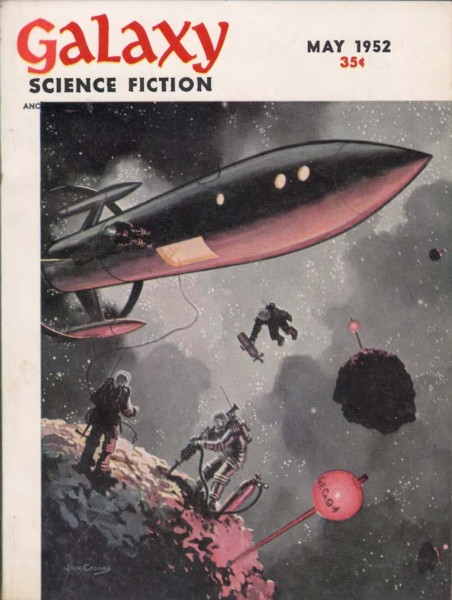
First published in the May 1952 issue of Galaxy Science Fiction. There’s no Phillips collection, but it’s been anthologized a fair number of times, including Gateway to Tomorrow (ed. John Carnell), Second Galaxy Reader of Science Fiction (ed. H. L. Gold), Science Fiction Terror Tales (ed. Groff Conklin), The Great SF Stories #14 (ed. Isaac Asimov and Martin H. Greenberg), In Space No One Can Hear You Scream (ed. Hank Davis), and We, Robots (ed. Simon Ings).
Enhancing Image
The action takes place on a planet which is hostile to organic life, it seems, although not to hostile to, say, mechanical beings. Indeed a race of mechanical life has grown here, or rather has produced and adapted itself for the situation. Palil is a robot, and a robot, so he’s like a robot reporter. There’s a storytelling method that often made the rounds in old-timey SF, and which Phillips uses effectively here, which is the reporter-protagonist-narrator. Such an archetype is common at this point, because it’s useful, although it doesn’t strictly follow the rules of “good” storytelling. Palil is the narrator, which means he’s our eyes and ears for how this society of robots operates, and his profession makes him doubly good (and convenient) for the task. The robots are presumably all male, since they don’t reproduce sexually (they probably also don’t have any idea of romance) and the characters in-story all refer to each other by male pronouns. Personally I wish Phillips had gone a step further and made the robots genderless, but this is a quibble at most, so I’m happy to live with it. The robots at the museum have encountered a problem in the form of a crashed ship, which to the reader should clearly be understood as an escape pod for some human or humans; but to the robots this is not clear at all. Palil and the others have no concept of human life, and they associate metal (as opposed to flesh) with life that they treat the ship itself as if it were a living thing.
Get this description of the ship:
He was thirty-five feet tall, a gracefully tapering cylinder. Standing at his head, I could find no sign of exterior vision cells, so I assumed he had some kind of vrulling sense. There seemed to be no exterior markings at all, except the long, shallow grooves dented in his skin by scraping to a stop along the hard surface of our planet.
To “vrull” is a sense the robots have which Phillips never explains, and for all we know it’s something unique to them.
The robots have nonsensical names like Chur-chur and Fiff-fiff, which come to think of it sound like sounds for machine parts grinding and whirring, as in the reptition of machinery. The human visitor, for his part, calls himself Entropy, although it’s unclear if that’s the name of the ship or somehow the man’s own name. This ties into the basis of the conflict: the fact that the robots don’t actually know what it is they’re trying to help. There’s a heavy dose of dramatic irony here, as we know perfectly well that Entropy is a human inside the ship, but Palil and the others don’t know what a “mann” is or what it looks like. They don’t even have the word for it in their lexicon. Aside from telling us what senses they have, we also don’t get really any descriptions of what the robots look like, so there’s a good choice they might not look humanoid at all. Howard Muller’s interior art for “Lost Memory” runs with this possibility and depicts what looks like a nightmarish scene, in which a bunch of weirdly designed robots are operating over a ship, as if the ship itself were the patient.
Observe:

While they’re able to establish communications, and both parties just so happen to speak “Inglish,” but this does little to help Entropy, who’s trapped inside his ship and who can barely even comprehend what is on the outside. (By the way, it’s a nice touch on Phillips’s part that Palil spells certain words unconventionally, as if they were either not in the robots’ dictionary or the spelling has simply changed over time. It’s a bit of extra effort that Phillips didn’t need to put in, but he did.) There’s speculation that the robots are the descendants of machines constructed by a fallen human astronaut or crew who had come to this planet many decades ago, that while the human(s) died (perhaps by suicide), their intelligent robots have succeeded them. Society has taken root and ultimately flourished here—only it’s not a human society. Indeed humanity doesn’t seem to have any place here, not because the robots are hostile, but because they’ve completely forgotten what humanity even is, hence the title. This is like a response to many earlier SF stories about man’s relationship with robots, in which the latter have come to either idolize or vilify their creators, but regardless there’s a lasting connection between the two, like a parent with an unruly child; whereas in “Lost Memory,” the connection has long been severed. Robots, at least on this planet, have no need for those who made them.
There Be Spoilers Here
The Fermi paradox is a famous question that’s served as inspiration for many good SF stories, even though it’s relatively recent, not becoming “a thing” until the ’60s. The paradox is basically that there is a high likelihood that Earth is not the only planet even in the Milky Way to contain intelligent life, and yet after all these decades we’ve yet to make contact with said life. The universe seems to be overwhelmingly a cold dead place. The robots of “Lost Memory” are all but confirmed to have been created by man, but they’re still an intelligent race not native to Earth, and the story itself plays out like a first-contact narrative. But, while he has made contact with the descendants of a group of intelligent machines, Entropy doesn’t live long enough to appreciate this at all. The “doctor” who breaks open the ship inadvertently kills Entropy, and even if he hadn’t done so directly, there’s very little chance of the human surviving long afterward anyway. This is a case where the reader can easily anticipate the ending, and yet despite the ending being practically a foregone conclusion, the inevitability of it only raises one’s anxiety as we get closer to the end.
A Step Farther Out
I mentioned Ted Chiang earlier as kind of a joke, but “Lost Memory” does unintentionally read like both a distant precursor and counterpart to Chiang’s “Exhalation.” Both have to do with mechanical life overcoming (or failing to overcome) entropy, but either way a price must be paid. Humans are totally absent in “Exhalation,” but in “Lost Memory” the robots meet a member of the race that created them—much to the human’s detriment. The ending is perhaps predictable, to the point of being inevitable, but this is a rare case where the ending being easily foreseen does nothing to ease mind’s mind at the impending horror of it. Phillips is pretty obscure and didn’t write much, but I’ll be keeping an eye on him.
See you next time.

 Science Fiction & Fantasy Remembrance