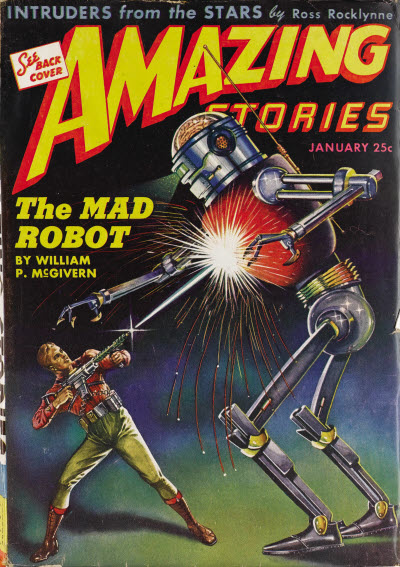
(Cover by Robert Fuqua. Amazing Stories, January 1944.)
What a year, huh? And we just started.
Since a lot of us are snowed in, or at least dealing with some pesky snow and ice (and ICE) in the midst of our everyday activities, we may as well pass the time by cozying up with some good reading. Or maybe not so good. Truth be told, I’m not so sure about the quality of what I’ll be tackling this month, with maybe one exception, the short story. Why yes, it’s been a while (a couple years) since I reviewed and quite enjoyed Philip José Farmer’s story “Mother,” which you may remember as being strange and pretty risqué for early 1950s SF. Farmer did write a sequel, “Daughter,” which from what I’ve heard is just as good if not better. As for choosing the obligatory item from Amazing Stories, to celebrate that magazine’s centennial, I decided to pick something from the rather neglected and maligned ’40s period. At the same time, Ross Rocklynne is not just some hack writer, so we’ll see. It had also been, for my money, too long since I’d scavenged the pages of If, namely for a serialized novel or novella, of which many were published in that magazine. For February it’s all sci-fi and all retro.
Now, there is an announcement I’d been wanting to make here, and maybe should have with last month’s review forecast, but now is as good a time. I recently launched a sister blog on Substack, Sketches from a Reader’s Album, which is not focused on genre fiction at all (although genre fiction will inevitably figure into it on occasion), but is like SFF Remembrance a review blog with the occasional editorial. At least that’s the idea. There I’ll be writing about literary fiction, nonfiction, and poetry, namely books that have won the National Book Award. (The National Book Award is sort of like to the Pulitzer Prize what the Nebula is to the Hugo, if you care for that sort of thing.) With both sites you can expect only so many posts a month, but they’ll be lengthy and hopefully entertaining.
As far as time frames go, we have one story from the 1940s, one from the 1950s, and one from the 1960s. Because I’ll be covering stories published in Amazing Stories in the 1920s and ’30s, we unfortunately will not be getting to more recent stuff until April at the earliest.
For the serial:
Earthblood by Keith Laumer and Rosel George Brown. Serialized in If, April to July 1966. Such a collaboration sounds out of the blue, and honestly I’m not even sure how or why Laumer and Brown came together to work on a novel. But it’s not totally unexpected. Laumer and Brown made their debuts at almost the exact same time, at the tail end of the ’50s, and both were prolific during the pre-New Wave years. They were also very close in age. Sadly Brown died at just 41 years old in 1967, one year after Earthblood was published, while Laumer suffered a stroke in 1971 which left him unable to write for a time. I know little about Earthblood aside from it being an adventure novel, of the sort that was common in If in the ’60s.
For the novella:
“Intruders from the Stars” by Ross Rocklynne. From the January 1944 issue of Amazing Stories. Retro Hugo finalist for Best Novella. Rocklynne is one of those unexpected survivors from the pre-Campbell years, having made his debut in 1935 when he was just 22, and continuing up to the early ’50s before going on hiatus. (Like too many SF writers of his generation he became interested in Dianetics.) He eventually made a comeback in the late ’60s, and even appeared in Again, Dangerous Visions. Despite the Retro Hugo nomination, “Intruders from the Stars” has almost never been reprinted.
For the short story:
“Daughter” by Philip José Farmer. From the Winter 1954 issue of Thrilling Wonder Stories. The SF market in the early ’50s was such that you could get your story published even if it was more daring than average, provided you accepted selling to one of the second-rate magazines. By 1954, Farmer had already become notorious for his novella “The Lovers,” about a sexually explicit (for the time) romance between an Earthman and an alien woman who is more bug-like than she appears. Early Farmer is pulpy in style, but he can be rather big and provocative with his ideas.
(Cover by Jack Coggins. Thrilling Wonder Stories, April 1953.)
Who Goes There?
I don’t know what to make of Philip José Farmer, but in my defense his peculiar place in SF history is partly what has secured his legacy. It’d be easy to say Farmer is a New Wave author, but he’s a whole generation older than the New Wavers and indeed his roots are distinctly pre-New Wave, despite getting started late as a writer. Farmer was already in his thirties when his debut story “The Lovers” was published in the August 1952 issue of Startling Stories, and apparently readers went nuts over it. There was nothing in terms of content (although not style) that quite matched “The Lovers,” as it was rejected by both Astounding and Galaxy for its graphic (for the time) depiction of romance between a human man and an alien woman who appears human enough. Samuel Mines, editor of Startling Stories and Thrilling Wonder Stories, knew he had found a special talent, and Farmer’s first few stories (mostly in Mines’s magazines) led him to winning the Hugo (although nowadays it would be the Astounding Award) for Best New Author. In hindsight this can read as a bit odd, considering Philip K. Dick and Robert Sheckley debuted the same year as Farmer, but the old saying that sex sells was and continues to be true.
The author spotlight for today’s story, “Mother,” labels it as Farmer’s second story, although this would not have been true unless it was the second story Farmer had sold—which is quite possible. Mines singles out “Mother” as being even more transgressive than “The Lovers,” and despite the latter being more famous I think Mines is right; not only does it go into more devious territory than “The Lovers,” it’s also the better story! This is a well-structured and more engrossing tale of first contact, and I’m about to explain why it works in conjunction with Farmer’s Oedipal hijinks.
Placing Coordinates
First published in the April 1953 issue of Thrilling Wonder Stories. I had first heard about “Mother” through its inclusion in the collection Strange Relations, not to be confused with the omnibus of the same title that also includes The Lovers (the novel version) and Flesh. I’ve read The Lovers and Flesh but not any of the stories in Strange Relations, which seem thematically related. Because “Mother” is a very good story it has been reprinted quite a few times elsewhere, most notably in the Farmer tribute collections The Best of Philip José Farmer and The Philip José Farmer Centennial Collection. If you like chunky anthologies there’s also The Science Fiction Century (ed. David G. Hartwell).
Enhancing Image
Paula Fetts and her son Eddie start out as the only survivors of a crash, and things only get worse from there. Paula is a scientist while Eddie, who must be at least in his twenties despite early descriptions of him (more on this later), is a famous opera singer. As with any mother-son relationship where the former pampers the latter, the son is a little maladjusted. Had Eddie lived in pre-Freudian times he could’ve lived the rest of his life as a shameless mama’s boy, but this is modernity and Farmer knows that such juicy material should not be passed up. Eddie is a bit of a hot mess, but Paula, wanting to stay close to her boy, pulls some strings so that her son can accompany her on this latest expedition to a charted but uncolonized planet, on the basis that Eddie’s expertise in opera could be used to study the form on human colonies. “That the yacht was not visiting any colonized globes seemed to have been missed by the bureaus concerned.” There are sprinkles of humor throughout the story and they’re surprisingly effective. For example, the sheer morbidity of Eddie not liking to clean up the gibbed remains of the crew (quite literally bones and tissue from the impact) because he doesn’t like the sight of blood.
Eddie is, at least symbolically, a child in a man’s body.
The expedition ends before it can even start, with Paula and Eddie being left stranded on the alien planet and with only some portable tech and rations to keep them going. While we’re still at this very early part in the story, before we get to the aliens themselves, I wanna talk about Paula and how interesting she is in terms of her function in the narrative. It was rare for a woman to be the protagonist of an SF story at the time, especially in the adventure mode as with “Mother,” and true enough Paula ends up not filling the protagonist role; she’s undoubtedly smart and competent, but we’re only gonna be in her shoes for a minute before the narrative’s perspective changes profoundly and Paula is, quite intentionally, pushed off-stage. It’s also this opening section that the story is at its most conventional before it goes off the rails (in a good way), with Our Heroes™ using radio to try to find some beacon on the planet; but it’s not too long before they unwittingly get themselves ensnared by the story’s real star.
Eddie and Paula get separated, with the POV now suddenly changing to Eddie’s, with the man-child being trapped in what resembles a huge egg turned on its side, the interior of which feels “soft and yielding—something fleshlike and womanly—almost breastlike in texture and smoothness and warmth, and its hint of gentle curving.” Farmer does not beat around the bush much here. (Also, take a shot every time Farmer uses the word “flesh” and its variants.) At first unsure of his surroundings, Eddie comes to find that he’s inside a very large and very motherly alien, itself unable to move but having tentacles so as to have a good reach both inside and outside. These aliens, which resemble boulders on the outside, hence Our Heroes™ not being aware of their nature at first, are in fact highly intelligent and communicative creatures, with the Mother (with a capital M) Eddie’s inside of even being able to talk to him via Eddie’s radio tech. The Mothers talk in a certain frequency, like they’re FM radio sets, which will prove to bode both good and ill for the humans.
The Mothers are the things on which the story hinges, so let’s talk about them. Often writers struggle (or simply don’t try at all) to create aliens that are not just humanoids with blue skin and funny ears, even though, in terms of probability, we’re far more likely to encounter alien life that’s akin to either starfish or an amoeba. Farmer seemed aware of this from the beginning, as the tragedy of “The Lovers” relies on the alien woman appearing to be more humanoid than she really is; but “Mother” goes a step farther by speculating on how a human might mate with an alien that, while sentient, does not look or behave like a human at all. The Mothers are a single-sex race in that all of the Mothers are female; there are no males of the species—not even disposable things that exist as sperm banks. How do the Mothers reproduce, then? Well, these aliens catch males of other species, only they’re not thought of as males, but as “mobiles.” A mobile, to a Mother, is a male, who will spend time in the egg chamber before getting devoured and released into the environment where the cycle will begin anew. “Mobiles were male. Eddie had been mobile. He was, therefore, a male.” This would intrigue if I found it in a story published in the current year, but for something published seventy years ago it’s kind of astonishing.
Okay, so Eddie and Paula will at some point get eaten by their Mothers, but think also about how I said that the Mothers aren’t exactly discerning about what is male and female. Paula is being kept in a fellow Mother and is apparently acting as that Mother’s mate, but while this can be construed as lesbianism on the Mother’s part, the Mother does not register Paula as being female. It’s almost like gender lines are blurry or something. That Farmer was messing around with this in 1953 should earn him a medal (it did get him a Hugo), but that he did so while showing that in only a matter of months he had matured as a storyteller gets him my respect. “Mother” is a novelette, nearly twenty magazine pages, but it feels shorter somehow, even though there’s little action once Eddie gets trapped inside the Mother. The degree to which Farmer explores the alien mindset of the Mothers while also injecting this with humor is admirable.
There Be Spoilers Here
Eddie has spent enough time in the Mother by now that he’s almost become accustomed to it; he has even given his Mother a name, Polyphema, as a sort of mythology gag. Eddie and Polyphema are able to understand each other somewhat, but there were still the problems of a) contacting Paula, and b) escaping. The first gets solved when Eddie’s able to negotiate with Polyphema and talk with Paula from across the aisle, so to speak. While the humans will eventually be eaten as Nature demands, being “semantic” mobiles (in that they’re able to talk with their Mothers) gives their respective Mothers significant prestige among their peers. (Again, while the Mothers are unable to move, they can communicate across considerable distances, and are thus quite talkative, even catty at times.) Paula has a plan to get out of her own Mother (she has no qualms about killing an intelligent alien being that is simply acting according to its nature) soon enough, but Eddie still has to figure a way to get away from Polyphema.
Unfortunately for everyone a bit of miscommunication comes in to deprive of us a happy (i.e., boring) ending. Without thinking Eddie tells Polyphema that Paula, the mobile in the neighboring Mother, is his mother. The mobile is herself female, which strikes Polyphema as a paradox. “Her world was split into two: mobile and her kind, the immoble. Mobile meant food and mating. Mobile meant—male. The Mothers were—female.” When Paula does come Eddie’s way, Polyphema takes her and devours her almost instantly, in which has to be the story’s most shocking moment—even if I anticipated something like this happening. What shocked me even more was the very dark joke to follow Paula’s death, which actually had me cackling a bit. I’m not gonna say it here because it would feel ruined without the proper buildup, but when you see you might feel compelled to do a double take. Farmer can be a real comedian when he feels like it.
Having lost his real mother, and without any chance of escape, let alone finding civilization again, something strange happens to Eddie: he starts to regress, not just mentally but even physically. The longer Eddie stays with the Sluggos (i.e., the pups, who will one day become Mothers themselves) in Polyphema’s sack the more alien he becomes.
He was, in a sense, their father. Indeed, as they grew to hog-size, it was hard for their female parent to distinguish him from her young. As he seldom walked any more, and was often to be found on hands and knees in their midst, she could not scan him too well. Moreover, something in the heavywet air or in the diet had caused every hair on his body to drop off. He grew very fat. Generally speaking, he was one with the pale, soft, round, and bald offspring. A family likeness.
At the beginning of the story a nearby clock goes backwards in time when the ship crashes—doesn’t stop, but goes back. Farmer brings back this little nugget of symbolism at the end when Eddie, having seemingly met the end of his tether, goes back in time in nearly every way possible—back, even, to being like an infant in his mother’s womb. I knew in advance that “Mother” would end with the human protagonist inside an alien womb, in a Freudian returning-to-the-womb bit, but having actually read it now, the context makes the ending much more effective; it even becomes eerie, although given the alternatives the ending could be worse for Eddie. While having lost his real mother, Eddie is able to leave behind the psychic trauma of human adulthood and will probably now spend the rest of his days in the care of an alien surrogate—one who also happens to be the mother of his children. And they say old SF is unsophisticated.
A Step Farther Out
“Mother” feels like a breath of fresh air especially after the last Farmer story I had read, which was “Don’t Wash the Carats,” a New Wave-era story from one of those goddamn Orbit volumes that I found nigh unreadable hippie garbage. I’m not against hippie-dippy literature and I’m not even against Farmer when he does it necessarily, being one of the few people in the world who likes “Riders of the Purple Wage,” but I just like my literature to read like it was deliberately constructed. Not only is “Mother” deliberately constructed but it shows that Farmer was on to some weird shit at a time when most genre authors were playing by the old rules. Its style is pulpy, yes, but it’s clearly written in the adventure mode so as to more effectively subvert expectations we have about old-school first contact narratives. Tts subject matter also points toward a grand liberalization of the field that had neither a name nor a shape yet… but it was on its way.
At the beginning of Moby Dick you may recall that Ishmael looks for seafaring jobs whenever he gets hit with one of his depressive episodes. “Whenever I find myself growing grim about the mouth; whenever it is a damp, drizzly November in my soul…” All that. I normally rotate through short stories, novellas, and serials for my reviews, but there are times when the latter two categories weary me deeply, and I wish to take a break from those more demanding tasks. Back in March I restricted myself to just short stories, and from the pages of Weird Tales more specifically. The timing felt right. I’ve come to realize that to alleviate myself of my review schedule I would do short stories only in March, July, and October of each year. Rest assured that I’ll be reviewing spooky stories for October, just like I did last year and will certainly do next year. But what about July? This is a question that’s been dogging me, because while my review roster for this past March had a theme to it, July proved more challenging.
Some months back I wrote an editorial on the state of SF in 1953, seventy years ago, and how it served as a high-water mark for the field, embodying the very height of the magazine boom—a level of fruitfulness that would not be matched until the 2010s. In the US alone there were over twenty SFF magazines running in 1953, versus less than half that a decade later. You could say the first half of the ’50s was one of the field’s summer periods, when there was this sense that life would never be this large again, nor would the market be this inclusive. It’s an argument I think is worth making, but now I think I’ll argue again—only this time by way of demonstration. We thus have nine short stories, all with 1953 dates, and all from different magazines. I couldn’t even include something from Astounding, which anyway was the least interesting of the Big Three™ at the time. I’m gonna be covering a nice mix of science fiction and fantasy, including a couple authors I’ve not read anything by before—plus a few old favorites.
The short stories are as follows:
“Watchbird” by Robert Sheckley. From the February 1953 issue of Galaxy Science Fiction. 1953 was a boom year for Sheckley, who had debuted in 1952 but who would amass a reputation and a large body of short fiction (something like thirty short stories) in his first full year as an author. Sheckley submitted to every outlet under the sun but he was particularly fond of Galaxy, to the point where he seemed to show up in every other issue of that magazine in the ’50s.
“Night Court” by Mary Elizabeth Counselman. From the March 1953 issue of Weird Tales. Yes, Weird Tales was still around at this point, even if it was no longer the leading magazine for short fantasy (then again, who was in the lead?). Counselman had debuted in Weird Tales a couple decades earlier and she was one of those authors who stayed loyal to it to the bitter end. I was ssupposed to read my first Counselman story back in March, but plans change. Now we start in earnest.
“Mother” by Philip José Farmer. From the April 1953 issue of Thrilling Wonder Stories. Farmer came to the field late, already deep in his thirties, but his first story, “The Lovers” (the novella version), made an immediate splash and helped earn Farmer a special Hugo for most promising new writer. “The Lovers” was transgressive as far as ’50s pulp SF goes, and it’s not surprising that Farmer would later fit in with the New Wave writers, what with the sexual weirdness…
“The Seven Black Priests” by Fritz Leiber. From the May 1953 issue of Other Worlds. Leiber’s one of my favorites, and also one of the most consistent SFF writers of the ’50s and ’60s just ignore The Wanderer, having debuted in 1939 but staying strong almost to the end of his life. “The Seven Black Priests” is a Fafhrd and Gray Mouser story, a sword-and-sorcery tale that oddly enough saw print in the SF-oriented Other Worlds. The early ’50s were not great for fantasy.
“Paycheck” by Philip K. Dick. From the June 1953 issue of Imagination. I know I covered him only a couple months ago, but what can I say, I’m a Dickhead. Like with Sheckley, Dick had debuted the previous year but really showed what he was made of in ’53, with about thirty short stories published that year and with some of them going on to be classics. As with a good deal of Dick’s work, “Paycheck” would serve as the basis for a (not very good from what I’ve heard) movie.
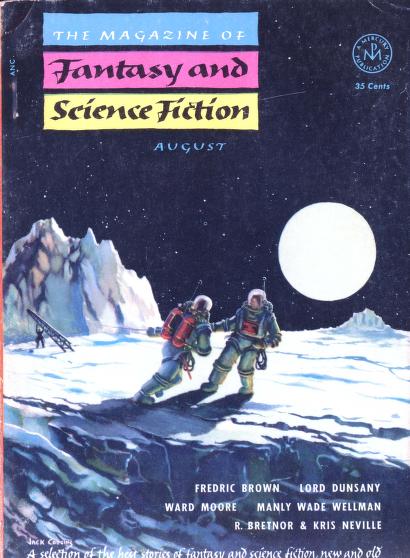
“Captive Audience” by Ann Warren Griffith. From the August 1953 issue of The Magazine of Fantasy and Science Fiction. A certain aquaintance (cough cough) had pointed me toward this one. Griffith apparently wrote her fair share of mainstream fiction, but she only wrote two SFF stories, both in the early ’50s and both in the pages of F&SF. Curious how you’d see authors from outside the genre magazine bubble feel comfy with submitting to F&SF.
“The Goddess on the Street Corner” by Margaret St. Clair. From the September 1953 issue of Beyond Fantasy Fiction. St. Clair is a fairly recent discovery for me, and one who’s quickly becoming a favorite. In the ’50s she was one of the more gifted SFF short story writers—though sadly her sstories are often too short to spend a couple thousand words on. (It gets weird if the review’s length comes close to that of the story it’s covering.) This one does not look so slight.
“Wolf Pack” by Walter M. Miller, Jr. From the September-October 1953 issue of Fantastic. I could theoretically review all of Miller’s short fiction for this site, though that would take about twenty years at the rate I’m going. Miller is known now for A Canticle for Leibowitz, but he also left behind a fruitful body of short fiction (given this all happened in less than a decade). “Wolf Pack” is one of the more obscure stories in an already overlooked oeuvre; it looked appetizing.
“Little Girl Lost” by Richard Matheson. From the Octover-November 1953 issue of Amazing Stories. Matheson is a favorite of mine—and unlike most genre authors of his generation he would make it big as a screenwriter in Hollywood, working in the ’50s onward on a variety of projects from Roger Corman movies to Star Trek. “Little Girl Lost” was one of several Matheson stories adapted (by Matheson himself, in this case) into a classic Twilight Zone episode.
It’s not vacation, because I’ll still be reading and writing as usual, but I’ll be taking time off from novellas and serials. For those who are still in school, summer represents a time for hanging out with friends and going to the beach and whatnot; in other words, doing what you love most with the time you have. The art of the short story is a passion of mine and I wanna take the time to cover more that may be of interest.
Oh, and I changed the site’s name partially. The verbosity of the previous name was getting to me and I hungered for something more straightforward; that and this new one better matches the URL. Anyway…

 Science Fiction & Fantasy Remembrance