(Cover by Frank Kelly Freas. Satellite, December 1956.)
Merry Christmas, happy birthday to me, and all that.
People who keep up with my posts may have noticed that I missed a couple things last month, including what was to be the start of the second serialized novel, Kuttner and Moore’s Fury. Let’s say I’ve been slow about it. Generally I’ve been slower about keeping up with this blog than I was a year ago, and there could be a few reasons for this, but the point is that I’ve come to understand I’m not as on top of my own blog as I once was. I’ve slowed down with the “required” reading, and I’ve been slower about writing, although (not to toot my own horn) I still write here more than some other fan writers I know. Maybe nowadays the load I give myself is just a bit too much, especially since I’ve also been wanting to get into writing professionally, for that bit of extra money, only I’ve not been able to find the time and/or motivation for it. So, I’ll lighten the load a bit. From now on I’ll only be covering one serial a month, regardless of length. Of course, if the serial is four parts or longer this won’t make a difference, but a lot of serials are three-parters, which should give me an extra day to myself. Other than that, it’s gonna be business as usual.
What do we have on our table? All science fiction, which isn’t very diverse, but when these stories were published is certainly more diverse. One story from the 1940s, one from the ’50s, one from the ’60s, one from the ’70s, one from the 2000s, and one from the 2020s.
For the serial:
Fury by Henry Kuttner and C. L. Moore. Serialized in Astounding Science Fiction, May to July 1947. Kuttner and Moore wrote so much, both together and each solo, that they resorted to a few pseudonyms, one of them being Lawrence O’Donnell. Fury takes place in the same universe as the earlier Kuttner-Moore story “Clash by Night.” Despite Fury historically being credited to Kuttner alone, Moore claimed years later to having been a minor collaborator.
For the novellas:
“Welcome to Olympus, Mr. Hearst” by Kage Baker. From the October-November 2003 issue of Asimov’s Science Fiction. Baker had spent much of her adult life working in insurance and with theatre as her primary hobby, before pivoting to writing SF in her forties. No doubt she would still be writing SF today, had she not died all too soon in 2010. Still, for about a dozen years she wrote furiously, with her big series following a team of time-traveling secret agents.
“The Dragon Masters” by Jack Vance. From the August 1962 issue of Galaxy Science Fiction. Winner of the Hugo for Best Short Fiction. This is a reread, although I only have a vague memory of having read it in the first place, and that was without Jack Gaughan’s accompanying artwork. Despite what the title might make you think, “The Dragon Masters” is pure planetary SF, albeit with fantasy-esque coloring that Vance had become known for at this point.
For the short stories:
“An Important Failure” by Rebecca Campbell. From the August 2020 issue of Clarkesworld. Winner of the Theodore Sturgeon Memorial Award. Born and raised in Canada but now living in the UK, Campbell has written only one novel so far, which in fact was her first SF writing of any sort. Good news is she’s been somewhat prolific in writing short stories and novellas over the past decade.
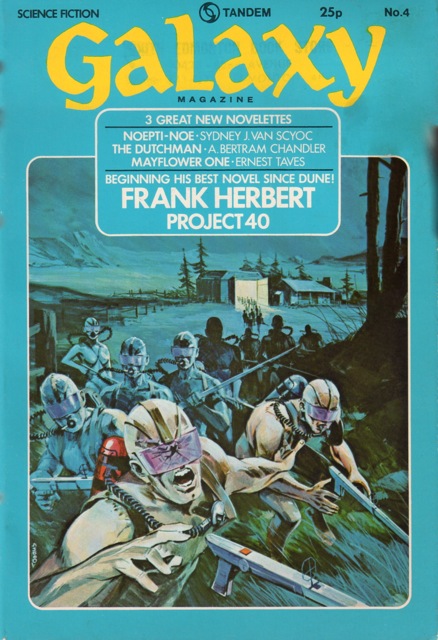
“The Earth Dwellers” by Nancy Kress. From the December 1976 issue of Galaxy Science Fiction. This is the third time now that I’ve come to Kress, and why not? Her career now spands nearly half a century, and her stories, if not always entertaining, often provide some food for thought. I know nothing about “The Earth Dwellers,” except it marked Kress’s very first appearance in the field.
For the complete novel:
A Glass of Darkness by Philip K. Dick. From the December 1956 issue of Satellite Science Fiction. This book sounds unfamiliar, even for seasoned Dick fans, although it may ring a bell under its book title: The Cosmic Puppets. Dick had burst onto the scene in the early ’50s as one of the most promising short-story writers at the time, in a generation that included such bright newcomers as Robert Sheckley, Algis Budrys, and Katherine MacLean. It only stood to reason, then, that while writing short stories nonstop was all well and good, writing a novel was the logical next step. A Glass of Darkness wasn’t the first novel Dick wrote, but it was the first to be published.
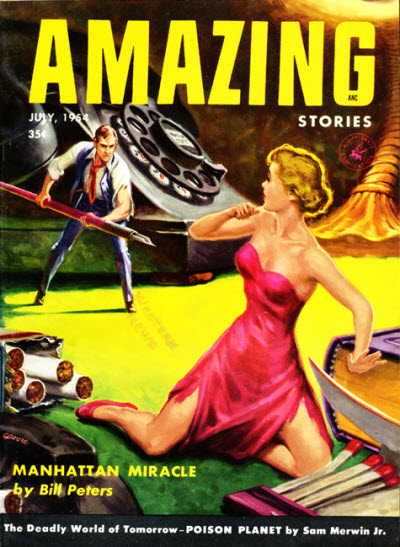
(Cover by Clarence Doore. Amazing Stories, July 1954.)
Who Goes There?
Philip K. Dick is one of the most important SF authors to ever live, and this is despite dying at 53 with a string of failed marriages and financial hardship left behind him. He was the first genre SF writer to get a Library of America volume, preserving some of his novels with fancy hardcover editions. The Philip K. Dick Award, given annually to the best SF novel first published in paperback, is still going to this day. Stanislaw Lem considered Dick to be the only American SF writer at the time (we’re talking the ’60s and ’70s) worth taking seriously. Whereas most authors would see their reputations taken a dent or two in light of certain transgressions, with Dick his mental illness and bad habits (namely his misogynistic streak and toxic behavior with friends, especially later in his life) are part of the “charm” for Dick fans. Indeed the fact that Dick was a hot mess is the name of the game. But before he became one of the most acclaimed novelists in the field he was one of the most acclaimed (and prolific) short story writers. 121 short stories and novellas, about half of which were written over the span of just a few years. “Breakfast at Twilight” is a Cold War parable, and one of the most solid (he wrote several) that Dick wrote.
Placing Coordinates
First published in the July 1954 issue of Amazing Stories. It was then reprinted in the November 1966 issue of Fantastic. For anthology appearances we have Amazing Science Fiction Anthology: The Wild Years 1946-1955 (ed. Martin H. Greenberg). As for Dick collections there are almost too many to count, but the big one is Second Variety, also titled We Can Remember It for You Wholesale and Other Classic Stories, which is the second in the book series collecting Dick’s short fiction.
Enhancing Image
The McLeans are a normal family who live just outside the city. Tim is an accountant, his wife Mary keeps house, and then there are their three kids, those being their son Earl, along with two daughters whose names are not important enough. One fine morning they’re having breakfast and the kids head off to school, only to discover there’s no school to go to—indeed there doesn’t seem to be anyone around for miles. The sky has also gone dark and the air is thick with a mix of fog and ash. Looks like the McLeans aren’t going anywhere after all, and this ends up being doubly the case when a group of soldiers come knocking at their door. The soldiers, unsure of how a house has remained in this landscape intact, accuse the McLeans of being “geeps” in disguise at first, which is to say Soviet infantry. The Cold War has apparently gone hot, with the Soviets having effectively invaded the US via a mix of “geeps” and “roms,” the latter being “robot operated missiles,” what basically amount to armed drones. The captain of the troops considers burning the whole place down with the McLeans inside, given that they don’t have their papers or their masks; but at the same time the whole situation is so inexplicable that the captain decides to call in a “polic” (a political commissioner) to investigate. The McLeans find that their house has somehow been launched seven years into the future, to the year 1980, three years after the Cold War escalated.
(By the way, the introductory blurb in the story’s original appearance is inaccurate, as it says “a hundred years” into the future. This is way off, which makes me think Dick didn’t write it.)
“Breakfast at Twilight” is a nicely self-contained little piece that honestly reads like it could’ve worked just as well for radio or a half-episode TV episode; that it has apparently never been adapted to another medium is a little perplexing. We get one location plus a small group of characters: the McLeans, the soldiers, and then Douglas the political commissioner. Very Twilight Zone vibes with this one, although it was published five years before that series. Dick’s beige prose style works in his favor, as we waste no time in establishing the premise and what’s at stake, and while most of the dialogue is expositional, it’s a lot to digest in only about a dozen pages. Given that Dick wrote quite a few stories about how the Cold War might escalate, he was kind of a pro at this sort of thing; but whereas “Second Variety” and “The Defenders” are from military points of voice, and “The Minority Report” uses policing as an allegory for the Cold War, “Breakfast at Twilight” is more about how civilians might cope with an American that has been all but torn asunder by bombs and boots on the ground. The future that the McLeans see is not that far from where they once were, and understandably they’re horrified not only by the physical destruction of the environment, but the US sliding into fascism in the name of combatting Soviet communism. Dick’s politics were honestly all over the place, but one thing he remained consistent on was being against McCarthyism and general alarmism when it came to the Soviets. The US of the near-future is not only in shambles but has devolved into a fiercely anti-intellectual and utilitarian culture, in which even certain books have been burned publicly (Douglas suggests Tim ditch the Dostoevsky in his library).
The creepiest part is that we have no clue who is even winning in this war, with the implication that whoever comes out on top will have experienced a pyrrhic victory. Earl, who’s depicted as being the most pro-war of the family (that the rash and naive son would be the most enthusiastic is, of course, a dig at ’50s jingoism), asks the soldiers more than once who is winning in this war, and nobody answers him. It’s a big thing that goes unsaid, and while Dick is not the most subtle of writers, he’s capable of some really insightful moments that cut with a trained surgeon’s precision. Now, we get an explanation for how the McLeans’ house got sent forward (or is it backward?) in time, having to do with radio and nuclear radiation, but it’s a nonsensical “sci-fi” thing that’s only there because it has to be. Dick was not a “hard” SF writer in that he was not concerned with the mechanics, or rather he saw the semblance of mechanics as a means to an end. I would take more issue with the SFnal conceit here being more or less arbitrary if the results weren’t worth it. The dilemma the McLeans then face is whether to go with the soldiers and basically become slave labor for a fascist shithole, but at leasr being safe in the short term, or remaining in the house in the slim hope that it might shuffle back to its original point in time before the Soviets are due to bomb the joint tonight. So you’ve got a bad situation vs. possibly an even worse situation, but the McLeans decide to stay.
There Be Spoilers Here
Tim gathers the family in the basement and the family makes it out by the skin of their teeth, with the house being sent back in time spontaneously just like they’d hoped. This in itself is predictable, because like, either their plan was gonna work or it wasn’t. What happens once Tim and his family emerge from the wreckage of their home (everything above the basement had gotten blasted to shit), is however quite different, and also haunting. See, the problem is that while the family narrowly avoided getting bombed, the war that they suddenly found themselves in is still happening in the future; not only that, but the war has already started. It began years ago, only soon it’s gonna go hot. The war is already happening. We then get a kind of internal monologue from Tim, who may as well be Dick’s mouthpiece in this instance, and it’s a good one:
It’s war. Total war. And not just war for me. For my family. For just my house.
It’s for your house, too. Your house and my house and all the houses. Here and in the next block, in the next town, the next state and country and continent. The whole world, like this. Shambles and ruins. Fog and dank weeds growing in the rusting slag. War for all of us. For everybody crowding down into the basement, white-faced, frightened, somehow sensing something terrible.
It’s an ending that’s not as much of a downer as what happens in “Second Variety,” but it’s no less fatalistic. Imagine living in 2018 and suddenly getting sent to 2025, and having to catch up on… more than a few things. Then you’re sent back to 2018. What would you do? Can you do anything to ease the sense of oncoming horror? On paper it’s a standard ending for this type of story, but it’s elevated by Dick’s unique intensity of paranoia, which captures the borderline apocalyptic feeling people were experiencing in the ’50s and at other points.
A Step Farther Out
Dick wrote quite a few short stories that are gimmicky and/or forgettable, but “Breakfast at Twilight” is not one of those. This is a taut and serious-minded story about a future that was quite possible at the time, and even if the Cold War never escalated to a certain point like Dick feared, it’s a paranoia that speaks to any age in which the government and ruling class could screw everyone over at any moment. We are unfortunately being forced to live in “interesting times.” This is also an effective companion piece to “Second Variety,” arguably more so than with “The Defenders,” which Dick had more explicitly written in tandem with that story. Dick’s stories (same goes for his novels) tend to riff on the same basic ideas over and over, so that they can often be compared with each other.
Not much to say this month, except of course it is the start of Pride Month. For me Pride Month is every month of the year, so I don’t put that much significance in it; maybe I would if I went out more, attended some events in my city, which I should probably do. I’m only now realizing, as I’m finishing up this forecast post, that I could’ve also given more space to authors I know to be queer, but oh well. I focus more on old-timey SF (What even counts as “old-timey” at this point, like pre-2000?), and unfortunately there aren’t many confirmed-queer authors from before maybe the ’70s. You’ve got Frank M. Robinson, who was gay. Ditto for Samuel R. Delany. I’ve heard from a respectable source that Theodore Sturgeon was bisexual, but I’ve yet to dig into this and find actual evidence of it. Marion Zimmer Bradley was queer, but she was also a heinous sex criminal so I’m not sure about counting that. Joanna Russ was a lesbian, although I forget when she came out. You can see what my problem is there.
More so I thought about using this month to inject a bit more variety into my reviewing plate, so that it’s not all science fiction. Obviously I have to finish the Zelazny serial, which I’m liking quite a bit so far, but I also got the itch to tackle some sword-and-sorcery fantasy that isn’t Fritz Leiber or Robert E. Howard. Fuck it, John Jakes’s Brak the Barbarian. We’re also finally returning to Brian Aldiss’s Hothouse “series” with the third entry, this “series” being very much science-fantasy rather than straight SF. We’ve got a ’50s Cold War story from Philip K. Dick, who I love, and who in the ’50s seemed preoccupied with the possibility of nuclear annihilation. Relatable. Last but not least I’ve got a cyberpunk novella from Pat Cadigan, who on reflection I think is one of my favorite short fiction writers from the ’80s and ’90s. Then there’s Sonya Dorman, who I know I’ve read a few stories from in passing but I’ve not actively sought her out until now.
Going by decade, we’ve got one story from the 1950s, two from the 1960s, two from the 1970s, and one from the 1990s.
For the serials:
Doorways in the Sand by Roger Zelazny. Serialized in Analog Science Fiction, June to August 1975. Zelazny is one of the most influential SFF writers of all time, his mark being apparent on the likes of George R. R. Martin and (God help us) Neil Gaiman; and yet despite a couple generations of writers (especially those of fantasy) owing a debt to Zelazny, much of his work remains obscure or simply out of print, including this standalone novel.
Witch of the Four Winds by John Jakes. Serialized in Fantastic, November to December 1963. Jakes later found mainstream success writing historical fiction, but his early career was defined by SF and especially fantasy. During the sword-and-sorcery revival of the ’60s Jakes came in with his own sword-swinging hero, Brak the Barbarian. This serial got published in book form under the much worse title of Brak the Barbarian Versus the Sorceress.
For the novellas:
“Fool to Believe” by Pat Cadigan. From the February 1990 issue of Asimov’s Science Fiction. When it comes to naming the architects of cyberpunk the first to come up are William Gibson and Bruce Sterling, but Cadigan was also instrumental in shaping the movement. She had actually made her debut in the late ’70s, but as she did not write her first novel for several years she initially made her name as one of the best short fiction writers in the field.
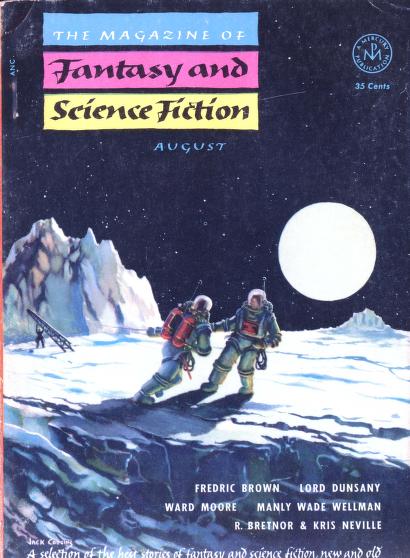
“Undergrowth” by Brian W. Aldiss. From the July 1961 issue of The Magazine of Fantasy and Science Fiction. Aldiss started as a brave new talent in the UK before quickly (much faster than most of his peers, it must be said) making a name for himself in the US. “Undergrowth” is the third Hothouse story, out of five, all of which would then form the “novel” Hothouse. Aldiss won a Hugo for these stories collectively, as opposed to the novel version.
For the short stories:
“Breakfast at Twilight” by Philip K. Dick. From the July 1954 issue of Amazing Stories. In the ’50s, before he turned more to writing novels, Dick was one of the most prolific and awesome short story writers in the field. Not everything he churned out was a hit, but he had a respectably high batting average. Of course it’s very hard for me to be objective with Dick since he’s one of my favorites.
“Journey” by Sonya Dorman. From the November-December 1972 issue of Galaxy Science Fiction. Dorman was a poet as well as a short story writer who only wrote SF sporadically, and mostly for original anthologies, even appearing in Dangerous Visions. Most of her short fiction has been reprinted rarely or not at all, with “Journey” never appearing in book form as of yet.
Philip K. Dick is arguably both the funniest and scariest writer to emerge from the early ’50s genre SF boom. He wanted to write full-time for a living, and as a result he wrote at a mile a minute; he would wrote some 120 short stories, about a quarter of which would be published in 1953 alone. “The Defenders” is one of those stories. I’ll say upfront that this is not top-tier Dick, although it is curious for a few reasons and I do have to recommend it. For one, this was the first Dick story to make the cover of a magazine, hence the memorable Ed Emshwiller illustration. It’s also one of only two Dick stories to get adapted for the SF radio series X Minus One, the other being the bone-chilling (and darkly humorous) “Colony.” “The Defenders” and “Colony” were published in Galaxy Science Fiction, which had partnered with X Minus One such that the latter often adapted stories from the former’s pages. Despite being so prolific in the ’50s, Dick only appeared in Galaxy a handful of times while H. L. Gold was editor, apparently because (as often happened with Gold) the two did not get along. Gold had a reputation for meddling with authors’ manuscripts, and indeed there’s a sense of meddling with today’s story. Gold shouldn’t feel too bad, though: Dick would appear in Astounding only a single time.
Another couple things. “The Defenders” reads like a companion piece to “Second Variety,” which I reviewed a minute ago. Both stories cover basically the same topic, and given that they were published five months or so apart it’s safe to say Dick wrote them in close succession; but apart from having similar premises they’re very different stories. More importantly is that Dick would cannibalize the premise and twist of “The Defenders” for the much later novel The Penultimate Truth, and if you know the twist of that novel then you can safely guess the twist of this story. I won’t say what the twist is here, but it’s not hard to figure out.
Placing Coordinates
First published in the January 1953 issue of Galaxy Science Fiction, which is on the Archive. “The Defenders” wouldn’t see book publication until Invasion of the Robots (ed. Roger Elwood). Other anthology appearances include There Will Be War (ed. John F. Carr and Jerry Pournelle), Battlefields Beyond Tomorrow: Science Fiction War Stories (ed. Martin H. Greenberg and Charles G. Waugh), and Sense of Wonder: A Century of Science Fiction (ed. Leigh Ronald Grossman). It’s also in *checks notes* every other Dick collection you can think of. To make things even better, it’s fallen out of copyright, so you can read it on Project Gutenberg here.
Enhancing Image
The Cold War went hot eight years ago, with Americans and Soviets having since burrowed underground, hunkering in shelters while the robots, “leadys,” continue to fight the good fight on the surface. The humans would do the fighting themselves, but nuclear fallout from the war’s beginning has rendered the surface uninhabitable—we know this because of newsreel footage and newspaper photos taken of the surface, the leadys keeping humanity updated on a war that seemingly has no end point. “Nobody wanted to live this way, but it was necessary.” Don Taylor is part of his bunker’s military personnel, although despite being in touch with the top brass the higher-ups don’t have a better idea of what’s going on aboveground than Taylor does. (I should probably take a moment to mention that Taylor’s wife, Mary, is in the classic Dick mold, in that she’s rather shrewish. Do not do a drinking challenge where you take a shot every time Dick writes a miserable couple wherein the husband has to put up with his unpleasant wife or ex-wife. What do you mean Dick was already divorced once at this point?) The higher-ups sometimes interrogate leadys to get a more direct line to what’s going on above, but this only goes so far. Nobody, at least on this side, has been to the surface in eight years.
The leadys are the most curious part of the story that isn’t the twist, being shown in the Emshwiller cover. They’re called “leadys” because their lead shells protect them from the radiation on the surface, although they have to be decontaminated every time one is brought underground. It’s also unclear just how they work in the ethical sense, since they’re programmed to not knowingly harm humans—or at least humans on the right side of the conflict, depending. This raises the question of what exactly the leadys are good for, aside from maybe fighting other leadys. Dick seems to conform to Asimov’s three laws of robotics, but he doesn’t delve deep into the matter. The humans bring down a leady for questioning one day and find, to their surprise, that the leady is not radioactive, nor does its chassis have the intense heat of radiation. Don and his superiors figure something must be up, although they can’t be sure what, since as far as they’ve been torn war continues to wage on the surface. But then why no radiation? It’ll be risky, but it looks like humans will be going to the surface for the first time since the war went hot—in leaded clothing, of course. Taylor, his superiors, and a platoon of men plan to go up, but a team of leadys tries to stop them—a fruitless effort, given that the leadys are programmed to not kill humans and so have no way to keep them from going through the Tube.
It’s hard to discuss “The Defenders” without also discussing the twist, but I do wanna point out a couple other things. As is typical of Dick’s early work (with exceptions), the characters aren’t really characters in the Shakespearian sense so much as they exist because the narrative demands human players. Moss and Franks, Taylor’s superiors, are basically interchangeable. Past their immediate circumstances we get to learn nothing about these people. But that’s not necessarily a bad thing. Dick would become far more ambitious in psychoanalyzing his characters later on, but even at this very early stage there are a few Dick hallmarks that are comforting for the returning fan, sure, but they also serve a purpose. We know life underground is miserable because despite being in a position of authority, Taylor’s life still kinda sucks. The standard Dick protagonist leads an unfulfilled and claustrophobic existence, and this applies even to characters with power, as if to show the hollowness of wanting to acquire power for the sake of itself. Also, as is typical of Dick, the prose is often beige and economical. “The Defenders” just barely qualifies as a novelette, and it feels even shorter than that. Again, not a bad thing. I would’ve had a worse time with this story, given its setup-twist nature, had it overstayed its welcome. I also wanna say the X Minus One adaptation is perfectly decent, much like the source material; it mostly sticks to the short story, with ultimately inconsequential deviations.
There Be Spoilers Here
In one of his books of genre criticism (I forget which one), James Blish lists “The Defenders” as an example of a story whose very existence hinges on its twist, although he doesn’t elaborate on this particular story. He’s undoubtedly accurate with the call, though. If you read early Galaxy you’ll come across a lot of great short SF—indeed some of the best of its kind, certainly in the context of the early ’50s. There were also a lot of setup-punchline stories, and while these weren’t necessarily bad, they could be tiring. Robert Sheckley made a name for himself at the outset with this type of story, but even then it’s clear that he eventually got tired of the routine. Dick could also fall into this trap, and “The Defenders” might be the most setup-punchline of his story; no wonder it would be printed in Galaxy, with Gold having a fondness (really too fond) for just this type of story. And if you know The Penultimate Truth then you already knew what was coming. It turns out the war had basically been over for almost as long as the humans had been living underground. The leadys had been working on reconstructing the surface world whilst feeding the humans (on both sides) false information. That’s right, fake news was a thing in the ’50s! On the one hand this is very much a Dick idea, one he would even return to later; but the execution and implication tell me that either this twist was half-baked or Dick originally had something else in mind but changed it (or maybe Gold changed it) for the sake of appearing in Galaxy.
To elaborate, if there’s one thing Dick does unconvincingly in my experience it’s a happy ending. I’m thinking of Eye in the Sky, arguably the best of his ’50s novels, which while still being an entertaining and mind-bending read, has a tacked-on happy ending that fails to convince. The leadys destroy the Tube and prevent the team of humans from returning underground, leaving them to cooperate with the Soviets for what will probably be several years. “The working out of daily problems of existence will teach you how to get along in the same world,” the top leady says. This is all swell, but it also assumes the leadys really do have the humans’ best interests at heart, which strikes me as fundamentally uncharacteristic for Dick. Contrast this with “Second Variety,” in which the Cold War goes hot, there’s a nuclear holocaust, but the robots are more sinister there. In “The Defenders” the leadys are like a benevolent dictatorship, or Plato’s philosopher king wrapped in iron. You can see what the problem is. This is really out of step with Dick’s generally ambivalent attitude toward robots and automation at large; it’s like he tried to write an Asimov or Simak robot story. And yet it must be said that the twist on its own is good enough that you could do a lot more with it, so it’s unsurprising that Dick would cannibalize it. Still, I found myself feeling underwhelmed by the reveal.
A Step Farther Out
When Dick started out writing professionally he submitted to seemingly every market in the early ’50s, and with a few exceptions he appeared in nearly every genre magazine that would’ve been active in 1953. Sometimes he phoned it in and sometimes you get the feeling the Philip K. Dick we recognize was still in utero. “The Defenders” is very early Dick and feels less Dick-y than the stories previously covered, and of the three it’s easily my least favorite. I recommend it still, but more as a sign of the time and place in which it was written than as a sign of Dick’s genius; for that I’d point towards “Second Variety,” which as I said earlier starts out very similarly to “The Defenders” but goes in a much darker direction. “The Defenders” is an indicative Cold War SF story that happens to have been written by someone who would move on to bigger and better things—something seasoned Dickheads would not find so impressive.
Not much to say with regards to updates here, other than I’m looking into a tutoring gig and I seem to be starting a polycule, the latter of which I’ve heard is kinda like starting a rock band. If anyone wants to join, please let me know. There are no gimmicks for this month’s review forecast, except that we have a complete novel on our hands for the first time in what feels like forever, and we’ve got a few familiar faces returning to the site. I may have also intentionally picked Lucius Shepard and Aliette de Bodard stories with similar titles. One thing I’ve been thinking about that I’ve decided to act on is reviewing more reprints of classic stories; one every couple months seems like a good deal. The reason for this is at least twofold: I have a soft spot for the classics, but I also wanna cover authors from the pre-pulp years who contributed to genre fiction. This month I’ll be reviewing an SF story by Jack London, who is not known primarily for his SF but who indeed wrote a lot of it. Once again Jack Vance will be providing the novel, which is unsurprising since quite a few of his novels first appeared in magazines, either as serials or all in one piece like this month’s novel.
Don’t wanna keep you long; just letting you know we have another month packed with fiction that looks to be at least interesting, although it’s mostly SF with a couple fantasy stories thrown in.
For the novellas:
“Birthright” by April Smith. From the August 1955 issue of If. Smith sadly is one of many women who wrote SF in the pre-New Wave days whom we know basically nothing about. We don’t know when she was born or when she died. She’s a ghost. She has one solo story, “Birthright,” to her credit, plus one collaboration. ISFDB classifies this story as a novelette, but running the Project Gutenberg text through a word processor shows it’s just over 17,500 words.
“Polyphemus” by Michael Shea. From the August 1981 issue of The Magazine of Fantasy and Science Fiction. Shea had a varied career, lasting from the ’70s until his death in 2014. His work ran the gamut from SF to high fantasy to the Cthulhu Mythos. He won the World Fantasy Award multiple times for his fantasy and horror. His most famous story, “The Autopsy,” is an SF-horror hybrid, and “Polyphemus” looks to be a similar blend of the two genres.
For the short stories:
“The Shadow and the Flash” by Jack London. From the June 1948 issue of Famous Fantastic Mysteries. First published in 1903. London was one of the most popular and prolific authors of the early 20th century, despite dying young. He’s best known for his adventure stories set in the Klondike, such as The Call of the Wild and White Fang, but he also wrote a surprising amount of science fiction.
“The Witch of Orion Waste and the Boy Knight” by E. Lily Yu. From the September-October 2016 issue of Uncanny Magazine. Yu burst onto the scene with her story “The Cartographer Wasps and the Anarchist Bees,” which nabbed her several award nominations. She won the Astounding Award for Best New Writer the same year she graduated from Princeton, which is no small feat.
“The Jaguar Hunter” by Lucius Shepard. From the May 1985 issue of The Magazine of Fantasy and Science Fiction. Speaking of late bloomers, Shepard didn’t start writing fiction as an adult until he was deep in his thirties, but he quickly emerged as one of the defining SFF writers of the ’80s. If you’ve read enough Shepard then you know he has a “type,” and this story looks to be typical Shepard.
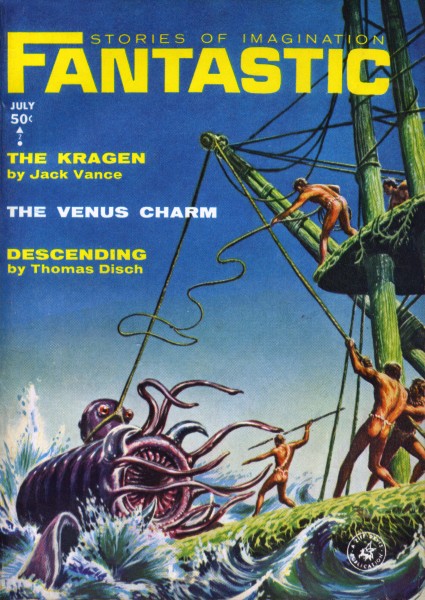
“Descending” by Thomas M. Disch. From the July 1964 issue of Fantastic. Feels like it’s been a long time since I covered Disch, with his novel Camp Concentration. Disch was one of the daring young writers to kick off the New Wave in the ’60s, although despite being a regular at Michael Moorcock’s New Worlds he actually first appeared in Fantastic, under Cele Goldsmith-Lalli’s editorship.
“The Defenders” by Philip K. Dick. From the January 1953 issue of Galaxy Science Fiction. It’s been ten months since I last talked about Dick on here, which in my book is too long a wait. The thing about Dick is that he’s become frankly over-discussed in “serious” SF discussions, or at least his most famous novels. Thankfully this is not the case with many of his short stories, such as this one.
“The Jaguar House, in Shadow” by Aliette de Bodard. From the July 2010 issue of Asimov’s Science Fiction. Of Vietnamese heritage, living in France, and writing predominantly in English, de Bodard has a curious cultural background, so it makes sense she would concoct one of the most curious future histories in modern SF. Spacefaring humanity here is decidedly non-white and non-American.
For the complete novel:
Planet of the Damned by Jack Vance. From the December 1952 issue of Space Stories. The early ’50s were a formative period for Vance, who was showing himself to be one of the most imaginative talents at the time—albeit one whose efforts were mostly relegated to second-rate magazines. I’ve previously coveredBig Planet, which was a breakthrough title for Vance, and now we’re on Vance’s follow-up novel, published just a few months later. Planet of the Damned has a rather convoluted publication history: as with Big Planet, the magazine version and not the first book version served as the basis for future “definitive” reprints. It’s also been printed as Slaves of the Klau and Gold and Iron.
Philip K. Dick started out as a talented and prolific short story writer, honestly one of the field’s best given how old he was and the competition. Dick sold his first story in 1951 but would not get published until the following year (and with a different story), being broke, in his early twenties, having gotten kicked out of UC Berkley, and now getting the bright idea to try writing full-time. By the time of his death in 1982 he had written something like forty novels and 120 short stories, with about a quarter of those being published in 1953 alone. Dick wrote at a mile a minute, which means some of what he wrote was competent but only done to pay the bills. “Paycheck,” today’s story and one that quite shamefully I had never read until yesterday, is a case of Dick boiling the pot, as it were. Despite its banal title, this really is one of Dick’s best short stories. Not waiting to give my opinion on this; it’s just a lot of fun.
Placing Coordinates
First published in the June 1953 issue of Imagination, which is on the Archive. What’s shocking to me is that “Paycheck” has never been anthologized in English, and also that despite being printed in a long-defunked second-rate magazine it’s not in the public domain; if you wanna read it you’ll have to read a magazine scan or find a Dick collection that has it. The good news is that there are many Dick collections and “Paycheck” is likely to be in any one of them, most notably Ballantine’s The Best of Philip K. Dick and The Philip K. Dick Reader.
Enhancing Image
Jennings is your typical working man, now finishing his two-year contract as a mechanic at Rethrick Construction—only he can’t remember what had happened during those two years. Not a minute of it. Nothing about his job, not even what he did outside of his job in all that time. Turns out Jennings got his memory wiped by the company, standard procedure, nothing to see here. This is troubling in itself, but things only get weirder once Jennings receives his pay, which is supposed to be an envelope with 50,000 credits. (I assume this is supposed to equate to a lot for two years’ labor in 1953 money.) Another weird thing, and just as concerning: the money isn’t there. Apparently Jennings, after starting his contract, chose an alternative over the conventional payment, and rather conveniently Jennings doesn’t remember doing that either. Hmmm.
Inside the envelope are seven items which normally would have little to no value: “A code key. A ticket stub. A parcel receipt. A length of fine wire. Half a poker chip, broken across. A green strip of cloth. A bus token.” Why would Jennings, in the past, have picked these specific things over 50,000 credits that he really could’ve needed? This baffles Jennings post-memory wipe, but there’s nothing he can do about it. He gets caught up on how things have changed in the two years since the start of his contract. The US has become a bit more authoritarian, with the Security Police patrolling city streets and keeping a close eye on the populace. This is also a future where I guess commercial flight never took off and instead we have “inter-city rockets,” which is one of those funny things that shows Dick had several talents but predicting future tech is not one of them.
At least Kelly, the company secretary, is nice.
Jennings leaves his job with his trinkets and hardly a minute passes before he gets picked up by SP goons, who are very curious about what he did for Rethrick Construction. Not being much of a fighter, Jennings would tell the cops what he knows—if only he knew anything. The memory wipe seems to have been a security measure for Rethrick, with even its employees being shut off from secret doings. It’s unclear what the SP are gonna do with Jennings, since they can’t get much info out of him, but the outcome will probably be grim; therefore escape sounds like a good idea. Jennings reaches into his pocket and pulls out the wire—of just the right length and material to pick locks and hightail it out of the SP building. But to go where? The SP probably know where he lives. If he’s to survive he’ll have to become a fugitive, or return to Rethrick.
Ah, but that bus ticket…
Bus to where? Does it matter? Possibly. Two of the items have been used and so far they’ve been shockingly useful. Jennings in the past must’ve requested these items for a specific reason, except that Jennings in the present can only guess as to their purpose. Surely it can’t be a coincidence. Something I wanna point out is that “Paycheck” reads like a compressed novel; it’s 13,000 words, a hearty novelette, but there’s enough suspense here to fuel a whole novel, only Dick comes from a generation of SFF writers that doesn’t believe in wasting the reader’s time. The only reason it took me two days to get through it is because I’ve been working since Thursday, so my time has been limited. If I had a whole day to myself I would’ve blazed through “Paycheck” in one sitting. In less than ten pages we’re introduced to a flamboyant future America, a likeable protagonist who’s not movie star material but still talented, and a plot that, once it kicks into motion, never ceases to intrigue me. And we’re just getting started.
Jennings realizes that the only real choice he has is to return to Rethrick Construction—only he doesn’t even remember where his own workplace was; he had been taken to a separate building, far away from the actual plant, to receive his payment. At the very least if he can find where the plant is he might be able to get hired again and hide from the SP, as while the SP can do many things they cannot interfere with business unless there’s an exception. This is an action narrative, but there are still a few nuggets of commentary from Dick, including a rather incisive moment where Jennings ponders that in the modern world it’s no longer the separation between church and state that divides man, but the separation between state and business. “It was the Government against the corporation, rather than the State against the Church. The new Notre Dame of the world. Where the law could not follow.” This rings true especially in the present day, but keep in mind that in the years following World War II Dick and his contemporaries would’ve seen an intense expansion of commercialism in American life. Capitalism had started to hit the fast-forward button.
Of course, as far as both Jennings and Dick are concerned the government is a bigger threat to human freedom than some company, even if said company memory-wipes its employees so that they don’t snitch to the competition or some third party. The memory-wiping thing would probably be used for more foreboding ends if used in a modern narrative, but here it’s little more than a pretext for Jennings to have a conversation with his past self. I won’t say there’s time travel here, but without getting too much into spoilers just yet there is a reason why Jennings is able to use the items he gave himself just when and where he needs them. Clearly these items were obtained in the past, but there’s no way Jennings could have discerned their usefulness without clairvoyance—or a time machine. This raises another question: What the hell could Rethrick be building, especially since they’re so keen on secrecy? The plot only thickens more when Jennings catches up with Kelly, who may or may not be just a secretary.
One more thing before we barrel into the back end of the story. “Paycheck” was published in the June 1953 issue of Imagination, but it was probably written a full year earlier, during the height of McCarthyism. Some editors in the field were squeamish about publishing material that criticized McCarthy and other anti-communism fanatics, but some stories slipped through the cracks. Jennings and Kelly have a bit of an argument where Kelly says that anyone who’s against the SP must be on the side of good, to which Jennings says, “Really? I’ve heard that kind of logic before. Any one fighting communism was automatically good, a few decades ago.” Dick was not a leftist, but he did have several leftist friends; in some ways he was a fellow traveler, although he did have hangups like his misogyny and anti-abortion stance. “Paycheck” does not indulge in misogyny like some other Dick narratives: Jennings is a bachelor, so minus the shrewish wife (or ex-wife) often found in Dick’s works, and Kelly, while not a three-dimensional character, is by no means a pushover.
There Be Spoilers Here
Using the parcel receipt to find the town where the plant is probably near and the green strip of cloth to disguise himself as a plant worker (well, he was a plant worker, after all, if only in the past tense), Jennings is able to retrace his steps and infiltrate the Rethrick plant, which of course is set in the middle of fucking nowhere—like a nuclear testing site. The narrative, which had hints of espionage up to this point, becomes practically a spy thriller once Jennings gets inside the plant with hopes of acquiring photos of schematics and blueprints. He has a theory about what’s being built here, but he needs to know—which might well spell his doom. Admittedly, and I have say unexpectedly, this section of the story is the least engrossing if I had to pick a weak spot, if only because this section reads like something out of a rather non-SF spy thriller and we already have a lot of those. Dick probably could’ve made more money writing spy thrillers, but he was too creative and thoughtful to be tied down like that.
This may be obvious to some, but Rethrick has in fact been working on a “time scoop,” or a time viewer as I’m gonna call it—a machine that can see into the future. “Like Berkowsky’s theoretical model—only this was real.” There are some questions that might arise when reading “Paycheck” if you stop and think, but the big one, how Jennings was able to predict his own future predicament, gets thoroughly answered. You may also be thinking, “If Rethrick has a time viewer then how come they haven’t been able to track Jennings’s movements?” Also answered: the time viewer had been sabotaged—by Jennings. The mad bastard snuck peeks at the machine and then fiddled with it such that even the company’s other top mechanics have so far been unable to get it working right again. His past self apparently had everything thought out; even the poker chip, broken in half, saves Jennings’s skin as he pretends to be a gambler who’s simply lost his way after curfew. Even the big twist, that Kelly is actually the daughter of Rethrick himself and that she planned to betray Jennings this whole time, gets accounted for. Is there anything this man cannot do…?
Turns out Rethrick is a family-owned business, with the ending implying that Jennings and Kelly will marry and that by extension Jennings will eventually take over the company. Kelly, despite being more loyal to her father than to Jennings, is implied to have had a fondness for Jennings when he worked at the plant; and even if that were not the case, I would be so impressed by Jennings’s gambit that I might just marry him anyway. Dick stories often have endings that are bleak, darkly comical, confusing, or all three at once, but “Paycheck” might have the most triumphant ending of any Dick story. I would gripe about the happy ending, as I did when I read Eye in the Sky and found that novel’s ending unconvincing, but here the victory had been alluded to almost from the beginning; indeed Jennings coming out on top is the point of the story. Dick wanted to write a story about how a man can save his own life, and even change it for the better, using everyday items that would seemingly be of no consequence; that he also wrote a great action narrative is the big cherry on top.
A Step Farther Out
Not sure if this is a hot take, but I think “Paycheck” deserved a Retro Hugo nomination more than “Second Variety.” In terms of Dick-penned action, “Paycheck” is a blockbuster only seriously topped by the second half of Ubik. Even when he’s unsure as to where a plot is going, Dick is supernaturally adept at pushing the reader from one set-piece to another with such swiftness that we can often forgive the inconsistencies—only “Paycheck” has to be one of the most tightly knit of Dick’s short stories. In a way it’s a power fantasy par excellence, pitting an unassuming but quick-witted man against a system that struggles to keep up with his maneuvers; in another way it has commentary that foreshadows Dick’s novels while also just so happening to feature a level of badassery that’ll have you cheering. Can’t wait to see how the Ben Affleck movie fucks it all up.
At the beginning of Moby Dick you may recall that Ishmael looks for seafaring jobs whenever he gets hit with one of his depressive episodes. “Whenever I find myself growing grim about the mouth; whenever it is a damp, drizzly November in my soul…” All that. I normally rotate through short stories, novellas, and serials for my reviews, but there are times when the latter two categories weary me deeply, and I wish to take a break from those more demanding tasks. Back in March I restricted myself to just short stories, and from the pages of Weird Tales more specifically. The timing felt right. I’ve come to realize that to alleviate myself of my review schedule I would do short stories only in March, July, and October of each year. Rest assured that I’ll be reviewing spooky stories for October, just like I did last year and will certainly do next year. But what about July? This is a question that’s been dogging me, because while my review roster for this past March had a theme to it, July proved more challenging.
Some months back I wrote an editorial on the state of SF in 1953, seventy years ago, and how it served as a high-water mark for the field, embodying the very height of the magazine boom—a level of fruitfulness that would not be matched until the 2010s. In the US alone there were over twenty SFF magazines running in 1953, versus less than half that a decade later. You could say the first half of the ’50s was one of the field’s summer periods, when there was this sense that life would never be this large again, nor would the market be this inclusive. It’s an argument I think is worth making, but now I think I’ll argue again—only this time by way of demonstration. We thus have nine short stories, all with 1953 dates, and all from different magazines. I couldn’t even include something from Astounding, which anyway was the least interesting of the Big Three™ at the time. I’m gonna be covering a nice mix of science fiction and fantasy, including a couple authors I’ve not read anything by before—plus a few old favorites.
The short stories are as follows:
“Watchbird” by Robert Sheckley. From the February 1953 issue of Galaxy Science Fiction. 1953 was a boom year for Sheckley, who had debuted in 1952 but who would amass a reputation and a large body of short fiction (something like thirty short stories) in his first full year as an author. Sheckley submitted to every outlet under the sun but he was particularly fond of Galaxy, to the point where he seemed to show up in every other issue of that magazine in the ’50s.
“Night Court” by Mary Elizabeth Counselman. From the March 1953 issue of Weird Tales. Yes, Weird Tales was still around at this point, even if it was no longer the leading magazine for short fantasy (then again, who was in the lead?). Counselman had debuted in Weird Tales a couple decades earlier and she was one of those authors who stayed loyal to it to the bitter end. I was ssupposed to read my first Counselman story back in March, but plans change. Now we start in earnest.
“Mother” by Philip José Farmer. From the April 1953 issue of Thrilling Wonder Stories. Farmer came to the field late, already deep in his thirties, but his first story, “The Lovers” (the novella version), made an immediate splash and helped earn Farmer a special Hugo for most promising new writer. “The Lovers” was transgressive as far as ’50s pulp SF goes, and it’s not surprising that Farmer would later fit in with the New Wave writers, what with the sexual weirdness…
“The Seven Black Priests” by Fritz Leiber. From the May 1953 issue of Other Worlds. Leiber’s one of my favorites, and also one of the most consistent SFF writers of the ’50s and ’60s just ignore The Wanderer, having debuted in 1939 but staying strong almost to the end of his life. “The Seven Black Priests” is a Fafhrd and Gray Mouser story, a sword-and-sorcery tale that oddly enough saw print in the SF-oriented Other Worlds. The early ’50s were not great for fantasy.
“Paycheck” by Philip K. Dick. From the June 1953 issue of Imagination. I know I covered him only a couple months ago, but what can I say, I’m a Dickhead. Like with Sheckley, Dick had debuted the previous year but really showed what he was made of in ’53, with about thirty short stories published that year and with some of them going on to be classics. As with a good deal of Dick’s work, “Paycheck” would serve as the basis for a (not very good from what I’ve heard) movie.
“Captive Audience” by Ann Warren Griffith. From the August 1953 issue of The Magazine of Fantasy and Science Fiction. A certain aquaintance (cough cough) had pointed me toward this one. Griffith apparently wrote her fair share of mainstream fiction, but she only wrote two SFF stories, both in the early ’50s and both in the pages of F&SF. Curious how you’d see authors from outside the genre magazine bubble feel comfy with submitting to F&SF.
“The Goddess on the Street Corner” by Margaret St. Clair. From the September 1953 issue of Beyond Fantasy Fiction. St. Clair is a fairly recent discovery for me, and one who’s quickly becoming a favorite. In the ’50s she was one of the more gifted SFF short story writers—though sadly her sstories are often too short to spend a couple thousand words on. (It gets weird if the review’s length comes close to that of the story it’s covering.) This one does not look so slight.
“Wolf Pack” by Walter M. Miller, Jr. From the September-October 1953 issue of Fantastic. I could theoretically review all of Miller’s short fiction for this site, though that would take about twenty years at the rate I’m going. Miller is known now for A Canticle for Leibowitz, but he also left behind a fruitful body of short fiction (given this all happened in less than a decade). “Wolf Pack” is one of the more obscure stories in an already overlooked oeuvre; it looked appetizing.
“Little Girl Lost” by Richard Matheson. From the Octover-November 1953 issue of Amazing Stories. Matheson is a favorite of mine—and unlike most genre authors of his generation he would make it big as a screenwriter in Hollywood, working in the ’50s onward on a variety of projects from Roger Corman movies to Star Trek. “Little Girl Lost” was one of several Matheson stories adapted (by Matheson himself, in this case) into a classic Twilight Zone episode.
It’s not vacation, because I’ll still be reading and writing as usual, but I’ll be taking time off from novellas and serials. For those who are still in school, summer represents a time for hanging out with friends and going to the beach and whatnot; in other words, doing what you love most with the time you have. The art of the short story is a passion of mine and I wanna take the time to cover more that may be of interest.
Oh, and I changed the site’s name partially. The verbosity of the previous name was getting to me and I hungered for something more straightforward; that and this new one better matches the URL. Anyway…
With most authors I’ve covered they’re either new to me or I don’t know enough about them to get really nostalgic and defensive about their work; unfortunately I won’t have that vantage point with Philip K. Dick. Spoilers in advance, but it’ll be virtually impossible for me to pretend to be objective about Dick, who has been for a good decade one of my top five favorite authors—inside or outside of genre fiction. I had read “classic” science fiction before but Dick was the one who turned me into an addict. You could say I like Dick a lot. From his debut in 1952 to his untimely death in 1982, Dick pushed the boundaries of what was possible in SF writing, evolving over three decades into someone who still remains a unique voice in the field—despite all the folks who owe a debt to him. He’s also, perhaps not incidentally, a perennial favorite for academics and fanboys with degrees in the growing department of science fiction studies.
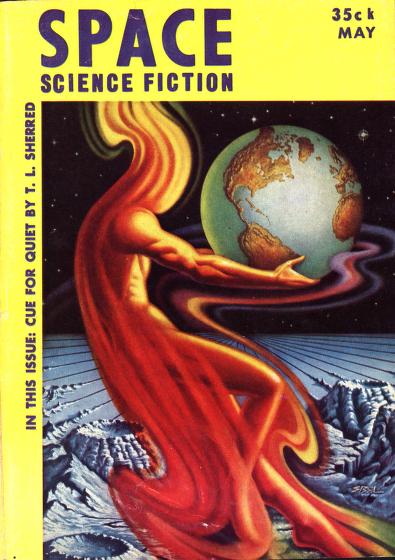
Before he became one of the field’s top novelists, though, Dick started out as one of the best and most prolific of short story writers; in what was in hindsight a short time span (most of his short fiction was published before 1960), Dick sold dozens of short stories a year during his peak, with something like thirty short stories being published in 1953 alone. I don’t think even Robert Sheckley wrote this much in a single year. Yes, 1953 was a boom year for Dick, and today’s story, “Second Variety,” might be the most famous to come out of that batch, garnering a Retro Hugo nomination for Best Novelette and coming close to winning—only losing to James Blish’s “Earthman, Come Home.” Truth be told, I always found the Blish story hard to digest without prior knowledge of his Cities in Flight series, whereas Dick’s story very much works on its own terms.
Placing Coordinates
First published in the May 1953 issue of Space Science Fiction, which is on the Archive. If I was to go through every time this story has been collected and anthologized we’d be here all day, so I’ll restrict myself to reprints that are in print, since even then you have several options. First, if you want a free and accessible version that’s not a legal grey area, good news, somehow “Second Variety” fell out of copyright a while ago and now you can read it perfectly legit on Project Gutenberg, link here. I do recommend reading a copy that doesn’t include interior illustrations, as while the ones by Alex Ebel for the magazine publication (and on Gutenberg) are nice, they also allude to the two biggest twists in the narrative. For book reprints the best choices would be Selected Stories of Philip K. Dick, The Philip K. Dick Reader, and The Early Science Fiction of Philip K. Dick. As for myself I also have The World Treasury of Science Fiction, a typical David G. Hartwell anthology in that it is fucking massive; proceed with caution.
Enhancing Image
Earth is fucked. The Cold War between the Americans and Soviets has long since gone hot and pretty much the whole planet has been rendered unhabitable. The American government, now in exile, has retreated to Earth’s moon. How they managed to build a moon base is beyond me. Meanwhile nearly the whole human population has either died or gone off-planet. “All but the troops.” Even the military is no longer organized, “a few thousand here, a platoon there,” with the only thing giving the soldiers a sense of cohesion being comms with the moon base. We start in one of the bunkers that are surely scattered throughout the scarred landscape, with Major Hendricks as our protagonist—a disciplined but otherwise unexceptional man who will prove to be our eyes and ears for the hell we’ll witness.
A Russian troop runs across the battlefield with a message (unbeknownst to the Americans) before getting killed and torn apart by a pack of claws—little robots that have enough agility and raw steel to slash a man’s throat. The Americans wear badges that prevent the claws from going after them, as they should, considering the claws will go after anything that’s organic; even the rats that populate the trenches and holes of the ruined earth sometimes get caught up a claw’s blades. The Russian’s message reads that the Russian encampment is looking to make peace with the Americans, a call for a cease fire that naturally the Americans are skeptical about. One soldier needs to head over to the Russian base to agree to peace. Simple enough. Hendricks volunteers and the plot, such as it starts, is a simple point-A-to-point-B mission, assuming the claws never mistake Hendricks for the enemy and assuming the Russians don’t get themselves killed by then…
Some backstory…
The Americans were losing the war, and badly; thus a super-weapon was needed to push back the enemy, and in this case the Americans got the bright idea to build the claws. Now the claws aren’t just killer robots: these are robots that are not only rabidly bloodthirsty but also granted enough cognitive capacity to be able to reproduce themselves, in that they’re able to run their own factories where they can build and program more claws, independent of human input. Since the top brass couldn’t figure out a way to program faction loyalty into the claws (an RPG, after all, cannot know anything about nationalism), they’re designed to go after anything that moves, making them not-too-picky killers.
Hendricks leaves, but en route to his destination he comes across a boy with a teddy bear who has apparently been surviving on his own. So, the boy is named David and he has a teddy bear. Did Brian Aldiss take inspiration from “Second Variety” when writing “Super-Toys Last All Summer Long,” or is this one of those weird coincidences? Anyway, Hendricks takes the boy under his wing until they’re stopped by a pack of what appear to be Russian soldiers, who at first seem to take aim at Hendricks—only to shoot David, blowing him to metal pieces and revealing him to have been a claw in disguise. Hendricks has unwittingly almost let a claw into the bunker with him, having mistaken the robot for a human. It wass a good job too; other than some strange behavior that can be explained by the fact that people become unhinged when put in isolation, the claw convinced the jaded military man that it was a real boy for a time. The blurring of the line between the real and fraudulent is a theme Dick will return to many times over his career, and while “Second Variety” was not even the first example of this, it was, along with “Colony,” an effective use of the theme to invoke horror.
Speaking of which, I did say that I’d prefer you read a version that doesn’t come with illustrations, but I’ll allow the first of Ebel’s interiors, which gives away David being a claw but which I think still properly conveys the eeriness of the claws starting to replicate humanity. This is a reminder that much of what Dick wrote can be classified as horror, even though Dick is never talked about as a horror author—probably because, in the hierarchy of genres, horror, for Dick, always came second to science fiction. The two genres have had a symbiotic relationship since the days of Mary Shelley, but that’s a lecture for another time. Like I said, Ebel’s work is good.
Hendricks meets up with a small group of survivors—some Soviet troops who have been cut off from headquarters. The implication, of course, is that there’s no longer any headquarters to get in touch with. The survivors are Rudi, Klaus, and Tasso, the last of these being a young woman whose relationship with the others is unclear. It’s here, in temporary safety (but are we really safe), where we get a further explanation of the claws, including the humanoid varieties, of which “David” is one. Variety I (mind the Roman numberals) is the Wounded Soldier, Variety III is the David, but nobody’s yet found what Variety II would be—hence the title. The idea behind the varieties seems to be not just extermination but infiltration, with claws posing as humans so as to make real humans let their guard down. Apparently the varieties were not the Americans’ idea…
The claws are evolving; not only can they make more of themselves but they’re producing new models, with the varieties even being immune to the badges the American troops wear. Nobody is safe anymore. “It makes me wonder,” says Hendricks, “if we’re not seeing the beginning of a new species. The new species. Evolution. The race to come after man.” It’s possible for a David or a Wounded Soldier to trick an American bunker into being let in, which does not bode well for Hendricks when he eventually has to get back to HQ. Ah, but as long as the claws don’t get to the moon base…! Not to spoil things, but if you’re looking for an optimistic take on mankind’s future you make wanna look elsewhere is all I’m saying.
A lot happens in “Second Variety,” which at first glance, going by page count, looks like a novella, but with a lot of scene breaks and short punchy bits of dialogue it turns out to be not as long as it looks. Still, this is a long novelette at 15,000 words, and Dick demonstrates his mastery of economical writing by keeping the pace of the narrative at a pop-pop-pop rhythm, only giving us a single lengthy infodump towards the beginning before letting short bursts of action and dialogue speak for themselves. It’s still a long story, but given how much Dick crams in here it’s a lot of bang for one’s buck. We spend enough time in the bunker with the survivors in the story’s midpoint that we’re lulled into a sense of security—which proves to be very false indeed. Everything goes to SHIT after this point, let’s see how.
There Be Spoilers Here
The party starts to dwindle. Klaus kills Rudi on the suspicion that Rudi is a claw—or so Klaus claims. Turns out, judging from the organic remains, Rudie was not a claw, but the damage has already been done. Personally I would take this as a huge red flag with regards to Klaus, but for the time being he has plausible deniability. SURPRISE, Klaus is a claw too, only stopped from killing Hendricks as well thanks to an EMP bomb that Tasso carries, which would only really be useful against claws. You’d think this would absolve her of being a claw herself, but there’s one little problem with that: Tasso is the second variety. More successfully than David and even Klaus, Tasso manages to trick Hendricks into thinking she’s human until it’s too late to stop her. I wanna point out that this is not as much of a shock if you’re reading the magazine version or on Gutenberg, where we get an illustration showing a woman-shaped robot well before the reveal, but I also have to admit that the foreknowledge of Tasso’s nature does little to lessen the impact.
Not that Dick’s stories tend to have happy endings, but “Second Variety” has to have one of the bleakest. Hendricks has just unwittingly let a claw take a ship to the moon base where the last of the American faction will probably get annihilated. As he’s fending off an army of claws and bleeding out he reflects back on the anti-claw bomb Tasso used on Klaus, and we get one of the most haunting final lines in a ’50s SF story: “They were already beginning to design weapons to use against each other.” A charitable reading of the ending is that the claws may destroy each other, having rid themselves of humanity at last, but Dick may also be implying that the end, for better or worse, is not yet. There will be no clear end to the destruction. There are quite a few post-apocalypse narratives that sprouted following the end of World War II, but unlike those other stories, wherein the fighting has more or less stopped at least, humanity being in too much a state of disarray to make matters worse, the ruined world of “Second Variety” continues to degrade itself, with machines simply continuing humanity’s “work.”
A Step Farther Out
Admittedly part of the fun of reading “Second Variety” is understanding the historical context behind it, because this is a Cold War story from start to finish. I actually watched Screamers, which is loosely based on this, the other day, and it just didn’t have the same punch—in part because it lacked the background of Cold War paranoia. In fairness to the filmmakers, Screamers came out in 1995; the Soviet Union had collapsed a few years prior. Sure, the claws are creepy, but the overall creepiness in the short story is greatly amplified by the constant uncertainty of things. We managed to stop the real Cold War from going hot, but in the ’50s it must’ve been easy to imagine the worst-case scenario, resulting in one of Dick’s bleakest narratives. And I’m here for it! Of Dick’s short stories, “Second Variety” is one of the most memorable that I’ve read; I suspect it didn’t find its way into any of the major magazines because a) Dick was too prolific at this point, and b) the story was too dark, at a time when editors—even the more liberal ones—preferred happy endings. Really it was their loss.
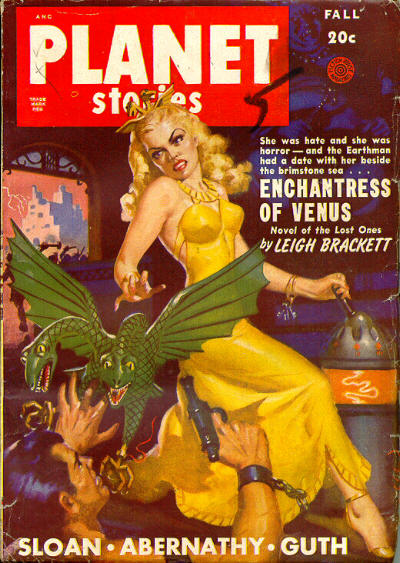
(Cover by Allen Anderson. Planet Stories, Fall 1949.)
This will turn out to be a busy month for me. I’m gonna be a guest on one or two podcasts/streams with some people I very much respect, and I’ll also be flying out of my Jersey/Pennsylvania bubble to visit some friends I rarely ever get to hang out with in person. On the one hand this is all more eventful than what I usually deal with, but also I’ll have a bit less time to manage this site—which won’t stop me from putting in as much effort as I usually do. It’s draining sometimes, but that is how passion works.
My personal life is gonna be busy, but also my review lineup is FILLED for May: we’ve got two serials, two novellas, two short stories, and finally a complete novel—our first one in six months. I know, the gap between novel reviews looks to be wide, but mind you that there aren’t too many of these “complete” novels in the magazines.
One more thing: I mentioned in a past editorial that I think very highly of 1953 as a year when SFF flourished, in general and especially in magazine publishing, which was experiencing a bubble we would not see again until… now, basically. Strangely, I haven’t before covered ANYTHING from that year, so to compensate we’ve got two stories from 1953 in the lineup. 1953 was such a banger that I could probably get five years out of just reviewing everything that was published then.
Enough wasting time, though, let’s see what we have.
For the serials:
All Judgment Fled by James White. Serialized in Worlds of If, December 1967 to February 1968. White is an author I’ve not read a single word of (or at least I think) up to this point, and given his philosophy with storytelling this feels a little criminal to me. When planning this post I flip-flopped between All Judgment Fled, Second Ending, and The Dream Millennium for my first White, since all three sound appealing, and ultimately went with this because I’ve also been meaning to tackle something—anything—that was published in If.
Sos the Rope by Piers Anthony. Serialized in The Magazine of Fantasy and Science Fiction, July to September 1968. Yes, that Piers Anthony. He actually appeared regularly in the genre magazines early in his career, when he was a promising young writer and people did not yet know the horrors he was about to unleash on the world. My only prior Anthony experience was the short story “In the Barn,” and let me tell you… that’s the kind of thing that puts you off an author for years. But maybe Sos the Rope, his second novel, will be good!
For the novellas:
“The Rose” by Charles L. Harness. From the March 1953 issue of Authentic Science Fiction. Retro Hugo nominee for Best Novella. Harness is one of those recent discoveries of mine that I’ve been meaning to explore further—made easier because Harness was not that prolific a writer; when he wrote he was fairly productive, but then he would vanish for several years. Harness apparently struggled to find a publisher for “The Rose” in the US, having to jump across the Atlantic and submit it to a filthy British magazine.
“Enchantress of Venus” by Leigh Brackett. From the Fall 1949 issue of Planet Stories. Brackett is now most known for her part in the messy scripting process for The Empire Strikes Back, for her collaborations with director Howard Hawks, and for the rather unchararcteristic novel The Long Tomorrow. Much of Brackett’s fiction, however, is planetary romance a la Edgar Rice Burroughs, complete with swashbuckling antics. “Enchantress of Venus” is one of several stories starring Eric John Stark, the barbarian hero for the space age.
For the short stories:
“Second Variety” by Philip K. Dick. From the May 1953 issue of Space Science Fiction. Retro Hugo nominee for Best Novelette. Not that I try to hide my biases anyway, but Philip K. Dick is one of my top five favorite authors—and he ain’t #5 on that list. But before he broke new ground as a novelist, Dick was one of the most talented and prolific SFF writers of the ’50s, with about thirty of his short stories being published in 1953 alone. “Second Variety” is one of Dick’s most famous short stories, and yet somehow I’ve not read it before.
“Black God’s Shadow” by C. L. Moore. From the December 1934 issue of Weird Tales. It’s been two months since I reviewed Moore’s “The Black God’s Kiss,” which was a reread, and true enough there was a two-month gap in publication between “The Black God’s Kiss” and its direct sequel. Only a year into her career and Moore had skyrocketed to being one of Weird Tales‘s most popular authors, with the adventures of Northwest Smith and Jirel of Joiry getting started during this period. Moore is a favorite of mine, naturally.
For the complete novel:
Big Planet by Jack Vance. From the September 1952 issue of Startling Stories. Believe it or not, this is a reread—actually one of the first stories I remember reading via magazine scan. As is often the case with me, though, there are surely many things about this novel that I didn’t pick up on a first reading. Vance is not an author I’m strongly attached to, but he does fill a certain niche, being a planet builder par excellence and a crafter of gnarly planetary adventures when he feels like it. Big Planet represents planetary romance shifting away from the Burroughs-Brackett model (which is really science-fantasy), and injecting the subgenre with some semblance of scientific plausibility. But how does this novel hold up on a reread? Let’s find out.
We have a nice mix of science fiction and fantasy, all of it vintage. We’ll get back to some more recent publications next month… maybe. You have to understand that I only cover so much in a given month and that there’s so much history behind the genre magazines. The roster, you may notice, leans toward adventure this month, between the Brackett, Moore, Vance, and probably the Anthony pieces; it just sort of turned out that way. Maybe given that I’ll be traveling soon I thought it appropriate to focus more on tales of high adventure for my site. Regardless, it won’t be a boring lot.




 Science Fiction & Fantasy Remembrance