Who Goes There?
I’ve been meaning to dig more into R. A. Lafferty’s early work, which is the stuff that tends to get overlooked when I see people evaluating his legacy. Lafferty is pretty divisive among readers, probably more so today than half a century ago: either you’re a fan of his stuff or you ain’t. I’m not a fan myself, really, but I’ll try anything once (or even twice). In the case of Lafferty it’s mainly because he’s Quirky™ that he has a love-him-or-hate-him reputation, although this same quirkiness also threw him into the midst of the New Wave, despite being politically and socially conservative and also already middle-aged, being about a generation older than most of his fellow New Wavers. He appeared in Dangerous Visions, because of course he did. He was also one of the most frequent contributors to Damon Knight’s Orbit series. Lafferty had made his debut in the late ’50s, but not many people know this. Also, I should mention that this will be a shorter review than usual, both because “Sodom and Gomorrah, Texas” is very short and also because there’s not much I can say about it.
Placing Coordinates
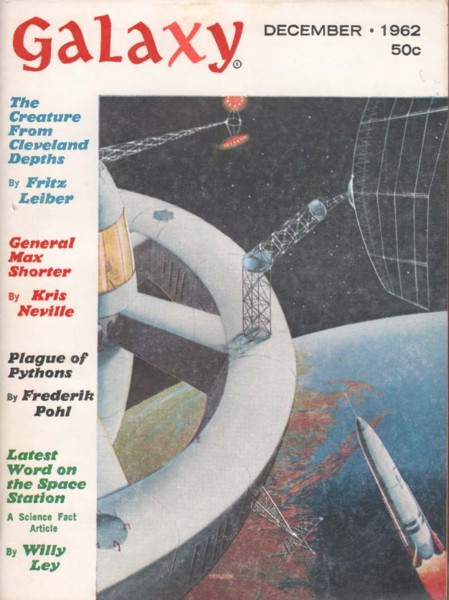
First published in the December 1961 issue of Galaxy Science Fiction. It’s been reprinted in the Lafferty collection Strange Doings, and has fallen out of copyright, so it’s on Project Gutenberg.
Enhancing Image
The tragedy of the situation is that Manuel is too thorough at his job, which is not the same thing as being good at one’s job. The state authorities hire Manuel as a census taker, which (the narrator tells us upfront) is a decision that will lead to the deaths of thousands. We’re basically told how the story will end at the beginning, but are not given context. The official who gives Manuel his job tells him to count all the people in the Santa Magdalena (which as far as I can tell is not a real place), a little mountain area on the outskirts of High Plains, Texas. The job should’ve been an easy one, since there aren’t many people in that area—or at least there aren’t many normal people. Unfortunately, Manuel knows something that the official does not. “The official had given a snap judgement, and it led to disaster. It was not his fault. The instructions are not clear. Nowhere in all the verbiage does it say how big they have to be to be counted as people.” So Manuel takes his mule, named Mula, into the desert, and three days later he returns to High Plains, his papers filled with names—thousands of them. Thousands more than there should be. Also, quite strangely, Manuel and his mule seem to have aged by decades, despite not being gone nearly that long. Manuel claims he had aged 35 years while doing the census, and he might be right about that. He also seems to have shrunk in size, to the size of—well, it’s a slur that Lafferty uses, which I will not repeat here.
There’s a large cratr near High Plains, about the size of where a small town might’ve been, and the crater (nobody knows what caused it) had long since been christened as Sodom. Now, Lafferty knew his Bible, and even if you don’t then you should still figure that if there’s a Sodom, there must also be a Gomorrah. These are the twin cities of the plain that God decided to blow to kingdom come, on account of their collective wickedness. The author (or maybe authors) of Genesis did not make it clear just what it was that the people of Sodom and Gomorrah were guilty of, but a common historical interpretation is that they indulged a little too much in old-fashioned sodomy—you know that’s where the word comes from. Of course, Lafferty is being ironic, since the people of High Plains and whatever Sodom used to be are not guilty of any crime worthy of a Biblical smackdown; but rather these people fall victim to a classic bureaucratic fuck-up. You could say it was a little misunderstanding. The problem is that Manuel knew about the little people who lived in the Santa Magdalena; by little we mean about the size of action figures, or Jonathan Swift’s Lilliputians. Manuel, who we’re told is quite stupid (he is apparently illiterate and can’t read a map), respects the little people, but irks them something fierce when he tries counting them as part of the census. Hilarity ensues.
How much you like Lafferty will depend on your own sense of humor, as well as if you can get behind his callousness as well as his religious ferocity. There’s an immense sadism in a lot of Lafferty’s writing, which is sometimes played for laughs, such as here, as well as the last Lafferty story I reviewed, “The Transcendent Tigers.” “Sodom and Gomorrah, Texas” is not as good as “The Transcendent Tigers,” for one because it’s not as funny, but also I feel like Lafferty has less of a point to make. The former is so short that we barely have time to understand any of these characters, and Lafferty doesn’t escalate the catastrophe like he does in his best/funniest work. I would describe this story as “cute,” which is to say it has the same energy as a decent joke that makes you exhale from your nostrils but doesn’t actually make you laugh. I do sometimes wonder why Lafferty had such a sadistic streak, but then again virtually every Catholic writer I know has a perverted preoccupation when it comes to death and human suffering. I’ve also seen criticisms of Lafferty for having misogynistic tendencies, but since there aren’t any female characters of note here, there is at least that.
There Be Spoilers Here
Manuel dies, seemingly from a mix of rapid aging and having lost his marbles, which then has the perspective change to that of Marshal, the census chief of High Plains. One night Marshal gets a visitor in the form of one of the little people, although Marshal’s not totally convinced it isn’t a hallucination. The little guy is upset about Manuel’s census list and wants it back, but it’s too late. The truth is that what had caused Sodom was that the people who lived there (this was a few hundred years ago, so says the little dude) had found out about the little people. The whole town had been blown up, from what the little dude reveals to be some kind of explosive “the size of a grain of sand.” Marshal does not take the warning seriously and—well, you already know the rest. The change in perspectives bugged me a bit, being that this is such a short story, and also there’s the fact that the back end suddenly becomes heavy on dialogue compared to the rest of it. The result almost reads like a rough draft.
A Step Farther Out
“Sodom and Gomorrah, Texas” is both early and minor Lafferty, in that it’s good for a chuckle but not much else. I suspect Fred Pohl accepted it because he liked it enough, and because of its lenght he thought it would be a good little piece to fill out an issue. Back in the days before online magazines, it was common practice to accept minor stories for the sake of filler, which is not something online magazine editors have to think about. There’s filler by the usual suspects when it comes to this sort of thing, but then there’s also filler by major writers. Lafferty was not a major writer yet in 1962, but he was on his way there.
See you next time.


 Science Fiction & Fantasy Remembrance