
The Story So Far
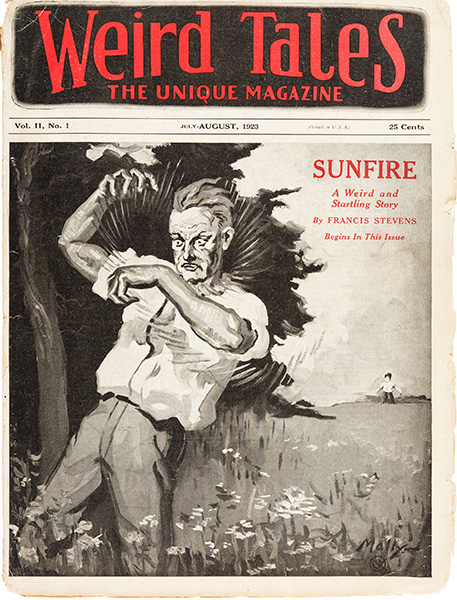
A group of five stupid white men explorers have ventured deep into the Brazilian jungle, along the Rio Silencioso, in search of a piece of ancient South American architecture which may hold immense riches. They do find what they’re looking for—and also a good deal more on top of that. The pyramid is “hollow,” and also seemingly abandoned. The only sign from the outside that there might be people here is a seaplane in the river, in working order but also abandoned. The explorers consider this now at least in part a rescue mission, starting with the one living person they find: a pretty young white girl, who does not give her name and who will not or cannot talk with the explorers. The extremely racist and apparently hormone-addled men practically trip over their own dicks in order to please the girl, or to understand her at all, but she makes it clear she’s not to be understood on their terms. The girl uses “Pan’s pipes” to charm the obligatory monster of the story, a giant snake-centipede creature, whose biological origin remains unexplained, although between that and the giant diamond at the center of the pyramid, the “Sunfire” of the title, this is a story that rings as nominally SF rather than fantasy. It could also be considered an early example of horror-comedy, albeit not an effective one. The explorers seem to have gotten this far on sheer idiot luck, since they repeatedly exhibit a lack of professionalism and competency. The question then is, how will they get out of this? Who is the girl, really, and what does she want? Who gives a shit? Certainly not me.
Enhancing Image
I started reading King Solomon’s Mines yesterday and am already about a third into it; it’s a rather short novel, but it’s also addicting. While H. Rider Haggard’s novel is certainly “problematic,” and has gained sort of a reputation for being such, it’s still nowhere near as racist as Sunfire, or indeed many of the “lost race” pulp adventures that Haggard partly inspired. Sunfire really is not unique in any way, compared to other pulp writing of the 1910s and ’20s, except maybe that it infuses more humor than the norm, and also the fact that Stevens was a woman. In fairness, there is a hint of proto-feminism here, although Stevens does little to advance it. While not technically the protagonist, the girl (we find out her name is Enid Widdiup) is the sun around which the rest of the story revolves, and ultimately, once she’s been broken out of her trance, she ends up being more competent and well-spoken than the explorers. Enid in fact turns out to be an aviator, which would make her one of the very first female aviators in history; she’s also an explorer herself, and she had actually come here on the seaplane the men had seen earlier. This is all rather curious, and it would be much more than just a curiosity if Stevens hadn’t waited until damn near the end of the story to tell us. If Sunfire has an major issue, aside from the dump truck’s worth of racism, it’s that it feels generally undercooked, being a novella with a cast of characters that’s mostly unmemorable and interchangeable. I neglect to mention the explorers’ names because they really don’t matter much. Because of the somewhat comedic tone, the stakes get deflated before Stevens can lay on some really juicy weird horror.
There’s also the villain, or rather villainess, named Sifa, who barely figures into things—another example of Stevens presenting us with something that would be curious, but only just that, as it stands. She only appears in the back end of Sunfire and ends up not being much of a threat. I was reading Bobby D.’s review of Sunfire, to see if he might’ve noticed something I did not, although given that his work tends to be focused around H. P. Lovecraft it was not as much about the story itself as I would’ve hoped; but still he said that Stevens’s story borders on being a parody of what was then a dominant form of pulp writing, although unfortunately it doesn’t go far enough. She has some fun with her incompetent “heroes,” but their rampant bigotry is more played for laughs than something that Stevens actually criticizes. Even for someone who was probably on the liberal side circa 1920, white supremacy was less of a threat to the wellbeing of mankind and more of perhaps a nuisance. The explorers are basically the white trio (so minus the fascinating and surprisingly progressively portrayed Umbopa) of King Solomon’s Mines, but without most of those men’s virtues and with their more unsavory characteristics turned up a notch or two. This may have been intentional on Stevens’s part, but then probably not; from the little pulp fiction of the era that I’ve read it’s not unusual for the protagonists to come off as, let’s say flawed to the point of obnoxiousness. Indeed despite being the literary generation to come after the likes of Haggard and Robert Louis Stevenson (who, make no mistake, wrote “popular fiction” and not what was then considered of the “literary” sort), the field that Stevens wrote seemed more stilted and narrow-minded. Even the most acclaimed of the early 20th century pulp writers, namely Edgar Rice Burroughs and A. Merritt, now strike us as semi-literate and offensive. Reading such fiction feels like seeing an ancient fly trapped in amber.
On a positive note, I do like the “author’s note” at the end, in which Stevens treats the characters as if they’re real people, and gives a kind of “where are they now” epilogue that one often sees at the end of the movies that are “based on a true story.” It’s cute.
A Step Farther Out
I’ve read from more than one person that Sunfire is really not where one ought to start with Stevens, which is a shame since it’s the only story of hers that’s eligible for review on this here website. Stevens wrote for the general pulps in the 1910s, before the likes of Weird Tales and other “modern” genre magazines came along, and one does get the sense that she wrote for that earlier market rather than what was then the new generation of pulp fiction. In that sense I feel bad, since I know I’ve been treating her a bit harshly by way of tackling something which she herself seemed to have thought so little of that she let it sit on her desk, or on some shelf, collecting dust for a few years before it was finally published.
See you next time.
 Science Fiction & Fantasy Remembrance