Who Goes There?
Rich Larson is probably the youngest author I’ve covered on this site; he’s only a few years older than me, but he’s been mighty busy for the past decade and change, mostly in the realm of short fiction. His debut back in the early 2010s coincided with the proliferation of online magazines, in a boom for the market not seen since the ’50s. (Ironically today’s story appeared in one of the old guard.) While he has not yet garnered a Hugo or Nebula nomination it’s only a matter of time before his work is given major awards recognition, as he has made first in the Asimov’s readers’ poll multiple times and has been featured in multiple best-of-the-year anthologies. His 2015 story “Ice” was adapted into a Love, Death + Robots episode, and his most recent novel, Ymir, came out in 2022. By Larson’s own admission much of his fiction can be considered a continuation of cyberpunk, with some transhumanist elements. “There Used to Be Olive Trees” is a coming-of-age narrative set in the far future, on an Earth that seems to be recovering from a worldwide catastrophe; and while it isn’t cyberpunk exactly it does have one or two elements of that subgenre.
Placing Coordinates
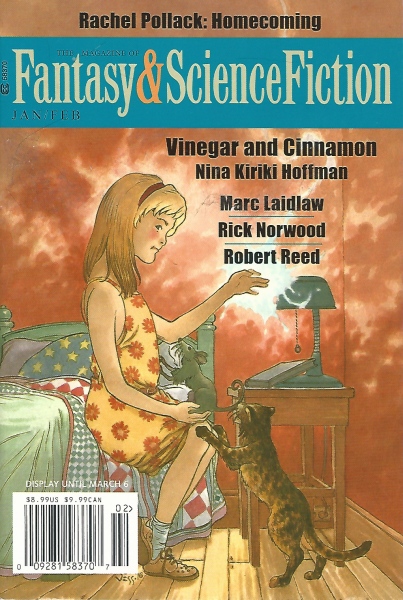
First published in the January-February 2017 issue of The Magazine of Fantasy and Science Fiction, which is not available online. If you want a copy you’ll have to hunt for a used copy or take your chances with F&SF‘s website. It’s been reprinted in The Year’s Best Science Fiction: Thirty-Fifth Annual Collection (ed. Gardner Dozois) and Wilde Stories 2018: The Year’s Best Gay Speculative Fiction (ed. Steve Berman).
Enhancing Image
Valentin is 16 years old and is one of the lucky few in “the Town” to have been fitted with an implant, or “godchip,” on his forehead, which should allow him to make contact with the Town’s “machine god.” The problem is that for those with implants there’s a test, or “prueba,” a kind of rite of passage one’s expected to pass with the first or second try; for Valentin he’s on his fourth attempt, which is unheard of. For reasons totally beyond him he’s been unable to talk with the Town’s god, and so he’s been sent out into the wilderness again, with just some provisions and most usefully his “nanoshadow,” a skin suit that will help him with the harsh climate. This sounds like a lot of setup for a story that will ultimately involve only two characters, more or less, plus a character (Javier, Valentin’s overseer) who is mentioned but remains offscreen, and it does seem a bit frontloaded! This is a solid novelette and it feels both simple and a little overly complicated, since once we meet the second main character the narrative turns into a Jack London-esque surviving-in-the-wilderness tale with technology playing a peripheral role. Soon after leaving the Town, Valentin meets a “wilder,” one of those people who lives outside what remains of civilization, a fellow teen boy named Pepe. The two don’t get along at first, which is understandable since Valentin’s implant and equipment make him a juicy target for wilders more vicious than Pepe.
Minding that Larson would’ve only been 23 or 24 when he wrote this, it’s a fine job that has enough meat on its bones to imply a larger world. I said Larson is a cyberpunk fan, and there are a few cues taken from that subgenre here, despite it falling much more into post-apocalyptic SF. The nanoshadow, which Valentin is unable to use for most of the story, would very much fit in with a cyberpunk narrative—the big difference being that the dystopian cityscape that would normally be host to cyberpunk is mostly no more. The Spain of the story has long since been ruined, and even in the wilderness there isn’t a lot that could sustain human life. Understandably, for someone who has spent his whole life in what amounts to a bubble, Valentin takes a fascination to Pepe, and this fascination might well be reciprocated. I’m not counting it as a spoiler, because something doesn’t sit right with me when it comes to treating characters’ sexualities as plot revelations, so I’ll say here that the reluctant friendship formed between Valentin and Pepe burns slowly into something romantic—or maybe just sexual. It’s hard to say. Our insights into Valentin’s mind tell us he finds Pepe very much attractive, but it’s never elaborated on if this has to do with Pepe’s looks or if it’s merely the fact that he’s interacting with someone around his own age who doesn’t see him as just a “prophet” in training. The queerness is shown but not discussed at all, and I’m not sure how to feel about this. Maybe taboos regarding homosexuality have become a non-issue now that the world has basically ended. Values change with time and circumstances. It’s not a bad depiction of queerness, but I wish there was more to it.
The plot borders on nonexistent, but we do have goals for both of the main characters which happen to intertwine. Valentin has to go to what is called the autofab, to speak with the god of the Town, and Pepe also wants to go to the autofab—only not for the same reason. At some point in the past humanity invented truly sentient AI, and these AI personalities may have become too powerful, to the point where they can interfere with the material world with a mere thought—or, in the case of Valentin and other prophets, with a bit of coaxing. Knowledge of how these AIs came about seems relegated to the Town and other strongholds of civilization, although interestingly I don’t recall us getting an explanation of how Earth came to be ruined and if the AIs had something to do with it. This story was written a few years before “AI” (machine learning) became a hot-button issue, so I have to wonder if Larson would’ve gone about the AI things if he had written this more recently. It makes sense that a humanity that’s mostly been thrown back to barbarism would see AIs as gods, but as with the relationship between Valentin and Pepe this idea feels underdeveloped. I’ve read that when it comes to first drafts Larson likes to write the whole thing in one long sitting, which admittedly is how I tend to go about my own writing (he who casts the first stone yadda yadda), but “There Used to Be Olive Trees” reads like it could’ve been polished more.
There Be Spoilers Here
When we do finally meet the “god” in the autofab, it comes off as sort of an anti-climax. The world opens up at the end a bit, but aside from Valentin’s own personal uncertainty as a prophet the story doesn’t end so much as it comes to a sudden halt. His relationship with Pepe goes unresolved, and the phrasing at the very end implies the possibility of a sequel, although as far as I can tell Larson never wrote one.
A Step Farther Out
“There Used to Be Olive Trees” is a robust and somewhat queer story that doesn’t have any glaring problems, but conversely it’s the kind of story I would consider unexceptional. It doesn’t help that while the title implies climate catastrophe and it’s something that clearly lingers in the background of the narrative, climate change is not really a topic that comes up for the characters, nor does the desolation of the setting seem to have much weight on their minds. Similarly the relationship between Valentin and Pepe is allowed to develop, but only up to a point, and I do have to wonder if the story’s queerness, or rather it’s playing with gender, could’ve been much expanded on, for the characters’ sakes but also to tie their budding relationship more into the plot. It’s a functional story that ultimately falls short an inch or two of its potential.
See you next time.

 Science Fiction & Fantasy Remembrance