Who Goes There?
We don’t know much about Rick Raphael. He was born in 1919 and died in 1994, just short of his 75th birthday. I can only find a few photos of him online (he had some gnarly facial hair). I don’t know what his day job was, but he clearly didn’t write for a living, given how small his output was. He wrote almost entirely for Astounding/Analog, which is normally a bad sign, although from what I can tell Raphael was a better writer, and perhaps more left-leaning, than the average Campbell regular. He’s one of the more recent winners of the Cordwainer Smith Rediscovery Award, and fitting for that “award” his work must have sold little enough that he let some of it fall out of copyright, including today’s story. “Code Three” would earn a Hugo nomination, placing second and only losing to Poul Anderson’s “No Truce with Kings.” Its sequel, “Once a Cop,” also got a Hugo nomination. Both would be combined (with some material added maybe, I’m not sure) into the fix-up novel Code Three. “Code Three” is a flawed but pretty curious piece of work, in the world it builds but also the ways it does (and does not) question the role of policing—both policing as we now understand it and how it might change in a future where vehicles are hulking beasts that travel cross-country at hundreds of miles an hour.
Placing Coordinates
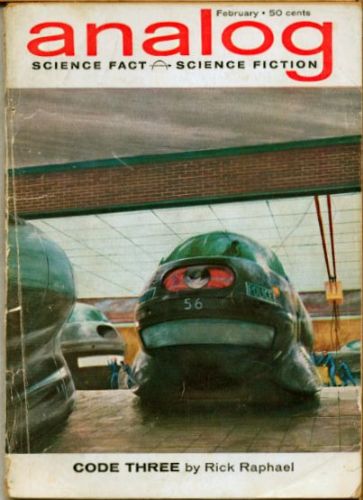
First published in the February 1963 issue of Analog Science Fiction. Probably due to it being incorporated into a fix-up, despite the Hugo nomination, “Code Three” would not be reprinted on its own for nearly thirty years, reappearing in The Mammoth Book of New World Science Fiction: Short Novels of the 1960s (ed. Isaac Asimov, Martin H. Greenberg, and Charles G. Waugh), then in The World Turned Upside Down (ed. Jim Baen, David Drake, and Eric Flint). It fell out of copyright a hot minute ago, so you can read it on Project Gutenberg without hassle.
Enhancing Image
In the future, the high-speed roadways that began with Germany’s autobahns have not only been made mainstream across North America but taken to their logical extreme. The sheer dimensions of these roadways, called “thruways,” along with the vehicles on them, combined with speeds often well over a hundred miles an hour, mean that at least partly out of physical necessity there’s some freedom of movement with where one can go. The so-called Continental Thruway system “spanned North America from coast to coast and crisscrossed north and south under the Three Nation Road Compact from the southern tip of Mexico into Canada and Alaska.” So long as you were on the mainland you could drive basically anywhere in North America with relative ease. However, the complexity and scale of this network also mean that the highway patrolman of today would be totally unequipped to handle it; so a new kind of road cop came along. It’s also how we’re introduced to our three leads: senior officer Ben Martin, junior officer (from Ontario, but don’t hold that against him) Clay Ferguson, and Medical-Surgical Officer Kelly Lightfoot. They’re stationed in Car 56, nicknamed “Beulah,” and this is their story.
Due to the nature of the plot, or rather the lack of it, I feel compelled to give my thoughts mostly in list form:
- “Code Three” starts off rough, largely because of the dialogue, which can range from decent to unbearably corny. Undoubtedly this story’s weak point, if I had to give one. The exchanges between the leads in the opening stretch, before they start their “shift” (a patrol that lasts several days before they head back for resupply), are quite unfunny, possibly intentionally so. Small talk among coworkers does tend toward either the banal or the stuff of gossip, so I can’t say it’s unrealistic—more that, if this story has a smoking gun for having been written in the pre-New Wave years, it’s how characters talk.
- Speaking of which, I’m sure Raphael stopped this little series after the second entry (or the fix-up novel if you wanna count that) because he got tired of it, but also it could be that say, 1965 or 1966, was the last time you could write something like “Code Three” without it having to compete with newer, fresher, gnarlier SF that would be written in the latter half of the ’60s. Mind you that when this issue of Analog hit newsstands in January 1963, John F. Kennedy was still very much alive, the Beatles would not land in America for another year, and the Hays Code still had a stranglehold on American filmmaking, albeit its grip was loosening. This was still culturally the ’50s, if not technically, hence people tending to ignore the early ’60s.
- Raphael’s speculation on the future of roadways would turn out to be completely wrong, of course. Whereas in this story people demanded “faster and more powerful vehicles,” that apparently would be nuclear-powered (as if), real-world car production would gear towards safer and more efficient vehicles. Of course, when Raphael wrote “Code Three” it was the norm to treat cars implicitly as death traps on wheels, and indeed in-story they’re even more dangerous. The first dramatic incident is a hit-and-run that results in a car pileup and three deaths. These cars are not only massive (probably the size of schoolbuses, if not even larger), but they can also go up in flames. The “ambulance” unit is so large as to function as a mobile hospital, complete with a surgery room, and Car 56 is big and well-equipped enough that Our Heroes™ can live in it more or less comfortably for days at a time.
- While the speculation is very much off, that doesn’t matter much considering science fiction isn’t about predicting the future but rather commenting on the present. We can learn a good deal about what relationships people had with the cars, or rather about the average driver’s mindset, as it was in 1963. It also helps that the technology Raphael plays with is fucking cool, if also laughably impractical. How would you even know where you’re going at 400 miles an hour? How many fatalities happen in a single day?
- I said before that “Code Three” doesn’t really have a plot, which is to say its structure is episodic rather than having conventional plot beats. This is actually works in the story’s favor, as it allows Raphael to focus on building the main characters and the world around them, although I can see how this might pose a problem in a novel. See, with amorphous plots it’s fine for a short story or novella, or even a really long novel, but for a short novel the reader may need something more linear. But here I think it works well. I was expecting more of a straight action narrative, but I was pleasantly surprised.
- Speaking of pleasant surprises, I knew in advance that one of the trio was a woman, but I didn’t know Kelly is also biracial, being Irish but also American indigenous. Martin and Clay, in typical cop behavior, make racist jokes about Kelly’s heritage (both her Native American half and also somehow her Irish half); but aside from her being written as more outwardly emotional than the boys she is not really made out to be a typical pre-New Wave woman. She’s proactive, is upfront about what she wants, and is shown to be a totally capable medical officer. She’s sort of like a McCoy figure, although this was a few years before the original Star Trek series premiered.
- I should probably bring up now that, yes, this is copaganda, albeit of a very soft sort. Any narrative that involves policing will have to make some kind of statement on the profession, for, against, or maybe a bit of both. “Code Three,” unsurprisingly, is pro-cop, although more of the “necessary evil” variety rather than outright bootlicking. Car 56’s job does not involve racial profiling or harassing the poor, which should tell us this takes place in a fantasy world where police do not do those things regularly. Aside from the aforementioned racist jokes at Kelly’s expensive, Martin and Clay basically mean well, even if the latter is a bit of a himbo, on top of being Canadian. Their job is to make sure the roads are safe for drivers, and to rescue as many people in the event of an accident as possible. Raphael argues that we need highway patrolmen because the roads and the vehicles on them are too dangerous—and of course there’s the occasional bad actor, such as the men behind the hit-and-run near the beginning.
- Hardcore propaganda goes on about crime, often of the violent sort, with some ethnic groups used as scapegoats; but in the case of “Code Three” the big fear is that an accident may happen on the road, as opposed to something deliberate. Someone I know called this story “blue-collar,” which I find a bit dubious since I don’t consider police to be workers—or at least they’re workers in a class of their own, separated from the proletariat and peasantry. It certainly gives the impression of being blue-collar in the sense that it really is just a boots-on-the-ground slice-of-life narrative. We sit through a few days in the lives of these three officers, which are sometimes dramatic but also sometimes very calm and personal. I do think the fact that we’re stuck in or around Car 56 the whole time juxtaposes nicely with the large scope of the outside world. It’s easy to see how Raphael could get a novel out of this, but also a shame he didn’t do more with it.
- I have no doubt that Raphael took some inspiration from Heinlein’s “The Roads Must Roll,” and there’s a good chance he had even read it when it was first published in Astounding.
- The number three comes up quite a few times and I’m not sure what Raphael means by this. There are three officers in Car 56, there are three fatalities near the beginning, there’s the Three Nation Road Compact, and then there’s code three itself.
It’s cool, right? At least on paper.
There Be Spoilers Here
There’s some romantic/sexual tension between Kelly and both of the lads, at different point, but there’s the implication that Martin in particular might return her feelings. This in itself is curious, especially for Analog in the ’60s, since Martin is presumably white and Kelly is a biracial woman who apparently does not pass as white. Will this tension amount to anything in the sequel? Probably not. Martin also gets injured in the climax, but he’ll be fine, don’t worry about him. Nothing fundamentally changes by the end and that’s certainly part of the slice-of-life deal.
A Step Farther Out
Someone could make a cool movie out of “Code Three,” without having even to pay the Raphael estate, assuming they only adapt the titular novella and not the full novel. Despite the aimlessness of the plot there’s also a cinematic quality about it that no doubt would have appealed to readers at the time, and while it does show its age in a few areas it’s also a genuinely forward-looking story—at least up to a point. The future Raphael conjures has practically nothing to do with our present, but that doesn’t matter much because history is not a strictly linear progression. We may not necessarily have cooler technology or more progressive values fifty years from now, and indeed industrial capitalism will probably still be suffocating us in 2074. It’s funny, because at one point Martin calls Kelly Pocahontas as part of his racist joke routine, and boy, it’s nice to live in a reality where a man with significant power can’t simply call a woman who may or may not have American indigenous heritage Pocahontas as a take-that and a get away with it. It would be especially a shame if a racist misogynist were to ascend to the highest position in our government and not only get elected, but elected a second time. The good news is that the average American voter is too morally responsible to let such a thing happen.
See you next time.
 Science Fiction & Fantasy Remembrance