Who Goes There?
You’re very likely reading this after December 31, 2025, in which case “Happy New Year” is not so relevant.
But still, Happy New Year!
Nancy Kress has had a pretty long career, even just a bit longer than people would think. It’s easy to think of her as one of many authors who came about in the ’80s, and indeed her first novel was published in 1981; but like with William Gibson and Bruce Sterling, she made her debut in the ’70s. “The Earth Dwellers” was her first story, published when she was 28, and it would take some years for her to come into her own as a writer. This is not unusual; if anything it was much weirder at this time to see someone like the late John Varley, who pretty much hit the ground running. Of course, decades later and with multiple Hugos and Nebulas under her belt, it’s easy to see that Kress was wise to hone her craft. Her debut story over here ain’t half bad either, being a short mood piece that feels just a little off-brand for Galaxy under Jim Baen’s editorship. It’s competently constructed, but unfortunately there’s not a whole lot too it either. This is similarly a short and not very demanding review for New Year’s Eve.
Placing Coordinates
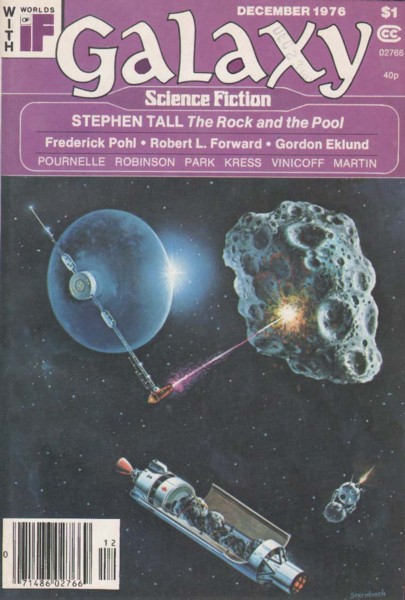
First published in the December 1976 issue of Galaxy Science Fiction. It has never been reprinted.
Enhancing Image
Rachel has just said farewell to her daughter Susan, along with Susan’s husband and small child. Susan, at this point in her twenties, went to college to study astrophysics, and now she and her family are on the spaceship Oregon as colonists, heading for Sirius V. It’s a one-way trip, and the trip alone will take 16 years in objective time, while the passengers aboard will be in cold sleep. Rachel and her husband Duncan knew this day was coming, but still these just-past-middle-aged parents are each handling the situation quite differently. The launch of the Oregon itself is anticlimactic, going off without a hitch and without much ceremony, with the “ugly utilitarian structures” of the spacefield around them. They go home together as if they had just sent their girl off to college, and not to a planet where they will never hear from her (or their grandson, it must be said) again. The treatment of space travel in this story is generally ambivalent, although Rachel is biased considering she herself has no interest in it. The topic would’ve appealed to Jim Baen and a certain type of space-colonization-now freak, but Kress’s treatment of it is more as a “necessary” evil than anything. I personally don’t see space travel as necessary, or even desirable, but if I went on a rant about that on a day like this then I’d feel like an asshole.
As for Rachel, she’s an environmentalist of sorts, being concerned with the ailanthus (misspelled in-story as “alianthus”), which unlike in real life has become endangered. Dodderson’s blight, seemingly of Kress’s invention, is threatening the species. “[Rachel] wasn’t usually a Joiner of Causes, but this one was different.” What little we’re told about the world of this future implies that environmental collapse on Earth is perhaps imminent, which really is not much different from how things are going in our world. Something I now appreciate about “The Earth Dwellers” that I did not in the heat of the moment is that this feels like a believable future setting. While published in 1976, it doesn’t have that burnt-out post-hippie stink a lot of ’70s SF has; there are no clear indicators that this was written from the perspective of just four out from the last moon landing. If there’s any indication of when it was written, it’s the sense that the Space Race was winding down and that NASA was at risk of losing funding. This is something quite a few SF people, including Baen and Jerry Pournelle, were concerned about. Whether Kress herself thought much of it at the time is hard to say. At the end of the day this is only nominally an SF story, since this is a character study where technology only plays a peripheral part. Rachel lives in a world that doesn’t seem all that futuristic, and Rachel herself turns inward and retrospective.
Something that’s struck me after having read “The Earth Dwellers” is what could’ve compelled Kress to center a story on a woman who is at least deep in her fifties, given Kress’s age at the time. Kress was about the same age as Susan, and she was also married (her first marriage) at the time, and may or may not have had her first kid by this point. Yet she seems to identify more with Rachel than Susan, the latter coming off as selfish and reckless. Having read my fair share of Kress’s more recent SF, from the ’80s onward, I assumed her sympathizing with middle-aged characters was an indicator of her own age, but it turns out this was a hallmark of hers from the very beginning. Also evident here is a style that borders on purple, but at the very least it’s more pleasant to read than much SF then being written. Kress’s style would fit well in the pages of Asimov’s and F&SF, but we see a rougher and less ambitious version of here in Galaxy.
There Be Spoilers Here
Really not much I can say here, given that there’s hardly even the skeleton of a plot to begin with and “The Earth Dwellers” more stops rather than ends. Like I said, it’s a mood piece.
A Step Farther Out
I have a couple announcements to make regarding this site tomorrow, which sounds vaguely ominous, but it’s really not all that. It’s also the end of the year and naturally I’ve been in a sort of retrospective mood. I like Kress, and I was curious about her no-doubt modest beginnings as a writer. “The Earth Dwellers” is not something I would seek out unless you’re a Kress fan or completionist, but it’s perfectly decent.
See you next time.
 Science Fiction & Fantasy Remembrance