(Cover by Michael Carroll. Asimov’s, December 2007.)
Christmas is coming up, and my birthday before that. Not incidentally we have a birthday among the authors covered, namely Connie Willis, whose birthday is the 31st. Willis is also very fond of Christmas stories so there’s that. Last December we did a month-long tribute to Fritz Leiber, who sadly will not be featured this time. (Don’t feel too bad, he’s already one of our most frequent “visitors.”) Since we’re closing out the first full year of this site, I figure it’s time to introduce one more major change (not permanent, don’t worry), not for this month but for January. December will be the last month probably until 2025 that I’ll be doing serial reviews; for 2024 I’ll be taking a break from serials and focusing on short stories and novellas, although I’ll still squeeze a few complete novels into the schedule.
The way it’ll work is, the days I would be reviewing sserial installments will instead be relegated to short stories, but otherwise the alternating slot method will not change, only starting in January you can expect to see two short stories for every novella. The space given to complete novels will remain the same: if a novella slot were to fall on the 31st of the month then I’ll at least try to tackle a complete novel. Why no serials for a year? For a few reasons. For one, I’m tired, and also I’ve come to find that my serial reviews are the least popular of my reviews, or rather they get the least feedback. Also, I’m a devotee of the short story at heart, and the reality is that there are way more short stories in the magazine market than serials, by at least a factor of ten; so for one year I think short stories deserve more of the glory. We do, of course, get two short serials to tackle before the hiatus, both of which are actually rereads for me.
There is one other thing I have in mind, a rather special thing, but you’ll have to wait until January to hear about it. It’s a secret. :3
For the serial:
Three Hearts and Three Lions by Poul Anderson. Serialized in The Magazine of Fantasy and Science Fiction, September to October 1953. Retro Hugo nominee for Best Novella. This is the first serial I’ll be covering where I’ve not only read the book version but also the serial version, so this is sort of my third go-around with it. It’s worth it, though; this is one of the more influential works in the history of American fantasy, having partly inspired Dungeons & Dragons. It also makes me wish Anderson wrote more fantasy.
Beyond the Black River by Robert E. Howard. Serialized in Weird Tales, May to June 1935. Despite committing suicide at the age of thirty, Howard wrote a truly staggering amount of fiction and created several series in the process, with his most famous creation being Conan the Cimmerian. Howard did not invent sword-and-sorcery fantasy but he had unquestionably the most influence on proceeding American fantasists. This right here was one of the first Conan stories I had read, and it still reads as one of the more unusual.
For the novellas:
“Pursuit” by Lester del Rey. From the May 1952 issue of Space Science Fiction. Del Rey started out as a sentimentalist at a time when genre SF was markedly unsentimental, filling a niche that had gone untapped such that early stories like “Helen O’Loy” and “The Day Is Done” were very popular. He would move away from that style, and in the ’50s he even edited several (very short-lived) SFF magazines, Space Science Fiction being one. Thus the first story in the first issue of this magazine is by del Rey’s favorite writer: himself.
“All Seated on the Ground” by Connie Willis. From the December 2007 issue of Asimov’s Science Fiction. Hugo winner for Best Novella. In the ’90s and 2000s Connie Willis could lay claim to being the most popular writer to appear regularly in Asimov’s, and that’s on top of her novels, a few of which are certified classics. Her novel Doomsday Book especially is excellent, although it does not indicate her penchant for humor. She holds the record for most Hugo wins for Best Novella, with “All Seated on the Ground” being her fourth.
For the short stories:
“The Keys to December” by Roger Zelazny. From the August 1966 issue of New Worlds. Zelazny looks like he might see a much deserved renaissance soon, with a TV adaptation of his Amber serie being in the works. This is good news, because for a couple decades Zelazny has been threatened with the dark cloud of obscurity, despite being one of the most acclaimed SFF writers to come out of the ’60s. I picked “The Keys to December” because, well, look at the title.
“Genesis” by H. Beam Piper. From the September 1951 issue of Future Science Fiction. Piper is surely one of the most tragic figures in old-timey SF, having started his writing career very late (he was in his forties) and committing suicide at the age of sixty, believing himself to be a failure, such that despite not dying young his career was short-lived. It’s a shame, because Piper was in some ways an unusual writer for the time; he was a bit of a character, one could say.
For the complete novel:
Lest Darkness Fall by L. Sprague de Camp. From the December 1939 issue of Unknown. From 1937 to 1942 (he took a break to support the war effort), de Camp was one of the designated court jesters in John W. Campbell’s Astounding, and perhaps more importantly in Unknown. It was here that de Camp got to show off his range as a fantasist (most famously in his collaborations with Fletcher Pratt), although ironically his two longest solo efforts in Unknown in its first year, Divide and Rule and Lest Darkness Fall, are science fiction, not fantasy. Lest Darkness Fall was de Camp’s solo debut novel, an early example of a modern person being sent back to an ancient time period, and according to a lot of people it’s also his best. It was expanded (although I can’t imagine by much, since the magazine version looks to be a solid 50,000 words) for book publication in 1941.
You may think it a weak move for me to have my last two serial reviews before the hiatus be of ones I’ve already read, but as I’ve said before and always hope to make clear, rereading is arguably more important than reading in the first place. So it goes.
(Cover by Hugh Rankin. Weird Tales, December 1929.)
The Story So Far
Stephen Costigan is a drug addict and traumatized World War I veteran spending his days in the Limehouse district of London, wasting away in an opium den, until he is called upon by Kathulos, a strange man who claims to be of Egypt but whose ethnicity is ambiguous. Kathulos frees Stephen of his hashish addiction but instead gets him hooked on a much more powerful drug, an elixir whose ingredients only Kathulos knows. Stephen is hired to carry out a rather strange assassination plot, but he goes to John Gordon of the London secret police and conspires with him to double-cross Kathulos and his gang. Part 2 is concerned with Stephen and Gordon playing detective and discovering both the whereabouts and origin of Kathulos, who had escaped with Zuleika, Stephen’s love interest. Turns out Kathulos is an Atlantean—found in a coffin in the ocean and either awakened or resurrected. The sorcerer’s plan is to overthrow “the white races” and take over the world, with Africans and Asians as his underlings.
Funny thing about the recap section for this installment is that because so little progress was made in Part 2 the synopsis is expanded from the front so that we start with backstory before ending on basically where Part 1 ended. I said this before, but Part 2 really ground the plot to a halt and generally this novella could’ve used an editor’s judgment.
Enhancing Image
This will be mostly a series of notes, since right now I don’t have the motivation to do otherwise. Skull-Face isn’t very good, but it is certainly strange—and baffling, especially for the modern reader.
Let’s consider the following:
If you thought we were done with Gordon’s monologuing from Part 2, think again. Given he is supposed to be of the secret police, Gordon has no qualms pouring out every little bit of information he knows to Stephen, who after all is a civilian and not even a British subject at that. His eagerness to trust Stephen turns out to not be ill-founded, of course, but it does ring as implausible.
Speaking of implausibility, Kathulos being from Atlantis and Atlantis being a real place are taken basically at face value, with Our Heroes™ not having a hard time accepting these as fast. I genuinely wonder how many people back in the ’20s believed in the Atlantis myth, but upon reflection it would not surprise me if a good portion of the Weird Tales readership bought into it.
So let’s talk about how this is sort of a white supremacist narrative. To put it simply, the villain of the story is a non-white person who has kicked off several revolts in Africa and Asia against white colonists, and we’re supposed to believe these oppressed peoples taking back their land is a bad thing. The phrase “white supremacy” is actually used at one point, quite literally, coming out of Gordon’s mouth if I recall correctly. Of course, being a British cop, Gordon has the perfect motivation to back white supremacist interests.
This is, however, complicated by Kathulos being open about using said revolts and building an empire of non-white people for his own gain. He’s essentially a grifter who has radicalized people into anti-colonialist action so that he can reap the benefits. I’m not sure if Howard did this because he realized that the villain of his story might come off too sympathetically or if he wanted to placate his readership, a fraction of whom would’ve been bona fide white supremacists.
Further complicated by the Atlanteans apparently viewing whites as little more than barbarians in suits, being still inferior to the Atlanteans who see themselves as the truly supreme race. Genocide against whites would be the cherry on top to Kathulos’s empire, although as he points out, he does not view blacks as any better, with Atlanteans (at least in the old days) thriving on racialized slavery not unlike much of the US leading up to the Civil War. I’m not sure if Howard, who came from a former slave state and who became increasingly aware of his country’s blood guilt as he got older, is making a comment here.
The story climaxes with Stephen rescuing Gordon from bloody sacrifice and Gordon shooting Kathulos in the chest point-blank, which may or may not have killed him. While I do find it funny that a sorcerer with plans to rule a billion people gets taken down by A GUN, I was also intrigued by the fact that we don’t know if Kathulos died or if he somehow survived both the gunshot and his underground tunnel network getting blown to bits. His body is never found. The ending hints at a possible sequel, but we never got one.
The romance with Zuleika is about as rushed and unconvincing as you would expect, although for what it’s worth we do get a romance between a white man and a non-white woman that ends happily. As far as I can tell interracial marriage was totes legal in the UK at the time, although the social acceptability of such a union is a different question, especially since Stephen is himself an immigrant.
Reading Skull-Face after having read some later Howard works, it seems like Howard was on the verge of becoming more socially aware of the world outside of lily-whiteness, which is to take most of the world. His sympathies for black Americans would become more pronounced as he aged, to the point where he would get into arguments with Lovecraft and others with regards to white supremacy, but I’m not quite sure when he reached that point. Keep in mind that Howard grew up in a time and place where he would’ve been force-fed pro-Confederacy falsehoods almost from birth. He took more pains than most of his peers to understand people who come from outside the white Southern bubble. Gone with the Wind came out the year of Howard’s death, and for being a thousand pages of Confederacy apologia it won the Pulitzer Prize and became an enormous bestseller.
I realize I sound like I’m excusing the obvious racism of Skull-Face, but to make it clear, I don’t blame anyone for disliking this story on the basis of its problematic elements, which are indeed appalling.
A Step Farther Out
Skull-Face is not something I would recommend unless you’re already a Howard fan and/or a completionist, since it’s not very good, for one, but it’s also likely to alienate readers who are not already familiar with the trajectory of Howard’s writing. Being the oldest Howard story I’ve reviewed, it’s easily the weakest and shows the most signs of having been penned by someone who was still honing his craft; and then there’s the racism. The absurd race war plot is probably what people will take away from it, which does not bode well for how much one can enjoy it. Howard would go on to write a few equally long works and structure them far more ambitiously than here while also justifying that length. He gets better.
(Cover by C. C. Senf. Weird Tales, November 1929.)
The Story So Far
Stephen Costigan is a traumatized World War I veteran and drug addict who’s taken up residence in London’s Limehouse district, at first a slave to hashish and then a slave to the enigmatic sorcerer Kathulos, a strange man of ambiguous ethnicity who draws Stephen into the underworld, promising him new vitality with an elixir that’ll grant him near-superhuman powers—but whose addictive power is lethal. As he gets further ensnared in the underworld Stephen comes across a beautiful woman named Zuleika who, aside from obviously being the love interest, lets Stephen in on how evil Kathulos’s machinations are. Our Hero™ soon gets wrapped up in an assassination plot that (I kid you not) involved a gorilla costume and Stephen allying with John Gordon of the British secret police.
Stephen and Gordon team up to take Kathulos and his goons into custody, but naturally things don’t go well and the skull-faced sorcerer escapes via a secret tunnel, taking Zuleika with him. Both sides have taken a few casualties in the fight, but now Our Heroes™ are left with the question of where Kathulos could’ve gone, what he might be planning, and perhaps most importantly, where the hell he came from.
Enhancing Image
Part 2 is hard to summarize as it’s not only the shortest installment, but very little actually happens in it; indeed, the plot moves hardly an inch forward between the start and end of this installment. Stephen and Gordon, now like buddies in a detective narrative, retrace their steps in an effort to find out Kathulos’s origins, in doing so hoping they can figure out what his endgame is. By the way, if you’re reading Skull-Face I recommend reading the text on Project Gutenberg as it’s not only easier to read but does away with the recap sections. In the case of Part 2 the recap givess away the big revelation in the installment to follow, which frustrated me because a) it made me worry I had missed a big plot point in Part 1 (I did not), and b) it sort of just hits you over the head with something major before you’ve had a chance to read it for yourself and digest it properly.
Gordon, who apparently knew more than he let on, givess us a truly massive infodump about a series of revolts in Africa as of late had had a common element about them, with Kathulos being involved and encouraging unrest among African and Asian peoples. There’s been a prophecy spreading that a man “from the sea” will unite the marginalized ethnicities of the world and overthrow the “white races.” There are apparently multiple white races; be sure to put a pin in that one. So… to make a long story short, Kathulos is not of Egypt like he claims, nor is he from any known country on the planet, but from Atlantis. Kathulos is an Atlantean who mummified himself and lay at the bottom of the ocean, only to be discovered and subsequently either resurrected or brought out of cold sleep. Kathulos doesn’t seem to have a personal desire to topple white supremacy but, it’s implied, is taking advantage of racial strife by crowning himself as emperor of a new society where non-white people are on top.
I have a few questions.
I had heard about the race war plot of this novella in advance, and yet even reading it now I feel like I wasn’t prepared for it. Howard has a rather messy relationship with racism, being a Texan in the early 20th century, but he was also a proud Irishman surrounded by WASPs, at a time when people still made distinctions between “types” of whiteness. Nowadays Jews are often considered white (I say often, but admittedly not always), but this was obviously much more of a point of contention a hundred years ago. At what point were Jews considered white? Evidently not at the time of Howard’s writing Skull-Face. Rather than the huge gelatinous blob with arbitrary boundaries that we now understand whiteness to be, it was like a school with different cliques in Howard’s time, thus in Skull-Face we have “the white races” pitted against several non-white races. This all sounds a bit cracked, but I’m trying to make sense of an understanding of racism that’s totally alien to modern conceptions, except maybe the most backwards parts of the US (i.e., the parts that think the Confederacy meant well).
You may be thinking, “Brian, you handsome devil, how come there’s no content warning for racism that came with this review?” The answer is simply that if you’re reading a Weird Tales pulp adventure from the ’20s, you ought to go in expecting at least some racism. I know this is gonna sound like a bit of a “these darn kids” rant, but I’m peeved whenever people fail to engage with old genre fiction because of the simple fact that values change over time and even left-liberal writers from more than half a century ago generally did not believe in intersectionality. Was Howard a racist? I’m gonna say no. In fact it seems Howard was vocally againsst notions of racial supramcy, at least in his later years. Did he have preconceived notions about race, and did he use white people’s ignorance of other cultures to give his fiction an “Orientalist” appeal? Absolutely to both those parts. I would be lying if I said a good portion of this installment of Skull-Face wasn’t baffling or painful to read, not to mention the plot grinds to a hault. By the end of Part 2 nothing except lore-dumping has been accomplished.
A Step Farther Out
This is a major step down from the first installment. Howard has a knack for writing action and there basically isn’t any here; worse than that, it’s almost entirely dialogue-driven, which I have to admit has never been Howard’s strong suit. It’s short, but even so I started to wonder when John Gordon’s borderline monologuing would come to an end so we can get back to the actual plot. Kathulos and his goons are pushed totally off-stage, and by extension we get zero development with Zuleika, instead being stuck with Stephen, who’s a hot mess of a person, and Gordon, who for this particular part of the novella acts as Mr. Exposition. Hopefully the final installment can bring back the momentum I so dearly missed in Part 2… and, ya know, maybe not make the race war plot as painful to read.
(Cover by Hugh Rankin. Weird Tales, October 1929.)
Who Goes There?
Robert E. Howard is a favorite on this site for a few reasons: he wrote a lot, pretty much all his work was published in the magazines, and he writes action that doesn’t bore me—a real achievement if you know my reading habits. Howard’s career was tragically short-lived but he got started very young and never stopped, debuting in 1924 at the age of 18 and only stopping with his suicide in 1936, aged thirty. Most authors barely get their feet off the ground by the time they’re thirty, but Howard was such a prolific and restless writer that he had accumulated what would be several hefty volumes of fiction when he died, and that’s not even counting posthumous releases. Nowadays Howard is most known for creating Conan the Barbarian (or the Cimmerian, yes I know that’s technically the correct title), which by itself would prove profoundly influential on American fantasy. True, he was not the first American fantasist, but Howard set the standard for a mode of fantasy writing that could not be confused with British fantasy a la J. R. R. Tolkien or Lord Dunsany.
Howard was only 23 when Skull-Face was serialized, but he had already been in the game for five years and his growing adeptness at storytelling shows. At about 33,000 words Skull-Face was also his longest work of fiction up to that point, and the first installment is also the longest. While Howard ran a ton of series and contributed to other people’s series, most notably the Cthulhu Mythos, Skull-Face is a complete standalone work. How does it measure up to his more mature stories? Hmmm.
Placing Coordinates
Serialized in Weird Tales, October to December 1929. You can read Part 1 on the Archive here, and subsequent installments are also available there. Skull-Face was later reprinted whole in the December 1952 issue of Famous Fantastic Mysteries, found here. This was added to Project Gutenberg pretty recently (and by that I mean two weeks ago, I’m not kidding), because as far as I can tell Howard’s work is basically all in the public domain, and you can read it here in the format of your choosing.
Enhancing Image
Stephen Costigan is what you might call a fuck-up, being a shell-shocked World War I veteran from America who now spends his days smoking hashish basically nonstop in a London opium den, called the Temple of Dreams. We start with Stephen recounting one of his hashish dreams, in which he sees what at first seems a skull floating midair but which is in fact attached to a person, yellow skin tightly wrapping it and the skull “endowed with some horrid form of life.” This is totally not the villain of the story and Stephen is totally not gonna meet him later.
For now we’re stuck with Stephen’s daily routine, which is to wallow in London’s Limehouse district, in the aforementioned opium den run by some shady Chinese individual (not the words Howard uses) named Yun Shatu. It’s pretty clear, although the term “post traumatic stress disorder” would not be invented for several more decades, that Stephen has become both an expat and a drug addict in no small part due to PTSD. Howard would’ve been a grade-schooler when World War I happened, but Stephen is at least thirty years old here, having survived No Man’s Land surrounded by mud and corpses. “My body recovered, how I know not; my mind never did.” Stephen’s wartime experiences go to explain his character in at least two ways: by giving context to his vulnerable state at the story’s beginning, and by justifying some rather heroic acts he commits later. Howard had a lot to write in so short a time so that every detail here contributes something to the narrative, for we do not have time to waste.
After a brief dream sequence we’re off to the races—at such a breakneck speed that when I reading I actually did not figure at first that we had transitioned from the dream world to the real one; it doesn’t help that the opium den is called the Temple of Dreams, which admittedly does add to the nightmarish atmosphere about to envelope Stephen. Since Howard’s not gonna stop the plot train, I figure I may as well take a break here and talk about a few things that caught my eye—for better or worse. Apparently in 1929 you couldn’t write about sex past some descriptions of scantily clad women in your pulp fiction, but drug addiction is fine. I find it a bit hard to believe Stephen is this much of a wreck because he smokes too much weed; a shame, in 2023 he could’ve started a YouTube channel as a charismatic stoner. We also know weed is not that harmful, although it’s possible (I’m not sure what first-hand experience he had) that Howard is pointing a finger at what would’ve been an enormous stigma against drug use at the time—for Stephen is about to come across a far worse drug than hashish.
Also, I shouldn’t have to explain this, but I do because I wanna recommend Howard’s fiction to people but not have them be blindsided by remarks that are very much part of the vocabulary of Howard’s time. To quote Walter from The Big Lebowski, “‘Chinaman’ is not the preferred nomenclature.” I do suspect Howard picked London because it’s a locale outside of what his American readership would be familiar with, and there’s undoubtedly a good deal of playing to exoticism with all the non-white characters who are described in racialized terms. For what it’s worth, no, Howard does not use the N-word (at least here), although he makes fair use of “negro,” which was a perfectly innocuous word in 1929 and would actually remain so for several more decades. I’m not sure when “negro” would stop being used by well-meaning white folks but it could not have been earlier than the ’70s. Anyway, there’s also a character whose ethnicity combined with her attire are a little dubious, but we’ll get to her in a minute.
Stephen gets taken by some brute named Hassim to an out-of-the-way part of the opium den, and this is where we’re introduced to the villain of the story (I’m just gonna say it here because why bother), Kathulos, the skull-face (get it) Stephen saw in his dream earlier. Kathulos turns out to be a man—sort of. He’s not a walking corpse, although he has unusual proportions, never mind that despite claiming to be of Egypt his skin complexion doesn’t align with any known ethnicity. It’s clear (at least to us) that Kathulos is a sorcerer of a sort, maybe even a zombie; regardless there’s something about him that pushes him into the realm of the supernatural.
A skull to which no vestige of flesh seemed to remain but on which taut brownish-yellow skin grew fast, etching out every detail of that terrible death’s-head. The forehead was high and in a way magnificent, but the head was curiously narrow through the temples, and from under penthouse brows great eyes glimmered like pools of yellow fire. The nose was high-bridged and very thin; the mouth was a mere colorless gash between thin, cruel lips. A long, bony neck supported this frightful vision and completed the effect of a reptilian demon from some mediæval hell.
Kathulos, seeing potential in Stephen, has a job offer for him, although it’s not out of the “kindness” of his heart. Unfortunately for Stephen the means by which Kathulos keeps him leashed to this new job is an elixir—a drug of such power (indeed life-restoring properties) but so addictive that withdrawal would mean death. Stephen’s hashish addiction is nothing compared to the hell Kathulos is about to put him through; on the upside, the elixir gives him near-superhuman abilities that’ll prove useful. Kathulos’s goons are also not all eye sores, as there’s a woman under his spell: Zuleika. Circassian “by blood and birth” and spending her youth in Turkey before being bought by Kathulos, Zuleika is a bit of a… problem. She’s a bit of a damsel, which for pulp fiction is not unusual, but this is more conspicuous by Howard’s standards, coming from the man who would write some strong-willed women later in his career. It’s also clear from her background and how she dresses (in a mix of “Oriental” and Western fashions) that Zuleika is acting as the exotic woman whom the white man will woo.
Lastly we’re introduced to John Gordon of the London secret police, whose role in things is vague at first but who will prove useful in Part 1’s climax. By the time we get to the back end of Part 1 we have a few parties involved, each other their own goalss in mind and, more importantly, these goals are not made clear to the reader. It’s clear Kathulos wants to use Stephen as his slave, to accomplish a mission whose bigger goal remains utterly a mystery to Our Hero™. What could the skull-face be planning? (By the way, Kathulos sounds a bit like Cthulhu, which, being correspondents with Lovecraft, Howard would’ve been well aware of at the time, though I’m sure it’s just a coincidence.) The elixir Stephen has become horribly addicted to will be both the ssaving and death of him as he takes part in a mission of impersonation, and later murder, that goes amiss.
There Be Spoilers Here
What happens from hereon is a bit much, but it involves, among other things, an assassination plot and Stephen dressing up in a gorilla costume. I’m not kidding about that last part. Stephen explains the situation to Gordon and the two agree to team up with, with Stephen lying about his mission and confronting Kathulos while Gordon and his men surround the opium den so as to block off escape routes. Since these are London cops I assume Gordon and his men plan to apprehend Kathulos using nothing more severe than harsh language. It doesn’t matter, because naturally Kathulos expected Stephen would betray him, and not only that but there’s a secret tunnel the cops could not have anticipated; that said tunnel turns out to be filled with “scores of hideous reptiles” only adds insult to injury.
So bad news, Kathulos has gotten away and he took Zuleika with him; the good news is that Stephen drank enough of that elixir that it should last him a few days before he starts going into withdrawal. The hunt is on, between a shattered veteran and an aloof plain-clothes cop for a sorcerer who is probably even more powerful than what we’ve seen up to this point. Howard wrote his stories with magazine publication in mind and as such he knew how serials worked, with the end of each installment leaving bread crumbs for intrigue but making the reader excited for more. Howard’s writing itself has a drug-like effect wherein it transports the reader to a mindset that is not lucid, but rather based primarily on imagery and action, with anything not action being omitted; as such you have potentially a 50,000-word narrative compressed to 2/3 that length.
A Step Farther Out
Every time I read a Howard story I feel tempted to become one who those nerds who digs up his letters to try to see how his brain worked. Not that Howard was an unparalleled genius whose inner workings would be a treasure trove, a Shakespeare for us to bow to, but more that his interests strike me as so human that reading much of his fiction almost reads like having a conversation for me. There’s a lot to unpack with Skull-Face and we’re only just getting started, so I’ll say for now that I feel the way I ought to feel when it comes to the opening salvo of a serial: that is to say intrigued. I would’ve read it all in one sitting if not for work, which I think again speaks to Howard’s skill with keeping the reader’s attention.
What the hell, a whole month went by and nothing crazy happened that wasn’t work-related. Well, the SFF magazines are being choked out by big daddy Bezos and Twitter is now no longer Twitter, but aside from that, everything has been pretty normal!
I’m being sarcastic.
To keep your mind off the fact that the short story within the context of genre publishing is an endangered species and that readers can hardly be bothered to support the lifeblood of the field, let’s read some stories! We have a curious set this month, focusing more on fantasy, which is not normally my thing; indeed the only science fiction stories covered this month are the novellas. Much like pushing myself just a little bit when trying a new food, fantasy is a genre I treat, paradoxically, with both caution and enthusiasm. Enough wasting time, though…
For the serials:
Skull-Face by Robert E. Howard. Serialized in Weird Tales, October to December 1929. Howard wrote for only twelve years, debuting in 1924 and stopping with his suicide in 1936—at age thirty. Most writers barely get their feet off the ground by the time they’re thirty, but not only was Howard a natural-born storyteller, he wrote at a blistering pace such that he still accumulated a vast body of work. Skull-Face is a standalone fantasy, predating Conan by a few years.
The Reign of Wizardry by Jack Williamson. Serialized in Unknown, March to May 1940. Retro Hugo nominee for Best Novel. This was not published in book form until 1964, a 24-year gap that normally would imply the author had died in the interim—only Williamson was not only alive but had another 42 years left in him. Was not Williamson’s first go at fantasy, but it marked his first appearance in Unknown, a new fantasy magazine with more exacting standards.
For the novellas:
“Immigrant” by Clifford D. Simak. From the March 1954 issue of Astounding Science Fiction. The review for this will be posted on Simak’s 119th birthday, which is the least we can do for the man. With the wave of “empathetic” and pastoral SF in recent years, especially the works of Becky Chambers, some have looked back to Simak (rightfully) as a direct ancestor. “Immigrant” hopefully will see Golden Age SF’s most compassionate writer in good form.
“Singleton” by Greg Egan. From the February 2002 issue of Interzone. I was gonna tackle “Oceanic” originally, but that seemed too obvious and maybe not characteristic of Egan’s work. I’ve been quasi-binging Egan’s short fiction as of late, because he interests me. Egan’s one of the major voices in transhumanist science fiction, as well as one of the first Aussie writers to leave a mark on the field. He’s also notoriously aloof; there are no pictures of him on the internet.
For the short stories:
“The Dreaming City” by Michael Moorcock. From the June 1961 issue of Science Fantasy. I’ve read a couple Moorcock stories before, but truth be told he’s one of those authors I’ve been slow to get around to because of a bad first impression. Let’s just say I’m not a fan of his essay “Starship Stormtroopers.” But still Moorcock has been an earnest chronicler of fantasy for the past six decades, and to celebrate we’re going back 62 years to the start of his Elric saga.
“Travels with My Cats” by Mike Resnick. From the February 2004 issue of Asimov’s Science Fiction. Hugo winner for Best Short Story. Resnick was one of the most popular and frequent contributors to Asimov’s in the ’90s and 2000s, winning three of his five Hugos there, with his Kirinyaga series being one of the most decorated in genre fiction. I intentionally picked a standalone story because the Kirinyaga stories kinda bug me, and also I like cats. 🙂
For the complete novel:
The Dwellers in the Mirage by A. Merritt. From the April 1941 issue of Fantastic Novels. During his life and in the years immediately following his death, Merritt was one of the most beloved American fantasists, at least among pulp readers; he even got a magazine named after him with A. Merritt’s Fantasy Magazine. Nowadays Merritt is obscure enough to have “won” the Cordwainer Smith Rediscovery Award. The Dwellers in the Mirage was first published in 1932, but its printing in Fantastic Novels was the first time Merritt’s preferred ending was incorporated, making it the preferred version.
One last thing I wanna mention is that I’ll be revamping my method for reviewing serials. I’ll be writing about the first installment in the same way as usual, but I’ve come to realize that for subsequent installments there are a couple sections of my review formula that are really unnecessary; for example we don’t need an introductory section where I give context to the author if we’re already in the middle of a work by said author. As such you can expect a more streamlined reading experience when we get to the second installment of Howard’s Skull-Face. Things will look a bit different, but this is less a radical change and more like tweaking. Other than that, my review schedule should be back to normal.
(Cover by C. C. Senf. Weird Tales, November 1931.)
Who Goes There?
I’ve covered Robert E. Howard on this site before not long ago; actually it was just last month with one of the longer Conan serials. Howard is one of the most important voices in the history of fantasy literature and he reached truly astonishing heights and put out an intimidatingly large body of work despite having committed suicide when he was only thirty. He began writing professionally as a teenager and never stopped until his death, and even then there was a healthy amount of work released posthumously. Given how well an “immature” Howard reads, it’s nothing short of tragic that we only barely got to see his writing reach a mature state by the end, but what we have is still one of the most impressive and versatile oeuvres to come out of pulp fiction. That for some reason Howard basically never got around to writing SF is in itself a bit tragic, and one has to wonder what would’ve happened had he lived to be direct contemporaries with his descendants.
While Howard is most known for Conan the Cimmerian, Kull the Conqueror, and other adventure characters, he also wrote a ton of horror, sometimes involving series regulars like Solomon Kane but more often venturing into different territory altogether. He even got a Retro Hugo nomination for his voodoo zombie story “Pigeons from Hell,” and indeed while his horror lacks the deliberate pacing of H. P. Lovecraft or Clark Ashton Smith, he compensates with that usual Howard brand of energized plotting. Today’s story, “The Black Stone,” is very much Howard trying to write a Lovecraftian (as in it’s clearly a Lovecraft homage) tale, but for better or worse it’s better this is still Howard’s show.
Placing Coordinates
First published in the November 1931 issue of Weird Tales, later reprinted as a “classic” in the November 1953 issue. The convenient thing about Howard is that he’s famous and has also been dead for a very long time. “The Black Stone” is easy to find online for free, even being included in the Library of America’s Story of the Week program, which you can find here. If you want printed copies then you can find it in LOA’s American Fantastic Tales: Terror and the Uncanny from Poe to the Pulps, although it looks like it might be out of print. More readily available is The Horror Stories of Robert E. Howard, a delightfully thick and heavy volume which still contains only a small fraction of Howard’s output. Because “The Black Stone” is set in the Cthulhu Mythos (although it wasn’t called that when Lovecraft and Howard were alive), it’s been anthologized alongside other Lovecraftian tales, the most available of these probably being Tales of the Cthulhu Mythos.
Enhancing Image
The unnamed narrator of “The Black Stone” is a bit unusual for a Howard protagonist in that he’s not a warrior or a tough guy at all, but a bookish dweeb who travels to Hungary basically for the lulz. Okay, there’s a bit more to it than that: the narrator is a linguist and archaeologist (or something like that), and like any good protagonist in a Lovecraftian narrative he also has a soft spot for the macabre. Here we start with Von Junzt’s Nameless Cults, also known as the Black Book, with Von Junzt being a 19th century studier of the uncanny and unexplainable. “Reading what Von Junzt dared put in print arouses uneasy speculations as to what it was that he dared not tell.” During his reading of Von Junzt’s book, the narrator catches mention of a mysterious object which Von Junzt doesn’t spill much ink over but which the narrator finds himself immensely curious about: the Black Stone.
The narrator cross-references Von Junzt’s writing (however scant) about the Black Stone with a few other documents, incidentally all early-to-mid 19th century, and struggles to distinguish fact from legend—though the legend, if true, would make quite the story. The Black Stone is supposedly a black monolith standing alone in the mountains of Hungary, near a village called Stregoicavar, roughly translating to “Witch-Town.” Nobody knows who built the Black Stone, but it possesses such power that even to gaze upon it apparently causes it to haunt one’s dreams, and to watch it on Midsummer Night (early on we’re given the pagan connection) for reasons unknown have driven people to insanity, then death. The narrator, being a perfectly reasonable man (I’m kidding), decides to travel to Hungary and see for himself what the fuss is about.
Mind you that we’re only just getting started.
Howard has a talent for compressing a novel’s worth of information into a much smaller space, and “The Black Stone” might be the most stark example of this I’ve seen yet; there’s enough backstory here for a narrative ten times the length. We haven’t even gotten to the thing with the Ottoman Turks yet. Okay, so we’re in Hungary, in an especially mountainous part of the country no less, and the narrator has come to Stregoicavar to inquire about the Black Stone; first he talks with the local tavern-keeper, then a schoolmaster about the village’s history. It’s—well, it’s a long story. You see, the Hungarians in the village are fairely recent settlers; they were not the first inhabitants of the village. Centuries prior there were people in the lowlands and people in the mountains, round Stegoicavar, and these latter peoples were of a different ethnic sort. The mountain people were half-castes: “the sturdy, original Magyar-Slavic stock had mixed and intermarried with a degraded aboriginal race until the breeds had blended, producing an unsavory amalgamation.” If this sounds problematic, boy do I have a tree to sell you.
Anyway, the original half-caste people of Stregoicavar, who were apparently pagans who kidnapped women and children from the lowland people, are not around anymore; they had been exterminated by the Turks, who had swept through Stregoicavar and had not left one person standing. Which even for warfare sounds a bit extreme; one would at least expect the Turks to have taken some as slaves, but for reasons unknown they gave no quarter, ridding the village and environs of the half-caste peoples and inadvertently making way for the lowland “pure” whites to settle.
Right, so there was an invasion…
The Hungarians, in 1526, entered Stregoicavar to push back the Turks, and by this point the mountain people had already been exterminated. Count Boris Vladinoff, in a nearby castle, had acquired a chest from a slain Turkish scribe, but nobody ever opened the chest or even discovered it, as the Count died suddenly in an artillery strike and, for some reason, the ruins of his castle have never been excavated. Keep this in mind for later. So the Turks had come into Stregoicavar and then were forced to retreat, and all seemed well for the lowland peoples, who then came in to occupy the village that had been made vacant before and which was now free once again. Only… they never could figure out what the deal with the black monolith in the woods was… only they figured out, the hard way, that this is not something to be touched or even seen for long.
We had a rough idea of what the Black Stone looked like before, but it’s only upon the narrator inspecting it first-hand that we get a detailed description. Mind you this is only part of a very long paragraph:
It was octagonal in shape, some sixteen feet in height and about a foot and a half thick. It had once evidently been highly polished, but now the surface was thickly dinted as if savage efforts had been made to demolish it; but the hammers had done little more than to flake off small bits of stone and mutilate the characters which once had evidently marched in a spiraling line round and round the shaft to the top. Up to ten feet from the base these characters were almost completely blotted out, so that it was very difficult to trace their direction. Higher up they were plainer, and I managed to squirm part of the way up the shaft and scan them at close range. All were more or less defaced, but I was positive that they symbolized no language now remembered on the face of the earth.
The engravings on the monolith would have only made sense to the original worshippers, who, all being dead now, no longer have opportunity to explain it to our unusually curious narrator. Personally I would’ve just fucked right off if I found this thing in the woods, but then I also wouldn’t be caught dead going to some backwater corner of Hungary. And yet the mysteriousness of the Black Stone has its allure, no doubt, and because Our Hero™ is a dumbass he thinks it would be just swell if he were to camp out in the vicinity and catch the monolith do its supposed freaky thing on Midsummer Night. Now, if you know even a little bit about paganism (or Hollywood depictions of paganism—I’m glancing warily at Midsommar) then you can predict the pagan connection and what will come next. What intrigues me, and what held my attention so sternly when reading this story, was how Howard couched what should be a derivative (and somewhat offensive) devil-worshipper narrative in so much history and lore.
I won’t spend much time talking about the back end of the story, partly because it’s at this point that we’re funneled from a busy backstory to a relatively straightforward plot in the present, and partly because I’ll be brutally honest with you, my beloved reader, for a second here: I’m pressed for time and while I’d love to write more about what’s probably my favorite horror story of Howard’s so far (I’ve read several), I must surely be on my way and meet the deadline I’ve set for myself.
There Be Spoilers Here
On Midsummer Night the narrator sets up camp near (but not too close) the monolith, presumably with some popcorm that he had microwaved in advance. I don’t know what this dude is expecting. Regardless, something very strange happens: Our Hero™ gets a free show that he didn’t expect, and ultimately he very much will not want. People start gathering round the Black Stone and, in one of those things silly old-timey people think pagans do, they dance around it and make some real noise. There’s a masked man with a thing round his neck that looks like it’s meant to carry a jewel, or perhaps a small idol, which the narrator deduces is a priest or elder of the cult. We’re then presented with a young naked woman and infant—possibly hers, possibly not; I don’t know which possibility is worse.
In what genuinely reminds me of a scene out of Blood Meridian, the priest takes the infant and, swinging it around, slams it down AND BASHES ITS FUCKING SKULL IN. WHAT THE FUCK? I mean, the Conan stories I’ve read have been violent as shit, but this is the single most gut-churning bit of violence I’ve read from him yet. The woman herself is beaten pretty severely, to the point where when she crawls toward the monolith she leaves a trail of blood in the grass, which can’t be good.
But that’s not the worst part of; well actually it is the worst part, but it’s not the only thing that would make you run in the opposite direction really fast. In the climax of the blood sacrifice, the mad priest has seemingly conjured a thing which the bloodied woman is meant to satisfy. “I opened my mouth to scream my horror and loathing, but only a dry rattle sounded; a huge monstrous toad-like thing squatted on the top of the monolith!” The toad-like creature, certainly not human but perhaps eerily close enough to humanoid, accepts the woman, although we never find out exactly happens to her—though probably her fate is similar to the baby’s. To make things even stranger, when the narrator wakes up (after having passed out), there is not even one sign of what had happened the previous night—no blood, no footprints in the grass, nothing.
And yet it was certainly not something he had imagined!
The narrator, working tirelessly, finds the castle of the late Count (who, mind you, would’ve been dead about 400 years) and uncovers what the Count had taken from the Turkish scribe, who had been so spooked by what he’d found that he never told anyone about it. In the Count’s chest of things is a parchment with Turkish writing, which the narrator can only make out pieces of—but enough to get the picture. More importantly he finds an idol of the toad-like creature—an idol which the priest would have been wearing during the sacrifice. The bad news is that what narrator saw last night was not a dream or him tripping balls; the good news is that he was not seeing a blood sacrifice in real time, but the projection of one. The people who worshipped this abomination have been dead for centuries, and even the creature itself had been slain “with flame and ancient steel blessed in old times by Muhammad, and with incantations that were old when Arabia was young.” So yeah, the Turks were basically in the right to massacre the village, as they murdered the cultists and their god.
At the end the narrator gets rids of the parchment and idol, drowning them in a river where hopefully no one will find them. Unusually for a Lovecraftian protagonist there’s no implication that the narrator will go insane or kill himself at the end; he is able, somehow, to retain his sanity, if only by the skin of his teeth. (Howard’s characters generally have stronger willpowers than Lovecraft’s.) And yet the knowledge that there may be other such beasts which walk the earth and acquire human worshippers may prove too much in the long run, and because this story got incorporated into the Cthulhu Mythos we know this much to be true.
A Step Farther Out
Apparently Howard got hooked on “The Rats in the Walls,” which distinctly is not cosmic horror (even the supernatural aspect is debatable) but which carries the theme of ancestral memories. Not unlike “The Rats in the Walls,” “The Black Stone” is intriguing partly because of its problematic elements; there’s some language Howard uses that’s rather unfortunate, and the topic of genocide is handled crassly. There’s racism crammed in which sadly is inextricably linked with the horror element; the fear of race-mixing, of “pure” white blood being tainted with something else, seems a chestnut of classic cosmic horror. At the same time, Howard does things here that Lovecraft probably wouldn’t, including a gruesome climax that juxtaposes pagan sexuality with death. The setting is also pretty unique, taking us away from even the outskirts of urbanity and placing us somewhere very distant from America or even modern civilization. A lot of the story’s eeriness is accomplished simply through Howard’s use of the location, and in things that took place long before the narrator was even born. The backstory has more meat than the story proper, which in this case is not really a negative; the backstory is the pearl inside the mollusk.
Is it assbackwards that I’ve reviewed a Cthulhu Mythos tale written by someone who is not Lovecraft before I got to Lovecraft himself? Well yes—but don’t worry, we’ll be getting to Lovecraft, and one of his more famous short stories, soon… very soon…
(Cover by Margaret Brundage. Weird Tales, July 1933.)
Weird Tales, across incarnations, has been arguably the most important outlet for dark fantasy and horror in the American market for the past century now. Yes, it’s been that long. The first issue of Weird Tales is marked March 1923 and would have appeared on newsstands in February (I’m not splitting hairs), and while it wasn’t immediately impressive it would become the quintessential pulp horror magazine within a decade. Given the nature of my site and how important Weird Tales is, I thought it appropriate (not to mention a break away from tackling serials) to do a month-long tribute by reviewing entirely short stories from this magazine’s pages—but make no mistake, this is not an attempt to cover its incredibly wide-spanning history. What I’m doing rather is to cover the most famous period of Weird Tales: from the mid-1920s to the end of the 1930s.
In a way this is not so much a tribute to Weird Tales as to the man who, more than anyone, made it the legend it now is: Farnsworth Wright. Wright hopped on as editor with the November 1924 issue and stayed until failing health forced him to step down after the March 1940 issue; he died only a few months later. But in the decade and a half that Wright was editor there was a profound change in the magazine’s contents, as it went from focusing on unassuming ghost stories to encompassing a wider range of “weird” fiction, including but not limited to sword and sorcery, operatic science fiction, and of course, cosmic horror. Ghost stories remained a firm part of the magazine’s identity, but under Wright we saw several big forerunners to modern horror and fantasy, including H. P. Lovecraft and Robert E. Howard, and indeed Weird Tales was the birthplace of both Conan the Barbarian and the Cthulhu Mythos.
Weird Tales was not that friendly to novellas unless they were serialized, and anyway I figured it’d be more accurate a representation to review all short stories this month, which also allows for a more diverse set of authors. We’ve got some famous ones here, but also some deep cuts that I’m very much interested in exploring.
Anyway, here are the short stories:
“The Stolen Body” by H. G. Wells. From the November 1925 issue. This is the first true reprint I’ll be reviewing for Remembrance. “The Stolen Body” was first published in the November 1898 issue of The Strand Magazine, but we’re reading it as it appeared in Weird Tales, and apparently Wright (or somebody) deemed it major enough to make it the cover story despite its reprint status. Wells is someone who needs no introduction, and this is a story from his peak era.
“The Canal” by Everil Worrell. From the December 1927 issue. Not much is known about this author, but her vampire story “The Canal” has been reprinted several times over the years, including as a “classic” reprint in Weird Tales itself. Lovecraft was apparently a big admirer of this one, and he also didn’t seem immediately aware that Worrell was a woman. There’s a later revised version with a different ending, but we’re reading its first magazine appearance.
“The Star-Stealers” by Edmond Hamilton. From the February 1929 issue. Hamilton had made his debut in Weird Tales, and he soon proved to be the most prolific contributor of “weird-scientific stories,” or ya know, just science fiction. “The Star-Stealers” is the second entry in the episodic Interstellar Patrol series, which while not often read now was an early exmaple of space opera, which Hamilton helped codify alongside E. E. Smith and Jack Williamson.
“The Black Stone” by Robert E. Howard. From the November 1931 issue. This has to be the fastest I’ve returned to an author for my site, since only last month I finished covering Howard’s Conan serial The People of the Black Circle. “The Black Stone,” however, is not sword and sorcery but cosmic horror, and it’s supposed to be one of the best old-school Lovecraftian narratives, on top of being one of the first examples of someone taking cues from Lovecraft’s work.
“The Dreams in the Witch-House” by H. P. Lovecraft. From the July 1933 issue. Speaking of which, it’d be impossible to do a Weird Tales tribute without covering its most famous contributor, although Lovecraft was certainly not that at the time. Wright and Lovecraft did not get along, with Wright rejecting At the Mountains of Madness and “The Shadow Out of Time.” Still, this is one of his more famous short stories, and it even got adapted for TV recently.
“The Black God’s Kiss” by C. L. Moore. From the October 1934 issue. The only reread of the bunch, and that’s because I honestly did not give this one the attention I should have when I encountered it a couple years ago. Moore is now more known for collaborating with her husband Henry Kuttner, but she started as one of the more popular authors in Weird Tales. “The Black God’s Kiss” is the first in the Jirel of Jory series, featuring the titular sword-and-sorcery heroine.
“Vulthoom” by Clark Ashton Smith. From the September 1935 issue. The literary sorcerer returns! Smith was, for a brief time, one of the most prolific contributors to Weird Tales, although he mostly retired from writing fiction by the time Wright left. “Vulthoom” is a “late” Smith story, and you can tell because it was one of only a few he put out in 1935. It’s also a comparitibely rare example of Smith doing SF, with the setting being not Earth but a haunted Mars.
“Strange Orchids” by Dorothy Quick. From the March 1937 issue. As with Worrell we don’t know much about Quick, and unlike “The Canal” this has not been reprinted so often. I do remember first seeing Quick’s name in Unknown, the magazine that for a brief time usurped Weird Tales, but she appeared more in the latter; she basically stopped writing fiction once the first incarnation of Weird Tales shut down. Probably the most obscure pick of the bunch.
“Roads” by Seabury Quinn. From the January 1938 issue. Quinn was the most popular author to appear in Weird Tales during the Wright era, and yet his reputation dwindled enough since his death that he later “won” the Cordwainer Smith Rediscovery Award. The posthumous obscurity could be because a lot of what Quinn wrote was hackwork, but “Roads” is distinct for apparently being one of those pieces that Quinn wrote out of passion, being an earnestly told Christmas story.
I know Halloween was only like five months ago, but truth be told it’s always Halloween in my heart. If I could get away with just reading and reviewing spooky fiction I probably would; nothing warms my bones like a good horror yarn. The greatest hits from Weird Tales are still cited after nearly a century, but I suspect there are also deeper cuts (especially by female authors, as there would’ve been several) that are worth our attention. We have a healthy variety of authors and a good deal of diversity as to this magazine’s contents, ranging from the supernatural to the weird-scientific.
But enough buildup…
It’s time to venture into the eerie, the uncanny, and the WEIRD!
(Cover by Margaret Brundage. Weird Tales, November 1934.)
Who Goes There?
We’re at the point where I probably don’t have to introduce Robert E. Howard to you, but I’ll do it anyway; or rather I’ll elaborate on what makes Howard special. Fantasy is a very old genre, but it’s much less so as practiced by American authors, at least if we’re talking fantasy as separated from horror. It doesn’t help that historically the magazine market hasn’t been very kind towards fantasy, but for a stretch Weird Tales was the most famous and most prolific outlet for American fantasy, and it was where Howard published much of his most famous work. Of course Howard was looking for several outlets at the same time, since he was such a massively productive writer, whether it be his fantasy, his horror, or hell, his stories about boxing. Oddly enough, though, he was basically absent from the then-growing science fiction scene, and one has to wonder if he would have eventually moved into SF had he lived longer.
Howard’s life was tragically short, and yet he wrote more in the span of a decade than most authors (especially today) write in fifty years. His tales of Conan the Barbarian alone take up several volumes, despite the fact that he was only able to write one Conan novel with The Hour of the Dragon. Conan is, of course, the godfather of sword-and-sorcery heroes, despite not even being Howard’s first such character. Conan is really more of an icon than a character with traits people recognize, whether it’s his very loose film depiction via Arnold Schwarzenegger or the more faithful paintings done by Frank Frazetta. As depicted in the original Howard stories, Conan shows himself to be quite different from people’s assumptions.
Placing Coordinates
Part 3 was published in the November 1934 issue of Weird Tlaes, which is on the Archive. Because Howard has been dead for almost 90 years at this point, pretty much all of his work is in the public domain, including The People of the Black Circle, which you can read in its entirety on Project Gutenberg. If you want a book copy, you have plenty of options; the Conan stories have been perpetually in print (albeit subject to some editing fuckery early on) for the past several decades.
Enhancing Image
Sadly there’s not a whole lot for me to say about the conclusion to this gripping novella; not the story’s fault really, it’s more that I’m not a very good reader and even worse when it comes to action. Howard has a sixth sense for writing action and suspense, although given how much there is of it in the third installment you might start to get the impression that Howard is grasping at straws, or rather ways in which he can challenge his nigh-invincible anti-hero.
To recap, Conan has teamed up with fellow gun for hire Kerim Shah to rescue Yasmina from the Black Seers of Yimsha, with help from some redshirts under Kerim Shah’s leadership. Kerim Shah and the Black Seers were originally working for the same country but the latter went rogue and snatched up Yasmina for their own ends. A bit of a disappointment, albeit an inevitable one, with this installment is that Yasmina is absent for much of it; she’s too busy being a damsel. I bring this up because Yasmina is almost as good a Conan woman as Bêlit from “Queen of the Black Coast,” which if I remember right was my first Conan story. I may have set up an unfair precedent with that one. Howard wrote “Queen of the Black Coast” and The People of the Black Circle close to each other, and I get the impression that at this point in his career he got pretty good at writing women who have personalities and agency. Bêlit has the advantage of being a criminal, the titular queen of the black coast, while Yasmina is filthy royalty (no truce with queens), but nobody’s perfect.
Conan, now armed with the magic girdle Khemsa had given him in the last installment, proves to be very valuable; arguably it’s the only reason he’s able to get out of this conflict alive. Something I’ve noted before and which I still like is that the enemy Conan faces off with in this story is objectively way more powerful than him, and even Conan admits that defeating the Seers for good is basically impossible. The key objective then is not to beat the Seers so much as to rescue Yasmina and get the hell out of there as fast as possible—which, naturally, involves facing off with the Seers and their underlings to some capacity. I don’t feel like recounting every detail of that journey, since it’s one long action sequence and I’m tired, but I do feel like pointing out a few things, such as…
Howard seems to be of the belief that when in doubt, throw a big aggressive animal at the protagonist. Not even an animal that’s all that fantastical, just take a normal animal and make it the size of a car. One of the first enemies Conan fights in this installment is a really big dog. How exciting. We also get giant magical snakes later on, which are at least marginally more exciting because of how Conan has to defeat them; it involves balls. I’m also pretty sure these snakes inspired this memorable interior, courtesy of Hugh Rankin. I can easily imagine Conan stories, especially this one, being adapted into an adventure flick in the ’50s or ’60s with stop-motion effects by Ray Harryhausen, although I doubt the gore would be replicated.
Speaking of gore, I was wondering, at the end of the last installment, if Conan and Kerim Shah would fight the Seers together and then have an epic duel in the aftermath, or if there would be a betrayal beforehand; turns out I was wrong about both. The master of the Seers, who last we checked was subjecting Yasmina to some pretty far-out torture, doesn’t care too much about Conan and Kerim Shah invading his private space—not because he doesn’t mind them but because he sees them as little more than petulant flies. While Conan was able to deal with the underlings and the giant snakes at the cost of a few redshirts, this forthcoming battle won’t be as easy. Actually it’s a battle that Conan hopes not to win outright so much as to incapacitate the master long enough to rescue Yasmina.
A barbarian would have absolutely no chance against such a high-level wizard—not even a certified badass like Conan, were it not for that magic girdle. Indeed the gift from Khemsa had saved him before; the aforementioned big dog went after the redshirts but ignored Conan for reasons he did not understand at first. No doubt the girdle has symbolic value: Khemsa used it to good effect when protecting Gitara, his girlfriend, while Conan is using it to help him in rescuing Yasmina. Is it quaint that we’re supposed to believe Conan and Yasmina love each other despite having known each other for less than a week and being mostly on the run during that short time? Maybe, but what’s a good old-fashioned adventure yarn without some high-spirited romance? Even for a super-macho guy like Conan.
There Be Spoilers Here
I was gonna discuss Kerim Shah’s death in the previous section, but realized a) it really is a spoiler, and b) I should probably hold off on talking about it. I just say that because it’s pretty gnarly; it’s the most memorable part of the novella’s concluding installment. The Conan series is not averse to gore at all, but even by its standards this man goes out in a gruesome fashion. When Conan and Kerim Shah confront the master of the Seers the creepy guy YANKS KERIM SHAH’S HEART OUT OF HIS BODY. Like it’s the easiest thing in the world, too. Since Kerim Shah isn’t protected by any kind of magic, well, honestly he probably should’ve seen that coming. Even so, Howard’s talent for describing visceral action kicks into high gear and the result is almost mesmerizing with how grotesque it is.
Observe in all its glory:
He held out his hand as if to receive something, and the Turanian cried out sharply like a man in mortal agony. He reeled drunkenly, and then, with a splintering of bones, a rending of flesh and muscle and a snapping of mail-links, his breast burst outward with a shower of blood, and through the ghastly aperture something red and dripping shot through air into the Master’s outstretched hand, as a bit of steel leaps to the magnet. The Turanian slumped to the floor and lay motionless, and the Master laughed and hurled the object to fall before Conan’s feet—a still-quivering human heart.
Anyway, Conan manages to “defeat” the master, nab Yasmina, and get the hell out of Yimsha, although by Conan’s own admission his defeat of the master is by no means permanent; it’s mighty hard to kill such a powerful wizard. But wait, we’re not quite out of the woods yet! In the previous installment Conan’s henchmen, by way of misunderstanding, thought he had betrayed them, so now we have to tie up that loose end with one last battle where Conan makes it clear that he was loyal to his homies the whole time. We also get what is implied to be the final appearance of the master of the Seers, in the form of a big bird (not to be confused with Big Bird), because, like I said, when in doubt just take an animal and super-size it.
The ending sees Conan and Yasmina parting ways, as is to be expected. Yasmina is the love interest of the week, and as is custom she must either die or be unable to “tame” the Cimmerian. I’m not sure if this story takes place before or after “Queen of the Black Coast,” but probably after. Bêlit was, as far as I can tell, the closest Conan had to a true love, which due to tragic circumstances was not to be. Yasmina is in many ways a worthy partner, but as queen of Vendhya she has an obligation to her people—an obligation that Conan refuses to take part in; wisely he chooses his nomadic lifestyle over being forced into becoming something he’s not in the name of love. This all reminds me of the back end of Robert Heinlein’s Glory Road, albeit more concise and without those weird Heinlein-isms.
Now I’m just thinking about what the field would look like had Howard and Heinlein crossed paths, since they’re both such unique personalities and have such odd views of how man ought to interact with the society around him. Mind you that Heinlein started out as a quirky New Deal Democrat and only later became the quirky right-libertarian we recognize him as, and meanwhile Howard’s political outlook is… harder to parse. At least in the Conan stories, however, his sympathy for barbarism (or rather his definition of barbarism, which involves being quasi-civilized) is easy enough to understand. Conan’s capacity to stay a free individual and keep himself outside the confines of normal society is what makes him such a noble figure despite his penchant for criminal activities, at least for Howard. So ends yet another adventure for the Cimmerian.
A Step Farther Out
I’m conflicted about the length of this thing. It could’ve been streamlined and shortened, but also it could’ve been expanded to novel length so that we get more character development. The scale Howard invokes here is enough to fill a modern fantasy novel (so like 600 pages), but he’s content to give us a novella that would fill 90 to a hundred pages. I might still prefer “Queen of the Black Coast” if we’re talking Conan, but it’s hard to fault The People of the Black Circle for its heightened ambition. Also, while there is some old-timey misogyny at play, Howard proves once again that he was pretty ahead of his time with regards to writing female characters. The relationship between Conan and Yasmina is a bit rushed but both parties are assertive types with their own agendas, and while Conan clearly has an upper hand physically they’re mostly shown to be equal partners. This is also one of the longest of the original Conan stories (albeit still a novella), so now I’m curious as to what the sole Conan novel (that Howard wrote) looks like.
(Cover by Margaret Brundage. Weird Tales, October 1934.)
Who Goes There?
Looking back on it, many of the most important figures in fantasy are British. J. R. R. Tolkien, C. S. Lewis, Lord Dunsany, William Morris, and of course we have William Shakespeare, whose fantastical plays (namely The Tempest) are essential to our understanding of the genre, even down to the language we use. As far as American fantasists go, though, few are more important (or more American) than Robert E. Howard, whose life was tragically short but who managed to produce a truly alarming amount of work in that short time. Across a near-endless supply of short fiction and poetry he ventured between low fantasy, horror, and the western, sometimes mixing the three to produce stories that were more invigorating than those written by his fellows. He was arguably the first literary swordsman, although he would probably prefer the position of “barbarian poet.”
Howard ran several series during his brief career, and Conan the Cimmerian was easily the most popular of the bunch, at least with hindsight; it, more than anything else, gave Howard a life after death as scord and sorcery’s key founder. While not Howard’s first sword-and-sorcery hero (or rather anti-hero), Conan was the final synthesis of Howard’s developing philosophy regarding man’s relationship with civilization.
Placing Coordinates
Part 2 of The People of the Black Circle was published in the October 1934 issue of Weird Tales, which is on the Archive. You can also read the whole novella (the individual installments are pretty short, totaling about 30,000 words) on Project Gutenberg in a variety of formats. Because this is a Conan story, and one of the more famous ones, you won’t have a hard time finding it at all, be it online or in print.
Enhancing Image
Picking up where we left off, Conan and Yamina are on the run yet again after Conan is accused of murdering an ally of his—an act actually committed by Kemsha, the wizard who, along with his girlfriend Gitara (she has a name now), turned his back on the Black Seers of Yimsha and is now trying to take Yasmina as ransom of his own. Part 1 saw us starting out in the Hyborian equivalent of India, and now we’ve moved towards the equivalent of the Himalayan mountains. You start filling in the blanks once you realize these locales are based on real places.
The romantic/sexual tension between Conan and Yasmina continues to grow when the former proposes that the latter ought to take on the clothes of a local girl so as to disguise herself; after all, at least three parties are looking for her. Conan trades with a local girl and gives her a gold coin for her troubles, although perhaps wisely he sees her running off in the buff rather than giving her Yasmina’s clothes, since if the girl were found with those clothes she could be tortured and, worse yet, Our Heroes™ could be found out. It’s a bit of a comedic scene and it provides some relief after what amounted to a prolonged chase sequence in the first installment. It’s also here that Yasmina’s attraction to Conan is written more overtly, and it turns out such attraction may not be one-sided: when Conan gives her the new robes he beckons her to change out of his sight—an unusually chivalric and modest move for the barbarian.
A little gripe to shove in here before we get to the big action set piece of this installment. I’ve said before that Howard tends to use the same words to describe things when a perfectly fine alternative doesn’t present itself immediately, like Howard is in a mad dash to get the words out and has to go with what comes to mind first. For example, I feel like there has to be a better word to describe an attractive woman’s spine than “supple.” Actually Howard throws the word “supple” at several body parts, and it only works occasionally. This is a small price to pay for writing that is, far more often than not, narratively adept. Howard, on top of having a superhuman work ethic, also had a sixth sense for plotting, both in sustaining narrative momentum and also coming up with twists and turns that’ll hold the reader’s attention.
Speaking of which, here’s one now!
Kemsha and Gitara catch up with Conan and Yasmina, quite miraculously considering Kemsha got damn near run over by Conan’s horse at the end of the previous installment, but their reunion is short-lived when the big (i.e., the true) villains of the story make their first in-person appearance. Four of the Black Seers appear out of a dark cloud, above Our Heroes™ and well out of reach, and while we were led to believe the Black Seers meant business before, this is the first time we get to see them.
Howard doesn’t miss here:
The crimson cloud balanced like a spinning top for an instant, whirling in a dazzling sheen on its point. Then without warning it was gone, vanished as a bubble vanishes when burst. There on the ledge stood four men. It was miraculous, incredible, impossible, yet it was true. They were not ghosts or phantoms. They were four tall men, with shaven, vulture-like heads, and black robes that hid their feet. Their hands were concealed by their wide sleeves. They stood in silence, their naked heads nodding slightly in unison. They were facing Khemsa, but behind them Conan felt his own blood turning to ice in his veins. Rising, he backed stealthily away, until he felt the stallion’s shoulder trembling against his back, and the Devi crept into the shelter of his arm. There was no word spoken. Silence hung like a stifling pall.
The Seers are mainly here to get at the one who betrayed them. On the one hand, fair, but also despite being a villain we’ve come to sympathize with Kemsha. Howard has a gift for creating characters who are, if not totally rounded, at least recognizably human; while we haven’t spent that much time with Kemsha and his girl we understand their motives. Surprisingly, Gitara is not a Lady Macbeth figure who bullies Kemsha into taking power so that she can rule vicariously through him; she genuinely cares for him, and he cares for her, which is a connection that is ultimately held to be true, even if what comes next is tragic.
I hate to bring up another blocky quote like this, but I had to copy down some of the confrontation between Kemsha and the Seers as told from Yasmina’s perspective. The wizards have a bit of a Dragon Ball Z standoff, and despite facing off against four wizards more powerful than him, Kemsha is able to hold his ground. We knew he was more powerful than he appeared from he was able to do in Part 1, but this battle of wills is easily the greatest test of Kemsha’s strength, both as a wizard and as a human being. Yasmina, however, being far from a brainless damsel, figures out how Kemsha does not immediately succumb to the Seers, and how he probably is only able to do this with Gitara by his side.
The answer, simply is love.
The reason was the girl that he clutched with the strength of his despair. She was like an anchor to his staggering soul, battered by the waves of those psychic emanations. His weakness was now his strength. His love for the girl, violent and evil though it might be, was yet a tie that bound him to the rest of humanity, providing an earthly leverage for his will, a chain that his inhuman enemies could not break; at least not break through Khemsa.
Unfortunately something has to give. The Seers, similarly to Yasmina, pick up on Kemsha’s love for Gitara as his shield and proceed to use it against him. Redirecting their efforts at Gitara, she unfortunately is not able to withstand their efforts and is thus guided off the mountain’s edge, taking Kemsha with her to their apparent deaths. Again, despite being villains, their downfall is framed as tragic, and such framing works as we feel their loss. With their biggest opponent (who isn’t Conan) out of the way, the Seers snatch up Yasmina and take her to their lair, with Conan getting the fuck away just by the skin of his teeth. If you’ve read a few entries in this series before then you know Conan ain’t scared of shit, except… well, maybe these creepy bald guys. Admittedly a barbarian, while he can punch and slice his way out of most trouble, would probably get ass-blasted by some high-level wizards.
The People of the Black Circle is a later Conan story and it definitely feels like a later entry, on top of being the longest written up to that point. Conan has loved and lost before, and faced off with some pretty scummy bad guys, but the Black Seers actually make the guy retreat and think hard about how he can get his girl back. Of course it’s a hard conflict to spoil since we know in advance that Conan will come out on top somehow, but it’s more a question of how many people have to die for the bad guys to get taken down. Speaking of which, there’s a character who only appeared for a second in Part 1 who makes a big reappearance here, and his crossing paths with Conan may well lead to quite the final battle with the Seers…
There Be Spoilers Here
There is one player I’ve not mentioned till now, and that’s Kerim Shah. He was allies with Kemsha in Part 1 for like five seconds before the latter decided to go rogue, but now that Kemsha is dead (well, not quite yet) it’s up to Kerim Shah to rescuse Yasmina (and by “rescue” we mean capture her for his own ends) with or without Conan’s help. Since Our Hero™ is at his lowest point towards the end of this installment and since all his allies are now either dead or think him a traitor (his own Afghuli henchmen, having thought he killed the glorified redshit from Part 1, are now after him as well), he might do well to enter a temporary truce with Kerim Shah.
The two thus join forces.
What I find entertaining about this arrangement is that Kerim Shah makes no secret of wanting to take Yasmina as ransom; he states clearly that he and Conan have different goals in mind, and that even if they were to defeat the Seers they would still fight over Yasmina. They team up anyway. Kerim Shah might be a mercenary and a bit of a shithead, but he’s nothign compared to the creepy bald guys who spend the final scene of Part 2 subjecting Yasmina to some rather esoteric torture. Hero versus villain? Yawn. Hero teaming up with Villain B to take down Villain A? Now that’s more interesting. Of course what separates Conan from Kerim Shah is that he’s not a dog for bureaucracy and he actually seems to care for Yasmina. Again, Conan is really an anti-hero; he’s the guy we root for because the people he faces off with are always much worse than him.
Oh, and one last thing…
Gitara has fallen to her death, sadly, but for better or worse Kemsha’s death was not as swift. Conan finds Kemsha barely alive, apparently little more than a pile of broken bones, but luckily Kemsha lives long enough to give Conan his magical… girdle? Yeah, I guess you’d call it that. Conan is not a magician at all, but even a tool handed down from a skilled wizard will certainly help him in his inevitable confrontation with the Seers. Then Kemsha finally dies, sort of in a state of grace, broken but not destroyed, his humanity preserved. We actually get a spectrum of villainy with this story, from irredeemably bad (the Seers), to bad pragmatic and cool (Kerim Shah), to kinda bad but also kinda good (Kemsha). Howard has a way with bringing characters to life with relatively few words.
A Step Farther Out
Thing about Conan stories is that, like any other episodic series with a recurring protagonist, we know Conan will get out of this ordeal fine; the question is how and at what cost. Conan is wearing plot armor, but they must’ve run out of stock at the plot armor store because nobody else has it. People are dropping like FLIES! And yet the good news is that the plot is funneling into what looks to be an exciting climax. Will Yasmina make it out okay? Will Conan and Kerim Shah keep to their truce or will there be BETRAYAL? Most importantly, how the FUCK do people run around half-naked or just totally naked fine when we’re in the mountains? I’m pretty it’d be chilly at that elevation. Anyway, stay tuned.
(Cover by Joe Tillotson. Fantastic Adventures, October 1951.)
I have to admit I take really niche pleasure in writing these forecast editorials. I suspect reviewers have a to-read list and just tackle shit when they feel like it, but I myself prefer to plan things out. Funny thing is that aside from these forecasts I don’t have a to-read list, anywhere. All this stuff is either in my noggin or it’s not shown up on my radar yet. Hell, I only started keeping a list of things I did read this year. I’m mostly a spontaneous reader, so let me have this one little bit of scheduled activity.
No gimmicks this month. Well, there is one, but you wouldn’t know it at first glance and I’m not even sure it counts. You see, I have a major soft spot for SF-horror; I love SF, and believe it or not I love horror too with almost equal passion, so what happens when you combine the two? This month’s short stories are crossbreeds of horror and science fiction, one by the most famous horror author of all time, the other by someone whose name probably doesn’t ring a bell but who really deserves more recognition.
Anyway…
No more wasting time, let’s see what’ll be on my plate!
For the serials:
The People of the Black Circle by Robert E. Howard. Published in Weird Tales, September to November 1934. Started this last month and now we’re gonna finish it. It’s been a fun ride so far. Howard only wrote about Conan the Cimmerian in the last four years of his life, but like with everything else he wrote a lot of it, and this is one of the longer Conan tales. Due to the episodic nature of the series it’s not necessary to have read previous Conan stories to enjoy this one.
Needle by Hal Clement. Published in Astounding Science Fiction, May to June 1949. Clement had already been active for several years, but Needle was his debut novel, and it would be published in book form in 1950. Clement is one of the founding fathers of what we’d call hard SF, with Mission of Gravity especially geing a genre-defining novel, but Needle seems to not fall into that mold; rather it’s one of the earliest known attempts at mixing SF with the mystery genre.
For the novellas:
“Dancing on Air” by Nancy Kress. From in the July 1993 issue of Asimov’s Science Fiction. Hugo and Nebula nominee for Best Novella (well, Best Novelette for the Hugo, I guess voters were confused). Kress is one of those authors I’ve been meaning to read more of, and I’ve been making progress… slowly. Like all great authors Kress seems very fond of the novella mode, but rather than go for one of her award-winners I’m going for a slightly deeper cut. Just slightly.
“Medusa Was a Lady!” by William Tenn. From the October 1951 issue of Fantastic Adventures. Tenn is supposedly one of the great comedians in SF from the late ’40s to his semi-retirement from the field in the late ’60s. Unusually for Tenn, “Medusa Was a Lady!” (also reprinted as the lamer-sounding “A Lamp for Medusa”) ventures into fantasy adventure territory. And look, I’m weak for a good cover, and the Joe Tillotson cover shown above convinced me.
For the short stories:
“Let Me Live in a House” by Chad Oliver. From the March 1954 issue of Universe Science Fiction. Oliver is one of those forgotten authors who popped up on my radar recently, with this story especially catching my interest. Oliver started young and was one of many authors who rode the wave of ’50s magazine saturation before quieting down circa 1960. While Ursula K. Le Guin is rightly praised for her anthropological SF, Oliver was a major forerunner in that vein.
“The Jaunt” by Stephen King. From the June 1981 issue of Twilight Zone Magazine. Does King need an introduction? Not really. Anyway, an SF Discord (shoutout to Media Death Cult, by the way) I’m in has “The Jaunt” on a list of short stories the group’s covering this month, and it’s one of the few on the list I had not read before in all honesty. Rather than just read and make a few remarks on it, I do believe I’ll give it the fancy long review treatment…
So it’s a short month. Only two serials, two novellas, and two shorts. I have something special in mind for March, but for now I’ll enjoy this calm before the storm. Nothing too gimmicky this month! Just catching up with some authors I’ve been meaning to do that with, plus some horror thrown into the mix—which may or may not be foreshadowing.
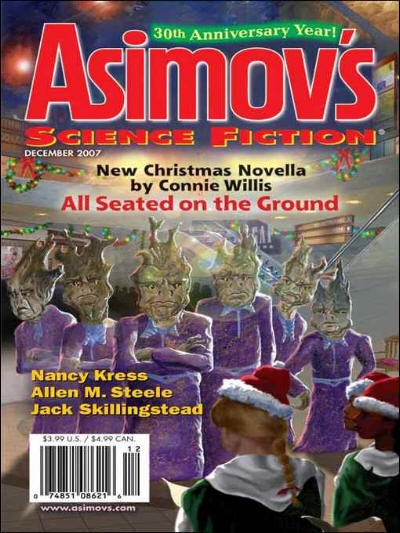


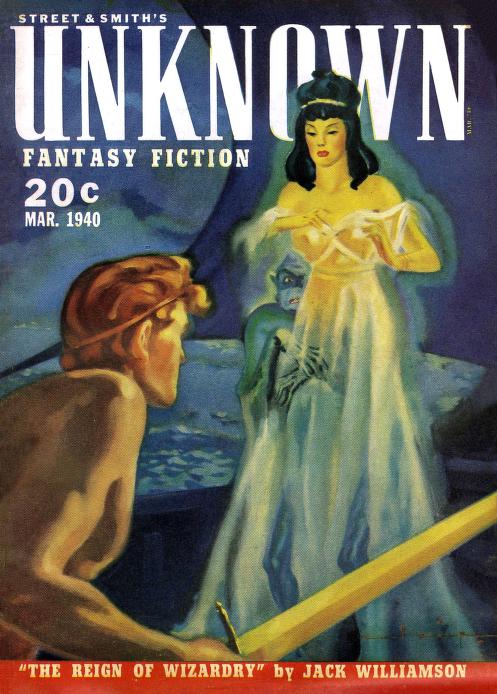



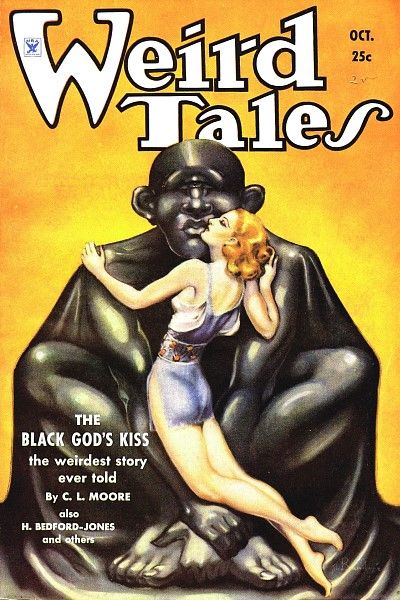
 Science Fiction & Fantasy Remembrance