The Story So Far
Life on Borthan is harsh, probably only marginally less so now compared to hundreds of years ago, when the human settlers came to this planet. Over a period of generations, the settlers constructed a religious creed, called the Covenant, which forbids “selfbaring” and general selfishness, to the point where even referring to oneself in the first-person singular is considered even worse than someone saying “fuck,” “shit,” or “cunt” in public today. This becomes a bit of a problem for Kinnall Darival, theoretically next in line to be septarch of Salla but in practice a nomad who has voyaged to Manneran in the name of settling down: ya know, finding a wife, getting a steady job, that sort of thing. He finds a wife in Loimel, a relative of Halum, Kinnall’s bondsister, who physically resembles Halum to an eerie extent but who otherwise has nothing in common with her. Their marriage is a cold one that soon turns into both parties regularly having affairs, which is not as bad a deal as it sounds; after all, marriage in Borthan is something more often done as a political maneuver than out of love. For some years, life in Manneran goes smoothly for Kinnall, but then of course something has to happen, or else this would be quite a short story.
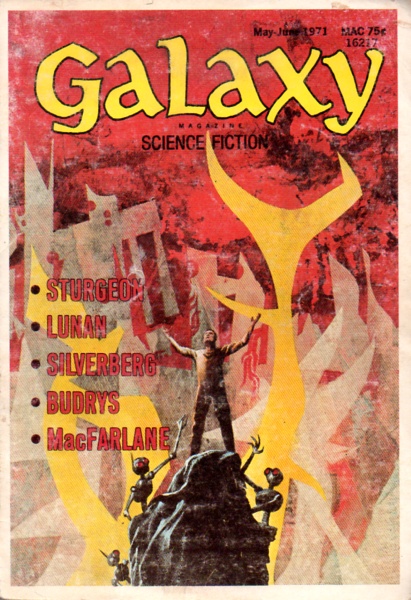
Through having a connection with the local bureaucracy, Kinnall meets Schweiz, an Earthman who’s come to Borthan on business, and indeed it’s not every day someone from Earth comes to this borderline inhospitable backwater. Kinnall and Schweiz quickly form a bond, which is solidified when the latter procures a “potion” hiterto unknown to Borthan’s people, although this potion turns out to be a mind-altering drug that exchanges the perspectives of those using it. Schweiz convinces Kinnall to take a leap of faith and totally give in to the selfbaring the drug grants. It’s a psychedelic experience, pretty “far out” as the hippies would’ve said at the time, and it flips a switch in Kinnall’s brain seemingly in an instant. Whereas there was some resentment towards the Covenant before (namely that, being bondsiblings, Kinnall is prohibited from having sex with Halum), now it has become a full-on rebellion in Kinnall’s heart. What’s more is that there are others in Manneran who share similar sentiments, such that Kinnall will play a role in this new movement.
Enhancing Image
I hope you weren’t expecting to become attached to Loimel (in fairness, you probably weren’t), because she does not appear in this final installment at all. All we get is a couple mentions. After everything goes to shit and Kinnall gets captured, Loimel has nothing to say to him, as if she had forgotten they were even married in the first place. As for Halum, she makes her final appearance when Kinnall shares the drug with her, although Kinnall had to be convinced to do this, seeing it as a bad idea—a hunch that’s proven to be correct. As if beholden to one of those self-fulfilling prophecies, Kinnall’s reluctance to share the drug with Halum (his concern mainly coming from the fact that he knows she’ll find out about his massive crush on her) only leads her to push for sharing it harder. The experience is so traumatic, however, that Halum opts to commit suicide in a rather odd fashion. It’s been clear up to this point that Halum’s death has haunted Kinnall the whole time he’s been writing this memoir of his, although I have to admit that even with such a dramatic event finally delivered, it didn’t hit me much at all. We don’t get to know Halum very well, and even when she and Kinnall have their mutual drug trip she’s revealed to be basically a virginal angel of a human being. So, of the only two women to feature prominently in the narrative, one walks out of the story by the time the third act comes around, while the other is unable to cope with the awesome new drug her bondbrother is now peddling. One is emotionally distant for no particular reason while the other turns out to be emotionally fragile. Somehow I don’t think this would’ve won points with feminists, although compared to some of Silverberg’s other novels from this period A Time of Changes‘s misogyny is mild.
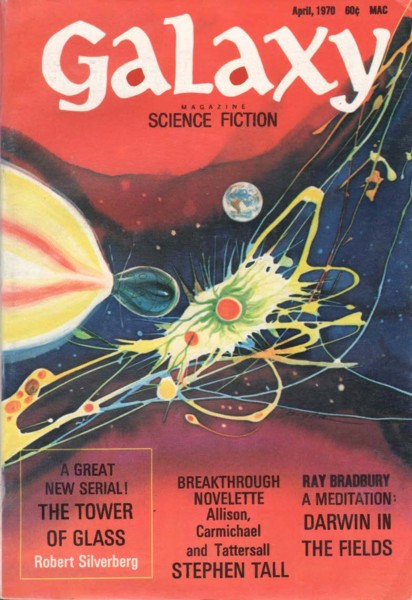
It would be easy to say this is a novel about how selfishness is a virtue, or about how greed, for lack of a better word, is good, but really it’s a novel about how emotionally connecting with people is, if not strictly necessary for human survival, something that would make living a lot more bearable. The need for human connection is a theme that recurs in Silverberg’s strongest novels from that period where he was supposedly at the height of his powers, see The Man in the Maze, Dying Inside, and “To See the Invisible Man,” a theme so persistent that he seemed to have an obsession with it. Why? I don’t know, I haven’t really looked into why Silverberg had this idea stuck in his head for years on end, despite reading essays, editorials, introductions to other people’s books, interviews, and so on. As with Yasujirō Ozu, who returned to the same basic elements in his later movies with somewhat varying degrees of success, Silverberg did similarly with his writing during the late ’60s and early ’70s, which might explain how he was able to write so many novels and short stories—a level of productivity only topped by his output in the mid-to-late ’50s, although nobody talks about that stretch of his career nowadays. He also tended towards the same character archetypes, because I would be hard-pressed to find anything that distinguishes Kinnall from most of Silverberg’s other protagonists, who likewise all share some qualities with the same person—that, it only stands to reason, being Silverberg himself. Once Kinnall tries and fails to convert Stirron to the drug cult and sits in prison, possibly awaiting execution (or maybe not, Kinnall is vague on what his punishment is to be), I feel like I’m saying farewell to yet another Silverberg surrogate.
By the way, I would bet a kidney (not one of my kidneys, somebody else’s) that Silverberg had read Aldous Huxley’s “The Doors of Perception” and thought it would be neat to turn Huxley’s thesis into a novel. In fairness to Huxley, he wrote that famous essay in the ’50s, and Huxley, it must be said, is a more likable narrator than Kinnall. All the same, considering the SF readership in 1971 must’ve been at least 25% hippie, I think those folks would’ve liked A Time of Changes.
A Step Farther Out
This must be the fifth or sixth Silverberg novel from the late ’60s and early ’70s that I’ve read, and if I were to rank them it would probably land smack dab in the middle. It didn’t offend me like Up the Line did, and Silverberg put more effort (it seems to me) into A Time of Changes than Across a Billion Years and To Live Again. Silverberg wrote these novels at a feverish pace, probably with little in the way of revising. These novels share more or less all the same problems, although some are more severely afflicted than others. (It’d be a hard task to overstate how creepy and misogynistic Up the Line is.) Similarly, the misogyny that permeates A Time of Changes holds it back, but it’s also a novel that reads as being very of its time. Why SFWA members felt it deserved the Nebula more than The Lathe of Heaven, a novel that still mostly holds up to scrutiny (its function as baby’s introduction to Taoism reeks a bit of New Age hippie bullshit, but it’s quite bearable), I’m not sure. Silverberg had written better at this time, but the problem is that I’m not sure if any of his novels (barring possibly Dying Inside) from this period were deserving of any major awards.
See you next time.




 Science Fiction & Fantasy Remembrance