Who Goes There?
It’s not every day you get to talk about a Nobel winner for your genre fiction review blog, but here we are. Rudyard Kipling was born in 1865, right at the end of the year, to British parents in India. Kipling was one of the few real prodigies in prose writing; while it’s not too surprising he started writing poetry from a very young age (although he didn’t consider himself much of a poet), he also showed himself pretty much off the bat as a consummate writer of short stories. That he also got a job as a journalist while still a teenager goes to explain his professionalism, but also his (at least when he was young) unadorned style, such that his straightforwardness partly inspired the title of his first big story collection, Plain Tales from the Hills. He would later write The Jungle Books, Just So Stories, and other collections of stories. His 1901 novel Kim was one of the first modern espionage novels, sort of, although it’s much more than just an exotic spy thriller. To this day he’s the youngest to ever win the Nobel Prize for Literature, being just 41 at the time, an age that would be unthinkable for an author nowadays; but like I said, Kipling started early and he ended up writing a lot.
Kipling also wrote a good deal of genre fiction, pretty much of every stripe, including what we now call science fiction. Like seemingly every British writer of the late Victorian and Edwardian eras, though, he really had a soft spot for the supernatural horror story—granted that his supernatural stories weren’t always horror. But Kipling came from a generation of Britons who apparently loved telling and writing ghost stories, partly to make a bit of extra money but also for some gather-around-the-fire entertainment. “The Phantom ‘Rickshaw” was published on the eve of Kipling’s twentieth birthday; yet despite being a teenager when he wrote it, and despite a bit of roughness, it shows a very promising young writer who has already nailed down the basics to an eerie extent.
Placing Coordinates
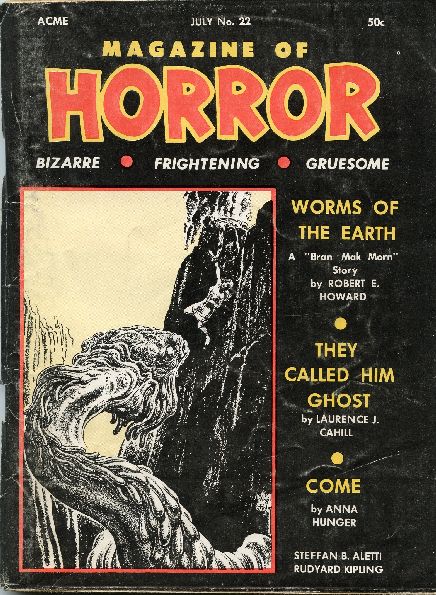
First published in 1885, it first appeared in book form in The Phantom ‘Rickshaw and Other Tales in 1888, the same year as Plain Tales from the Hills. On top of the July 1968 issue of Magazine of Horror you can find it in H. P. Lovecraft Selects: Classic Horror Stories (ed. Stefan Dziemianowicz), The Big Book of Ghost Stories (ed. Otto Penzler), and The Body-Snatcher and Other Classic Ghost Stories (ed. Michael Kelahan). By all rights I should recommend the meaty tome Rudyard Kipling’s Tales of Horror and Fantasy, but having gotten a copy for myself, I have to say the proofreading is abysmal, to the point where there seems to be a typo every other page. Fine. You can read “The Phantom ‘Rickshaw” on Project Gutenberg.
Enhancing Image
This story technically has two narrators, the first being unnamed and presumably a fictionalized version of Kipling himself. The first narrator serves as a walking framing device, telling of the unfortunate demise of his friend Jack Pansay, who supposedly died of some wasting disease, but who according to his own written testimony (he wrote of his experiences in the last few months of his life), the cause is something quite different. Writing with “a sick man’s command of language,” the now-deceased Pansay tells us, in his own words, of the horror that befell him. A few things to say first, not the least being that even with this short opening section, which gives context to the switching of narrators, Kipling’s ear for dialogue is on-point. We only see him a few times, but the quack doctor Heatherlegh is memorable both for his quirkiness and his seeming incompetence, or rather cluelessness as to what could be ailing Pansay. Pansay himself is indicative of the kind of anti-hero Kipling was fond of writing for his early set-in-India horror yarns: the haughty Englishman who learns a harsh lesson. Some of Kipling’s characters live to put what they learned into practice, but Pansay is not one of them. (Of course, since we already know what has become of the main character, this is a rather hard story to spoil.)
A few years ago, Pansay had an affair with a married woman, one Agnes Wessington, fellow Briton traveling in India, and the two worked out well—for a while. But Pansay grew tired of her, which was not in itself unusual, as he confesses to us he tires of his partners sooner or later, the only problem being Mrs. Wessington did not feel the same way. “Ninety-nine women out of a hundred would have wearied of me as I wearied of them; seventy-five of that number would have promptly avenged themselves by active and obtrusive flirtation with other men. Mrs. Wessington was the hundredth.” Since it is surprisingly hard to ghost someone in the 1880s, Pansay struggles to get her off his back before making clear that he is no longer interested in the relationship. Mrs. Wessington doesn’t take the rejection well, although rather than plot revenge or running back to her husband, she simply… withers. Eventually she dies of a wasting disease, similarly to how Pansay goes, but it’s clear that what really killed her was a broken heart. Pansay feels a pang of remorse about this, mixed with a hateful resentment towards the poor woman, even after she has died—but he’ll learn the error of his ways soon enough. When Mrs. Wessington dies it had been a couple years since Pansay dumped her, and since then he’d moved on to another woman, Kitty Mannering. There’s no going back.
Mind you that despite being a ghost story, and despite the setup leading us to expect a certain chain of revenge, this is not a revenge narrative; rather it’s a narrative about guilt and misogyny. Pansay, in trying to rid himself of Mrs. Wessington, comes to loathe her but also pity her, these two very different emotions clashing, and so he mistreats her even as he tries to cement the bad news in her mind. “I was the offender, and I knew it. That knowledge transformed my pity into passive endurance, and, eventually, into blind hate—the same instinct, I suppose, which prompts a man to savagely stamp on the spider he has but half killed.” I was taken back by this a bit, because truth be told, as someone who considers themself a Kipling fan, issues of feminism and womanhood are not his strong suit—at least early on. He would later write some pretty memorable and well-rounded heroines in stories like “Mary Postgate” and “The Gardener,” but a childish sort of misogyny runs through some of his early fiction. Indeed woman-forsaking bachelorhood is treated as something to be aspired to (and conversely, something to be mourned when it is lost) in one of my favorite Kipling stories, “‘The Finest Stories in the World.’” Kipling, like pretty much every great writer, is someone with a few internal contradictions: he was a proud Englishman, but ended up marrying an American woman; he was a lifelong imperialist, with the belief that the British empire really had Indians’ best interests at heart, yet some of his writings come off as deeply ambivalent about government. To paraphrase George Orwell (who, like me, was a socialist and thus not a fan of Kipling’s politics), Kipling’s brand of conservatism doesn’t really exist in the US, UK, and Canada.
Of course, Kipling’s brand of misogyny is in itself sort of alien in today’s Anglosphere, in that he was not actively a woman-hater who believed women were basically property with legs; rather he believed in a softer kind of misogyny that modern-day liberals would probably find agreeable, in that he believed women and men are different on some fundamental level (a level that transphobes have a hard time defining, despite their “best” efforts), with women being fragile in some immaterial way. Granted that this is all told from Pansay’s POV, but Mrs. Wessington and Kitty are both depicted as overly emotional and temperamental, being more beholden to the id than the superego, whereas Pansay’s problem (aside from the titular ghostly ‘rickshaw that haunts him) is that he’s torn apart by having too active a conscience. Another way of looking at it is that Pansay didn’t have enough of a conscience before Mrs. Wessington’s death, but the haunting presence of her ‘rickshaw (a two-wheeled carriage, for those who forgot), with its spectral bearers (or “jhampanies” as they’re called), drives him to realize that he had indirectly killed someone who had meant him no harm. That the story is a bit overlong in getting to this point says that Kipling had not yet gotten down the flow of narrative pacing (a gift he would use with extreme prejudice in just a few years), but he’s getting there. “The Phantom ‘Rickshaw” is not a scary story, nor does it try that hard to be scary in the first place, but it’s compelling and psychologically thorny.
There Be Spoilers Here
Something I was thinking about while reading “The Phantom ‘Rickshaw” was a fallacy in first-person narrative writing that even hardened professionals make, which is that the narrator, telling a story in the past tense and thus something that has already happened, makes remarks on their story as if they were currently experiencing it, without time to think retrospectively on the events. At least here, though, Kipling averts the fallacy by having there be a time skip in Pansay’s writing; he has, after all, spent a fair amount of time writing about the thing which is now killing him. As the end looks to be nigh, Pansay comes to grips with the notion of dying, and also that he was in a way responsible for Mrs. Wessington’s death, his only concern being what will happen to him after he dies, since he is convinced that there is such a thing as a life after this one—a kind of afterlife which doesn’t look inviting, if it’s true. His final comment, and by extension the story’s final paragraph, is a haunting one, so I’ll just repeat it here: “In justice, too, pity her. For as surely as ever woman was killed by man, I killed Mrs. Wessington. And the last portion of my punishment is ever now upon me.”
A Step Farther Out
I was indulging myself a bit with this one, as an aforesaid Kipling fan, although I had not read “The Phantom ‘Rickshaw” before and there was a very real chance it would disappoint. (Truth be told, I’m not the biggest fan of Kim or the first Jungle Book.) But Kipling, even baby-faced Kipling, often delivers the goods, as he does here.
See you next time.
 Science Fiction & Fantasy Remembrance