Who Goes There?
In his lifetime Russell Kirk was known firstly as a conservative political theorist, at a time when American conservatism was still capable of producing intellectuals. His 1953 non-fiction book The Conservative Mind was a seminal political text in its day, although, having been written and published when the Old Right still held sway in government, it now has been seemingly forgotten in a post-Reagan/post-Trump landscape. Kirk was good friends with T. S. Eliot, a fellow conservative and one of the leading members of the Modernist movement; and this may have influenced Kirk to try his hand at literature that would very much stand on its own merits, regardless of the reader’s political biases. Nearly all the fiction Kirk wrote would be supernatural horror, as like M. R. James he seemed uninterested in writing fiction of any other kind, and he would even win the World Fantasy Award for Best Short Fiction for his story “There’s a Long, Long Trail A-Winding.” Kirk also appeared semi-regularly in F&SF, and indeed it’s very likely he would’ve never appeared in the genre magazines if not for F&SF‘s mix of classiness and friendliness towards short horror fiction. “Balgrummo’s Hell” is a (relatively) modern take on what would’ve already been a very old tradition in 1967: the Gothic supernatural tale.
Placing Coordinates
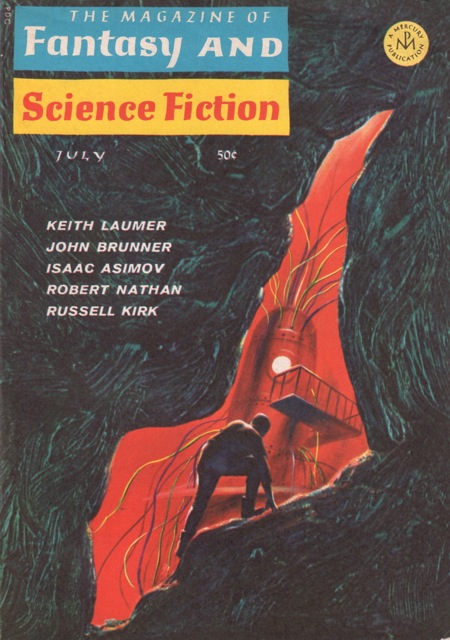
First published in the July 1967 issue of The Magazine of Fantasy and Science Fiction, which is on the Archive. It’s been reprinted in The Best from Fantasy and Science Fiction: Seventeenth Series (ed. Edward L. Ferman), The Best Horror Stories from the Magazine of Fantasy and Science Fiction (ed. Edward L. Ferman and Anne Jordan), and the Kirk collections The Princess of All Lands and Ancestral Shadows: An Anthology of Ghostly Tales, the latter seemingly collecting all of Kirk’s ghost stories.
Enhancing Image
Rafe Hogan is a thief, and a pretty good one at that. His latest location for a heist is a secluded mansion in Scotland: Balgrummo Lodging. It’s not exactly a solo job, as his sort-of-girlfriend Nan had gotten hired as a nurse for the mansion and has given Hogan some valuable information as to the treasures lurking inside—namely that the mansion is home to a lot of paintings that would go for a pretty penny on the market, if anyone were to sell them. God knows there’s very little else of value inside, as Alec Fillan Inchburn, the tenth and last baron (he never had children) of Balgrummo Lodging, has sold off everything else of real value for the sake of paying off debts. Alec is extremely old, having not ventured outside his mansion in half a century, having committed an unnamed crime in the years right before World War I and having since been put under a kind of unofficial house arrest. Alec’s only associates now are his niece Euphemia “Effie” Inchburn, T. M. Gillespie, “chairman of the trustees of Lord Balgrummo’s Trust,” and a lone bodyguard at the mansion, Jock Jamieson. There are also nurses who have passed through, to aid the elderly Lord Balgrummo, but Hogan can’t figure for the life of him how these women would’ve lasted more than a week at a time. There aren’t even any guard dogs on the premises. “‘The brutes don’t live long at the Lodging,’ Gillespie had muttered in an obscure aside.” Overall it sounds like this heist shouldn’t be too taxing.
The heist itself only takes up a fraction of the story, most of the wordage being spent on the setup for the heist and the backstory for the mansion, the latter especially contributing to a sense of impending doom—yet we’re kept in the dark as to what kind of doom awaits us. Overall it’s a nonlinear structure, and I’m not totally sure it works out. As far as the action goes it borders on being a one-man show, as once Hogan gets past Jamieson he wanders through the mansion by his lonesome, at night. Kirk might’ve been aware that the actual plot he had conceived would not be able to sustain a short novelette, so he jumps back and forth in time, or rather has Hogan think back on conversations he’d had with Gillespie and Effie, both of whom are fluent in Expositionese. Normally I would fault the exposition-heavy dialogue more, but since the purpose of sucking up to Alec’s associates is to gather info, it makes sense Hogan would be recalling backstory, of which there is a lot. If I had to call “Balgrummo’s Hell” a single word it would be “atmospheric,” which is often used as very polite shorthand for when nothing happens in a story, but at least the vibes are right. It doesn’t help that Hogan is not by any stretch a “hero,” although in his defense he could be more of an outright villain: for example he contemplates murdering Lord Balgrummo while the old man seems to be comatose, but dismisses such a thought as unnecessary cruelty. He’s not exactly a likable protagonist, though, and knowing how Kirk’s worldview operates it becomes too easy to figure out that Our Anti-Hero™ is practically begging to get his just desserts. How he gets his comeuppance is a different story.
“Balgrummo’s Hell” is basically a story about two men who are damned—only one of them doesn’t know it. Something is not right about Balgrummo Lodging, but we’re not told exactly what had happened to make it fall into such decrepitude. There’s a haunting early passage where Hogan is doing location scouting in the neighborhood the mansion is found on, in which the rot of the place seems to have spread like a virus, the rot creeping like a darkness on what is already decaying Scottish urbane landscape. Kirk is a good writer, even if after having read a few of his short stories I don’t consider him that good a storyteller.
Observe:
Beyond the linoleum-factory, he had come upon a remarkably high old stone dyke, unpleasant shards of broken glass set thick in cement all along its top. Behind the wall he had made out the limbs and trunks of limes and beeches, a forest amidst suburbia. Abruptly, a formal ancient pend or vaulted gateway had loomed up. On either side, a seventeenth-century stone beast-effigy kept guard, life-size almost: a lion and a griffin, but so hacked and battered by young vandals as to be almost unrecognizable. The griffin’s whole head was lacking.
I have qualms with the payoff for the mystery, which I’ll get to, but you have to admit Kirk sets things up beautifully. We’re given a location that’s in the midst of crumbling, yet like a dying animal it has become vicious in its own way. Balgrummo Lodging is practically a living thing in itself. We know going in that this is supernatural horror, but the actual supernatural element is alluded to rather than show for almost the entire story, and for me that’s where the sense of dread really comes from. For most of the story nothing strictly supernatural happens, but we know something is wrong. This sense of dread only becomes heightened once Hogan meets Lord Balgrummo face to face, or rather comes upon Lord Balgrummo’s near-lifeless body in his study, the old man having deteriorated physically to the point where he seems unaware of what’s happening around him. One has to wonder how he’s still alive after all this. “But was this penny-dreadful monster of fifty years ago, with his white beard now making him sham-venerable in this four-poster, still among the living?” Yet Alec may well be kept alive by a torment which for him is the never-ending present—a kind of hell that, in line with Kirk’s traditional Catholic conception of punishment, is not a recollection of a horrible past but rather an obliteration of both past and future, so that the present never stops. The explanation for Alec’s condition, courtesy of a flashback with Gillespie, borders on sermonizing, which at this point I’ve come to expect. You can blame it on me being an agnostic, but Kirk’s skill for me is often held back by his sermonizing.
There Be Spoilers Here
Hogan has gone into Lord Balgrummo’s chamber to take a key which only Lord Balgrummo has, which turns out to be a mistake. It’s at this point that we’re told what the supernatural element is, and it ends up being an odd reveal because Hogan had already learned this information before entering the mansion—it’s just that the reader is only learning about it in the climax of the story. I blame myself for not guessing early on, because it’s not a hard twist to figure out; if anything, aside from his tendency to sermonize, Kirk’s biggest flaw as a writer is that he’s not very original when it comes to incorporating horror elements. The reveal that Alec had gotten involved in some horrible pagan ritual may have been a decent twist in 1887, but not so in 1967; nowadays it comes off as tired, but also a little culturally insensitive. So Effie tells us in a flashback:
“[Alec] was out in Nigeria before people called it Nigeria, you know, and in Guinea, and all up and down that coast. He began collecting materials for a monograph on African magic—raising the dead, and summoning devils, and more. Presently he was dabbling in the spells, not merely collecting them—so my father told me, forty years ago. After Uncle Alec came home, he didn’t stop dabbling.”
Lord Balgrummo fucked around and found out, and so for decades now has spent his life in perpetual torment, a torture which will continue until his body expires—and possibly may even continue after his physical death. Whether or not Hogan gets off better is up for debate. The story ends more or less how you think it will, although given the suddenness of the reveal it feels more like a stop than a proper ending. Like I said, Kirk is much better at setting up the mystery than giving us an answer for it, which come to think of it is not unusual for mysteries. I was intrigued for most of the story, but at the end I felt weirdly empty from it.
A Step Farther Out
Gothic narratives always interest me, even if the narrative turns out to be totally derivative and not worth my time. “Balgrummo’s Hell” is worth your time, depending on your appetite for an old-fashioned haunted house story with a religious moral at its center. Kirk clearly held the Gothic tradition in reverence, and line-for-line he’s a more elegant writer than most genre writers in the ’60s—whether he’s able to sustain that elegance for a whole story is yet for me to see. Maybe it has to do with my being allergic to being moralized at. Maybe I’m just not Catholic enough.
See you next time.

 Science Fiction & Fantasy Remembrance