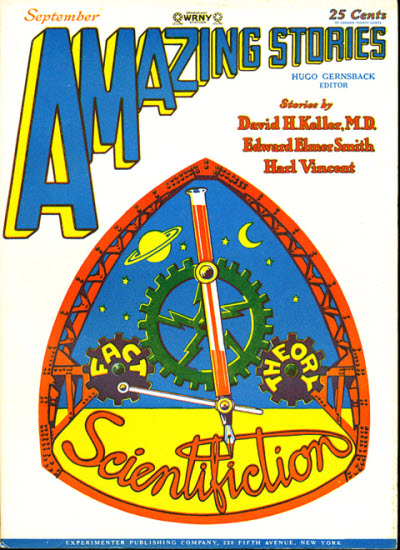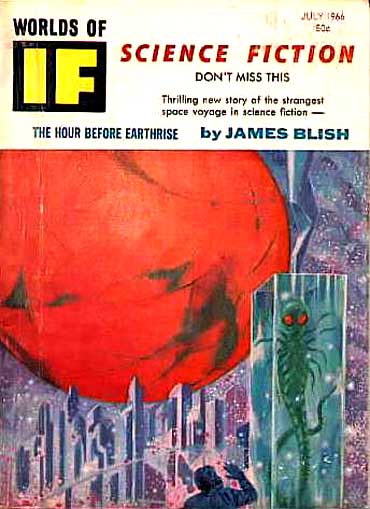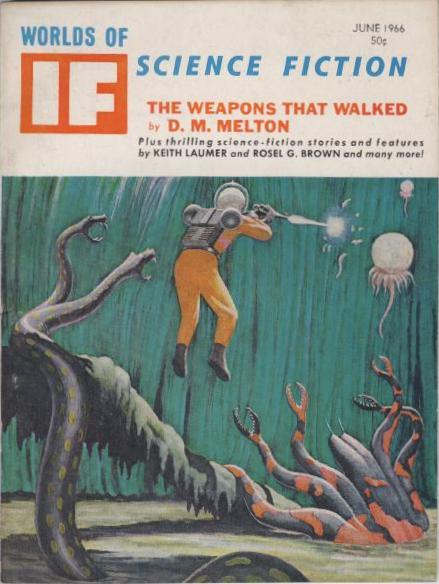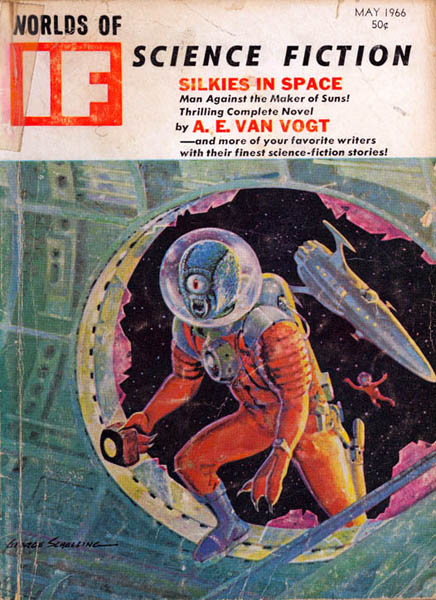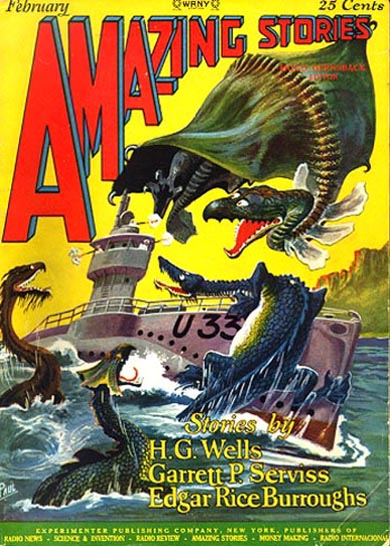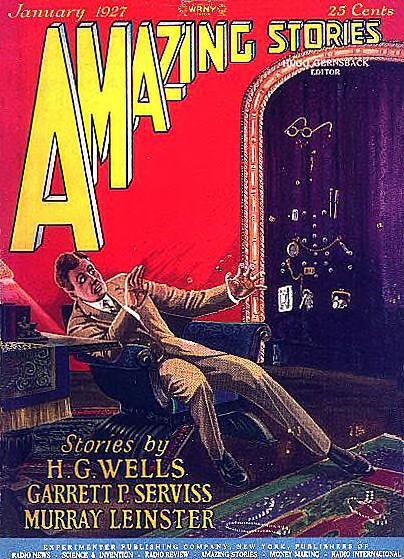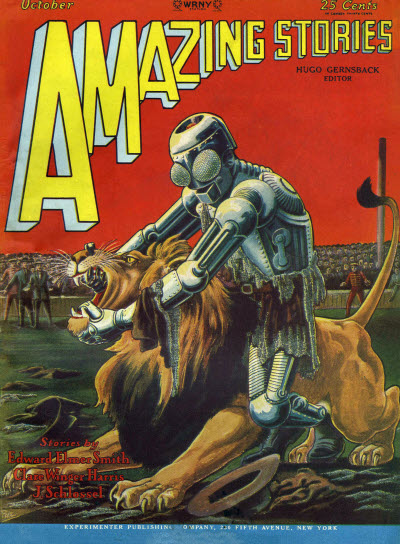
(Cover by Frank R. Paul. Amazing Stories, January 1927.)
The Story So Far
Bedford is an aspiring playwright and a failed businessman who strikes up an unlikely friendship with the scientist Cavor. Bedford is working on a play whilst licking some financial wounds and Cavor has been trying to perfect a metal of his own design, so that each man has been struggling with his own goals. Their friendship takes on a business aspect, with Bedford basically acting as Cavor’s manager while the latter messes around with the elements and God knows what. Because this novel is narrated from Bedford’s perspective and because Bedford himself is not a scientist at all, the details of how Cavorite is perfected are rather sketchy. It’s a combination of metals that works like helium, despite being solid, in that it has an anti-gravity effect. The accidental perfecting of this man-made element results in a cyclone that damn near kills Our Heroes™, but the good news is that it works. The question then becomes what to do with Cavorite. Mind you Wells wrote the novel around 1899, the years it takes place, so airplanes were just a little bit off in the future, with hot air balloons being up to this point the only practical way man could take flight.
Cavor gets the “brilliant” notion to not only construct a giant metal sphere made partly of Cavorite, but to test it by flying himself and Bedford to the moon. Thus our means of getting to the moon is not via rocket ship, or even like Jules Verne’s From the Earth to the Moon where we’re shot out of a cannon, but what amounts to an anti-gravity metal sphere. How these two Englishmen plan on getting back to Earth, let alone England, remains to be seen. When they land on the moon they find that the air is breathable, if also taking some getting used to, and that there is plant life here at the very least—albeit plant life of an exotic sort. The gravity is also only a fraction of Earth’s, which Bedford struggles with. And yet despite the breathable atmosphere there doesn’t seem to be any alien life possessing anything like human intelligence… at least so far.
Enhancing Image
The second installment opens with Bedford and Cavor actually stepping out of the sphere and getting a whiff of that comparatively thin moon air. I need not tell the reader (but I will) that aside from the lower gravity, the moon in Wells’s novel is completely different from the moon as we know it—so different that it may as well be a fantasy realm. What was scientifically plausible in 1901 was very much not so even a few decades later, never mind in 2026. If The First Men in the Moon suffers from anything, aside from being heavier on the adventure elements than Wells’s more iconic novels, it’s not being nearly as plausible as The Time Machine or The Island of Dr. Moreau. Granted that all science fiction is founded on at least one big lie (and more likely several lies in concert), The First Men in the Moon now almost reads more like fantasy than SF. It’s more scientifically grounded than Edgar Rice Burroughs’s Barsoom novels, but not by a whole lot. What’s interesting is how the atmosphere and gravity affect Bedford and Cavor’s sense of time and even hunger, with them realizing after a while that they’d not eaten in hours, yet don’t feel like they’re starving. It’s also easy (and fun) to traverse the moon by jumping around. The only problem (well, the first problem) is that they at some point lose track of the sphere.
It takes nearly halfway through the novel, but it does live up to its title. I said that the moon here is radically different from how it is in real life, another difference being that the moon here has a vast network of underground tunnels. Not only is the moon alive, with plants and “mooncalves” to serve as livestock, but there is indeed a race of intelligent beings here. The Selenites are about man-sized and bipedal, but insectoid. More to the point, there’s no overlap in language between the Englishmen and the aliens, except maybe basic body language. The Selenites don’t intend to kill them, at least not right away, instead taking them prisoner and holding them in this underground cavern. This isn’t quite as cool as it sounds. It could be because Bedford and Cavor, while being eccentric (especially the latter), are not natural-born adventurers like John Carter or Conan, but much of the conflict in this stretch of the novel comes down to Our Heroes™ bickering with each other rather than working together to fight their captors. Not that there’s anyone else around to converse with. Even the human cast of The Time Machine is bigger, by virtue of the framing narrative. Something I’ve just noticed about protagonists in Wells’s stories, be it his novels or short stories, is that a) they’re not given to introspection, b) they’re reacting to strange happening, rather than causing them, and c) they’re always dudes, without fail. When I say “protagonist” I also mean the narrator, since there tends to be a secondary character, the deuteroganist, who acts rather than reacts. Cavor is thus the deuteroganist to Bedford’s protagonist.
A Step Farther Out
Wells was not known for writing long novels, but even being about the same length as The War of the Worlds, The First Men in the Moon feels smaller in scale and less intellectual. We’re two thirds of the way in and the Selenites are still mostly a mystery. I can’t help but feel like this novel is missing something Wells’s best novels have, although I can’t quite put my finger on it. I’m gonna wait until the final stretch to pass judgment, but this is not looking to be one of my favorites of his. Oh well.
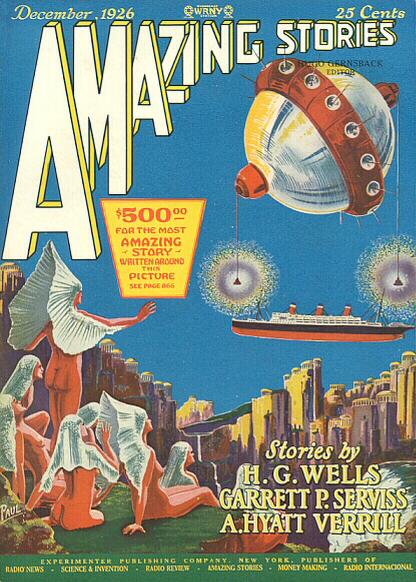
(Cover by Frank R. Paul. Amazing Stories, December 1926.)
Who Goes There?
Herbert George Wells was born in 1866 and died in 1946, meaning he lived to see both World Wars, as well as the dropping of the first nuclear bombs. By the end of his life he came to believe humanity was in a pretty sorry state, but for much of his career he could be considered an optimist. He was an early advocate for Darwin’s theory of evolution and was what we’d now call a democratic socialist, both of these beliefs playing major roles in his fiction writing. While he wrote essays and articles prolifically, and wrote quite a bit of non-genre fiction, it’s his SF that secured his legacy. Between 1895 and 1901 alone he either invented or codified multiple subgenres of SF, between a handful of novels and a fair number of short stories. That his output became increasingly sporadic and lacking in vitality after that point is a relatively small price to pay, given the heights of his major work. He’s arguably the most important SF writer to ever live, even taking into account authors who wrote SF before him, such as Jules Verne and Edgar Allan Poe. The First Men in the Moon was first published in book form in 1901 and is perhaps Wells’s last major novel, although he did write some very good short stories after this point.
Starting my Amazing Stories run with a reprint might seem odd for those who are not in the know, but reprints played a big role in the first years of that magazine’s history. Hugo Gernsback quickly became infamous for not paying his writers in a timely fashion, and the original work he received was often of pretty dire quality anyway. Therefore, reprints of classic (from the perspective of the 1920s) SF sounded like a logical choice. The relationship between Gernsback and Wells eventually soured, but it’s hard to come across an early issue that doesn’t feature a Wells short story or novel in serial form. There was a generation of young readers who, lacking in hardcover books, associated Wells with Amazing Stories and those colorful Frank R. Paul covers, and that’s not a bad thing.
Placing Coordinates
First serialized from 1900 to 1901 in The Cosmopolitan and The Strand Magazine, in the US and UK respectively. It was first published in book form in 1901. It was serialized in Amazing Stories from December 1926 to February 1927. Obviously it’s still very much in print, but because it’s public domain it’s also on Project Gutenberg.
Enhancing Image
Wells is famous for a lot of things, but his protagonists (except maybe the unnamed hero of The Time Machine) are not among them. Here we have Mr. Bedford, a businessman who’s recently come into hard times by way of bankruptcy. He’s the narrator of this story, but it’s hard to call him a hero; on the bright side, he’s at least affable. Bedford’s chosen to put his money issues aside for the moment and concentrate on writing a play. During this retreat he has a series of encounters with Mr. Cavor, who turns out to be an eccentric scientist. Cavor is mildly and passively annoying, and when Bedford makes this known to him Cavor threatens to buy his bungalow. The two men come to an understanding, though, and even start a business relationship that might evolve into friendship. It’s a case of how opposites might attract, since Bedford is “practical” and business-minded while Cavor, despite being highly intelligent, has yet to make much of a living off of his inventions. His latest invention might prove profitable, though, being an artificial element called Cavorite, which is missing an ingredient. The making of Cavorite is rather vague, with Bedford, himself far from being a scientist, not knowing “the particulars” of its final (and accidental() making. The basic idea is that Cavorite is an anti-gravity amalgamation of metals, in that it’s like helium but a solid rather than a gas. It’s worth mentioning that Wells wrote The First Men in the Moon just prior to the first modern plane taking flight, and the novel itself is set at the very end of the Victorian era. The only practical way a man could take flight in 1899 was with the hot air balloon, which of course is mentioned.
Also mentioned is Verne’s From the Earth to the Moon, which in case you don’t know involves a bunch of adventurers building a huge fucking gun and firing themselves out of it, their capsule being like a bullet. It’s pretty hard to take seriously nowadays, not that Wells’s solution to the moon problem is much better. Cavorite is a made-up element that may as well be magic, and the ship the two men (with the help of some laborers) build is a sphere made partly of this element. It’s not really a rocket ship, but rather an anti-gravity ship. Maybe the most unserious part is that Bedford and Cavor are not astronauts, which goes without saying, but also they don’t bring any equipment that even a child nowadays would understand as required for space travel. No pressure suits in this novel. The men also don’t experience the ill effects of low or zero gravity. We really didn’t know anything about our moon in 1899, did we? There’s speculation that the moon might have a breathable atmosphere (it doesn’t) and even life (not that either). Of course, since this is a Wells novel, the air is perfectly breathable and some of the first things we see are flowers indigenous to the moon.
But I’m getting ahead of myself a bit.
It’s hard to spoil this novel, since even having not read it before I’m aware of the general trajectory of its plot. We wait until nearly a third into it to witness the revelation of life on the moon, but this fact is made apparent even on the covers of some modern editions. Like with Wells’s other famous works, it suffers nowadays from seeming too familiar, although not to the level of, say, The War of the Worlds. It doesn’t help that Wells is big on using archetypes for his characters, so that Bedford and Covar are about one step above the level of cardboard. The stakes are also low, or at least so it appears at this point, since Our Heroes™ only decide to journey to the moon as a sensational way of testing the sphere. You may then be wondering what the appeal of reading Wells in [the current year] might be, if the science is laughably outdated and his characters lack the dimensions found in the works of Wells’s more literary contemporaries. The secret is that Wells, at his best or even just close to it, is a pretty engrossing storyteller. Wells is like his close contemporaries Arthur Conan Doyle and Rudyard Kipling, in that a) he wrote a fair amount of SF and horror, and b) he had a knack for titillating the reader’s imagination. Despite not much happening in terms of plot with this opening installment, I did read most of it with ease.
There Be Spoilers Here
Well, they do land in the moon, or rather on it.
A Step Farther Out
Funny thing about reading this novel and Wells generally is how one can see his influence on other authors pretty readily, be it on Robert Heinlein or Michael Crichton. (I wouldn’t be surprised if the anti-gravity sphere here was an influence on the reality-warping chamber in Crichton’s Sphere.) As with Wells’s other major novels it can also be better understood as adventure fiction than SF of the more serious/modern sort, even if those authors partly got their game from Wells. The question then is, what happens next? We’ve technically already made first contact, but surely there will be aliens that can converse with a couple of Englishmen.
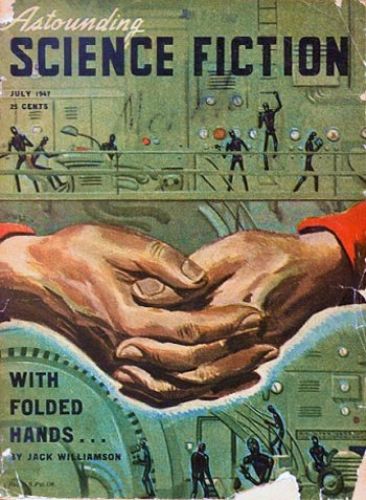
(Cover by Williams Timmins. Astounding, July 1947.)
The Story So Far
Sam Reed is ugly both physically and as a person. He’s a remorseless thug and grifter who makes money in the underworld of Delaware Keep, but he’s also rough-skinned and bald as an egg. It wasn’t always supposed to be like this, though. When he was born, Sam Reed was actually Sam Harker, of the Immortal (long-lived) Harker family, perhaps the single most powerful family in the Keeps. Unfortunately his mother died in childbirth and the father, his mental state in a downward spiral, decided to take revenge on Sam by giving him up as well as having him modified to make him appear like a “short-termer.” Sam grew up unaware of his lineage, and also the fact that he would live for centuries—assuming someone doesn’t kill him first. The possibility of getting murdered is quite real, considering Sam already had enemies to begin with, but also he gets into dealing with the Harkers and more specifically Zachariah, the patriarch of the family and Sam’s grandfather, unbeknownst to either of them at first. A love triangle of sorts develops between Sam and Kedre Walton, Zachariah’s mistress, which naturally irks the old man. Still, Zachariah finds Sam useful and hires him to assasinate Robin Hale, a fellow Immortal and a former Free Companion who’s looking to revive efforts to colonize the hostile islands of Venus. Sam goes along with this at first, but quickly realizes he’s as likely to get killed himself after killing Hale. Thus the two men, when they meet, decide to come up with a scheme behind the Harkers’ backs, and within this scheme Sam forms a plan to fuck over Hale for the sake of a ton of money.
Just when it seems like Sam has pulled off a successful grift, he gets blasted with dream-dust by Rosale, a popular dancer who’s been looking to double cross Sam this whole time. Our Anti-Hero™ finds himself coming out of this drug-induced stupor—a whole forty goddamn years later. All this without having aged at all, which means he must be an Immortal. That’s like the only explanation, right? Really he should’ve died, but Kedre, apparently out of genuine fondness for him, had him drugged, walking the streets as an addict for decades, until one day he snapped out of it. Despite having no prospects and no money, and even his own name being cursed after the grift he pulled on the colony, Sam manages to get back on his feet and even strike a new deal with Hale—as Joel Reed, Sam’s long-lost son. The landside colony did happen, but it’s been lacking in manpower and resources for years, as the Immortals have made sure it won’t prosper. Sam sees a new grift on the horizon, but also a chance to get revenge on Zachariah and the others. In a big fat lie that he’s sure will be found out, in time, Sam claims to have found a way to immortality landside.
Enhancing Image
A character I did not mention before and probably should have, although she only appears in a couple scenes throughout the novel and not at all in the final installment, is Sari Walton. Sari is Kedre’s granddaughter, and bears enough of a resemblance to her that when they first meet early in the novel Sam actually confuses her for Kedre. She’s also, by extension of being both Walton and Harker, Sam’s cousin(?), although neither picks up on this family connection. She’s less a character and more an example of the Immortals’ sleazy decadence, being a hedonist and a barely functioning drug addict. Similarly Sam can’t even take revenge on his father, Blaze, who has long since lost his mind and been confined to a padded cell, a development that would’ve happened even if Sam had never started on his warpath against Zachariah. Of course, Blaze being institutionalized is bad PR for the Immortals, who while being a bunch of idlers and schemers take pride in their ability to govern over the proletariat. On the one hand I take issue with how with maybe the exception of Kedre, every female character in this novel serves a plot function as a warning sign with legs for Sam, but characters of either gender come off pretty badly. This is a Kuttner-driven story, and Kuttner had a rather dim view of humanity. Sadly even Kedre takes a backseat in the final installment, really just being there as someone for Zachariah to explain his plans to.
Much of the final installment takes place landside, in which, over the span of quite a few years, the new wave of colonists set up on several islands. We get very little description as to what life is like landside, but the idea is that it’s rough, made more so because now there is a ticking-clock element. Sam and Hale both know that the lie about immortality is just that, and that at some point the young settlers will notice that they’re not quite as young as they were, say, five years ago. At some point they will come for Sam’s head. Sam, on his part, had given the settlers some bogus explanation, something about radiation that only works on the very young, which now sounds even more ridiculous than was intended in 1947. Somehow the ploy works, despite an underground group of dissenters threatening to overthrow Sam. The Logician, who you may have forgotten about, has even decided to join in on the fun, although eavesdropping on the dissenters gets him into quite a bit of trouble, and only his connection with Hale saves him. The Logician (he has a name, but that’s not very important) is the unlikeliest character in the whole novel, both for the power he possesses and how he has a tendency to show up in just the right place at just the right time. Indeed without the Logician the ending would not have happened, but I’m getting ahead of myself slightly. This is a curious subplot, if only it didn’t suffer from the same problem as the rest of the novel, which is that it feels underdeveloped to the point of malnourishment. I’m not sure how much time Kuttner and Moore spent on writing Fury, but even by the standards of ’40s SF it strikes me as rushed and stripped-back to a fault.
Speaking of which, there is one new character of note introduced, although I’m barely exaggerating when I say she exists as plot device. See, we’re told over and over that the Immortals are fond of playing the long game, partly because of their extremely long lifespans but also implicitly because they’re lazy. Zachariah comes up with an assassination plan for Sam that would take a couple decades at least to come to fruition, but… I was going to say it’s all but foolproof, but it’s so strange. The Harkers, through the power of eugenics, are able to breed selecively a girl whom Sam would unconsciously trust, which is important for a man who is (rightfully) paranoid about everyone around him. The girl in question, Signa, eventually gets hired as Sam’s secretary when she comes of age, but little does Sam know that this is like The Manchurian Candidate and that Signa has been brainwashed to kill him upon a specific unconscious trigger. This is pseudo-science of the highest order, and it’s one of those things that makes me wonder if Fury had been written specifically with John W. Campbell’s tastes in mind. Certainly it feels more made-to-order than “Clash by Night,” which at least has a touch of the personal. Fury leans much harder on what you might generously call oudated psychology, to its detriment, and while the scene where Signa nearly kills Sam is a tense one, this is all such a last-minute development that the impact is minimal. Sam spends several years with Signa as a secretary, but we get very little impression of what they’re working relationship is like, only that they’re not romantically or sexually involved. I guess that’s all well and good, considering Sam is over a century old by this point and old enough to be Signa’s great-great-grandfather.
On the one hand Fury is about man quite literally crawling out of the swampy waters of Venus onto dry land, as a sort of retelling of man’s evolution, both as a descendant of amphibians and as homo sapiens evolved from hunter-gatherers to “civilized” people. Taken less as allegory and more as political commentary, it becomes more ominous. After the failed attempt on Sam’s life he’s essentially put into cold sleep by the Logician, after it’s become apparent that the colony might succeed without him, and just as apparent that if Sam continues in his position he’ll emerge as a Mussolini-esque figure. Democracy was already a fugazi landside, and it’s implied that the Immortals, who by this point had been forced out of the Keeps, will govern alonside Hale. This probably won’t be much of an improvement, if we’re being honest. If we’re to take the Logician at his word then we’re supposed to believe that there are times and places where strongmen like Sam are necessary for the betterment of humanity. The novel doesn’t challenge this notion at all. Sam may have been raised to be a criminal, but his Harker genes made sure he be destined for greatness—even if it comes at a rather high price. Intentionally or not, Fury is one of the more overtly fascistic works I’ve read from Astounding‘s so-called golden age, which sounds disconcerting (because it is).
A Step Farther Out
This is the longest Kuttner-Moore story I’ve read, as while the two wrote a mindboggling amount of fiction they wrote relatively few novels, and I have to admit it’s not one of my favorites. The virtues that mark the best of Kuttner and Moore’s (alone or together) short fiction is here, sort of, but these good qualities are held back by strange pacing and characters who are not totally worth caring about. This is not to say I wish the characters were lovable little woobies, as Sam being an asshole is indeed critical to the plot happening in the first place, but it can be hard to stay invested when, for instance, conversations between Sam and Zachariah are basically like Zoom calls between you and that coworker you hate. It’s also a disappointing follow-up to “Clash by Night,” which with a much smaller cast and in less than half the word count managed to evoke a vaster and more lively world. The problem ultimately is that while Moore did write parts of Fury, her contributions as a stylist and a sort of humanist (although like Kuttner she was a pessimist) are sorely missed.
(Cover by Charles Schneeman. Astounding, June 1947.)
The Story So Far
600 years ago, mankind on Earth blew itself to smithereens via a nuclear chain reaction, with the saving grace being the human colony on Venus. Venus, as depicted in-story, is not only habitable but absolutely teeming with indigenous life—the problem being that said life is also totally hostile to human habitation. Unable to make “landside,” the settlers built undersea domed dwellings known as the Keeps, each Keep named after an American state, so New York Keep, Delaware Keep, etc. Long ago, before the Keeps unified, these city-states employed Free Companies, that is to say teams of mercenaries, to fight proxy battles for them, and for a good price. By the start of Fury, the Free Companies have long since disbanded, the Keeps now living more or less in harmony, or at least in complacency. There’s been peace among the Keeps for so long, actually, that things have gotten too peaceful, which is where Sam Reed and Robin Hale come in. Sam thinks of himself as just an ambitious hustler in Delaware Keep’s underworld but is, in fact, a member of the “Immortal” Harker family, having been denied knowledge of his lineage by his vengeful father. Hale is also an Immortal, that is to say an extremely long-lived person and a member of the Keeps’ upper crust, but he’s a former Free Companion who remembers the glory days when there were naval battles on the swampy surface of Venus. Hale wants to unite the common people of the Keeps and start a colonization effort for landside, something many thought to be impossible. Meanwhile Sam sees a business opportunity in such a venture.
The problem for Sam is that his goals are mixing business with the need for personal vengeance. He’s resentful towards the Immortals generally, believing himself to be just another common man, but he ends up having a complicated relationship with the Harkers especially. Sam has romantic (or at least sexual) tension with Kedre Walton, an Immortal who’s the mistress of Zachariah Harker, Zachariah being Sam’s grandfather. Sam doesn’t know about this blood relation, although it’s unclear at this point if Zachariah is also unaware. The older man hires Sam for a job: to kill Robin Hale. Hale’s landside idea troubles the Harkers and the other Immortal families, whose idleness depends on the proletariat themselves being complacent. A colonization effort, even if it fails, would inconvenience the families. Figuring himself expendable in all this, Sam decides to team up with Hale rather than kill him, although he also plans to take advantage of Hale’s campaign. At the same time Sam has his eyes on Rosale, a popular dancer who is secretly (to Sam, but not the reader) in cahoots with the Harkers. Sam pulls a grift once Hale’s campaign takes off, on the assumption that the colonization effort will fail, but this doesn’t do him any good since Rosale doops him by blowing some dream-dust in his face, just as Sam thinks he’s won. He wakes up, or rather regains consciousness, after forty years of total blackout. Sam, now eighty years old, finds that he’s barely aged in the intervening time, which means he’s an Immortal himself!
Enhancing Image
Censorship in Astounding was a funny matter, because on the one hand, sex was pretty much off the table and manuscripts were scrubbed for salty language, but violence and drugs (at least SFnal drugs) were just fine. Rosale basically roofied Sam with dream-dust, a drug so addictive that people hooked on it walk around for years like zombies before, eventually, dropping dead from malnutrition. Drugs are very bad, kids. Sam is relatively lucky, because not only is he still alive and in relative good health, it doesn’t take him long to acquire a bit of cash. Through illicit means, of course. The bigger problem is that he quite literally can’t afford to get back on his feet as Sam Reed. Sam Reed is not only disgraced for having screwed over Hale’s campaign, but also broke. The government had confiscated not only the money he got from selling his stock, but the caches of hard money he had left hidden in case of an emergency. Forty years is a long time—for “short-timers.” A lot has happened since he got knocked out. Now, one of the first questions the reader should be asking is why the Harkers decided to spare Sam when they could’ve just as easily killed him. We do actually get an answer to this, which is that while Zacharia wanted Sam killed, Kedre managed to argue for his being drugged instead, apparently out of genuine fondness for him. This is a bit strange, because Sam is about as cuddly as a cactus, but I guess it’s a matter of different strokes for different folks. Anyway, compared to his grandpa Sam still comes off as somewhat affable. That’s really the key to Fury working at all: the fact that while Sam is objectively a shithead, the people he’s up against are even worse.
It is awfully convenient how Sam, despite being homeless for decades, is not horribly starved or marred by disease, and also that he’s able to get a foothold again relatively easily. He does have to retrace his steps, but thankfully he still has some connections in Delaware Keep, including the Slider, his old (and now even older) mentor, and the Logician, an oracle who was selectively bred to calculate future events with almost perfect precision. (That’s right, this novel follows the RPG logic of having stats for intelligence and luck.) Sam also gets some help in donning a disguise, since he can’t go around looking like Sam Reed. Ah, but everyone thinks that Sam Reed would be, if not dead then visibly quite old, by now. Another question is how Robin Hale is still alive at this point, since the Harkers wanted him dead, but the logic seems to be that once the colonization campaign got underway the cat was out of the bag. There was no stopping it, at least without the people turning on the Immortals, but the Immortals could work to make sure the landside colony did not prosper. The colony is not totally a failure, but it’s also not really a success either. Despite the setbacks, both from the Harkers and Sam himself, Hale is surprisingly still determined to see his dream through; but then, being an Immortal, he has all the time in the world. We’re told multiple times that Immortals do not think in the same way as short-termers, which is an interesting observation if we’re to take this dynamic as analogous to real-world class division. The rich are, in some way, fundamentally different from the rest of humanity. This was quite deliberate on the authors’ part, which makes the dissonance between Fury‘s class politics and the hawkishness of the rest of it rather jarring.
The second installment is pretty long, I would say close to twenty pages longer than the first installment, so it feels both long and compressed. A lot happens, between Sam recovering from getting roofied, reuniting with Hale under the guise of being Sam’s long-lost son (nobody asks who the mother would’ve been), and his rivalry with Zachariah, but we’re not given much time with any one of these for the most part. It doesn’t help that this novel doesn’t have chapter breaks, and the scene breaks (as seems to be typical of stuff printed in magazines for the time) are also inexplicable at times. The pacing is very strange. The most exciting part of this installment happens at the very end when Sam, going toe to toe with Zachariah, makes a gambit which may or may not blow up in his face. See, Sam knows by this point that he’s an Immortal and a Harker, and Zachariah knows he’s actually Sam Reed, but the people listening are still sort of in the dark. Sam throws a Hail Mary and announces to the world (well, the Keeps) that yes, he’s an Immortal, and that something he had found landside (mind you he’s not been to the colony) somehow made him an Immortal. There’s something immensely precious in that colony, if only the common people of the Keeps would get behind it again! I do have to admit, I’m intrigued to see how this turns out, although I’m sure Sam will win at the end.
A Step Farther Out
It can be easy to complain about how long SFF (especially fantasy, it must be said) novels can run nowadays, so I wanna take a moment to say that back in the old days these novels instead sometimes erred on the side of being too short. With Fury there’s the bluntness of the style itself, which reads as more Kuttner than Moore, but also I feel as if I’m reading the abridged version of a longer novel. I don’t mean this to say the serial version is abridged compared to the book version, because they seem to be about the same length, but that in writing Fury so that it might fit neatly as a three-installment serial, Kuttner and Moore decided to tell a lot more than show. Indeed it has the opposite problem of its prequel, “Clash by Night,” which leans more on Moore’s strengths and limitations. I’m enjoying Fury enough, in that I’m curious how it ends, but I’m not loving it.
There have been power couples throughout the history of science fiction: Ed and Carol Emshwiller, Edmond Hamilton and Leigh Brackett, Damon Knight and Kate Wilhelm, and so on. These are creatives, be they writers, artists, editors, or what have you, who supported each other and fed into each other’s work. But the biggest power couple of the pre-New Wave years, even if it was laced with tragedy, had to be the marriage of Henry Kuttner and C. L. Moore. Kuttner and Moore both started in the ’30s, incidentally making their debuts in the same magazine (Weird Tales), and Kuttner even made contact with Moore as a fan of her work. They started as correspondents, but since they lived close together it didn’t take long for them to meet in person, and by 1940 they were married. They tried, and sadly failed, to have kids, but their bountiful output as writers would serve as their offspring. Each was prolific on their own (especially Kuttner, who was maybe one of the last of the old-school pulp writers), but together they formed a gestalt which called for a few pseudonyms. The ’40s saw the two contributing massively to Astounding, especially during the war years since several of John W. Campbell stable writers took a break from writing to join the war effort, with the ’50s seeing a downturn in productivity. It’s possible that Kuttner and Moore would’ve returned to writing full-time by the end of the ’50s, had Kuttner not died suddenly in 1958, just short of his 43rd birthday. Moore remarried, but she gave up the pen soon after.
A couple years ago I reviewed “Clash by Night,” written under Kuttner-Moore’s Lawrence O’Donnell pseudonym, which is an effective mood piece as well as one of the earliest examples of military SF I’ve encountered. SF historians tend to say that the O’Donnell name signaled a story in which Moore had primary creative input, which sounds accurate enough given that “Clash by Night” speaks to Moore’s style and emphasis on atmosphere over plotting. They eventually returned to the setting of that novella, it being a swampy and very much inhabited Venus. In stark contrast to Venus as we know it, the Venus of “Clash by Night” and Fury teems with alien life—much of it very hostile to humans. The human settlers, unable to take to land, built underwater cities known as the Keeps. But whereas “Clash by Night” is assumed to be Moore-driven, Fury was long thought to have been written by Kuttner alone, although Moore late in her life claimed to have been a minor collaborator on it. I’ve yet to find an edition of Fury that credits Moore as co-author, but I feel comfortable with crediting her here. Also, despite being marketed as the “sequel” to “Clash by Night,” Fury doesn’t share anything with that story aside from setting.
Placing Coordinates
Serialized in Astounding Science Fiction, May to July 1947. It was published in hardcover in 1950 as by Kuttner alone, which has been the case with every subsequent reprinting (at least in English). It’s in print at least in the UK now, although it’s not hard to find used.
Enhancing Image
Similarly to “Clash by Night,” Fury begins with a fictionalized introduction which establishes the ensuing story as already having happened in some distant future. You could say it’s an attempt at a future history. Once we get past that section, though, Fury reveals itself to be quite a different beast from the earlier story, in subject matter and even in how it’s written. While “Clash by Night” has a more elegiac tone, Fury reads more like a pulpy detective novel. The protagonist, fittingly, is rather hardboiled. Of course, Sam Reed (born Sam Harker) has a good reason to be the way he is. But first, a bit of backstory, since Fury treats the reader as if they might not have read the earlier story, which is understandable considering it had been four years. About 600 years ago, humanity destroyed life on Earth in some nuclear castrophe, which meant that the only way humanity hadn’t gone extinct right then was a colony on Venus. The problem was that the flora and fauna on land would’ve had mankind for breakfast, so the settlers had constructed undersea domes called the Keeps. (How these cities would’ve been built in the first place, I’m not sure. Stories about man-made underwater cities tend to be vague about that part.) Life in the Keeps is hard knocks really no matter what your status is, but there has indeed come about an upper crust in this society, defined not so much by money as by genetics. “The Immortals” are not literally immortal, but they are extremely long-lived thanks to selective breeding. This was not a new idea, even in 1947 (see Robert Heinlein’s Methuselah’s Children from 1941), that eugenics may result in a group of people who can live, virtually without aging, for centuries. Eugenics comes up several times in Kuttner-Moore stories (more often, it must be said, when Kuttner is the one primarily in control), and its legitimacy is never really questioned, which is disquieting.
The Immortals are long-lived, and also conventionally attractive, in a world where the average person tends to be short and ugly, in keeping with the cramped environments of the Keeps. Sam would have enjoyed being handsome and long-lived himself, as a member of the Harker family, but his mother dying in childbirth compels his father to take revenge on baby Sam, which even Sam’s grandfather and great-grandfather (mind you that these people live for centuries at a time) think is a bad idea. The father not only gives up Sam but has him tinkered with before doing so, so that Sam grows up bald as an egg and decidedly unhandsome. Most importantly, Sam grows up without the knowledge of being a Harker, and without knowing he is himself an Immortal. As is typical among the Immortals, Sam’s parents were “hedonists,” which is to say they were basically drug addicts (sex being a big no-no in Astounding) who sat around doing nothing. The Immortals are generally given to being idle, as befits their status as the ruling class, although while they certainly are not in desperate need of money, what they really have over the rest of the Keeps is time. As for Sam, he grows up in the city’s underbelly, having been orphaned and denied his birthright. He thus comes to think of himself as Sam Reed. You may notice, if you’re reading Fury, that Sam’s a bit more unlikable (by design) than the standard SF protagonist of the day, which is saying something considering “heroes” in SF magazines at the time tended to be actually anti-heroes. Sam is an unrepentant criminal who has a strong resentment towards the Immortals (understandably), and he’s not above doing anything heinous in the name of getting his way. He’s also, ya know, rather ugly.
During Carnival, Sam, now forty years old and notorious in the underworld, meets Kedre Walton, a lovely woman and an Immortal, being some 220 years old, although she looks maybe middle-aged. There’s some romantic tension between the two, although it’s complicated by a) Sam (so they both think) not being an immortal, and b) Kedre being Zachariah’s mistress. Zachariah is Sam’s grandfather, although Sam doesn’t know this. So there’s a bit of an age gap between Sam and Kedre, but that turns out to be the least of their problems. (It’s also worth mentioning, at this point, that the Immortals seem to play fast and loose with regards to monogamy. This is similar to the Free Companions, defunct by the time of Fury, who in their day had so-called “free-marriages” which were basically open. This is a progressive view of relationships, all things considered.) The Immortals know Sam is hot shit in the underworld, and they want him to do some dirty work for them: to kill Robin Hale. Hale is a former Free Companion, which is to say he used to be a mercenary, waging naval warfare on Venus for hard cash, but the Free Companies have long been disbanded and Hale has become disillusioned with the Keeps’ complacency. Surely humanity has to conquer “landside” somehow or slowly perish underwater, if only from decadence. Kedre and the others think Hale’s plan to unify the Keeps for a colonization effort will fail, for one, but also it will jeopardize Immortal supremacy. If there’s anything the Immortals hate, it’s change. Sam agrees to the job, but realizes pretty quickly that he’s totally expendable in this affair, since as far as anyone knows he’s just one of the proletariat. There’s also the issue of Jim Sheffield, a rival of Sam’s in the underworld, although Sam forgets about this for a while once he takes on the Hale job.
Quite a few characters are introduced in this first installment, and unfortunately while Kuttner was good at many things, writing three-dimensional characters wasn’t really one of them. The women here, namely Kedre and the popular dancer Rosathe, are made to be temptresses who are as likely to lead Sam to his doom as anything. The men are better, but not by that much. Maybe the most curious character here, if only because his function and powers strains one’s suspension of disbelief, is the Logician, an oracle who disguises himself as a super-computer, for the sake of the people who converse with him. I mentioned that faith in eugenics is very much played straight here, and that includes the Logician having been selectively breed to (get this) predict future events with supernatural accuracy. I mean fuck, it may as well be magic. The Logician himself is aware that his ability is a tough pill to swallow, hence his wizard-of-Oz routine. Sam himself is more interesting as a symbol than as a character with a Shakespearean personality. It’s made clear from his genetics that Sam is meant to be highly intelligent and even charming, and that had he been raised among the Harkers he might’ve used these traits for good—or maybe not. It’s actually not clear at all that Sam’s positive qualities would’ve been better put to use as a patrician than as a member of the criminal class. As it is he’s totally amoral, a man who loathes the Immortal less out of moral conviction and more out of jealousy, and even his opting to help Hale instead of killing him is done more as a pragmatic maneuver than anything. Would Sam have become a better person had his dipshit father accepted him?
There Be Spoilers Here
At lot happens in the back half of this installment, so only twenty or so pages. This is a fast-moving novel, considerably more so than its prequel, and in book form it totals only about 180 pages. Now, Sam and Hale conspire to garner public approval for colonization of landside in record time, and they need to do it fast because “the Families” expect Hale to be dead within 48 hours, and then if he isn’t by then it’ll be both of their heads. Just when the Immortals will take their vengeance on Sam, he’s not sure of, because the Immortals understand time itself differently from everyone else. (As an aside, I still find it amusing that they use physical film reels. Technology in the Keeps is very analog, despite this being like the 27th century. Writers at the time could envision undersea cities on Venus, but they couldn’t envision the microprocessor.) The plans, miraculously, at least in the short term, and Sam is even able to make a ton of money off the situation. Unfortunately he forgot about Sheffield, and he’s also unaware that Rosathe has been scheming behind his back this whole time. They don’t kill him, however, instead drugging him and making him unconscious for forty years. Or at least he blacked out, as he doesn’t remember the past forty years at all. So he’s eighty now, and yet when he looks at himself he finds that he hasn’t aged, which should be impossible. Unless—?
A Step Farther Out
There’s a literary quality to “Clash by Night” which Fury noticeably lacks, although given the change in subject matter it’s easy to understand why the style here is pulpier. Kuttner was not as precise a writer as Moore, but here the ruggedness of Kuttner’s style fits with the grimy underbelly of the Keeps. We’re talking about a story that, even in its opening stretch, involves murder, backstabbing, and forced drugging. This is less proto-military SF and more consciously (it seems to me) taking after Heinlein’s ’40s work. It also, by sheer coincidence, has a twist at the end of the first installment which anticipates Heinlein’s The Door into Summer by a decade. If “Clash by Night” is somber then Fury is a lot more vicious.
(Cover by Richard and Wendy Peni. Galaxy, October 1975.)
The Story So Far
Allen Carpentier has died, which turns out to be only the beginning of his suffering. He’s in Hell now, or Infernoland as he calls it, at first stuck in a little bottle like he were a genie before being released by a fat balding guy named Benito. Benito what? You’ll see. Now, Benito has been in Hell for a long time, and seems to know a way to get out. To where? Who’s to say. He’s to act as the Virgil to Allen’s Dante, and after all, Infernoland does seem to be modeled after Dante Alighieri’s vision of Hell. Funnily enough, the only way to get out of Hell and possibly into Heaven (or at least purgatory) is to go down, through each circle, each being stranger and more torturous than the last. For a while Allen has a hard time believe he’s in the real Hell and not some simulacrum; after all, he’s an SF writer and a rational man, not one given to superstition. But if Infernoland is a prank, or some sado-masochistic theme park, it’s extremely elaborate. “The Builders” have put a lot of work into it. Of course, it’d probably be easier just to take the whole setting as supernatural than to try some mental gymnastics, but that’s where some of the humor comes in—this being kind of a dark comedy. People have gone to Hell for all kind of reasons, not all of them seemingly reasonable. Niven and Pournelle get a lot of mileage out of depicting kinds of people they don’t like (mostly, but not always, people with left-wing bents) suffering in Hell, although the suffering itself is not always so bad either. There are a few times where they get more specific about whom they’ve thrown into Hell, although not too specific if the person was still alive in 1975. There’s a pretty memorable scene where Kurt Vonnegut (not named, but it’s very clearly meant to be him) is locked up in a big tomb, much to Allen’s annoyance.
Of course, it isn’t just Allen and Benito stuck together on this voyage, since their party does grow some, if also only temporarily. In an episode where the gang builds a glider, they get the help of Corbett, who was a pilot in life, and later they also recruit Billy the Kid—or at least a guy who claims to be Billy the Kid. Eventually they lose Corbett when he loses his nerve and decides to trudge his way back up to one of the higher circles. The thing is that nobody can die in Hell, on account of already being dead, and even though you may suffer incredibly gruesome torment that would have killed a normal person, you’ll not only live but heal in record time. So, this must be the real deal, then. Not helping is that aside from people populating Hell there are also black-skinned demons, a beast with an impossibly long tail named Midos, and a fishman named Geryon. Allen can barely bring himself to trust Benito as well, since the man knows a bit too much and acts more than a little off, like Allen is supposed to know who he is—or, more specificially, like Benito is some infamous figure from history.
Enhancing Image
We’re in the last stretch of Inferno, and it’s actually the shortest, which makes me think there’s more in the book version than what made it into the serial. I’m starting to think that yeah, there had to be some stuff cut out, because this feels stripped down within an inch of its life. Overall it feels more like the skeleton of a novel than the full picture, but I do have to say I like the bones on this thing enough. Then again, I’m not sure how much you can add to it and I’m even less sure why Niven and Pournelle felt compelled to return to it a few decades later. Something genre writers, both old and young, should learn is that more often than not, you should leave a good story well enough alone. Quit while you’re ahead.
It doesn’t take much time at all for Billy the Kid to quite literally get carried out of the novel, which in a world where nobody can die if I guess one way to do it. Just yoink a character out and put them in a location that’s virtually unreachable, it’s kinda like killing them off but not exactly. The party disintegrates rather quickly thereafter, since some World War II guys are all too happy (by that I mean outraged) to tell Allen he’s been traveling with Benito Mussolini this whole time. Yes, that Benito Mussolini. It really isn’t a shocker at all if you’ve been reading along and have not been living under a rock since the time of the pharaohs. I do genuinely have to wonder if the authors intended this to be a big reveal or if it’s meant to be like a joke, because I found it straining on my suspension of disbelief that Allen never figured it out for himself when it should’ve taken him maybe a few minutes. Also it sure is convenient that every historical figure we’d met up to this point where not know who Mussolini is, although that doesn’t go to explain why nobody who lived in a post-WWII world pointed out (or at least more strongly than merely hinted) that Benito looks and sounds familiar. It’s a contrived twist while also being laid on pretty thick, although maybe it was not so thick for readers in 1975. The reveal now feels demeaningly obvious, but given what Americans were allowed to learn in high schools in the days before the internet it’s possible that Mussolini was a semi-obscure figure for those not much interested in politics.
Well, anyway, Allen does what any reasonable person who’s confronted with the so-called father fascism: he chucks him into a goddamn fiery pit. Benito doesn’t even resist Allen turning on him, as if he expected and maybe even wanted this to happen. Of course, nobody can die here, which includes Benito, and you bet we’ll be seeing him again before the end. I do think the decision to make Benito Mussolini a pretty flawed but ultimately heroic character is certainly a choice. The former dictator, who was an avowed atheist in life, seems to have caught a second wind of Catholicism in Hell, and it seems to be an earnest religious awakening. The idea is that if Hell is meant to be punishment, then someone can choose to either better themself admist the horror or wallow in their sins until the end of time, and Benito has chosen the former. Niven and Pournelle are clearly trying to make an example of Benito, as to the potential of Hell’s cleansing flames, although they don’t go so far as to, say, rehabilitate Hitler or Stalin, who are mentioned but (for better or worse) never seen in-story. If Inferno were published as a new novel today it would probably cause a minor stir on social media and in SF fandom, what with how it handles real-life people; but in 1975, if it stirred any controversy then I’ve yet to find evidence of such a thing happening. I have to admit I like the audaciousness of such a move, even if it’s wrongheaded (and it probably is).
Eventually Allen and Benito do reunite, and despite having a good reason to wanna have a go at Allen’s neck, Benito’s pretty understanding about the whole thing. If for much of the novel we were stuck with Benito in the throws of religious mania, then this last stretch sees him having sunk into a depression. Speaking of religious mania, I mentioned that Kurt Vonnegut is one of the few then-living people featured in Hell. For those who think what the authors did with Vonnegut was really petty, just be aware that L. Ron Hubbard gets treated so much worse that it’s almost incomparable. As we reach the final circle of Hell and are about to meet Lucifer himself, Hubbard (again, not named, but context clues make it obvious) makes a cameo as a strange and disfigured monster which shambles around. For some reason Niven and Pournelle have a real bone to pick with people who create “false” religions, or who found religions chiefly for the purpose of making money off of gullible would-be followers.
The ending of Inferno is a bit of an anticlimax, although this seems to be by design, after the increasingly horrific bodily harm Allen has gone through. The iced-over lake, the final area, is relatively easy to traverse, and Lucifer, in the brief time he appears, seems like a chill guy. He only has a couple lines, but he does hit Allen with an epiphany about the purpose of Hell. There’s been a running debate among Christians for centuries as to the purpose of Hell, whether punishment in Hell is eternal or temporary, and so on. The authors here reach a compromise of sorts: Hell is eternal if you choose to stay there. Most of the people stuck in Hell are there either because they refuse to admit to their sins or because they see their punishment as appropriate. There have been at least a handful of people who’ve been escorted out of Hell thanks to Benito, so God knows how many others must have voyaged out over the eons. Benito has chosen to stay in Hell up to now because, well, he’s Benito Mussolini. (I think it needs be mentioned that Niven and Pournelle, while arguing that of course fascism is bad, also downplay just how instrumental a role Mussolini played in the world political climate unto the present day.) Allen convinces Benito that his time in Hell is finally up and that he can go on without him, for ironically, given that his goal this whole time has been to escape Hell, Allen chooses ultimately to stay. The ending is really abrupt, to the point where I’m convinced there’s more to it in the book version, but there’s a passing of the torch between Allen and Benito, the former taking the latter’s place.
A Step Farther Out
I remember years ago trying to read The Mote in God’s Eye, which is supposed to be the best of the Niven-Pournelle collaborations, and even after a couple false starts I couldn’t through it much. Mind you this was years ago, I’ve changed quite a bit as a reader, but I remember it being a rather stuffy and conservative (in a bad way) novel. I did not have such an issue with Inferno, although even in its book form it’s still less than half the length of The Mote in God’s Eye. Cut out the language and the most violent of the gore and you have something that could’ve appeared in Unknown a few decades earlier, since Inferno is essentially a fantasy novel, but with an evident SFnal bent to it that gives one the impression that its authors (or at least one of them, since Niven has occasionally written fantasy) are more accustomed to writing science fiction. It’s a detour for both its authors that more or less works, assuming you’re not too bothered by the humor and the fact that Inferno almost reads like fanfiction.
(Cover by Stephen Fabian. Galaxy, September 1975.)
The Story So Far
Allen Carpentier was once a bestselling if not very respected science fiction writer, but in the world of the living he recently became a mesh of blood and bones on pavement. At a sci-fi convention he decided to impress some fans by doing a drinking challenging on a window sill, only for Isaac Asimov to come in at the last second and steal his thunder. Even if Asimov had not done what he did best, Allen still would’ve fallen to his death, in what is perhaps one of the more embarrassing ways a person can go. Almost without skipping a beat, Allen regains consciousness, soon finding himself in the Vestibule of what he comes to call Infernoland. The good news (or maybe not so good) is that he has company in this strange room, in the form of Benito, a fat balding man with a weird accent and an even weirder sense of zealotry that the agnostic Allen finds suspicious. Still, Benito has been here for a hot minute, and he’s come up with a plan for how the two of them might get out of Hell—for of course it is Hell as Benito understands it. This place is modeled after Dante Alighieri’s The Divine Comedy, and with Benito as the Virgil to Allen’s Dante, the two of them set out to escape Hell by going straight through it, ever downward, circle after circle. One of the problems here is that Allen, being a committed rationalist, isn’t even convinced that he is in Hell, but rather thinks this is all an extremely elaborate (and far-fetched) science-fictional scenario.
Benito theorizes that Hell is one giant funnel, with the end of it being at the bottom. This sound simple, except that Allen and Benito have go through the circles of Hell, each one more painful (and weirder) than the last. So we have a start point and an end point, with a simple goal, the result being that this is a quest narrative. Allen, who doesn’t done anything particularly bad in his life, must find a way out of Hell while also figuring out why Hell (or Infernoland) is the way that it is. He meets one or two friends along the way, as in people who had died and been sent to Hell for seemingly minor infractions. We also meet a variety of cartoon characters, from food diet freaks to anti-nuclear activisits—so, in other words, the kinds of people a couple of right-wing authors wouldn’t like. It’s more complicated than that, not least because while these people the authors don’t like are being tortured, the torturing itself seems wildly disproportionate with what wrongs these people committed, and Allen himself points this out. As he says, in what has to be the most memorable line in the whole novel (if only because it gets repeated more than once, like a mantra): “We’re in the hands of infinite power and infinite sadism.” Not that there aren’t sympathetic characters in Hell, and Allen is not left alone with Benito all the time, namely that the two acquire the help of Corbett in building a glider. Unfortunately the glider doesn’t work out, so walking it is, then.
Enhancing Image
We’ve come to the scene in Inferno that’s probably the most (in)famous, in that it comes up as a first example of Niven and Pournelle’s biases, but it’s also an encapsulation of the novel’s leaning on bitchy SF fandom hijinks. At some point Kurt Vonnegut died in-story and got sent to Hell, although unlike every other character we’ve met so far he specifically gets special treatment, being locked up in a big monument, like he was one of the pharaohs. A sentence, one of Vonnegut’s most famous lines, is quoted ad nauseum, “SO IT GOES.” It nearly drives Allen crazy, both from the realization that he himself really is dead and in Hell, and also that Vonnegut, a fellow SF writer whom he didn’t like, has this big tomb dedicated to him in Hell. Vonnegut is not named, but it’s very clearly meant to be him. Real-life figures who appear in Inferno are generally people who’d been dead in Niven and Pournelle’s world for a good minute, whereas Vonnegut was very much alive still; but at some point after Allen went over to the other side, so did he. On the one hand, they clearly have a bone to pick with the man (as Allen says, ““If you must know, I was writing better than Vonnegut ever did before I left high school!”), but as Benito and Corbett point out, there’s also some palpable jealousy, which may or may not be reflective of the authors. Vonnegut had become a highly respected literary figure by the ’70s, and while Niven and Pournelle would write a few bestselling novels, they never even came close to that level of acclaim and acceptance.
Now, one can go on a whole tangent about Kurt Vonnegut, his troubled relationship with SF, and also his outspoken atheism and leftist viewpoint, with how Niven and Pournelle would find all of those objectionable. But I’m not going to. Okay, maybe a little bit. I kinda have to, since I did read a lot of Vonnegut in high school and college, and he’s one of those authors who played a big role in my formative years as an avid reader, even if I don’t read him much nowadays. Keep in mind that a few of Vonnegut’s early stories appeared in the very magazine Inferno was serialized in, and also that while he tried distancing himself from SF as a literary ghetto, this didn’t stop him from appearing in Again, Dangerous Visions. To a seasoned reader who hopefully has read their fair share of “classic” literature, not just classic SF but the likes of Faulkner and George Eliot, Vonnegut can now come off as maybe too simplistic and cloying, both in his style and how he tries to boil complex morality down to simple statements. Along with John Steinbeck he’s probably the first openly leftist fiction author a young American reader would encounter. Of course, in Inferno it’s less about Vonnegut’s politics and more his mocking of religion.
Anyway, we do meet a couple other historical figures in this installment, including a guy who claims to be Billy the Kid. The big revelation Allen has, aside from already being dead, is that nobody in Hell can die again. For better or worse. You can be put through all kinds of hideous and bloody torture, even having your skin and meat literally melted off your bones, and you will still come out of it alive; not only that, but you’ll heal so rapidly that you won’t even get to taste the sweet release of death temporarily. Allen’s party does grow over the course of this installment, although Corbett leaves and starts crawling his way back to a higher circle in Hell. You can’t really blame him, since going through this shit means, among other things, wading through a swamp of burning hot blood and being stalked by Geryon, a mythological fishman with webbed hands and feet. There are some humanoid creatures in Hell that are decidedly not human, including literal demons (black-skinned as opposed to red-skinned, though), which are scary, sure, but which also poke holes in Allen’s theorizing about “the Builders” and Hell being one giant theme park. I wanna mention that while being rather tame at first, Inferno by this point has gotten more graphic and unforgiving in its depiction of Hell. There’s gore that’s described in stomach-churning detail, and there’s even (unusually for magazine SF at the time) some pretty salty language, including a “fuck” or two. I thought at first that maybe the magazine version of Inferno is censored compared to the book version, but this doesn’t seem to be the case.
A Step Farther Out
You could definitely pick apart this novel, especially from a modern left-leaning perspective, but I think it’s fun! I’m willing to forgive right-wing tendencies in art if a) it achieves its goals as art, and b) there was clear thought put into it. It would be hypocritical for me to say I still love reading Yukio Mishima and Rudyard Kipling while also trashing Niven and Pournelle’s grudge against people who are really into health foods. If the novel were not entertaining and occasionally thought-provoking, things would be different. There is good right-wing art and there is bad right-wing art, although we’ve gotten so much of the latter, corresponding with the former shrinking, in recent years, that it’s easy to say all right-wing art is bad. This is understandable, especially since it seems like with a few hand-picked exceptions we simply don’t have any good right-wing artists anymore. Inferno really does feel like a novel from a different era, in that it is dated, but also it’s unserious in a way that most science-fantasy novels dare not be nowadays, or so it seems to me. I could be biased.
Niven and Pournelle had similar temperaments and politics, but their career trajectories were a fair bit different. Larry Niven emerged as arguably the best new hard SF writer of the ’60s, after being discovered by Frederik Pohl, winning a Hugo for his story “Neutron Star” and appearing in Dangerous Visions. Despite being just the kind of writer John W. Campbell would want, at least on paper, Niven stuck to Pohl’s magazines, and even appeared several times in F&SF. Niven’s biggest contribution to SF is undoubtedly his Known Space universe, in which mankind inhabits the galaxy alongside several intelligent alien races, most famously the Kzinti, a warmongering catlike race that are technically also canonical to the Star Trek universe. Niven’s most famous novel, Ringworld, also won a Hugo (and a Nebula), and served as an influence on the Halo franchise. (The titular halos are basically like Niven’s ringworld, but smaller and serving a different function.) Jerry Pournelle took a bit longer to go pro than Niven, despite being a few years older. He had been active as a fan since at least the early ’60s, but didn’t appear professionally in the field until 1971, just in time to have his first stuff bought by Campbell’s before the latter’s passing. Pournelle has his own ambitious universe, called the CoDominium universe, involving a future history that very much takes after those by Robert Heinlein and Poul Anderson. Eventually Pournelle stuck more to writing nonfiction rather than fiction, although he still collaborated with Niven sometimes, with their novels often being bestsellers.
At the time that Inferno was published, it came between two of Niven and Pournelle’s biggest successes, those being The Mote in God’s Eye (set in the CoDominium universe) and the massive standalone Lucifer’s Hammer. Despite being much shorter than these novels, Inferno is considerably more obscure, maybe because it’s harder to get a read on in terms of its genre. It’s been labeled at different times as SF and/or fantasy, being serialized in Galaxy (granted that Galaxy occasionally published fantasy) and with Jim Baen himself calling it SF, but with other sources calling it a fantasy novel. So, let’s call it science-fantasy. Obviously this is a riff on Dante’s The Divine Comedy (says someone who has not read The Divine Comedy yet), but also with a heavy metatextual element. Contemporary reviewers in the genre magazines also ignored Inferno, inexplicably, which didn’t stop it from getting Hugo and Nebula nominations.
Placing Coordinates
Inferno was serialized in Galaxy, August to October 1975. It was published in book form the following year, supposedly expanded although I can’t imagine by much. It seems to still be in print.
Enhancing Image
Allen Carpentier is dead, to begin with. Allen (I’m gonna be calling him by his first rather than last name) has died, in what has to be one of the more embarrassing ways someone can die. In life he was a bestselling (although not that respected) science fiction author, and the first scene he recounts is that at some unspecified science fiction convention. By the way, his real last name is Carpenter, but he added the i so as to appear more distinctive on book covers, although even in his internal monologue he refers to himself as Carpentier. Well, he was an author, and historically there’ve been a lot of hijinks at conventions like these, some more innocuous than others. Allen takes part in a bet, or you could say it’s a drinking game. He’s to finish a fifth of rum while sitting on an opened window sill, some eight stories above ground level. Not only does he fail the bet, falling to his death, but nobody even sees him do so, since the crowd got distracted by Isaac Asimov (I’m not kidding) entering the scene and naturally hogging all the attention. That Asimov is depicted as an egomaniac is accurate enough, although his penchant for sexual harassment (something which at this point was kind of an open secret) goes unmentioned.
For a while Allen finds himself miraculously conscious but without any of his senses. He is somehow nowhere at no particular point in time, but soon he really wakes up to find himself in the Vestibule, in Hell. Well, it’s supposed to be like Hell, although Allen is not convinced that it’s the real deal. He would be totally lost if not for the help of a fat, balding, middle-aged, and “Mediterranean” man who simply calls himself Benito. Both Allen and Benito are very much aware of Dante’s epic poem, although Allen is irreligious while Benito seems to be some flavor of zealous Christian, and as such they have very different interpretations of the situation. Benito thinks that they’re really in Hell, of course, as modeled after Dante’s version of it, whereas Allen thinks they’re in a man-made reproduction of said version, which he decides to call Infernoland. Allen takes on the position of Dante (the self-insert character, not the author) while Benito takes on the role of Virgil. This implies a couple things: that Allen is himself a self-insert for the authors, and that Benito, like Virgil, is a real historical figure. I’m gonna hold off on saying it outright, but who Benito is supposed to be has to be this novel’s most poorly kept secret. It’s apparently supposed to be a twist, but I’ve seen at least one reviewer casually give that away. It’s not hard to figure out, though, and knowing the answer makes Benito’s interactions with other characters, along with the authors’ implicit view of him, a lot more… let’s say awkward. I have some thoughts.
Similarly to Allen thinking of Infernoland as like a theme park, the novel itself feels like a darkly funny theme park ride, rather than a serious novel. Actually, from what I can tell, it seems like people who’ve read Inferno have a bad habit of taking it a little too seriously. More understandably your enjoyment of this novel will depend on a) your sense of humor, and b) how much you can tolerate Niven and Pournelle’s “I just wanna grill, for God’s sake!” conservatism. Just like how the real Dante used his epic poem to rag on people and historical figures he didn’t like, Niven and Pournelle use the setting of their novel as a pretext for taking potshots at certain types of people, and even occasionally named individuals. Granted that I’m only a third in so far, I was expecting worse. Some of the authors’ targets are what you’d expect from a couple of right-wingers (there’s a scene where they poke fun at treehuggers), but their targets aren’t always people on the so-called left (scene with said treehugger also depicts a real estate yuppie type just as unflatteringly). The people that Allen and Benito find in Infernoland are not necessarily “bad” people either, but often people who simply indulged in one of the deadly sins too much. While in the circle for gluttons they meet Jan Petri, whom Allen was friends with in life, Petri having died suddenly some years before. Petri is a decent guy, except he’s also one of those people who’s neurotic about dieting, which, as Benito (if I remember right) points out, is its own kind of gluttony. There’s also the first circle of Infernoland the two men go through, which the inhabitants see as purgatory, and indeed it’s not half bad an existence. The first circle includes people who died without having heard of The Word™, as well as unbaptized children. Allen is understandably disturbed by all this, but he’s also of the mind that really these people are robotic doubles of real people.
At this point, Inferno could be considered fantasy but as envisioned by writers who normally write science fiction. Allen writes (or wrote) SF, and being a rationalist he tries to find a non-supernatural explanation for Infernoland—even if the explanations he comes up with may as well be magical. He thinks of Infernoland as an incredibly ambitious theme park, one not made for entertainment but for the sadistic pleasure of “the Builders.” Allen doesn’t seem to believe in the God of Abraham, but rather he finds it easier to believe that Infernoland was made by a kind of demiurge, or a team of human-hating demigods. The absurdity of Allen trying to find a “natural” explanation for Infernoland when a supernatural explanation would do just as well says something about the religious stances of the authors, although it’s a bit complicated. Pournelle was a practicing Catholic while Niven is an atheist, but both men took a materialist stance on things, with Pournelle (as far as I can tell) keeping his religious beliefs walled off from his nonfiction writing. It’s worth mentioning that Pournelle, along with being friends with Niven, was also good friends with H. Beam Piper, who was also an outspoken atheist. Of course, science fiction has a long history of authors who are, if not agnostic or atheistic outright, prone to keeping their religious leanings on the sidelines when it comes to their work. Obviously there are some notable exceptions, but the idea that one need not be a Catholic or even a Christian to “get” Inferno.
There Be Spoilers Here
The back end of this installment is basically a quest, in which Allen and Benito try to build a glider from scraps that they might fly a high rim wall, by which they might be able to escape Hell. Assuming there’s anything “outside” the wall. How this will turn out, we don’t know—or at least Allen doesn’t know. We can safely guess the glider will not work, because we still have two installments to go. This is like when a movie tries tricking you into thinking it’s about to end, but you’re watching it on streaming or home video so you can look at the time stamp and know it’s LYING. At least the making of the glider, including Benito conning a not very smart desk worker (there is, of course, bureaucracy in Hell), is fun.
A Step Farther Out
I’ve seen some pretty mixed opinions on Inferno, but I’m enjoying it so far. Not sure why Niven and Pournelle felt it necessary to write a sequel thirty-odd years later, given that this feels like very much a standalone. While the setting is big, there’s also only so much you can do with it, at least with these two particular characters. You can only do the “sci-fi author doesn’t believe he’s in a fantasy world” routine for so long. For a comedy, which Inferno more or less is, you don’t wanna overdo a joke. I can see why the book version’s only about 240 pages, compared to the behemoths that came before and after it, since it’s meant to be more lightweight.
(Cover by H. R. Van Dongen. Astounding, January 1956.)
The Story So Far
John Ramsey is a gifted psychologist on an assignment from Bu-Psych, to play the role of the new electronics officer for the Fenian Ram, a subtug that’s out to raid oil in enemy territory, just off Siberia. This is the 21st century, and not only has the Cold War gotten a bit warmer, but oil has become an increasingly precious resource. The last twenty subtug missions have ended in failure, with the higher-ups suspecting there are “sleepers” aboard these submarines—spies who are sabotaging things from the inside. Ramsey’s job is twofold: to sniff out a possible spy among the Ram‘s small crew, and to evaluate Sparrow, the Ram‘s captain. Sparrow has been shown to be an incredible captain, but he also seems to have a bit of a screw loose, being a Bible-spouting borderline psychotic who expects nothing less than the utmost devotion from his crew. The other crew are Bonnett and Garcia, who’ve been on the Ram for many months by now. Ramsey is an outsider here, which already puts him at a disadvantage, never mind that he has to keep his real profession a secret.
Another problem is that being in a submarine means there’s no such thing as a minor accident, especially when it comes to dealing with enemy patrols. Of course the Ram is totally outmanned and outgunned against the wolf packs that are patrolling the Pacific, so the only option is evasive action. After a close call with the enemy, Sparrow falls ill from radiation sickness for a time, meanwhile the rest of the crew are unsure as to where they stand with each other. There’s the growing sense that somebody here is a spy, and the cards are stacked against Ramsey since he’s fresh meat. For better or worse Garcia has also figured out that Ramsey is a psychologist who has some ulterior motive for hopping aboard the Ram. The two have a kind of mutual respect, if also ambivalence mixed with paranoia. The last installment ended with Bonnett, having misconstrued Ramsey helping with the ship for planting a “spybeam,” jumping the gun and beating Ramsey within an inch of his life. Does this mean Bonnett is really the spy? Is everyone a little too tightly wound with this mission? I would know the answers, considering I’ve read the final installment or else I wouldn’t be here.
Enhancing Image
Surprise! Turns out Garcia is the spy, although how this is revealed is a bit odd; I don’t mean this in a bad way. Prior to the actual reveal Garcia implies, in a conversation with Ramsey, that he’s become tired of working for the Soviets, or more accurately he’s become tired of being a spy, but also knows that it’s too late to turn back now. If he’s caught then he would be tried and most likely executed for espionage. Interestingly, Herbert would’ve written Under Pressure in the wake of the Rosenbergs being tried and executed as spies, which in the age of McCarthyism was a major blow to civil liberties in the US. There was a crackdown on those suspected of having Soviet or generally leftist sentiments, and while Herbert was not a leftist at all, he held a long-standing disdain for government. Garcia is technically the closest thing the novel has to a villain, by virtue of being on the Soviets’ payroll, and yet Herbert writes him sympathetically. I’m not totally sure how this flew over John W. Campbell’s head, given that Campbell was a committed hawk during the Cold War and Under Pressure is evidently ambivalent about the conflict. It’s not unusual to find SF from the era that takes a rather neutral or ambivalent stance on the Cold War, but that’s usually reserved for stuff published in other magazines, and there’s a moral greyness here that is not often seen in SF published in Astounding at the time. I have to admit I didn’t expect that from Herbert.
Of course, stuck between either dying in the Ram or being taken back to the States for the gas chamber, Garcia opts for the former, dying from a heavy dose of radiation, with the wish that his family at least be provided for after his death. Sparrow, a man who prays for the souls of his enemies even as he goes up against them in battle, takes Garcia up on this, although we’re told at the end that the government killed two birds with one stone by giving Garcia’s widow a position so that they can keep an eye on her. There’s a touch of cynicism in what is otherwise a happy ending—just enough to satisfy Herbert’s own tendency toward cynicism, but not enough to scare Campbell. As for Sparrow, there’s a curious insight about how he’s psychologically unfit to live on land, but perfectly adapted to life in a submarine, in the sense that he’s married to the job. What counts as being mentally unfit? It’s a matter of perspective. Sparrow is so attached to the Ram that it’s like a second skin, or like his natural environment. I’ve noticed that in the years leading up to the space race escalating, there was some speculation in SF about the psychology of the astronaut, and how an astronaut might be changed mentally by life in a tin can, in zero gravity; but Herbert posits the same question about people who work in submarines, a question that has only become more pertinent with the invention of long-range nuclear subs. You don’t see this specific kind of speculation often in fiction.
A Step Farther Out
Only been, what, a couple weeks since I last posted here? Feels like it hasn’t been that long on my end. Then again, I was posting every few days here up until recently, and since I can look at the numbers, I can tell you that I’ve written a lot for this site. A fair bit of time and effort with relatively few returns, except of course the pleasure of (sometimes) reading fiction that is in itself enjoyable. I’m nothing if not a compulsive reader; in fact while I’ve mostly taken a break this month from writing, I never stopped reading, say, two or three books at a time.
Well, Under Pressure is a pretty decent serial, to the point where I can see how reviewers in 1956 saw it as an impressive debut from Herbert. For his part Herbert wouldn’t properly follow up Under Pressure (or The Dragon in the Sea as it’s also called) for nearly a decade, but when he did it would be the beginning of maybe the single most famous SF book series of all time. I do recommend Under Pressure if you’re into old-school hard SF that has also aged better than a lot of stuff from that time period, although your mileage may vary with regards to Herbert’s writing quirks, some of which are very much present here.
(Cover by Frank Kelly Freas. Astounding, December 1955.)
The Story So Far
John Ramsey is a gifted psychologist, part of the Bureau of Psychology, who’s given the unenviable assignment of surveying the crew of the subtug Fenian Ram, and especially its captain. Captain Sparrow is on the one hand the master of his ship, and his performance on the job has been off the charts; but he’s also a Christmonger, and the higher-ups fear he might be a little too unhinged. Meanwhile there’s also the suspicion that there’s a spy aboard the submarine, which is a bit odd considering the crew (minus Ramsey) is a total of three men, all of whom have known each other for months. Still. Ramsey takes a crash course in a submarine’s layout and becomes the fourth crewman, as the new electronics officer. (The last one had lost his mind.) Of course, Ramsey’s job as psychologist is kept secret from the others, as well as the fact that he’s here to sniff out a potential rat. You have Captain Sparrow as well as Bonnett and Garcia, with Bonnett being Sparrow’s right-hand man and Garcia being a practicing but rather pessimistic Catholic. Sparrow is fond of spouting prayers and Bible verses, to the point where if I were in Ramsey’s position I would just assume the man was totally psychotic. But that’s just me. There is indeed a whiff of religious mania in the air, but rather than immediately cause problems this instead constributes to a kind of synergy among the three crewmen. Ramsey is the odd one out; his contributions to the team add a degree of tension presumably not there before, and what’s worse is that at one point Ramsey comes to the realization that he’s afraid of being underwater.
While set in the 21st century, actually around the same time as [current year], Under Pressure takes place in a world where the Cold War has gone a bit hot and East and West and battling under the seas for control of oil. Frank Herbert seems to have a fondness for narratives about factions fighting over a precious resource. The Fenian Ram is a top-performing subtug, and she’ll need to be considering the previous twenty subs that have been on this raid have failed—indeed destroyed. We’re in the depths of the sea, off the coast of Siberia, in enemy territory, where Soviet wolf packs have been picking off American subs and, the top brass suspects, there may be a spy sabotaging these subs. For some reason damn near every SF writer in the business at the time thought the Cold War would go on for a century or more, with the exception of John Brunner and one or two others. Sure, the Cold War lasted a while, but it seems nobody had speculated that the Soviet Union would dissolve as early as it did.
Enhancing Image
Much of the first installment is concerned with setting up the context for this undersea voyage, as well as the crew. Now that we’ve become acclimated it’s time for some sweet submarine-on-submarine action, of the sort you may have seen watching Das Boot. (I’m sorry that I’ve mentioned that movie more than once at this point, but in my defense, it is the gold standard for the niche subgenre that is submarine media.) The second installment is a lot heavier on action, which ironically means there’s a lot less for me to talk about. If you’ve been reading my posts for at least a few months then you know I’m not very good at writing about action, nor am I even good at recapping what happens. When it comes to reading fiction I’m about ideas, characters, dialogue, and individual moments, which is probably why I’ve been a Thomas Pynchon fan since college. (Try not to hold that against me.) Thankfully, while he does have weaknesses as a writer (his tendency to jump from one character’s internal monologue to another without pause can be grating at times, and he was by no means a poet), Herbert has a talent for giving what is at least on paper a simple scenario a layer of complexity. Think about it: we’re stuck in this submarine for most of the novel, and with a small set of characters the whole time, none of whom are all that likable. Like sure, Ramsey is not as suspect as the others, but that’s because a) he’s the protagonist, b) he really does wanna do the right thing, and c) he’s not a Jesus freak. Even while these characters are prone to bickering and having tirades, it’s a setting that perfectly calls for such things. When a close call with some enemy subs leads to Sparrow getting a case of radiation sickness and lying in the infirmary for a time, you get the sense that while it wouldn’t happen at this point, if only for the sake of the plot, it’s very possible that a freak incident can leave this little ship without a captain. Everything can go to hell in a second, and it nearly does.
Things are tense while Sparrow is recovering, and even when he resumes control the situation doesn’t lighten any. It becomes apparent to everyone that one of them is probably out to sabotage the subtug, so that there are always two people awake to keep watch on each other. (It does not occur to them, of course, that there could be two spies.) The first revelation is that Garcia has somehow found out that Ramsey is a psychologist and not really an electronics officer by trade, even calling him a “head thumper.” This sparks an uneasy agreement between them, because it would be inconvenient for Sparrow especially to discover that Ramsey’s been sent here to check his head. The second revelation comes at the very end of the installment when Bonnett, having been roused into zealotry by Sparrow and convinced Ramsey is suspect, misunderstands the situation and almost punches Ramsey’s lights out before the latter can even get a word in. Something I have to say about Under Pressure that I usually don’t get to say about SF of this vintage is that I’m really not sure how this is supposed to play out in the final act. All three men are suspect in some way, and of course Ramsey himself could be secretly working for the other side, although I would be much peeved if that were the case considering we’ve been given insight into his thought processes. At that point I’d feel like Herbert was cheating. This also goes for Sparrow, to a lesser extent, since he’s the other character whose internal monologue we’re let in on throughout the novel. Herbert is rather inconsistent about how much attention each man’s internal monologue gets and at what points we’re allowed to read their thoughts, which is a problem that would haunt Herbert for decades.
A Step Farther Out
I had actually read this installment about a week ago, but didn’t feel motivated to write about it until recently. You’d think giving myself time to focus on other things would mean that at some point I’d be really itching to hop back on the horse that is writing, but this is not so. The problem with writing is that in order to be effective you have to work at it at least somewhat regularly or else you will lose the touch, so in that way it’s like how you ought to hit the gym at least a few days a week. I also seem to have not gained any extra insight into what Herbert’s doing with this novel, which I might add is looking to be a pretty solid debut novel, since I finished this installment. My initial thoughts and feelings didn’t change or expand, which disappointed me. It was just a matter of sitting down for a couple hours and pushing out some words. Don’t worry, I’ll have finished reviewing this serial by the end of the month.