It’s now September, or as I like to think of it, the month before October. Yeah, I don’t have anything special in mind for this. Summer is about to end, the kids have gone back to school, and I’m about to head back to work as I’m finishing up this post. As has become typical I’ve toyed around with what I’m gonna review repeatedly, right up to the last minute, because I cannot make up my damn mind sometimes. There’s so much fiction, especially short stories, to cover that I’m constantly going, “Hmm, I wanna check this out. But ohhh, what about THIS?” Much as I want to at times I can’t do everything I want in a day. I’m a slow reader and I don’t give myself the heavy loads of someone who gets paid for review columns.
Speaking of making a good use of your time, I recommend subscribing to a few SFF ‘zines; doesn’t matter too much which ones, although I’m biased and I think Uncanny Magazine and Lightspeed are very much worth supporting. Even buying the latest issues of The Big Three™ (Analog, Asimov’s, and F&SF) would be a much better use of your time and money than a no-good piece-of-shit (HBO) Max subscription.
Apparently Analog and Asimov’s now have their own digital subscription services, to compensate for the Amazon bullshit, so that’s great honestly. Not sure what F&SF is gonna do since, with all due respect, of The Big Three™ they’re the ones most “behind” with regards to adjusting to changing market forces. We’ll see what happens there.
So what reading materials do we have?
For the serials:
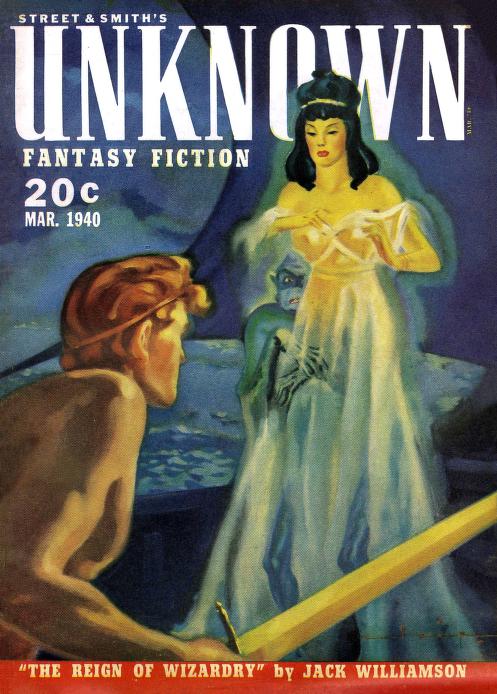
The Reign of Wizardry by Jack Williamson. Serialized in Unknown, March to May 1940. From a historical perspective, Williamson has to be one of the most intriguing figures in American SFF, debuting in 1928 and more or less remaining active until his death in 2006. At his best he also proves to be one of the most gripping and thoughtful “Golden Age” authors. The Reign of Wizardry was Williamson’s first attempt at writing fantasy that was not in the Weird Tales mode.
The Chronicler by A. E. van Vogt. Serialized in Astounding Science Fiction, October to November 1946. In the ’40s and early ’50s van Vogt was a star among genre readers, about on par with Robert Heinlein and Isaac Asimov—only since then his popularity has waned massively, for several reasons. A direct precursor to Philip K. Dick (by Dick’s own admission), van Vogt’s influence on the field is still discernable but now understated. He remains a divisive figure.
For the novellas:
“The Earth Quarter” by Damon Knight. From the January 1955 issue of If. As author, editor, and critic, Knight did much to bridge the gap between ’50s SF and the New Wave, with his Orbit series proving the viability of original anthologies. But in the ’50s he was one of the finer short story writers, with such classics as “Four in One” and “To Serve Man.” “The Earth Quarter” was later revised for book publication, but we’ll be reading the magazine version.
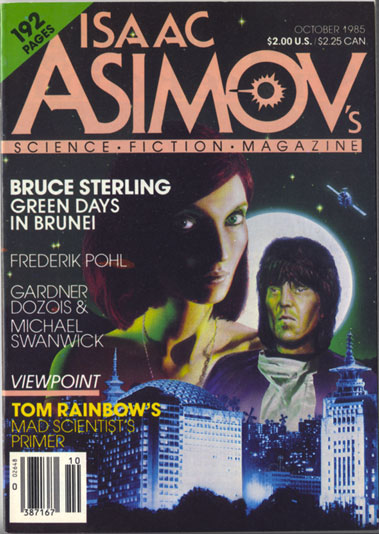
“Green Days in Brunei” by Bruce Sterling. From the October 1985 issue of Asimov’s Science Fiction. Probably the most important writer of cyberpunk whose name is not William Gibson, much of Sterling’s work is actually not cyberpunk—at least in content. If Gibson codified the tropes that would define the movement, Sterling codified the attitude of cyberpunk, emphasizing the “punk” half of that word. Will be one of two Sterling stories I review this month.
For the short stories:
“Forever to a Hudson Bay Blanket” by James Tiptree, Jr. From the August 1972 issue of Fantastic. Real name Alice Sheldon, Tiptree was one of the thorniest authors to come out of the New Wave, being much discussed for the outward feminism (and pessimism) of her work, the mystery of her true identity, and the tragic circumstances of her death. Tiptree made waves in the early ’70s, but I’m going for a relatively obscure story from that period.
“Wong’s Lost and Found Emporium” by William F. Wu. From the May 1983 issue of Amazing Stories. Surprisingly, given how obscure a name he is, this is not my first time reading or even reviewing Wu. He must’ve been one of the first Asian-American authors to partake in magazine SFF, and yet he remains to be rediscovered. This story, for one, was up for the Hugo, Nebula, and World Fantasy Award, and it even got turned into a Twilight Zone episode.
Next month is when we’ll be doing all short stories and all spooky shit, so be on the lookout for that. In the meantime my review schedule is pretty normal and I assume nothing will be replaced last-minute.
Jack Williamson was the second author to be made an SFWA Grand Master, after Robert Heinlein, and yet he is little read nowadays. Actually, past the first decade of his career, I’m not sure when Williamson would’ve been “popular.” That’s not a knock. This man right here is one of the most respectable old-timey SF writers, never quite reaching the heights of Heinlein, true, but also never sinking nearly to such lows as latter day Heinlein. Remarkably, unlike most writers of his generation, Williamson caught a second wind at such a late point in his career, putting out some pretty good work in the ’90s and 2000s—so, ya know, when he was in his 80s and 90s. He remains, by a good margin, the oldest person to have won a Hugo in any of the fiction categories.
I recently read Williamson’s autobiography, Wonder’s Child (which also won him a Hugo), and I’ve somehow gained an even greater respect for the man. He discusses, to some degree, all the fiction he wrote up to 1980 he thought worth mentioning, although of course the book is more about his life and how he tried balancing that (various jobs, romantic/sexual false starts) with trying to make it as a pulp writer. Curiously, today’s novel only got a single paragraph to itself, and Williamson says little about it even within that space. The Reign of Wizardry was his first published work in Unknown, the fantasy sister magazine to Astounding Science Fiction, and for both readers and Williamson himself it does not hold the esteem of his subsequent Unknown effort, “Darker Than You Think.”
There may be a reason for this.
Placing Coordinates
Started serialization in the March 1940 issue of Unknown, which is on the Archive. It has an e-book edition, wooo. For print versions your best bet would be either the Phantasia Press hardcover (out of print) or the Williamson collection Gateway to Paradise (also out of print). Yeah it’s a novel, but it’s apparently short enough to fit in the latter.
Enhancing Image
The prologue is a curious one, in that while the story to come is unabashedly fantasy, Williamson takes the effort to root it in actual science: in this case archaeology. Crete is an island, still existing today with its own people, off the coast of Greece, but what in modern times (i.e., the 19th century onward) archaeologists uncovered what must’ve been as advanced a civilization as ancient Egypt, during a time when Greece itself would not have been so prosperous. For centuries there were only hints, combined with legends, as to the workings of ancient Crete, whose golden age came to an abrupt end before being occupied by several empires over the centuries. The narrator proposes that the myth of the minotaur and the labyrinth, and the Greek hero Theseus, may have some historical legitimacy in explaining the golden age of ancient Crete coming to an end.
Now we’re on the high seas, with Our Hero™, whom to us is known as Theseus but to other characters as Captain Firebrand—a redheaded pirate who patrols the waters between Greece and Crete. One day, upon raiding a Cretan ship, Theseus and his right-hand man Cyron take in what appears to be a woman of incredible beauty as part of the loot, but who turns out to be an impish Babylonian wizard named Snish; this character, at least so far, seems to be Williamson’s biggest contribution to the myth. Snish is a low-level wizard who, for all his physical weakness, can get through trouble by disguising himself, although the illusion is an audio-visual one that will evaporate if touched and especially if kissed. Curiously the narrator refers to Snish as a “she” when in his female disguise. Anyway, Theseus considers killing the little man, but Snish convinces the crew he’d be of more use in infiltrating the island empire of Crete, at that point the most powerful nation in the Mediterranean—and host to evil wizardry.
While obviously not historically sound, we’re led to believe that Crete is such a powerful nation at this point in history because it is ruled with an iron fist by Minos, the most powerful wizard in the known world. Minos, who apparently is immortal, has ruled Crete for a thousand years, but there is at least theoretically a chance that such a tyrant can be overthrown. We’re told that every nine years (why not ten is beyond me) games are held to test the finest warriors in the land, to see if any survive the trials. “And if any man wins the contests, the old Minos must give up his life, and go down into the dread Labyrinth of the Dark One.” The Dark One being the minotaur—one part bull, one part man, one part god. Being a pirate, Theseus hates authority, and especially authority with magic powers. The games are set to begin in a couple days. If he could get to the shores of Crete, and into Knossos, that magical palace just in time to participate…
I might not be making it obvious, but the first half of this installment (which is really the first quarter of the novel) is messy. The goal is simple: Get Theseus from point A to point B, i.e., from off the island to on the island. Sounds simple, right? But this is a 50,000-word novel and said novel is frontloaded with lore, a few characters who will not matter later, and a couple action scenes that lack the pulpy zest of Williamson’s earlier writing. This was his attempt at writing a “serious” fantasy tale, and I also think there’s a reason why he would only show up in Unknown two more times; in fairness, the second of these three appearances was “Darker Than You Think,” which really is one of the standout fantasy narratives of the ’40s. But whereas that novella captivates with its grimness and psychological implications, The Reign of Wizardry starts out as too convoluted for people not already familiar with what its retelling and yet too shallowly written to be considered a demanding-but-it’s-worth-it reexamination of old material. It’s a remix of a song that barely stands on its own.
But it’s not all bad. A shipwreck puts Theseus on the shores of Crete but separates him from both Cyron and Snish, and this is where the plot goes from a series of random events to something more cohesive. Snish is not exactly Williamson’s best attempt at humor, being the closest we have to a comic relief character, so him being absent for most of the latter half of this installment is no loss. It’s here that we meet Talos, the living statue who serves Minos’s will, although sadly unlike his depiction in Jason and the Argonauts he’s not the size of a goddamn building, just a twelve-foot-tall man with an odd skin condition. He also talks. Then there’s Ariadne, Minos’s daughter, who serves the role of the single female character of any significance. (There’s also a haggard old woman who is implied to be a prostitute, but that’s the closest this novel gets to acknowledging sexuality thus far.) It took a while to get started, but once we’ve met all the key players, including Daedalus, Minos’s right-hand man, it’s time to (quite literally) let the games begin. Took long enough.
There Be Spoilers Here
Entering the games at Knossos under the disguise of a “Northman” (a viking) named Gothung, since apparently Minos was expecting Captain Firebrand to participate, the plot gets funneled into a series of action scenes wherein Theseus proves his might against a series of opponents, first bulls and then other men. This ties into the nature of the minotaur, which as said is part bull and part man, and of course there will be the final trial: judgment by the dark god himself. This section of the novel is the strongest part, but even so the action is not as grippingly written as it would be in a Robert E. Howard or Fritz Leiber fantasy adventure. There’s a bit of gore, but surprisingly it’s not as violent as the back end of the other Williamson novel I’ve covered, The Legion of Time, despite Williamson giving himself the perfect pretext for blood and guts. It could be that in an attempt to write something more dignified he wrote something that’s not as fun.
You may be thinking, “Brian, what are you saying? Violence isn’t fun!” And in the context of real life I agree. Violence, in the real world, is usually horrific and completely unnecessary. As Asimov said, violence is the last refuge of the incompetent—and there are a lot of incompetent people out there. But in fiction, especially when it’s a couple degrees removed from reality, violence can be immensely satisfying. Unfortunately that level of carnage was reserved for the “pulpy trash” of Weird Tales, which John W. Campbell wanted to counter. As such, even in this opening installment’s most gripping moments, it seems underwritten—like it’s afraid to go all out.
Anyway, Theseus succeeds in his trials, and a little too easily at that. This skepticism turns out to be justified as Minos, Daedalus, and the bitchy Ariadne pull a fast one on him and reveal his true identity. It’s implied that Minos knew Theseus would come to Crete in disguise well in advance, and just as it looks like Theseus will take to the throne as the new ruler of Crete, the rug gets pulled out from under him. We know that something like this had to happen, because this is the first part of a three-part serial, but we also know, and are all but told at the beginning, that Theseus will ultimately succeed in ending the Cretan empire’s reign of wizardry (get it?). It’s possible Williamson has a few tricks up his sleeve, but I have to wonder how much he can change given that ultimately he has to abide the trajectory of the myth. Or does he? We’ll have to wait and see… and hope.
A Step Farther Out
Ehhhhhhhhhhhhhhhhhhhhhhh…
At first I wasn’t feeling it, and even by the end of this first installment I wouldn’t say I was onboard. Something is wrong here. It could be that I need to catch up on my Greek mythology, but this seems like a straightforward retelling of a myth that would’ve probably been common knowledge for readers in 1940. That Theseus starts out as a pirate and mostly uses his wits instead of his brawn to get the job done can only go so far. The thing about much of the material published in Unknown is that while a lot of it would now be called urban fantasy, the stuff that wasn’t still had a sense of humor—you could say a lust for life—that defined the magazine. Yet at least so far Williamson’s retelling of the minotaur-and-labryinth routine is humorless, and Williamson is not one for straight-faced action—pulpy action, sure, but not something trying to be this serious.
(Cover by Hugh Rankin. Weird Tales, December 1929.)
The Story So Far
Stephen Costigan is a drug addict and traumatized World War I veteran spending his days in the Limehouse district of London, wasting away in an opium den, until he is called upon by Kathulos, a strange man who claims to be of Egypt but whose ethnicity is ambiguous. Kathulos frees Stephen of his hashish addiction but instead gets him hooked on a much more powerful drug, an elixir whose ingredients only Kathulos knows. Stephen is hired to carry out a rather strange assassination plot, but he goes to John Gordon of the London secret police and conspires with him to double-cross Kathulos and his gang. Part 2 is concerned with Stephen and Gordon playing detective and discovering both the whereabouts and origin of Kathulos, who had escaped with Zuleika, Stephen’s love interest. Turns out Kathulos is an Atlantean—found in a coffin in the ocean and either awakened or resurrected. The sorcerer’s plan is to overthrow “the white races” and take over the world, with Africans and Asians as his underlings.
Funny thing about the recap section for this installment is that because so little progress was made in Part 2 the synopsis is expanded from the front so that we start with backstory before ending on basically where Part 1 ended. I said this before, but Part 2 really ground the plot to a halt and generally this novella could’ve used an editor’s judgment.
Enhancing Image
This will be mostly a series of notes, since right now I don’t have the motivation to do otherwise. Skull-Face isn’t very good, but it is certainly strange—and baffling, especially for the modern reader.
Let’s consider the following:
If you thought we were done with Gordon’s monologuing from Part 2, think again. Given he is supposed to be of the secret police, Gordon has no qualms pouring out every little bit of information he knows to Stephen, who after all is a civilian and not even a British subject at that. His eagerness to trust Stephen turns out to not be ill-founded, of course, but it does ring as implausible.
Speaking of implausibility, Kathulos being from Atlantis and Atlantis being a real place are taken basically at face value, with Our Heroes™ not having a hard time accepting these as fast. I genuinely wonder how many people back in the ’20s believed in the Atlantis myth, but upon reflection it would not surprise me if a good portion of the Weird Tales readership bought into it.
So let’s talk about how this is sort of a white supremacist narrative. To put it simply, the villain of the story is a non-white person who has kicked off several revolts in Africa and Asia against white colonists, and we’re supposed to believe these oppressed peoples taking back their land is a bad thing. The phrase “white supremacy” is actually used at one point, quite literally, coming out of Gordon’s mouth if I recall correctly. Of course, being a British cop, Gordon has the perfect motivation to back white supremacist interests.
This is, however, complicated by Kathulos being open about using said revolts and building an empire of non-white people for his own gain. He’s essentially a grifter who has radicalized people into anti-colonialist action so that he can reap the benefits. I’m not sure if Howard did this because he realized that the villain of his story might come off too sympathetically or if he wanted to placate his readership, a fraction of whom would’ve been bona fide white supremacists.
Further complicated by the Atlanteans apparently viewing whites as little more than barbarians in suits, being still inferior to the Atlanteans who see themselves as the truly supreme race. Genocide against whites would be the cherry on top to Kathulos’s empire, although as he points out, he does not view blacks as any better, with Atlanteans (at least in the old days) thriving on racialized slavery not unlike much of the US leading up to the Civil War. I’m not sure if Howard, who came from a former slave state and who became increasingly aware of his country’s blood guilt as he got older, is making a comment here.
The story climaxes with Stephen rescuing Gordon from bloody sacrifice and Gordon shooting Kathulos in the chest point-blank, which may or may not have killed him. While I do find it funny that a sorcerer with plans to rule a billion people gets taken down by A GUN, I was also intrigued by the fact that we don’t know if Kathulos died or if he somehow survived both the gunshot and his underground tunnel network getting blown to bits. His body is never found. The ending hints at a possible sequel, but we never got one.
The romance with Zuleika is about as rushed and unconvincing as you would expect, although for what it’s worth we do get a romance between a white man and a non-white woman that ends happily. As far as I can tell interracial marriage was totes legal in the UK at the time, although the social acceptability of such a union is a different question, especially since Stephen is himself an immigrant.
Reading Skull-Face after having read some later Howard works, it seems like Howard was on the verge of becoming more socially aware of the world outside of lily-whiteness, which is to take most of the world. His sympathies for black Americans would become more pronounced as he aged, to the point where he would get into arguments with Lovecraft and others with regards to white supremacy, but I’m not quite sure when he reached that point. Keep in mind that Howard grew up in a time and place where he would’ve been force-fed pro-Confederacy falsehoods almost from birth. He took more pains than most of his peers to understand people who come from outside the white Southern bubble. Gone with the Wind came out the year of Howard’s death, and for being a thousand pages of Confederacy apologia it won the Pulitzer Prize and became an enormous bestseller.
I realize I sound like I’m excusing the obvious racism of Skull-Face, but to make it clear, I don’t blame anyone for disliking this story on the basis of its problematic elements, which are indeed appalling.
A Step Farther Out
Skull-Face is not something I would recommend unless you’re already a Howard fan and/or a completionist, since it’s not very good, for one, but it’s also likely to alienate readers who are not already familiar with the trajectory of Howard’s writing. Being the oldest Howard story I’ve reviewed, it’s easily the weakest and shows the most signs of having been penned by someone who was still honing his craft; and then there’s the racism. The absurd race war plot is probably what people will take away from it, which does not bode well for how much one can enjoy it. Howard would go on to write a few equally long works and structure them far more ambitiously than here while also justifying that length. He gets better.
(Cover by C. C. Senf. Weird Tales, November 1929.)
The Story So Far
Stephen Costigan is a traumatized World War I veteran and drug addict who’s taken up residence in London’s Limehouse district, at first a slave to hashish and then a slave to the enigmatic sorcerer Kathulos, a strange man of ambiguous ethnicity who draws Stephen into the underworld, promising him new vitality with an elixir that’ll grant him near-superhuman powers—but whose addictive power is lethal. As he gets further ensnared in the underworld Stephen comes across a beautiful woman named Zuleika who, aside from obviously being the love interest, lets Stephen in on how evil Kathulos’s machinations are. Our Hero™ soon gets wrapped up in an assassination plot that (I kid you not) involved a gorilla costume and Stephen allying with John Gordon of the British secret police.
Stephen and Gordon team up to take Kathulos and his goons into custody, but naturally things don’t go well and the skull-faced sorcerer escapes via a secret tunnel, taking Zuleika with him. Both sides have taken a few casualties in the fight, but now Our Heroes™ are left with the question of where Kathulos could’ve gone, what he might be planning, and perhaps most importantly, where the hell he came from.
Enhancing Image
Part 2 is hard to summarize as it’s not only the shortest installment, but very little actually happens in it; indeed, the plot moves hardly an inch forward between the start and end of this installment. Stephen and Gordon, now like buddies in a detective narrative, retrace their steps in an effort to find out Kathulos’s origins, in doing so hoping they can figure out what his endgame is. By the way, if you’re reading Skull-Face I recommend reading the text on Project Gutenberg as it’s not only easier to read but does away with the recap sections. In the case of Part 2 the recap givess away the big revelation in the installment to follow, which frustrated me because a) it made me worry I had missed a big plot point in Part 1 (I did not), and b) it sort of just hits you over the head with something major before you’ve had a chance to read it for yourself and digest it properly.
Gordon, who apparently knew more than he let on, givess us a truly massive infodump about a series of revolts in Africa as of late had had a common element about them, with Kathulos being involved and encouraging unrest among African and Asian peoples. There’s been a prophecy spreading that a man “from the sea” will unite the marginalized ethnicities of the world and overthrow the “white races.” There are apparently multiple white races; be sure to put a pin in that one. So… to make a long story short, Kathulos is not of Egypt like he claims, nor is he from any known country on the planet, but from Atlantis. Kathulos is an Atlantean who mummified himself and lay at the bottom of the ocean, only to be discovered and subsequently either resurrected or brought out of cold sleep. Kathulos doesn’t seem to have a personal desire to topple white supremacy but, it’s implied, is taking advantage of racial strife by crowning himself as emperor of a new society where non-white people are on top.
I have a few questions.
I had heard about the race war plot of this novella in advance, and yet even reading it now I feel like I wasn’t prepared for it. Howard has a rather messy relationship with racism, being a Texan in the early 20th century, but he was also a proud Irishman surrounded by WASPs, at a time when people still made distinctions between “types” of whiteness. Nowadays Jews are often considered white (I say often, but admittedly not always), but this was obviously much more of a point of contention a hundred years ago. At what point were Jews considered white? Evidently not at the time of Howard’s writing Skull-Face. Rather than the huge gelatinous blob with arbitrary boundaries that we now understand whiteness to be, it was like a school with different cliques in Howard’s time, thus in Skull-Face we have “the white races” pitted against several non-white races. This all sounds a bit cracked, but I’m trying to make sense of an understanding of racism that’s totally alien to modern conceptions, except maybe the most backwards parts of the US (i.e., the parts that think the Confederacy meant well).
You may be thinking, “Brian, you handsome devil, how come there’s no content warning for racism that came with this review?” The answer is simply that if you’re reading a Weird Tales pulp adventure from the ’20s, you ought to go in expecting at least some racism. I know this is gonna sound like a bit of a “these darn kids” rant, but I’m peeved whenever people fail to engage with old genre fiction because of the simple fact that values change over time and even left-liberal writers from more than half a century ago generally did not believe in intersectionality. Was Howard a racist? I’m gonna say no. In fact it seems Howard was vocally againsst notions of racial supramcy, at least in his later years. Did he have preconceived notions about race, and did he use white people’s ignorance of other cultures to give his fiction an “Orientalist” appeal? Absolutely to both those parts. I would be lying if I said a good portion of this installment of Skull-Face wasn’t baffling or painful to read, not to mention the plot grinds to a hault. By the end of Part 2 nothing except lore-dumping has been accomplished.
A Step Farther Out
This is a major step down from the first installment. Howard has a knack for writing action and there basically isn’t any here; worse than that, it’s almost entirely dialogue-driven, which I have to admit has never been Howard’s strong suit. It’s short, but even so I started to wonder when John Gordon’s borderline monologuing would come to an end so we can get back to the actual plot. Kathulos and his goons are pushed totally off-stage, and by extension we get zero development with Zuleika, instead being stuck with Stephen, who’s a hot mess of a person, and Gordon, who for this particular part of the novella acts as Mr. Exposition. Hopefully the final installment can bring back the momentum I so dearly missed in Part 2… and, ya know, maybe not make the race war plot as painful to read.
(Cover by Hugh Rankin. Weird Tales, October 1929.)
Who Goes There?
Robert E. Howard is a favorite on this site for a few reasons: he wrote a lot, pretty much all his work was published in the magazines, and he writes action that doesn’t bore me—a real achievement if you know my reading habits. Howard’s career was tragically short-lived but he got started very young and never stopped, debuting in 1924 at the age of 18 and only stopping with his suicide in 1936, aged thirty. Most authors barely get their feet off the ground by the time they’re thirty, but Howard was such a prolific and restless writer that he had accumulated what would be several hefty volumes of fiction when he died, and that’s not even counting posthumous releases. Nowadays Howard is most known for creating Conan the Barbarian (or the Cimmerian, yes I know that’s technically the correct title), which by itself would prove profoundly influential on American fantasy. True, he was not the first American fantasist, but Howard set the standard for a mode of fantasy writing that could not be confused with British fantasy a la J. R. R. Tolkien or Lord Dunsany.
Howard was only 23 when Skull-Face was serialized, but he had already been in the game for five years and his growing adeptness at storytelling shows. At about 33,000 words Skull-Face was also his longest work of fiction up to that point, and the first installment is also the longest. While Howard ran a ton of series and contributed to other people’s series, most notably the Cthulhu Mythos, Skull-Face is a complete standalone work. How does it measure up to his more mature stories? Hmmm.
Placing Coordinates
Serialized in Weird Tales, October to December 1929. You can read Part 1 on the Archive here, and subsequent installments are also available there. Skull-Face was later reprinted whole in the December 1952 issue of Famous Fantastic Mysteries, found here. This was added to Project Gutenberg pretty recently (and by that I mean two weeks ago, I’m not kidding), because as far as I can tell Howard’s work is basically all in the public domain, and you can read it here in the format of your choosing.
Enhancing Image
Stephen Costigan is what you might call a fuck-up, being a shell-shocked World War I veteran from America who now spends his days smoking hashish basically nonstop in a London opium den, called the Temple of Dreams. We start with Stephen recounting one of his hashish dreams, in which he sees what at first seems a skull floating midair but which is in fact attached to a person, yellow skin tightly wrapping it and the skull “endowed with some horrid form of life.” This is totally not the villain of the story and Stephen is totally not gonna meet him later.
For now we’re stuck with Stephen’s daily routine, which is to wallow in London’s Limehouse district, in the aforementioned opium den run by some shady Chinese individual (not the words Howard uses) named Yun Shatu. It’s pretty clear, although the term “post traumatic stress disorder” would not be invented for several more decades, that Stephen has become both an expat and a drug addict in no small part due to PTSD. Howard would’ve been a grade-schooler when World War I happened, but Stephen is at least thirty years old here, having survived No Man’s Land surrounded by mud and corpses. “My body recovered, how I know not; my mind never did.” Stephen’s wartime experiences go to explain his character in at least two ways: by giving context to his vulnerable state at the story’s beginning, and by justifying some rather heroic acts he commits later. Howard had a lot to write in so short a time so that every detail here contributes something to the narrative, for we do not have time to waste.
After a brief dream sequence we’re off to the races—at such a breakneck speed that when I reading I actually did not figure at first that we had transitioned from the dream world to the real one; it doesn’t help that the opium den is called the Temple of Dreams, which admittedly does add to the nightmarish atmosphere about to envelope Stephen. Since Howard’s not gonna stop the plot train, I figure I may as well take a break here and talk about a few things that caught my eye—for better or worse. Apparently in 1929 you couldn’t write about sex past some descriptions of scantily clad women in your pulp fiction, but drug addiction is fine. I find it a bit hard to believe Stephen is this much of a wreck because he smokes too much weed; a shame, in 2023 he could’ve started a YouTube channel as a charismatic stoner. We also know weed is not that harmful, although it’s possible (I’m not sure what first-hand experience he had) that Howard is pointing a finger at what would’ve been an enormous stigma against drug use at the time—for Stephen is about to come across a far worse drug than hashish.
Also, I shouldn’t have to explain this, but I do because I wanna recommend Howard’s fiction to people but not have them be blindsided by remarks that are very much part of the vocabulary of Howard’s time. To quote Walter from The Big Lebowski, “‘Chinaman’ is not the preferred nomenclature.” I do suspect Howard picked London because it’s a locale outside of what his American readership would be familiar with, and there’s undoubtedly a good deal of playing to exoticism with all the non-white characters who are described in racialized terms. For what it’s worth, no, Howard does not use the N-word (at least here), although he makes fair use of “negro,” which was a perfectly innocuous word in 1929 and would actually remain so for several more decades. I’m not sure when “negro” would stop being used by well-meaning white folks but it could not have been earlier than the ’70s. Anyway, there’s also a character whose ethnicity combined with her attire are a little dubious, but we’ll get to her in a minute.
Stephen gets taken by some brute named Hassim to an out-of-the-way part of the opium den, and this is where we’re introduced to the villain of the story (I’m just gonna say it here because why bother), Kathulos, the skull-face (get it) Stephen saw in his dream earlier. Kathulos turns out to be a man—sort of. He’s not a walking corpse, although he has unusual proportions, never mind that despite claiming to be of Egypt his skin complexion doesn’t align with any known ethnicity. It’s clear (at least to us) that Kathulos is a sorcerer of a sort, maybe even a zombie; regardless there’s something about him that pushes him into the realm of the supernatural.
A skull to which no vestige of flesh seemed to remain but on which taut brownish-yellow skin grew fast, etching out every detail of that terrible death’s-head. The forehead was high and in a way magnificent, but the head was curiously narrow through the temples, and from under penthouse brows great eyes glimmered like pools of yellow fire. The nose was high-bridged and very thin; the mouth was a mere colorless gash between thin, cruel lips. A long, bony neck supported this frightful vision and completed the effect of a reptilian demon from some mediæval hell.
Kathulos, seeing potential in Stephen, has a job offer for him, although it’s not out of the “kindness” of his heart. Unfortunately for Stephen the means by which Kathulos keeps him leashed to this new job is an elixir—a drug of such power (indeed life-restoring properties) but so addictive that withdrawal would mean death. Stephen’s hashish addiction is nothing compared to the hell Kathulos is about to put him through; on the upside, the elixir gives him near-superhuman abilities that’ll prove useful. Kathulos’s goons are also not all eye sores, as there’s a woman under his spell: Zuleika. Circassian “by blood and birth” and spending her youth in Turkey before being bought by Kathulos, Zuleika is a bit of a… problem. She’s a bit of a damsel, which for pulp fiction is not unusual, but this is more conspicuous by Howard’s standards, coming from the man who would write some strong-willed women later in his career. It’s also clear from her background and how she dresses (in a mix of “Oriental” and Western fashions) that Zuleika is acting as the exotic woman whom the white man will woo.
Lastly we’re introduced to John Gordon of the London secret police, whose role in things is vague at first but who will prove useful in Part 1’s climax. By the time we get to the back end of Part 1 we have a few parties involved, each other their own goalss in mind and, more importantly, these goals are not made clear to the reader. It’s clear Kathulos wants to use Stephen as his slave, to accomplish a mission whose bigger goal remains utterly a mystery to Our Hero™. What could the skull-face be planning? (By the way, Kathulos sounds a bit like Cthulhu, which, being correspondents with Lovecraft, Howard would’ve been well aware of at the time, though I’m sure it’s just a coincidence.) The elixir Stephen has become horribly addicted to will be both the ssaving and death of him as he takes part in a mission of impersonation, and later murder, that goes amiss.
There Be Spoilers Here
What happens from hereon is a bit much, but it involves, among other things, an assassination plot and Stephen dressing up in a gorilla costume. I’m not kidding about that last part. Stephen explains the situation to Gordon and the two agree to team up with, with Stephen lying about his mission and confronting Kathulos while Gordon and his men surround the opium den so as to block off escape routes. Since these are London cops I assume Gordon and his men plan to apprehend Kathulos using nothing more severe than harsh language. It doesn’t matter, because naturally Kathulos expected Stephen would betray him, and not only that but there’s a secret tunnel the cops could not have anticipated; that said tunnel turns out to be filled with “scores of hideous reptiles” only adds insult to injury.
So bad news, Kathulos has gotten away and he took Zuleika with him; the good news is that Stephen drank enough of that elixir that it should last him a few days before he starts going into withdrawal. The hunt is on, between a shattered veteran and an aloof plain-clothes cop for a sorcerer who is probably even more powerful than what we’ve seen up to this point. Howard wrote his stories with magazine publication in mind and as such he knew how serials worked, with the end of each installment leaving bread crumbs for intrigue but making the reader excited for more. Howard’s writing itself has a drug-like effect wherein it transports the reader to a mindset that is not lucid, but rather based primarily on imagery and action, with anything not action being omitted; as such you have potentially a 50,000-word narrative compressed to 2/3 that length.
A Step Farther Out
Every time I read a Howard story I feel tempted to become one who those nerds who digs up his letters to try to see how his brain worked. Not that Howard was an unparalleled genius whose inner workings would be a treasure trove, a Shakespeare for us to bow to, but more that his interests strike me as so human that reading much of his fiction almost reads like having a conversation for me. There’s a lot to unpack with Skull-Face and we’re only just getting started, so I’ll say for now that I feel the way I ought to feel when it comes to the opening salvo of a serial: that is to say intrigued. I would’ve read it all in one sitting if not for work, which I think again speaks to Howard’s skill with keeping the reader’s attention.
What the hell, a whole month went by and nothing crazy happened that wasn’t work-related. Well, the SFF magazines are being choked out by big daddy Bezos and Twitter is now no longer Twitter, but aside from that, everything has been pretty normal!
I’m being sarcastic.
To keep your mind off the fact that the short story within the context of genre publishing is an endangered species and that readers can hardly be bothered to support the lifeblood of the field, let’s read some stories! We have a curious set this month, focusing more on fantasy, which is not normally my thing; indeed the only science fiction stories covered this month are the novellas. Much like pushing myself just a little bit when trying a new food, fantasy is a genre I treat, paradoxically, with both caution and enthusiasm. Enough wasting time, though…
For the serials:
Skull-Face by Robert E. Howard. Serialized in Weird Tales, October to December 1929. Howard wrote for only twelve years, debuting in 1924 and stopping with his suicide in 1936—at age thirty. Most writers barely get their feet off the ground by the time they’re thirty, but not only was Howard a natural-born storyteller, he wrote at a blistering pace such that he still accumulated a vast body of work. Skull-Face is a standalone fantasy, predating Conan by a few years.
The Reign of Wizardry by Jack Williamson. Serialized in Unknown, March to May 1940. Retro Hugo nominee for Best Novel. This was not published in book form until 1964, a 24-year gap that normally would imply the author had died in the interim—only Williamson was not only alive but had another 42 years left in him. Was not Williamson’s first go at fantasy, but it marked his first appearance in Unknown, a new fantasy magazine with more exacting standards.
For the novellas:
“Immigrant” by Clifford D. Simak. From the March 1954 issue of Astounding Science Fiction. The review for this will be posted on Simak’s 119th birthday, which is the least we can do for the man. With the wave of “empathetic” and pastoral SF in recent years, especially the works of Becky Chambers, some have looked back to Simak (rightfully) as a direct ancestor. “Immigrant” hopefully will see Golden Age SF’s most compassionate writer in good form.
“Singleton” by Greg Egan. From the February 2002 issue of Interzone. I was gonna tackle “Oceanic” originally, but that seemed too obvious and maybe not characteristic of Egan’s work. I’ve been quasi-binging Egan’s short fiction as of late, because he interests me. Egan’s one of the major voices in transhumanist science fiction, as well as one of the first Aussie writers to leave a mark on the field. He’s also notoriously aloof; there are no pictures of him on the internet.
For the short stories:
“The Dreaming City” by Michael Moorcock. From the June 1961 issue of Science Fantasy. I’ve read a couple Moorcock stories before, but truth be told he’s one of those authors I’ve been slow to get around to because of a bad first impression. Let’s just say I’m not a fan of his essay “Starship Stormtroopers.” But still Moorcock has been an earnest chronicler of fantasy for the past six decades, and to celebrate we’re going back 62 years to the start of his Elric saga.
“Travels with My Cats” by Mike Resnick. From the February 2004 issue of Asimov’s Science Fiction. Hugo winner for Best Short Story. Resnick was one of the most popular and frequent contributors to Asimov’s in the ’90s and 2000s, winning three of his five Hugos there, with his Kirinyaga series being one of the most decorated in genre fiction. I intentionally picked a standalone story because the Kirinyaga stories kinda bug me, and also I like cats. 🙂
For the complete novel:
The Dwellers in the Mirage by A. Merritt. From the April 1941 issue of Fantastic Novels. During his life and in the years immediately following his death, Merritt was one of the most beloved American fantasists, at least among pulp readers; he even got a magazine named after him with A. Merritt’s Fantasy Magazine. Nowadays Merritt is obscure enough to have “won” the Cordwainer Smith Rediscovery Award. The Dwellers in the Mirage was first published in 1932, but its printing in Fantastic Novels was the first time Merritt’s preferred ending was incorporated, making it the preferred version.
One last thing I wanna mention is that I’ll be revamping my method for reviewing serials. I’ll be writing about the first installment in the same way as usual, but I’ve come to realize that for subsequent installments there are a couple sections of my review formula that are really unnecessary; for example we don’t need an introductory section where I give context to the author if we’re already in the middle of a work by said author. As such you can expect a more streamlined reading experience when we get to the second installment of Howard’s Skull-Face. Things will look a bit different, but this is less a radical change and more like tweaking. Other than that, my review schedule should be back to normal.
(Cover by Jeff Jones. Amazing Stories, October 1973.)
Ladies and gentlemen? I love monster movies. I know, it’s not very classy or literate to say so, but I love movies about monsters—big and small. I love Godzilla, Mothra, Rodan, King Kong, Frankenstein’s monster, the blob, the werewolf, the creature from the black lagoon, the shape-shifting alien of John Carpenter’s The Thing, and of course the many creatures brought to life by Ray Harryhausen. Among those movie monsters are the dinosaurs and prehistoric reptiles which roamed the earth long before man came along—real-life monsters that were ultimately animals, trying to live their lives like the elephants and giraffes of today. Jurassic Park was probably the first monster movie I ever saw, and as such it was my first dose of what would turn out to be a lifelong addiction. Jurassic Park hit theaters in June 1993, and even now its effects, mostly practical contrary to its place as an innovator in CGI, are mostly seamless and dazzling.
Since now is the time of the film’s 30th anniversary, I figured it’s time to put a couple prehistoric-themed stories on the roster, a short story and novella which predate Jurassic Park but which hopefully will evoke a similar sense of wonder and amazement for Earth’s distant past. Aside from that we’ll be continuing a serial we had started last month, and we have a reliable workhorse in Henry Kuttner returning to the site once again. There is not a whole lot else to say, frankly—except for one thing.
As a young and earnest fan I was stoked to appear as a guest on my first SFF podcast, which actually was uploaded earlier today. I wanna thank Seth over at Hugos There Podcast for giving me the opportunity to embarrass myself to discuss a certain obscure and scoffed-at book that I would be unable to review for my own site. I believe I also mentioned a second podcast I’d be guesting on, which sadly was a bust, but depending on when it’ll be rescheduled (I’m really hoping it will be that and not simply trashed for good) it may be uploaded by the end of June.
Now it’s time for the stories!
For the serials:
Sos the Rope by Piers Anthony. Serialized in The Magazine of Fantasy and Science Fiction, July to September 1968. I’m still stunned that we’re covering Piers Anthony—because of his reputation, but also because he was not much of a magazine contributor. Strange as it may sound, however, Anthony wrote much of his early fiction for the ‘zines, with his second novel, Sos the Rope, being written for a contest and first seeing print in F&SF. Anthony was already a Hugo nominee by then, though everyone I know loathes Chthon, the nominee in question.
The Stone That Never Came Down by John Brunner. Serialized in Amazing Stories, October to December 1973. Brunner was one of the most prolific SF writers of the era, in no small part because he wrote full-time and he had bills to pay. While he wrote a handful of classic novels, most famously Stand on Zanzibar, he seemingly wrote three times as many novels that were much shorter and less demanding than his major ones, The Stone That Never Came Down being one of those minor novels. I picked it because I liked the title.
For the novellas:
“Time Safari” by David Drake. From the August 1981 issue of Destinies. I’ve said this before, but for the purposes of my site I’m counting Destinies and its ilk as magazines; don’t @ me about this. All I really know about Drake is that he’s a Baen regular as author and editor, being one of many military SF authors to write for Jim Baen and later become a mainstay at Baen Books. “Time Safari” itself ia apparently part of a series, but given that these were published out of order I think it’s safe to assume this is functionally a standalone work.
“The Oceans Are Wide” by Frank M. Robinson. From the April 1954 issue of Science Stories. I know little about Robinson, but what I do know has my attention firmly held. Like a lot of SF authors of his generation Robinson got started around 1950, during the height of the SFF magazine boom, and wrote a good deal of his SF in the ’50s. More importantly, Robinson was one of the first unequivocally queer SF writers, even being associated with Harvey Milk and later being inducted into the Chicago LGBT Hall of Fame.
For the short stories:
“Exit the Professor” by Henry Kuttner. From the October 1947 issue of Thrilling Wonder Stories. ISFDB lists this as a collaboration with C. L. Moore, but with all due respect I doubt that very much. Kuttner has the rare misfortune of being overshadowed by his equally (many would say more) talented wife, apparently to the point where Kuttner made jokes about Moore secretly writing stories attributed to him. True, he’s not as refined as Moore, but Kuttner’s humor and pessimism make him prescient, never mind that he was seriously prolific.
“The Wings of a Bat” by Pauline Ashwell. From the May 1966 issue of Analog Science Fiction. Ashwell is an author I’ve discovered recently in large part thanks to the anthology Rediscovery: Science Fiction by Women (1958-1963) and its related fanzine Galactic Journey. Sadly Ashwell did not write a lot; “The Wings of a Bat” would be her last story for 16 years. Equally peculiar is that she wrote exclusively for Astounding/Analog, being loyal to John W. Campbell and later Stanley Schmidt (for some reason). This one has pterosaurs I think…
Enjoy the serials while you can, because in July we’ll be going without them again. I have a certain idea in mind that may or may not pan out. Hopefully June will not see any dents in my schedule like last month.
James White was one of the more successful British SF authors who did not (as far as I can tell) partake in New Wave antics in the ’60s. His loose Sector General series started in the ’50s and remained steadfast as a conventionally written setting for hospital dramas IN SPAAAAAAAACE, and his novel that I’ve reviewed, All Judgment Fled, is, excepting a couple passages (there’s a bit toward the end of Part 3 that references LSD), a pretty vanilla affair—which is not to say it’s boring. On the contrary, White is clearly a writer who considers the logical implications of his narratives, which naturally then snowball into ethical implications; he also has a sarcastic whit which at no point rang as irritating to mine ears. While my feelings on the novel are a bit mixed I do look forward to future adventures with White, especially since he’s one of those prolific magazine contributors and therefore someone (like Poul Anderson and Jack Vance) I fall back on for emergencies.
Placing Coordinates
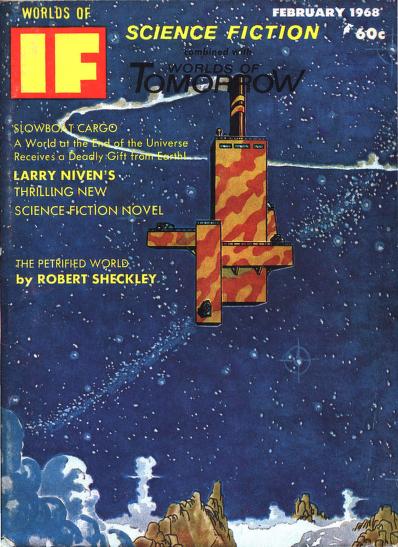
Part 3 was published in the February 1968 issue of If, which is on the Archive. I’m not usually a fan of If‘s cover art, but the Bodé covers (we got too few of them, sadly) are very well done and eye-catching, including this one. As for book publication we only have a few editions to work with, for a novel that’s over half a century old, but you can find used copies cheap.
Enhancing Image
Before I get into the installment itself, I wanna talk a bit about what the past week has been like for me. If you’re reading this it means it’s May 22nd and by extention this post is two days late. I set deadlines for myself with these but I found out the hard way that there was just no doing this post on-time. I didn’t even finish reading Part 3 until the night of the 21st. Last week round this time I guested on a certain podcast, which went well and which you can expect to see at the beginning of June, probably back-to-back with my review forecast; that was not the hard part. No, the irony is that going on vacation can make it very hard to do things you normally do in your spare time. I had requested time off work and flew to Chicago (from Newark) on Friday, and only got back Monday. I was there to visit a couple friends I very rarely get the chance to hang out with in person; as such, combined with the brief time window I’d given myself, we crunched a week’s worth of fun times into three days. It was a good time, needless to say, but I also got precious little time to work on this site, hence the delay.
Now that I’ve said that, it’s time to finish this damn serial.
Last time we were with the boys, the mission had gone to hell. Morrison got killed by a Type Two, a tentacled creature with a giant horn and without any capacity to reason with the explorers. As violence has broken out on the Ship, a mysterious object orbiting between Mars and Jupiter, the higher-ups at Prometheus Control have been chastising McCullough (the audience surrogate) and company for their lack of professionalism. The Twos are hostile to the point of seeing the humans as food, which results in much of Part 3 being an all-out skirmish between the explorers and a horde of Twos, making for an extended action sequence that admittedly sort of struggled to hold my interest. A weakness of mine as a reader is that my eyes tend to glaze over when it comes to action, whith it being too easy for me to lose track of who’s dealing with what and who’s still alive and who has bitten the big bazooka. The action in Part 3 is especially confusing, partly (I suspect) deliberately and also because White refuses to give us a clear picture of the ship’s interior. The illustrations do a lot of leg work.
The most egregious example of White’s confusing laying out of action happens at the very beginning, wherein we’re told via narration that Drew has died—somehow. I wondered if I had missed something at the end of the previous installment, made worse because the recap section makes no mention of it—but no, Drew is not dead, he’s actually fine. The logic seems to be that in the heat of battle McCullough thinks Drew is dead, but this turns out to be a false alarm; the third-person narration sharing McCullough’s confusion is a hard pill to swallow, however. A similar case happens toward the end when (not getting into specifics here, because spoilers) a character has apparently died and the narration does not tell us this explicitly (unless I missed something, which is possible) until after the fact. Did he die offscreen? What happened? I’m getting ahead of myself.
We’ve discovered by now that the Ship is, or was, operated in all likelihood by a very small crew, and that the Twos wandering about looking for scraps are either non-sentient or driven (by something) to insanity. We never get a clear answer as to the nature of the Twos, but we do know that they’re an active threat to the explorers. Drew’s maddened call for extermination of the Twos (which is supposed to inform us that the explorers have basically reached rock bottom) does not come off as too unreasonable. Regardless, the mission has degenerated to such an extent that Prometheus Control and the explorers are all but no longer on speaking terms—a relationship that is about to get even rockier, if you can believe it.
McCullough sums it up nicely:
He realized suddenly that although he was terribly afraid for his own immediate safety he was furiously angry about the things they had done and were doing on the Ship. From the very beginning they had no control of the situation. It had been a stupid if well-intentioned muddle. And while they had changed their minds several times when new data became available they had not really used their brains. They had been panicked into things. They had not allowed themselves time to think. And when threatened with danger they thought only of survival.
The higher-ups at one point bring in a woman on the speaker to calm the men and reassure them with an incoming supply drop, but this doesn’t work too well. Keep in mind that said woman, whose name we never learn and who is called “Tokyo Rose” at one point (I get the reference, but it’s also a cute bit of symbolism with how the woman’s reassuring voice functions as and is acknowledged as basically propaganda), is the only female character in the novel; and she’s not really a character at that. From here on it’s all a war of nerves, of the explorers fighting off Twos while trying not to have total mental breakdowns. We do get some relief in the form of a new alien species with the Threes, which are like a cross between a snake and a teddy bear; I know that sounds like a weird combination. The Threes appear to be friendly, but are still not the intelligent alien(s) running the Ship that the explorers are looking for. This is the longest installment, so be prepared for a big third-act blowout and the summit of the conflict.
All Judgment Fled is technically a Big Dumb Object™ story, but that’s desceptive given how close-quarters the novel’s scale is. From start to finish we’re stuck with two small ships from the Prometheus Project and the Ship, which while nearly half a mile long is not spacious like the interior of, say, Rama. Comparisons will inevitably be drawn between White’s novel and Arthur C. Clarke’s undying classic, which depending on your worldview may or may not be favorable. If you’re looking for gosh-wow moments that provoke your inner child (what Rendezvous with Rama does in spades) then you’ll have no such luck with White’s novel. The setting is cramped, paranoid, claustrophobic, verging on inner space rather than outer with how much we’re stuck with the flawed humanity of the characters, but this is still a hard-headed old-school SF tale at the end of the day. McCullough, our lead, never becomes fully human in that his conscience never wanders from the physical problem at hand for long, but the novel still deals with the ethical equations of first contact more than some of its ilk.
It’s respectable is what I’m saying, if also cagey.
There Be Spoilers Here
After losing Drew (for real this time) and Berryman we finally get to have a “chat” with the alien that’s really running the Ship, and it looks—interesting. Another thing I gotta give White credit for is that we do not get any humanoid aliens here, with the different types vaguely resembling Earth animals but having nothing that could be mistaken for human. (I bring this up just so we can rest easy that none of the explorers go chasing lustily after some blue-skinned space babe.) The intelligent—and benevolent, wow how lucky—alien running the Ship is itself nightmarish in appearance to our battered explorers, “a great, fat, caterpillar, an LSD nightmare with too many eyes and mouths in all the wrong places.” Still the two species are able to communicate through visuals, since obviously verbal communication will do nothing, and ultimately we get a sort of cultural exchange.
Since half the human crew is dead there’s now few enough people to accommodate the reduced number of space suits, along with one of the P-ships no longer working. Which is all rather… convenient? If also morbid. I don’t totally buy the happy ending here, but then maybe White is not the kind of writer to totally fuck his characters over. J. G. Ballard would fuck shit up with this premise, which makes me wonder what this novel would’ve been like had it been a more ruthless deconstruction of first contact narratives—a premise that’s started here but not completely fulfilled.
A Step Farther Out
I know a couple people who prefer this over Rendezvous with Rama, and I can see the argument for it even though I ultimately have to disagree, because in some ways All Judgment Fled is the anti-Rama. Whereas the explorers in Clarker’s novel are always up against some tangible external problem that can be solved fine with bruce force or swiftness of speed, the conflict in White’s novel comes largely from the fact that the people heading the Prometheus Project failed to consider the possibility of interacting with alien lifeforms, not to mention explorers who might not be the most rational people; yet All Judgment Fled also feels incomplete somehow, whereas Rama is undoubtedly the complete package. This is a short novel, coming in at no more than 55,000 words, and truth be told it could’ve been 5,000 words longer, much of that devoted to scenery and character moments. The characters are not the flattest, but it can be easy to confuse some of them; half of them lack clearly defined roles but also nuance. White also has this thing for not describing places in any great detail, which made the action-heavy back end of the novel read as too abstract for my tastes.
James White was most popular in his time for the Sector General series, about a giant hospital station in space where conflicts comes not from epic space battles but doctors dealing with bizarre alien biology. White wanted to become a doctor but financial concerns at the time prevented this, although frankly I would’ve just assumed he was a doctor, going by what I’ve read of All Judgment Fled so far. I’m very curious about exploring White more, given his fascination with non-violent causes for conflict, and how violence isn’t treated as a solution but a catalyst for bigger problems.
Placing Coordinates
Part 2 was published in the January 1968 issue of If, which is on the Archive. Bad news is All Judgment Fled has not been given many paperback editions; good news is the few editions we have go for cheap used.
Enhancing Image
Now that we’re on the Ship, it’s time to do some exploring! The men of P-One (Drew, Morrison, and Hollis) and P-Two (McCullough, Walters, and Berryman) are officially stuck together, with the two small ships being now conjoined near the Ship to make moving between the two easy. Last time we hung out with the boys, Walters narrowly survived an encounter with one of the starfish aliens (now called a Type Two), and his suit is now basically unusable. This is a bit of a problem. For the men the suits are like a second layer of skin that, if removed, would greatly increase the risk of death, even though they don’t need the suits in the Prometheus ships; on the Ship it’s a different story. And apparently the aliens are hostile!
On top of all this, the men also have to deal with an increasingly cranky Prometheus Command, the top brass back home who are relaying the men’s actions back to Earth, with millions people (at least a billion, actually) tuning their radios to hear about what happens next. There’s a bit of meta hijinks going on here since McCullough is made all too vividly aware that the men’s sense of privacy has been eroded, that nearly their every move and word is being judged by a vast unseen audience—although unbeknownst to the characters that audience also encompasses readers. We’re given a better idea as to the relationship between the explorers and the rest of mankind, with this lop-sided arrangement that’s probably not good for the explorers’ mental health. Hollis was already on the verge of a breakdown in Part 1, but that turns out to be the least of the men’s problems.
Then there’s the question of the aliens’ intelligence. Frankly there’s no way to be sure. Somebody must’ve been intelligent enough to have built the ship, but the aliens that are actually onboard are unlikely to have been the culprits. The Type Two, for instance, is almost certainly non-sentient, but even then there’s no guarantee about that. Maybe up to now there’s just been failure to communicate. There are also at least two types of alien (as in, aliens that cannot be of the same species) that are on the Ship, and likely there’s a third species waiting for Our Heroes™ down the road. Still, despite the close encounters with aliens, the question as to who built the Ship remains perfectly unanswered—and yet conceivably it has to be something of at least the same intelligence as humans, and more likely of greater intelligence. White understands that in the highly unlikely event of first contact the aliens in question would be akin to angels—or an amoeba.
Their idea was simply that any piece of machinery beyond a certain degree of complexity—from a car or light airplane up to and including spaceships half a mile long—required an enormous amount of prior design work, planning and tooling long before the first simple parts and sub-assemblies became three-dimensional metal on someone’s workbench. The number of general assembly and detail drawings, material specification charts, wiring diagrams and so on for a vessel of this size must have been mind-staggering, and the purpose of all this paperwork was simply to instruct people of average intelligence in the manufacture and fitting together the parts of this gigantic three-dimensional jigsaw puzzle.
Speaking of first contact, Murray Leinster doesn’t quite get namedropped, but he gets the next best thing: a not very subtle hint directed his way. At one point McCullough, evidently a science fiction fan, thinks about “the old-time author responsible for a story called First Contact.” We also get a reference to another classic Leinster story, “The Ethical Equations,” and both these stories are indeed very much relevant to the current situation. White’s fannish side comes to the surface here, but at the same time it makes sense for the explorers to have been made at least somewhat familiar with classic science fiction, since SF would be the only even remotely useful reference point for their mission. I could fault White for a couple things, but over and over I find his logical outlook admirable; he takes something that with most writers would get pushed under the rug with some handwavium and he guides it along to a logical conclusion. There are no easy answers.
Part 2 does suffer a bit from what we might call Middle Installment Syndrome, in which the middle entry of a trilogy has to contend with not having a beginning or a conclusion, but making do as a big gelatinous second act. Why do people remember The Two Towers less than Fellowship of the Ring and Return of the King? Well, what happens in The Two Towers? We’re introduced to Gollum properly, that’s gotta be worth something; and we get the Battle of Helm’s Deep, often the most cited action set piece in the trilogy—yet going by IMDB and Letterboxd scores people aren’t quite as fond of The Two Towers as its siblings. Middle Installment Syndrome. I’ve come to realize that this also applies to novel serials, although I probably wouldn’t feel the “gelatinous second act” thing as much if I was reading All Judgment Fled as a single unit. Still, it’s short enough to not drag much.
There Be Spoilers Here
Things really go to shit in the second half of Part 2. The explorers kill a Type Two in another encounter, which is more or less accidental but which starts a snowball of paranoia and calls for violence among the men. As I supposed should be expected with White, violence is treated as something to be prevented as much as possible, since it will not solve issues but instead cause a snowball effect of greater violence. Command is not happy with how things are turning out, since at the outset this was supposed to be a mission that would unite mankind, rather than cause people to splinter on, for example, the treatment of alien lifeforms. “But now that the meeting had degenerated into violence, had become literally a blow-by-blow affair, the idea had backfired.” This culminates in the first fatality among the explorers, with Morrison, one of the most experienced men on the team, getting brutally killed by a Type Two. Even though we don’t get to know any of these men (except for McCullough) too much as individuals, Morrison’s death still works as a point of no return for the venture.
For better or worse, the men can only move forward.
After Morrison’s body is tucked away, the men keep searching through the big corridors of the Ship, coming upon rooms of different kinds, although McCullough seems to be the only one keeping his eye on the prize at this point. Most disconcerting is a room that almost resembles something humans would use—like a bedroom or a drawing-room. “A lab animal would not require a furnished room. Which meant that there were intelligent extraterrestrials on the Ship.” Maybe the Type Twos aren’t sentient, but somebody here sure is. And just as it looks like the men are about to hit a big clue as to the aliens’ nature, the Ship has started moving—away from the Prometheus ships. The Ship, which hitherto had been orbiting freely, is now moving on its own again. Well gosh darn it!
A Step Farther Out
It’s enjoyable, but there’s also something missing about it that I can’t put my finger on. It could be that there are too many characters that can be thought of as “nondescript white guy,” with only a couple standing out. That can’t be it, though. The characters in Rendezvous with Rama are made of cardboard, but that doesn’t bother me. I think it may be that White, unlike Clarke, is not concerned with evoking a Sense of Wonder™, which no doubt contributes to Rama remaining popular after half a century. White obviously has different goals from Clarke, which so far he’s been meeting admirably; it’s just that if you’re expecting a first contact narrative that’ll leave you breathless you’ll be disappointed. White does, however, have a special talent for making me think about the situation these characters are in—about logistical problems that would naturally arise from such a situation, but also the deep moral quandary that would come about in the event of first contact with a spacefaring alien race. Looking forward to how White’s gonna end this!
James White was an Irish SF fan-turned-writer who was one of the many authors to have found his footing in the ’50s, and it was in that decade when he started his Sector General series—about a massive hospital in space that deals with many alien species. Rather than focus on hardboiled adventure narratives, White seemed to prefer to write about issues that naturally arise from psychology and biology; he wanted to practice medicine, but economic troubles apparently led him elsewhere. With this in mind I’m ashamed to say I’ve not read anything by White prior to today’s novel, All Judgment Fled, which is a one-off and which was serialized in If, as opposed to New Worlds, where the Sector General series was published. All Judgment Fled is a Big Dumb Object™ story, published in the midst of several famous BDO stories (notably Ringworld, and, more regrettably, The Wanderer), but White looks to add his own flavor to the basic premise.
Placing Coordinates
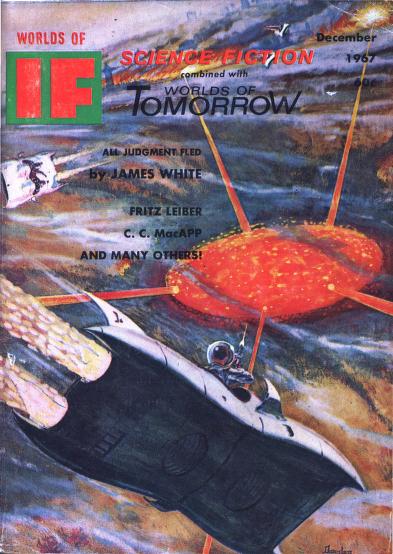
Part 1 was published in the December 1967 issue of If, which is on the Archive. (You may notice that this issue has been mislabeled on the Archive as the May 1967 issue. Somebody fucked up.) Also be aware that If and Galaxy under Fred Pohl’s editorship well actually Galaxy also had this issue when H. L. Gold was in charge have some pretty sloppy copy-editing, which may distract from the experience. Sadly there aren’t many paperback editions either; the most recent edition, from Old Earth Books, predates 9/11. The good news is that used copies still go for cheap.
Enhancing Image
In the near future (a future which rather closely resembles the space race in the years following the moon landing), a mysterious vessel is spotted orbiting our sun between Mars and Jupiter, “shaped like a blunt topedo with a pattern of bulges encircling its mid-section and just under half a mile long.” The Ship (with a capital S) is a massive cylindrical object that is no doubt artificial, and which has not responded to any attempts to contact it. Thus we have the Prometheus Project, a first contact mission wherein two small ships, P-One and P-Two, are sent out to rendezvous with the Ship. (If this sounds a bit like Rendezvous with Rama, keep in mind that All Judgment Fled came first.) Six of the sharpest minds in the space program, three to each ship, are set to spend more than five months locked up in tight quarters on their way to the Ship, with McCullough, the doctor on P-Two, as the closest we get to a protagonist. Perhaps not coincidentally, all six of the men chosen are unmarried; survival is not guaranteed.
Aside from McCullough on P-Two we have Berryman and Walters; and on P-One we have Drew, Morrison, and Hollis. McCullough is the only one of the six to have sufficient medical training, and while the ships are always in communication with each other, they’re still a good distance apart as they voyage out to the Ship. Berryman and Walters are trained astronauts while McCullough is the outlier; meanwhile on P-One Hollis is the noobie while Drew and Morrison are the veterans. While it must’ve been tempting for command to hire all veteran spacers for the voyage, a more diverse team (in profession, though it must be said not in skin color or nationality) was probably for the best. Certain skills might be needed…
Instead of six of the world’s acknowledged scientific geniuses there had been chosen four experienced astronauts and two under training who were not even known in scientific circles and were respected only by friends. All that could be said for them was that they had a fairly good chance of surviving the trip.
Something about this novel that struck me is that you can tell that it was written when the space race about the reach its climax. The moon landing was still more than a year off, but Yuri Gagarin had left Earth’s orbit several years prior and it’s quite possible White wrote the novel immediately following the Apollo 1 tragedy. It was widely known by this point that being an astronaut was dangerous—that blood had already been spilled in the name of the US and Soviet Union outdoing each other. As such, despite the peppering of light sarcastic humor throughout (more on this in a bit), there’s still this persistent sense that Our Heroes™ could meet an unfortunate end at pretty much any moment. Of course, space is scary enough; the astronauts also have to deal with each other.
The boys are stuck with each other, in living quarters “which compared unfavorably with the most unenlightened penal institutions,” having to eat paste through tubes, having to wipe themselves down with alcohol periodically since they can’t take water baths, having no idea at all what they’re gonna do exactly when they arrive at their destination. When Hollis comes down with a skin condition and McCullough has to venture out to P-One to take care of him, there’s some worry—not just for Hollis’s body, but his mentality, which doesn’t look good either. McCullough doesn’t have to prod Hollis for long before the latter starts ranting about his co-workers. “A person could say an awful lot about themselves by the way they talked about someone else.” It’s clear to McCullough that Hollis is threatening to have a mental breakdown—that he’s having paranoid delusions about Drew and Morrison, whom he claims have snuck a “Dirty Annie,” a small nuclear weapon, into P-One. Even after Hollis is calmed down, it’s clear that this man’s instability will probably contribute to later problems.
Both the characters and the third-person narrator engage in some banter, which makes sense given the situation; few things deflate tension like humor. Actually while I have my reservations about the characters themselves, I don’t fault White for bordering the narrative with jokes—helped by White’s sense of humor (in my opinion) being often effective and unintrusive. While the BDO story had certainly not been done to death at this point (give it another decade), White’s deconstructing of the premise almost feels like commentary on the basic premise and how in reality, if we were to make contact with some alien vessel in our solar system, things would be much less glamorous than what Hollywood gives us. The lack of imput from the outside world, despite us being told about millions of eyes and ears keeping track of the voyage, only adds to the isolation and claustrophobia.
There Be Spoilers Here
So we finally get to the Ship, and we even meet some aliens, although these are far from little green men. The aliens are obviously intelligent enough to have built the Ship, but whether they’re capable of understanding human speech or even gestures is another question. “We know,” says McCullough at one point, “that they do not have fingers, and may have a two-digit pincer arrangement.” Turns out they have even less than that (or more, depending on how you look at it), with one alien looking like an actual starfish while another resembles a dumbbell. Between Hollis’s paranoia, Walters nearly dying from getting a tear in his spacesuit, and the aliens being totally unintelligible, Our Heroes™ have some work to do.
Stay tuned.
A Step Farther Out
I’m cautiously optimistic about this one. I occasionally find White’s attempts at dry humor chuckle-worthy, but I’m not sure if this is the norm for him or something unique to this novel. We’re also about a third into All Judgment Fled and the action has barely started; this is not the fastest of reads, despite being short overall. At the same time White is focusing on things that are not normally dwelled on in Big Dumb Object™ stories, namely the logistical and psychological cost of coming into contact with a BDO in the first place. McCullough and crew are not the most vividly drawn of characters, but their uneasy dynamic should be fruitful for future conflicts. Given the nature of the aliens this may also prove to be an unorthodox first contact narrative, since we’re not dealing with humanoids or even seemingly aliens capable of verbal speech. I’m already prepping to start Part 2.




 Science Fiction & Fantasy Remembrance