It’s that special time of year, and I’m not just saying that because it’s Christmastime. Truth be told, I’m not crazy about Christmas; I certainly don’t go nuts over it like I do with Halloween—which is why my review roster for this month is not Christmas-themed. My birthday is also this month (it’s the 9th, if you’d like to know), but that’s not why I’m here. Some months thing will be totally normal, but then there are times like this. Oh, we still have the usual rotation, albeit with a little twist (in fact it’s a new department), which I’ll get to in a minute. The real twist is that this will be a single-author lineup, and the guest of honor is Fritz Leiber.
Fritz Leiber was born on Christmas Eve, 1910, and when he made his professional genre debut in 1939, he was about to mark a new era in fantasy writing—although people were not aware of this at the time. His most lasting achievement is the grand episodic narrative of Fafhrd and the Gray Mouser, one of fantasy’s most daring duos and a landmark in what is now called Sword and Sorcery (the same subgenre which contains Robert E. Howard’s Conan, among other things). Leiber’s tales of Fafhrd and the Gray Mouser are by no means his only contribution to the genre, and indeed his turf goes far beyond just fantasy. You know, I really like Leiber, but even with most of my favorite authors I would not dedicate a whole month to reviewing works of theirs; what makes Leiber different from most is his ability to dabble in basically everything, from fantasy to horror to science fiction. Across the half-century of his career, Leiber shfited from genre to genre, mood to mood, not being as easy to pin down as most of his contemporaries.
Since this is a bit of an unusual month for reviews, I decided to go an extra step and introduce another new department—albeit an irregular one. There aren’t too many of them, but there are in fact “complete” novels in the magazines, especially in the ’40s and ’50s. Or rather were, because magazines running novels was basically an attempt to keep paperbacks (which were gaining traction) from biting their heels, an attempt which ultimately and inevitably proved a failure. A lot of “complete” novels being run in magazineare also just novellas, but there are exceptions! Leiber’s 1950 novel You’re All Alone is one such exception, and while it is technically an abridged version of The Sinful Ones (long story), at 40,000 words it’s a bit too long to be comfortably called a novella, at least for my blog. I’ll explain how this new thing will work at the end.
So, we get two serials, two novellas, two short stories, and a complete novel in honoring this bastard. Not the last time I’ll be doing this single-author month deal, but obviously it’s something I’ll only do maybe once a year. But enough! It’s time to reveal what we’ll be reading.
The serials:
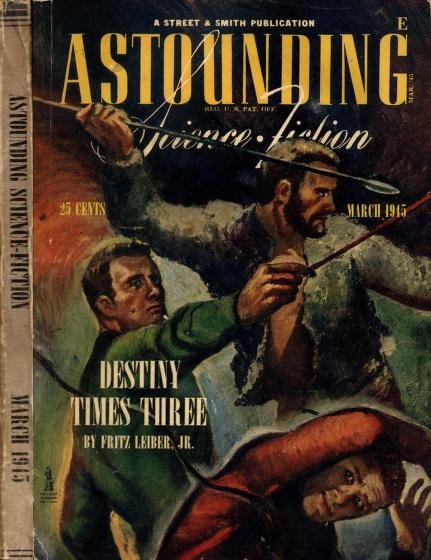
Destiny Times Three, first published in the March to April 1945 issues of Astounding Science Fiction. Retro Hugo nominee for Best Novel. Not one of Leiber’s more famous works, if the number of times it’s been reprinted says anything, but then it is quite a short novel—probably too short to sell on its own but also too long to be anthologized easily. One of Leiber’s earliest attempts at depicting alternate timelines, a premise that he would return to fruitfully much later.
Rime Isle, first published in the May to July 1977 issues of Cosmos Science Fiction and Fantasy. Never heard of Cosmos? Don’t worry, it only lasted four issues. Rime Isle is part of the Fafhrd and Gray Mouser series, being a later entry, as well as one of Leiber’s final appearances in the magazines; thereafter he stuck to original anthologies. Whereas some other Fafhrd and Gray Mouser stories are often cited, this is not one of them. I know basically nothing about it.
The novellas:
“Scylla’s Daughter,” from the May 1961 issue of Fantastic. The late ’50s saw a major revival for the Fafhrd and Gray Mouser series, which was not coincidental considering Fantastic‘s new editor, Cele Goldsmith, clearly sympathized with Leiber and wanted to buy what he was selling, with Fafhrd and the Gray Mouser getting at least one story a year in that magazine until Goldsmith left. “Scylla’s Daughter” would later be expanded into The Swords of Lankhmar.
“Ship of Shadows,” from the July 1969 issue of The Magazine of Fantasy and Science Fiction. This is a special issue of F&SF, being one of its author tribute issues, with “Ship of Shadows” as the lead novella. Technically a reread, but it’s been long enough that I could use a refresher, and hell, I remember liking it quite a bit. Leiber stories tend to fall into SF, fantasy, or horror, but “Ship of Shadows” ticks all three boxes, and it won a Hugo while it was at it!
The short stories:
“The Hound,” from the November 1942 issue of Weird Tales. The first several years of Leiber’s career saw him dwell primarily in Weird Tales and Unknown, the top fantasy-horror magazines of the early ’40s. Not being the most comfortable with SF, Leiber distinguished himself at first as a young master of terror and the supernatural. “The Hound” is one such early horror effort from Leiber, and hey, it’s apparently a werewolf story, and I love me some werewolves.
“The Moon Is Green,” from the April 1952 issue of Galaxy Science Fiction. After being relatively inative in the late ’40s, Leiber came back strong early the next decade, and his return to the field coincided with those explosive first years of Galaxy, the new SF magazine on the market. Leiber became one of Galaxy‘s leading writers in the early ’50s, and “The Moon Is Green” is one of those Galaxy-Leiber tales to get adapted for the legendary X Minus One.
Now, finally, the complete novel:
You’re All Alone, from the July 1950 issue of Fantastic Adventures. Apparently the magazine version is an earlier draft that Leiber had tried but failed to get published, since the fantasy market in the latter half of the ’40s was in the dumps, but luckily Fantastic Adventures, previously a second-rate pulp outlet, was under new management. Leiber would then “expand” the novel for book publication under the title The Sinful Ones, but from what I’ve heard the magazine version is better.
About how these complete novel reviews will work. My review schedule is on a rotation basis, switching between short stories, novellas, and serials; depending on how many days there are in a month I would cram in a third novella or short story. The way I have it figured is, if a month has 31 days, and if I’m set to review a novella on the 31st day, I’ll switch that would-be novella out for a complete novel. After all, I wanna save the biggest single review project for last, and I wanna give myself enough time to really digest the extra long material. The resulting review will itself of course be longer than average. Now, how do I separate a complete novel from a novella? How does one tell the difference, especially since magazines, while usually two-columned, have different type sizes and therefore some can pack more wordage into each page? Sometimes magazines give rough word counts, but much of this, admittedly, will come down to my own discretion.
Not making promises, but complete novel reviews will probably be the last department I add to my blog. This is a one-man show, ya know, and I do have a day job to contend with. Still, I wouldn’t be doing this if it wasn’t out of passive, and you also know that I’m a compulsive reader. The more the merrier! Just hope I can do someone as great as Leiber justice with this.
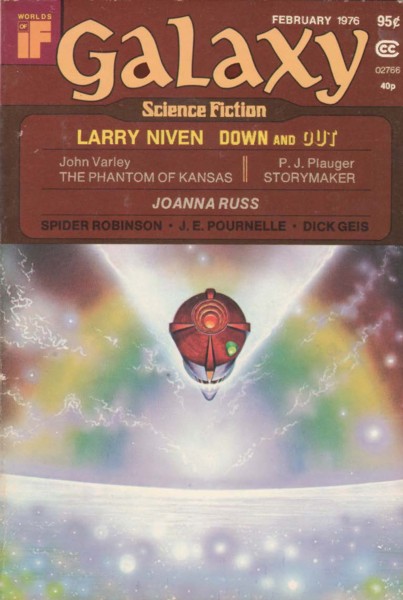
(Cover by Andrew M. Stephenson. Galaxy, February 1976.)
Who Goes There?
Joanna Russ was one of the defining feminist voices in ’60s and ’70s SF, as both a fiction writer and a critic. Her combative nature combined with her keen insight led to her accumulating a fair amount of enemies, but also some surprising allies; James Blish and Jim Baen were apparently defenders of Russ, despite being about as different from her politically as one can imagine. Her 1975 novel The Female Man remains her single most famous work, but she probably resonates with modern readers most strongly with her book-length essay How to Suppress Women’s Writing. In case these title choices don’t make it obvious, Russ is deeply concerned with women’s autonomy as people and as creatives. Lesbianism also figures into Russ’s writing, which is not unusual for second-wave feminism, though you’d be surprised how much it doesn’t show up (at least explicitly), including in today’s serial.
We Who Are About To… is Russ’s penultimate novel; she hadn’t even turned forty yet, but her fiction output would slow almost to a dead halt by the time the ’70s ended. This is my second Russ novel, as I had read Picnic on Paradise, her debut, and honestly I didn’t have much fun with that. The subject of today’s review isn’t fun either, but then again it would probably be insulted if you had a good time with it in the conventional sense. It’s a contender for the darkest SF novel of the ’70s, which I suppose is a point of praise. If you have a history of suicide ideation like I do then you’ll have a very bad time with Russ’s novel.
Placing Coordinates
Part 2 was published in the February 1976 issue of Galaxy Science Fiction. I’ve said before where you can find We Who Are About To… in book form, just check out my review for Part 1. I will say, the Feburary 1976 issue might be the most essential Baen-era issue of Galaxy that we have; it ticks all the boxes. We have a science article by Jerry Pournelle, a story by Larry Niven, a book review column by Spider Robinson, as well as pieces by daring young authors like John Varley and P. J. Plauger. And then we have Russ, who might stick out like a sore thumb, but I like said, Baen liked Russ, and he also liked paying lip service to explicitly leftist authors.
Enhancing Image
At the end of Part 1, the nameless narrator killed most of the party, excepting Mrs. Graham and her adopted daughter Lori. I didn’t bring up the fact that Lori is adopted in my review of Part 1 because I didn’t really think it mattered—and it doesn’t! Except on a symbolic narrator, which the narrator makes clear to us. The Grahams married for money, then “bought” a child with their wealth, painting them as delusional petit bourgeois, though they don’t do anything that I would say is too bad. Mr. Graham is a decent fellow and his death (via natural causes) in Part 1 is the closest the narrator comes to actually relating to another person who isn’t Cassie; sure, she treats Lori well (before she kills her), but that’s just being nice. At first I thought the narrator being so unlikable was an oversight on Russ’s part, but Part 2 showed me that this assessment was mistaken.
Returning to the campsite, the narrator kills a now justifiably furious Mrs. Graham with her own gun (Mrs. Graham probably never having handled a gun before), and proceeds to use the gas pellet gun on Lori, killing her instantly and relatively bloodlessly. “You must not shoot Lori with a large-caliber revolver. It’s not right.” This is all in the first few pages of Part 2, and the narrator, having done in everyone, is now left completely on her own. You may notice that we still have a little over thirty magazine pages to go at this point and the novel has become a one-woman show: it’s not as bad as it sounds, but it’s also not… great? The novel stumbles to its predetermined conclusion, but being stuck with just the narrator proves to not be the kiss of death I feared it would.
In Part 1, the narrator isn’t reflecting as much as she’s interacting with other characters, and much like Hamlet she seems to mess with other people intentionally: she claims to have been a “neo-Christian” but also a communist at one point, and everything she says is cloaked in hateful snark. An indicator of when the novel was written is that the narrator comes off like a burnt-out former hippie, with her idealism crushed under what would’ve in the real world been the gas shortage, Watergate, etc. Much like John Lude, the bureaucrat who thinks himself an intellectual, the narrator’s actual humanity is closed off from other eyes, her snarky antagonism being a foil to John’s calm smugness, or rather John is a foil to the narrator. Now that John is dead, along with everyone else, the narrator has nobody left to take her antagonism out on, though that doesn’t stop her from trying!
The realization that she is now by definition the loneliest person in the universe does not hit her immediately. It also doesn’t occur to her until some days in that starving yourself to death might be the slowest way to die possible. Oh sure, she could use her gas pellet gun on her self, or one of a myriad of poisons, or drown herself, but starving will do just fine. “I shall be bored to death long before I starve.” Indeed. As both the narrator and the reader try to fight off the onset of boredom, we get one of those old chestnuts of stranded astronaut stories: hallucinations! The most sustained hallucination is a mock trial in which the dead members of the party dunk on the narrator for killing them, seemingly with no better a justification thant she didn’t like them. These dialogues are all in the narrator’s head, though, something she acknowledges repeatedly.
There’ll be hallucinations about being rescued, I know: croaking thinly, “no, let me die!” (with immense dignity, of course) and I’m carried out to a shuttlecraft by great, coarse, strong, disgustingly healthy people in uniforms with thick necks. Actually it would be a little awkward trying to explain what happened to the others.
You killed them. Why?
They were trying to kill me.
Why?
To prevent me.
From doing what?
Dying.
It’s hard to not frame the narrator killing off most of the party as unforgivably heinous, even if she did it to retain some level of personal freedom in what she saw as a hopeless situation anyway. The thing is, I would’ve actually been more on the narrator’s side if her antagaonism resulted from the men in the party wanting to turn the women into breeding stock, but while there is a conversation in Part 1 about “repopulating,” the moral black hole of procreating without consent never takes center stage in the novel. The narrator is also maybe a lesbian, and at most this would be subliminal since we don’t get much at all from her regarding her orientation, despite the circumstances in Part 1 calling for transparency with that sort of thing. Of course it’s tempting to project Russ’s lesbianism onto the narrator, but I really do think the novel’s deconstruction of survival for its own sake would’ve been more effective if the narrator’s views on sex and relationships were made clearer.
Part 2 is arguably stronger than the first installment because we actually get some insight into the narrator’s motives and how she sees herself. It took long enough, but the novel does eventually become something like a character study, since the plot has basically ended only a fraction into Part 2 and we (and the narrator) are stuck with the protracted aftermath. If you’re a reader who favors plot then the latter half of We Who Are About To… will probably make you pull your hair out, but if you’re much more into character and/or thematic depth like myself then you’ll have more to chew on in the latter half. The other characters were little more than caricatures anyway, so dedicating so much wordage to the one character who might have some real human depth was a good move, even if it was made on what I would argue was a fundamentally flawed premise.
In other words, it sort of pans out, but I don’t think this novel should’ve been—well, a novel. Certainly it could be a novella, but even as a short novel I don’t think it justifies itself.
There Be Spoilers Here
The narrator dies. The end.
This time there really isn’t much more to be said. I’ll take this as a moment to clarify something, because I think there’s a timeline very similar to ours where We Who Are About To… came out as a 30,000-word novella and not a 50,000-word novel, and it would’ve been much stronger while being just as light on plot. The story continues past the point where the narrator has killed everyone, but the plot basically ends halfway through the novel—the plot, or any plot, being a sequence of events. There is action in a plot. That’s not to say something light on events is lacking in depth or even entertainment value; one of my least favorite criticisms of anything is when someone disses it for basically not having a theatrical (or cinematic) three-act structure. A work of art doesn’t have to hit a set quota of plot beats in order to be of enduring value. One of the most experimental and boundary-pushing novels of all time, James Joyce’s Ulysses, has very little in the way of plot, but the nuances of Joyce’s prose, his references, and the psychology of his characters, have been studied for quite literally a century now.
Here’s another example, and this one is directly SF-related: Samuel R. Delany’s Dhalgren. Delany’s novel is mostly, on its surface, 800 pages of druggy sex and totally-not-hippie artists discussing the nature of art and reality, but when taken past its mere plot it becomes a dense and wide-ranging fable about what might happen when a society tries to rebuild itself while being physically and culturally cut off from the rest of the world. You could hit all the plot beats in a quarter of the word count, but you would lose the juiciness of its meditations and allusions in the process. There’s a peculiar charm to a long rambling novel, but Russ’s novel is short, and it can afford to be even shorter. Russ doesn’t allow her characters, not even the narrator, to take on the human dimensions of Delany’s or Joyce’s, nor does she enchant the text with aesthetic flourishes except in short bursts.
The result is a novel that’s paradoxically short and yet long-winded. The narrator spends so much time starving that she eventually gives up and opts to put both herself and the reader out of her misery with poison. Having turned in her membership card to the human race with first her thorny attitude and then the murders (a mistake she realizes too late to remedy), she bids a final farewell (to herself, if nobody else) in the very last sentence fragment. There’s a line not long before that when she brings up a brief and incisive neo-Christian saying, which encapsulates the narrator’s relationship with the rest of the party as well as her failure to appreciate what little of humanity she had left.
I’ll tell you the neo-christian theory of love. The neo-Christian theory of love is this:
There is little of it. Use it where it’s effective.
It was a life poorly lived.
A Step Farther Out
Do I like this novel? Hmmmmm. Is it a novel that’s meant to be liked? Obviously there are people who are fond of it; it actually has a higher rating on Goodreads than The Female Man. But I don’t see We Who Are About To… as a novel to be enjoyed so much as a novel to be argued with. If you’re totally behind Russ’s apparent feelings on stranded astronaut and Adam & Eve plots (she loathes them) then you’ll at least like the novel on paper, but you’ll still have to contend with how it reads.
I have to admire making a protagonist so unlikable, and to have us be stuck inside the head of said protagonist, but we only begin to understand what her deal is once the excess weight of the rest of the cast has been expelled. This is not a novel that tries to win you over from the beginning; rather, this is the kind of novel that wants you to work for it a little. Again, I can respect that, but that doesn’t mean I have to enjoy reading it. I hate few things more than when a work of art dares me to experience it, like the experience is a game and I can only “win” if I refuse to play. I’ve been hesitant to check out Norman Spinrad’s The Iron Dream for the same reason, despite the praise. If a novel, by the nature of its premise, is not meant to be read but to be thought about then why read it? The act of reading should be pleasurable, not just a challenge.
I’m getting ahead of myself.
I respect Russ’s novel, but I don’t “like” it. If you’re one to search for transgressive ’60s and ’70s SFF novels, though, then I would go so far as to say We Who Are About To… is a hidden gem, even by the standards of that niche.
The ’60s saw an influx of explicitly feminist SFF writers, in correspondence with the sexual revolution of the period, with authors like Ursula K. Le Guin and Kate Wilhelm (although the latter had debuted in the late ’50s) coming to prominence. Perhaps the most abrasive of these new voices in the field was Joanna Russ, whose professional debut was in 1959 and who really hit the scene with her classic vampire story “My Dear Emily” in 1962. Her series of stories about Alyx the barbarian are of interest for a few reasons: first was the novelty of having a female protagonist in what amounted to heroic fantasy, and the second was that said heroic fantasy hopscotched its way between that genre and science fiction. What made Russ most famous (or infamous), though, was her 1975 novel The Female Man, which had apparently been written half a decade earlier but remained shelved until then. Russ, in both her fiction and her criticism (she, along with Judith Merril, was considered one of old-timey SFF’s great critics), was a real warrior with the pen—her combativeness earned her some enemies, but also much respect.
Due to health problems, Russ’s output petered out after the ’70s, and her career as a novelist was short-lived, with her first and last novels (Picnic on Paradise and The Two of Them, respectively) being published only a decade apart. She did, however, get some awards recognition, winning the Hugo for Best Novella with her 1982 novella “Souls,” which, though people must not have figured it at the time, had come out during Russ’s twilight years as a fiction writer. Still, as arguably the most outwardly spoken vanguard of second-wave feminism in relation to SFF, it’s possible that by 1985 Russ had said pretty much everything she wanted to say. While she lived until 2011, Russ’s legacy is very much conjoined to prevailing feminist modes of thought in the ’60s and ’70s.
Placing Coordinates
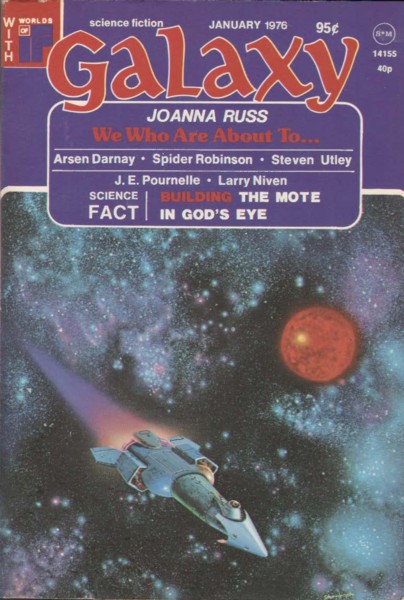
Part 1 of We Who Are About To… was published in the January 1976 issue of Galaxy Science Fiction, which is on the Archive. I assumed that this novel would be out of print, but this is not so! There’s a paperback from Wesleyan University Press that looks like it’s still in print, and the same goes for a more recent paperback from Penguin Books; yes, apparently Penguin thought We Who Are About To… was significant enough to give it a fresh printing. Of course, the Wesleyan edition is superior by virtue of not being British. Keep in mind also that this is a very short novel—170 pages in its first edition and just under 120 in the Wesleyan, almost making it a novella really.
It could’ve been even shorter, I’m just saying.
Just as interestingly, this was published in Galaxy during that period when Jim Baen was editor. Baen was a truly remarkably editor, one of the all-time greats, but it’s funny to see a serial by leftist firebrand Joanna Russ in the same issue as pieces by such grumpy right-wing stalwarts as Larry Niven and Jerry Pournelle; mind you, Baen’s fondness for out-of-left-field (pun intended) authors like Russ and Le Guin paled in comparison to his devotion to the conversative/libertarian crowd.
Enhancing Image
Before we get into the actual plot, let’s talk about a niche but weirdly prolific and popular subgenre, if you can even call it a subgenre: the stranded astronaut story. You know the drill, it’s when an astronaut (or at least someone who is spacefaring) gets stranded in some hostile environment and has to find a way either call for rescue and live in that new environment. Even by 1976, when Russ’s novel was serialized, this was a real old chestnut of the genre, and evidently it continues to be hugely popular in the present day if The Martian is anything to go by. Name an SF author and they probably wrote a stranded astronaut story at some point, and more often than not such a story is fundamentally optimistic about the prospect of humanity surviving amongst the stars. Such a premise is very much Campbellian, and while it didn’t start in John W. Campbell’s Astounding, it appeals to that sensibility.
We Who Are About To… does not hold such an optimistic view of humanity being able to overcome such obstacles; this is a novel that basically tells us right at the beginning that everyone will be dead by the end, so I’m not counting that as a spoiler, since it’s all but predestined. You may be wondering what I’m gonna do about the spoilers section, since I always have that for these reviews: don’t worry, you’ll see. You may also be wondering what the point is of Russ introducing us to these characters that she’s pointing at and saying, “Hehe, I’m gonna fucking KILL them by the end of this!” Well, you know what they say about the journey and the destination; more importantly, this novel would not be able to justify its own existence if it didn’t result in a kill-’em-all type of ending. Let’s pretend, though, for a second that we might get invested in these people.
Now, as for the characters…
There are eight of them at the outset, but only maybe half of them really matter. Five women and three men, and one of those women is very much underage (there’s a ’70s-ism here that I don’t feel like getting into, except to say that putting barely-in-their-teens characters in sexually compromising situations seemed like something you just did as an SFF writer in that era), not to mention a daughter of one of the other women. We have Mr. and Mrs. Graham and their daughter Lori, Cassie, Nathalie, Alan, John, and the unnamed female narrator. John is possibly the most interesting of the bunch since he acts as kind of a foil to the narrator, thinking himself an intellectual when in reality he’s a know-nothing bureaucrat. Alan is the youngest of the men and the closest the novel has to a conventional antagonist; he’s the only one who, prior to Part 1’s climax, resorts to physixal violence. Nathalie is a bit of a nonentity while Cassie is the closest (aside from Lori) the narrator has to an ally in all this. Not that that means much.
Our Heroes™, as part of an interplanetary expedition gone awry, crash land on what is probably a “tagged” planet, which is to say a planet whose makeup is not immediately fatal to humans. So it’s more habitable than Mars, which is something. Left with only the remains of their vessel, a land rover (or something like it), and some supplies, it’s time for the group to get their act together and see if they can make the best of a bad situation. They may as well get used to it since they have no way of calling for help and the planet itself is so distant from human civilization that help is simply not coming. But it can’t be all bad, can it? Well, the narrator thinks it’s all bad.
John Ude said, “Come on now, come on, dears. It’s a tagged planet. It has to be. Too much coincidence otherwise, eh? The air, the gravity. Now if it’s tagged, that means it’s like Earth. And we know Earth. Most of us were bom on it. So what’s there to be afraid of, hey? We’re just colonizing a little early, that’s all. You wouldn’t be afraid of Earth, would you?’’
Oh, sure. Think of Earth. Kind old home. Think of the Arctic. Of Labrador. Of Southern India in June. Think of smallpox and plague and earthquakes and ringworm and pit vipers. Think of a nice case of poison ivy all over, including your eyes. Status Asthmaticus. Amoebic dysentery. The Minnesota pioneers who tied a rope from the house to the barn in winter because you could lose your way in a blizzard and die three feet from the house. Think (while you’re at it) of tsunamis, liver fluke, the Asian brown bear. Kind old home. The sweetheart. The darling place.
The narrator has a snarky sense of humor—humor which, if absent, would render the novel borderline unreadable. The snark helps both the character and the reader cope with how hopeless things are. The narrator proceeds to list all the problems with a “tagged” planet and how basically nobody in the group is equipped to live long-term on such a planet, let alone set up a colony. Think of how many parts of our world are uninhabitable and compare that to a planet Our Heroes™ know nothing about, and whose very water could be lethal to humans. Something that constantly gets ignored or handwaved in these stranded astronaut stories is how fucking difficult (i.e., impossible) it would actually be to live in an environment that’s not suited for human habitation. While I have my issues with Russ’s novel, its mission statement as a strong dose of anti-Campbellian SF is admirable, even if I find it far too pessimistic for its own good. I do often prefer my SF to be at least a bit more hopepilled, just saying.
While the narrator is incessantly bitchy, her fatalistic viewpoint (we may as well play Uno until we die of starvation) is not unfounded. As far as she’s concerned, everyone died in the crash (not physically, but more metaphysically) and all this talk of setting up a colony is just delaying the inevitable. She might be more invested in survival if, say, they were literally the last human beings in the universe and if they didn’t procreate then the race would die out, but something tells me even if that was the case her response would still be “meh.” Naturally this attitude does not vibe well with the rest of the group, and she’s soon treated as a buzzkill at best and some kind of antisocial deviant at worst.
Take this little exchange between the narrator and John (again), which is easily one of my favorite bits of dialogue in Part 1:
“Civilization must be preserved,’’ says he.
“Civilization’s doing fine,’’ I said. “We just don’t happen to be where it is.’’
To say the narrator is thorny would be putting it mildly. Assuming the doom-and-gloom premise doesn’t alienate you, the total unlikability of the protagonist (even calling her an anti-heroine doesn’t feel right) just might, and I suspect is also the big reason why contemporary reviewers were not kind to the novel. It would be one thing if the narrator was set in her ways and she just wanted to be left to her own devices, but those dumb fellow humans keep trying to rope her back in, but she’s so nasty to everyone (except the Grahams, and even with them she’s standoffish) that we’re not sure why the others would want to keep her. The most plausible explanation is that they need everyone they can get, even the person who refuses to cooperate, if they hope to rebuild on this strange new planet, but I feel like it’s possible to do without just one person, especially if that person is a huge pain to be around.
Indeed, while the narrator is not without redeeming qualities, the conflict is only allowed to happen because she, for some reason, refuses to just take a hike and kill herself in peace, at least sparing everyone else the trouble. The whole idea is that she wants to die, since she sees no point in living under such dire circumstances, yet she keeps going. Oh, there are attempts from the others to keep the narrator from hurting herself, but she still has plenty of opportunities, not to mention means, of ending her own life, yet she can’t do it. She has a gas pellet gun which she can load with poison and enough drugs on her person to take down an elephant or two, so it shouldn’t be that hard. Of course, the narrator’s lack of drive to do what she herself thinks ought to be done is probably the point, which finally brings us to…
There Be Spoilers Here
Most of them die. End of Part 1.
…..
…………..
……………………
Okay, there’s more to it than that.
I can’t remember now when it happened exactly, but I realized that the narrator reminded me of a certain other character, and while I wasn’t expecting the comparison, it makes total sense to me now. I’m talking about Hamlet. The doomed prince of Denmark was a revolutionary character in theatrical storyteller, and, being innovative, he’s easy to poke fun at. The tragedy of Hamlet is that he is a man who is all thought and no action; every action he takes in the place is either misguided or comes about too late. To have the protagonist of your tragedy spend so much of the story saying so much and doing so little is probably frustrating for a lot of modern readers/viewers, but consider how unique Hamlet is as possibly the first true introvert in the history of theatre. The tragic hero, no matter how doomed, is typically a person who acts, while Hamlet is a person who thinks.
Similarly, the narrator of We Who Are About To… spends so much of her time thinking and so little time doing, so much so that the violent confrontation at the end of Part 1 struck me as more action-packed than it really was. The narrator is forced to take action against the rest of the group once she had literally nowhere left to run, resulting in her killing John, Alan, and Nathalie, and with Cassie, opting to do the reasonable thing and no longer put up with the narrator’s bullshit, killing herself. Had the narrator done so herself earlier, none of this would have happened, but like Hamlet she either acts in the wrong way or too late. Also like Hamlet, she thinks about suicide a good amount, and while I have to think of the novel’s pro-suicide (or at the very least pro-euthanasia) stance as almost more a shock tactic than an actual argument Russ is making, I also think it makes sense that she would (like Hamlet) struggle to go through with shuffling off this mortal coil.
The narrator being a Hamlet-esque figure does something to explain (if not to justify totally) her constant antagonism toward the rest of the group, not to mention her obsession with death. It’s all engaging on a thematic level, and it’s nice to think about—I just wish I could say the same for it as a reading experience.
A Step Farther Out
Part 1 ending where it does immediately brings up a structural problem, since by this point most of the cast is dead and there’s frankly not much than can happen from this point onward. At the end of Part 1 it feels more like we’re approaching the last third, or even the last quarter of the novel, and not the second half. It’s also a problem of length, since even taking into account how short it already is, I can’t help but feel like We Who Are About… can stand to be even shorter; it would be feasible, possibly even desirable, to whittle this 50,000-word novel (I would say Part 1 is about 25,000 words) down to a 30,000-word novella without sacrificing the important things. After all, we don’t need this many characters who inevitably will be snuffed out, nor do we need to know too much about them aside from how they figure into (i.e., oppose) the narrator’s viewpoint. Also, while I do find some of the narrator’s snark mildly funny, there’s only so much of her ultra-pessimistic unlikability that I can stomach.
Despite my reservations, I am curious as to how Russ plans to justify what looks to be mostly a one-woman show in the novel’s back half, and how that might impact my enjoyment of the whole thing as opposed to just admiring its thematic audacity. I’ve been burned before.
(Cover by Howard V. Brown. Astounding, July 1938.)
Who Goes There?
Almost like chameleon, Jack Williamson blended in enough with his surroundings during his long career, from his debut in 1928 to his death in 2006, having work published in Amazing Stories, Weird Tales, Astounding Science Fiction, Galaxy Science Fiction, Asimov’s Science Fiction, The Magazine of Fantasy and Science Fiction, Science Fiction Age, and other publications across a span of 78 years. While he is most known today for his novelette “With Folded Hands…,” truly one of the most haunting stories ever written about man’s relationship with robots, Williamson wrote a great deal of notable science fiction and fantasy. On top of his fiction, Williamson also pioneered the study of SF in academia, having earned his M.A. in the ’50s and writing a respectable thesis on the SF of H. G. Wells. Williamson remains the oldest (as far as I can tell) person to win a Hugo, having won the Hugo for Best Novella with his 2000 story “The Ultimate Earth,” which became part of his novel Terraforming Earth.
Williamson was the last of the Campbellian authors, even outliving other incredibly long-lived persons like L. Sprague de Camp and A. E. van Vogt (though van Vogt spent the last decade or so with Alzheimer’s), but more impressively, he was the last of the Gernsbackian authors. Having encompassed and taken part in virtually all of 20th century SFF, Williamson’s contribution to the field is nigh-incalculable.
Placing Coordinates
The final part of The Legion of Time appeared in the July 1938 issue of Astounding, which is on the Archive. This particular issue of Astounding is quite interesting. We have the final part of Williamson’s novel, but we also have “Rule 18” by Clifford Simak, the story which marked his return to writing SF (this time he would not look back), and which would win him a Retro Hugo. There’s Ross Rocklynne’s “The Men and the Mirror,” being an early example of what we’d now call hard SF. Then we have L. Ron Hubbard’s SFF debut, “The Dangerous Dimension,” marking the beginning of one of SFF’s great pulp adventure writers long before he became one of SFF’s great villains. To cap things off we get one of L. Sprague de Camp’s most memorable essays, “Language for Time Travelers,” which even got a follow-up essay from Willy Ley titled “Geography for Time Travelers.” All around this is an impressive issue, and I’m actually surprised it doesn’t get cited more often as being at least historically notable.
Enhancing Image
Since Part 3 is basically like the third act of a movie, in which the action comes to a head, it’ll be hard to keep the spoiler and non-spoiler sections separate, but I’ll try.
At the end of Part 2, Dennis Lanning and best buddy Barry Halloran had made it into the depths of Sorainya’s fortress, finding a black brick containing the object whose presence determines whether Jonbar or Gyronchi come into being, only to be trapped when Soraniya appears out of thin air. But that’s okay! The Chronion, the time ship which Lanning and Halloran had been rescued by before, manifests and comes to the rescue once again. We get a deus ex machina in the first five pages, which is whatever, but of course Our Heroes™ are far from out of the woods yet, as they have two objectives now: to return the mysterious object to its proper time, and to defeat Sorainya. With the help of former college friend and current mad scientist Wilmot McLan, Lanning takes the brick and escapes Sorainya’s wrath for the time being. Now, the question becomes: Where and when does this object go and what even is it? The object turns out to be a magnet, nothing special in itself, but it’s where and when the object is supposed to be that things get interesting.
The question burning in his eyes. Banning whispered: “Did you find—anything?”
Solemnly, the old man nodded, and Banning listened breathlessly.
“The time is an afternoon in August of the year 1921,” whispered Wil McLan. “The broken geodesics of Jonbar had already given us a clue to that. And I have found the place, with the chronoscope.”
Banning gripped his arm. “Where?”
“It’s a little valley in the Ozarks of Arkansas. But I’ll show you the decisive scene.”
Arkansas, 1921. We meet a character who, it turns out, serves as the turning point for the story, despite not (as far as I recall) having a single line of dialogue. John Barr (get it, John Barr, Jobar…) is a twelve-year-old kid in 1921, but depending on whether he finds that magnet by happenstance or not he’ll go on to either become a revolutionary scientist or a still capable but unambitious good-for-nothing. We by now know why it’s vastly preferred for Barr to cause the existence of Jonbar than for his lack of action to cause the existence of Gyronchi so we don’t need much of an explanation beyond who Barr is in the first place. If you’ve been following things then you’ll remember that time travel in Williamson’s novel is based on probability, as opposed to predetermined futures, and it’s a sneaky way for Williamson to throw in this last-minute rally for the good guys so that the event of Sorainya stealing the magnet can be corrected. It raises the question, of course, of why Sorainya would keep the magnet locked away in a tiny vault and not, say, simply destroy the thing, but we’re not here to think about that.
I suppose you could poke a ton of holes in the narrative, but Williamson moves the action along so quickly that the reader is not incentivized to dwell on the story’s mechanics—a tried and true way to get over spotty exposition. Williamson would take the inventiveness apparent in The Legion of Time and fine-tune it for his remarkable werewolf novella “Darker Than You Think,” but he unquestionably set the standard for time war narratives with his earlier effort. Interestingly, while many novels (especially time-spanning ones) broaden in scope as they approach the climax, The Legion of Time shrinks, furthering a great shrinkage of scope that had occurred in Part 2. John Barr isn’t a character so much as a plot device with legs, and since Lethonee had “died” early in Part 2 and Our Heroes™ don’t fix things until towards the end of the final installment she’s also basically a non-factor here. If Sorainya is far more thoroughly characterized than Lethonee it has partly to do with the fact that she gets a lot more time on the page. I think it’s also because deep down we prefer the whore over the Madonna, which I suspect Williamson thinks as well; more on that later.
There Be Spoilers Here
The final fight with Soraniya is epic, brutal, and approaches some pretty weird and grotesque territory. While the solution for dealing with Sorainya is stupid (and makes McLan look like even more of a fool than he’s supposed to be), the result is quite… something. A dying McLan rolls a tube Lanning’s way as he’s also on his last leg, his fight with Sorainya not going in his favor, and tells Lanning to smash it, which he does. The tube, filled with a mysterious liquid, is connected to Soraniya’s past and how she was supposed to die young from a plague, only to be saved by the giant ants with an antedote. Once the tube breaks, Soraniya’s past is rewritten and she dies in a remarkably gruesome fashion. Why didn’t McLan use this much sooner……? Still, get a load of this:
The bright blade slipped out of her hand, rang against the dome, and fell at Lanning’s feet. The smile was somehow frozen on her face, forgotten, lifeless. Then, in a fractional second, her beauty was—erased.
Her altered face was blind, hideous, pocked with queerly bluish ulcerations. Her features dissolved—frightfully—in blue corruption. And Lanning had an instant’s impression of a naked skull grinning fearfully out of the armor.
And then Sorainya was gone.
Lanning and Halloran are FOR THE LAST TIME rescued once the battle is over and Our Heroes™ are brought to the now-existing Jonbar where they can spend the rest of their days, since they’re not allowed to return to their own time periods. You can imagine my shock when the futuristic machinery that literally brought Lanning and Halloran back from the dead was not able to save the severely injured McLan.
But aside from that it’s a happy ending! The future is saved, and Lanning even gets his beloved back—only… Lethonee is not exactly as she was before. Their reunion is described ambiguously, but it seems that Lethonee and Soraniya were, in fact, the same person, or rather extensions of the same germ of a person. The resurrected Lethonee seems to have Sorainya’s voice and is even dressed in red, although her memories of Lanning were not erased. While the twist of Jombar and Gyronchi being the same place, made only different by circumstance, is predictable, the implied twist of Lethonee and Soraniya now being combined into a woman who bears Lethonee’s name but who also shares traits from both women is a far more curious choice. True, the whorish warrior queen is no more, but then so is the saintly love interest as well, and in a way it’s a shame that we get nothing like an epilogue for this story. Still, the ambiguity with Lethonee reuniting with her shadow counterpart borders on Lynch levels of surrealism and I’m here for it.
A Step Farther Out
Did The Legion of Time fumble the ball in the final installment? Maybe a little bit, but I still find it pretty memorable. Williamson pulls a deus ex machina or two, and pulls technobabble out of his ass to explain why some things happen and other things don’t, but the action which takes up the bulk of the installment is engrossing, the scope feels so epic despite actually being so compressed, and the very end gave me food for thought. I’m not sure if Williamson was consciously aware of what he writing the whole time, of what he meant by this or that, but it’s a pulp narrative that has a good deal more substance to it than one might expect. Williamson’s background as a Gernsbackian writer as well as a regular contributor to Weird Tales reveals itself in the brisk pacing and technobabble, but most importantly a willingness to get his hands dirty that would become largely unseen in Campbell’s Astounding, once that magazine under that editor further established its own voice. The result is a novel that feels both of its time and very much out of step, showing that Williamson was indeed one of the most capable of substantive genre authors of that era.
In the ’60s there was a very short-lived but prescient journal called SF Horizons, run by Brian Aldiss and Harry Harrison, and the most well-known essay from that journal was about The Legion of Time, titled “Judgment at Junbar.” Aldiss supposedly makes an argument for Williamson’s novel as an excellent work of pulp fiction—I say “supposedly” because I haven’t been able to read the damn thing yet. I have, however, read parts of Aldiss’s Trillion Year Spree, in which he calls The Legion of Time a delight but also “philosophically meaningless,” an assertion I don’t think I can agree with. Then again, Aldiss is eloquent and thoughtful as usual, even when he’s being disagreeable (which he often is), and you can bet I’ll get to him at a later date.
Jack Williamson was the second person to be made a Grand Master of science fiction (after Robert Heinlein), which may sound weird to people nowadays because he’s a relatively obscure figure now. This is a shame, because Williamson has a pretty interesting career and if I did reviews of non-fiction books I would totally cover his autobiography, Wonder’s Child. Born in 1908, made his professional debut in 1928, and only stopped writing SFF with his death in 2006, which in itself is mindblowing, but there’s also the fact that while some authors from that same erakept being published based on their legacy value, Williamson did something considered nigh-impossible: he remained contemporary. Not only did he win a Hugo for Wonder’s Child but he would also win a Hugo and a Nebula for his 2000 novella “The Ultimate Earth,” making Williamson (as far as I’m aware) the oldest person to have won a Hugo. His 1947 novelette “With Folded Hands…” is still one of the most haunting robot-focused stories that I’ve read and that shit’s 75 years old.
Despite the fact that Williamson had not quite turned thirty yet when he wrote it, The Legion of Time came about a good decade into his career—a career that would ultimately span 78 years. You could say it marks a transition point not just for Williamson, who was coming out of his Gernsback phase, but also magazine SF at large, since John W. Campbell had taken over Astounding Science Fiction in late 1937, slowly but surely introducing his own eccentric vision into the field. More apparent in Part 2 than in Part 1, The Legion of Time feels like the missing link between adventure-based SF in the Edgar Rice Burroughs tradition (actually it reminds me more of Robert E. Howard, but I’ll elaborate on that later) and the cerebral high-concept SF of the Campbell era. For Part 2 we’re really leaning into the adventure part of the equation, but as it turns out, that’s not necessarily a bad thing.
Placing Coordinates
Part 2 was published in the June 1938 issue of Astounding, which is on the Archive. If you thought Part 1 was short (only about thirty pages in the magazine) then you might be surprised by Part 2, which is even shorter, clocking in at a little over twenty pages. I’m starting to get the impression that maybe The Legion of Time is actually a novella, although it would definitely skirt the line between novella and novel assuming Part 3 is the same length as Part 2. I wish I had a book version to compare the serial with, but rarely has The Legion of Time been printed on its own, most often being bundled with another Williamson story, the novella “After World’s End.” Confusingly, this bundle of two stories is just called The Legion of Time, because those double paperbacks Ace did back in the day weren’t a thing yet and nobody knew what they were doing. You can also get it as part of The Collected Stories of Jack Williamson, but those volumes aren’t exactly cheap. Despite getting a Retro Hugo nomination and despite being well-liked by the few who’ve read it (Brian Aldiss was apparently a fan of it), it has not been reprinted that often.
Enhancing Image
I want to start off with a bit of a rant. The Wikipedia entry for The Legion of Time states that there is no “Legion of Time” in the novel, and that the title was probably chosen as a marketing move, since Williamson was up to that point most famous for The Legion of Space, though the two are not connected in any way. The latter is probably true, but first point is false. Maybe this is not the case in the book version, but in the magazine version the time-traveling army Dennis Lanning joins is called the Legion of Time at one point in Part 1; mind you, it’s also called the Legion of the Dead, and these titles don’t seem official, but to say there’s no Legion of Time would be inaccurate. Now with that out of the way…
Part 1 had ended on a foreboding note, with the dystopian society of Gyronchi decreasing to the probable existence of the utopian Jonbar to such a degree that Jonbar starts to face out altogether—or rather, its likelihood of ever existing approaches zero. Part 2 begins with Lethonee, being herself only possible through Jonbar, fading out of existence, and it’s a bitter scene despite our intuition that Lanning, Our Hero™, will somehow bring his beloved back into existence by the end. The way time travel works here is that Jonbar and Gyronchi are mutually exclusive in that they cannot exist in the same timeline; if one comes into being, the other is booted out. Existence is based on probability, and the less probable a future thing is, the less it can interact with the past, or rather Lanning’s present. Once Lethonee gets wiped from the timeline, Sorainya (her evil counterpart) becomes solid. What’s important to note is that Lethonee has not exactly died, as Wilmot McLan (our resident mad scientist) explains:
The ship, in a moment, was back in her timeless blue abyss, driving through the ceaseless flicker of possibility. Fanning hastened to join Wil McLan beneath the crystal dome, and asked a breathless, tortured question: “Lethonee is gone—dead?”
The sunken, haunted eyes looked at him solemnly.
“Not dead,” rasped Wil McLan, “for she was never born. Jonbar was merely a faint probability of future time, which we illuminated with the power of the temporal ray. This last triumph of Sorainya has—eliminated the probability. The reflection, therefore, vanished.”
Sorainya and her army of giant ants (more on those later) have all but succeeded in making sure Jonbar never comes into being; there is, however, still another way. The villains have found an object which McLan and his crew have been unable to identify, which apparently represents a fork in the road leading to Jonbar and Gyronchi. Whereas Lanning had been previously led to believe that he was said object, this turns out to not be the case—but rather something else from the past. Ignoring all the technobabble about temporal rays and whatnot, the idea is simple enough: if Lanning can find this mysterious object and return it to its proper place in time, then Jonbar has a chance. Where could this object be? If Sorainya has it in her possession, and if the Chronion is capable of interacting physically with past and future (how, for instance, they were able to pick up Lanning and other members of the Legion), then Our Heroes™ have but one option.
An all-out assault, practically a suicide run, on Sorainya’s front door.
In a movie, typically, we have three acts, and what often happens is that there’s a turning point, you could say a bridge between the second and third acts, where Our Heroes™ are at their lowest point and it takes either a good pep talk or a deus ex machina to pull them out of it. Not so with The Legion of Time, where Lanning and company reach their lowest point about halfway through, and why not: Lethonee is dead, or rather un-alive, and Sorainya has basically won. Whereas Part 1 is high-spirited and briskly paced, Part 2 still has that pacing, but the tone is now much darker. I’ll get into this in the spoilers section, but I do have to wonder if Williamson was maybe inspired by Robert E. Howard when it came to writing… basically everything about Sorainya’s fortress. While the timespan of Part 1 was considerable, starting in 1927 and ending in 1938 (if I remember right) before Lanning gets picked up by the Chronion, the timespan of Part 2 is far more compressed. This is not a bad thing, mind you. Williamson can write pretty good action when he wants to, and most of Part 2 is straight action.
In my review of Part 1 I brought up the novel’s overt sexuality, at least by the standards of ’30s SF, and how Williamson injects as much lust into his weird love triangle as—well, love. We don’t get as much of that here, since Lethonee and Sorainya are off-screen for most of it, but that’s fine, because a different problem crops up: what to do about Sorainya. Because the whole point is that we have to kill Sorainya, or at least set things up so that she was never born in the first place, but this is easier said than done. Lanning knows he has to kill the bitch, and he’ll do it, but despite the fact that Sorainya’s tried to kill him several times over the years, he can’t bring himself to hate her completely. The pussy is too good. Speaking of which, you may recall that Sorainya had captured and tortured McLan for yeeeeears, and you’d think this would make it easy for him to hate her.
Not quite so.
“Fifteen years—” came the slow whisper at last. “Fifteen years since I found that she is a demon. Lying, treacherous, savagely cruel, as near a female devil as could be. And still—beautiful. Somehow, glorious!” Some deep-hidden agony throbbed in his whisper.
“I hate Sorainya!” It was a savage rush. “She tricked me, tortured me, maimed me forever ! She—she—” Something seemed to choke him. At last came the voiceless sigh: “But still—for all her hateful evil—could I kill Sorainya? Could any man?”
What interests me about Sorainya, especially as a symbol, is that while usually with a super-attractive evil girlboss we get maybe a passing mention from Our Hero™ about her attractiveness, and ain’t it a gosh darn shame that she’s evil (Robert E. Howard does this sometimes, come to think of it), this is not so with Sorainya. Not only is Sorainya noted as being some hot shit, but her personality also entrances the men she meets; her sheer force of will is intoxicating, and in that sense she’s the ideal fascist woman. She’s blonde and fair-skinned, for one, but she also thinks that action for the sake of itself is glorious, and of course she’s a total warmonger. I’m pretty sure I’m wrong, but I get the feeling that Williamson is about the macabre eroticism of fascism, or rather fascism’s eroticization of death, and how that could be appealing for lonely white dudes like Lanning and McLan. The bitch must be destroyed, but we would be lying to ourselves if we said she was totally unattractive. I don’t think it’s coincidence that Gyronchi, Sorainya’s homeland, is not only a theocratic militarist state, but is (at least according to McLan) destined to destroy itself along with the rest of mankind.
There Be Spoilers Here
So, Lanning and a bunch of redshirts jump into the future and attack Sorainya’s fortress. The results are grim. Not to say these men are afraid of dying, they had already died before, but the ensuing carnage is fairly outrageous. Remember how I said Sorainya has giant ants for minions? Oh yeah. We’re talking ants the size of people, and they’re bipedal and intelligent; they use weapons, but they also have their big fucking mandibles that can cut off a dude’s head. Which yeah, that happens. Williamson started out writing for Hugo Gernsback, and he later became one of Campbell’s regular authors, but he also submitted frequently to Weird Tales in the ’30s. I just bring this up because Weird Tales occasionally published SF, but it was primarily a horror and dark fantasy magazine (the original horror and dark fantasy magazine), which where we saw a lot of Howard and Lovecraft and so on. The sequence that takes up the bulk of Part 2 of The Legion of Time reads like one of Howard’s Conan stories, but not as flamboyant. I’m not even sure what to single out here, since there are whole pages of gory man-on-bug action.
Okay, I’ve got one passage, and it’s not even one of the fight scenes. It’s this grim little moment in the depths of the prison—more of a dungeon, really.
A dreadful silence filled most of the prison. But from one cell came an agonized screaming, paper-thin from a raw throat, repeated with a maddening monotony. Glancing through a barred door, as he passed, Lanning saw a woman stretched out in chains on the floor. A crystal vessel swung back and forth, above her, pendulumlike. And drops of cold green fire fell from it, one by one, upon her naked flesh. With each spattering, corrosive drop, she writhed against the chains, and shrieked again.
The half-consumed body, Lanning thought, might once have been beautiful. Could this have been some rival of Sorainya’s? A cold hate turned him rigid, and quickened his step. A muffled shot echoed behind him, and the screaming stopped.
Not fun. Well, it does get fun later. When I reviewed Robert Heinlein’s If This Goes On— I took issue with how the first-person narration not only diluted the stakes but gave us a fainter impression as to what’s going on during action scenes, which that novella has quite a few of, especially in its second half. Williamson gets around this by not having a first-person narrator, but he’s also simply more capable as an action writer, or at least he’s more brutal as an action writer. The brutality is not disturbing, but it is surprisingly extreme for a story published in Campbell’s Astounding, yet considering it’s basically not horror at all it probably would not have sold to Weird Tales. I’m reminded of an earlier story of Williamson’s, “The Moon Era,” which I liked, mostly for a female character who was a) an alien, b) an active player in the story, and c) not objectified by the male hero (who, admittedly, would not be quite old enough to objectify much of anything). But that novella is about a boy who takes a rocket ship to the moon and gets caught up in a war between alien races. That story was also heavy on action, and by the time he wrote The Legion of Time it seems like Williamson had gotten even better at concocting gripping action scenes.
A Step Farther Out
So far I’m liking this a lot. The Legion of Time is this combination of Campbellian big-brain SF with pre-Campbell adventure pulp, with a tinge of weird fiction thrown into the mix. I’m pretty sure Williamson frequently appearing in Weird Tales in the ’30s (making him contemporaries with Howard and Lovecraft, though I don’t think he interacted with either of them personally) had changed his writing philosophy somewhat by the time Campbell came around, and we can see this in The Legion of Time as well as the stories he would later submit to Unknown. Ultimately, though, we still have an ingenious time travel narrative that hardly ever stops to catch its breath, being too eager to either explore its mechanics further or to indulge in some swashbuckling action. The pacing may be too brisk for you, and I suspect a lot of modern readers will be put off by the sheer artlessness of the whole thing, despite the concepts it puts forth. Unless the final installment drops the ball, I suspect I’ll rate it pretty highly.
(Cover by Charles Schneeman. Astounding, May 1938.)
Who Goes There?
Jack Williamson made his debut in 1928 with “The Metal Man,” in Hugo Gernsback’s Amazing Stories. While not the oldest author we’ve covered so far (Clifford Simak is a few years older than him), Williamson is remarkable for his versatility and longevity, and he debuted before Simak, first being published when he was only twenty years old. Williamson started out as an SF author of the Gernsbackian mode, being close contemporaries with E. E. Smith and Edmond Hamilton, guys who wrote fast and often sloppily in the hopes of getting as many stories published as quickly as possible—and why not? The pulps generally didn’t pay well, and Gernsback was especially notorious for being slow to pay his writers. Still, Williamson persisted, and when Astounding Science Fiction started hitting its stride in 1934 he jumped ship pretty readily, giving us perhaps the most notable SF novel of that year, The Legion of Space. But whereas Smith and Hamilton remained most known for their grand space operas, and while Williamson was no slouch in that department, he would soon branch out and reveal an almost startling intelligence.
When John W. Campbell took over Astounding in late 1937, not immediately making his mark but gradually reshaping the magazine in his own image over the next two years, most of the Gernsback-era authors failed to adjust; Williamson, however, was not one of them. While he would never again reach the level of productivity of his first decade, Williamson not only survived the coming of Campbell but became one of the brighter (albeit relatively infrequent) stars in Campbell’s stable. From this period (1938 to about 1950), Williamson wrote the famous novelette “With Folded Hands…” and its follow-up novel …And Searching Mind (published in book form as The Humanoids), the equally inventive and deliciously atmospheric horror novella “Darker Than You Think” (published in Unknown, Astounding‘s arguably superior sister magazine), and the short novel that we’re starting today, The Legion of Time. Contrary to what its title may imply, The Legion of Time is not connected to the Legion of Space series, but is indeed a totally standalone work; the folks at ISFDB seem confused about it, since it’s classified as part of a series there—a series where it’s the only entry.
In the ’50s Williamson devoted much of his time to going back to school, where he would write a respectable thesis on H. G. Wells and would, in the process, become one of the first people to bring SF to the world of higher education. Still, he never strayed from the field as a writer for too long, with the occasional solo effort or collaboration (especially with Frederik Pohl) popping up to remind people that Williamson was still in the game. In 1985 he won a Hugo for his autobiography, Wonder’s Child, which details not only his early life but his long and ongoing relationship with SF. He won another Hugo in 2001, this time for Best Novella, for “The Ultimate Earth,” which became part of his novel Terraforming Earth. Williamson was 93 when he won that second Hugo. When Williamson died in 2006, he was still very much active, and he immediately stood out as having (to this day, as far as I can tell) the longest career of any SF author at 78 years. Like Hailey’s Comet, which can appear at the beginning and end of a person’s long life, Williamson lived to witness not only the prehistoric dawn of the Gernsback era but the neon sunrise of 21st century SF.
Placing Coordinates
Part 1 of The Legion of Time appeared in the May 1938 issue of Astounding. It’s on the Archive. Despite being long enough to qualify as a full novel (albeit barely), The Legion of Time has mostly been printed in book form as part of a bundle, most often with another short work of Williamson’s from that period, “After World’s End.” It has also been collected in Spider Island, which is the fourth volume of Williamson’s collected stories. It’s worth noting that The Collected Stories of Jack Williamson has eight volumes, and stories published between 1928 and 1938 comprise the first four. Despite not being reprinted too often (I’ve never seen a copy in the wild), and despite not being one of Williamson’s most famous works (though it is undoubtedly considered major), it garnered a Retro Hugo nomination for Best Novel. You could argue the pool for eligible novels (never mind the quality) from 1938 has to do with it, but I would also argue the nomination was well-earned.
Enhancing Image
We start out with a quartet of college boys: Dennis Lanning, Wilmot McLan, Barry Halloran, and Lao Meng Shan. Lanning passes the time by himself in the apartment he shares with the homies by reading a scientific paper by McLan, the latter seeming to be the most intelligent and well-read of the bunch, and of course it’s about time travel.
Deep-hidden in its abstruse mathematics, Lanning had sensed an exciting meaning. He leaned back, with tired eyes closing, trying to complete the tantalizing picture he had glimpsed through the mist of symbols on the page. The book began with Minkowski’s famous dictum: “Space in itself, and Time in itself, sink to mere shadows, and only a kind of union of the two retains a kind of independent existence.”
Was Time, then, another extension of the universe; to-morrow as real as yesterday? What if one could leap forward—?
It takes all of three pages (I’m not kidding, three pages) for the plot to kick in as, in the midst of reading his friend’s paper, Lanning comes into contact with a mysterious woman—or rather the specter of a mysterious woman, who appears spontaneously out of nothingness. The woman is almost impossibly beautiful, and because Lanning is a young man circa 1927 who’s had zero pussy in his life, he instantly falls for her. The woman is Lethonee, someone from a future society called Jonbar, and while she can’t interact physically with Lanning, she stays long enough to warn him about her dark counterpart—an evil girlboss named Sorainya who comes from another future society called Gyronchi. Jonbar has milk and cookies while Gyronchi is a shithole, apparently. Lanning at first doubts the validity of this chance encounter, after Lethonee has vanished, but because this is a pulp SF story from the ’30s it doesn’t take long for him to get over that small hiccup.
A few things struck me immediately. The first is Williamson wastes absolutely no time in introducing the conflict, and he also makes no bones about who’s good and who’s bad. It’s not a spoiler at all to say Lethonee is the good girlboss while Sorainya is the bad girlboss, and that Lanning will, at some point, come to the side of Jonbar, which is obviously the goody-two-shoes side. What makes this interesting is that while Sorainya is a villain, she’s by no means unattractive or unappealing, embodying one of my favorite tropes in old-timey pulp fiction: the sexy villainness whose assertiveness and cunning makes (let’s face it) the female love interest look bland by comparison. While there’s no question that Lenning will ultimately end up with Lethonee, it’s not as quite as east as that, but more on that later.
Another thing that struck me is that we’re not given a totally conventional depiction of time travel here, and it still feels somewhat unorthodox in the year 2022. This is not like The Terminator or Back to the Future, or even Heinlein’s “By His Bootstraps,” because future actors cannot directly impact the subjective present. When Lethonee and Sorainya appear to Lanning they appear as ghosts, being seen but unable to interact physically with the present; they can, however, influence the present in more indirect ways. Lanning and Halloran are both aviators, and Lethonee convinces Lanning to not go flying solo on a specific day, as she suspects Sorainya has a trap for him—a trap that seems to instead get Halloran, who dies in a freak accident but whose body is conspicuously not recovered. You probably have an idea as to what happened with Halloran, but I urge you to hold onto that thought. The point is that Sorainya basically tempts Lanning more than once to kill himself, or rather to put himself in a situation where he dies in an untimely manner. Good pussy will do that.
I’m not sure if The Legion of Time was bought by Campbell or by F. Orlin Tremaine, Astounding‘s previous editor. Sure, Campbell was in full control by then, but story purchases tend to be carried over between editors, and Tremaine had only been gone a few months; still, Campbell had say on what got published, and this feels out of character for him. I say this because Campbell, while he was undoubtedly a Promethean figure and an innovator in the field, was a puritan (among other things). Sex, even implicitly or metaphorically, rarely showed up in the fiction of Campbell’s Astounding, yet The Legion of Time stands out as being unquestionably and almost unapologetically horny. We get something like a love triangle where the two female leads (having two female leads, imagine that) each try to get the male hero to do her bidding, and at least part of this is done via sexual temptation. The descriptions of Lethonee’s physical beauty are one thing, but Sorainya’s sexual ferocity is not only undeniable but plays an actual role in the plot, as I’ll explain in the spoilers section.
This is not to downplay the story’s ingenuinity with its time travel mechanics, which are quite intriguing. Lanning, unbeknownst to himself, plays a pivotal role in the advents of Jonbar and Gyronchi, and Lethonee does an admirable job of throwing exposition at him to explain how these two societies are related and how the interplay between present and future works. Mind you we’re talking about the subjective present (Lanning’s present), and not some kind of past; the past has already happened, but conversely, the future is but a phantom of itself.
“The World is a long corridor, from the Beginning of existence to the End. Events are groups in a sculptured frieze that runs endlessly along the walls. And Time is a lantern carried steadily through the hall, to illuminate the groups one by one. It is the light of awareness, the subjective reality of consciousness.
“Again and again the corridor branches, for it is the museum of all that is possible. The bearer of the lantern may take one turning, or another. And so, many halls that might have been illuminated with reality are left forever in the darkness.
“My world of Jonbar is one such possible way. It leads through splendid halls, bright vistas that have no limit. Gyronchi is another. But it is a barren track, through narrowing, ugly passages, that comes to a dead and useless end.”
Not unlike how the Time Traveler in Wells’s The Time Machine jumps forward 800,000 years to see the grotesque future of mankind, divided between the feeble-minded Eloi and the ruthless Morlocks, Lanning glimpses into a future where mankind either flourishes or devolves into a kind of techno-fascism. The catch is that these are two different futures, and they do not exist on the same physical plane. It’s here that we are introduced to what has to be one of the first (if not the first) time wars in SF history, involving not just one future timeline but several conflicting timelines. That Williamson came up with this premise circa 1937 is astounding in itself, but it’s how he rationalizes what sounds pretty far out that gets me. It’s an adventure yarn, sure, but it’s an adventure yarn brimming with ideas, not to mention red hot blood in its veins.
There Be Spoilers Here
We only get something like a clear answer as to the mechanics of time travel in this story’s universe when Lanning dies—or does he? As it turns out, it was more important that Lanning live long enough to get to a certain point in his life than for him to perform a specific action; Sorainya spends much of Part 1 trying to kill Lanning, so as to prevent him from bringing about the existence of Jonbar, but conversely there’s a right time for him to die, and die he does, under circumstances not dissimilar from Halloran’s. As if by magic, Lanning finds himself recovering on a ship called the Chronion, a time-traveling vessel that picks up soldiers at the time of their deaths, revives them, and recruits them into the forces of Jonbar. Lanning reunites with Halloran, who hadn’t died (not permanently, anyway) after all, but rather was snatched up at the time of his death; while years had passed for Lanning, time had only gone by a few days in Halloran’s subjective present.
Two things here. The first is that I honestly have to wonder if Fritz Leiber found inspiration in this for his Change War series, because the time war in that series is eerily similar to the deal with Jonbar and Gyronchi, what with people from throughout history being recruited into both sides. The second is that while this has to be a coincidence, I can’t help but feel like the Chronion is a distant precursor to the Epoch from Chrono Trigger. Sorry, was that a video game reference? Pardon me. I’m curious about what influence this short novel has had on future time travel fiction, considering it doesn’t get brought up often, and yet it must be said that Williamson’s concocting of the time travel shenanigans here is genuinely innovative, even if the prose itself doesn’t indicate as such.
Not only is Halloran aboard, but so is McLan! Unfortunately, despite the fact that it had only been a decade for Lanning, many more years have passed for McLan, who’s been (from his viewpoint) in this fight for a long time. Not only that, but his own encounter with Sorainya was not a happy one; she fucked him up pretty good. Now a decrepit old man, McLan now acts as Mr. Exposition—which is an important title for this sort of thing. Lethonee had explained to Lanning how time works before, but McLan’s explains the situation more concretely and with 50% more technobabble.
“The crux of it all is this: If Jonbar exists, Gyronchi can not. And equally, if Sorainya exists—Lethonee never comes to be. Each of those cities—each of those women—represents a possible future, a possible epoch. And—they represent different possibilities of the same epoch.
“Each has the secret of Time. But neither can, by any means whatever, reach the other! They can see each other—but they cannot reach or affect each other. Those doctors of Jonbar aboard the Chronion—they cannot reach Gyronchi, even though this ship goes down the geodesics that lead there. They cannot—for Gyronchi and Jonbar, and all things of either city are mutually exclusive. Either is possible—but not both!
“Each is possible—but because of my blundering, I know now that the geodesics of Gyronchi are far stronger. The probability of Gyronchi is far greater.”
Now, when it comes to time travel there’s always the big question: Is the future fixed or flexible? Are things predetermined to happen? Does everything work in a loop? A rule of thumb is that the more flexible the future is, the more optimistic the story is, in which case The Legion of Time is very much optimistic; the future in this novel is a work in progress. Williamson comes close to entering multiverse territory by playing with probabilities and divering paths, with Jonbar and Gyronchi trying to prevent the other’s existence by making that existence increasingly improbable. The reason why actors from the future aren’t able to physically interact with the present is because said actors are little more than theoretical in their existence. We very much want Jonbar to win because the alternative is a future where mankind is ultimately destroyed by a race of giant uplifted insects. That’s right, we get BEMs here, but Williamson gets away with it by focusing on the human drama.
A Step Farther Out
So far I’m excited about The Legion of Time, but I’ve been burned before. The two previous serials I reviewed started out strong but then weakened by the end, with the authors seemingly frontloading their stories with their best ideas and most disciplined writing. I suspect the same will be true of Williamson’s novel to some extent, but I hope it’s only minor. I honestly struggle to imagine how you’re supposed to top the latter half of Part 1, but then again, we’re only just being introducsed to a conflict that’s way bigger than any one person. While none of the three leads are complexly characterized, they don’t need to be; for one it’s unusual to have two thirds of your main cast be female in an SF story published in 1938, but it’s also appropriate to think of our leads as like sentient chess pieces on a board. Williamson’s treatment of sexuality is remarkably frank for its time, and his formulation of probability-based time travel is nothing short of prescient. Some will take issue with the super-brisk pacing and the gosh-wow style that defined pulp fiction of that era, but I don’t mind it really. I don’t feel like my time is being wasted.
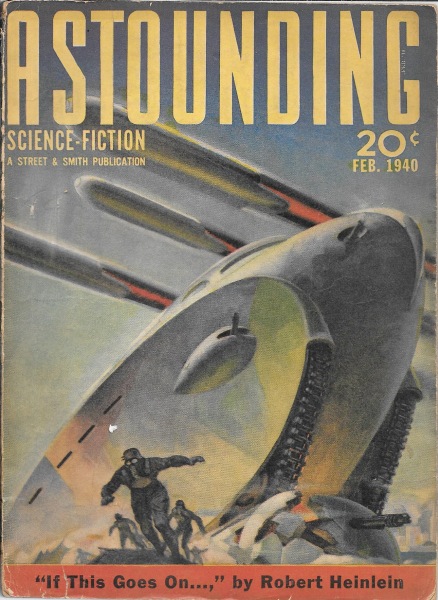
Need I introduce you to Robert Heinlein again? You probably know him already, either by reputation or because you’ve read a portion of his considerable body of work. Heinlein debuted in 1939 and became the most popular writer of SF in just a couple years; he remains the only person aside from John W. Campbell to have been made Guest of Honor at Worldcon three times. People love and hate him—occasionally at the same time! Yet he remains a seminal figure, most of his work remains very much in print, and at his best he continues to teach us. If This Goes On— was Heinlein’s longest story up to that point, and when it was serialized in February and March 1940, it was revolutionary in both its content and its impact.
Curiously, despite its themes, If This Goes On— has never been so much as nominated for induction in the Prometheus Hall of Fame, although its sequel, “Coventry,” is an inductee. I have to assume this is because the libertarian revolution thing was already well-covered with The Moon Is a Harsh Mistress, which is, after all, far more advanced, more complicated, and more enjoyable than its precursor. It did, however, win the Retro Hugo for Best Novella of 1940, beating out no less than two other Heinlein novellas (the aforementioned “Coventry” along with “Magic, Inc.”) along with the first two Harold Shea stories by L. Sprague de Camp and Fletcher Pratt, “The Roaring Trumpet” and “The Mathematics of Magic.” Did it deserve the win? I’m gonna say no. For one thing, even if we’re comparing the Heinlein novellas, “Magic, Inc.” is no less inventive while also packing a tighter narrative thrust, and a good sense of humor to boot. Really the whole shortlist could’ve been from Unknown, as its contents have aged more gracefully by and large than what came out of Astounding.
There are a couple Heinlein biographies out there, but if you want more insight into the man’s early career then I highly recommend Alexei and Cory Panshin’s unrivaled tome on the Golden Age of SF, The World Beyond the Hill, which focuses more on Heinlein’s artistic evolution, and also Alec Nevala-Lee’s much more recent book Astounding, which focuses more on Heinlein as a person. The former especially illuminates us about the place If This Goes On— holds in SF’s history, it being the first of Heinlein’s great experiments, not only cementing what would be known as his Future History but also paving the way for a kind of SF which genuinely anticipates future possibilities based on current trends. In other words, it would serve as a foundational document for Campbellian SF.
Placing Coordinates
The March 1940 issue of Astounding is on the Archive. I’m not sure where else the magazine version of If This Goes On— appears. I know Heinlein went back and revised it a decade or so later for inclusion in the collection Revolt in 2100, and if what I’m reading here is correct, the changes were indeed substantial. Still, it was the magazine version which won the Retro Hugo (though it wouldn’t surprise me if voters were going off the Revolt in 2100 version), and if you can believe it, Part 2 is even shorter than Part 1. I would have to guess that, when the parts are combined, we have a longish novella of about 35,000 words. Two-part serials are a tricky thing, because depending on the magazine (we’re talking type size, margins, overall dimensions), a two-part serial could total anywhere from as low as 20,000 words (a novella, but barely) to 50,000 words or more (a full novel). If only there was an easy way to calculate all this.
Enhancing Image
You may recall that at the end of Part 1, John Lyle, our brave hero, had gone undergone with someone else’s identity—a ruse that lasted all of about five minutes. Soon enough he’s on the run again! The opening stretch of Part 2 is an extended chase scene, with John hijacking a ship and blazing through several states in the west and midwest.
Provo is not a particularly large town and might not be expected to have a particularly alert police force, but Utah has been a center of heresy and schism ever since the Mormon Church was suppressed, during the lifetime of the First Prophet.
Once again we come across maybe the most interesting part of If This Goes On—, and it’s actually not territory that Heinlein would return to for many years (although he had started working on Stranger in a Strange Land in the ’40s), which is the topic of religion. I was surprised to find an overt reference to Mormonism here, for one because it’s a pretty divisive sect, and also because it’s a pretty obscure sect, very few people would know anything factually correct about it, let alone anyone who was a practicing Mormon (though it must be noted that contemporary SF author Raymond F. Jones, who we might cover eventually, was a Mormon). It also further establishes a link between the future world of the story and the current reality, or you know, what would’ve been the current reality in 1940.
Part 2 of If This Goes On— is hard to summarize, not because so much happens, but because not enough happens. Let’s look at this another way: in Part 1, we have a quartet of characters, with John, Judith, Zebadiah, and Magdalene, and while the plot was moving at a mile a minute, we at least got some character growth, never mind interactions. In Part 2, Zebadiah is barely here, and I hope you weren’t invested in John and Judith’s romance, because I don’t think Judith has even a single line of dialogue here. Even John himself becomes somehow less of a character; not unlike Ishmael, who basically evaporates midway through Moby Dick, John takes a back seat as an active character while also giving us details on events he probably wouldn’t know about firsthand. When I finished Part 1, I was worried that the super-fast pacing of that first part would, at some point, result in the narrative having to stop dead in its tracks from sheer exhaustion, and my fears were proven right. Part 2 is far less entertaining, far less interesting, and ultimately feels less finished than what came before it.
You see, once John meets up with his favorite weed dealer a fellow member of the Cabal, his direct role in the narrative is basically over; he can sit back, relax, and watch the fireworks. Well, he does get to do one more thing, but I’ll save that for spoilers. Point being, the narrative turns mostly third-person from then on, and all the character stuff from Part 1 has been thrown at the window. Now, if Part 1 was about Our Hero™ getting introduced to the revolution, then Part 2 is about the revolution actually happening, and in this case the setup is better than the payoff. As it turns out, when you try to capture a whole goddamn socio-political movement from a first-person perspective, and in the span of as a short a novel as this one, you’re probably gonna lose something there, like basic fucking character. Heinlein would try this again much later with The Moon Is a Harsh Mistress, and a good deal more successfully; that novel is a real chef’s kiss, in part because it’s mostly dialogue and not much action.
The Cabal, which John had theorized in Part 1 as being an ancient underground society with its own traditions, turns out to be just that. Indeed, the Cabal is all but said to have descended from the Freemasons, that old chestnut of conspiracy theories. Shocking, and yet not shocking at all, is the realization that the Cabal, while not having millions of people in its employ, is highly organized, to the point of having its own military.
The system of gigantic caverns called General Headquarters is located southeast of Phoenix, about thirty miles from the Mexican border. It had been in use for more than twenty years and had grown from a hideaway for fugitive brethren into a complete, modern military base. It had a dozen different entrances separated by miles of desert terrain, each entrance carefully concealed and protected by sensitive eye and ear devices and by automatic mines capable of destroying all trace of the tunnels that led to GHQ.
Even so, with hundreds of people in on this, and with some ex-military in the resistance, the Cabal would not be able to take on the Prophet’s forces in a one-on-one battle. As it turns out, this is only a mild inconvenience, but more on that later; admittedly the Cabal’s solution here is kind of ingenious. Anyway, we have the beginnings of an all-out war, or at least a curb stomp on a nationwide scale, but don’t get too excited since this is, after all, written from John’s now-ghostly perspective, after everything’s been said and done. Not very tense, is it? You could say The Moon Is a Harsh Mistress runs into this problem as well, but at least with that novel there’s a lot more to chew on other than the revolution itself. The worldbuilding so prevalent in Part 1 has now largely been put aside, in favor of action, except it’s action that’s not particularly appetizing to read, simply for the fact that John is now removed from it, and we’re given what amounts to half a novel’s worth of combat in about 15 pages. It’s very short, to the point of feeling emaciated.
There Be Spoilers Here
How does the Cabal plan to gather enough people to take on the Prophet? By tricking people across the country into thinking the Prophet sitting in New Jerusalem is an impostor, of course! The process of doing this is a bit convoluted in how it’s explained, and reading this is a post-Trump post-truth era definitely makes this all seem a little implausible, but I do like the idea of tricking people into thinking the fake Prophet is the real Prophet and vice versa. If only it were this easy to convince people to wear masks in HOSPITALS. I’m digressing, though. People across the country rebel against what they see as a false idol, indirectly doing the Cabal’s bidding while the Cabal itself is putting what troops it has into action. The way the revolution works out in this story feels weirdly truncated and multi-faceted at the same time, since it’s not so simple as the Cabal telling people the Prophet is a corrupt asshole and everyone just buying into it, but I also find it hard to believe people would get bamboozled by the Cabal this easily.
Aside from the revolution itself, there’s also the problem (which I suppose I should credit Heinlein for considering in the first place) of what to do about the millions of people who are loyal followers of the Prophet. This is where we get to a passage that really bothers me, and I guess it just goes to show that no matter where you land in Heinlein’s long and winding career you’re bound to find something that’s problematic. In this case it’s something so stupid and backwards on its face that even Heinlein himself, when he went back to revise If This Goes On— for Revolt in 2100 over a decade later, felt the need to rebut it. Get a load of this:
You can see that we had our work cut out for us, and that we did not dare hurry. More than a hundred million persons had to be examined to see if they could stand up under quick re-orientation, then re-examined after treatment to see if they had sufficiently readjusted. Until a man passed the second examination we could not afford to enfranchise him as a free citizen of a democratic state. We had to teach them to think for themselves, reject dogma, be suspicious of authority, tolerate difference of opinion, and make their own decisions—types of mental processes almost unknown in the United States for many generations.
Keep in mind that Heinlein, in 1939, was a flaming liberal, to the point where he was arguably a fellow traveler to the leftist movement of the period (he had worked on Upton Sinclair’s campaign for governor in 1934), so this is a bit jarring to see. Remember, however, that this is also pre-Maoist China, so it’s probably safe to assume that Heinlein was blissfully ignorant of the horrors that would necessarily come from re-education camps, not to mention the gross scale of the government apparatus required for such an effort. It’s uncomfortable to read now, given that to this day there’s a small but vocal portion of the American leftist population that thinks concentration re-education camps would be gosh darn neat. According to The World Beyond the Hill (as I’ve not read Revolt in 2100), Heinlein had evidently changed his mind on the whole brainwashing thing, inserting a bit character to decry the Cabal’s proposition of mass re-education.
It’s clear that Heinlein, regardless of when we find him, was always chiefly concerned with individual liberty—that the individual’s right to autonomy ought to be highly respected, and in this sense he was always philosophically libertarian. A problem that would always haunt Heinlein’s writing, though, is that his penchant for didacticism (and make no mistake, even some of his most disciplined works contain lectures) results in his actual beliefs getting shuffled with ideas he is merely putting forward for discussion. For instance, it should be clear to anyone with more than two brain cells that Heinlein is not actually advocating for ritual cannibalism in Stranger in a Strange Land, but it can be hard to tell at first since he throws in that devil’s-advocate argument with his genuine arguments for polyamory and nudism. Even with an early and well-rounded story like “The Roads Must Roll,” some people take that piece as anti-union, when it is in fact very much pro-union, being rather about corruption within what is otherwise a fine power structure. Some people, being sycophants, see even the most reasonable criticisms of unions as slander, but that’s their problem.
I’m digressing again. In all honesty I find Heinlein’s career far more interesting to talk about than Part 2 of If This Goes On—, and really I find this novella’s place in said career more interesting than the novella itself. There is one last thing I wanna bring up, though. There’s a question which probably no one asked up till now, but which is not necessarily a bad question: Why has John been writing all this? Well, another thing this story has in common with The Moon Is a Harsh Mistress is that the narrator also acts as an amateur historian; what we’ve been reading is actually a historical record about the revolution that John wrote after the fact. Oh, and he ends up with Judith, so there’s that. Another difference between the magazine version and the Revolt in 2100 version is that in the latter, John and Judith do not end up together, with John instead going with Magdalene at the end. Why not? It’s not like Judith had literally anything to do in the second half of the magazine verson. It’s just as well—maybe better—and hell, Heinlein may well have improved his story for book publication.
A Step Farther Out
I was worried that If This Goes On— was gonna let me down in its second half, and I’m sad to say it did, which is not to say it suddenly took a nosedive. There are some sprinkles of worldbuilding here that reminded me that Heinlein, impressively so for this early in his career, knew what he was doing with regards to mapping out what would become his Future History. The notion that the US, in a time not too far from ours, could fall to Christian fascism, is concerning and believable, and I was actually surprised by the more implied but still unmistakable notion that the generations of religious persecution which defined the country’s history would logically result in a Christian cult running the government—maybe not tomorrow, but perhaps a decade from now. We seem to be halfway there already. Heinlein was a supporter of religious freedom throughout his life, and while I do think the whole “the good Christians overthrow the bad Christians” thing is a bit of a copout, I can’t say it’s not plausible. That there aren’t any explicitly irreligious characters in the story is maybe more due to the social norms then being enforced in the magazine publishing business at the time.
I wouldn’t call If This Goes On— great by any means; it strikes me as too clunky, too lopsided in its pacing, and ultimately too conventional to be considered that. Upon rereading sections of The World Beyond the Hill (to refresh my memory), it now strikes me as unsurprising that Heinlein wrote “Requiem” after If This Goes On— and not before, given it feels like the work of an artist one step closer to perfecting his craft. Still, this is mandatory for Heinlein completionists, and even for those who just want a thorough understanding of how a master of the field got to where he was. I’m sure that without the great experiment of If This Goes On— we would not have gotten better long works from Heinlein in that first phase of his career, such as “Magic, Inc.” and “By His Bootstraps.” As such, it’s an important story, but not one I’m likely to read again.
(Cover by Hubert Rogers. Astounding, February 1940.)
Who Goes There?
Robert Heinlein doesn’t need an introduction, but I’ll write one anyway. Heinlein was a bit of a late bloomer when it came to writing SF; his first story, “Life-Line,” was published when he was already in his 30s, but whereas some authors spend several years doing apprentice work, Heinlein’s apprenticeship phase was virtually nonexistent. While “Life-Line” is by no means Heinlein’s best, it exhibits an inventiveness and economy of style that would quickly define his writing, and in the January 1940 issue of Astounding Science Fiction we got “Requiem,” his first great story. Heinlein’s rise to prominence possessed a swiftness which few authors in the genre’s whole history can come even close to matching, and despite having been active for only a couple years, he was chosen as the Guest of Honor for the 1941 Worldcon, held in Denver that year.
What else? He would go on to win four Hugos for Best Novel (a record only matched so far by Lois McMaster Bujold), and he also has several Retro Hugo wins under his belt, including one for If This Goes On—. Evidently Heinlein continues to be a favorite with SF fandom, and nearly all of his works remain in print. He also continues to be immensely controversial. Heinlein’s views on many subjects changed radically over the course of his life, and while he was a New Deal Democrat during the first phase of his career (1939 to 1942), by the ’60s he had become something like a Goldwater Republican. Some views Heinlein held remained consistent, though; for one, he seemed to be pro-military from the start (not surprising, given his time in the Navy), and yet he also seemed to believe in the virtues of the nudist lifestyle, as well as plural marriage (the word “polyamory” had not yet been coined in Heinlein’s lifetime, though some of his fiction unequivocally endorses it). With Heinlein there is at least something to enjoy regardless of where you fall on the political spectrum—and conversely, there’s always something to reject.
If This Goes On— was Heinlein’s fourth published story, coming right after “Requiem,” and it was also his longest up to that point, having to be serialized in two parts. By February 1940, Astounding Science Fiction had become without question the top SF magazine in the field, with its sister magazine Unknown also donning the crown for fantasy; by this time, John W. Campbell had mostly established his stable of writers—mostly men in their 20s, with a few holdovers from the previous era like Clifford D. Simak and Jack Williamson. There were quite a few talented authors writing regularly for Astounding, but Heinlein soon became Campbell’s favorite of the bunch, and it only takes a reading of If This Goes On— to see why.
Placing Coordinates
While Heinlein’s novels remain readily in print (with maybe one or two exceptions), the same can’t be said for his short fiction. If This Goes On— has the awkward position of being far too long to be called a short story, yet not quite long enough to count as a full novel; call it a long novella. Sad thing about novella reprints is that novella-oriented anthologies are a super-niche subspecies of something that’s already pretty niche—a shame, considering SF is often at its best at novella length (imo). It has appeared mostly in two collections, both of which seem to have fallen out of print lately, though I can’t imagine they’re hard to find used: Revolt in 2100 and The Past Through Tomorrow. Thnakfully the February 1940 issue of Astounding is on the Archive. Did you know that this issue also contains Leigh Brackett’s debut story, “Martian Quest”?
Enhancing Image
Rather than being set on an alien planet, If This Goes On— takes place in a future United States, where democracy has died and been replaced with a kind of Christian fascism wherein the ruler of the country is also the so-called Prophet Incarnate. I’m so glad we don’t have to worry about this happening in the real world. The story follows John Lyle, a junior member of a section of this future military called the Angels of the Lord, and during one of his routine night watches he thinks about the painfully obvious subtly growing corruption within the system he was born and raised to respect.
I sighed and returned to my lonely vigil. I mused glumly on the difference between life here in New Jerusalem and life as I had envisioned it when I was a cadet. The Palace and Temple were shot through and through with intrigue and politics, I was forced to admit. Where now, was the proud and altruistic motto of the service: “Non Sibi, Sed Dei?” I knew, too well, that the priests and deacons, ministers of state, and Palace functionaries all appeared engaged in a scramble for power and favor at the hand of the Prophet. Even the officers of my own corps, the Angels of the Lord, seemed corrupted by it.
Whereas protagonists in dystopian narratives tend to be loyal members who are convinced to join the other side through some violent revelation, John was already becoming skeptical about the government he worked for. We don’t get much backstory for John, outside of his military training, but we do get, in a remarkably short amount of time, a good deal of backstory as to the workings of the novella’s setting. If This Goes On— was not the first story to form part of Heinlein’s Future History, but it was the most ambitious entry up to that point, and it was the first to send everyone the message that Heinlein wasn’t fucking with his worldbuilding. In order to understand what makes If This Goes On— special, you have to also understand that nobody was concocting what we’d now call a future history at this time; while there were series, and stories set in the same continuity, nobody was mapping out a fictional timeline like Heinlein did.
Something that this novella does which is very much in line with other dystopian narratives, though, is that the (always male) hero starts to change his mind because he sees even the smallest opportunity to get some PUSSY; in this case it’s Judith, one of the Prophet’s Virgins (a Virgin being a nun, possibly also a sex slave). John talks with Judith while on his watch for literally five minutes and he can’t keep his mind off her for the rest of Part 1—his cock is just hard as a fucking statue the whole time. In fairness to the faster-than-a-speeding-bullet love story that unfolds, John and Judith are in positions where they are basically prohibited from interacting with the opposite sex beyond the absolute necessities. While the Angels of the Lord are not strictly celibate, becoming a volcel means you’re more likely to get promoted, and of course Judith is not supposed to fuck around at all. Now, while we’re never told this, it is rather heavily implied that the Prophet gives Virgins the Harvey Weinstein treatment, hence Judith’s own disillusionment with the government.
We then witness what may be the fastest turnaround in the history of fiction; in about ten pages, John decides that he’s had enough of being a dog of the military, and it doesn’t take long at all for him to rope in his friend and comrade Zebadiah, though it turns out Zeb knows more than he lets on anyway. In the span of a dozen pages we’re introduced to a vast and unfamiliar future society, a well-thought-out system of government, a military hierarchy, a conspiracy, and quite a bit of action. The thing I realized reading If This Goes On— is that this story has the unique problem of being actually too fast; it feels less like a proper short novel and feels more like a compressed novel, with Heinlein simultaneously overwhelming us with details while also omitting anything that could be considered fat. The result is a narrative which is almost packed more with sketches of scenes than scenes proper, and I have to suspect John is a first-person narrator so Heinlein wouldn’t have to worry himself with multiple perspectives.
We hear about something called the Cabal very early on, and if you have even the slightest idea where this is going then you know that the Cabal—an alleged underground movement working to undermine the Prophet—is a real thing after all. What happens after John joines the Cabal is something I’m saving for the spoiler section, but needless to say we get quickly wrapped up in a festering underground movement which seeks to expose the Prophet as a fraud. John now not only has to work with the rebels, but keep Judith as well as evade authorities himself, since by this point he has become a fugitive. Like I said, this all happens in pretty much the blink of an eye, yet despite my reservations about the pacing, it says something of Heinlein’s talent that his mixing of action and exposition never left me confused. Most authors, especially circa 1940, would’ve spent whole pages explaining the inner workings of this future theocracry, not to mention the futuristic technology (not that there’s a lot of that here), but Heinlein keeps exposition quick and mostly passive; he’s a wizard at this sort of thing.
There Be Spoilers Here
Things get more interesting once John enters the Cabal, although we don’t get much in the way of what becoming a new member is like. I suspect Heinlein made John a first-person narrator because he doesn’t wanna deal with subplots involving different characters, but also because with John recounting his own experiences, he can skim over them if he doesn’t feel like going into dirty details with his audience. Take the following passages, for instance, which compresses potentially a whole chapter of material into one paragraph:
It is not necessary, nor desirable, that I record here the rest of my instruction as a newly-entered brother. Suffice to say that the instruction was long, and of solemn beauty, and there was nowhere in it any trace of the macabre and blasphemous devil-worship that common gossip alleged. It was filled with reverence for God, brotherly love, and uprightness, and included instruction in the principles of an ancient and honorable profession and the symbolic meanings of the working tools of that profession.
Heinlein also wants us to know that while the Prophet is totally a sham, Christianity itself gets a pass. Now, I’m not sure how much of this was due to beliefs held at the time and how much was due to Campbell being squeamish about a plot where a Christian theocracy is depicted as evil, though it must be said that Heinlein and Campbell were not Christians. I have to assume this was done because at the time many readers were, while not outwardly religious, churchgoing folks; still, the idea that “reasonable” Christians like John would want to rebel against a corrupt government that uses the Gospels as a shield is not implausible. Indeed, what helps coax John into joining the Cabal is the notion that these rebels are themselves quite religious.
With Judith being spirited away to Mexico (they deliberated over whether she should flee to Mexico or Canada, and decided correctly that the latter was too horrible), and with John having abandoned his post, our hero now much take on an alternate identity. Up to this point in this story, we haven’t gotten much in the way of futuristic technology, but things take a turn when John has to take on someone else’s personality—literally. The higher-ups bring a short list of people matching closely enough with John physically who are in the unique position of being physically but not legally dead. John Lyle becomes Adam Reeves, a textiles salesman, and how the Cabal surgeon—sorry, metamorphist—is able to change John to resemble Adam is really something.
The most difficult thing in matching him physically, and the last to be applied, was artificial fingerprints. An opaque, flesh-colored plastic was painted on my fingers, then my fingers were sealed into molds made from Reeves’ fingers. It was delicate work and hard to get a satisfactory result. One finger was done over seven times before the metamorphist would pass it.
Hair, nose, ears, eyes, even fingerprints. John effectively becomes Adam, and for a while he works well as a doppelganger. We do come to find, though, that there is one area the Cabal could not have possibly accounted for, and which sends John fleeing once againat the end of Part 1: blood type. How will John get out of this debacle? Will he reunite with Judith? Will the Cabal succeed in overthrowing the Prophet? Stay tuned.
A Step Farther Out
There are SF stories from the late ’30s and early ’40s that I enjoy more than If This Goes On—, or at least the first half of it. As sentimental as it is, I find “Requiem” to be the more emotionally resonant and structually balanced story, but then we’re talking about a short story compared to something a good deal more ambitious. It only makes sense, I suppose, that a story about revolution should itself be revolutionary; this was the moment Heinlein went from a promising newbie to one of the big names in the field, and he had been active for less than a year at that point. This is not the Heinlein of much longer and more ungainly works like Stranger in a Strange Land, but the young Heinlein, the disciplined Heinlein, the fast-witted Heinlein. That If This Goes On— now reads as fairly predictable speaks more of its influence than its innate quality. We’ve gotten some pretty vast and complicated future histories post-Heinlein (Poul Anderson comes to mind), but Heinlein was the first to do it.
I’m sure when people read this thing when it was first being serialized they were glued to their seats, but from a modern perspective I more often found myself dissecting Heinlein’s methods, seeing how they worked, and how he managed to dish out (not always perfectly, it must be said) so much exposition with so few words without it being confusing. It helps, of course, that we don’t get what would later become pervasive Heinlein-isms here; John is not a perpetual wisecracker, Judith isn’t constantly thinking about making babies, the infodumps are shockingly constrained compared to what we’d get much later. I guess the biggest complaint I have is that when I finished Part 1 I was thinking less “I wonder what happens next” and more “Hmm, that’s interesting. Old-timey SF tends to be fast-paced, but this takes such quickness to at times ridiculous extremes. Will it get worse in Part 2, or will things slow down a bit and we get to learn more about this dystopian future United States?
We’ve come to the final part of Alfred Bester’s debut novel, The Demolished Man. Bester arrived to novel-writing late, already being deep in his 30s when his debut was serialized, and truth be told, he wasn’t much of a novelist; he only wrote a handful of novels in his lifetime, and his first two remain by far the most famous. Like some of his contemporaries, (Theodore Sturgeon, C. M. Kornbluth), Bester hit a remarkable stride in the ’50s, starting with “Oddy and Id” in 1950 and ending with “The Pi Man” in 1959. I have to assume the broadening of the SF market in the early ’50s, namely the premieres of Galaxy Science Fiction and The Magazine of Fantasy & Science Fiction, coaxed Bester back to genre writing, after a near-decade-long break from the field.
Placing Coordinates
Do I really need to tell you? Part 3 of The Demolished Man was published in the March 1952 issue of Galaxy, and yes, it’s on the Archive.
What strikes me about this particular issue of Galaxy is that there are at least two stories here that not only come off stronger than the serial, but give a more accurate impression of what the newfangled magazine was all about. Yeah, I’m letting you know this early on that I wasn’t a big fan of the conclusion to Bester’s novel, but I would still recommend checking out the issue it appears in. We get a certified hood classic from Robert Heinlein with his novelette “The Year of the Jackpot” (the subject of one of Galaxy‘s first great covers imo) and we also get a pretty funny outing from Damon Knight with “Catch That Martian.” Early Galaxy is so good that it’s honestly hard to go wrong.
Enhancing Image
You may recall that last time on The Demolished Man, we get two twists for the price of one, one of them interesting, the other horrendous. When searching the depths of Barbara D’Courtney’s unconscious, once she’s taken into the safety of his home, Preston Powell discovers that not only are Barbara and Ben Reich related in some way (implicitly connected to the late Craye D’Courtney, whom Reich had murdered), but that Barbara (who, keep in mind, is consciously at the mental level of a toddler at this point) has a big crush on Powell—which Powell reciprocates.
The horror…
Much of Part 3 concerns Reich’s last-ditch attempt to evade Powell, who knows he had committed murder but can’t prove it objectively. To make a long story short, it’s not enough legally to have an Esper peep on a crime suspect’s deepest thoughts; presumably this is to prevent Espers from having too much power, but even so, the future society of the novel works such that it has become nigh-impossible to commit a crime and get away with it. Powell needs three things to bag Reich: motive, method, and opportunity. We know Reich was at Maria Beaumont’s party from the end of Part 1 (still the novel’s highlight imo), where Craye D’Courtney was hiding, and we know how he could’ve killed the old man.
The means are rather convoluted, but Reich had acquired an “ancient” 20th century pistol and removed the cartridges. Wouldn’t this mean Reich would be shooting blanks? Technically yes, but as Powell explains:
“With a powder charge, you can shoot an ounce of water with enough muzzle velocity to blow out the back of a head if you fire through the victim’s palate. That’s why Reich had to shoot through the mouth. That’s why Kr1/2t found that bit of gel and nothing else. The Projectile, of course, was gone.”
People forget (or don’t know) that even shooting blanks in an enclosed space can still be harmful; in the case of D’Courtney, firing the gun in his mouth was enough to kill him. Powell’s figured out the method.
The opportunity was easy enough to discern. The police team already knew Reich was at the party where D’Courtney had been killed, while everyone else was playing the Sardine game, and you may recall that in Part 2 Powell got a confession out of Gus T8 (Reich’s Esper accomplice) shortly before his death. Reich could’ve figured out where D’Courtney was by way of a peeper. There’s your opportunity.
The big problem Powell runs into is the motive. Now, I won’t give away the details in this section, but I’ll say that Reich’s motive for killing D’Courtney was not what we thought it was. Without a motive, they can’t connect Reich to the crime with objective evidence, and without that, Reich goes free. It looks like Reich is about to win, but Powell, being a top-level Esper (meaning he can fully read a person’s unconscious psyche), does have one last trick up his sleeve…
The cat-and-mouse game that took up much of Part 2 now comes to a head in the serial’s finale, and my feelings on it are quite mixed. The stuff with Powell and Reich is still great. Bester has a special talent for writing wiley and despicable characters, and few are more wiley or despicable than Ben Reich. Much like Gully Foyle, his marginally less evil counterpart in The Stars My Destination, Reich is relentless in his ruthlessness; there is nobody he won’t fuck over to get what he wants. Bester’s snappy style still retains its magic, too, with many passages being just dialogue exchanges with the bare minimum of description, yet rarely if ever is the reader lost in all this. Bester really is one of the writers of dialogue when it comes to ’50s SF.
When he’s good.
When he’s not, we get shit like this (yes it’s the Powell/Barbara subplot):
He kissed her forehead. “You’re growing up fast,” he smiled. “You were just baby-talking yesterday.”
“I’m growing up fast because you promised to wait for me.”
This is BULLSHIT.
I wonder if Piers Anthony is a fan of this novel. Just a thought. Much like Reich himself, the novel is half angel and half louse, and I’m trying to separate one from the other. When it’s good, it’s pretty great; it’s witty, inventive, and as I’ll elaborate on in a bit, the ending is a fair bit thought-provoking. But when it’s not good… it’s almost unreadable. I get the impression that writing at novel-length forced Bester to give into his worst impulses—stuff he wouldn’t normally indulge in at shorter lengths. Some authors, especially in SF, benefit from more succinct writing (opinion, sure, but I really do think SF works best in the novella mode), and Bester is one of those. Part 1 of The Demolished Man shows the novel at its best partly because it focuses the most on its two best assets: Ben Reich, and the way Espers contribute to this future interplanetary society.
There Be Spoilers Here
The problem with Reich’s motive for killing D’Courtney is that it doesn’t make sense. In Part 1, Reich offers to merge his company with D’Courtney’s, but D’Courtney refuses; this turns out to not be true. Upon interrogating Reich about the rejection, the teams finds that Reich had misinterpreted D’Courtney’s response. Now why would Reich take D’Courtney’s acceptance as a rejection? We know now that D’Courtney, when confronted by his killer, was not lying; he really did accept Reich’s offer to merge their companies. Reich’s true motive will have to be uncovered with some weapons-grade mundfuckery, and that’s what Powell does at the climax of Part 3.
The climax of Part 3 is a wild ride that almost rivals the climax of Part 1, even anticipating the mind games Philip K. Dick would play on us with his later novels. Just when Reich is convinced he’s gotten away with murder, his world starts to shrink—literally. People and places Reich knows start to disappear, even including entire planets, and he fears he may be losing his mind (sort of right) or that Powell’s pulling an epic prank on him (absolutely right). Even the sun, for no reason, disappears, and nobody he asks even knows what the sun is anymore. Even confessing to the murder of D’Courtney out of desparation does not release him.
The police looked at each other in surprise. One of them drifted to a corner and picked up an old-fashioned hand phone: “Captain? Got a character here. Calls himself Ben Reich of Sacrament. Claims he killed a party named Craye D’Courtney last month.” After a pause, he grunted and hung up. “A nut,” he said.
“Listen—” Reich began.
“Is he alright?” the policeman asked the doctor.
“Just shaken a little.”
“Listen!” Reich shouted.
The policeman yanked him to his feet and propelled him toward the door of the station. “There ain’t no Preston Powell on the force. There ain’t no D’Courtney killing on the books. Now, out!” And he hurled Reich into the street.
It’s a lot of fun. Eventually the world shrinks to the point where there’s only Reich left—and the one thing that’s scared him since the beginning, the Man With No Face. As it turns out, the Man With No Face is a representation of Reich’s guilt, just as we’ve suspected this whole time, though not quite for the reasons one would’ve assumed. You see, Reich and Barbara are half-siblings; their father is Craye D’Courtney. Through some convoluted backstory we learn that the Reich and D’Courtney family trees intertwined at one point, and not only is Barbara old man D’Courtney’s secret child, but so is Reich. D’Courntey didn’t resist Reich because he felt immense guilt about never acknowledging Reich as his son, and Reich tricked himself into wanting to kill D’Courtney because of some… Oedipal… thing…
So Reich is finished; it almost cost Powell his life, but it was worth it. Only at the very end do we find out what Demolition means, and it’s basically a memory wipe. The society of the novel hasn’t implemented the death penalty in decades, and correctly they regard such a practice as barbaric. Reich lives, in some way, but from now on he will be effectivelybecome a different person—the louse having been separated from the angel, or maybe the other way around. The novel makes an argument regarding criminals that I don’t think I’ve heard before, which is that someone who goes against societal norms must be at least of some value, therefore it’d be a waste to execute that person. It’s a curious argument against the death penalty, and I have to wonder how readers circa 1952 would’ve taken it.
A Step Farther Out
The Demolished Man could just as easily be titled The Diminishing Returns. Not to say it goes downhill exactly, but Part 2 introduces a certain subplot that I would consider the opposite of great; by Part 3 this same subplot was driving me up the fucking wall. I’m not even sure if the “romance” between Powell and Barbara is a product of the novel’s time as it is a quirk of what seems to be Bester’s actual honest-to-goodness worldview; he really did seem to believe in the legitimacy of Freudian psychology. Not to say Freud didn’t do much to advance how we as a species try to understand our own minds, our own desires, and so on, but The Demolished Man may be the most obnoxiously Freudian novel in existence, ultimately much to its detriment. I can see why, between Bester’s first two novels, The Stars My Destination has become the more popular one; the truth is that it holds up better to scrutiny.
I have yet to read the book version of The Demolished Man, but from what I’ve heard it might actually be an improvement over the serialized version, which doesn’t happen too often. Usually the differences between a novel’s serial run and its book incarnation are negligible, but Bester apparently revised his novel to a substantial degree between versions. The result is (from what I’ve heard anyway) a short novel that was made even more concise, even cutting out some of the stuff between Powell and Barbara that makes me feel all shitty inside. Even so, the serial is worth reading; historically it’s nothing short of essential, of course, but it’s still an ultimately statisfying experience, made more palpable by being split into smaller chunks.
Well, the next serial I cover is also something I’ve not read before, despite it being by one of my favorite authors, and like The Demolished Man it also won a Hugo—a Retro Hugo.
Alfred Bester is baaaaaack. He was early in the period of his career when he was at his best and most prolific (though in reality we only got two novels and little over a dozen short stories from him between 1950 and 1960), and nothing proved this more than the serialization of his debut novel The Demolished Man. This novel demonstrates what made Bester special at the time, and by extension what made Galaxy Science Fiction so different from its contemporaries. We’re talking about SF that’s witty, lurid, hardboiled, uncompromising, and generally more “mature” than what came before it. Interestingly, Bester would have his two novels from this era published in Galaxy while most of his short fiction would appear in The Magazine of Fantasy and Science Fiction.
Placing Coordinates
Part 2 of The Demolished Man appeared in the February 1952 issue of Galaxy. It’s on the Archive. If you REEEEEEALLY wanna read the book version (which I do hear is a fair bit different from the serial), you won’t have a hard time finding that at all.
Enhancing Image
How do you get away with murder in a society where a fraction of the populace can read not only your conscious thoughts but the darkest depths of your unconscious mind? Ben Reich has found a way—or at least he thinks he’s found a way.
Last time on The Demolished Man, Ben Reich has murdered Craye D’Courtney, his top business rival, with an “ancient” 20th century handgun that doesn’t leave a bullet hole or any markings. There is just one problem: there was a witness to the killing, and not only that, it’s D’Courtney’s secret daughter, Barbara. With Barbara having escaped the scene, Reich and his Esper accomplice Gus T8 are forced to remain at Maria Beaumont’s party so as to not look too suspicious. No matter, though, as soon police are called in—Esper police—with Police Prefect Preston Powell spearheading the invesitgation. It doesn’t take long for our villain protagonist and hero antagonist to start their game of cat and mouse.
A few things I want to make note of before I dive deeper into the plot, as Part 2 is not as long as the first installment, and I would say somehow the plot has become even more streamlined. Once The Demolished Man kicks into high gear it doesn’t stop. Now, I said in my review of Part 1 that certain Espers have symbols and Arabic numerals as part of their names, for reasons never given as far as I can tell. While I could at least see this arbitration as consistent, one of the mentioned characters, Duffy Wyg&, is not an Esper; this makes me wonder what the hell Bester could mean by this naming convention, and since apparently he drops the act for the book version, spelling characters’ names normally, I have to assume he did this for the serial version just to be QuIrKy.
I also brought up the weird Freudian symbolism that permeates the narrative, and indeed renders part of it incomprehensible otherwise, such as Reich’s recurring nightmares of the Man With No Face. I don’t even wanna get into how the Esper rankings work again, since they work on the basic assumption that the Freudian map of the human psyche (the ego, the id, etc.) is totally legitimate. A certain subplot involving Barbara D’Courtney fundamentally involves Freudian psychology in a way I won’t give away in this section, but needless to say I have some thoughts about it. It’s a story that only makes sense if you’re willing to be generous with its assumptions, and even then you might have a hard time after a certain point.
Part 2 is considerably more of a mixed bag than Part 1; while Part 1 has some pacing issues in the beginning, being frontloaded with exposition as it is, Part 2 develops the novel’s Freudian angle for the worse. I tend to be generous with this sort of thing, but there are certain passages here that make me wonder if they were ghostwritten by Robert Heinlein—not the good Heinlein either, but the embarrassing, somewhat creepy Heinlein. The creepiness is uncharacteristic even for ’50s SF; if anything it feels almost more like a byproduct of the late ’60s/early ’70s New Wave period. I have to assume H. L. Gold looked at the manuscript and thought, “Hmm, yes, this is very good indeed.” I don’t know about this one, chief.
It’s a shame, too, because the good parts of The Demolished Man are still really good, and now they have an extra good element added to the equation: the intense and totally not homoerotic rivalry between between Reich and Powell. It’s a classic case of the unstoppable force (Reich) against the immovable object (Powell), two psychotically determined men set to rip out each other’s throats. Powell knows, simply by contacting Sam Jordan, Reich’s lawyer, and by using a police lab map of the party-turned-crime-scene to trace Reich’s steps, that Reich is 99% likely to be the killer. However, Powell will need (thanks to convoluted legal restraints) more than just an Esper’s intuition, and Reich knows it.
When the two meet up during the investigation, there’s an intense butting of heads, yet Powell can’t help but admire Reich; it’s a curious dynamic. While obviously wanting Reich to be Demolished (we’re still not quite told what this means yet), Powell says this:
“You’re two men, Reich. One of them’s wonderful; the other’s rotten. If you were all killer, it wouldn’t be so bad. But there’s half louse and half saint in you, and that makes it worse.”
The game is afoot. The bulk of Part 2 is a chase wherein Reich and Powell try to find Barbara, the key witness, as without her Powell won’t be able to nab Reich, while Reich won’t be entirely sure of his own safety from Demolition. There is a remarkably fast-paced, if somewhat repetitive sequence where hero and villain play tricks on each other, Reich using T8’s powers and those of the criminal underworld to undermine Powell’s operation while Powell tries using T8 and Jerry Church (who you may remember as the exiled Esper who gave Reich the murder weapon) to push Reich into a corner. I would perhaps find this chase less repetitive if every scene didn’t end with each side going, “Well gosh dang it, where is that GURL?” This is an instance where Bester’s economy of description might have worked against him a bit.
We’re at the point where The Demolished Man truly has become an episode of Columbo, and Preston Powell is a fine not-Columbo—the big difference being that while he does play dumb in order to lure Reich into a false sense of security for a bit, his act is subtler than Columbo’s. Another big difference has less to do with Powell himself and more a certain subplot that I’ll be tearing apart discussing very soon. While we were technically introduced to Powell in Part 1, he only now actively takes a role in the story, and he sure is up to the task.
A shame all this other shit had to happen.
There Be Spoilers Here
Powell, T8, and Church are ambushed by Reich’s hired guns, with T8 dying in the process. It’s a curious scene in how it’s written, since not only is T8’s potential redemption cut short, but his death is described in a way that’s uncharacteristically indirect for Bester—and all the better for it. A rule of thumb with Part 2 at least is that when Powell is not with Barbara, things are going great. The problem is that the scenes where Powell is with Barbara make me hunger for death.
Basically, the trauma of seeing Reich killer old man D’Courtney caused Barbara’s conscious mind to regress to that of an infant; she barely even has any motor skills, never mind the ability to articulate. Powell has the idea to move Barbara from the hospital (which, to be fair, is a place where someone can easily kill or kidnap her) to his house, and that’s where things get weeeeird. A good portion of Part 2 is spent on Powell, along with fellow Esper Mary Noyes (who has a crush on Powell, which Powell is well aware of but refuses to reciprocate), helping Barbara “mature” from being mentally an infant to where she was just before the murder. It’s certainly a curious plot development, but it’s seriously hampered by some very off-color interactions Powell has with Barbara, and that’s before we get to the big twist involving her character.
The big twist is that whilst in the process of regaining her mental stability, as she “grows up” from infant to child, Barbara develops a crush on Powell—and no just any crush, noooo, no no no no. When peeping on Barbara, diving into the depths of her unconscious mind (or whatever the hell it’s called, I don’t care for it too much), Powell sees surreal images of the adult Barbara as well as the baby version of herself, and that’s where we find out how Barbara, in the wrecked state of her consciousness, sees Powell.
Get a load of this:
There was her picture of herself, pathetically caricatured, the blonde hair in strings, the dark eyes like blotches, the lovely figure drawn into flat, ungracious planes. It faded and the image of Powell-Powerful-Protective-Paternal rushed at him, torrentially destructive. The back of the head was D’Courtney’s face. He follows the Janus image down to a blazing channel of doubles, pairs, linkages and duplicates to—yes. Ben Reich and the caricature of Barbara, linked like Siamese twins. B linked to B. B & B. Benedictine & Brandy. Barbara & Ben.
That’s right, we’re venturing into Electra complex territory! In seeing Powell as her new father figure, connecting him with the deceased D’Courtney, Barbara now sees him not only as a daddy figure but as a Daddy figure, if you know what I mean. The implication of this final scene is also that Reich seems to be the subject of an Oedipus complex, being Barbara’s male counterpart in how he’s linked to D’Courtney’s murder, which is just—just—
It’s trash.
I’m trying to remember the last time I saw an otherwise good novel sink to such lows as this. Previously I was perplexed as to the Freudian angle Bester seemed keen on taking with this story, but now I’m deeply wary as to what he’s gonna do with it in the final installment. I said before that certain aspects of the plot will only make sense in a Freudian context, but now I think there are certain aspects here that can just be shot into the vacuum of space and the novel would be stronger for it. The worst part is that, assuming Part 2’s final revelation is followed up, corrupt business won’t be the “real” reason why Reich killed D’Courtney, as if we needed a “real” reason for it.
A Step Farther Out
I’m morbidly curious as to where The Demolished Man is going. Unless it pulls a 180 in the final installment, I can say with certainty The Stars My Destination will come out the better novel. Not that there aren’t problematic elements in Bester’s second novel, but I don’t remember anything as ridiculous as Barbara’s character development happening there. I would also argue the problematic parts of The Stars My Destination add to that novel’s sense of ruthlessness, but I can’t say the same for The Demolished Man. I’m still not sure why Bester, who was sharp-witted enough to make his novel a proto-cyberpunk reverse whodunnit in the first place, felt so compelled to root his story in Freudian psychology the way he did; I seriously doubt Gold requested the Freudian stuff.
This is a novel that, at least right now, is hard to call great. Part 1 was mostly pretty gripping, and I found myself hanging onto to pretty much every word of every passage, even if it dragged at first. With Part 2 I found myself wanting to get through the scenes with Barbara as fast as possible, and I simply didn’t find the scenes focusing on Reich to be as compelling as when we were almost completely tied to his perspective in Part 1. As short as this novel is, it’s already getting messy, but I’ll very well stick around for the end.