(Cover by Jeff Jones. Amazing Stories, October 1973.)
Ladies and gentlemen? I love monster movies. I know, it’s not very classy or literate to say so, but I love movies about monsters—big and small. I love Godzilla, Mothra, Rodan, King Kong, Frankenstein’s monster, the blob, the werewolf, the creature from the black lagoon, the shape-shifting alien of John Carpenter’s The Thing, and of course the many creatures brought to life by Ray Harryhausen. Among those movie monsters are the dinosaurs and prehistoric reptiles which roamed the earth long before man came along—real-life monsters that were ultimately animals, trying to live their lives like the elephants and giraffes of today. Jurassic Park was probably the first monster movie I ever saw, and as such it was my first dose of what would turn out to be a lifelong addiction. Jurassic Park hit theaters in June 1993, and even now its effects, mostly practical contrary to its place as an innovator in CGI, are mostly seamless and dazzling.
Since now is the time of the film’s 30th anniversary, I figured it’s time to put a couple prehistoric-themed stories on the roster, a short story and novella which predate Jurassic Park but which hopefully will evoke a similar sense of wonder and amazement for Earth’s distant past. Aside from that we’ll be continuing a serial we had started last month, and we have a reliable workhorse in Henry Kuttner returning to the site once again. There is not a whole lot else to say, frankly—except for one thing.
As a young and earnest fan I was stoked to appear as a guest on my first SFF podcast, which actually was uploaded earlier today. I wanna thank Seth over at Hugos There Podcast for giving me the opportunity to embarrass myself to discuss a certain obscure and scoffed-at book that I would be unable to review for my own site. I believe I also mentioned a second podcast I’d be guesting on, which sadly was a bust, but depending on when it’ll be rescheduled (I’m really hoping it will be that and not simply trashed for good) it may be uploaded by the end of June.
Now it’s time for the stories!
For the serials:
Sos the Rope by Piers Anthony. Serialized in The Magazine of Fantasy and Science Fiction, July to September 1968. I’m still stunned that we’re covering Piers Anthony—because of his reputation, but also because he was not much of a magazine contributor. Strange as it may sound, however, Anthony wrote much of his early fiction for the ‘zines, with his second novel, Sos the Rope, being written for a contest and first seeing print in F&SF. Anthony was already a Hugo nominee by then, though everyone I know loathes Chthon, the nominee in question.
The Stone That Never Came Down by John Brunner. Serialized in Amazing Stories, October to December 1973. Brunner was one of the most prolific SF writers of the era, in no small part because he wrote full-time and he had bills to pay. While he wrote a handful of classic novels, most famously Stand on Zanzibar, he seemingly wrote three times as many novels that were much shorter and less demanding than his major ones, The Stone That Never Came Down being one of those minor novels. I picked it because I liked the title.
For the novellas:
“Time Safari” by David Drake. From the August 1981 issue of Destinies. I’ve said this before, but for the purposes of my site I’m counting Destinies and its ilk as magazines; don’t @ me about this. All I really know about Drake is that he’s a Baen regular as author and editor, being one of many military SF authors to write for Jim Baen and later become a mainstay at Baen Books. “Time Safari” itself ia apparently part of a series, but given that these were published out of order I think it’s safe to assume this is functionally a standalone work.
“The Oceans Are Wide” by Frank M. Robinson. From the April 1954 issue of Science Stories. I know little about Robinson, but what I do know has my attention firmly held. Like a lot of SF authors of his generation Robinson got started around 1950, during the height of the SFF magazine boom, and wrote a good deal of his SF in the ’50s. More importantly, Robinson was one of the first unequivocally queer SF writers, even being associated with Harvey Milk and later being inducted into the Chicago LGBT Hall of Fame.
For the short stories:
“Exit the Professor” by Henry Kuttner. From the October 1947 issue of Thrilling Wonder Stories. ISFDB lists this as a collaboration with C. L. Moore, but with all due respect I doubt that very much. Kuttner has the rare misfortune of being overshadowed by his equally (many would say more) talented wife, apparently to the point where Kuttner made jokes about Moore secretly writing stories attributed to him. True, he’s not as refined as Moore, but Kuttner’s humor and pessimism make him prescient, never mind that he was seriously prolific.
“The Wings of a Bat” by Pauline Ashwell. From the May 1966 issue of Analog Science Fiction. Ashwell is an author I’ve discovered recently in large part thanks to the anthology Rediscovery: Science Fiction by Women (1958-1963) and its related fanzine Galactic Journey. Sadly Ashwell did not write a lot; “The Wings of a Bat” would be her last story for 16 years. Equally peculiar is that she wrote exclusively for Astounding/Analog, being loyal to John W. Campbell and later Stanley Schmidt (for some reason). This one has pterosaurs I think…
Enjoy the serials while you can, because in July we’ll be going without them again. I have a certain idea in mind that may or may not pan out. Hopefully June will not see any dents in my schedule like last month.
(Cover by Margaret Brundage. Weird Tales, December 1934.)
Who Goes There?
Given that her career as an a genre writer was cut short, on account of the premature death of her first husband Heny Kuttner, C. L. Moore’s time in the field was wide-spanning and much lauded. Nowadays (unless you’re a Weird Tales fan) she’s most recognized for her collaborations with Kuttner and the occasional solo story written during their marriage, but Moore gained cred as one of Weird Tales‘s most gifted writers within a year of her professional debut. Her planetary vampire story “Shambleau” was an instant hit and editor Farnsworth Wright cheerleaded her as a force to be reckoned with; within a year she established the two series that would define the first stage of her career, contributing to the planetary romance with Northwest Smith and the fast-growing sword-and-sorcery tradition with Jirel of Joiry. I recommend reading my review of the first Jirel story, “The Black God’s Kiss,” before continuing with this review, since today’s story very much assumes you’ve read what came before it.
Placing Coordinates
First published in the December 1934 issue of Weird Tales, which is on the Archive. Because this is a direct sequel to “The Black God’s Kiss” and thus does not stand on its own, it’s be reprinted considerably fewer times than its predecessor. The good news is that you can still find it readily in Jirel of Joiry and Black God’s Kiss, collections which as far as I can tell are mostly identical and which collect the whole (rather short) series. If you’re British and/or you suck eggs then there’s the SF Gateway omnibus collecting Jirel of Joiry, Northwest Smith, and the short novel Judgment Night.
Enhancing Image
It hasn’t been long since the end of “The Black God’s Kiss,” and yet despite having had her vengeance on the rogue invader Guillaume, Jirel has been tormented by guilt. She had ventured into the dark underworld beneath the castle of Joiry and received the most cursed of weapons: a kiss from a black Buddha-like statue in a temple. Not only did the kiss kill Guillaume but it seemed to send his soul to the underworld, which is the part that’s been troubling Jirel so much. You may recall the ending of “The Black God’s Kiss” was a bit odd, maybe problematic, due to Jirel realizing—too late—that her immense hatred for Guillaume was actually lust (or “love,” but let’s be real with ourselves, what Jirel feels is not love) in disguise.
The first story was almost a subversion on the sword-and-sorcery formula with how it de-emphasized action in favor of describing, in a great detail, an environment totally alien to human experience; call it a Lovecraftian heroic fantasy. Jirel herself is heroic in that she’s quite brave, true, but she’s really an anti-heroine, having no problem with chopping dudes’ heads off if they come into her castle without her consent (this both does and does not feel like a euphemism), and it’s not like she has any virtuous plans for the world in mind. She’s also not a virginal waif who has never seen a man’s drill before, as it’s made clear to us that she’s taken on several lovers before. I’m just gonna say it: she’s a top. The sexual undertones of “The Black God’s Kiss” are more or less absent in “Black God’s Shadow,” though, as Jirel is less concerned now with satisfaction than she is with finding inner peace.
The opening scene focuses on Jirel trying and failing to sleep at night, her castle restored but her faith in herself wrecked. She considers the possibility of Guillaume, in some spirit form, wandering the underworld beneath the castle, calling her out for her act of strange cruelty.
By the power of that infernal kiss which she had braved the strange dark place underground to get as a weapon against him—by the utter strangeness of it, and the unhuman death he died, it must be that now his naked soul wandered, lost and lonely, through that nameless hell lit by strange stars, where ghosts moved in curious forms through the dark. And he asked her mercy—Guillaume, who in life had asked mercy of no living creature.
Jirel knows what she must do: return to the underworld and find some way to put Guillaume’s soul to rest. Pretty simple goal, right? And it is! This is even more straightforward on a plot level than the first story, to the point where it actually becomes a bit hard to talk about. It’s a bit shorter than “The Black God’s Kiss” but feels about the same length because of the density of Moore’s descriptions, compounded by the fact that there’s virtually no dialogue this time around. We have three characters, but without being too specific for fear of spoiling only one of them is both human and alive; therefore don’t expect to read conversations here.
Another thing to take into account is that there’s even less action here than in “The Black God’s Kiss,” with Jirel fighting off strange creatures so much here as battling the strangeness of the underworld and her own psyche, which has taken a hit since the end of the first story. The most we get prior to the (rather prolonged) climax is an encounter with an unseen venomous creature that goes after Jirel’s legs during the underworld’s starlit nighttime—a bit of horrific ambiguity that shows once again that Moore could’ve become a horror maestro on par with Lovecraft and Howard had she kept going down this path. Indeed it’s here in her early fiction that Moore is the most poetic, being preoccupied with capturing places and emotions to an extent that may read to some people as trying too hard but which nevertheless gives the Jirel of Joiry stories a unique weird-adventure atmosphere.
With that said, some of the things I found memorable from “The Black God’s Kiss,” such as Jirel’s encounter with her evil mirror image and the herd of blind white horses, are gone here, replaced with things which do not strike me as eerie or memorable. The temple where the black god dwelled in the first story is no longer on an issland connected to the rest of the underworld by an invisible bridge but is instead at the head of a river. Stuff has changed around without explanation, which I suppose makes sense given the unhuman and eldritch nature of the underworld, but there are still certain rules it abides; for example, Jirel still has to ditch her crucifix in order to see the vast underground realm for what it is.
As far as Jirel’s wandering the landscape goes there’s a bit of “second verse, same as the first” at work, but what makes this one distinct is how it refuses to turn into an action fantasy. Actually I’d go so far as to say “Black God’s Shadow” is considerably more obscure than its predecessor because it almost doesn’t work as a short story—nay, it reads almost more like a prose poem, written by someone who may or may not have survivor’s guilt. I don’t know enough about Moore’s life to speculate, but I do have to wonder what could’ve prompted her to zero in on trauma and overcoming said trauma like she does in the first two Jirel of Joiry stories. There’s a darkness lurking at the core of these stories that makes them hard to grapple with, even from a modern reader’s perspective—a meditation on guilt and the dark side of lust that rings somehow as more personal than is to be expected from a 1930s fantasy series starring a bad bitch with red hair.
I don’t like “Black God’s Shadow” as much as what came before it, but when taking the two stories as two halves of one whole I do think they work better together than each on its own. “Black God’s Shadow” is gloomier and more contemplative than its predecessor, but as I’ll explain it’s also the more uplifting of the two at the end of it.
There Be Spoilers Here
The climax is basically a standoff between Jirel and the black god, the living and demonic statue she made a deal with before, now her adversary. Guillaume’s soul is kept prisoner by the black god and Jirel has to free it while also not being taken prisoner herself. A lot happens… and yet not a whole lot if you think about it. This is a spiritual battle, but it’s more so a psychological one. Jirel has to forgive both Guillaume and herself; in other words, she has two souls to save. While Jirel is unable to resurrect the man she had killed (thankfully Moore does not pull such a deus ex machina), she is ultimately able to free his soul from the black god’s clutches. While Jirel is unsure as to where Guillaume’s soul went, his voice no longer haunts her in her mind and dreams, which means we’ve gotten about as happy an ending as we can expect. Jirel’s victory is hard-won, but she has learned to love herself again, and thus this chapter in her life has now ended.
(I have to wonder how the next story, “Jirel Meets Magic,” follows up on the sheer darkness here, but my assumption is that it won’t, which is fair. A direct acknowledgment of Jirel’s suffering henceforth is unneeded.)
A Step Farther Out
I pulled up the letters column in the February 1935 issue of Weird Tales, which has responses to the December 1934 issue, and was dismayed by how unconstructive responses to “Black God’s Shadow” were. There’s the usual “I really like this and all hail C. L. Moore” stuff, but nothing I could find about how radically different “Black God’s Shadow” is from its predecessor, despite the two very much forming a duology—even more so when we consider that Moore very likely wrote the two back-to-back and had already sold “Black God’s Shadow” to Wright before “The Black God’s Kiss” saw print. The two were printed as separate stories and not part of a serial because, I reckon, there’s a clear divide between them such that they sort of mirror each other, and would not cohere as part of a single narrative. Still, with Jirel having resolved the internal conflict that plagued her since the end of “The Black God’s Kiss,” she was free to go on other adventures, and Moore was free to not return to Jirel of Joiry for several months.
Contains spoilers for “Flowers for Algernon,” a story that’s over half a century old and which a lot of people have read already.
Act III Scene 1 of Hamlet has what must be the most famous soliloquy in the English language, although it’s so lengthy that only teachers and trained actors can recite all of it; but that doesn’t matter because anyone who’s had at least a high school English education knows parts of it. You know the one. “To be or not to be…” We’re about knee-deep in the play at this point; there’s no going back. Hamlet has already gotten word from his ghost dad (whose presence we’re supposed to take at face value) that his uncle Claudius had indeed murdered Hamlet’s father and taken his place on the throne deliberately. This is not long before the play-within-a-play that serves as Hamlet‘s third-act climactic event. Really there should be no reason for this play to be longer than three acts, but Shakespeare is gonna keep us seated for much, much longer. As we all know, Hamlet may be the slowest avenger in the history of English fiction; he really TAKES HIS TIME.
And yet where would we be without that soliloquy? The strange part is that from a strictly plot-relevant standpoint there’s no reason for it to be in the play: Hamlet contemplates suicide and ultimately chooses to keep going. Why stop like this? Actually there are a lot of soliloquys and conversations in Hamlet that do nothing to push the plot forward, but “To be or not to be…” is the most famous example; more importantly, it offers a key to figuring out what the hell all this is about. Rereading it, I’m inclined to quote a specific passage here, which has to do with today’s topic. And why not? It’s such a wonderful bit of poetry. Get this:
Thus conscience does make cowards of us all, And thus the native hue of resolution Is sicklied o’er with the pale cast of thought, And enterprises of great pith and moment, With this regard their currents turn awry And lose the name of action. […]
Hamlet would avenge his father sooner if he wasn’t so burdened with conscience. The very ability to contemplate his actions, to such an extent that he struggles to act. Hamlet’s chief flaw, as we understand it, is that he dooms about half the cast by acting either too late or not at all; and when he does put his foot down it’s pretty much always for the worse. Action is the enemy. Or is it thought? You may not know this, but it’s pretty hard to convey a character’s thoughts, divorced from their actions, on the stage. Theatre is not a medium that naturally lends itself to introspection; if a character thinks about something they have to say so out loud—quite loud, for the sake of the people in the back row. Shakespeare also knew that people think basically nonstop, even if it’s about the most banal nonsense, hence why Hamlet, a famously introspective character whose every thought pours from his maw, has easily the most lines of any Shakespeare character.
Yet there’s nothing more human: the burden of conscience.
Shakespeare wrote Hamlet for the stage, but the chances of it being meant to be performed in its entirety are not high. Only the foolhardy try to perform Hamlet unabridged, with Kenneth Branagh’s film adaptation being more of a gimmick than an act of faithfulness to the text. Wow, all four exhausting hours! At the same time it’s much more digestible if read to oneself, with the ideal cast being a single performer: the reader. Even its length supports this notion that we’re supposed to wallow in Hamlet’s flawed humanity by ourselves, in our mind’s voice, which you have to admit is remarkable. Aside from being a natural-born poet, Shakespeare did something that was probably thought to be impossible for the stage, in how he explored the zones and textures of human thought. Many people wrotes plots like Shakespeare, and even better than Shakespeare (the man borrowed quite a few of his plots and even then he wasn’t an inventive plotter with his “original” stories), but the characters are something else.
Despite being first performed circa 1600, we would not see the heights of human consciousness in Hamlet even remotely reached in magazine SF in the genre’s early days. Even when John W. Campbell came along, with his preoccupation with the potential of the human mind (yadda yadda psi powers yadda yadda), there was still a conspicuous lack of writing about human thought as opposed to action. Consider this: the typical Campbellian SF story is a problem story. There’s a problem, due to technology or human error or something else, and the (it’s always human) protagonists must find a material, practical solution. A cult manifests among conveyer belt workers in Robert Heinlein’s “The Roads Must Roll” and this problem must be solved practically. Two spacefaring races meet unexpectedly in Murray Leinster’s “First Contact” and they must find a way to avoid blowing each other to smithereens. Isaac Asimov’s robot stories are largely concerned with testing the Three Laws of robotics. In Fredric Brown’s “Arena,” a human and an alien warrior must battle to death for the fate of humanity.
A common criticism of so-called Golden Age SF I’ve seen from people my age (i.e., in the 18-to-30 brackett) is that characters in these stories are almost always made of cardboard. The characters to serve a problem narrative, in which the author will demonstrate possible future tech or, more interestingly, moral dilemmas that may arise from future developments. These are stories that are fundamentally rooted in action, which is to say they exclude thought that does not contribute to propelling said action. The logical conclusion of this school of genre storytelling comes in the form of Hal Clement—who, make no mistake, is quite good at what he does. Clement characters are, at their core, totally sane, reasonable people who, if we’re given a window into their thought processes, will generally only consider problems and solutions. Probably why a lot of people bounce off Clement: his “human” characters are little more than abstractions. Not very Shakespearean!
Sure, the best of these stories are memorable and entertaining, but thre’s also not a warm human heart beating at their cores—with exceptions. Even then, with the rise of Galaxy and The Magazine of Fantasy and Science Fiction in the ’50s, presenting a more liberal and humane side to SF, stories published in the magazines were still, at least without the shackles of Campbell this time, problem narratives that fed on action. You won’t exactly see the SF equivalent of a John Cheever story in Galaxy. There are examples sprinkled here and there, but we would have to wait until 1959 to witness what would, up to that point, be the single finest example of thought-driven—character-driven—science fiction, and that’s the short story version of “Flowers for Algernon,” in the April 1959 issue of F&SF. Daniel Keyes had originally written “Flowers for Algernon” for H. L. Gold over at Galaxy, but after Keyes refused to give the story a happy ending, Gold turned it down—in what has to be one of the biggest editorial mistakes in magazine SF history. Robert P. Mills of F&SF then picked it up and it won a Hugo.
There are a few stories I’ve read several times before that I refuse to cover for this site in a review, and “Flowers for Algernon” is one of them. What more can I say about it? Only that it’s one of the most perfectly crafted and emotionally resonant works of modern fiction, inside or outside of the genre, and that its lasting popularity is a testament to its humanity. I could give a couple gripes that don’t really mean anything—namely that the science-fictional aspect is clearly implausible and that our understanding of people with mental disabilities has grown considerably since the time of Keyes writing the short story; but really, I’d be wasting my time. Both the short story and novel are award winners and undying classics in the field, with the novel alone selling over 5 million copies with no sign of its star power waning; it’s even been enshrined with a Library of America edition. Most “classics” in the field don’t get this treatment.
We all know the basic “plot,” with Charlie Gordon, a mentally disabled man who consents to partake in an experiment that may revolutionize the capacity for human thought—the other test subject being the white lab mouse Algernon, who himself has become abnormally intelligent due to the treatment. Charlie’s own arc is pretty much a full circle, with him starting as a man of below-average intelligence who gradually soars to intellectual heights previously only dreamt of—only to plummet to Earth in the end when the treatment reverses itself. One man gains and then loses his immense capacity to think, and this in itself is the tragedy. The world is not in danger. No significant portion of the human race is in danger. There is no grand “problem” to be solved. Charlie tries to make good with his time but at some point he realizes there really is nothing to be done about averting his fate. All he can do is think, and ya know, try not to ruin the relationships he’s formed with some people in the meantime.
“Flowers for Algernon” (I’m using quotation marks because I’m primarily referring to the short story version) does not give us a complicated narrative; there’s a reason it works as both a short story and a 300-page novel. Stuff happens, but there is surprisingly little action. Charlie does not do a whole lot, especially in the short story version. The story’s maleability with its plot beats is intentional—as is a journal being used to frame everything. There’s nothing more personal, more given to introspection, than someone’s journal/diary, on top of the inherent intimacy of a first-person narrative. “Flowers for Algernon” would not work so well, nor would we be able to relate to Charlie so much, if it was all told with bird’s-eye-view third-person narration; we can’t afford to be that detached from what we’re reading. Charlie Gordon would not be one of the most beloved protagonists in SF history if we weren’t able to read his every written hope and dream—and nightmare. This was it: character-driven SF.
Not that Keyes has Shakespeare’s knack for the language (I’m not sure who does), but he does tap into the same source that the bard’s most rounded characters came from. It wasn’t the very first example, but “Flowers for Algernon” became a phenomenon damn near overnight in no small part because it gave genre readers something in so perfectly crystalized a form that they previously may have only found in the most psychologically adept of “literary” fiction: a human character who feels human. We get a character who is not constantly on the move, but someone who often stops and thinks about where he is and why he’s here. When Algernon dies near the end, we feel sad because Algernon is a cute little mouse who never did anything wrong, but we also empathize with Charlie and his grief—which would not hit us with such force if Charlie was a Campbellian protagonist, someone who was not burdened with conscience.
In her review of the novel (June 1966, F&SF), Judith Merril says the following, as she sums up the story’s appeal so well:
The impact of the original story rested primarily in the author’s extraordinary—perhaps unique—success in conveying an identifiable-and-identifiable-with subjective portrait of a subnormal intelligence. Charlie Gordon was a moron, and he was also a man; the reader could accept him as a fellow-human, share his fears and hopes and desperate needs. ([Theodore] Sturgeon has occasionally come close to accomplishing the same thing for me, but never so completely; offhand, I cannot think of another writer who has even come near it.)
Indeed Sturgeon was arguably the closest precursor to what Keyes tried with “Flowers for Algernon,” but, much as I also love Sturgeon, none of his characters (at least in his short fiction) are as deeply drawn as Charlie Gordon; and of course the Sturgeon who wrote “Microcosmic God” kept more in line with Campbellian logic than the Sturgeon who wrote “The Other Celia” and “A Saucer of Loneliness.” Keyes, who apparently had said all he wanted to say within the confines of science fiction, wrote very little SF following his masterpiece—not a full stop like what happened with Walter M. Miller in the wake of A Canticle for Leibowitz, but the effect was more or less the same. Keyes’s importance to the field rests on one short story and its novel expansion, but these set a new standard for SF storytelling that we’ve been taking for granted ever since. We still have big-picture extravaganzas that bet their money on a Sense of Wonder™, but these have been exceptions rather than the rule in recent years.
Now it’s hard to accept science fiction that’s anything less than human.
With most authors I’ve covered they’re either new to me or I don’t know enough about them to get really nostalgic and defensive about their work; unfortunately I won’t have that vantage point with Philip K. Dick. Spoilers in advance, but it’ll be virtually impossible for me to pretend to be objective about Dick, who has been for a good decade one of my top five favorite authors—inside or outside of genre fiction. I had read “classic” science fiction before but Dick was the one who turned me into an addict. You could say I like Dick a lot. From his debut in 1952 to his untimely death in 1982, Dick pushed the boundaries of what was possible in SF writing, evolving over three decades into someone who still remains a unique voice in the field—despite all the folks who owe a debt to him. He’s also, perhaps not incidentally, a perennial favorite for academics and fanboys with degrees in the growing department of science fiction studies.
Before he became one of the field’s top novelists, though, Dick started out as one of the best and most prolific of short story writers; in what was in hindsight a short time span (most of his short fiction was published before 1960), Dick sold dozens of short stories a year during his peak, with something like thirty short stories being published in 1953 alone. I don’t think even Robert Sheckley wrote this much in a single year. Yes, 1953 was a boom year for Dick, and today’s story, “Second Variety,” might be the most famous to come out of that batch, garnering a Retro Hugo nomination for Best Novelette and coming close to winning—only losing to James Blish’s “Earthman, Come Home.” Truth be told, I always found the Blish story hard to digest without prior knowledge of his Cities in Flight series, whereas Dick’s story very much works on its own terms.
Placing Coordinates
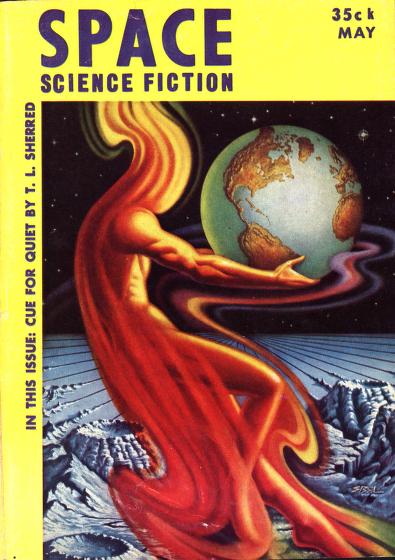
First published in the May 1953 issue of Space Science Fiction, which is on the Archive. If I was to go through every time this story has been collected and anthologized we’d be here all day, so I’ll restrict myself to reprints that are in print, since even then you have several options. First, if you want a free and accessible version that’s not a legal grey area, good news, somehow “Second Variety” fell out of copyright a while ago and now you can read it perfectly legit on Project Gutenberg, link here. I do recommend reading a copy that doesn’t include interior illustrations, as while the ones by Alex Ebel for the magazine publication (and on Gutenberg) are nice, they also allude to the two biggest twists in the narrative. For book reprints the best choices would be Selected Stories of Philip K. Dick, The Philip K. Dick Reader, and The Early Science Fiction of Philip K. Dick. As for myself I also have The World Treasury of Science Fiction, a typical David G. Hartwell anthology in that it is fucking massive; proceed with caution.
Enhancing Image
Earth is fucked. The Cold War between the Americans and Soviets has long since gone hot and pretty much the whole planet has been rendered unhabitable. The American government, now in exile, has retreated to Earth’s moon. How they managed to build a moon base is beyond me. Meanwhile nearly the whole human population has either died or gone off-planet. “All but the troops.” Even the military is no longer organized, “a few thousand here, a platoon there,” with the only thing giving the soldiers a sense of cohesion being comms with the moon base. We start in one of the bunkers that are surely scattered throughout the scarred landscape, with Major Hendricks as our protagonist—a disciplined but otherwise unexceptional man who will prove to be our eyes and ears for the hell we’ll witness.
A Russian troop runs across the battlefield with a message (unbeknownst to the Americans) before getting killed and torn apart by a pack of claws—little robots that have enough agility and raw steel to slash a man’s throat. The Americans wear badges that prevent the claws from going after them, as they should, considering the claws will go after anything that’s organic; even the rats that populate the trenches and holes of the ruined earth sometimes get caught up a claw’s blades. The Russian’s message reads that the Russian encampment is looking to make peace with the Americans, a call for a cease fire that naturally the Americans are skeptical about. One soldier needs to head over to the Russian base to agree to peace. Simple enough. Hendricks volunteers and the plot, such as it starts, is a simple point-A-to-point-B mission, assuming the claws never mistake Hendricks for the enemy and assuming the Russians don’t get themselves killed by then…
Some backstory…
The Americans were losing the war, and badly; thus a super-weapon was needed to push back the enemy, and in this case the Americans got the bright idea to build the claws. Now the claws aren’t just killer robots: these are robots that are not only rabidly bloodthirsty but also granted enough cognitive capacity to be able to reproduce themselves, in that they’re able to run their own factories where they can build and program more claws, independent of human input. Since the top brass couldn’t figure out a way to program faction loyalty into the claws (an RPG, after all, cannot know anything about nationalism), they’re designed to go after anything that moves, making them not-too-picky killers.
Hendricks leaves, but en route to his destination he comes across a boy with a teddy bear who has apparently been surviving on his own. So, the boy is named David and he has a teddy bear. Did Brian Aldiss take inspiration from “Second Variety” when writing “Super-Toys Last All Summer Long,” or is this one of those weird coincidences? Anyway, Hendricks takes the boy under his wing until they’re stopped by a pack of what appear to be Russian soldiers, who at first seem to take aim at Hendricks—only to shoot David, blowing him to metal pieces and revealing him to have been a claw in disguise. Hendricks has unwittingly almost let a claw into the bunker with him, having mistaken the robot for a human. It wass a good job too; other than some strange behavior that can be explained by the fact that people become unhinged when put in isolation, the claw convinced the jaded military man that it was a real boy for a time. The blurring of the line between the real and fraudulent is a theme Dick will return to many times over his career, and while “Second Variety” was not even the first example of this, it was, along with “Colony,” an effective use of the theme to invoke horror.
Speaking of which, I did say that I’d prefer you read a version that doesn’t come with illustrations, but I’ll allow the first of Ebel’s interiors, which gives away David being a claw but which I think still properly conveys the eeriness of the claws starting to replicate humanity. This is a reminder that much of what Dick wrote can be classified as horror, even though Dick is never talked about as a horror author—probably because, in the hierarchy of genres, horror, for Dick, always came second to science fiction. The two genres have had a symbiotic relationship since the days of Mary Shelley, but that’s a lecture for another time. Like I said, Ebel’s work is good.
Hendricks meets up with a small group of survivors—some Soviet troops who have been cut off from headquarters. The implication, of course, is that there’s no longer any headquarters to get in touch with. The survivors are Rudi, Klaus, and Tasso, the last of these being a young woman whose relationship with the others is unclear. It’s here, in temporary safety (but are we really safe), where we get a further explanation of the claws, including the humanoid varieties, of which “David” is one. Variety I (mind the Roman numberals) is the Wounded Soldier, Variety III is the David, but nobody’s yet found what Variety II would be—hence the title. The idea behind the varieties seems to be not just extermination but infiltration, with claws posing as humans so as to make real humans let their guard down. Apparently the varieties were not the Americans’ idea…
The claws are evolving; not only can they make more of themselves but they’re producing new models, with the varieties even being immune to the badges the American troops wear. Nobody is safe anymore. “It makes me wonder,” says Hendricks, “if we’re not seeing the beginning of a new species. The new species. Evolution. The race to come after man.” It’s possible for a David or a Wounded Soldier to trick an American bunker into being let in, which does not bode well for Hendricks when he eventually has to get back to HQ. Ah, but as long as the claws don’t get to the moon base…! Not to spoil things, but if you’re looking for an optimistic take on mankind’s future you make wanna look elsewhere is all I’m saying.
A lot happens in “Second Variety,” which at first glance, going by page count, looks like a novella, but with a lot of scene breaks and short punchy bits of dialogue it turns out to be not as long as it looks. Still, this is a long novelette at 15,000 words, and Dick demonstrates his mastery of economical writing by keeping the pace of the narrative at a pop-pop-pop rhythm, only giving us a single lengthy infodump towards the beginning before letting short bursts of action and dialogue speak for themselves. It’s still a long story, but given how much Dick crams in here it’s a lot of bang for one’s buck. We spend enough time in the bunker with the survivors in the story’s midpoint that we’re lulled into a sense of security—which proves to be very false indeed. Everything goes to SHIT after this point, let’s see how.
There Be Spoilers Here
The party starts to dwindle. Klaus kills Rudi on the suspicion that Rudi is a claw—or so Klaus claims. Turns out, judging from the organic remains, Rudie was not a claw, but the damage has already been done. Personally I would take this as a huge red flag with regards to Klaus, but for the time being he has plausible deniability. SURPRISE, Klaus is a claw too, only stopped from killing Hendricks as well thanks to an EMP bomb that Tasso carries, which would only really be useful against claws. You’d think this would absolve her of being a claw herself, but there’s one little problem with that: Tasso is the second variety. More successfully than David and even Klaus, Tasso manages to trick Hendricks into thinking she’s human until it’s too late to stop her. I wanna point out that this is not as much of a shock if you’re reading the magazine version or on Gutenberg, where we get an illustration showing a woman-shaped robot well before the reveal, but I also have to admit that the foreknowledge of Tasso’s nature does little to lessen the impact.
Not that Dick’s stories tend to have happy endings, but “Second Variety” has to have one of the bleakest. Hendricks has just unwittingly let a claw take a ship to the moon base where the last of the American faction will probably get annihilated. As he’s fending off an army of claws and bleeding out he reflects back on the anti-claw bomb Tasso used on Klaus, and we get one of the most haunting final lines in a ’50s SF story: “They were already beginning to design weapons to use against each other.” A charitable reading of the ending is that the claws may destroy each other, having rid themselves of humanity at last, but Dick may also be implying that the end, for better or worse, is not yet. There will be no clear end to the destruction. There are quite a few post-apocalypse narratives that sprouted following the end of World War II, but unlike those other stories, wherein the fighting has more or less stopped at least, humanity being in too much a state of disarray to make matters worse, the ruined world of “Second Variety” continues to degrade itself, with machines simply continuing humanity’s “work.”
A Step Farther Out
Admittedly part of the fun of reading “Second Variety” is understanding the historical context behind it, because this is a Cold War story from start to finish. I actually watched Screamers, which is loosely based on this, the other day, and it just didn’t have the same punch—in part because it lacked the background of Cold War paranoia. In fairness to the filmmakers, Screamers came out in 1995; the Soviet Union had collapsed a few years prior. Sure, the claws are creepy, but the overall creepiness in the short story is greatly amplified by the constant uncertainty of things. We managed to stop the real Cold War from going hot, but in the ’50s it must’ve been easy to imagine the worst-case scenario, resulting in one of Dick’s bleakest narratives. And I’m here for it! Of Dick’s short stories, “Second Variety” is one of the most memorable that I’ve read; I suspect it didn’t find its way into any of the major magazines because a) Dick was too prolific at this point, and b) the story was too dark, at a time when editors—even the more liberal ones—preferred happy endings. Really it was their loss.
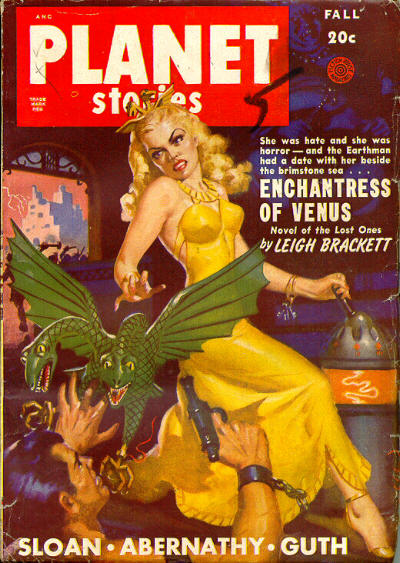
(Cover by Allen Anderson. Planet Stories, Fall 1949.)
This will turn out to be a busy month for me. I’m gonna be a guest on one or two podcasts/streams with some people I very much respect, and I’ll also be flying out of my Jersey/Pennsylvania bubble to visit some friends I rarely ever get to hang out with in person. On the one hand this is all more eventful than what I usually deal with, but also I’ll have a bit less time to manage this site—which won’t stop me from putting in as much effort as I usually do. It’s draining sometimes, but that is how passion works.
My personal life is gonna be busy, but also my review lineup is FILLED for May: we’ve got two serials, two novellas, two short stories, and finally a complete novel—our first one in six months. I know, the gap between novel reviews looks to be wide, but mind you that there aren’t too many of these “complete” novels in the magazines.
One more thing: I mentioned in a past editorial that I think very highly of 1953 as a year when SFF flourished, in general and especially in magazine publishing, which was experiencing a bubble we would not see again until… now, basically. Strangely, I haven’t before covered ANYTHING from that year, so to compensate we’ve got two stories from 1953 in the lineup. 1953 was such a banger that I could probably get five years out of just reviewing everything that was published then.
Enough wasting time, though, let’s see what we have.
For the serials:
All Judgment Fled by James White. Serialized in Worlds of If, December 1967 to February 1968. White is an author I’ve not read a single word of (or at least I think) up to this point, and given his philosophy with storytelling this feels a little criminal to me. When planning this post I flip-flopped between All Judgment Fled, Second Ending, and The Dream Millennium for my first White, since all three sound appealing, and ultimately went with this because I’ve also been meaning to tackle something—anything—that was published in If.
Sos the Rope by Piers Anthony. Serialized in The Magazine of Fantasy and Science Fiction, July to September 1968. Yes, that Piers Anthony. He actually appeared regularly in the genre magazines early in his career, when he was a promising young writer and people did not yet know the horrors he was about to unleash on the world. My only prior Anthony experience was the short story “In the Barn,” and let me tell you… that’s the kind of thing that puts you off an author for years. But maybe Sos the Rope, his second novel, will be good!
For the novellas:
“The Rose” by Charles L. Harness. From the March 1953 issue of Authentic Science Fiction. Retro Hugo nominee for Best Novella. Harness is one of those recent discoveries of mine that I’ve been meaning to explore further—made easier because Harness was not that prolific a writer; when he wrote he was fairly productive, but then he would vanish for several years. Harness apparently struggled to find a publisher for “The Rose” in the US, having to jump across the Atlantic and submit it to a filthy British magazine.
“Enchantress of Venus” by Leigh Brackett. From the Fall 1949 issue of Planet Stories. Brackett is now most known for her part in the messy scripting process for The Empire Strikes Back, for her collaborations with director Howard Hawks, and for the rather unchararcteristic novel The Long Tomorrow. Much of Brackett’s fiction, however, is planetary romance a la Edgar Rice Burroughs, complete with swashbuckling antics. “Enchantress of Venus” is one of several stories starring Eric John Stark, the barbarian hero for the space age.
For the short stories:
“Second Variety” by Philip K. Dick. From the May 1953 issue of Space Science Fiction. Retro Hugo nominee for Best Novelette. Not that I try to hide my biases anyway, but Philip K. Dick is one of my top five favorite authors—and he ain’t #5 on that list. But before he broke new ground as a novelist, Dick was one of the most talented and prolific SFF writers of the ’50s, with about thirty of his short stories being published in 1953 alone. “Second Variety” is one of Dick’s most famous short stories, and yet somehow I’ve not read it before.
“Black God’s Shadow” by C. L. Moore. From the December 1934 issue of Weird Tales. It’s been two months since I reviewed Moore’s “The Black God’s Kiss,” which was a reread, and true enough there was a two-month gap in publication between “The Black God’s Kiss” and its direct sequel. Only a year into her career and Moore had skyrocketed to being one of Weird Tales‘s most popular authors, with the adventures of Northwest Smith and Jirel of Joiry getting started during this period. Moore is a favorite of mine, naturally.
For the complete novel:
Big Planet by Jack Vance. From the September 1952 issue of Startling Stories. Believe it or not, this is a reread—actually one of the first stories I remember reading via magazine scan. As is often the case with me, though, there are surely many things about this novel that I didn’t pick up on a first reading. Vance is not an author I’m strongly attached to, but he does fill a certain niche, being a planet builder par excellence and a crafter of gnarly planetary adventures when he feels like it. Big Planet represents planetary romance shifting away from the Burroughs-Brackett model (which is really science-fantasy), and injecting the subgenre with some semblance of scientific plausibility. But how does this novel hold up on a reread? Let’s find out.
We have a nice mix of science fiction and fantasy, all of it vintage. We’ll get back to some more recent publications next month… maybe. You have to understand that I only cover so much in a given month and that there’s so much history behind the genre magazines. The roster, you may notice, leans toward adventure this month, between the Brackett, Moore, Vance, and probably the Anthony pieces; it just sort of turned out that way. Maybe given that I’ll be traveling soon I thought it appropriate to focus more on tales of high adventure for my site. Regardless, it won’t be a boring lot.
The idea that George R. R. Martin, perhaps the most famous living fantasy writer (or the most famous to not be a raging transphobe) right now, used to be mostly a science fiction writer would strike a lot of people as odd, but that’s the truth. I recommend picking up both volumes of Dreamsongs, the retrospective collection that covers Martin’s essential short fiction up to the turn of the century. The stories themselves are worth it, but Martin also wrote lengthy autobiographical introductions for each section (the stories are divided into thematically appropriate sections), and keep in mind that this was back in 2003… two whole decades ago. In his intro for the section containing “The Lonely Songs of Laren Dorr” and a few other early fantasies, Martin gets weirdly defensive about what must’ve been a recurring criticism of him in fandom at the time: that he was a science fiction writer who “sold out” and started writing fantasy once market forces shifted.
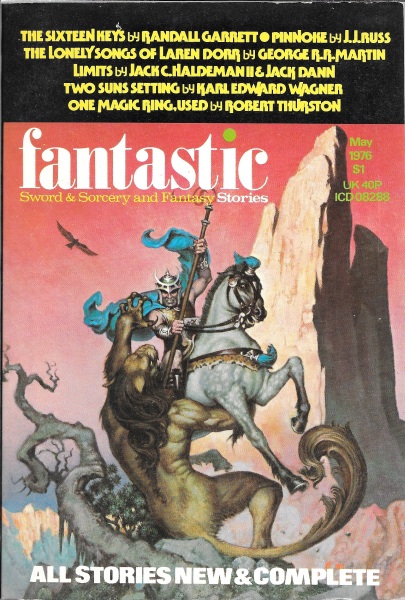
There’s no question that Martin’s priorities with genres changed radically by the time he started working on A Song of Ice and Fire, but the reality is that Martin was always more of a fantasist than a science-fictionist at heart. In the ’70s, when Martin started writing professionally, you had basically two options for getting short fantasy published: The Magazine of Fantasy and Science Fiction, which tended toward fantasy of the whimsical Lewis Carroll sort, and Fantastic, which welcomed adventure fantasy but sadly also paid considerably less than F&SF. Despite the pay gap, though, it was Fantastic and not F&SF where Martin cut his teeth on short fantasy, with him calling “The Lonely Songs of Laren Dorr” his first “pure fantasy” as a pro. Of course, by 1976 Martin was not just a pro but a Hugo winner.
Placing Coordinates
First published in the May 1976 issue of Fantastic, which is on the Archive. It was first collected in Songs of Stars and Shadows, but now you can easily find in the first volume of Dreamsongs. You can also read “The Lonely Songs of Laren Dorr” totally free and legit online as a reprint in Fantasy Magazine, which can be found here. Really you have no excuse.
Enhancing Image
Martin’s third-person narrator, not quite omniscient, gives us the immediate impression that this will play out like a fairy tale—or at leaat part of a fairy tale. Like your typical fairy tale we’re given a broad outline of the plot in advance, along with something like a message we’re supposed to take from it. The narration borders on childlike, but this is ultimately still a fantasy for adults, though I’ll say right now that certain Martin hallmarks like gore and sexual assault are nowhere to be found; you can rest easy on that. Anyway, the narrator tells us that this story is incomplete, like so:
We have only the middle, or rather a piece of that middle, the smallest part of the legend, a mere fragment of the quest. A small tale within the greater, of one world where Sharra paused, and of the lonely singer Laren Dorr and how they briefly touched.
I have to admit that I assumed going in that Laren Dorr would be a woman, even though thinking about it, Laren is not exactly a feminine name. Unconscious bias maybe? Doesn’t matter, because while he’s not strictly the protagonist Laren is very much the character of interest here; he is, after all, the one who changes. Hell, there are only only two onscreen characters, plus one who is mentioned but never seen, plus a group of villains who are also unseen but who still very much lurk just outside the confines of the page. The real protagonist is Sharra, “the girl who goes between the worlds,” a warrior lady whom sadly we find out very little about. We start with Sharra, who is in pretty rough shape, having just escaped a violent encounter into Laren’s world, with a dark crown on her head that apparently lets her use gates between worlds—an ability that the Seven do not approve.
Who are the Seven? We find out basically nothing about them, aside from the fact that they are supposed to be a pretty powerful bunch—perhaps a league of sorcerers—who can see across worlds. We know they’re evil and that also they wanna get their hands on Sharra, having already separated her from her lover (whose name I can’t remember).
I’ve struggled to write about this story, despite its length, because a) the plot is very abstract, and b) very little actually happens. Sharra is a refugee in Laren’s world, and Laren, being the sole keeper of his castle, takes her in as a guest. Laren doesn’t want Sharra to leave but Sharra has to find the gate to the next world at some point. Laren is not necessarily a sorcerer but he’s certainly a powerful being on this world where he’s the only human: he has magical healing powers, for one, and is also seemingly immortal. He’s also in contact with the Seven, and may be in cahoots with them. We get this lengthy explanation for how Laren knew Sharra before she came to his world and how her arrival did not strike him as a surprise, despite him having been by himself for—let’s say a stupidly long amoutn of time.
“You are Sharra, who moves between the worlds. Centuries ago, when the hills had a different shape and the violet sun burned scarlet at the very beginning of its cycle, they came to me and told me you would come. I hate them, all Seven, and I will always hate them, but that night I welcomed the vision they gave me. They told me only your name, and that you would come here, to my world. And one thing more, but that was enough. It was a promise. A promise of an ending or a start, of a change. And any change is welcome on this world.”
Somehow this does not concern Sharra too much—certainly not enough for her to go scrambling for a gate. A few other things I feel like noting, because to his credit Martin does try to generate intrigue with the setting while failing to do so with the characters. Like I said Laren’s world is barren as far as civilization goes, with his castle being stuck in the middle of endless forest; the castle itself also seems to be alive, acting of its own accord by, for example, turning its windows into stone at night as a security measure. During the daytime, though, Sharra and Laren are free to wander and hunt outside the castle as they please—so long as Sharra does not find the gate that is surely hidden around here.
Something I’ve noticed about early Martin is that he was preoccupied with capturing mood over plot and character, sometimes to his detriment. I don’t know what was going on in his personal life at the time that made him write several stories about isolation and feeling disconnected from other people, but then again, anyone who grows up in New Jersey seems to go through a social maladjustment phase. (I wanna point out that John W. Campbell, fellow New Jerseyan and someone Martin’s been open about admiring, had kind of a shitty childhood that no doubt impacted his capacity to get along with others in adulthood.) It could also be that it was simply an artistic thing of his—one that he’s never entirely gotten over. Consider how music is great at capturing emotions but not action (hence most rock operas are kinda lame from a narrative standpoint), and how some of Martin’s fiction is clearly meant to evoke music: “A Song for Lya,” “The Lonely Songs of Laren Dorr,” “Remembering Melody,” and of course A Song of Ice and Fire.
(I mean given that it’s a series of really long novels it should be called An Album of Ice and Fire, but I can see I’m getting distracted.)
Another Martin story I’m reminded of here is “Bitterblooms,” which has a somewhat similar premise, what with someone (a girl, again) being rescued by someone who might be a sorcerer/sorceress (only it’s a woman this time!), and there’s this wiff of Stockholm Syndrome you get from the pages. The difference is that there’s a tangible sense of danger in “Bitterblooms,” an actual conflict between characters that reveals their unsavory sides and puts them to the test. Sure, you could say there’s conflict in the story I’m reviewing here: Sharra wants to leave and Laren wants her to stay. The problem is that Sharra doesn’t wanna leave that badly; she’s not desperate to rescue her lover, nor does she ever come up with a scheme to get rid of Laren. Sharra thinks strongly about leaving for about a minute and then is easily convinced to stay for God knows how long; she may even think Laren worthy of a pity fuck or five. In other words, there’s no imminent threat and no reason to worry, with even the Seven apparently taking a nap through all this.
Much of the story’s 7,000+ words is speant on Laren monologuing about how lonely he is and how much he had been hoping for the day when he and Sharra would meet and he’d be, momentarily, relieved of his loneliness; this is the fantasy equivalent of writing about the tragic tale of a man who has not gotten his dick sucked since the days before 9/11.
There Be Spoilers Here
Zzzzzzzzzzzzzzz…
A Step Farther Out
It took me only a lunch break to read this, but much longer to come up with something to say about it. “The Lonely Songs of Laren Dorr” is almost as pure a mood piece as you can get—at the expense of plot and even basic conflict. When I reviewed Martin’s earlier story “With Morning Comes Mistfall” (review here), I was impressed at how much he was able to do in the span of a dozen pages; sure, it too was a mood piece, but it was rich in characters, themes, and even prose style. It could just be that I much prefer Martin when he’s writing SF over fantasy, as for some reason I rarely find the latter convincing. I’m reminded of when I read “Blood of the Dragon,” which was Daenerys’s chapters from A Game of Thrones edited into a novella, and I thought much of the dialogue was cringe-inducing. “The Lonely Songs of Laren Dorr” did not make me cringe, but it did bore me more than a little. I think Martin went too far in one direction in an effort to capture a specific mood, which strikes me more as play-acting than genuine feeling, which is actually a problem some of his other early fiction has.
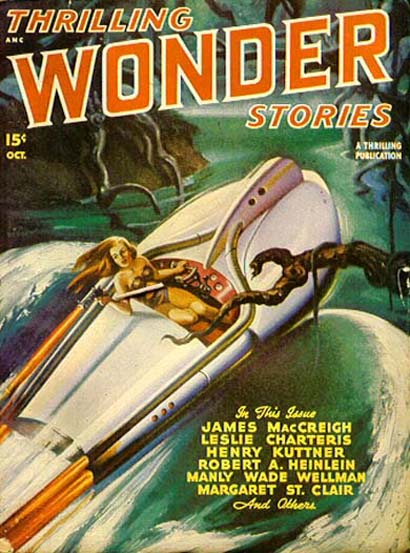
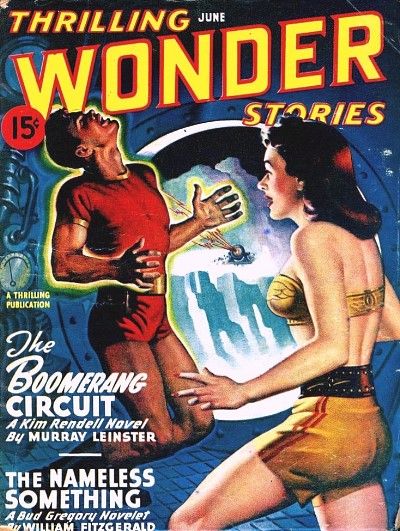
(Cover by Earle Bergey. Thrilling Wonder Stories, June 1947.)
Who Goes There?
Last month I reviewed C. L. Moore’s “The Black God’s Kiss” (review here), which was a reread and a reminder that sometimes rereads are important. As I delve deeper into the works of Moore and her first husband, Henry Kuttner, the more I think that there ought to be a major resurgance in interest with regards to these two. In the ’40s Kuttner and Moore were the writing duo in science fiction, being so seamless in their collaborations that they struggled to tell who wrote what—a layer of ambiguity that has plagued genre historians ever since. With some stories it’s safe enough to say who did what, but sometimes it comes down to “educated” guesses: a rule of thumb is that if a story post-1940 is credited to Moore alone then it probably is just her, but Kuttner sadly does not receive the same treatment for stuff published under his byline without Moore. The two as a pair contributed frequently to Astounding Science Fiction, but each would also submit to other outlets solo, and Kuttner especially appeared without Moore’s next to his quite often in Startling Stories and Thrilling Wonder Stories. It might be that because Kuttner did not have as high a reputation as Moore that he was more inclined to appear in second-rate magazines.
It’s true that Kuttner was a less refined writer than his wife; his technique was more steeped in the tradition of pulp craftsmanship, being more adept at producing “raw” story over memorable lines of prose. As such, Kuttner is harder to judge on a line-by-line basis, but rather should be judged by the total effect his work has, which at its best certainly rivals Moore’s. Kuttner was also one of the great humorists of classic SFF, being one of John W. Campbell’s court jesters in the peak days of Astounding and Unknown, but the downside is that his knack for comedy can cast a veil over his talent for social commentary and, yes, a bit of philosophy. Today’s story, “The Big Night,” is relatively serious for Kuttner (though it’s still knee-deep in pulp prose), which might be why he had it initially published under the pseudonym Hudson Hastings.
Placing Coordinates
First published in the June 1947 issue of Thrilling Wonder Stories, which is on the Archive. The good news is that if you want a more readable digital copy you’re in luck, because for some reason this story fell out of copyright and it’s available, perfectly legally, on Project Gutenberg. As for paper reprints you only have a few options, but the ones I recommend are pretty good. First, and as will usually be a source for Kuttner/Moore reviews, there’s Two-Handed Engine, a massive tome that collects “essential” stories from Kuttner and Moore, both solo and in collaboration, and you can get a used copy for a reasonable price. There’s also the Ballantine paperback volume The Best of Henry Kuttner, which admittedly relies too much on stories that were most likely written in collaboration with Moore (Moore does not get the same treatment for her Ballantine Best Of volume). Suprisingly “The Big Night” has not been anthologized anywhere, not even for like a stray collection of pulp-era space opera stories. Oh well.
Enhancing Image
Normally when we’re introducing to spaceships, especially in pulp-era SF, there’s an attempt on the author’s part to capture a sense of wonder with the ship’s bulk and speed, but Kuttner doesn’t do that; instead we’re introduced to La Cucaracha (yes, that’s its name) with language that would be considered unflattering, her “fat body” scarred with a molten streak across her middle and with spot-welds standing in for liver spots. La Cucaracha is an old ship and she’s on her last leg, and to make matters worse her skipper, Sam Danvers, is drunk again. Danvers mostly plays second fiddle to the story’s real protagonist, Logger Hilton, the first mate.
(An aside before we continue is that I wouldn’t go into this expecting female representation at all, as there’s not a single named female character and La Cucaracha‘s crew is all-male.)
Hilton is called to talk with Danvers, or rather to talk him out of his stupor, as Danvers is indeed quite drunk and, like his ship, is very old. “He was a big man, or rather he had been once, but now the flesh had shrunk and he was beginning to stoop a little.” We aren’t told ages, but judging from some comparisons I’d say Hilton is in his forties while Danvers is in his seventies, so you know we’re not dealing with spring chickens. When we meet Danvers he’s “making a speech to an imaginary Interplanetary Trade Commission.” The ITC, as I’ll call it from now on, had recently done a routine inspection of the ship and found she’s “unsafe,” which isn’t surprising given she’s riddled with scars and she may break apart any moment. On the one hand Danvers is fundamentally a sympathetic character, and from his perspective the ITC (i.e., government regulation) is the villain, but both Danvers and Hilton know that La Cucaracha is not long for this world.
You see, La Cucaracha is a hyper-ship, which is to stay a ship that can cross hyperspace and easily venture into what’s called the Big Night—the space beyond our solar system. To get around the speed-of-light barrier in space travel authors will opt for some kind of shortcut, and jumping into hyperspace—a dimension totally removed from ours—is this story’s shortcut of choice. Interstellar travel was, up till recently, done with hyper-ships, but something has been threatening to make these great ships obsolete: long-distance teleportation. More useful for transporting cargo than people, but still teleportation presents a cheap and relatively safe alternative to hyper-ships. The implication, which Kutter might agree with, is that the introduction of “matter-transmitting” will be a net positive for interstellar relations and commerce (important because, as we’ll see, there are a few intelligent alien species to contend with), but still hyper-ships being outmoded will put thousands of men out of work.
So about those aliens. We’re introduced to several characters on the ship, not all of whome are human. There’s Hilton and Danvers; there’s Wiggins, the second mate; there’s Saxon, a fresh “recruit” who is not exactly there of his own volition; but most intriguingly for me there’s Ts’ss, a Selenite, Kuttner’s most original creation here. The Selenites are a tentacled raxce akin to octopi, and in disposition they’re rather stoic, a very old and wise race, even bearing a resemblance to Vulcans. Ts’ss is the Spock equivalent, which… look, I’ve held off on this long enough: I can’t help but make comparisons to Star Trek with this one, they’re too obvious. Even hyperspace reminds me of a ship warping, although the blinking-in-and-out-of-existence part is more stark here; you can’t see SHIT in hyperspace, you have to calculate where you’ll end up. “You had to work blind here, with instruments. And if you got on the wrong level, it was just too bad—for you!” Anyway, in a story where characters each have a single defining trait (we can’t afford more than one), Ts’ss is the closest we get to someone multi-layered, though ultimately he is still merely a support player.
At a little over 10,000 words this is a novelette, but “The Big Night” has perhaps one too many characters/subplots. There’s a subplot with the ship meeting up with a trader on a distant planet, which naturally doesn’t work out because the trading post there is set to have teleporters installed; there’s a subplot with Saxon, the new recruit, which doesn’t do much aside from provide a sort of deus ex machina for the climax; there’s a weird little detour involving another alien race that I’ll get into deeper in the spoilers section that could’ve been cut. Generally this story suffers from being overstuffed considering the simplicity (albeit effective simplicity) of its tone and thesis. Kuttner also does the thing where alien races are boiled down to traits that basically all members of that race share, but for a short story this is more forgivable than if it was a whole novel.
Kuttner was always the pessimist, but that sense of doom was usually counterbalanced by a healthy dose of humor; not so with “The Big Night.” While I just shat on this story for its pacing, I’m impressed that something from the late ’40s can be this fatalistic about the future of space travel. By most metrics the crew of La Cucaracha would probably be tried in court for smuggling and kidnapping; a fraction of the crew, including Saxon, the new guy, were shanghaied, a fact that Hilton and Danvers find bitter but ultimately a necessary evil to keep the ship going. There just aren’t enough people signing up for hyper-ships these days, and even Hilton plans to put his engineering degree to good use once this last trip is finished. The end of an age coming and nobody can stop it.
There Be Spoilers Here
The second alien race we come across are the Canopians, who are considered to be morons as far as sentient races go, albeit with one attribute that makes them indespensible space-farers: they have a real knack for navigation. While at the trading outpost Hilton gets roofied by Danvers, in a way, Hilton is well aware, not dissimilar from how the ship shanghais people, but this time it’s to get Hilton back on the ship without him putting up a fight—over the fact that Danvers recruited a Canopian. Hilton just wants to go home and be done with this whole business, but Danvers isn’t done yet. The Canopian’s skill with navigating and Saxon’s background as a teleporter engineer (a little fact that Hilton is hesitant to tell Danvers) rescue La Cucaracha from almost certain destruction during its return trip. The back end of “The Big Night” is a little too convoluted for me, and if I didn’t run it through Google Docs (Is there a more efficient way to get a word count for something?) I would’ve assumed it was a longer novelette.
By the end we’ve reached the point where the ship has some more time bought for itself, but how long is the question. Now doubt some of the crew will jump ship on the next step; there may even be threats of mutiny, which anyway is always a concern with ships. It’s here that we get my favorite bit of dialogue, which naturally comes from Ts’ss, and it really sums up Kuttner’s point in a way that borders on poetic:
“The reason I keep shipping on La Cucaracha is because I can be busy and efficient aboard, and planets aren’t for Selenites any more. We’ve lost our own world. It died long ago. But I still remember the old traditions of our Empire. If a tradition ever becomes great, it’s because of the men who dedicate themselves to it. That’s why anything ever became great. And it’s why hyper-ships came to mean something, Mr. Hilton. There were men who lived and breathed hyper-ships. Men who worshipped hyper-ships, as a man worships a god. Gods fall, but a few men will still worship at the old altars. They can’t change. If they were capable of changing, they wouldn’t have been the type of men to make their gods great.”
Ts’ss supposes that yes, teleportation is replacing the hyper-ships, but then eventually something else will come along and replace teleportation. No doubt the riders of horse carriages felt a similar sense of doom when the automobile started becoming commercially viable, or when silent movie actors had to face spoken dialogue. Some do not make the transition, and that’s a perfectly natural byproduct of change, if unfortunate. Danvers would rather die than give up his ship, and given his age that’s likely to happen whether anyone would want that or not. Some people will never give up the old ways. Kuttner doesn’t seem to be rooting for tradition here (he hardly strikes me as a conservative), but he may be saying that there’s virtue in stubbornness, if that stubbornness serves something great.
A Step Farther Out
I said at the beginning that Kuttner’s writing ought to be taken in totality, and that very much applies to “The Big Night,” a story that could’ve been a thousand words shorter but which remains, at its core, a bittersweet passing the torch in the distant future. Usually in SF we see spaceships and teleportation working in tandem, and realistically, if the two were to ever happen, they probably would not conflict so much—but still Kuttner considers, more than some other authors, the possible repurcussions of teleportation. I’m reminded specifically of the early section of Star Trek II: The Wrath of Khan, and also Star Trek VI: The Undiscovered Country, where there’s a palpable sense of an era coming to an end, and also Kirk and Danvers not being that dissimilar: both love their ships too much to pack it in just yet. Most of Kuttner’s work that I’ve read up till now has been set on Earth and in the near future or even the “present” day, but “The Big Night” makes me wonder what other space-faring SF he wrote…
It’s the first day of April… and I don’t have a prank in mind.
I’m just gonna do what I do with every one of these forecast blogs, which is to give you a quick update on things and then list off what I’ll be reviewing in the coming weeks. Hope you did your taxes well in advance and aren’t scrambling now! If you’re a filthy American, that is.
Anyway, the biggest thing to happen to this blog recently has been the opportunity to get interviewed by German warrior queen and Hugo winner Cora Buhlert (link here), which naturally gave me the warm fuzzies. This is a relatively young blog, but already I feel I’ve made major progress with it, and it’s been a reliable excuse for discovering new (to me) authors and returning to old favorites. My goal with this site has been to indulge my own quirky and admittedly retro-leaning love of genre fiction, with a literary if also highly colloquial bent, and on that front it’s been a success. Honestly there are too few active fanzines in the field right now, with a good number of them being one-man shows like myself, and goddamnit we deserve to get more notice among industry regulars.
Now, where was I?
Right. It’s been what, four months since I covered a so-called complete novel? And uhh, we still haven’t gotten there yet: April is thirty days, not 31. Sad. Just one more month, I promise. In the meantime we have a serial, two novellas, and two short stories. Admittedly we have more familiar faces in the lineup than I would normally prefer, but given my schedule as of late I’ve made an exception for myself. Let’s see what we have.
For the serial:
Camp Concentration by Thomas M. Disch. Published in New Worlds, July to October 1967. Disch is one of those American authors who appeared regularly in New Worlds during the height of the New Wave era, alongside Samuel R. Delany and Roger Zelazny. This is a four-part serial, but don’t be fooled! From what I can tell each installment is pretty short, which adds up because the novel in book form is like 180 pages. Short, but potent—or so I’ve heard. I’ve read a few short works from Disch before but this will be my first novel of his.
For the novellas:
“Forgiveness Day” by Ursula K. Le Guin. From the November 1994 issue of Asimov’s Science Fiction. Hugo and Nebula nominee for Best Novella, and winner of the Theodore Sturgeon Memorial Award. I hate to say this as someone who likes Le Guin a lot, but I’ve yet to read the linked collection Four Ways to Forgiveness—thought apparently now it’s titled Five Ways to Forgiveness (they found another one). Three of the stories in this collection were published in Asimov’s in fairly close succession, with “Forgiveness Day” being the first.
“Memorare” by Gene Wolfe. From the April 2007 issue of The Magazine of Fantasy and Science Fiction. This is one of those F&SF special author issues. Hugo and Nebula nominee for Best Novella. Wolfe made his first SFF sale in 1951, but he didn’t start writing regularly until the mid-’60s, where from then on he became one of the field’s most distinguished authors. He’s most famous for The Book of the New Sun and the fix-up novel The Fifth Head of Cerberus, but Wolfe did not shy away from short fiction, with “Memorare” as but one example.
For the short stories:
“The Big Night” by Henry Kuttner. From the June 1947 issue of Thrilling Wonder Stories. I covered C. L. Moore again last month, so I figure I ought to do Kuttner the same. The two are often treated as a package deal, forming like Voltron under their own names as well as a variety of pseudonyms, especially for the high-paying Astounding Science Fiction. Kuttner also appeared in several magazines apart from Moore. Take “The Big Night,” for example, which Kuttner had published under the pseudonym Hudson Hastings.
“The Lonely Songs of Laren Dorr” by George R. R. Martin. From the May 1976 issue of Fantastic. Martin has spent the past few decades so entrenched as a fantasist that it’s easy to forget there was a time when he mostly wrote science fiction instead, and that it was fantasy which was reserved for once in a blue moon. In 1976 you had two fantasy magazines: F&SF and Fantastic, and the latter paid worse. But Martin was good buddies with Ted White, Fantastic‘s editor, and this saw the publication of Martin’s first “pure” fantasy.
That’s it, that’s all I have. I take way too long to come up with these forecasts. I actually wrote this about a week ago; you’re only reading it now. Funny how time works. And as for those adventures in time and space…
(Cover by Margaret Brundage. Weird Tales, January 1938.)
Who Goes There?
Some authors are vindicated posthumously while others see their high reputations in life dwindle in death: Seabury Quinn is one of those latter authors. In the ’20s and ’30s he was almost certainly the most popular author to appear in the pages of Weird Tales; he was so popular that, as far as the disreputable realm of pulp fiction went, he was basically a celebrity. (I’m thinking of an anecdote wherein prostitutes in a New Orleans brothel recognized Quinn as that most prolific and starred contributor to Weird Tales, offering him a “round” free of charge.) His Jules de Grandin series, starring the eponymous occult detective, would alone have made him a household name, but as fate would have it both Quinn and de Grandin are overlooked nowadays—names to be checked off for people like myself who get a kick out of genre factoids. Yet Quinn was surely not bereft of talent, as he was deemed both good and overlooked enough to have “won” the Cordwainer Smith Rediscovery Award.
No doubt a good portion of Quinn’s output was hackwork; this was not unusual among authors of the era, who had to crank out story after story to make a quick buck. All this, however, brings us to today’s story, which Quinn had apparently written out of passion and which, ironically, did not become the cover story for that month’s issue of Weird Tales. “Roads” is a Christmas story, one of such high caliber that Sam Moskowitz (who mind you was not religiously inclined to hold Christmas in special reverence) considered it the best Christmas story ever written by an American, putting it in the same league as Charles Dickens’s A Christmas Carol. This is my first time with Quinn and something tells me I’ll be tracking more of his stuff down, because “Roads” fucking rules.
Placing Coordinates
First published in the January 1938 issue of Weird Tales, which is on the Archive. ISFDB says there was also a highly limited chapbook release that same year, but it does not give a month of publication, which means the chapbook was probably released some months after the story’s magazine appearance. Of much more interest is the chapbook from Arkham House that released in 1948, which a) is riddled with lovely illustrations by Virgil Finlay, and b) may trick you into thinking this is a novella—a trick that even fooled the folks at Wikipedia. No, “Roads” is not a novella; the type in the Arkham House chapbook is almost laughably big, never mind the Finlay illustrations. There are two facsimile reproductions of that chapbook: one in hardcover and the other in paperback, with the former by Red Jacket Press and the latter by Shadowridge Press. The facsimiles are pretty affordable, and if you don’t mind your wallet crying that original Arkham House chapbook is still circulating in the second-hand market.
Enhancing Image
The thing about “Roads” is that I reckon it’s no longer than H. P. Lovecraft’s “The Dreams in the Witch-House” (review here), but whereas Lovecraft’s story is a novelette that just goes on and on, “Roads” is essentially three short stories for the price of one; it’s split into three distinct sections, each covering a different period in will turn out to be a very long life for the protagonist. Just how long are we talking? Wait and see…
We start in Biblical times, indeed not long after Jesus’s birth, the star over Bethlehem and all that. As should be expected, though, life in ancient Roman-occupied Jerusalem is brutish and often short, encapsulated with the opening scene, wherein some marauders try to kill and rob Our Hero™, who is very much not a man of Biblical times: he is Klaus, later (Quinn all but tells us in advance) to become Santa Claus, and he’s a decorated gladiator for Herod—and a Viking. Some of you may be raising an eyebrow at this, since the Vikings would not become a thing for several more centuries. It’s not like this was a silly little detail Quinn snuck into the narrative; no, much is made of Klaus being Nordic, and, in contrast to pretty much everyone else in the story, built like a brick shithouse. On top of being dressed for battle, Klaus carries “a double-bladed ax” and “a long two-handed sword with a wide, well-temptered blade, pointed and double-edged,” which makes me wonder how the fuck these bandits hoped to rob him.
The affair goes about as well for the bandits as you’d expect. Actually a bit better, because Klaus breaks a guy’s wrist rather than smash his head against a stone. Later opponents will not be nearly as lucky.
Klaus, being a stranger in a strange land, is not terribly picky about whom he serves; the idea seems to be that he’ll fight for you so long as you treat him with decency, and so long as you don’t order troops to go around killing infants. Right, about that. Klaus gets along surprisingly well with the Roman occupiers, who treat him basically like a good dog and who even give him a sort of pet name. “Though he had been among the Romans since before his beard was sprouted, their rendering of his simple Nordic name of Klaus to Claudius had never failed to rouse his laughter.” Trouble brews, though, when local king Herod, having been told a prophecy that another will take his place, orders men to go out and slaughter any Jewish boy under the age of two. If you’ve read the novel (or at least the Wikipedia synopsis for the novel) that “Roads” is loosely based on then this sounds like a faithful adaptation so far, insofar as the Jesus narrative is concerned.
Klaus, a natural warrior who is used to fighting with honor, is naturally repulsed when he discovers that legionaries have been marching through the streets and snatching babies from their mothers’ breasts. Although he is not aware of it at the time, Klaus does in fact save an infant Jesus from a small group of soldiers, as the kids parents (though not his real dad) try to get the hell out of Dodge. The fight between Klaus and the soldiers is one of the more shockingly violent scenes I’ve read in recent times, but it’s justified partly because of Klaus’s swordsmanship and partly because of his righteous fury that so-called honorable soldiers would carry out such an order. He fucking cuts a dude in half diagonally. A lesson a lot of people should but do not learn throughout the story is that you don’t want an angry Northman who looks and acts like he belongs in a Robert E. Howard adventure on the rampage. Anyway, Joseph and Mary thank Klaus and inform him of the massacre, and meanwhile there’s something a bit odd about their own, which naturally spooks Klaus at first.
(So Joseph says, “Only last night the Angel of the Lord forewarned me in a dream to take the young child and its mother and flee from Nazareth to Egypt, lest the soldiers of King Herod come upon us unawares.” People took dreams very seriously in Biblical times, but also Joseph taking his family out of Nazareth without warning anyone else in advance is, if you ask me, more than a little morally dubious. Indeed if you want to see the actual moral quandry that would spawn from such an action I recommend checking out José Saramago’s The Gospel According to Jesus Christ. Good novel, that one. I’m getting a little sidetracked here. Quinn is writing a compelling Christmas story, but he’s also deliberately toying with very old and revered material that some people take very seriously.)
The infant Jesus, unbeknownst to Mary and Joseph, communicates with Klaus with what I can only call telepathy. Of course we know that Jesus, being both entirely God and man, is conversing with Klaus in the former form while his baby self just stares at him and makes blup-blup sounds. It’s here that Jesus tells Klaus about the broad strokes of the rest of the plot and how he will eventually give up his warrior ways to become a friend to all children—and not only that, but that Klaus will be made immortal, something that only a couple figures in the entirety of the Bible are granted. (No one is sure what happened to Enoch; maybe he went out to get some milk.) The baby Jesus with his Jedi mind powers has this to say:
When the name of Odin is forgot, and in all the world there is no man to do him reverence at his altars, thy name and fame shall live; and laughing, happy children shall praise thy goodness and thy loving-kindness. Thou shalt live immortally in every childish heart so long as men shall celebrate my birthday.
It’s here that the first section of “Roads” ends, with Klaus and the infant Jesus parting ways, Jesus to return to the land of his birth eventually and Klaus to stay with the Romans. Between the first and second sections there’s a thirty-year time skip: Klaus, a man who should at least be pushing sixty, has not aged a day while Jesus, the man destined to rise from the dead, sees himself at the other end of his mortal life. By the time the two meet again Klaus has become the right-hand man of Pontius Pilate, who, as he is depicted in “Roads,” is a little bitchy and a little antisemitic, but who ultimately has little interest in executing or even punishing Jesus. I know I’m biased, and I’m thinking of a certain movie while reading this tale, but I keep imagining David Bowie in the role of Pontius Pilate; it must be the bitchiness and coded gayness, what with how he calls Klaus “my Claudius.” Well, you can take the Roman out of Rome but you can’t take Rome out of the Roman, or something like that…
This review may seem frontloaded with summarizing the first section, but I wanna give you some time to adjust to the nature of the story’s world before we get into spoilers, which after all are hard to define since, like I said, the broad strokes of the plot are laid out for us in advance. We know that Klaus will eventually become Santa Claus and that his role as a friend to children and the downtrodden is inextricably tied to Christianity (ironic, given that Klaus is, at least for much of the story, a devout pagan). An old platitude goes that it’s not the destination that matters so much as the journey, though, and what follows makes good on the promise made in that first section—that being that this will be one of the weirdest and most capitvating Christmas stories I’ve read in a long time.
There Be Spoilers Here
This section is basically gonna be a series of random notes for me, because while I would looooove to give a beat-by-beat rundown of this story, I’m pressed for time and also, as I said, this one is hard to spoil. As such I’m more interested in the ways Quinn messes with the Jesus narrative and other things more than the beats of the plot. Some may say the liberties Quinn took border on blasphemy, but as far as I’m concerned he’s simply taking a story that is already at least partly fabricated and moving some pieces of the jigsaw puzzle around, occasionally also adding in pieces from a totally different puzzle. In fact let’s make this a list, shall we?
Despite Pontius Pilate sending Jesus, a man Klaus had served before, to his death, Klaus remains loyal to both Pilate and Jesus, even staying by the former’s side while he’s on his death bed. At first it may seem odd that Klaus bears Pilate no ill will, but Jesus makes it clear that he is supposed to be crucified, and that while Klaus and the others are not in on the details of Jesus’s plan, Jesus tells Our Hero™ to not be too worried about it.
Speaking of the crucifixion, one of the most striking little things Quinn does, as far liberty-taking goes, is he puts Klaus in the shoes of the soldier who spears Jesus’s body between the ribs to make sure he’s dead, rather than leave him to the elements. “’Tis long since I have done that favor to a helpless man,” says Klaus, and Jesus in his spirit form thanks him for this act of mercy, however morbid it may be.
I was worried for a bit during the middle section that Quinn was pulling a Mel Gibson and overemphasizing the role Jewish religious leaders played in Jesus’s execution, and I’m still not totally convinced there isn’t some antisemitism at play here. However, while nobody likes or respects the Jewish priests, this turns out to be a running theme in the story, not just with Jewish religious leaders but Christian ones later one. Be sure to put a pin in this note.
Klaus later rescuse a girl from a collapsed building following an earthquake—a girl who will turn out to be Mrs. Claus. Oh boy, a few things to unpack here. First, Erinna is a prostitute who came from Lebanon, a fact that revolts Klaus until Jesus tells him to stop being an asshole and not slut-shame her. (Reminder that Jesus’s “cast the first stone” speech might be the oldest call against slut-shaming in the history of human literature, just so puritanical Christians in the audience are aware.) Klaus, being in need of companionship and aware that Erinna fucks like a champ (that’s right, Mrs. Claus is a SLUT), takes her as his wife, with her being made immortal as well.
With Erinna taking on the married name of Unna, as is apparently a custom for Klaus and his people, the two start traveling the world and working for a number of governments, first over a span of decades and then centuries. Quite remarkably (by that I mean implausibly), Klaus and Unna being both famous and apparently ageless does not become a problem for them until Christianity has become the majority religion in mainland Europe—so like, a few hundred years at least. What I find interesting, though, is that the immortality thing doesn’t really become a problem for them until the crusades start.
Ultimately this is still a “Christian” Christmas story, but something tells me Quinn did not get along with religious authorities, because regardless of their religion, they’re consistently depicted here as at best obnoxious and, later on, as actively murderous. When some Christian do-gooders capture Unna with the intention of executing her as a witch, Klaus shows them no mercy in rescuing his wife. Klaus is also repulsed when crusaders sack Muslim cities and murder what he considers to be innocent people in their homes. I wonder how alt-right shitheads are supposed to take all this.
While it’s implied, via crosses Klaus and Unna wear in later years, that the former eventually abandons his pagan beliefs, we never actually get a conversion scene for Klaus. This is not a preachy work wherein the heathen “sees the light” and is swayed to become a Christian; rather Klaus spreads the best potential of Christianity because he wants to follow the words of a man he respects and whom he knew personally. Giving up his sword and ax at the end to become Santa Claus (with elves and reindeer and all that) at the end is merely the conclusion to an arc that had been in mottion since the beginning.
I could keep going, by the way. The fact that Klaus, who longed to return to his homeland at the beginning, goes back north at the end to evade persecution, only to meet up with the elves (who really are akin to Tolkien’s dwarves in that they’re short and born craftsmen), a fellow persecuted race; the fact that the first time he helps a child in an impoverished town he happens to be dressed in red; the fact that his Roman name of Claudius sets up his changing his name again, this time permamently. A lot happens, and not all of it “makes sense,” but this only really matters if you’re someone asking for strict rationalization in a story that, even without Quinn’s inserts, does not and cannot entirely make sense. The result is an adaptation that’s only slightly more fantastical than the source material, and no less quirky, only it’s not preached as being gospel.
A Step Farther Out
I wouldn’t call “Roads” perfect, but I’m also not sure if I’ve read anything else quite like it. Charlatans, or just people who don’t like to have fun, would knock this story for its “flaws,” but I’d argue those flaws are what give it character—for anything bereft of flaws cannot possibly be considered human, and “Roads” is very much a human story. We have here a retelling of the Jesus narrative with Santa Claus inserted as a Viking out of both time and place, a warrior with sword and ax who becomes a friend to all children. If you ever wanted to see a totally jacked Santa Claus cut down legionaries and crusaders like they’re trees, for some godforesaken reason, then boy do I have just the thing for you. This has to be the most violent Christmas story I’ve ever read/seen that wasn’t made to be edgy on purpose, and yet I can’t say Quinn is being disingenuous; on the contrary, the violence being juxtaposed with Klaus finding his calling as the role we know he’ll ultimately play makes the latter more profound. This is a Christmas story for those true believers who also happen to be fans of Conan the Barbarian.
So Finally we’ve reached the end of my month dedicated to stories from Weird Tales. I revisited a few familiar faces and came across some others whom I had never read before. It was also nice to take a break from covering serials and novellas, much as I love them. There was a lot of hackwork in Weird Tales, and some experiments that didn’t work out, but I was reminded that at the height of its popularity, Weird Takes was easily more daring than most of the pulp magazines on the market, even being a good deal edgier than the relatively puritanical Unknown which all but succeeded it. During this month we covered space opera, vampires, mad scientists, sword and sorcery, good old-fashioned ghost stories, and everything in between. You have to admit that’s a lot of variety for one magazine!
(Cover by Margaret Brundage. Weird Tales, March 1937.)
Who Goes There?
Dorothy Quick is a name I recognize but prior to today’s story have not read anything by; specifically I know her as a contributor to Unknown, wherein her most prominent work would be a series of short stories called the Patchwork Quilt series, which sadly only has three entries and which Quick apparently abandoned by the time Unknown died. We don’t know a lot about Quick: we know she started writing SFF in the early days of genre pulp and that she basically stopped once the first incarnation of Weird Tales went under. She seems to be one of those authors whose genre output positively correlates with the state of magazine fantasy, in that once Unknown closed that was a market gone for her, and Weird Tales later closing must’ve been the last straw. She did, however, continue to write fiction in mainstream outlets. Anyway, I feel bad because I don’t have much to say about today’s story and I can’t say reading it filled me with confidence about covering Quick in the future, though I do wanna get to those Patchwork Quilt stories.
Placing Coordinates
First published in the March 1937 issue of Weird Tales, which is on the Archive. Judging Margaret Brundage covers, on a scale from 1 to 10 with 1 being chaste and 10 being “Is this pornographic?,” I would give this one a 2 or a 3; it’s pretty tame. I didn’t even notice the naked girl with the orchid on her body at first. Anyway, sad reality with most pulp-era lady authors is that their stuff doesn’t get reprinted often, and “Strange Orchids” is no exception. As far as I can tell there’s only one reprint, that being Sisters of Tomorrow: The First Women of Science Fiction (ed. Patrick B. Sharp and Lisa Yaszek), which thankfully looks to be in print in hardcover and paperback. But yep, looks like those are all your options.
Enhancing Image
We start with Louise, the narrator/protagonist, telling us that everything basically turned out fine in the end: oh sure, her hair is white now from getting spooked so hard, but she came out of whatever ordeal it was fine and she even ended up with this guy she really likes. This might be the fastest way possible to defuse tension, and I don’t know why Quick informs us of the bittersweet ending so far in advance. Within just a few sentences we get one of my biggest issues with this story, which is that Louise is not in any real danger; at most she has a tough time for a bit, we already know she gets better, and thus this is a hard story to spoil.
Whilst at a friend’s party, Louise meets the other two corners of what amounts to a love triangle: Rex, who is obviously a Good Guy™ and the aforementioned handsome fella Louise gets together with; and Angus, who is so obviously the villain that it’s actually not funny. (Never trust a guy named Angus.) Just how obvious is Angus’s villainy? Well, there have been several girls who’ve gone missing as of late, under similar circumstances, and Angus over here is acting incredibly suspicious—to the point where, if not for the plot that unfolds, Angus would probably be the first white man in history to get arrested simply for acting like someone who ought to be arrested. That Angus acts creepy towards Louise, simultaneously insulting her and trying to seduce her, should already make him a suspect.
Hmmmmmm.
To make things slightly more complicated, Rex is a G-man who’s part of a task force looking for these missing girls; already this story strains my suspension of disbelief by depicting a federal agent as a good guy who will not do anything morally dubious. I’m getting ahead of myself, as you may guess, but there’s really not much of intrigue here. I will, however, list off a couple things—really little more than references themselves—that I found at least memorable, if not very substantive.
The first is that there are several references to homosexuality sprinkled in the text that ultimately don’t amount to anything, but which are still work mentioning considering this is the ’30s and it was uncouth to mention homosexuality in pulp fiction. Right away, during the party in the opening stretch, we have a reference to “female impersonators,” whom we’re to take as transvestites (probably the word that would’ve been used at the time, or something even less flattering). Any queer man who’s lived in the past century will be at least a little familiar with the term “female impersonator,” which seems to cover anyone from drag queens or just gay men who dress in feminine-leaning attire. Again, not flattering, but Quick even mentioning this at all is above what we’d normally expect from ’30s pulp fiction.
The other thing is the coded homosexuality of Angus, who despite seeking to own Louise (as a wife but also maybe as something else), comes off as a bitchy and effeminate gay man, even being called “Oscar Wildish” at one point. He dresses well and Louise can’t help but notice the soft whiteness of his hands, “the hands of an artist or a dreamer,” which indicate that a) he’s not used to doing menial labor, and b) he pays more attention to grooming himself more than the average man. He’s also obsessed with flowers, especially orchids (I wonder why), with flowers typically being taken as symbolically feminine. There’s another reason why Angus’s heterosexuality is rather hard to take at face value, but I’ll get to that (briefly) in the spoilers section; it’s not like I can talk about much else.
Finally, we get a reference to contemporary cinema here, which does not happen often in genre fiction from any era, let alone one where sound film was still a recent phenomenon. There’s a movie starring Lionel Barrymore (yes, related to Drew Barrymore) wherein a mad scientist “reduced people to dolls” and made them do his bidding. I’m pretty sure this is supposed to be The Devil-Doll, but it goes unnamed in the story—point being it’s almost certainly a real movie. Now isn’t that fun?
Easy to forget I’m a movie buff, but whatever.
There Be Spoilers Here
Zzzzzzzzzzzzzzzzzz…
Okay, I do wanna talk about the ending a bit, if only because it kinda pisses me off; not because the ending on its own is bad, but because it wastes the last chance this story had to become really interesting.
Louise and Rex hatch a plan to nab Angus, since Rex already suspects Angus (as would anyone with more than two brain cells) but lacks hard evidence with which to book him. The plan goes amiss since for some reason Angus is telepathic and can read Louise’s intentions, thus kidnapping her and having a rather protracted James Bond villain moment wherein he explains (at length) what he plans to do: namely he wants to turn Louise into another slave, hypnotized via a special kind of orchid Angus has been breeding, to go along with the other girls he has kidnapped.
But all is well! Well Rex and the other feds are unable to save the other girls, who by this point have become humanoid abominations with orchids sprouting out of their chests, they’re able to save Louise in the nick of time. They uhh, gas Angus’s mansion? I wonder how that would read to a post-World War II audience. Anyway, my main problem here is that Louise is never in real danger, in that she does basically nothing in order to save the day since Rex is at her beck and call and the feds managed to break in without her input. Despite being the narrator, and you’d think the protagonist, Louise is ultimately little more than a damsel in need of rescuing, and I have to say I expected better.
How disappointing.
A Step Farther Out
In covering exclusively Weird Tales stories this month I’ve run the spectrum of genres that saw print in that magazine, but also a spectrum of how I feel about these stories, from the sublime (“The Black God’s Kiss”) to the putrid (“The Dreams in the Witch-House”) and everything in between, and “Strange Orchids” is certainly in that nebulous “in between” spot. This is about as middle of the road as you can get for me, in that I don’t dislike it exactly but I also don’t have anything strongly positive to say about it. If this story has committed a crime it’s the crime of being totally predictable, to the point where I was anticipating some kind of twist or catch to what seemed to me like a strictly formula affair, only to find out that no, this is not really a creative story but something that would’ve struck readers even at the time as nothing to write home about. I almost prefer something memorably bad like “The Dreams in the Witch-House” over a story so forgettable.