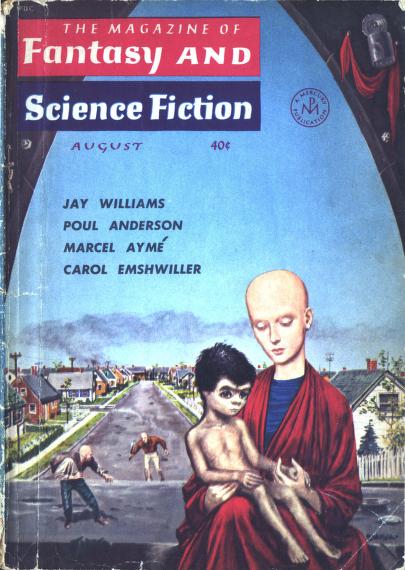
One of the things that made The Magazine of Fantasy and Science Fiction unique in its early years was its mysterious ability to attract authors who normally wouldn’t be caught dead in one of the genre magazines. In the ’50s, if you were a “serious” short story writer (and wanted the big bucks), you would aim for The Saturday Evening Post, The New Yorker, and even Playboy. Still, you had famous mainstream authors like Ray Bradbury and Shirley Jackson appearing in F&SF without issue. Ann Warren Griffith is another one of these mainstream authors, although she is leagues more obscure (at least now) than Bradbury and Jackson. According to Anthony Boucher and J. Francis McComas’s intro for “Captive Audience,” Griffith was “an actress, a librarian, a shipfitter, a pilot in the WASPS, a Red Cross ‘overseas-type girl,’ an ‘editorial assistant-type girl’ on trade magazines and, of course, a writer.” Griffith was apparently busy in several outlets, but she only wrote two SFF stories, both of them for F&SF.
Placing Coordinates
First published in the August 1953 issue of F&SF, which is on the Archive. To my surprise “Captive Audience” has been reprinted a few times over the decades, including The Best from Fantasy and Science Fiction, Third Series (ed. Anthony Boucher and J. Francis McComas), reprinting what the editors felt were the best F&SF stories from 1953. There’s also Tomorrow, Inc.: Science Fiction About Big Business (ed. Martin H. Greenberg and Joseph D. Olander), which sounds like catnip for those who want SF that satirizes American capitalism. For something that’s more recent and in print we look toward Rediscovery: Science Fiction by Women (1953-1957), edited by… somebody. I wish I knew who this person was.
Enhancing Image
This is gonna be half a review and half an essay on the nature of dystopian science fiction, because frankly I don’t have a lot to say about “Captive Audience” but I do have a fair bit more to say about how it figures into the hitory of dystopian SF. The subgenre goes back a long way—back to Yevgeny Zamyatin’s We, and even further back to E. M. Forster’s “The Machine Stops” and Jack London’s The Iron Heel, although the first of these is often cited as the prototypical dystopian SF work. Regardless, these are stories about Bad Futures™, wherein the author makes an “If this goes on—” kind of statement, in some way criticizing some aspect of what was then their current society. Dystopia is typically defined by taking a current issue and taking it to a logical extreme. For example, Ray Bradbury reacted to what he saw as TV enabling anti-intellectualism with book burnings in Fahrenheit 451, and Aldous Huxley reacted to the rampant hedonism of the 1920s by turning it into a cult of pleasure in Brave New World.
In the case of “Captive Audience” the explosive rise in consumer culture in the years following World War II is taken to an admittedly cartoonish extreme by having advertisements that talk to you constantly. It’s the near-future—so near that it more reads like a slightly altered version of the ’50s—and we’re met with Fred and Mavis, a happy well-to-do couple who in most ways embody the “ideal” affluent American family. Fred is the Assistant Vice President of Sales at MV, short for Master Ventriloquism; like most vapid shitheads he’s into marketing. Fred and Mavis make for almost a perfect couple, except Fred has to deal with a certain in-law. “Fred honestly didn’t know if he would have gone ahead and married Mavis if he’d known about her grandmother.” Grandmother has been in jail for the crime of wearing earplugs, after the Supreme Court ruled them unconstitutional since they obstruct advertising—the freedom of marketing being held higher than freedom of the individual.
I wanna say the Supreme Court would never make so assbackwards a decision, but the past few years have shown us that this is actually the most believable part of the story.
In the America of “Captive Audience,” advertising is not only virtually omnipresent, but quite vocal; even cereal boxes will sing jingles at you, which makes me wonder how these things are profitable, given the tech involved. Going back to Brave New World, advertising has so thoroughly infiltrated the human psyche that people will regurgitate jingles at each other—that they will even think about jingles and slogans as if they’re Bible passages. Both Huxley and Griffith satirize the mindless pleasure-seeking that would’ve been spreading during what were, incidentally, years of huge economic growth in the US especially. Fred and Mavis are total converts of this new pleasure-at-all-costs mindset and are thus totally devoid of humanity; these are not sympathetic characters, although it’d be hard to call them monstrous. The funniest scene hass to be where Mavis has a splitting headache and decides she needs an aspirin, only she can’t pick between the three bottles she has based on their advertising—so she takes one of each. Robert Sheckley would’ve been proud to write this bit.
As for Grandmother, she fits into this weird archetype of the one character in a dystopian narrative who remembers the beforetimes. She is apparently the only person Fred knows who rejects the ad overload of the modern age, and when she gets out of prison her rebellious attitude is liable to ruin Fred’s reputation as an upstanding citizen. Aside from the inherent joke of an old lady being a remorseless “criminal,” I do have to wonder how much time has passed since American society metamorphized into this soulless hellscape that knows not love nor individuality; given the ’50s-isms it’s probable that Griffith didn’t mean the action to take place more than a couple decades into what was then the future. Endless jingles and Muzak pollute the ears of the populace, although strangely I don’t remember television getting more than maybe a few words of attention.
As with a lot of dystopian narratives, the characters are really not the highlight of the story. Grandmother is endearing, but she’s not the protagonist, being little more than a side character who appears so as to act as a reader surrogate; otherwise we would not be able to latch onto goddamn anybody. The closest we have to a real protagonist, the character who’s faced with a problem upon which the story hinges and whose actions matter the most, is Fred, whom as I’ve said is a shell of a man. Remember how John Savage, the “hero” of Brave New World, doesn’t even appear until halfway through the novel? Anyway, while there are a few good jokes here, and while Griffith’s observations are sadly on-point, I didn’t find myself thinking about this one much as I was reading it. “Captive Audience” is socially relevant now, especially since people have become more overtly anti-advertisement and anti-capitalist (again) in recent years. It’s pessimistic in that it assumes the average American is, or will become, incredibly stupid and short-sighted, but it’s sure not boring!
There Be Spoilers Here
Rather than try to change the world or even change her relatives’ minds, Grandmother finds she’s quickly gotten sick of the outside world and opts to return to prison. Again, it’s a little funny, this old lady who’s probably buddies with actual criminals. But the implication is that prison is partly where non-conformists go, those who commit the crime of standing “in the way of progress,” as Fred puts it, although what he means by progress is unclear. The story would be perfectly satisfactory if it were to stop there, but then Fred gets the “bright” idea that Grandmother is a non-conformist because being in prison has not allowed her to adapt to the brave new world. Prisoners aren’t consumers because they’re basically slaves so there’s the question of what to do about this “problem.” Indeed, what to do…
There are several flavors of dystopian ending: there’s the protagonist-gets-their-shit-kicked-in ending, the ray-of-hope ending, the Bolivian army ending, and so on. While Grandmother does not meet a destructive end like John Savage or Winston Smith, it’s implied that she and her kind will at some point be forced to join the crowd—that the skyscraper-high iron of capitalism, a la FLCL, will smooth out the wrinkles, as it were. I say this is a comedy, but it’s a bit of a dark one.
A Step Farther Out
I chuckled a couple times. “Captive Audience” has a grim ending but it’s more or less a comedy, and unfortunately an all-too-believable one. Still I find the problem here to be the same I have when reading Robert Sheckley stories, in that there’s a point being made and I can’t tell if there’s anything beneath that one meaning we’re supposed to take from it. It’s a ten-page story that was clearly meant to be taken a certain way so I can’t fault it much, but it’s just that I tend to like stories that make me think and feel more. The characters being totally superficial was no doubt intentional, but part of me wonders if this would’ve caught my eye more as a satire if it had more of a touch of humanity to it. But hey, it’s funny!
(Cover by C. C. Senf. Weird Tales, November 1931.)
Who Goes There?
I’ve covered Robert E. Howard on this site before not long ago; actually it was just last month with one of the longer Conan serials. Howard is one of the most important voices in the history of fantasy literature and he reached truly astonishing heights and put out an intimidatingly large body of work despite having committed suicide when he was only thirty. He began writing professionally as a teenager and never stopped until his death, and even then there was a healthy amount of work released posthumously. Given how well an “immature” Howard reads, it’s nothing short of tragic that we only barely got to see his writing reach a mature state by the end, but what we have is still one of the most impressive and versatile oeuvres to come out of pulp fiction. That for some reason Howard basically never got around to writing SF is in itself a bit tragic, and one has to wonder what would’ve happened had he lived to be direct contemporaries with his descendants.
While Howard is most known for Conan the Cimmerian, Kull the Conqueror, and other adventure characters, he also wrote a ton of horror, sometimes involving series regulars like Solomon Kane but more often venturing into different territory altogether. He even got a Retro Hugo nomination for his voodoo zombie story “Pigeons from Hell,” and indeed while his horror lacks the deliberate pacing of H. P. Lovecraft or Clark Ashton Smith, he compensates with that usual Howard brand of energized plotting. Today’s story, “The Black Stone,” is very much Howard trying to write a Lovecraftian (as in it’s clearly a Lovecraft homage) tale, but for better or worse it’s better this is still Howard’s show.
Placing Coordinates
First published in the November 1931 issue of Weird Tales, later reprinted as a “classic” in the November 1953 issue. The convenient thing about Howard is that he’s famous and has also been dead for a very long time. “The Black Stone” is easy to find online for free, even being included in the Library of America’s Story of the Week program, which you can find here. If you want printed copies then you can find it in LOA’s American Fantastic Tales: Terror and the Uncanny from Poe to the Pulps, although it looks like it might be out of print. More readily available is The Horror Stories of Robert E. Howard, a delightfully thick and heavy volume which still contains only a small fraction of Howard’s output. Because “The Black Stone” is set in the Cthulhu Mythos (although it wasn’t called that when Lovecraft and Howard were alive), it’s been anthologized alongside other Lovecraftian tales, the most available of these probably being Tales of the Cthulhu Mythos.
Enhancing Image
The unnamed narrator of “The Black Stone” is a bit unusual for a Howard protagonist in that he’s not a warrior or a tough guy at all, but a bookish dweeb who travels to Hungary basically for the lulz. Okay, there’s a bit more to it than that: the narrator is a linguist and archaeologist (or something like that), and like any good protagonist in a Lovecraftian narrative he also has a soft spot for the macabre. Here we start with Von Junzt’s Nameless Cults, also known as the Black Book, with Von Junzt being a 19th century studier of the uncanny and unexplainable. “Reading what Von Junzt dared put in print arouses uneasy speculations as to what it was that he dared not tell.” During his reading of Von Junzt’s book, the narrator catches mention of a mysterious object which Von Junzt doesn’t spill much ink over but which the narrator finds himself immensely curious about: the Black Stone.
The narrator cross-references Von Junzt’s writing (however scant) about the Black Stone with a few other documents, incidentally all early-to-mid 19th century, and struggles to distinguish fact from legend—though the legend, if true, would make quite the story. The Black Stone is supposedly a black monolith standing alone in the mountains of Hungary, near a village called Stregoicavar, roughly translating to “Witch-Town.” Nobody knows who built the Black Stone, but it possesses such power that even to gaze upon it apparently causes it to haunt one’s dreams, and to watch it on Midsummer Night (early on we’re given the pagan connection) for reasons unknown have driven people to insanity, then death. The narrator, being a perfectly reasonable man (I’m kidding), decides to travel to Hungary and see for himself what the fuss is about.
Mind you that we’re only just getting started.
Howard has a talent for compressing a novel’s worth of information into a much smaller space, and “The Black Stone” might be the most stark example of this I’ve seen yet; there’s enough backstory here for a narrative ten times the length. We haven’t even gotten to the thing with the Ottoman Turks yet. Okay, so we’re in Hungary, in an especially mountainous part of the country no less, and the narrator has come to Stregoicavar to inquire about the Black Stone; first he talks with the local tavern-keeper, then a schoolmaster about the village’s history. It’s—well, it’s a long story. You see, the Hungarians in the village are fairely recent settlers; they were not the first inhabitants of the village. Centuries prior there were people in the lowlands and people in the mountains, round Stegoicavar, and these latter peoples were of a different ethnic sort. The mountain people were half-castes: “the sturdy, original Magyar-Slavic stock had mixed and intermarried with a degraded aboriginal race until the breeds had blended, producing an unsavory amalgamation.” If this sounds problematic, boy do I have a tree to sell you.
Anyway, the original half-caste people of Stregoicavar, who were apparently pagans who kidnapped women and children from the lowland people, are not around anymore; they had been exterminated by the Turks, who had swept through Stregoicavar and had not left one person standing. Which even for warfare sounds a bit extreme; one would at least expect the Turks to have taken some as slaves, but for reasons unknown they gave no quarter, ridding the village and environs of the half-caste peoples and inadvertently making way for the lowland “pure” whites to settle.
Right, so there was an invasion…
The Hungarians, in 1526, entered Stregoicavar to push back the Turks, and by this point the mountain people had already been exterminated. Count Boris Vladinoff, in a nearby castle, had acquired a chest from a slain Turkish scribe, but nobody ever opened the chest or even discovered it, as the Count died suddenly in an artillery strike and, for some reason, the ruins of his castle have never been excavated. Keep this in mind for later. So the Turks had come into Stregoicavar and then were forced to retreat, and all seemed well for the lowland peoples, who then came in to occupy the village that had been made vacant before and which was now free once again. Only… they never could figure out what the deal with the black monolith in the woods was… only they figured out, the hard way, that this is not something to be touched or even seen for long.
We had a rough idea of what the Black Stone looked like before, but it’s only upon the narrator inspecting it first-hand that we get a detailed description. Mind you this is only part of a very long paragraph:
It was octagonal in shape, some sixteen feet in height and about a foot and a half thick. It had once evidently been highly polished, but now the surface was thickly dinted as if savage efforts had been made to demolish it; but the hammers had done little more than to flake off small bits of stone and mutilate the characters which once had evidently marched in a spiraling line round and round the shaft to the top. Up to ten feet from the base these characters were almost completely blotted out, so that it was very difficult to trace their direction. Higher up they were plainer, and I managed to squirm part of the way up the shaft and scan them at close range. All were more or less defaced, but I was positive that they symbolized no language now remembered on the face of the earth.
The engravings on the monolith would have only made sense to the original worshippers, who, all being dead now, no longer have opportunity to explain it to our unusually curious narrator. Personally I would’ve just fucked right off if I found this thing in the woods, but then I also wouldn’t be caught dead going to some backwater corner of Hungary. And yet the mysteriousness of the Black Stone has its allure, no doubt, and because Our Hero™ is a dumbass he thinks it would be just swell if he were to camp out in the vicinity and catch the monolith do its supposed freaky thing on Midsummer Night. Now, if you know even a little bit about paganism (or Hollywood depictions of paganism—I’m glancing warily at Midsommar) then you can predict the pagan connection and what will come next. What intrigues me, and what held my attention so sternly when reading this story, was how Howard couched what should be a derivative (and somewhat offensive) devil-worshipper narrative in so much history and lore.
I won’t spend much time talking about the back end of the story, partly because it’s at this point that we’re funneled from a busy backstory to a relatively straightforward plot in the present, and partly because I’ll be brutally honest with you, my beloved reader, for a second here: I’m pressed for time and while I’d love to write more about what’s probably my favorite horror story of Howard’s so far (I’ve read several), I must surely be on my way and meet the deadline I’ve set for myself.
There Be Spoilers Here
On Midsummer Night the narrator sets up camp near (but not too close) the monolith, presumably with some popcorm that he had microwaved in advance. I don’t know what this dude is expecting. Regardless, something very strange happens: Our Hero™ gets a free show that he didn’t expect, and ultimately he very much will not want. People start gathering round the Black Stone and, in one of those things silly old-timey people think pagans do, they dance around it and make some real noise. There’s a masked man with a thing round his neck that looks like it’s meant to carry a jewel, or perhaps a small idol, which the narrator deduces is a priest or elder of the cult. We’re then presented with a young naked woman and infant—possibly hers, possibly not; I don’t know which possibility is worse.
In what genuinely reminds me of a scene out of Blood Meridian, the priest takes the infant and, swinging it around, slams it down AND BASHES ITS FUCKING SKULL IN. WHAT THE FUCK? I mean, the Conan stories I’ve read have been violent as shit, but this is the single most gut-churning bit of violence I’ve read from him yet. The woman herself is beaten pretty severely, to the point where when she crawls toward the monolith she leaves a trail of blood in the grass, which can’t be good.
But that’s not the worst part of; well actually it is the worst part, but it’s not the only thing that would make you run in the opposite direction really fast. In the climax of the blood sacrifice, the mad priest has seemingly conjured a thing which the bloodied woman is meant to satisfy. “I opened my mouth to scream my horror and loathing, but only a dry rattle sounded; a huge monstrous toad-like thing squatted on the top of the monolith!” The toad-like creature, certainly not human but perhaps eerily close enough to humanoid, accepts the woman, although we never find out exactly happens to her—though probably her fate is similar to the baby’s. To make things even stranger, when the narrator wakes up (after having passed out), there is not even one sign of what had happened the previous night—no blood, no footprints in the grass, nothing.
And yet it was certainly not something he had imagined!
The narrator, working tirelessly, finds the castle of the late Count (who, mind you, would’ve been dead about 400 years) and uncovers what the Count had taken from the Turkish scribe, who had been so spooked by what he’d found that he never told anyone about it. In the Count’s chest of things is a parchment with Turkish writing, which the narrator can only make out pieces of—but enough to get the picture. More importantly he finds an idol of the toad-like creature—an idol which the priest would have been wearing during the sacrifice. The bad news is that what narrator saw last night was not a dream or him tripping balls; the good news is that he was not seeing a blood sacrifice in real time, but the projection of one. The people who worshipped this abomination have been dead for centuries, and even the creature itself had been slain “with flame and ancient steel blessed in old times by Muhammad, and with incantations that were old when Arabia was young.” So yeah, the Turks were basically in the right to massacre the village, as they murdered the cultists and their god.
At the end the narrator gets rids of the parchment and idol, drowning them in a river where hopefully no one will find them. Unusually for a Lovecraftian protagonist there’s no implication that the narrator will go insane or kill himself at the end; he is able, somehow, to retain his sanity, if only by the skin of his teeth. (Howard’s characters generally have stronger willpowers than Lovecraft’s.) And yet the knowledge that there may be other such beasts which walk the earth and acquire human worshippers may prove too much in the long run, and because this story got incorporated into the Cthulhu Mythos we know this much to be true.
A Step Farther Out
Apparently Howard got hooked on “The Rats in the Walls,” which distinctly is not cosmic horror (even the supernatural aspect is debatable) but which carries the theme of ancestral memories. Not unlike “The Rats in the Walls,” “The Black Stone” is intriguing partly because of its problematic elements; there’s some language Howard uses that’s rather unfortunate, and the topic of genocide is handled crassly. There’s racism crammed in which sadly is inextricably linked with the horror element; the fear of race-mixing, of “pure” white blood being tainted with something else, seems a chestnut of classic cosmic horror. At the same time, Howard does things here that Lovecraft probably wouldn’t, including a gruesome climax that juxtaposes pagan sexuality with death. The setting is also pretty unique, taking us away from even the outskirts of urbanity and placing us somewhere very distant from America or even modern civilization. A lot of the story’s eeriness is accomplished simply through Howard’s use of the location, and in things that took place long before the narrator was even born. The backstory has more meat than the story proper, which in this case is not really a negative; the backstory is the pearl inside the mollusk.
Is it assbackwards that I’ve reviewed a Cthulhu Mythos tale written by someone who is not Lovecraft before I got to Lovecraft himself? Well yes—but don’t worry, we’ll be getting to Lovecraft, and one of his more famous short stories, soon… very soon…
Do I really need to introduce you to Stephen King? Nah, I don’t. So this is not so much a cursory look at King’s life and works as my own personal experience with him, because I have to admit, I was slow to read King at all. A lot of people have probably read him in high school, but I didn’t read a single word of his until I was in college; that’s not a gloat or anything, that’s just the reality of the situation. Had I read King earlier I probably would’ve been more entranced. My first exposure to King was “The Gunslinger,” the short story that later became part of the novel of the same name, the first in his Dark Tower series. I remember basically nothing about it. But later I read Different Seasons, his novella collection (although I will die on the hill of arguing Apt Pupil and The Body are full novels), which was sort of a mixed experience but mostly positive, although honestly The Shawshank Redemption improves on its source material in several ways.
Then last year I read ‘Salem’s Lot, his second novel, and I was sort of impressed; I love the first half and while the second half is oddly not nearly as scary (it loses its foreboding tone once the vampire-hunting gets underway), I liked that too. Good novel, even if it proved to be ground zero for so many of King’s… well, let’s call them quirks. King has written a lot. Like a fuckton. Like it’s intimidating to see just how many novels he’s written, although his list of short works is more manageable. Point being, King inevitably repeats himself; he has a list of go-to tropes and plot devices, and probably even turns of phrase that he can resort to over and over. I don’t really blame him: Philip K. Dick had a set of formulae too. But it’s also easy to poke fun at King’s tendency to, for example, set a given story in his home state of Maine—although today’s tale is an exception.
Despite being labeled a horror author, King has at least dabbled in pretty much every genre you can think of, including some good ol’ science fiction. “The Jaunt” is one of his more famous short stories (admittedly his short stories are not nearly as famous as his novels and novellas), and it’s the most pronounced example of him combining SF with horror in that both genres about equally play off each other here.
Placing Coordinates
First published in the June 1981 issue of Twilight Zone Magazine. Because this is a King story from his prime era it’s very easy to find in print. The obvious choice is Skeleton Crew, which contains, among other things, The Mist. (I don’t know why I got The Mist as a standalone paperback, that was a waste of money. Actually several of King’s novellas have been resold as standalone paperbacks despite being only marginally cheaper than the collections they appear in.) The weird thing about “The Jaunt” is that it hasn’t been anthologized much; in four decades it’s been anthologized in English only a couple times.
Enhancing Image
Mark is taking his family for a business trip; in the old days they would’ve taken a ship to Mars, but with the Jaunt they can fall asleep and wake up at their destination in what feels like seconds. The Jaunt (with a capital J) is a revolutionary method of transportation that has made moving things and people between planets as easy as possible. Mark has Jaunted before but his wife Marilys and son Ricky and daughter Patty have not before. As they’re waiting to get a hit of sleeping gas (you have to be rendered unconscious before Jaunting), Mark passes the time and indulges his kids’ curiosity by telling them the story of how teleportation was invented; the kids would know little bits and pieces already, but Mark decides to tell them enough of the story, if not all the grisly details.
A few things to note before we get into that origin story…
King would’ve written “The Jaunt” circa 1980, or maybe earlier, and indeed this could not have been written any later than the early ’80s with how much it explicitly references OPEC and the oil crisis in the ’70s—a rather specific period in American history that the characters in this far-future setting treat like it was a recent and life-changing happening. I find this funny, because while the oil crisis no doubt impacted millions of Americans who were there to live through it, even people born, say, 1990 and later would have basically no context or sense of attachment with that period. The story shows its age by using what was then a recent time in history and overestimating how people in the future would relate to said time. Jaunting would be considered a monumental breakthrough in transportation regardless of when it was invented, but while King’s decision to date the story may seem superfluous, it does what most if not all science fiction sets out to do: not to predict the future but to comment on the present.
Also, if you’re a seasoned SF reader then you probably thought of jaunting (lower case l) as depicted in Alfred Bester’s The Stars My Destination, which was by no means the first use of teleportation in SF but definitely had one of the most creative and influential uses. I figured, even before starting to read this one, that “The Jaunt” was harking to Bester’s novel, and that it would subvert our expectations about the mechanics of teleportation in some way since it’s clearly a horror story. Rather than let the reference go unspoken, though, King goes out of his way to let you know that he too manages to fit reading science fiction into his no doubt busy schedule. It’s one of those hat tips to fandom that makes me roll my eyes, but it also makes me wonder if “The Jaunt” would’ve gotten a Hugo nomination had it been published in an SF (and not horror) magazine.
Get this:
“Sometimes in college chemistry and physics they call it the Carew Process, but it’s really teleportation, and it was Carew himself—if you can believe the stories—who named it ‘the Jaunt.’ He was a science fiction reader, and there’s a story by a man named Alfred Bester, The Stars My Destination it’s called, and this fellow Bester made up the word ‘jaunte’ for teleportation in it. Except in his book, you could Jaunt just by thinking about it, and we can’t really do that.”
Anyway, about Victor Carew. The Carew story is when “The Jaunt” starts to grab my attention and as far as I’m concerned it’s the good SF-horror story that, like one of those Russian toys, is nestled inside a less scary and more cliched story. Carew was a scientist who struggled to retain autonomy while under government surveillance, using a barn as a makeshift laboratory and, like Jeff Goldblum’s character in The Fly, using this space to work on teleportation. The good news is that he finds that inanimate objects can be teleported from Portal A to Portal B with no issues; this alone would’ve revolutionized transportation, being able to move cargo between whole planets without a human driver. But of course this is sort of a cautionary tale and Carew does something that sounds reasonable but which will prove to have very mixed results: teleporting living things.
Having experimented on himself partly (he “loses” two fingers), Carew wonders if something can go through Portal A wholesale and come out of Portal B unscathed. Now, rather than experiment on people, Carew does the sane thing and tests Jaunting on animals—more specifically white mice. The mice (King erroneously calls them rats at one point) unfortunattely don’t fare well with teleportation: they come out the other end seemingly unharmed, but every one them dies soon after Jaunting. What’s more interesting is that if a mouse is put through Portal A tail-first and only partly subjected to the Jaunt, such that their head is still on the side of Portal A, they’re fine; if they’re put in head-first, however, with their head at Portal B and their tail at Portal A, they die even if they’re not completely teleported. Clearly then the mice dying has something to do with vision—what they’re seeing at that point between Portal A and B.
“What the hell is in there?” Carew wonders. Indeed.
I was wondering if King would go in a body horror or cosmic horror direction with this, and turns out it’s a bit of both. The body horror stems from how teleportation, if done gradually, reveals the insides of anything being teleported, such that we’re able to see the organs of the mice as they’re put slowly through the portal. The effect is uncanny and King, admirably, doesn’t dwell on it for too long, since he has another trick up his sleeve—that being the cosmic aspect. You see, teleportation takes a tiney fraction of a second, but during that incredibly brief time the subjective time it takes to Jaunt is enormous, although Carew does not realize this immediately. After all, the mice, aside from acting dazed when they come out the other end, don’t show any physical signs of being on the brink of death. What, then, could be killing them? Doesn’t matter, at least to the government, because Jaunting works and it’s about to change everything.
The results of the announcement of the Jaunt—of working teleportation—on October 19th, 1988, was a hammerstroke of worldwide excitement and economic upheaval. On the world money markets, the battered old American dollar suddenly skyrocketed through the roof. People who had bought gold at eight hundred and six dollars an ounce suddenly found that a pound of gold would bring something less than twelve hundred dollars. In the year between the announcement of the Jaunt and the first working Jaunt-Stations in New York and L.A., the stock market climbed a little over two hundred points. The price of oil dropped only seventy cents a barrel, but by 1994, with Jaunt-Stations crisscrossing the U.S. at the pressure-points of seventy major cities, OPEC solidarity had been cracked, and the price of oil began to tumble. By 1998, with Stations in most free world cities and goods routinely Jaunted between Toyko [sic] and Paris, Paris and London, London and New York, New York and Berlin, oil had dropped to fourteen dollars a barrel. By 2006, when people at last began to use the Jaunt on a regular basis, the stock market had leveled off seven hundred points above its 1987 levels and oil was selling for six dollars a barrel.
By 2006, oil had become what it had been in 1906: a toy.
Again I’m amused that King made the invention of teleportation so close to what would’ve then been the present day. What is he trying to say here? Genuine question, although I have to think it has to do with what was then (and still is, really) a mad search not only for alternative energy sources but to make those sources commercially viable. Sadly he doesn’t go deeper into the socio-economic implications of Jaunting (I imagine truckers would be mad about being out of a job), but he does enough that we’re given a juicy slice of how society in the future could be changed radically. And hell, even if you consider the negatives, the environmental consequences (there don’t seem to be any drawbacks in this regard) alone would make Jaunting a godsend not just for most people but for life on Earth generally.
A shame about those who Jaunt while still awake…
There Be Spoilers Here
Turns out Jaunting does have a physical effect on people, and there’s a reason why Carew is not able to see that by testing on the white mice. Apparently Jaunting while awake (although not when asleep, weird) turns your hair white (assuming it’s not already) while also aging you massively—physically, with the hair, but especially mentally. I’m embarrassed actually that it took until mere minutes prior to my writing this that the reason why Carew doesn’t see a physical change in the mice is that their coats are already white. In fairness the mice having their coats unchanged is a detail that’s unusually subtle by King’s standards, and it makes me think about how much better “The Jaunt” could’ve been had he put more of that storytelling discipline into action. I know I may sound unfairly harsh to the most popular horror author of all time, but King really does have moments where he’s able to push himself to the realm of true artistry, something higher than workmanlike technique; sometimes he really doesn’t, though.
(My favorite King short story is still “The Reach,” which is an unusually low-key outing for him, though that paid off with a World Fantasy Award win. It’s refined and effective as both a ghost story and simply as a work of fiction, and if you want prime King then I’d say that’s an example.)
So now we’re at the end. The time has come for Mark and his family to Jaunt to Mars; they get the gas and at first everything seems fine when they arrive at the other end. The only thing is that Ricky, being a dumbass, intentionally held his breath during the gassing and stayed conscious during the Jaunt, with predictably horrific results. Like with other people who supposedly stayed conscious during the Jaunt he comes out the other end with his hair snow-white, only this time, rather than being dazed like the mice, Ricky is laughing mad to the point of clawing his own eyes out while he cackles. Presumably Ricky will not live long, and to say this trip for the family proves traumatic would be an understatement.
A few questions:
Since the Jaunt has been proved to be potentially deadly, and in a dramatic fashion at that, you’d think there’d be more safety measures. I get that if “The Cold Equations” can work in spite of how implausible its situation is then so can “The Jaunt,” but with the former I get the feeling (well actually we know this from correspondence between John W. Campbell and author Tom Godwin) that the decision to forego measures that would’ve saved the girl in that story was deliberate, whereas in “The Jaunt” it feels like a way for King to sneak in a scary ending.
If all it takes for someone to stay awake during the Jaunt is so just hold their breath when being gassed, shouldn’t there be more cases like this? We’re given the impression that surely no one would be stupid enough to do that, given that Ricky is shown to be only a mildly stupid child, shouldn’t there be more cases of children dying from the Jaunt? I know that sounds morbid, but surely it’s no more morbid than quite a bit of what King’s written over the years.
Come to think of it, how come the attendants didn’t notice that Ricky wasn’t inhailing the gas? Couldn’t they tell? Shouldn’t there be some kind of backup measure to make sure that someone is unconscious before Jaunting? You have a two-step authentication process to check your damn bank statements on your phone, there should probably be something extra here. Not that the story as a whole doesn’t work, but the ending specifically would not be allowed to happen if even rudimentary safety measures were in place.
Children should probably not be allowed to Jaunt, right? It sounds like too much of a safety hazard. I know the obvious counter-argument would be that children are allowed in cars all the time and cars kill far more people in a year than sharks and airplane accidents combined (by like a lot), but there are also measures in place to try to minimize car fatalities. Granted, when “The Jaunt” was being written cars were far less safe than now and some people even today are reckless enough to cheat around using seatbelts. Still, the red tape for a Jaunting accident involving a child would be tremendous.
Anyway, even if I ignored the leap in logic, it’s too over the top for me to find scary. Ricky, a character whom we’ve gotten to know very little up to this point, does something monumentally stupid so that we can get a shocker ending. You could argue that it justifies the frame narrative, since otherwise the story just ends once Mark is done telling the story within the story, but I’d retort by saying that at least if the frame narrative is gonna be here at all then an ambiguous and moody ending would do better. We already had some body horror earlier that was creative and restrained enough that King left a good deal to the imagination. Personally I think we could’ve done without the frame narrative entirely; it’s not like Mark and his family are more compelling voices than Carew, and I was far more gripped by the substance of the story that’s being framed than how it was being framed.
A Step Farther Out
Kinda mixed on this one. There’s a pretty interesting SF-horror narrative nestled within a rather pointless frame narrative that not only verges on cornball but has a twist so obvious that it can be seen from orbit. It wouldn’t take too much to reframe the narrative in a documentary-like fashion, like Lovecraft’s “The Call of Cthulhu” and “The Dunwich Horror,” wherein we’re like witnesses to a series of realistic but supernatural events. Unfortunately that requires a degree of restraint that King fails to practice here, and the result is ultimately too overblown for me to be genuinely spooked by. On the bright side, it’s memorable! King is aware that readers, even in 1981, are well aware of teleportation as a genre chestnut and tries admirably to subvert our expectations regarding this technology. That he’s able to conjure something menacing out of tech that, realistically, would change society for the better, is a sign of talent. It’s just a shame that the execution renders the story not all that scary, and also maybe too self-conscious.
(Cover by Luis Lasahido. Lightspeed, December 2012.)
Who Goes There?
The 2010s was the decade that Chinese SFF, which had been quite active in its native country for some years, broke into the Anglosphere unequivocally and irreversibly, and while such a phenomenon is complex, necessitating the actions of many talented people, perhaps no individual marked this shift more than Ken Liu. As an author, translator, and editor, Liu has marked the point where Chinese and American SFF meet, in his own fiction and in his efforts to bring Chinese authors (most famously Cixin Liu) to the English reading public. For better or worse, he’s by far the leading ambassador for a whole generation of authors, the result being that the formidable quality of his own fiction can get overshadowed. Liu himself won back-to-back Hugos for his short stories “The Paper Menagerie” and “Mono no Aware,” both about transplanted Asian protagonists (Chinese and Japanese, respectively) who must contend with their heritage. Despite the intensity of some of his fiction, it’s never less than humane, with Liu curiously managing to combine tenderness with a confrontational focus of vision.
On top of being one of the best short story writers of the current era, Liu was, at least up until a few years ago, one of the most prolific. From 2010 to about 2015 (incidentally when his debut novel, The Way of Kings, was published) he wrote what must’ve been at least a dozen short stories and novellas a year, with some of these even getting adapted. His short story “Good Hunting” was adapted into one of the better Love, Death & Robots episodes while a connected series of short stories served as the basis for the animated series Pantheon. His most recent novel, Speaking Bones, the latest in the increasingly epic (and long) Dandelion Dynasty series, came out in 2022 from Saga Press.
Placing Coordinates
“The Perfect Match” was published in the December 2012 issue of Lightspeed, and you can read it online for free here. The bad news is that this story has only been reprinted in English twice; the good news is that they’re both pretty easy to find new copies of. First we have the Liu collection The Paper Menagerie and Other Stories, which I have proudly on my shelf and which I would say is essential for anyone wanting to catch up on one of the masters of “modern” SFF. The second is the anthology Brave New Worlds, edited by John Joseph Adams, although I have to warn you that there are two editions of this book and the first does not include “The Perfect Match,” with Liu’s story apparently being added at the last minute to the second. Given that Brave New Worlds is about dystopian SF, it doesn’t take a rocket scientist to figure out what we’ll be dealing with here…
Enhancing Image
Sai is a pretty average dude who works a job he likes enough and who, while currently single, got out of an amicable relationship and is ready to get back on that horse—all too easy to do, given that his AI helper, Tilly, is able to match him with any woman whose interests most closely match his own. Tilly is like Alexa if Alexa was also a dating app that didn’t suck. Make no mistake, though, Tilly is not a character; she’s only slightly more advanced than the “AIs” we currently have, in that she’s not actually sentient, but rather an extension of a program. Like Alexa, or hell, Joy from Blade Runner 2049, her seeming femininity is meant to be a cushion, because unconsciously we want a motherly figure who cares for us and yet who does not need or want to be intimate with us.
I’m saying all this up front because both the title and the opening section of the story make it sound like it’s about romance, which it really isn’t. A shame too, because once I realized where the plot was heading I became somewhat less interested, if only because on paper you’ve seen this story literally a hundred times before if you’re a genre veteran. Anyway, Tilly recommends Sai this woman, name not important, who sounds like a great match for him, except their date doesn’t go so perfectly—not because of the woman, but because recently Sai has been having some intrusive thoughts. It has to do with Jenny, his paranoid neighbor whom he doesn’t see much and who comes off as a neo-Luddite, yet there’s something alluring about her. What’s her deal? Not that it takes too long for him to find out.
Talking to Jenny was like talking to one of his grandmother’s friends who refused to use Centillion email or get a ShareAll account because they were afraid of having “the computer” know “all their business”—except that as far as he could tell, Jenny was his age. She had grown up a digital native, but somehow had missed the ethos of sharing.
This may sound familiar. You have the male protagonist who starts out a sleeper in a world he thinks to be swell but is actually shit, only to have the sleeper awoken by a rebellious woman; for some reason it’s always this dynamic, with a man being driven to rebellion via awakening, both having his eyes opened metaphorically to the world around him but also often being awakened sexually. If you’ve read George Orwell’s 1984 or Yevgeny Zamyatin’s We then you know how this will play out generally (although for the sake of the rest of us I’ll save the later plot developments for spoilers), and even more so if you’ve read the seemingly endless supply of dystopian fiction inspired by those novels. Sai and Jenny are based on archetypes, and for all his narrative craftsmanship (the story moves along at a brisk but natural pace), Liu does little to subvert those archetypes.
Can we talk about how 1984 totally FUCKED UP the very idea of writing dystopian SF? Not that it was Orwell’s fault, he was simply reacting to what was then a rising approval of Stalinism among the Western left, seeing authoritarian socialism as no better than capitalism and possibly in some ways being even worse. The problem is that the characters, plot beats, and overall message of 1984, when not misunderstood (which they often are, most conspicuously by right-wingers), have become so diluted that the novel doesn’t even read like a novel anymore so much as a blueprint for writing baby’s first dystopian narrative. Every other male lead is an analogue for Winston, every other rebellious female love interest is an analogue for Julia, and O’Brien… well, we’ll get to O’Brien later, because he also sort of gets an analogue in “The Perfect Match.”
When Sai meets Jenny again, post-date, something has changed for Sai and by extension the two of them. As I’ve said Jenny is the rebellious woman, and detecting this change in Sai she invites him inside. How did she figure this change? Because Sai got home off-schedule, for the first time ever; he has a rigid routine and thanks to Tilly he’s constantly reminded to keep to that routine. Yet his dissatisfaction with the date has led him home off-schedule, and so Jenny wonders if maybe she can recruit him for a scheme she has in mind. The thing is that while Sai has begun questioning his life a bit, he’s still of the conviction that the corporate-run future of his world is benevolent, that Tilly has his best interests at heart, that he’s a free individual despite his lack of personality.
Jenny has some words about that.
“Look at you. You’ve agreed to have cameras observe your every move, to have every thought, word, interaction recorded in some distant data center so that algorithms could be run over them, mining them for data that marketers pay for.
“Now you’ve got nothing left that’s private, nothing that’s yours and yours alone. Centillion owns all of you. You don’t even know who you are any more. You buy what Centillion wants you to buy; you read what Centillion suggests you read; you date who Centillion thinks you should date. But are you really happy?”
Prior to the story’s beginning Sai was presumably content, but he was probably never happy and he certainly was never free. I don’t know if this Ken Liu’s actual worldview, but I suspect he’s of the opinion that conflict is necessary for happiness. Sai faced basically no conflict prior to the story and thus he was deprived of happiness, but interestingly, once conflict enters his life, his range of emotions is widened, his horizons expanded. Once he ditches the notion of perfection and living a totally peaceful (i.e., boring) life he starts to feel things, which like anything transformative can be traumatizing but also a positive force ultimately. Sai’s budding relationship with Jenny (see the aforementioned metaphorical and sexual awakening) is just a bonus, and not really a convincing one. Liu has written romance well elsewhere, but in “The Perfect Match” it’s done because other dystopian narratives have done it and also because it moves the plot along.
This may sound vaguely militaristic, but conflict builds character. The conflict doesn’t have to be violent or earth-shattering, mind you, it can be as banal as deciding whether to order an Uber or to call a friend who lives nearby. A character’s capacity to make decisions (and this applies to both fictional characters and real people) is what makes that character, which admittedly is why I feel Jenny is more of a plot device than a real person; she does everything we think she’s going to do and she doesn’t go off her own script, never mind the dystopian SF cliches she tosses at Sai. But Sai, on the other hand, contradicts himself and prevents himself from being totally consistent, which, aside from him being the POV character, makes him feel more flesh-and-blood, never more shown than in the climax.
There Be Spoilers Here
Jenny has this hacking scheme wherein Sai, who’s already a corporate worker, sneaks in a virus that will basically fry Tilly by corrupting her with false data. Not that the world would be saved all of a sudden, but it would be a good start. Sai had turned off his phone when he first met up with Jenny and from then on the two made sure there was no way for Centillion (the company behind Tilly) to spy on them. At first the hacking seems to have worked! Only for, you guessed it, Sai and Tilly to be placed under arrest and shown to Christian Rinn, the big cheese at Centillion himself. I had legitimately forgotten this dude’s name and I didn’t put it down in my notes; his name really is not important.
What’s important is that Rinn is this story’s version of O’Brien, except he had no pretense of being a rebel, just somebody who waited off-screen for Our Heroes™ to make their move. Thinking about it, Rinn first slightly more into the same category as Mustapha Mond from Brave New World (if you remember that guy), who lectures John Savage and friends in that novel’s climax about why the world as they know it works the way it does and why an authoritarian like Mond is totally in the right. Rinn’s justification for Centillion tech monopoly is basically that it was inevitable—not because of how technology is advancing or because people want to feel “safe,” but because technology serves to make people’s lives more convenient. People want as much convenience as possible and companies like Centillion are only too happy to oblige.
In fairness to Rinn, he is objectively correct. How do you undo this? How would you turn back the clock on how technology figures into our lives? It’s not like you can nuke civilization back to the dark ages, that would be comically evil and also wildly impractical. Liu seems to be making the argument that while progress as seen in-story is not exactly “good,” it is progress, and progress will not be defied. There is no feasible way, especially for two people, to take down a whole system like this. This shouldn’t come as a surprise, but how did Centillion even find out about the hack? By tracking Sai’s phone. And they were not even unaware of Jenny’s doings. The hacking was never gonna work, although I just assumed that would be the case anyway. Because we can’t have happy endings with this sort of thing, right?
Well, it’s not all bad. Whereas Winston Smith and John Savage awaken to the hell they live in and get completely fucking destroyed for their troubles, Sai comes out of the deal unharmed—not just physically but also he’s about as psychologically adept as he’s ever been. While Sai and Jenny are all but blackmailed into working for Centillion at the end, the fire of rebellion has clearly not gone out in Sai’s heart, and his traumatic awakening has made him into more of an individual. You might be able to defeat the system, sure, but you as a free-thinking person can resist it…
A Step Farther Out
A little mini-rant for my final thoughts. A common misconception about SF, which has been around for decades and which persists in a lot of modern discourse (more so for people outside of fandom), is that SF works to predict the future. This is very obviously bullshit. Like SF so clearly is not predictive that it’s laughable, and true enough we often poke fun at old-timey SF wherein the “predictions” were dead wrong. No, we did not get fully functioning androids by 2019 a la Blade Runner, although Los Angeles certainly became more of a smog-covered shithole by that point. No, we did not get immense overpopulation and death of the oceans by 2022 like in Soylent Green. Whenever an SF writer puts out a future date it’s basically a placeholder, to let us know that the action is happening in the future and not in our present; it’s not supposed to be the author’s actual prediction of what things will be like by a given year.
Liu wisely refrains from putting a date on “The Perfect Match,” which after all is a future society that basically doesn’t seem all that futuristic. There isn’t anything totally out there in terms of technology being showcased here; everything we read about in-story is feasible, indeed (Liu would argue) it’s likely to be realized. When an SF story is called “prescient” or “ahead of its time,” this is just a little bit insulting to the author, even if it feels true to us. Don’t worry, I’ve done it many times myself. So if someone were to remark about this story, “Wow, Ken Liu was being prescient with this one,” they’re making the incorrect assumption that Liu in 2012 was predicting what have by now become the clear dangers of technocracy, as opposed to extrapolating on what he sensed was a growing trend at the time. “Extrapolation” is maybe the biggest key word to understanding SF.
“The Perfect Match” is somewhat derivative, but it certainly feels modern in its concerns, which sounds lame considering 2012 was not that long ago, but for all of us a great deal has changed since that time. Hell, I was in high school in 2012, a portion of my life that now feels totally alien to me. And while the ending isn’t a happy one, it leaves room for hope on the micro scale, if not the macro one, which for a dystopian narrative is good enough.
Ursula K. Le Guin is one of the most lauded SFF writers of the 20th century, by far; it’s not even close. She made her genre debut in 1962, already in her thirties, and while she was a bit slow to start she managed to kick off both of her most famous series by the end of that decade: Earthsea and the Hainish cycle. (I remember some people in middle school reading A Wizard of Earthsea, but I didn’t read it myself until years later.) From the ’60s until her death in 2018, Le Guin was not only crowned as one of the field’s great storytellers but as one of its very few sagely figures; there’s a Twitter bot that posts nuggets of Le Guin’s wisdom daily. Of course, it can be a bit stifling to have to contend with someone who apparently never said or did anything wrong—who is treated by many as a saint. The result is someone who is most fascinating (in my opinion) when she is dealing with human faults and the inherent conflict of sentient existence; she is not, as it were, something to packed inside a fortune cookie or an automated Twitter account.
What’s really impressive about Le Guin is her versatility. Aside from being equally comfortable with SF and fantasy writing, there are also few authors (anywhere, not just in the field) who wear as many hats as Le Guin does. There’s Le Guin the sociologist, Le Guin the feminist, Le Guin the Taoist, Le Guin the anarchist, Le Guin the pacifist, Le Guin the teller of tall tales, and often these hats are not mutually exclusive. Much as I love guys like Philip K. Dick and Robert Heinlein, they very much have formulas (or in Heinlein’s case fetishes), whereas Le Guin is harder to pin down, and even when she was in the fourth decade of her career she was still, as Joseph Conrad would put it, “striking out for a new destiny.” Today’s short story, “Mountain Ways,” is part of the Hainish cycle, a grand continuity Le Guin had abandoned midway into the ’70s but then returned to in the ’90s. It’s late Le Guin, but that’s not a mark against it!
Now, a brief rant…
“Mountain Ways” won the James Tiptree, Jr. Award, which is now called the Otherwise Award. The James Tiptree, Jr. Award is bestowed upon SFF which explores gender; it’s a reference to the fact that Tiptree was a pseudonym for a woman, Alice Sheldon, but it also makes sense since much of “Tiptree’s” writing is concerned with gender relations and women’s precarious status in a world where men almost without exception hold the most power. Recently the award’s name was changed, on account of the contentious circumstances surrounding Sheldon’s death. This was really fucking stupid. This is not the same as, say, the John W. Campbell Award for Best New Writer being renamed the Astounding Award; I don’t entirely agree with the rationale behind that award being renamed, but I can at least sympathize with the people calling for that change. The story behind Tiptree is too complicated for me to recount here (I’ll cover her more in-depth later, don’t worry), but I just think that, regardless of how well-intentioned the change was, erasing Tiptree’s achievements like this was monstrously stupid, even in bad taste. It should be corrected as soon as possible.
Placing Coordinates
First published in the August 1996 issue of Asimov’s Science Fiction, which is on the Archive. If that’s not good enough then just know it was reprinted online FOR FREE in the March 2014 issue of Clarkesworld, so you have no excuse! We have a few book reprints of interest, including the Le Guin collection The Birthday of the World and Other Stories, along with the Library of America box set containing the entire Hainish cycle. Le Guin is one of the few SFF authors to get LOA editions, although weirdly they have not collected the Earthsea series. There’s also the anthology The Mammoth Book of SF Stories by Women, edited by Alex Dally MacFarlane, which might still be in print? I’m not sure. With this story the reprints are a matter of quality over quantity; it’s hard to go wrong with the options.
Enhancing Image
We get an author’s note from Le Guin at the very beginning, detailing the most unusual aspect of human culture on the planet O: its version of polygamy. I say “version of” because while polygamy is the norm on O, its setup is both convoluted and conservative. You have four people, two mena dn two women, who each come from different clans; you have a Morning man and a Morning woman, as well as an Evening man and an Evening woman. The Morning man is allowed, within the marriage, to have sex with the Evening man and the Evening woman (homosexuality is not taboo here, but as we’ll see there are other problems), BUT he is prohibited from having sex with the Morning woman. While it does involve four people, the plural marriage typical of O is effectively four pairings mingled together with certain arbitrary restrictions.
The main characters of “Mountain Ways” are a Morning woman and an Evening woman, named Shahes and Akal respectively. Shahes is the daughter of a marriage that sadly is now half-empty, since the Evening partners died in an accident, leaving the Morning partners “widowed” despite the fact that they still have each other. The setting, in broad strokes, will strike some readers as familiar, since it is mountainous farmland, not unlike rural Switzerland or the landscape of Alberta, Canada. Also not unlike the rural Swiss, the people of these mountains are a conservative lot, with their strict adherence to their version of polygamy being a fine example of Le Guin subverting our expectations at the outset. In the real world, the traditionalists are always the ones crying for strict monogamy, with even groups with histories of polygamy like the Mormons now being staunch monogamists (just reminding myself to chew out Orson Scott Card when I inevitably review something of his), but here it’s quite the opposite.
The people up there in the mountains are civilized but not very civilized. Like most ki’O they pride themselves on doing things the way they’ve always been done, but in fact they are a willful, stubborn lot who change the rules to suit themselves and then say the people “down there” don’t know the rules, don’t honor the old ways, the true ki’O ways, the mountain ways.
Akal, who goes at first by the religous name of Enno, comes to Shahes’s place as a farm hand, and a pretty able one; she’s taller than the average woman, and while her occupation has been as a religious scholar, she has not exactly lived a pampered life. It takes all of about five minutes for Shahes and Akal to fall in love—and by that I mean they start fucking at the first opportunity. Their love affair is a fast and furious one, and it doesn’t take long for them to pledge their whole selves to each other and all that, except there’s one problem that faces them: they can’t get married. Sure, as Morning and Evening women they could love each other to their hearts’ content within a group marriage, but that would require two extra people. In the area there is one viable (by that we mean desirable) Morning man, named Otorra, but even if he were to say yes that still left the problem of an Evening man.
Unless…?
Shahes suggests that Akal go away for some months and returns disguised as an Evening man; she thinks it’s positive because Akal, who already has a masculine physique, could pass off as a man, and also because people in the area know Akal by her religious name, not her true name. What would happen then if that Shahes would ask Temly, a woman she likes enough and with whom she’s had intimate relations before, to become the Evening woman in the marriage while Akal becomes the Evening “man.”
Akal stared through the dark at Shahes, speechless. Finally she said, “What you’re proposing is that I go away now and come back after half a year dressed as a man. And marry you and Temly and a man I never met. And live here the rest of my life pretending to be a man. And nobody is going to guess who I am or see through it or object to it. Least of all my husband.”
“He doesn’t matter.”
“Yes he does,” said Akal. “It’s wicked and unfair. It would desecrate the marriage sacrament. And anyway it wouldn’t work. I couldn’t fool everybody! Certainly not for the rest of my life!”
“What other way have we to marry?”
“Find an Evening husband—somewhere—”
“But I want you! I want you for my husband and my wife. I don’t want any man, ever. I want you, only you till the end of life, and nobody between us, and nobody to part us. Akal, think, think about it, maybe it’s against religion, but who does it hurt? Why is it unfair? Temly likes men, and she’ll have Otorra. He’ll have her, and Danro. And Danro will have their children. And I will have you, I’ll have you forever and ever, my soul, my life and soul.”
Aside from the fact that there’s no fucking way this plan would work, it’s still an effective subversion of the typical “marriage plot” narriage; you have two people who basically want to be monogamous with each other but can’t due to the staunch polygamy of their culture. Rather than a couple of cheaters plotting to cut out a third wheel so they can be together, Shahes and Akal plot to recruit a couple people. But like I said, this plot is doomed to fail. For one thing (and mind you, Akal is aware of this), you would not be able to fool somebody like this for decades on end; you probably couldn’t even away with it for a month. We’re also not given much detail as to how Akal intends to pass as a man, but if dressing up different really is all she does, then the whole thing is doomed, no question.
There is one thing that popped into my head, and I’m not sure if this was by design or if it was simply an oversight on Le Guin’s part: What if Akal was transgender? Or rather, what if Akal passed as a trans man? How does this culture deal with genderqueer people? It’d be safe to bet that given their conservatism they’d want nothing to do with genderqueer people, but also remember that homosexuality is a non-issue for the people of O. My assumption is that Le Guin didn’t consider this, not that it’s her fault really, but still the conflict would remain if Akal were to fake her gender in this way; if anything it’d be more plausible if she said she was a trans man and fooled Otorra and Temly, but still faced internal conflict because she felt guilty over not being true to herself. The biggest argument against such an alteration to the narrative is that it could possibly come off as transphobic (you know, person lies about their gender to fool others), but you could already make that argument with the story as is.
The words “straight,” “gay,” “lesbian,” and “bisexual” never get used in “Mountain Ways,” which I actually like since jargon changes over time and refraining from using such terminology helps the story feel a bit more timeless. On O, biseuxality is presumed to be the norm, but part of the conflict comes from the fact that Shahes is strongly drawn to Akal (to the point of irresponsibility) and Akal is all but said to be a lesbian, although her terrible experience with a former male partner is implied to factor into that. This is by means the first time Le Guin has played with gender (see perhaps her most famous novel, The Left Hand of Darkness), but she’s clearly still playing with tools she had not touched before, combining the conundrum of gender with rigid societal norms. O is not a dystopia, but its culture is shown here to not be very inclusive.
Of course it’s not just a conservative culture that fans the plot: things probably wouldn’t be too bad if Shahes and Akal kept their libidos in their pants long enough to agree that maybe it’d be better if they kept their relationship on the down-low. It wouldn’t be ideal, but it’d be a lot better than to trick a couple people into a joining a marriage, and Akal knows this, being a scholar and considerably more morally upright than Shahes. Like I said, the central internal conflict is Akal feeling bad that she has to lie to herself and other people like this, and correctly she thinks it would be wrong to their other partners to treat them this way. Not immediately apparent, but Shahes is at best a decent person who lets her passion compel her to do some shitty things, and more likely is a manipulative person who all but coerces Akal into going along with what she sees as the only “correct” option. Shahes is not evil (rarely does Le Guin write “evil” characters), but her insistence on doing wrong in the name of true love naturally leads to tragedy.
There Be Spoilers Here
The biggest problem with the scheme is that since Akal is now the Evening “man” and Otorra is the Morning man, they’re expected to have sexual relations, which means Akal will be outed. Conveniently, it turns out that Otorra is straight! Like Akal he also had a bad experience with a male partner in the past, although it’s not clear if he had already thought of himself as straight or if the bad experience put him off of same-sex relations. It’s also not clear if the scene where Otorra confesses his orientation is also the point where he gathers that Akal is actually a woman, but a later conversation implies this is the case. Both Otorra and Temly, at different points, figure out Akal’s true nature, although curiously they don’t make a scene about it and they don’t tell Shahes anything. Indeed Shahes is the last person to be informed that the scheme had failed, which leads to the climax and the story’s most dramatic scene—and also its weakest.
If I had one major qualm with “Mountain Ways” it would be the ending, or rather the fact that there isn’t one. There just isn’t an ending. Like yeah it technically exists, the story does come to a close, but it’s so abrupt and inconclusive that I actually thought there had been a misprint and the story was cut off prematurely. Unfortunately no. The implication I think we’re supposed to get is that Shahes plots to kill… Otorra? Temly? Akal? All of them somehow? But literally nothing comes of it; the story ends without resolution. It’s also weird because up to this point the narration has been third-person, yes, but it’s also been more or less anchored in Akal’s perspective. Suddenly the perspective changes to Shahes’s in the very last page and her growing jealousy and insecurity have apparently reached a boiling point, overhearing the others laughing at Akal being found out.
I can’t believe the plan that was obviously never going to work unraveled in a matter of weeks. I’m not even sure how Otorra and Temly feel about Akal being a woman; they say they had figured out what she was, but we get nothing as to what they intend to do about the fact that the Evening man is an Evening woman. Partly this has to do with Otorra and Temply (especially Temly, she gets next to nothing to do here) being underdeveloped, but I also see this as a case where ambiguity doesn’t actually add anything.
You could probably come up with a defense for the ending, but I have to admit I can’t add it up on either an emotional or intellectual level. It’s unsatisfying on a gut level but it also feels like Le Guin legitimately couldn’t come up with a reaction worth anything for when Akal is inevitably found out. Not that I want to see Shahes stick a knife in one of her partners; quite the contrary, I was hoping Le Guin would refrain from such a option altogether. It’s just so cliched for a love triangle (or in this case a love square) to end in violence, and it’s especially beneath “Mountain Ways” since so much thought was put into O’s customs and norms.
I guess it’s also frustrating that this all wasn’t told from Shahes’s perspective, since her journey from heroine to anti-heroine to villainess (it’s very hard to sympathize with her by the end) feels choppy and somewhat implausible as is. This perspective issue, combined with the lack of a real ending, leads me to think “Mountain Ways” could’ve used one more rewrite, so that maybe it could be ranked among the best of Le Guin’s short fiction.
A Step Farther Out
“Mountain Ways” sees Le Guin in full-on sociologist mode, but it’s also justified in its Tiptree Award win as an examination of gender in the midst of a culture that’s too stuck in its ways to handle such a topic properly. The people of O are strict polygamists, and their adherence to plural marriage is clearly meant to parallel real-life heteronormative crusaders who die on the hill of “traditional marriage.” It’s not perfect. It could’ve been longer, not only to give us a proper conclusion but also to flesh out the charactrs, half of whom existence as little more than plot devices. Is it anti-polygamy? Of course not, and it’s not transphobic either. Le Guin, as she often does, argues that tradition for its own sake is a bad thing, and that there is no such thing as a one-size-fits-all relationship model. Shahes and Akal would be happy together if they were allowed to just marry each other, but they weren’t and the outcome was a tragic one. How tragic, and in what way exactly? You’ll just have to read it for yourself.
(Cover artist uncredited. Thrilling Wonder Stories, April 1950.)
Who Goes There?
James Blish is one of the defining practitioners of ’50s SF, although his legacy is sort of a mixed bag and he has not retained nearly the level of popularity of, say, Isaac Asimov or Ray Bradbury. Like Asimov, Blish spent his formative years as part of the Futurians, a left-leaning New York-based fan group (although Blish’s politics were much murkier). Thus, Blish hung out with the likes of Frederik Pohl, Judith Merril, Donald Wollheim, and C. M. Kornbluth. The Futurians would have an incalculably large impact on the history of the field, and like Kornbluth and others, Blish got his professional start in the early ’40s writing for Astonishing Stories and Super Science Stories. Also like Kornbluth, Blish would go on hiatus during America’s involvement in World War II, and would not return until the tail end of the ’40s, by this point having metamorphized into his “mature” phase.
1950 was an especially important year for Blish, as he started his epic Cities in Flight series with the novelette “Okie,” in the April 1950 issue of Astounding Science Fiction. That same month (although technically it would’ve been a month prior) we got “There Shall Be No Darkness,” one of the most notable SF-horror efforts of its era. The story was considered major enough (or at least fit enough for adaptation, and I would agree on that) to be made into a film, titled The Beast Must Die. But whereas as the source material is more concerned with rationalizing lycanthropy in scientific terms (it is, as I’ll explain, totally SF and not fantasy), the film looks to be more of a straight murder mystery. The Beast Must Die remains the only film adaptation of Blish’s work, which is a big shame because something like “A Work of Art” or “Surface Tension” could work great as a short film—maybe in the next season of Love, Death & Robots?
Little bit of trivia: Blish’s A Case of Conscience is so far (assuming they bring back the Retro Hugos) the only story to have won the Hugo twice, as the novel version won the Best Novel Hugo in 1959 while the novella version (which from what I’ve heard is the first third of the novel) won the Retro Hugo for Best Novella. This is also if we’re not counting Asimov’s Foundation trilogy, which won both a special series Hugo and a couple Retro Hugos.
Placing Coordinates
First appeared in the April 1950 issue of Thrilling Wonder Stories, which is on the Archive. Was later reprinted in the January 1969 issue of Magazine of Horror, also on the Archive. Unless you have a real phobia of two-columned writing (in which case you should not be reading old-fashioned SFF magazines like yours truly), it’s pretty easy to find online. Ah, but those book reprints! Because “There Shall Be No Darkness” is a somewhat famous story we have some options here. Firstly there’s A Treasury of Modern Fantasy by Terry Carr and Martin H. Greenberg; as I said in my review of C. L. Moore’s “Daemon,” this and Masters of Fantasy are the same anthology. There’s also The Fantasy Hall of Fame, edited by Robert Silverberg, which seems to have a pretty loose conception of “fantasy” but whose contents are nonetheless of exceptional quality.
For single-author collections we have some good ones. If you’re a collector then I would suggest The Best of James Blish, as part of the Ballantine/Del Rey Best Of series from the ’70s and ’80s; these babies are old but gold, and their covers all range from good to excellent, making them fine collectors’ items. More recent, and even being in print, is Works of Art, which strives to be a more comprehensive collection of Blish’s short fiction. It’s a fancy hardcover from NESFA Press and it’s reasonably affordable (if you consider $30 to be reasonable). This is definitely one of that more reprinted stories I’ve reviewed thus far.
Enhancing Image
We start at a house party, the people therein being functionally the entire cast; there are something like eight or nine people at the party, but only six of them are plot-crucial, so I’ll focus on those. We’ve got Paul Foote, Jan Jarmoskowski, Doris Gilmore, Chris Lundgren, and Tom and Caroline Newcliffe, the host and hostess respectively. Tom and Caroline are filthy rich, and it’s not a coincidence that all the guests have to do with the arts and sciences—Painter being a painter, Jan and Doris being pianists (Doris actually being a former student of Jan’s, though they’re only seven years apart in age), and Chris being a psychiatrist as well as the story’s resident Mr. Exposition. Paul is the protagonist by virtue of the fact that he’s the POV character for most of it (I say most, put a pin in that one), since he’s not much of a hero; he’s more or less an ordinary guy who thinks, right from the beginning, that there’s something suspicious going on at the party.
There was another person in the room but Foote could not tell who it was. When he turned his unfocused eyes to count, his mind went back on him and he never managed to reach a total. But somehow there was the impression of another presence that had not been of the party before.
Jarmoskowski was not the presence. He had been there before. But he had something to do with it. There was an eighth presence now and it had something to do with Jarmoskowski.
What was it?
What is off about Jan, exactly? For one, his index and middle fingers are the same length, which admittedly is a little weird. Paul also notes that throughout dinner, Jan keeps stratching the palms of his hands (which also look unusually hairy), and, perhaps most telling, his canines are more pronounced than one would expect. If you’re in a werewolf story and you’re aware that you’re in a werewolf story, these all sound like very obvious signs that the person is a werewolf, but Paul is working off a hunch here—a hunch he acts on when he thinks the time is right. Unfortunately for Paul, he does something you’re very much not supposed to do in a horror story: confront the person who is probably (i.e., almost certainly) the killer by himself. I’m not sure what compelled Paul to do all this in the first place, as it’s not implied that he believed in werewolves before all this, though we soon find out that a certain other character knows a lot more than he lets on.
When Paul interrogates Jan, silver knife in hand (it has to be silver), we get what is very much not a twist but which feels like it could be one in another writer’s hands, which is Jan’s transformation. From what I’ve heard, The Beast Must Die tries really hard to save the werewolf reveal until the third act, but in “There Shall Be No Darkness,” there is no such stalling; we get a confirmation of Jan’s lycanthropy less than a third into the story, and frankly, it was telegraphed pretty strongly in advance. If you’re looking for a straight murder mystery, you’ll be let down, but Blish is clearly going for something else here. This is not, contrary to my initial expectations, a rehash of John W. Campbell’s “Who Goes There?” The reveal of Jan as the werewolf is not what the story is about; rather, the reveal of the werewolf serves as only the beginning of what makes this story so interesting: its science-fictional rationalization for lycanthropy.
Normally we would waist a lot of time with Paul trying to convince the other guests that there’s a werewolf on the property, but not so! Doris happened to catch a glimpse of Jan in his wolf form, mistaking him at first for one of the mansion’s dogs, though Jan is a big black wolf with red eyes. It’s a cool design, and it’s no surprise that Virgil Finlay would use it as inspiration for his badass interior art—ya know, the thing that convinced me to pick up this story in the first place. Finlay sure can get it.
Now, about how lycanthropy works in this story, because while it is inventive, and Blish’s attempt is an ambitious one, he can’t make it work 100%. Firstly, lycanthropy is treated basically like a physical illness with psychological ramifications, like a combination of tuberculosis and epilepsy. Like with TB back in ye olden times, someone with lycanthropy is rendered an outcast, even if the people casting them out can’t quite articulate what’s wrong with them. There is a truckload of technobabble Blish employs to make it sound like it makes sense, but basically a lycanthrope is able to manipulate organic matter to such an extent that they’re able to morph into animals whose skeletal structures are similar enough—at will! Hence, a lycanthrope can change into a wolf. This even extends to their clothes, assuming the clothes are made of organic material like cotton or what have you.
A lot of questions are raised with regards to how lycanthropy works here, and while Blish doesn’t answer all these questions, the mechanics behind lycanthropy are surprisingly not the most far-fetched thing in this story. But we’ll get to that in the spoilers section. Point being, werewolves are a bit different in “There Shall Be No Darkness,” but there are consistencies that will strike horror veterans as familiar; for one, Paul was right to confront Jan with a silver weapon, as lycanthropes are in fact weak to silver. They’re also weak to wolfsbane (called wolfbane in-story) and related plants, which was actually what made Jan scratch himself and act irritable—he was having an allergic reaction to the plants around the mansion.
We get all this information from Chris Lundgren, who, on top of being an apparently highly respected psychiatrist, is also experienced in dealing with lycanthropes. It’s not surprising, then, that he’s the first to believe Paul’s claim that Jan is a werewolf; what is surprising is that despite having known Jan for some time, Chris remained unaware of his lycanthropy while Paul, the average dude, had his suspicions. Regardless, without Chris the story would be standard horror as opposed to horror-tinged sicnec eifction, which is certainly unique; rarely is a story’s genre dependant on a single character. None of these characters is written with too much depth, and like I said, Chris is Mr. Exposition, but it says something of Blish’s vision and storytelling prowess that things remain very much engaging.
The question then becomes one of how to deal with Jan. Silver would work great, but the only silver Our Heroes™ have that could be used for weaponry is knives and candlesticks. They try melting some of the silver to make homegrown bullets, since the Newcliffes are hunters and have some guns to go around, but these prove to be woefully inaccurate, never mind possibly dangerous to the shooter. Ambushing Jan would be incredibly unlikely, due to his agility, so a hand-to-paw fight would probably not end well. Not helping matters is a snow storm which eventually turns into a blizzard, essentially trapping everyone on the property while Jan is on the prowl. “Why doesn’t he just go off somewhere and never be seen again?” Well, the explanation is a weird one: basically, Jan specifically has Doris in mind for his next victim, or at the very least is drawn to her, since during the first stretch of the story he imagined a pentagram on her hand which marked her. The obsession with the pentagram apparently last seven days, which is why Jan doesn’t escape right away.
Blish is very fond of putting science and religion in the boxing ring and seeing who wins, and while it certainly doesn’t go as in-depth as A Case of Conscience, there’s a bit of science-versus-religion with “There Shall Be No Darkness.” It’s all but said that Jan is a Christian, and a particularly superstitious one at that. According to Chris the vision of the pentagram is a hallucination lycanthropes have might compell them to unleash beastly violence (hence my earlier comparison to epilepsy, what with afflicted people having visions because of their seizures), but Jan probably believes the pentagram carries real metaphysical weight. Indeed, the larger effort to understand a mythical creature like the werewolf in scientific terms seems to be Blish trying to reconcile science with supernatural forces.
There Be Spoilers Here
What to do about the silver bullet problem? You’ll never guess. I said before that the Newcliffes are a rich couple, but what happens strains suspension of disbelief so hard that it actually put ths werewolf technobabble in perspective. Tom Newcliffe orders a shipment of guns and silver bullets to be FLOWN IN OVERNIGHT, DURING A SNOW STORM. This would be hard enough to take if the story was set in modern times and Tom had an Amazon Prime account, never mind the cartoon shit that we get here. Perhaps more than anything else, this passage tells me that Blish could’ve had a masterpiece on his hands if he had so much as gone through one more rewrite; alas, this was the ’50s (or more accurately the late ’40s) and people writing for the pulps were not inclined to revise too much.
I wanna take this moment to talk about where and when “There Shall Be No Darkness” was published, because I think it explains the story’s unique but unrefined nature. Thrilling Wonder Stories was, along with its sister magazine Startling Stories, a second-rate SFF magazine in an era when Astounding was king; there was no question that Campbell’s magazine paid the most and had the most prestigious image. Which is not to say there weren’t alternatives! Albeit not many, especially for a horror tale like Blish’s. Weird Tales was still going, and you could argue “There Shall Be No Darkness” is what could’ve been called a “weird-scientific” tale, but it’s totally possible that Weird Tales paid an even lower rate at this point than Thrilling Wonder Stories. I wouldn’t know off the top of my head. It almost certainly would not have appealed to Campbell, whose tastes were starting to narrow, and who very soon would unleash a cataclysm upon the field: Dianetics.
Maybe it was for the best that Blish’s story ended up where it did.
A lot happens in “There Shall Be No Darkness,” much of it best experienced without having the whole thing spelled out, so I won’t delve too much here. It’s a long and complex story; ISFDB erroneously cites it as a novella, when really it comes out to about thirty book pages, but that mistake says something about its density. I’ll zero in on the climax, which I think actually leans closer to tragedy than horror. Following the deaths of a couple characters, and with Jan nowhere to be seen, Paul contemplates what might happen if Jan were to escape off the property and spread the disease of lycanthropy far and wide (lycanthropy being an infectious disease, not unlike our modern conception of zombies). We arrive at perhaps the most Blish-esque passage, which seems to forecast one of Blish’s chief concerns during his mature phase: mankind’s metaphysical place in the universe.
Maybe God is on the side of the werewolves.
The blasphemy of an exhausted mind. Yet he could not put it from him. Suppose Jarmoskowski should conquer his compulsion and lie out of sight until the seven days were over. Then he could disappear. It was a big country. It would not be necessary for him to kill all his victims—just those he actually needed for food. But he could nip a good many. Every other one, say.
And from wherever he lived the circle of lycanthropy would grow and widen and engulf—
Maybe God had decided that proper humans had made a mess of running the world, had decided to give the nosferatu, the undead, a chance at it. Perhaps the human race was on the threshold of that darkness into which he had looked throughout last night.
But Jan comes back—to Doris. Perhaps he hasn’t killed her yet because he loves her, and she’s had a crush on him for years; if not for the current circumstances, they might be perfect for each other. Like something out of the book of Genesis, Jan tempts Doris by making her an offer, and a pretty simple one: he bites her, “infects” her with his disease, and they run off together, two lycanthropes who will have nothing except each other. Despite what Paul suspects, lycanthropy is a genetic dead end; it can only be spread via infection, and lycanthropes, no matter where they go, will be treated as pariahs. Could two lycanthropes also breed in order to continue this pseudo-species? Probably. Blish isn’t very clear on that, but then, oddly less so than the earlier Jack Williamson novella “Darker Than You Think,” “There Shall Be No Darkness” is not really concerned with sex. Regardless, lycanthropy sounds like a fine recipe for succumbing to madness, then death.
Paul, who we’re told has a habit of eavesdropping, uses his habit for good this time when he stops by Doris’s room and catches the two talking, and… well, you can get what happens next. Not that Jan seems to mind dying too much; for him it would either be that or living an impossible dream with Doris. Think living day after day as a werewolf would be cool? Think again! Of course, it seems like in werwolf media a person’s life expectancy whittles down to a fraction of what it would normally be if they become a werewolf; if authorities or werwolf hunters don’t get them then their own inevitable self-loathing will. Damn near every werewolf narrative I can think of is ultimately a tragic one, in the sense that we get a grim end that comes about because of a combination of circumstances and the main character’s flaws. In the context of the story, lycanthropy may as well be a terminal illness, and Jan no longer wants to be treated—he just wants it to end.
A Step Farther Out
I would highly recommend “There Shall Be No Darkness,” even though I think it’s obviously flawed in parts. A problem I’ve often encountered with Blish (except for “A Work of Art,” which I think is a masterpiece) is that his prose does not quite match up with the breadth of his ideas. You could make that criticism with a lot of old-timey SFF authors, especially guys like Philip K. Dick and A. E. van Vogt whose raw prose does not do justice to what they’re writing about, but Blish was heavily inspired by the modernists of all people! He was a big fan of James Joyce! He thought Joyce’s “The Dead” was the best short story ever written. Clearly he wanted to be like Joyce, or at least a D. H. Lawrence, but like most SFF writers (especially from that period), Blish was not a poet; he did not have a delicate ear for the English language. I say all this because “There Shall Be No Darkness” is a very good story that feels like it could’ve been a truly great story, and in that it feels both deeply satisfying and disappointing at the same time.
Well, that’s spooky month for you. Despite the fact that I’ve covered three vampire stories this month, I have to admit I’m more fond of werewolves; it’s just a shame that there don’t seem to be as many werewolf stories as vampire stories. I can think of several reprint anthologies wholly dedicated to vampire stories, but werewolves don’t get that much love. If you’re looking for some vintage but inventive werewolf action, then today’s story will almost certainly do the trick. I’m quite fond of it.
Elizabeth Bear is one of the bright stars in recent SFF, having made her debut in 2003 and being nominated for the Astounding Award for Best New Writer twice, winning the second time. Unusually prolific as both a novelist and short story writer, Bear arguably anticipated the resurgance of magazine SFF in the 2010s, being associated with Asimov’s Science Fiction and more recently with Lightspeed and Uncanny Magazine. Her 2007 short story “Tideline” won the Hugo and Theodore Sturgeon Memorial Award, and it still reads like one of the great modern fables of SFF. Only a year after winning her first Hugo, she would win another one with the subject of today’s review, “Shoggoths in Bloom,” and if that title alone doesn’t radiate enough Lovecraft energy for ya…
She’s very much active on Twitter, in case you’re wondering. She really speaks for herself, and so does her work. On top of her award-winning novels and short works, she also won multiple Hugos as a co-host for SF Squeecast, which sadly is no longer active. Her latest novel, The Origin of Storms, was released by Tor earlier this year.
Placing Coordinates
“Shoggoths in Bloom” is pretty easy to find; for one, it was first published in the March 2008 issue of Asimov’sScience Fiction. It’s also been reprinted in two major best-of anthologies, those being The Best Science Fiction and Fantasy of the Year: Volume Three by Jonathan Strahan and The Year’s Best Science Fiction & Fantasy: 2009 by Rich Horton. A more niche but certainly just as appropriate anthology would be New Cthulhu: The Recent Weird, edited by Paula Guran, which, as you can expect, tackles weird fiction (not necessarily horror fiction, though a lot of it would be). If you’re a fan of Elizabeth Bear and/or wanna play this reprint game on Hard Mode then may I suggest The Best of Elizabeth Bear? It’s a fat fucking book collecting Bear’s greatest short works, being a fancy hardcover from Subterranean Press—and yes, it’s a limited edition, which means you’re looking at a thick price point on eBay. Is it worth it? Perhaps.
Enhancing Image
Paul Harding is a black professor from a historically black college. The year is 1938. November. It gets cold, especially in New England, where Harding is now—in Maine, to be more exact, the land of Stephen King, and a land of the shoggoths. The story takes place in an alternate timeline (which, as we’ll see, is mostly the same as ours) where shoggoths are real; not just real, but biologically plausible, seen, studied like other animals. Now you may be wondering, if you’re not familiar with Lovecraft or the Cthulhu mythos: What the hell is a shoggoth? It’s not an overpowering cosmic lord like the Old Ones, but rather it’s an esoteric lifeform that seems harmless, unless you make the mistake of getting in its way. A shoggoth, physically, is like a massive jellyfish, or a man o’ war without the stingy bits. Huge blobs that seem to spend all day submerged or basking in water, and Harding arrives in time to catch the shoggoths “mating,” which is of course inaccurate because the shoggoths don’t seem to copulate.
Harding is in Maine to study the shoggoths.
We’re not given the date of November 1938 at first, but we quickly get the impression that the story takes place sometime between the two World Wars, with Harding himself being a World War I veteran. There are basically two threads weaved through this story, and I have to admit I think one was more convincingly executed than the other, though I may be biased. The first is the nature of the shoggoths, which, despite being technically prehistoric (they’ve been on Earth for millions of years, as shown through the scant fossil record), may as well be aliens—but well-characterized aliens, not the bug-eyed monsters of yore. The second is the rather odd game Bear plays with the fact that this story is recursive; it’s a story published in 2008, set in 1938, and sort of written like it could’ve been published in the late ’30s or early ’40s if not for a couple things. I’m reminded of Brian Aldiss’s equally recursive novella “The Saliva Tree,” which also takes some cues from Lovecraft but instead combines them with late 19th century Wellsian SF, even being written like a late Victorian SF tale.
I’m not sure how much the second thread works, but I’ll elaborate on that in a moment; for now we have some on-the-nose dramatic irony to deal with. See, we’re at a point where we’re not quite a year away from the Nazi invasion of Poland, and even at the time the potential Nazi threat was no secret, though many Americans (some well-meaning, some not) wanted no part in it. Even so, Harding really wants to remind us that war is coming absolutely 100% for sure no doubt about it, and it can be a touch grating. Take this passage, for instance, which does a fine job at giving us some of Harding’s backstory but which also insists on this point; keep also in mind that this is not directly Harding telling us, but rather info being filtered through the all-seeing third-person narrator:
Harding catches his breath. It’s beautiful. And deceptively still, for whatever the weather may be, beyond the calm of the bay, across the splintered gray Atlantic, farther than Harding—or anyone—can see, a storm is rising in Europe.
Harding’s an educated man, well-read, and he’s the grandson of Nathan Harding, the buffalo soldier. An African-born ex-slave who fought on both sides of the Civil War, when Grampa Harding was sent to serve in his master’s place, he deserted, and bed, and stayed on with the Union army after.
Like his grandfather, Harding was a soldier. He’s not a historian, but you don’t have to be to see the signs of war.
There has to be some kind of way to integrate the two more seamlessly. Indeed, regarding Harding’s own position as a black man in ’30s America, even in a more “civilized” place like New England, Bear does a better job I think. There are only two characters who really matter in this story, those being Harding and a local fisherman named Burt. Burt, we find out after the opening scene, is a bit of a racist; he’s not exactly hostile towards Harding, but his discomfort is very unsubtle, though ultimately he comes off as far more pitiful than monstrous. Come to think of it, this is a rare case of a short story that could possibly benefit from a larger cast, since for much of it Harding is stuck by himself, with his own thoughts about the impending war and the mystery of the shoggoths. Maybe not even enlarge the cast to make Harding less lonely, but change the mode of narration to first-person so that we get a more intimate relationship with our protagonist. Telling the story in the historical present tense makes sense from a certain angle, as it’s like we’re being transported back to an ongoing but slightly different 1938, but it also creates a sense of detachment with regards to Harding, who’s supposed to be a character we’re to empathize with.
Sorry I’m getting caught up in this. Let me switch back to what the story does best, which is with the shoggoths. Now, I wasn’t sure going into it if it was going to be horror-tinged (not new territory for Bear by any means) or if it was gonna be something else, and to my pleasant surprise it was the latter. The shoggoths, despite their elusive nature and possible threat (they’re said to be able to devour a man whole), are not treated by Harding or Bear as movie monsters; they’re treated like animals, even if they’re weird animals; they’re written as being hardly less natural than a giant squid or the many deep-sea creatures which strike us as totally alien. Speaking of totally alien, the fossil record for shoggoths is so scant because shoggoths seem incapable of dying, or at least they seem to be extraordinarily long-lived.
Like the Maine lobster to whose fisheries they return to breed, shoggoths do not die of old age. It’s unlikely that they would leave fossils, with their gelatinous bodies, but Harding does find it fascinating that to the best of his knowledge, no one has ever seen a dead shoggoth.
Whereas Lovecraft writes about the shoggoths and other such creatures with digust to the point of hysterics, Bear takes genuine interest in them. Aside from being readable, unlike Lovecraft (who too often strikes me as borderline unreadable), Bear’s prose is snappy, disciplined in its vocabulary, and not at all concerned with giving the reader the thorough impression of something that supposedly can’t be comprehended. The shoggoths, with their mysterious “mating” rituals and their pseudo-eggs (Harding collects a few of those, and why not), can possibly (if improbably) be understood, and that’s what Harding tries to do. Despite echoing Lovecraft with just its title, “Shoggoths in Bloom” does not read like Lovecraft at all; rather it reads far more like a different kind of pulp narrative from the last ’30s, by someone who maybe doesn’t have a thesaurus on their nightstand but who is not prone to manhandling the English language like Lovecraft is; it reads in parts, actually, a good deal like A. E. van Vogt.
Van Vogt is not a household name anymore—not even among the hardcore SFF readership, and this is tragic for reasons I’ll get to at a later date, but for now I’ll say that Bear’s briskness and economy of description—most importantly her flirting with the endless world of the subconscious—remind me of van Vogt. “Shoggoths in Bloom” reads partly like one of those dreams you have that you wouldn’t describe as a nightmare but which you would also hesitate to describe as pleasant; it’s the kind of dream that makes you feel a certain strange way as you start your morning routine and the faint etchings of that dream have not totally left your mind. Van Vogt was a master at conveying such a dream, or what Joseph Conrad called “the dream sensation,” by way of science fictional imagery, and Bear does such a thing here as well. The heart of the conflict has to do with Harding’s mind, his case of conscience, his psyche, and it’s another reason why I feel an opportunity was lost by not making the narration first-person.
You may be wondering: What do the shoggoths have to do with the impending war in Europe? Hell, what do the shoggoths have to do with Harding’s own background as a man who’s had to deal with persecution all his life? These are certainly disparate elements, especially for a story that only goes on for 15 pages. And that’s where we get to spoilers, and also where we get to the climax of the story, where I’d say the story shines brightest and Bear’s thesis comes through most clearly.
There Be Spoilers Here
The shoggoths turn out to be even weirder than first suspected. Harding not only finds that these creatures are effectively immortal, but that they don’t mate at all; they don’t even reproduce in any normal sense. The shoggoth is revealed to be a self-perpetuating animal, being able to live for centuries via mutation, and unless killed is apparently incapable of dying. The shoggoth acts as its own parents, encompassing whole generations on its own, and sure, that sounds possibly a little nightmarish, but the shoggoth is not a nightmarish creature; no, it is, like Burt, mostly a creature of pity. Whereas in most cases a creature like the shoggoth would become a thing of horror, something that would be nigh-impossible to kill and which is theoretically capable of taking over the planet, here the shoggoth is pitiful because it has no choice—quite literally. An accident while on the water leads Harding to come face to face with death, only to be saved by shoggoths, in a way he could not have possibly expected.
Harding finds that the shoggoths are capable of at least mimicing humanlike intelligence; they speak to him, telepathically, in his own language. The shoggoths are prehistoric, true, but they were not the only esoteric beings to roam the earth, as they are in fact an artificial race, created by a much more intelligent, much more advanced race, one which has left no trace of itself but which was apparently unable to adapt to Earth’s changing climate. The shoggoths project images into Harding’s mind and somehow he’s able to understand, or at least is able to make an educated guess about the shoggoths’ incredibly long history. The shoggoths are a slave race without a master (indeed the creator race are called the Masters), their programming so perfect that they literally have no choice but to take orders; in that way they’re like organic robots.
The shoggoths were engineered. And their creators had not permitted them to think, except for at their bidding. The basest slave may be free inside his own mind—but not so the shoggoths. They had been laborers, construction equipment, shock troops. They had been dread weapons in their own selves, obedient chattel. Immortal, changing to suit the task of the moment.
This selfsame shoggoth, long before the reign of the dinosaurs, had built structures and struck down enemies that Harding did not even have names for. But a coming of the ice had ended the civilization of the Masters, and left the shoggoths to retreat to the fathomless sea while warmblooded mammals overran the earth. There, they were free to converse, to explore, to philosophize and build a culture. They only returned to the surface, vulnerable, to bloom.
I’m not saying Bear actively took inspiration from van Vogt (she told me she had not read van Vogt in a long time), but I have to admit that this whole climax reminds me strongly of van Vogt. Not just the telepathy, which is a given, but how Harding finds a kindred spirit in the shoggoths, not unlike the human protagonist pitying the shape-shifting and misshapen creature in van Vogt’s “The Vault of the Beast.” But whereas van Vogt’s alien dies lamenting that it only wanted to become more human, Bear’s shoggoths come close to humanity in a different way—being ordered, or rather taught, how to be closer to mankind. Harding, being a surrogate master, orders the shoggoths (who are perfectly obedient) to think for themselves, and to tell other shoggoths about their supposed newfound freedom of choice. Normally I would object to the paradoxical notion of conditioning someone to think for themselves (I gave Heinlein shit for this in my review of If This Goes On—), it feels more justified with a non-human being that was made explicitly to take orders.
Also bringing things full circle is for Harding to make his own choice with regards to the war he sees coming in plain sight. Harding is not in love with his own country, and his experiences from World War I left him bitter, but he wants to fight the Nazis, to the stop the violent persecution of European Jews and other minorities. Rather than wait for the US to come out of its neutral stance and to fight in a segregated military anyway, Harding resigns from his post and leaves the country to join the French Foreign Legion. He considers, briefly, ordering the shoggoths to fight the Nazis for him, but he also comes to the (correct, in my opinion) conclusion that it wouldn’t be right to keep a race of intelligent beings in servitude, even if it’s for a noble cause. Darkness is about to engulf Europe, but there’s at least hope on a personal level, with Harding seemingly having resolved his own moral hangup and a small number of shoggoths maybe going out spreading the word to their brethren—the wonderful word that they no longer be slaves.
Admittedly I was not fond of the ending at first. The dilemma with the shoggoths and their mental slavery seemed too easily resolved, and the very end came on quick, with Harding (who is not exactly a young man anymore) heading off to take up the gun once again. I do think, however, that the ending becomes more textured and nuanced upon further inspection. Sure, there’s the dramatic irony of Harding going to fight for the French, a power that would crumble under the boot of the Nazis in a matter of weeks (never mind the French fascist collaborators that would help hold the country hostage for four years), but there’s also another kind of irony here. While he got to achieve a sort of moral victory by combatting the Nazis as quickly and directly as he could manage, Harding will ultimately also serve a power which is imperalist and at times murderous; that France was still very much a colonial power in 1938, arguably more so than the US, did not bother him too much apparently.
It’s possible that Bear is saying the fight against fascism is a he-who-fights-monsters scenario where we have to, out of horrible necessity, support a lesser evil; it’s also possible I’m completely bullshitting here.
A Step Farther Out
The best negative criticism you can give something is that you wish there was more of it. I liked “Shoggoths in Bloom” a fair bit, and I wish there was more of it. It won the Hugo for Best Novelette, which feels weird to me because it barely qualifies as novelette-length; lacking a raw word count, I have to assume it barely makes it past 7,500 words. Really it could’ve been 17,500 words and I don’t think anyone would complain, as Bear packs a good deal of meat into this package, to the point where the package is about to burst. Still, there’s a tenderness and a dreaminess about it, and despite my reservations about the mode of narration, Harding is a perfectly fine lead character whose personal issues end up aligning with his research on the shoggoths. Like any good recursive story, Bear comments on the time period about which she is writing, and she does this in a style that also harks back to the days of Heinlein and van Vogt. I at first thought about putting a much more recent story of Bear’s, “She Still Loves the Dragon,” on my review plate instead of “Shoggoths in Bloom,” but maybe the latter serves better as an introduction. It may take six months or six years, but I’ll be reviewing more Bear… eventually.
Rebecca Roanhorse is a fairly new writer, with her first story in the field being published in 2017; “Welcome to Your Authentic Indian Experience™” is that first story. It’s also the only short story Roanhorse would see published that year, and sadly her body of short work remains quite small. The good news is that if you want more Roanhorse, she has (contrary to her short fiction output) been highly productive as a novelist, with six novels published in just five years and with a seventh already coming out soon. Her next novel, Tread of Angels, is due in November… 2022. This year. In about three months. And she already had a 2022 release with Fevered Star.
Well, you can’t say she’s not putting in the work.
“Welcome to Your Authentic Indian Experience™” must’ve blown people’s socks off, since it not only won the Hugo and Nebula for Best Short Story (insane already for someone’s debut), but it also pretty much singlehandedly earned Roanhorse the 2018 John W. Campbell Astounding Award for Best New Writer. Roanhorse was the first person to win the Hugo, Nebula, and Astounding Award in the same year since Barry B. Longyear took his share of glory in 1980 (we’ll get to Longyear eventually, fret not), so clearly people were hyped to shit. I wasn’t in on the buzz at the time, though, so this is actually my first time with Roanhorse at all, and it’s not a reread.
Placing Coordinates
First published digitally in the August 2017 issue of Apex Magazine, and you can read it for free here. “Welcome to Your Authentic Indian Experience™” has been reprinted several times, although curiously not in any of the year’s-best-SF anthologies, with the exception of The Year’s Best Dark Fantasy & Horror: 2018. I probably wouldn’t call Roanhorse’s story horror and I most certainly wouldn’t call it dark fantasy—it’s clearly SF. People be smoking CRACK up in here. Even so, it’s freely available online and you won’t have trouble finding a book reprint.
Enhancing Image
A brief rant before I begin properly. I don’t have a problem with the Astounding Award being renamed (I get the rationale for it), but my beef with it has to do with something that’s always apparently been part of the Astounding Award: eligibility. An author becomes eligible for the Astounding Award after their first professional publication, and they’re eligible for nomination twice—i.e., within two years of their professional debut. This is such an arcane and unbelievably stupid rule that I don’t know what you’re supposed to do with it. Why two years? Why not just one? Why not three? What if an author technically debuts with like one story, but then goes away for a few years and doesn’t debut in earnest until after the two-year mark? At what point does a new writer stop being a new writer? These are philosophical questions the Astounding Award does not seem equipped to handle.
Okay…
What first struck me about this is that the “You” in the title is no joke; this was written as a second-person narrative. Which is not to say the protagonist is unnamed. No, the protagonist is Jesse Pinkman Turnblatt, though he goes by the “stage name” of Jesse Trueblood, to make himself sound more Indian, even though he already has a good dose of Indian blood in him. Jesse lives with his wife Theresa, who does not approve of his job but is at least glad he has one, since if the narrator is right then Jesse has a bit of a history of fucking things up. The thing is that Jesse currently works a virtual reality gig, setting up scenarios called Experiences which place him and the client in “authentic” Indian scenarios from the Old West—by that, we of course mean the Old West as depicted in cowboy movies.
What Theresa doesn’t understand is that Tourists don’t want a real Indian experience. They want what they see in the movies, and who can blame them? Movie Indians are terrific! So you watch the same movies the Tourists do, until John Dunbar becomes your spirit animal and Stands with Fists your best girl. You memorize Johnny Depp’s lines from The Lone Ranger and hang a picture of Iron Eyes Cody in your work locker. For a while you are really into Dustin Hoffman’s Little Big Man.
I seriously doubt anyone would subject themselves to The Long Ranger, but to each his own. The point being that Jesse gives so-called Tourists what they want, which is a fantasy that makes them feel good about themselves, or gives them the illusion of spiritual enlightenment. If you know anything about the kind of person who buys fake arrowheads and rabbit’s-feet at a trinket shop, then you can guess that these Tourists are pretty much all white folks; they’re at least assumed to be such, since both performers and clients don avatars when in the Experiences. The VR part of “Welcome to Your Authentic Indian Experience™” is the only even tangentially SF part of the story, so you can bet Roanhorse milks it a good deal.
While I do feel tempted to criticize how upfront the cultural appropriation theme here is, it almost feels like a red herring. You take one look at the title, complete with the trademark symbol, and you know you’re in for some juicy satire about white people copping alleged Indian souvenirs; the twist is that the story does, in fact, cover more ground than that. We don’t have to wait long for Jesse to have an unusual encounter with a Tourist—a man who claims to be have some Cherokee blood in his veins. We don’t get the man’s real name, but as part of the Experience (and because he’s desperate to not fuck up and have his boss sack him), Jesse gives him the vaguely Indian-sounding name of White Wolf. Jesse isn’t sure if White Wolf really is part Cherokee; the truth is that Jesse doesn’t know shit about Cherokees.
You’ve heard of ancestral memories, but you’ve also heard of people claiming Cherokee blood where there is none. Theresa calls them “pretendians,” but you think that’s unkind. Maybe White Wolf really is Cherokee. You don’t know any Cherokees, so maybe they really do look like this guy. There’s a half-Tlingit in payroll and he’s pale.
The Experience is basically a success, and Jesse and White Wolf become pals. Performers and clients aren’t supposed to interact outside of Experiences, but Jesse can’t help himself; he even tells White Wolf his true name. The story then skims through at least a couple months in-story, which is honestly a bit of a problem, because we don’t get to see Jesse and White Wolf’s relationship develop gradually, nor do we get much of an idea as to what they even talk about. “Welcome to Your Authentic Indian Experience™” is quite short indeed (I’d be shocked if it goes over 5,000 words, though Apex frustratingly does not give a word count), and I do feel like the virtual lack of a middle section hurts it.
I’m conflicted about the plausibility of the premise here. I want to say it’d be way too obviously distasteful for a company to profit off of such blatant cultural appropriation, but again, trinket shop with fake arrowheads and rabbit’s-feet. I also live in a timeline where The Lone Ranger, starring actual cannable Armie Hammer, is a real thing that exists. I suppose my suspension of disbelief isn’t strained by the Experiences (the tech needed for such things is not far off, after all), but rather something I’ll have to get into with the spoiler section.
There Be Spoilers Here
In a way that feels like something out a cheap thriller, White Wolf takes over Jesse’s life—first by taking up so much of his time by chatting with him a local bar, then by taking his job and even his wife. Jesse gets replaced by the more “authentic” Indian, despite White Wolf’s heritage being dubious, and we see him at the end of the story as a broken husk of a man.
Now, I have a few questions.
White Wolf seems to take advantage of Jesse falling ill in the back half of the story and swipe his wife out from under him while he’s not looking. And his co-workers. And his boss. What if Jesse didn’t become bedridden for days on end? Was he poisoned? Was it a coincidence? Did White Wolf have some weird plan to cuck Jesse this whole time? Why plot to steal some guy’s job which, by all accounts, looks pretty self-demeaning? What information did Jesse tell White Wolf that would presumably let the latter run the former’s name through the mud? According to Jesse he told White Wolf things he’s never even told Theresa. Why? Surely they can’t be that close. I could’ve sworn this was building up to Jesse realizing he’s in love with White Wolf, but that’s not the route Roanhorse goes down; indeed, she seemingly implies the beginning of a homosexual affair, but then she deflects it.
The best thing about “Welcome to Your Authentic Indian Experience™” is that, as a psychological metaphor, it’s very much convincing. We’re given a man of actual Indian background who plays into his role for the sake of profit, and for being fake, a poser, even a bit of a scoundrel, he pays a big price for it. The narrative arc of the protagonist having his life taken over by a doppelganger is not new at all—actually it’s quite old. The trick with Roanhorse’s story is that we have the replaced-protagonist narrative combined with the surface commentary about people of a certain demographic selling out their own history; that Jesse suffers because he doesn’t respect his own heritage, nor the heritages of adjacent peoples (those of other Indian nations), makes his fate at least somewhat deserved.
As an allegory, the story works, but if taken on a literal level, it’s kinda rubbish. If taken literally, there are far too many questions left unanswered for it to be altogether satisfying for me. We get the message that Jesse is a fuck-up, but we get so little concrete backstory from him, about his strenuous relationship with Theresa and why she’s apparently threatened to leave him many times already, about why he’s drawn to White Wolf (a character who remains mostly mysterious, at least to us) in particular, and so on. The second-person narration doesn’t help things since it puts you, the reader, in the shoes of a character who already has a name and something like a backstory; that some of Jesse’s actions are inexplicable and unexplained is not helped by the peppering of you’s.
It’s certainly a thought-provoking story, to some extent, but I came out of it asking questions that are almost certainly not the ones Roanhorse wanted me to ask. In a way it feels like a story that’s only half-finished; it feels like maybe the penultimate draft, rather than the finished product. And yet, I can’t fault it for being thematically ambitious.
A Step Farther Out
I got a feeling reading “Welcome to Your Authentic Indian Experience™” similar to when I first read C. J. Cherryh’s Hugo-winning short story “Cassandra.” In both cases, an author most active in novel-writing has her first or second short story win surprisingly big, and like with Cherryh, I can’t shake the feeling that Roanhorse’s story will eventually be regarded as minor in the context of her career. This is not to be taken as a put-down exactly; we’re talking about someone who’s not only just getting started, but who is already proving herself to be a powerhouse. Only it’s not in the mode of writing that won her a Hugo. Whereas Cherryh’s story got hardly any emotion out of me, though, Roanhorse’s left me feeling polarized, which I suppose is the preferred reaction.
Like I said earlier, the lack of this story’s inclusion in the biggest year’s-best anthologies is conspicuous. It didn’t show up on what turned out to be the late Gardner Dozois’s final The Year’s Best Science Fiction anthology, nor did Neil Clarke include it in his The Best Science Fiction of the Year anthology for 2017. Does this underexposure mean Roanhorse’s debut is destined to not be regarded as a classic in twenty years’ time? Probably not. Who the hell knows what will be considered a classic for future generations? I have to admit, though, that I did find it overrated, and I’m personally not convinced it’ll withstand the great funnel of the coming decades; more importantly, I am convinced that Roanhorse will (like Cherryh) move on to bigger and better things if she hasn’t already.