Who Goes There?
It’s been a hot minute since I last talked about Joanna Russ on this site, although it has in fact not been long since I last wrote about her period. I reviewed her 1971 story “Poor Man, Beggar Man” for Young People Read Old SFF, and I wasn’t a fan of it. I have mixed feelings on Russ’s fiction (although not her criticism, which I generally love), in part because it seems to me that she wrote her fiction with the intention of it being more studied than enjoyed; and I think fiction, if nothing else, should be read for pleasure—even if it’s a morbid kind of pleasure, like reading horror for the sake of feeling scared or unnerved. The Russ stories I like most tend to be fun, but with a venomous bite that also lurks in her criticism. It’s why I have yet to read her supposed magnum opus, The Female Man, because frankly it doesn’t look like a very fun novel. Russ’s seriousness (with some sardonic humor) paid off in the long run, though, as ten years after her death she’s now one of the most studied and lauded of the New Wave writers, even recently getting a Library of America volume. As with some of Russ’s other fiction I enjoyed thinking about today’s story more than actually reading it, which is not to say I don’t recommend it. “My Boat” is ostensibly horror and set in the Cthulhu Mythos, but while it’s a bit of horror and a bit of fantasy, it could be described more accurately as fantastic metafiction. It’s a story about a story, more about the Mythos than set in it.
Placing Coordinates
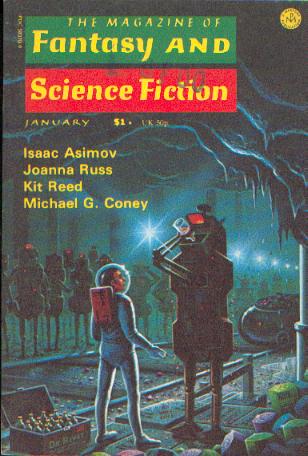
First published in the January 1976 issue of The Magazine of Fantasy and Science Fiction. It has been reprinted in The 1977 Annual World’s Best SF (ed. Arthur W. Saha and Donald A. Wollheim), The Best from Fantasy and Science Fiction 22nd Series (ed. Edward L. Ferman), Sorcerers! (ed. Jack Dann and Gardner Dozois), Tales of the Cthulhu Mythos (editor uncredited), and the Russ collection The Zanzibar Cat.
Enhancing Image
Jim is a down-on-his-luck screenwriter on the phone with Milt, his agent, about a story—not a script story but something from Jim’s early life which for some reason he is compelled to share now. “It’s something that happened to me in high school in 1952 and I just want to tell someone. I don’t care if no station from here to Indonesia can use it; you just tell me whether I’m nuts or not, that’s all.” Two decades earlier, when Jim was 17, his high school became one of the first in the state to integrate; segregation had been the norm up to this point, and would continue to be the norm for most of the country for the coming decade. In 1952 the civil rights movement was still in utero; it was the year Ralph Ellison’s Invisible Man hit store shelves, but otherwise there was no MLP, no Malcolm X, James Baldwin had not yet broken through as a novelist, the “race issue” was talked about but there was no mobilization yet. Emmett Till was very much alive (he would be 83 today). Jim recalls that when his high school integrated only a handful of black kids came in initially, and Cissie Jackson was one of them—a scrawny 15-year-old girl who seemed like she wouldn’t amount to anything but who was, almost in spite of her physical limitations, a gifted actress. She was a drama club regular. She was also supposedly crazy. Her father had been murdered, which if anything made her more world-weary.
You know Malcolm X saw his father killed by white men when he was four and that made him a militant for life? Well, Cissie’s father had been shot down in front of her eyes when she was a little kid—we learned that later on—only it didn’t make her militant; it just made her so scared of everybody and everything that she’d withdraw into herself and wouldn’t speak to anybody for weeks on end. Sometimes she’d withdraw right out of this world and then they’d send her to the loony bin; believe me, it was all over school in two days. And she looked it; she’d sit up there in the school theater—oh, Milty, the Island high schools had money, you better believe it!—and try to disappear into the last seat like some little scared rabbit. She was only four eleven anyhow, and maybe eighty-five pounds sopping wet.
Then there’s a white friend of Jim’s, Alan, who was a bit of a weirdo, being into Lovecraft at a time when this was very much not a cool thing to like. Lovecraft’s legacy had already been more or less secured at this point, but Alan would’ve been almost certainly branded as an outcast, a 17-year-old boy who was into cosmic horror and weird fiction. Maybe it’s because they were both outcasts, albeit in different ways, but Alan and Cissie took a liking to each other, becoming friends with Jim as the third wheel. “She got better and better friends with Al, and when they let me tag along, I felt privileged. He loaned her some of those crazy books of his and I overheard things about her life, bits and pieces.” Cissie comes from a very religious household, with a very strict mother. Of course it’s hard to blame Cissie’s mom for being so uptight, being wife to a murdered husband and mother to a girl who is entering a newly integrated school. One quibble I have with this story, or I suppose one way it shows its age, is the way Cissie’s mental illness is discussed, or rather how it is not. It’s pretty clear Cissie has PTSD at the very least, although Jim doesn’t use that term and it wouldn’t have been part of his vocabulary. Despite being the character upon whom the plot hinges Cissie is kept totally closed off from us, as a person, which is part of the point, but it also—I guess “exoticizes” is a fine enough word for it. Her mental illness is exoticized and made to be part of the “weirdness” of the story, which I don’t think would go over well today. Some of her dialogue can also border on caricatured, although Russ means well, and anyway you could make the excuse that this is merely Jim’s recollecting of events. It’s possible Cissie did not talk like how Jim makes her sound.
I called “My Boat” fantastic metafiction, but it’s also very much allegorical, a fact that only becomes more apparent as the story progresses. Jim is telling Milt, his agent, this story as if it had literally happened, but it becomes increasingly clear to the reader (if not poor Milt) that Jim is sort of talking in code; maybe he really believes in the strange events he’s about to relate, but these events also stand in for something that would’ve happened in the normal world. The friendship sparked between Alan and Cissie might be developing into something more, which would’ve been taboo at the time, to the point where both could’ve been killed if their relationship was discovered. They trusted Jim enough to have him tag along as the third wheel, although by Jim’s own admission he was barely aware enough of racial strife at the time to understand what their relationship could’ve meant. Jim as a grown man in his thirties doesn’t seem to think fondly of his younger self, calling him a “run-of-the-mill, seventeen-year-old, white, liberal racist” who was simply not as open-minded as Alan. I wouldn’t say Jim is an autobiographical sketch of Russ, because aside from the gender difference there are too many other basic differences between the two (for one I’m sure Russ would shudder at the thought of writing for Hollywood), but he could be read as Russ criticizing her own upbringing. Russ was a leftist, but the thing is that most leftists were not brought up that way; maybe they were raised liberal, or like me they were raised conservative. Regardless adopting leftist politics is a long and rather winding process, and part of that process is admitting that the ideology of your parents is inadequate for dealing with real-world problems. Jim was raised liberal, but this did not prepare him for two of his friends falling in love.
This brings us to My Boat, which is the name of a rowboat with only one oar, a kind of secret place for Cissie and Alan, and which Jim is allowed to visit one day. Of course it turns out to be much more than a rowboat—rather it acts as a gateway into other parts of the world, across different periods of history, and even maybe to other worlds. In what is admittedly a confusing development Cissie and Alan take on different personae, becoming full-grown adults before Jim’s eyes and taking on the guises of historical figures. Cissie becomes the Queen of Sheba (although she says it’s Saba) while Alan becomes Francis Drake. A warrior queen and an explorer. Al’s fondness for Lovecraft, the way Lovecraft’s works expanded his imagination, allowed him to come along with Cissie, and in this sense Russ is celebrating Lovecraft. Mind you that even in the ’70s it was not unheard of to denounce Lovecraft as a reactionary, racist, etc., as Michael Moorcock’s essay “Starship Stormtroopers” came out a year after “My Boat.” Moorcock saw Lovecraft as massively overrated, never mind problematic, while Russ seems to understand Lovecraft’s limitations (as both a person and writer) while also showing that she’s read enough of his work out of what has to be a genuine fondness. “My Boat” is about a few things: racism, regret, memory, and of course how fiction might bleed into our reality—not as in the Cthulhu Mythos might become real but rather how the Mythos might inspire someone. Of course the Mythos wasn’t even called that until after Lovecraft’s death (courtesy of August Derleth), and “My Boat” is too metafictional (and I would say too not-horror) to be thrown in with the classic Mythos stories. It’s a story that struggles with categorization.
There Be Spoilers Here
The tragedy of the situation is that Jim turned down going along with Cissie and Alan on their magical boat. “I didn’t want that knowledge, Milt. I didn’t want to go that deep. It was the kind of thing most seventeen-year-olds don’t learn for years: Beauty. Despair. Mortality. Compassion. Pain.” The door had been closed on him, or rather he had refused to open it, much to his regret. He never saw Cissie again after that day. He did eventually see Alan again, twenty years later, the strange part being that Alan had not aged during that time: he was still that 17-year-old. (I wanna point out that there’s no science-fictional explanation for any of this, and that if what Jim says is true then this story is firmly in the realm of fantasy, not SF.) After Cissie and Alan went missing Jim got to meet Cissie’s mom, who was not the Aunt Jemima caricature he had in his head: she was scrawny and nerve-wracked, like her daughter, and very much human. Jim as an adult chastises his younger self’s unconscious racism. In recent years Jim has taken to reading up on Marxism and feminism, apparently having shifted more to the left end of the political spectrum. He’s also been reading Lovecraft. The ending is bittersweet, or rather bitter with a little ray of hope, that maybe it’s not too late for Jim to get back in touch with Cissie—wherever she’s gone. Surely she couldn’t have left him behind forever.
A Step Farther Out
Do you need to be familiar with Lovecraft’s works to “get” what “My Boat” is going for? Not really, although Russ makes references that would otherwise go over one’s head. For example I’ve not yet read The Dream-Quest of Unknown Kadath, so I’m not sure how Russ incorporates it into her narrative. I’m not exactly a fan of Lovecraft, so I mostly read “My Boat” on its own terms. It’s not really a horror story, and it isn’t scary except maybe in an existential sense; what it really does well is tell a story about an interracial couple, a mutual friend of the two young lovers, and give such an earthly story metafictional implications.
See you next time.





 Science Fiction & Fantasy Remembrance