Who Goes There?
He made his debut in the ’80s, but Greg Egan is one of the quintessential voices of ’90s SF—a bridge connecting cyberpunk and transhumanist SF, sometimes wandering well outside the boundaries of either. Egan’s fiction is notorious for its incorporating of biology, computer science, quantum physics, and what have you. Egan started out as a programmer and his work often reads like the product of someone from that profession who also happens to read a lot of detective fiction. The typical Egan narrator, including the one for today’s story, is a rather melancholy white man who struggles with emotional honesty, and as such, depending on your frame of reference, it’s easier to understand Egan’s stories as detective narratives with cybernetics involved, rather than hard science fiction.
Placing Coordinates
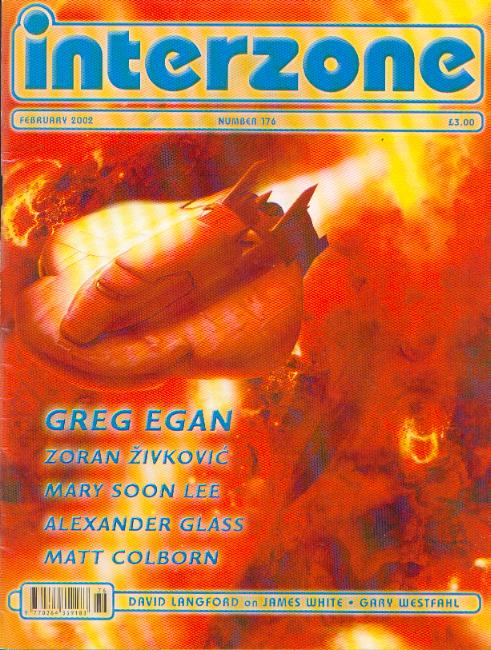
First published in the February 2002 issue of Interzone, which is on the Archive. If you have qualms with reading a scan of a 21-year-old back issue of a magazine that you would have to buy used anyway, rest assured you can read this story perfectly legit on Greg Egan’s site, found here. You can also find “Singleton” in The Best of Greg Egan.
Enhancing Image
We start in the now-ancient year of 2003, with Ben, the narrator, a snot-nosed college geek, being witness to what is likely a gang-related beatdown in an alley, with a ton of other people watching. A kitchen hand is getting his ass beat by two guys who don’t seem to be carrying guns but do seem to mean to kill this man with their bare hands. Nobody intends to interrupt the killing. “Keeping your distance from something like that was just common sense.” Something, however, snaps in Ben—maybe a jolt of guilt. He steps in and gets beat for his troubles, but the kitchen hand comes out the situation alive and Ben gets to feel like not just another bystander. Now, for most people an act of heroism like this would be a shining moment in their lives, maybe a fond memory, but the prossibility of not helping the kitchen hand will haunt Ben for the rest of his years.
The details of this first section are the foggiest in the story. We never learn exactly why those goons wanted to beat this man to a pulp, nor do we even learn the man’s name. We’ll never get the full context for some things—even the most important days of our lives. This haziness makes sense when you consider Ben is narrating this many years down the road, reflecting on when he was a teenager and the world seemed a fundamentally different place. Not unlike Marcel Proust in his search for lost time, there details of the past that time has simply devoured.
Ben, while still an undergrad, kicks it off with Francine, who will turn out to be his college sweetheart and life partner. The incident with the kitchen hand had, in the short term, given Ben a confidence that normally would be absent in young scientists, and he’s well aware that it was that incident which probably motivated him to pursue Francine. “There was no denying that if I’d walked away from the alley, and the kitchen hand had died, I would have felt like shit for a long time afterwards. I would not have felt entitled to much out of my own life.” But why shouldn’t they get together? They’re both scientists, albeit in different fields of study. Much of their relationshio will be long-distance due to work, but that will not be unusual in the coming years (as indeed it’s not out of the ordinary now); it may even strengthen their bond, that distance. “Singleton” is, among other things, a love story, and the romance is believable because there’s so little of it.
(A note here: There are several time-skips throughout the novella. We start in 2003 but creep across decades, well into even our own future. “Singleton” was published in early 2002 but it would’ve been written probably a whole year prior, which means Egan did not, for instance, take 9/11 and the War on Terror into account. This is like publishing an SF story in 1946 that was written, evidently, pre-Hiroshima.)
Some years go by and unfortunately the two hit a major speed bump in their relationship when Francine suffers a miscarriage that’s painful both physically and psychologically, possibly caused by Ben handling radioactive dust in a previous job but never confirmed. Regardless the two are not confident about the prospect of producing a child, and while adoption is on the table, their relationship is in enough of a rough patch that they don’t agree right away on the proper course of action. Not to say the romance aspect of “Singleton” is great, because that’s not its main purpose, but I do like how Egan shows the often banal (from the outside, anyway) downside of relationships. Ben and Francine love each other, but there are real-life issues standing in the way of an Eden-like existence, which of course also applies to a lot of real-life couples. Never mind that the idea of becoming a parent, as to be expected, fills Ben with an anxiety that’s both terrible and exhilarating. “I wasn’t ready,” he admits at one point, but for better or worse he would have to wait some more to become a parent after all.
Before we get into the actual science-fictional aspect of “Singleton,” I wanna take a moment to talk about how short fiction may be structured so as to resemble a novel; this is not exclusive to novellas as I’ve also seen it done with shorter works. The time skips and the conservation of detail (achieved via first-person narration, which you may notice is easier to do in that mode than in the third person) give the impression of a story being longer than it is, since it covers enough time and events to fit into a novel. We cover a lot of ground here in the development of Ben and Francine’s relationship, but there’s still plenty of room for Egan to explain, in language that is mostly beyond my dumb-dumb brain, quantum mechanics, the Many Worlds Interpretation, and how they relate to the major action of the narrative—which, to boil it down, is the raising of an AI.
Putting it as basically as I can, Ben builds a device, the Qusp, “the quantum singleton processor,” which basically acts as a funnel for a quantum computer. What separates a quantum computer from a normal or “classical” computer, you may ask? As a layman my explanation would be that while a classical computer can make decisions with incredible speed, it can only make one decision at a time, in other words being a linear thought processor. A classical computer, no matter how intelligent, even if it were sentient as with a true AI, would only be able to comprehend one decision at a time. A quantum computer, meanwhile, is able to see, with the naked eye so to speak, dozens or even hundreds of possible decisions simultaneously. Imagine you’re in a maze and you’re wondering which way to go; if you were a classical computer you would consider each direction one at a time, but as a quantum computer you would have all these decisions superimposed on top of each other, like cutting into a cake and seeing all the layers on the inside. I’ll let Egan explain more in his own words:
The Qusp would employ all the techniques designed to shield the latest generation of quantum computers from entanglement with their environment, but it would use them to a very different end. A quantum computer was shielded so it could perform a multitude of parallel calculations, without each one spawning a separate history of its own, in which only one answer was accessible. The Qusp would perform just a single calculation at a time, but on its way to the unique result it would be able to pass safely through superpositions that included any number of alternatives, without those alternatives being made real. Cut off from the outside world during each computational step, it would keep its temporary quantum ambivalence as private and inconsequential as a daydream, never being forced to act out every possibility it dared to entertain.
As such, a quantum computer that passes the Turing test could, with the Qusp installed, consider decisions simultaneously whilst being able to come to a single result and without being overwhelmed with information. Or so that’s the idea. The Many Worlds Interpretation is of course tied to quantum mechanics, wherein basically (I’m saying that word a lot, I know, but bear with me) every decision has its own branch, resulting in what would probably be billions (or functionally an infinite amount) of alternate universes—many of them very similar, but some very different. Ben and Francine eventually agree to try again at having a child—only this time they won’t make or adopt, but build a child. The result will be a quantum computer with the Qusp as its anchor, wrapped in a plastic human body. A ghost in a shell. Such a child would be tapped into many worlds, being able to consider decisions at a speed and complexity incomprehensible to humans.
What could possibly go wrong?
There Be Spoilers Here
In some robot/AI narratives the intelligence in question would turn out to be malicious, or perhaps too smart to relate to its human creators. Thanks to the Qusp, however, the resulting child, Helen, is not much more intelligent than a smartypants like Ben or Francine. There are certain things that are uncanny about her, such as the variety of plastic shells she can inhabit, but she is by no means an evil AI run amok. It does turn out, though, that of course there would be several issues that are not Helen’s fault. Our Heroes™ have functionally created a synthetic person or android, although it’s made clear that Helen only has her human body for the sake of her “parents.” The introduction of true AI in human form naturally causes a major stir throughout the world, with cultists both pro- and anti-AI popping out of the woodwork to make our characters’ lives worse.
(Another note: I appreciate that the future world Egan conjures is still very much recognizable as our own, albeit with a couple changes. We don’t get rayguns and flying cars, but we do get to see how an invention—in this case adais, or “Autonomously Developing Artificial Intelligences”—would interact with the known world. Aside from the whole pre-9/11 thing this is a plausible depiction of the near future.)
The back end of “Singleton” is concerned with raising Helen and how such a “unique” child poses a problem for Our Heroes™, who after all are doing this more so out of personal trauma than a need to do good. Ben eventually admits that he took on this extended project because he had become consumed by the implications of the Many Worlds Interpretation, with it all going back to that fateful day in the alley when he was but a teenager. The results are somewhat tragic, with Ben’s relationships with Helen and Francine eroding over time, but there is a ray-of-hope ending that hints at something which may bring an understanding between human and AI. If you’ve read enough Egan then you know that he’s in sympathy with transhumanism—more specifically the notion that consciousness can be totally divorced from organic biology. While there are several questions raied about Helen’s inner workings and how she may survive in the human world, what’s not questioned is that she is a thinking creature who deserves to be treated as such, and indeed the story ends with Helen caught in an act of contemplation. For better or worse, the machine is alive.
A Step Farther Out
“Singleton” is a curious novella (or, as I said before, a compressed novel) that would probably hit stronger on a reread—preferably after I’ve done more research on computing. I’ve read several Egan short stories throughout this year in preparation for reviewing a longer work of his, and yet—maybe it’s because I had read short stories from early in his career—”Singleton” is still a more demanding read than I had expected. I recommend it, because I’ve sat on it for a couple days now and it’s left an impression on me that’s hard to articulate (usually a good sign for a work of art), but it’s not what I would recommend for someone just starting to get into Egan; either shorter works or his most famous novels (so I’m told) would do the trick.
My Egan journey has been progressing at a pace where I’ll be getting to his novels, particularly Permutation City and Diaspora, soon enough. I hear the former is the best thing since sliced bread.
See you next time.
 Science Fiction & Fantasy Remembrance