This marks Tanith Lee’s third consecutive Halloween appearnace on this site, and why not. I wouldn’t call myself a Lee fan (yet), but as I chip away at her massive body of work I do find more to appreciate. And I do mean massive. Over the span of five decades Lee wrote something like ninety novels and 300 short stories, so we’ll be here for a while. She debuted in the late ’60s, but did not gain attention until midway through the ’70s with novels like The Birthgrave and The Storm Lord. She specialized in horror and dark fantasy at a time when this only just being made possible due to the proliferation of the mass-market paperback; had Lee tried breaking through a decade earlier she would’ve been ten years old or something she would’ve surely been screwed, due to how the market was at the time. But she did get to thrive, and write some nifty fiction while she was at it. “Red as Blood” marked Lee’s first appearance in F&SF, which is weird because it seems like the two were made for each other. No matter. I feel like I’m giving the game away by saying this now, but “Red as Blood” is a pretty neat (if at times confusing) retelling of Snow White, in a way that screams Tanith Lee. Look, dark fantasy retellings were more novel in the ’70s.
Placing Coordinates
First published in the July 1979 issue of The Magazine of Fantasy and Science Fiction. It’s been reprinted quite a number of times, including but not limited to The Year’s Best Fantasy: 6 (ed. Lin Carter), Young Monsters (ed. Isaac Asimov, Martin H. Greenberg, and Charles G. Waugh), The Penguin Book of Modern Fantasy by Women (ed. Richard Glyn Jones and A. Susan Williams), and the Lee collections Red as Blood, or Tales of the Sisters Grimmer and Tanith by Choice: The Best of Tanith Lee.
Enhancing Image
Once upon a time (it’s that kind of story) there was a king and his queen. The queen gave birth to a daughter, but died in childbirth. The queen (or the Queen) was also kind of an odd woman. “She never came to the window before dusk: she did not like the day.” She had black hair and dressed in a crimson gown, and had made a blood sacrifice (her own blood, not someone else’s) to gift her future daughter with certain traits, “hair black as mine, black as the wood of these warped and arcane trees. Let her have skin like mine, white as this snow. And let her have my mouth, red as my blood.” She got what she wanted, although she wouldn’t live to see her daughter grow up. The daughter is Bianca, and for the past seven years she’s been living with her stepmother, the Witch Queen. The Witch Queen is somehow both a witch and a devout Christian who is repulsed by Bianca’s aversion to churchgoing and Christian symbols; she’d much rather spend time in her garden. The thing is that her problems only just beginning.
So, this is a retelling of Snow White, as in “Snow White” by the Brothers Grimm, although we all know the Disney animated film. Lee would do this multiple times, so much that she made a whole collection of such retellings, but this was still fairly early in her career. The idea of making Bianca (Snow White) a vampire is a novel twist on the classic story. At least in the Disney film the relationship between the Witch Queen and Snow White is unclear, as the former is indeed a queen and the latter is some girl who lives in the woods, whereas in “Red as Blood” Bianca is explicitly the Witch Queen’s stepdaughter; it’s also implied the Queen was a vampire and that Bianca is following in her “true” mother’s footsteps. This is a curious role reversal because in the normal story we would see Bianca as the protagonist and the Witch Queen as the antagonist, but now the Witch Queen is not only the POV character but has the understandable goal of wanting to do something on her vampire daughter. Yet this is not a horror story! It’s dark fantasy, but Lee is not trying to scare us.
I have some theories as to what Lee is going for with this story, because this is not just a case of “What if we told this classic fairy tale but it’s FUCKED UP?,” which makes a lot of fairy tale retellings dull. No, she clearly wrote it with thematic purpose—only I’m not totally sure to what end. There’s a surprising amount of Christian symbolism going on that only intensifies as we get closer to the end. This is also a short story, so there’s only so much ground to cover, and the fact that it’s a fairy tale everyone knows (albeit with a twist or two) means it’s hard to spoil. Lee doesn’t exactly make Bianca’s vampirism a secret, the implications she drops being so heavy as to be fucking anvils. You can’t possibly miss it. But part of the fun of reading this story, aside from the beauty of Lee’s controlled, almost Bible-inspired prose, is seeing the Witch Queen, from her perspective, realize that she has one hell of a problem child on her hands. When she asks her magic mirror what the mirror sees it says it specifically can’t see Bianca. Get it? Vampires don’t have reflections? When her mother was alive there was an epidemic of “wasting sickness” in the kingdom, which was never explained and which they never found a cure for; and when Bianca comes of age (gets her first period), the “wasting sickness” starts up again.
Well this is a problem.
The Witch Queen hires a huntsman to take care of her stepdaughter, but as with the fairy tale it takes all of five minutes for the deal to backfire—only this time Bianca outright kills the huntsman and sucks his blood (he doesn’t seem to mind too much). If I had to quibble about something I do find it concerning that Bianca is depicted (at least analogous to) sexually active and desirable… at 13 years old. This is a recurring thing in ’70s SFF writing and I don’t know if we should blame Michel Foucault or what. It makes me cringe, although for what it’s worth nothing explicit happens in this case. So the huntsman is dead and the Witch Queen has to come up with a plan B, which involves making a deal with a most unusual party: Satan himself. Or more accurately Lucifer, the fallen angel. Lucifer works up a disguise for the Witch Queen that Bianca will be certain to fall for, and we can guess well in advance that the Witch Queen will become an old hag somehow. So. As for the seven dwarves Snow White befriends they’re represented here by trees in Bianca’s garden, which come to life. The only weakness the Witch Queen knows of is that Bianca finds Christian iconography repellant, maybe to the point of it being maybe physically harmful.
There Be Spoilers Here
The climax of “Red as Blood” starts weird and only gets weirder from there, to the point where it becomes honestly mind-bending. The Witch Queen gives Bianca an apple, although it turns out to not be poisoned; instead it contained (I don’t know how, maybe through witch stuff) a wafer, “a fragment of the flesh of Christ.” How Catholic. So Bianca dies and is put in a transparent glass coffin, which may sound familiar, where she lies until a prince (just a prince, from where I don’t know) comes along and revives her. It’s implied, via a mark on his wrist, “like a star,” that he is the embodiment of Christ. (People often forget Jesus would have been nailed through the wrists, not the hands, a mistake even Christmonger and antisemite Mel Gibson makes.) The bad news is that Bianca is back, but it seems the love of the prince transforms her, into a series of birds before time goes backwards to when she was seven years old—only this time not a vampire. The prince had not only reversed time but seemingly cured Bianca of her vampirism. This is… confusing. Obviously it’s meant to be taken as allegorical, and it’s so overtly Christian that I have to wonder if it’s maybe satirical, or maybe if Lee was actually a churchgoer. I’m not sure if she was religious or not, truth be told. The Witch Queen is a Christian who ultimately is in the right, but she also had to seek Lucifer’s help to deal with Bianca’s vampirism, which is certainly odd. It could be that Lee is saying we need that bit of darkness, or that there’s some evil lurking in every one of us. Or maybe, when the chips are down, we must side with a lesser evil.
A Step Farther Out
I’m a bit weary at the idea of reading a whole collection of fairy tale retellings, but as an individual story I think “Red as Blood” is quite strong. Again it’s surprising it took until 1979 for Lee to get published in F&SF, but the pairing was perfect. The more I read Lee the more I understand what she’s going for, which actually makes me wonder if I had treated “Bite-Me-Not or, Fleur de Fleu” unfairly when I reviewed that a couple years ago. I was not as familiar with Lee at the time.
Everyone has their preferences when it comes to genre, which makes sense; there are only so many hours in the day, and time plus one’s temperament equals a preference for literature that seeks to entrance, excite, and/or titillate. We also like to be scared sometimes, or at the very least uneased. I’ll be honest with you, when someone tells me they simply have no appetite for horror I’m tempted to give them the side-eye. As far as my own genre preferences go I would put horror only behind science fiction—and not by much. The key difference is that I can enjoy SF at really any length, whereas I very much believe horror is at its best at short story and novella lengths, which is an old-school belief not least because the novel has dominated horror since at least the ’80s.
The conventional narrative (and I do think this is more or less accurate) is that prior to the ’70s, horror had at most fleeting moments of mainstream recognition. There were exceptions, but they were exceptions that proved the rule. Maybe ever few years you got a horror novel that reached bestseller status. But then, in the ’70s, what had been a once-in-a-blue-moon thing became something of a trend, arguably started when William Peter Blatty’s The Exorcist and Richard Matheson’s Hell House both came out in 1971. In the film world the influx of horror can be explained by the advent of the MPAA rating system combined with independent studios like New World Pictures pumping out exploitation cinema by the truckload, but in the literary world the rise of horror is harder to explain—except for one thing. Stephen King had been writing since the late ’60s, but his debut novel Carrie became a bestseller when it was published in 1974, and the crazy part is that noy only did King (a snotty 26-year-old at the time) gain overnight success, he managed to sustain it with more hits. The meteor shower that was King in the ’70s brought a change to horror that it had not seen before, and frankly will probably never see again. Many writers (some of whom are more elegant than King) would hop on the horror bandwagon, but none can be said to have reached King’s level.
While the horror novel was in, the short story was not so much. For most of the ’70s The Magazine of Fantasy and Science Fiction was the only genre magazine to publish horror with any regularity. Magazine of Horror did mostly reprints, and by 1972 was no more, while Weird Tales had a brief revival in the early ’70s, only to go dormant again. So it was up to F&SF to pick up the slack. For the magazine’s 75th anniversary, and in covering short stories from the ’70s, we’ll be focusing more on horror, dark fantasy, and spooky science fiction. These are mostly the usual suspects when it comes to horror, but there are one or two surprises.
For the short stories:
“Longtooth” by Edgar Pangborn. From the January 1970 issue. One of the most criminally overlooked SF writers of the ’50s through the ’70s, Pangborn wrote some pretty touching fiction that went against the rather hard-headed norm of the times. He would spend the last decade or so of his life on a post-apocalyptic continuity, but “Longtooth” is both a standalone and detour into horror.
“The Smell of Death” by Dennis Etchison. From the October 1971 issue. Etchison started writing in the ’60s, but he gained more prominence in the following decade as the horror boom for film and novels had kind of a trickle-down effect. He would also later become acclaimed as an editor, on top of writing, winning the World Fantasy Award multiple times for his horror-centered anthologies.
“In the Pines” by Karl Edward Wagner. From the August 1973 issue. Wagner debuted in 1970 and would remain a mainstay of horror and heroic fantasy until his untimely death in 1994. Last time we read Wagner it was one of his Kane stories, but “In the Pines” is an early example of his mastery of scares. I believe this also marks his only appearance in the pages of F&SF.
“The Same Dog” by Robert Aickman. From the December 1974 issue. Aickman has a reputation as a writer’s writer, with good reason, being your favorite horror writer’s favorite horror writer. He debuted in the early ’50s but remained a hidden gem in the UK until the ’70s. Aickman would appear in F&SF several times throughout this decade, with “The Same Dog” being an original publication.
“The Ghastly Priest Doth Reign” by Manly Wade Wellman. From the March 1975 issue. Wellman remained a presence in American fantasy writing for six decades, and especially in the latter half worked to evoke the rural mysteries of his adopted home state of North Carolina. For better or worse Wellman’s most authentic fiction is distinctly Southern in flavor, this story being one example.
“My Boat” by Joanna Russ. From the January 1976 issue. Known much more for her SF and criticism, a fair amount of Russ’s fiction (especially early on) was horror, such that even some of her SF oozes with a certain existential dread. She even wrote a few stories set in the Cthulhu Mythos, of which “My Boat” is one. I suspect this will be a Lovecraft pastiche with a Russ-type twist or two.
“Manatee Gal Ain’t You Coming Out Tonight” by Avram Davidson. From the April 1977 issue. This will be the first time we’ll be reading a story by one of F&SF‘s editors. Davidson was already a respected writer when he took over F&SF for a few years in the early ’60s, injecting the magazine with eccentricity. This story is actually the second in an episodic series starring Jack Limekiller.
“Hear Me Now, My Sweet Abbey Rose” by Charles L. Grant. From the March 1978 issue. Grant got his start in the ’60s and would soon become one of the moodier and more experimental horror writers of the following decade, winning awards for his efforts. Truth be told, I’ve not been keen on the Grant I’ve read, but as I’ve said before, I’m usually open to giving authors another chance.
“Red as Blood” by Tanith Lee. From the July 1979 issue. This is the third consecutive time Lee’s appearing on my October slate, although this won’t be the case next year for reasons I’ll give… in due time. But for now it’s safe to say I’ve warmed up to Lee, gradually, and can see how for decades she was a mainstay of horror and dark fantasy. “Red As Blood” marked her first appearance in F&SF.
(Cover art by Dominic Harman. Interzone, September 1998.)
Who Goes There?
Tanith Lee was one of the most prolific writers of the macabre and the weird of the past half-century, up until her somewhat recent death. I should check out more Lee at this point but she wrote a truly staggering number of novels across several series and I have commitment issues. She’s one of the codifying voicess of what we now call dark fantasy. She’s also, if memory serves me right, the only person to get more than one issue of Weird Tales (its ’80s/’90s revival) dedicated to her. Lee is one of two authors I’m covering this month who were also part of last year’s spooktacular, and I’ll be honest, my first taste of her fiction left me less than satisfied. The good news is that second chances sometimes pay off and this is one of them, with today’s story being a winner, if also hard to categorize.
Despite what the title may suggest, “Jedella Ghost” is not a horror story—except maybe by way of implication; it’s also not a tale of the supernatural, despite what the title would lead you to believe. Indeed, one could argue this story is not SFF, but I would wager it falls under the banner of science fiction, or at least speculative fiction. Explaining this will involve spoilers, so I’ll hold my tongue on that, but I’ll say now that this is a haunting character study that had a surprisingly tight grip on my imagination after I had finished reading it. If my first encounter with Lee didn’t seem promising then this is—at least for me—a much finer impression of her talents.
Placing Coordinates
First published in the September 1998 issue of Interzone, which is on the Archive. It has since been reprinted three times, first in The Year’s Best Science Fiction: Sixteenth Annual Collection (ed. Gardner Dozois), which was what tipped me off that this story is more than what it seems. Then there are the collections Tanith by Choice: The Best of Tanith Lee and the more comprehensive Tanith Lee A-Z. Worth mentioning that both of the Lee collections were published only after her death.
Enhancing Image
John Cross is not a savior, despite what the obvious symbolism of his name would imply (it’s a trick Lee plays on us), but he is a writer, which might be the next best thing. He’s a minor celebrity who lives in a quiet little town… somewhere. It’s unclear when or where we are, but John’s mannered style of narration and the wooded location lead me to believe we’re in the US—maybe New England—in the first half of the 20th century. Lee puts a good deal of effort into making this story, which was published 25 years ago (not a long time ago in literary terms), read as older than it is—one could say aged, which is not to say dated. Anyway, things have been going normal, until one day when the town gets an unusual visitor in the form of Jedella, a young woman who claims to have come from the pines.
She’s polite with people, and John admits to finding her attractive, but there are a few eerie things about Jedella: for one, she’s wearing what appear to be glass slippers (like it’s The Wizard of Oz), although she says she doesn’t know what they’re made of. She also claims to have lived in a house with people in it, except these people are not part of a family unit, and that for reasons unbeknownst to Jedella the house has been abandoned. When Jedella sees a few village elders on a bench she stands there staring at them, as if transfixed, and more tellingly she later confesses to not knowing what a funeral is. She seems to have no conception of aging or death. Most troublingly of all, she claims to be 65 years old despite her looks.
Lee does something clever here is that she makes us think, repeatedly, that something malicious is brewing with Jedella. We’re led to believe, through her bizarre interactions with people and the inexplicableness of her life, that surely there’s something going on behind the scenes—that Jedella, despite her innocence, is planning something. Either she is the perpetrator of some crime yet unseen, or she is the victim of some very unusual circumstances. Should we be wary around Jedella or should we pity her? Both we and John are drawn to her specifically because she seems unreachable, even maybe impossible to rationalize. As John says at one point, “The woman you can’t have is always fascinating.” Worth mentioning that John is telling this story a few decades after having first met Jedella, and he’s quite an old man now. The passage of time works in very funny ways in this story. We get a sense of the eerie and even the uncanny, but not suspense, since the events of this story happened long ago and have long since been resolved.
A different writer—maybe a male writer—might’ve turned John and his younger friend Luke’s shared infatuation with Jedella into a full-on love triangle, but Lee makes the wise decision to push any pretense of romance to the sidelines. Jedella is so disconnected from normal human life (for a reason that will be given later) that something as irrational and multifaceted as romance would be likely impossible—even ill-advised. Instead we focus on the implications of Jedella’s existence and how she sees the world, and what—assuming we exclude the supernatural—could’ve produced such a character. The fact that it was published in Interzone and that it was later reprinted in an SF anthology lead us to think the explanation is something that can be rationalized; but the title, the archaisms of the setting, and Jedella’s ghostly nature make us doubt ourselves. After all, we as readers tend to be materialists, unless something even hinting at the supernatural points to the contrary, at which point we become superstitious.
There Be Spoilers Here
Eventually John decides to retrace Jedella’s steps and try to find out where she came from, which is what leads us to the big reveal. In the wood, in a house which stands as if made of cubes, something “a child had made, but without a child’s fantasies,” we meet Jedediah Goëste, a man who at this point would be at least ninety years old but who is still active and sound enough of mind to let us know what had happened. Jedella claims she’s 65 and this is correct, because about six decades ago Jedediah—when he was in his 20s—adopted a very young Jedellah, who was an orphan. With the cooperation of his servants and with a whole house as his laboratory, Jedediah got the bright idea to answer a pretty esoteric question: “What would happen if you raised someone in a controlled environment for decades, in which they never discovered death, illness, or even old age?” The answer, Jedediah supposes, is that the person would stop aging past a point.
The ethical problems are obvious, and John is quick to point these out. At the same time, can it be considered abuse? It’s certainly unlike any kind of abuse you’d find in the real world. Jedella was apparently never beaten or scolded, and eventually she was allowed to run off the plantation, so to speak. Rather, Jedediah and his successors (since he himself left once he got too old) set up a system so as to shield Jedella—not so much from the sufferings of the world as the passage of time itself. Nothing dies or decays, or rather nothing is allowed to appear that way. Jedella recalls a childhood memory wherein she saw a squirrel get “stunned” and then revived by one of the house servants, when in reality the squirrel had died and was replaced with a different one. The experiment, however, has been taken about as far as it can go, and now it’s up to John and the townsfolk to take care of Jedella for the last years of her life—assuming she ever dies. The ending, which is pretty powerful for how it blurs the line between real life and something like magic realism, implies that she has started to age, now having lived outside her controlled environment for a few decades (she would be probably a century old at story’s end), and incredibly this revelation does not destroy her. No, time finally continuing is taken as a kind of victory.
Finally, I wanna try to answer a question of my own: What is this story? It’s not horror, nor is it a ghost story in the classic sense. My argument is that it’s science fiction, for the simple reason that it asks a what-if question that could, theoretically, apply to the real world as we might understand it. Sure, we don’t have goblins or elves, nor are these things possible, but it is possible (albeit incredibly protracted and convoluted) to run an extended experiment in which you take a person at an age where they wouldn’t understand basic concepts like death and aging, and you put them in an environment where they aren’t exposed to these things for however many years. What would be the result? It’s scientific, and it’s fiction, not to mention that the ending hints at something that is out of the ordinary.
A Step Farther Out
I’ve read three or four Lee stories at this point, and I do think “Jedella Ghost” is easily the most impressive of the ones I’ve read. Then again, it’s not really a horror story; there’s a bit of the eerie about it, with Jedella’s characterization and her backstory, but there are no scares to speak of. It’s arguably not even science fiction (although I would argue it is), which makes its publication (not to mention getting the cover) in Interzone a little hard to explain. The Lee stories I’ve read have put new spins on old archetypes, like vampires and werewolves, and with “Jedella Ghost” she managed to write a ghost story that conveys a supernatural eeriness without containing anything supernatural, even if the ending challenges one’s notion of time.
Now, rather than continue to act as a series of disembodied text blocks, I’ll be upfront with you about how my life’s been going. Not good. I’m at a bit of a low point and I’ve struggled to enjoy reading for the past couple weeks, and I have to admit I’ve enjoyed writing about what I’ve been reading even less. You might notice there was no editorial post on the 15th this month; sorry about that. I might be able to write up a belated editorial in a few days, before the month is out, but I can’t guarantee it. I’m taking a couple steps to improve my Mental Health™, and while it might be advisable to take a break from writing, I’ve long been of the opinion that the show must go on.
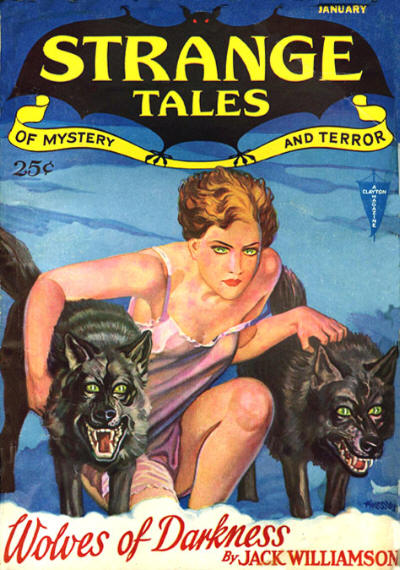
(Cover by H. W. Wesso. Strange Tales, January 1932.)
Let me tell you about monsters.
I love monsters of all sizes, although I have to admit I tend to prefer the giants that stalk whole landscapes. The bigger the better, but then “bigger” doesn’t always mean physical size. I love Frankenstein’s monster, especially Boris Karloff’s mildly talkative and rather emo depiction in Bride of Frankenstein, with his hungering for both love and death. I love Max Schreck’s Count Orlock in Nosferatu, who despite being modeled on Dracula seems to be almost more rat than man. I love the blob, especially in the 1988 version of The Blob—a mindless eating machine that digests people while they’re still alive. I love Godzilla, Mothra, Rodan, King Ghidorah, and even Hedorah, the walking turd that might be the strangest of Godzilla’s foes. I love the zombies of George Romero’s Dawn of the Dead and Day of the Dead, the shambling corpses who walk the earth in search of something they can’t put a rotted finger on. I think the creature from the black lagoon deserves a break (which he finally gets in The Shape of Water, a Best Picture winner!) and I think werewolves are SEXY.
Fantastical horror always involves monsters, even if they’re the theoretical ghosts of Henry James’s The Turn of the Screw. As such the stories I pick for review every October (and it will be every October for the foreseeable future) always seem to be monster tales at their core. It’ll be Halloween soon and we’re putting up the decorations. We’ll be seeing vampires, ghosts, zombies, werewolves, witches, black cats, and things from beyond that cannot be easily classified. Because I believe horror, more than any other genre, benefits from brevity, we’ll be doing all shorts again. These are rapid-fire terrors that hopefully will ignite the imagination.
We have the usual suspects: Weird Tales, Twilight Zone Magazine, The Magazine of Fantasy and Science Fiction. Certain outlets have served as safe havens for short horror fiction through the decades, and admittedly I would feel weird if I were to not include a selection from something as foundational as Weird Tales. Some traditions ought to be respected.
Here are the stories:
“Not Our Brother” by Robert Silverberg. From the July 1982 issue of Twilight Zone Magazine. We’re starting with someone who probably doesn’t come to mind when one thinks of horror, although Silverberg’s work can sometimes evoke existential dread. Having made his debut in the early ’50s and still active in fandom, Silverberg has had one of the longest careers of any writer—inside or outside the field. This is a rare example of him doing straight terror.
“Nightmare Island” by Theodore Sturgeon. From the June 1941 issue of Unknown. I consider Sturgeon one of the finest short story writers of the 20th century, and a major inspiration. Without Sturgeon and those like him this site probably wouldn’t exist. While most associated with SF, Sturgeon wrote a good deal of horror, including the stories “Bianca’s Hands,” “Bright Segment,” and the novel Some of Your Blood. This one is from very early in Sturgeon’s career.
“The Naturalist” by Maureen F. McHugh. From the Spring 2010 issue of Subterranean Online. McHugh won a Hugo for her alternate history story “The Lincoln Train,” and her debut novel China Mountain Zhang is one of the cult classics of ’90s SF; but her range goes well beyond alternate history as she has proven herself to be quite versatile over the last 35 years. “The Naturalist” looks to be a rare horror turn from McHugh, having to do with zombies.
“The Ancient Mind at Work” by Suzee McKee Charnas. From the February 1979 issue of Omni. I had a bad first experience with Charnas a couple years ago, but have been meaning to give her another shot since her reputation is solid and her devotion to the weird is unquestioned. “The Ancient Mind at Work” was Charnas’s first short story, although she already had two novels in print. It would then be absorbed into the fix-up novel The Vampire Tapestry.
“Pipeline to Pluto” by Murray Leinster. From the August 1945 issue of Astounding Science Fiction. Here we have another surprising inclusion, given Leinster isn’t normally associated with horror. He first started writing genre fiction in 1919, predating even Weird Tales. What’s surprising is that not only did he stay relevant several decades into his career, but he peaked in the ’40s and ’50s, holding his ground against writers a generation younger than him.
“Brenda” by Margaret St. Clair. From the March 1954 issue of Weird Tales. I covere St. Clair only a few monthss ago, but she’s back already. She wrote a lot in a relatively short span of time (mostly from the late ’40s to the late ’50s), and during that time she was arguably one of the best short story wrriters in the field. Not one to be tied down to any single genre, or even any mode of writing, St. Clair swerved effortlessly between pulpy and more refined prose.
“Jedella Ghost” by Tanith Lee. From the September 1998 issue of Interzone. One of two returning authors from last October, because honestly I wanna taste more of what Lee has to offer before forming a real opinion; that and she’s such a prolific and consistently spooky writer that her well never runs dry. I’ve read one or two of her stories since our last encounter (which admittedly did not enthuse me) and I think I’m starting to get what her deal is.
“The Door to Saturn” by Clark Ashton Smith. From the January 1932 issue of Strange Tales. The other returning author from last year’s Spooktacular, and this time it’s because I do love me some Clark Ashton Smith. While he can sometimes phone it in, Smith’s writing is often vibrant, poetic, and deeply enchanting—like a wizard casting a spell. Here we have a story set in his Hyperboria universe, a land where sorcerers and dark gods are in charge.
“The Last Feast of Harlequin” by Thomas Ligotti. From the April 1990 issue of The Magazine of Fantasy and Science Fiction. We’re ending with what has to be the longest story of the bunch, but it’s by one of those rare modern masters of horror. Ligotti is not the most popular writer in his field, but those who read him hold him in the highest regard. A devout student of Lovecraft, Ligotti’s fiction can be disturbing by way of implication, as opposed to violence.
Tanith Lee debuted in the ’70s and kept it up as a one-woman writing factory until her death in 2015. Her output, on sheer quantity alone, is formidable. Not really a practitioner of SF, Lee made fantasy her game at a time when the market for fantasy publishing was just starting to pick up. Interestingly, her short fiction seemed to appear more often in Asimov’s Science Fiction (under Shawna McCarthy and later Gardner Dozois) than in, say, The Magazine of Fantasy and Science Fiction. As both a novelist and short story writer, she was dauntingly prolific and her vision seemingly never wavered, running the gamet from sword-and-sorcery to weird fiction. She has the rather unique honor of winning both the World Fantasy and Bram Stoker awards for Life Achievement, these wins being emblematic of her immense contribution to what we now call dark fantasy.
As a side note, I asked on Twitter sometime ago about authors who’ve gotten more than one tribute issue in the magazines. Fritz Leiber was the only example I knew of then (he got tributes in Fantastic and F&SF), but wouldn’t you know it, Lee also got two! On top of being a frequent contributor to Asimov’s in the early days, she also appeared in the revived Weird Tales (or one of its revivals anyway, it’s a long story), which ran at least one issue dedicated to her. Might also be responsible for the second, but I wish I could dig up that one Tweet and confirm it easily. Oh well. Regardless, Lee is undoubtedly one of the big names in horror and dark fantasy. Which makes it all the more a shame that I didn’t like the first story of hers that I’ve read.
Placing Coordinates
First appeared, fittingly enough, in the October 1984 issue of Asimov’s, and yes, it’s on the Archive. The most convenient reprint I can think of is The Penguin Book of Vampire Stories, also simply titled Vampires, edited by Alan Ryan. I’ve cited this anthology before (it’s a useful volume), but don’t worry, I think this is the last time I’m bringing it up. I want to talk briefly about the weird history of Asimov’s as a tertiary fantasy magazine, despite its name. Gardner Dozois would notoriously nab a lot of stories that would otherwise have been published in F&SF, or even Realms of Fantasy, reinforcing what was in hindsight a stifling borderline monopoly on the part of Asimov’s in the ’90s. The tendency for Asimov’s to venture outside SF did not start with Dozois, though, as Shawna McCarthy, during her brief but impactful editorship, also occasionally picked up raw fantasy, “Bite-Me-Not” being just one example. Funnily enough, McCarthy would later become the fiction editor for Realms of Fantasy, a position she held for much longer, though her earlier editorship remains more often cited by far.
Enhancing Image
I said upfront that I’m not fond of this damn thing, but most of the qualms I have with “Bite-Me-Not” belong in the spoilers section. Things start off well enough. We have a castle which has shut itself off from the rest of the world, with a duke (known as the Cursed Duke) who keeps everyone within practically held prisoner, though we’re not immediately told that conditions are this dire. Why is this castle shut off? Why is nobody allowed to enter? What are they so afraid of? There’s an air of mystery and even a bit of the macabre, although very quickly we run into my chief issue with “Bite-Me-Not,” which is Lee’s Frank Herbert-esque style of third-person narration. What I mean by this is that we aren’t planted in the perspective of a single character, or even stay with one character on a scene by scene basis, but rather change perspectives abruptly, paragraph by paragraph. This is a problem that gets worse as the story progresses, but things start simple enough. We have the Cursed Duke, and we have Rohise, a young maid whose relationship with the Duke is sort of enigmatic.
Is the Duke the protagonist? Is Rohise the protagonist? The latter is certainly closer to the correct answer, but we get to know very little about Rohise and indeed she doesn’t have many lines, all things considered. Lee’s style of narration reads like an old-style fairy tale to an extent—it’s very telly, if that makes any sense. We get descriptions of character actions and we’re told about character motives as filtered through the third-person narrator, but we don’t actually get to read these characters’ thoughts. What Lee does much better is scenery, and there’s a lot of it. The castle is this grand and yet desolate thing, like a corrupted Eden, and there’s this passage early on about a vast garden, so encompassing that the Duke even has lions in captivity. The garden is the most important location in terms of action, but it also holds the closest the story has to a MacGuffin: the Nona Mordica, otherwise known as the Bite-Me-Not.
At the furthest, most eastern end of the garden, there is another garden, sunken and rather curious, beyond a wall with an iron door. Only the Duke possesses the key to this door. Now he unlocks it and goes through. His courtiers laugh and play and pretend not to see. He shuts the door behind him.
The sunken garden, which no gardener ever tends, is maintained by other, spontaneous, means. It is small and square, lacking the hedges and the paths of the other, the sundials and statues and little pools. All the sunken garden contains is a broad paved border, and at its center a small plot of humid earth. Growing in the earth is a slender bush with slender velvet leaves.
The Duke stands and looks at the bush only a short while.
He visits it every day. He has visited it every day for years. He is waiting for the bush to flower. Everyone is waiting for this. Even Rohise, the scullery maid, is waiting, though she does not, being only sixteen, bom in the castle and uneducated, properly understand why.
Personally I think the Duke is wasting his time by not growing marijuana plants in this big fucking garden of his, but to each his own. The Bite-Me-Not is a curious invention of Lee’s, as it’s a plant with implied supernatural powers, or at least a profound aesthetic quality that it makes it highly valuable, and yet nobody knows for sure what makes it grow. The bush is the only one of its kind that we see, and how it’s described leads us to believe it has something to do with vampirism; this is a red herring. The Duke is also presented at first as a tragic figure, given his solitude and the loss of both his wife and daughter, but this too turns out to not be the whole story. Why we’re not simply anchored in Rohise’s point of view, I don’t know; she’s the more relatable character, despite not being written that vividly, and her ignorance would only add to the mystery. Imagine living in a castle your whole life and how that might affect your personality. The story would practically write itself, but no, we have to make due with this.
It’s at this point that we change locales and are introduced to a raced of winged humanoid creatures that live in the mountains and caves, being weak to sunlight and only going flying once the sun has gone away. We’re told that the Duke’s daughter had been killed by one of these creatures years ago, and since then they’ve been biding their time, waiting for the perfect time to infiltrate. The Prince of this tribe of vampires, Feroluce, is our second true protagonist, although, being a non-human creature, he doesn’t have any dialogue. Even so, Feroluce is the most thoroughly characterized of our trio of main characters, which says something about his human counterparts. The vampires subsist on blood (and water, but that’s not important), and unlike many vampires they don’t just feed on human blood, though human blood is something of a delicacy to them. I always wonder why vampires in most fiction feel the need to only go after humans, and I appreciate that here they basically function like any other animal.
Speaking of animals, Feroluce’s first victim in-story is not a person, but one of the lions the Duke keeps as part of his menagerie. Feroluce breaks a window in one of the turrets and ventures into the castle in the dead of night. We get two big action set pieces in “Bite-Me-Not,” and the first is when Feroluce fights one of the Duke’s lions, which turns out to be a closer battle than Feroluce had anticipated, yet the brutality of it turns out to be very much to his liking. There are certain tropes deeply associated with vampires: one of them is vampirism as a metaphor for sex. With a few exceptions (the vampires in I Am Legend are totally asexual, if I remember right), a vampire hungering for and/or taking a victim is conveyed at least subliminally in sexual times, the vampire being both a dietary predator and a sexual predator. Take how Lee writes this fight between Feroluce and the lion, for instance, how Feroluce somehow gets an erotic thrill from the ordeal:
To the vampire Prince the fight is wonderful, exhilarating and meaningful, intellectual even, for it is colored by nuance, yet powerful as sex. He holds fast with his talons, his strong limbs wrapping the beast which is almost stronger than he, just as its limbs wrap him in turn. He sinks his teeth in the lion’s shoulder, and in fierce rage and bliss begins to draw out the nourishment. The lion kicks and claws at him in turn. Feroluce feels the gouges like fire along his shoulders, thighs, and hugs the lion more nearly as he throttles and drinks from it, loving it, jealous of it, killing it. Gradually the mighty feline body relaxes, still clinging to him, its cat teeth bedded in one beautiful swanlike wing, forgotten by both.
Truth be told, I would find this all a little weird, if not for the fact that Feroluce, despite his humanoid appearance, is closer to a highly intelligent bird than a person; as such, his mentality is quite different from ours. Replace both parties with a typical human vampire and a typical human victim, though, and you see what I mean. Unfortunately for Feroluce, the fight has injured him more than expected, to the point where he can barely move, let alone head deeper into the castle in search of human prey. Unlike the typical vampire, which is conditionally immortal, the winged people can age and die like any other animal, not to mention they’re highly photophobis. In hindsight, Feroluce not actually getting to kill anyone aside from some animal in-story seems like an easy way out, a convenient way for us to sympathize with him more, but I’m getting ahead of myself a bit. Naturally Feroluce gets caught and, not being strong enough to combat the people in the castle, is held captive quite easily.
I imagine there’s an alternate timeline very similar to ours where “Bite-Me-Not” is a shorter, more concise, more psychologically driven story, where we actually get direct insight into the minds of these characters, and where the episode with Feroluce in the castle is basically the second of three acts. Unfortunately we’re not in that timeline. Feroluce getting caught and imprisoned sounds like it’s setting up the third act, when in actuality there’s a whole damn second half of the story that we’re about to get into. I don’t wanna spend all day on the second half, but I’ll just let you know now that I’m gonna be a little mean about it.
There Be Spoilers Here
The second half of “Bite-Me-Not” really blows. I don’t know how else to say it. Not that I would call the first half all that scary (but then I’m not sure if Lee was necessarily going for horror here), but whatever was intimidating about the winged people before has now been thrown out the window. Feroluce has gone, literally overnight, from a foreboding and somewhat deviant creature of darkness to a thing of pity. The thing is, he could still be a foreboding creature even when held prisoner; a fox is most dangerous, after all, when it’s cornered. You’d think that the people of the castle would have Feroluce killed outright, but this is not so; the Duke is convinced that blood from one of the winged people will feed the Bite-Me-Not and make it bloom. I’m not sure how the Duke could possibly know this (and actually it turns out he’s not even right about that), but more importantly, why does Feroluce have to be put on display on the garden for everyone to see, making a big show out of his would-be execution? Couldn’t they just kill him first and then harvest his blood if that’s what does the trick?
For reasons that at least at first are totally elusive to us, Rohise stops the execution, grabbing a sword and actually killing one of the castle guards before freeing Feroluce. This came as a total surprise to me, but not for good reasons. For one, Rohise has been such a passive character up to this point that her suddenly taking control and doing something so outrageous felt totally out-of-character. I would understand the suddenness of it better, too, if we actually got to understand Rohise’s mentality, but we’re just sort of told about how she feels about some things. Rohise rescuing Feroluce and all but falling in love with him at first sight is baffling, and could theoretically make sense, but as is I can’t make sense of it. I especially hate how the perspective is constantly shifting during this scene. Anyway,nce Rohise and Feroluce escape the castle, something else unexpected happens: Feroluce doesn’t immediately kill Rohise and drink her blood. Indeed the two are now a bit of pairing, surviving in the wilderness together, and we get this one paragraph about their newfound relationship that really pushed a button of mine.
They are not alike. No, not at all. Their differences are legion and should be unpalatable. He is a supernatural thing and she a human thing, he was a lord and she a scullery sloven. He can fly, she cannot fly. And he is male, she female. What other items are required to make them enemies? Yet they are bound, not merely by love, they are bound by all they are, the very stumbling blocks. Bound, too, because they are doomed. Because the stumbling blocks have doomed them; everything has. Each has been exiled out of their own kind. Together, they cannot even communicate with each other, save by looks, touches, sometimes by sounds, and by songs neither understands, but which each comes to value since the other appears to value them, and since they give expression to that other. Nevertheless, the binding of the doom, the greatest binding, grows, as it holds them fast to each other, mightier and stronger.
I almost find this paragraph insulting. There is so much heavy lifting the narrator tries to do here that could’ve been far better used actually developing the characters. We are told, not shown, why Rohise and Feroluce are such opposites and why opposites attract, or at least bond in a hopeless situation. Having been presumed dead, Feroluce is no longer the Prince of his tribe; they now see him as at best a nuisance, and worst as a new food source. The two are now forbidden from both the castle and what Feroluce used to call home, and if other vampires don’t get them then the elements probably will. I would care more, but we’re still kept at arm’s length, not being able to dive deep into the minds and emotions of these characters. On the one hand it makes sense that there wouldn’t be much dialogue at this point, since Feroluce can’t speak, but we could at least get some internal monologues, right? Some streams of consciousness? Anything beneath the surface? I feel like I’m grasping at air here.
But that’s not the worst of it.
Do you wanna know what makes the Bite-Me-Not bloom? Do you really wanna know? It’s not the blood of a vampire: it’s love. Supposedly. I find this about as believable as the moon being made of cheese. That there’s a distant epilogue which explains (via a third party who was not alive during the events of the story) the Duke’s motivation for keeping Rohise around, along with the true nature of the Bite-Me-Not, only adds salt to the wound. I struggle to think of a short story I’ve read recently whose conclusion is more poorly conceived and whose third act is more poorly structured. And the disingenuousness of it! If we’re to believe that the bond between Rohise and Feroluce is true then we ought to be shown it, as opposed to being told, “Nah, trust me on this one.” Admittedly I was expecting a much darker ending, or at least something less straightforward, but it’s all framed so romantically as to become diabetes-inducing. I expected better.
A Step Farther Out
“Bite-Me-Not” has the dubious honor of being the first story I’ve reviewed for this blog that I just plain didn’t like. It’s not terrible. Tanith Lee clearly has a style worked out for herself, even though her constant perspective-changing is maddening. I think what really bothers me about this, conceptually, is that its attempt at old-style romanticism is so bogus, so unearned, so saccharine that it almost feels like a joke. I feel like surely there must be something more substantive here that I’m missing, but I can’t find it. While the winged vampires whose diet consists entirely of fluids is somewhat original, the originality is wasted on an invented species which is not presented as all that scary, nor all that plausibly pitiable. In a classic murder mystery, the killer needs opportunity, method, and motive to have a plausible connection with the victim, and much the same can be said for character writing. While we’re given a bit of opportunity and method with the Duke, Rohise, and Feroluce, we’re basically not given any motive, despite a last-minute effort on the all-seeing narrator’s part to do so. Much like a fancy-looking meal that provides very little nutritional value, “Bite-Me-Not” looks nice but seems to have next to nothing beneath the surface.
Obviously this will not be the only Tanith Lee story I’ll ever read. Her position in fantasy is too prominent and her output is both legion and varied; it would be unfair to write her off based on a story that may or may not represent her at her strongest. Still, I have to admit I’m a little wary. I talked with a friend of mine about stories I’ll be reviewing for this month, giving her a list of works, and she said the only author of the bunch she had read previously was Tanith Lee—and she’s not a fan. I think I get why now.
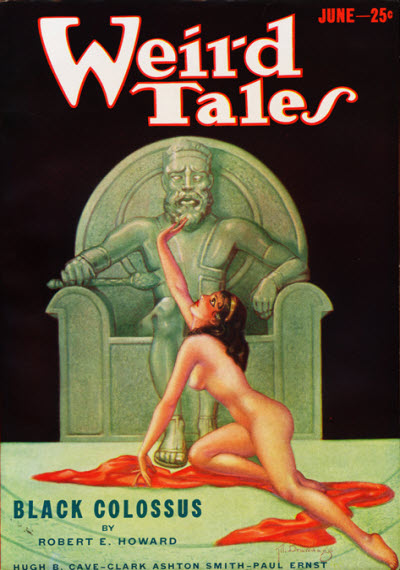
(Cover by Margaret Brundage. Weird Tales, June 1933.)
Halloween is getting close, and you know that means: a Halloween-appropriate story lineup! I feel no shame when I say I fucking love Halloween; it’s the only holiday I really get in the mood for. As such I figured I ought to do something special for October, not only picking more horror-centric stories but also changing my rotation method. Normally I would cycle short stories and novellas with serials, but something I’ve realized about horror (and you can say this is just my opinion) is that it works best in small doses. There wasn’t even much of a market for horror novels until the ’80s, and aside from Weird Tales there has, historically, not been much magazine space given to longer horror tales unless they’re reprints. As such, serials are OUT this month, and so are novellas, much as I love the things. Instead of getting only a few short stories and novellas we’re looking at nine short stories and novelettes, which is a considerable number!
For a while, when picking stories for my schedule, I had planned on including works by Lovecraft, Bradbury, and Stephen King, but decided at the last minute that I didn’t wanna deal with those who are unquestionably the most popular in the field; instead I went for deeper cuts, some by established horror authors, others by authors who are not normally associated with horror. I had almost included “Colony” by Philip K. Dick, but seeing as how I had already read it before and since I had come to the conclusion that I wanted all of these to be first reads, I ejected it. I’m sorry, Phil, I STILL LOVE YOU. This is also the first lineup where there are more female authors than male authors—that’s right, there are five women against four men! But to “compensate” we have the raw male chauvinism of James Blish and Harlan Ellison.
Now, as for the short stories…
“The Mindworm” by C. M. Kornbluth. Published in the December 1950 issue of Worlds Beyond. While not usually associated with horror, Kornbluth’s fiction tends to run in a morbid vein, being incredibly pessimistic and clearly disguted with the human condition. Despite dying at the horribly young age of 34, Kornbluth was both something of a prodigy (he started getting published professionally while still a teenager) and prolific at short lengths, especially from 1949 to his death in 1958. “The Mindworm” belongs to that streak of fiction, and is apparently a rare instance of Kornbluth writing straight horror.
“Hungry Daughters of Starving Mothers” by Alyssa Wong. Published in the October 2015 issue of Nightmare Magazine. Wong is a young author in the field, and their body of work remains fairly small, but their interests are spread impressively wide and they’ve already gotten their fair share of accolades. On top of being a productive short story writer (no novel as of yet, though), Wong has also written for comic books and even video games, with Overwatch being their big credit in the latter medium. “Hungry Daughters of Starving Mothers” won the Nebula as well as the World Fantasy Award.
“Bite-Me-Not or, Fleur de Feu” by Tanith Lee. Published in the October 1984 issue of Asimov’s Science Fiction. Lee is (or was) a startlingly prolific author of mostly fantasy and horror, writing dozens of novels plus a small army of short stories. Her reputation is apparently quite high, but unfortunately I’ve not read anything by her before. I found out through someone on Twitter that she’s one of the very few authors in SFF history to have more than one magazine issue made in tribute to her, including but not limited to an issue the revived Weird Tales.
“Genius Loci” by Clark Ashton Smith. Published in the June 1933 issue of Weird Tales. Smith was, along with H. P. Lovecraft and Robert E. Howard, one of the defining authors contributing to Weird Tales during its “classic” run. A poet first and foremost, Smith turned to writing short stories as a way of paying the bills, and during that brief time in the early to mid-1930s he gave Lovecraft a run for his money with both his lavish prose and his tales of cosmic speculation. Smith virtually stopped writing fiction by 1937, but his legacy very much lives on.
“Daemon” by C. L. Moore. Published in the October 1946 issue of Famous Fantastic Mysteries. Aside from the trio of Lovecraft, Howard, and Smith, no author defined the glory days of Weird Tales more than C. L. Moore, although unlike her aforementioned contemporaries she would move on to bigger and better things. Moore was, alongside her husband Henry Kuttner, one of the great masters of Golden Age SF, but “Daemon” sees her try her hand at horror and fantasy once again, at a time when the market for both genres had shrunk greatly.
“The Horse Lord” by Lisa Tuttle. Published in the June 1977 issue of The Magazine of Fantasy and Science Fiction. Tuttle debuted in 1972 and immediately made some sort of impression with the SFF readership, being barely out of her teens when she tied with Spider Robinson for the Astounding Award for Best New Writer. While she sometimes writes science fiction, most famously collaborating with George R. R. Martin, Tuttle’s home turf would remain feminist-tinged horror, and more often at short lengths.
“Grail” by Harlan Ellison. From the April 1981 issue of Twilight Zone Magazine. Ellison has to be onf of the most acclaimed and yet divisive personae in SFF history. When his career gained direction in the mid-’60s he seemingly catapulted from a second-rate hack to one of the biggest names in the field, eventually winning the Hugo, Nebula, Bram Stoker, and other awards. Much of Ellison’s fiction can be classified as horror, despite Ellison himself not being thought of as primarily a horror author, but “Grail” sees him in pure terror mode.
“The Idol of the Flies” by Jane Rice. Published in the June 1942 issue of Unknown. Rice is pretty obscure nowadays, which isn’t surprising considering she never had a novel published (she did write one, but for reasons I’ll get into it’s lost media) and her output became highly sporadic after Unknown shut down. A shame, because Rice was one of the more interesting young horror authors coming about at a time when there wasn’t much of a market for horror. “The Idol of the Flies” is considered major enough to have Rice’s single collection named after it.
“There Shall Be No Darkness” by James Blish. Published in the April 1950 issue of Thrilling Wonder Stories. Like Kornbluth, Blish was a member of the Futurians, a New York-based SF fan group that would prove unspeakably influential on the field, especially in the ’50s. Also like Kornbluth, Blish would die fairly young, albeit under different circumstances. 1950 saw the start of Blish’s iconic Cities in Flight series, but he also produced a curious SF-horror mashup with “There Shall Be No Darkness,” which supposedly explains werewolves in science-fictional terms.
As of late I’ve been struggling a bit to keep up the read/review schedule as my day job has gotten a bit more hectic lately (though my natural tendency toward procrastination doesn’t help things), but with all short stories this month it looks like I’ll get a breather for the moment. I’m in the mood for SPOOKY MONTH and I hope these stories won’t let me down.



 Science Fiction & Fantasy Remembrance