
Who Goes There?
I don’t know what to make of Philip José Farmer, but in my defense his peculiar place in SF history is partly what has secured his legacy. It’d be easy to say Farmer is a New Wave author, but he’s a whole generation older than the New Wavers and indeed his roots are distinctly pre-New Wave, despite getting started late as a writer. Farmer was already in his thirties when his debut story “The Lovers” was published in the August 1952 issue of Startling Stories, and apparently readers went nuts over it. There was nothing in terms of content (although not style) that quite matched “The Lovers,” as it was rejected by both Astounding and Galaxy for its graphic (for the time) depiction of romance between a human man and an alien woman who appears human enough. Samuel Mines, editor of Startling Stories and Thrilling Wonder Stories, knew he had found a special talent, and Farmer’s first few stories (mostly in Mines’s magazines) led him to winning the Hugo (although nowadays it would be the Astounding Award) for Best New Author. In hindsight this can read as a bit odd, considering Philip K. Dick and Robert Sheckley debuted the same year as Farmer, but the old saying that sex sells was and continues to be true.
The author spotlight for today’s story, “Mother,” labels it as Farmer’s second story, although this would not have been true unless it was the second story Farmer had sold—which is quite possible. Mines singles out “Mother” as being even more transgressive than “The Lovers,” and despite the latter being more famous I think Mines is right; not only does it go into more devious territory than “The Lovers,” it’s also the better story! This is a well-structured and more engrossing tale of first contact, and I’m about to explain why it works in conjunction with Farmer’s Oedipal hijinks.
Placing Coordinates
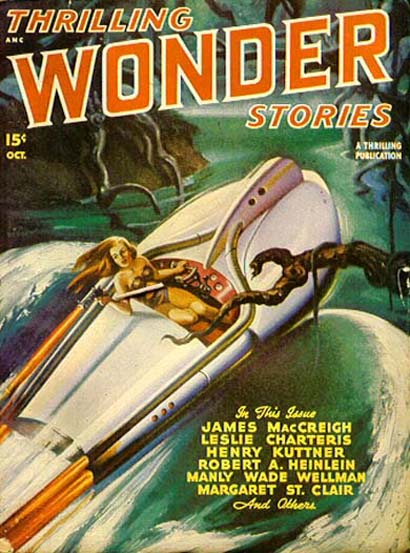
First published in the April 1953 issue of Thrilling Wonder Stories. I had first heard about “Mother” through its inclusion in the collection Strange Relations, not to be confused with the omnibus of the same title that also includes The Lovers (the novel version) and Flesh. I’ve read The Lovers and Flesh but not any of the stories in Strange Relations, which seem thematically related. Because “Mother” is a very good story it has been reprinted quite a few times elsewhere, most notably in the Farmer tribute collections The Best of Philip José Farmer and The Philip José Farmer Centennial Collection. If you like chunky anthologies there’s also The Science Fiction Century (ed. David G. Hartwell).
Enhancing Image
Paula Fetts and her son Eddie start out as the only survivors of a crash, and things only get worse from there. Paula is a scientist while Eddie, who must be at least in his twenties despite early descriptions of him (more on this later), is a famous opera singer. As with any mother-son relationship where the former pampers the latter, the son is a little maladjusted. Had Eddie lived in pre-Freudian times he could’ve lived the rest of his life as a shameless mama’s boy, but this is modernity and Farmer knows that such juicy material should not be passed up. Eddie is a bit of a hot mess, but Paula, wanting to stay close to her boy, pulls some strings so that her son can accompany her on this latest expedition to a charted but uncolonized planet, on the basis that Eddie’s expertise in opera could be used to study the form on human colonies. “That the yacht was not visiting any colonized globes seemed to have been missed by the bureaus concerned.” There are sprinkles of humor throughout the story and they’re surprisingly effective. For example, the sheer morbidity of Eddie not liking to clean up the gibbed remains of the crew (quite literally bones and tissue from the impact) because he doesn’t like the sight of blood.
Eddie is, at least symbolically, a child in a man’s body.
The expedition ends before it can even start, with Paula and Eddie being left stranded on the alien planet and with only some portable tech and rations to keep them going. While we’re still at this very early part in the story, before we get to the aliens themselves, I wanna talk about Paula and how interesting she is in terms of her function in the narrative. It was rare for a woman to be the protagonist of an SF story at the time, especially in the adventure mode as with “Mother,” and true enough Paula ends up not filling the protagonist role; she’s undoubtedly smart and competent, but we’re only gonna be in her shoes for a minute before the narrative’s perspective changes profoundly and Paula is, quite intentionally, pushed off-stage. It’s also this opening section that the story is at its most conventional before it goes off the rails (in a good way), with Our Heroes™ using radio to try to find some beacon on the planet; but it’s not too long before they unwittingly get themselves ensnared by the story’s real star.
Eddie and Paula get separated, with the POV now suddenly changing to Eddie’s, with the man-child being trapped in what resembles a huge egg turned on its side, the interior of which feels “soft and yielding—something fleshlike and womanly—almost breastlike in texture and smoothness and warmth, and its hint of gentle curving.” Farmer does not beat around the bush much here. (Also, take a shot every time Farmer uses the word “flesh” and its variants.) At first unsure of his surroundings, Eddie comes to find that he’s inside a very large and very motherly alien, itself unable to move but having tentacles so as to have a good reach both inside and outside. These aliens, which resemble boulders on the outside, hence Our Heroes™ not being aware of their nature at first, are in fact highly intelligent and communicative creatures, with the Mother (with a capital M) Eddie’s inside of even being able to talk to him via Eddie’s radio tech. The Mothers talk in a certain frequency, like they’re FM radio sets, which will prove to bode both good and ill for the humans.
The Mothers are the things on which the story hinges, so let’s talk about them. Often writers struggle (or simply don’t try at all) to create aliens that are not just humanoids with blue skin and funny ears, even though, in terms of probability, we’re far more likely to encounter alien life that’s akin to either starfish or an amoeba. Farmer seemed aware of this from the beginning, as the tragedy of “The Lovers” relies on the alien woman appearing to be more humanoid than she really is; but “Mother” goes a step farther by speculating on how a human might mate with an alien that, while sentient, does not look or behave like a human at all. The Mothers are a single-sex race in that all of the Mothers are female; there are no males of the species—not even disposable things that exist as sperm banks. How do the Mothers reproduce, then? Well, these aliens catch males of other species, only they’re not thought of as males, but as “mobiles.” A mobile, to a Mother, is a male, who will spend time in the egg chamber before getting devoured and released into the environment where the cycle will begin anew. “Mobiles were male. Eddie had been mobile. He was, therefore, a male.” This would intrigue if I found it in a story published in the current year, but for something published seventy years ago it’s kind of astonishing.
Okay, so Eddie and Paula will at some point get eaten by their Mothers, but think also about how I said that the Mothers aren’t exactly discerning about what is male and female. Paula is being kept in a fellow Mother and is apparently acting as that Mother’s mate, but while this can be construed as lesbianism on the Mother’s part, the Mother does not register Paula as being female. It’s almost like gender lines are blurry or something. That Farmer was messing around with this in 1953 should earn him a medal (it did get him a Hugo), but that he did so while showing that in only a matter of months he had matured as a storyteller gets him my respect. “Mother” is a novelette, nearly twenty magazine pages, but it feels shorter somehow, even though there’s little action once Eddie gets trapped inside the Mother. The degree to which Farmer explores the alien mindset of the Mothers while also injecting this with humor is admirable.
There Be Spoilers Here
Eddie has spent enough time in the Mother by now that he’s almost become accustomed to it; he has even given his Mother a name, Polyphema, as a sort of mythology gag. Eddie and Polyphema are able to understand each other somewhat, but there were still the problems of a) contacting Paula, and b) escaping. The first gets solved when Eddie’s able to negotiate with Polyphema and talk with Paula from across the aisle, so to speak. While the humans will eventually be eaten as Nature demands, being “semantic” mobiles (in that they’re able to talk with their Mothers) gives their respective Mothers significant prestige among their peers. (Again, while the Mothers are unable to move, they can communicate across considerable distances, and are thus quite talkative, even catty at times.) Paula has a plan to get out of her own Mother (she has no qualms about killing an intelligent alien being that is simply acting according to its nature) soon enough, but Eddie still has to figure a way to get away from Polyphema.
Unfortunately for everyone a bit of miscommunication comes in to deprive of us a happy (i.e., boring) ending. Without thinking Eddie tells Polyphema that Paula, the mobile in the neighboring Mother, is his mother. The mobile is herself female, which strikes Polyphema as a paradox. “Her world was split into two: mobile and her kind, the immoble. Mobile meant food and mating. Mobile meant—male. The Mothers were—female.” When Paula does come Eddie’s way, Polyphema takes her and devours her almost instantly, in which has to be the story’s most shocking moment—even if I anticipated something like this happening. What shocked me even more was the very dark joke to follow Paula’s death, which actually had me cackling a bit. I’m not gonna say it here because it would feel ruined without the proper buildup, but when you see you might feel compelled to do a double take. Farmer can be a real comedian when he feels like it.
Having lost his real mother, and without any chance of escape, let alone finding civilization again, something strange happens to Eddie: he starts to regress, not just mentally but even physically. The longer Eddie stays with the Sluggos (i.e., the pups, who will one day become Mothers themselves) in Polyphema’s sack the more alien he becomes.
He was, in a sense, their father. Indeed, as they grew to hog-size, it was hard for their female parent to distinguish him from her young. As he seldom walked any more, and was often to be found on hands and knees in their midst, she could not scan him too well. Moreover, something in the heavywet air or in the diet had caused every hair on his body to drop off. He grew very fat. Generally speaking, he was one with the pale, soft, round, and bald offspring. A family likeness.
At the beginning of the story a nearby clock goes backwards in time when the ship crashes—doesn’t stop, but goes back. Farmer brings back this little nugget of symbolism at the end when Eddie, having seemingly met the end of his tether, goes back in time in nearly every way possible—back, even, to being like an infant in his mother’s womb. I knew in advance that “Mother” would end with the human protagonist inside an alien womb, in a Freudian returning-to-the-womb bit, but having actually read it now, the context makes the ending much more effective; it even becomes eerie, although given the alternatives the ending could be worse for Eddie. While having lost his real mother, Eddie is able to leave behind the psychic trauma of human adulthood and will probably now spend the rest of his days in the care of an alien surrogate—one who also happens to be the mother of his children. And they say old SF is unsophisticated.
A Step Farther Out
“Mother” feels like a breath of fresh air especially after the last Farmer story I had read, which was “Don’t Wash the Carats,” a New Wave-era story from one of those goddamn Orbit volumes that I found nigh unreadable hippie garbage. I’m not against hippie-dippy literature and I’m not even against Farmer when he does it necessarily, being one of the few people in the world who likes “Riders of the Purple Wage,” but I just like my literature to read like it was deliberately constructed. Not only is “Mother” deliberately constructed but it shows that Farmer was on to some weird shit at a time when most genre authors were playing by the old rules. Its style is pulpy, yes, but it’s clearly written in the adventure mode so as to more effectively subvert expectations we have about old-school first contact narratives. Tts subject matter also points toward a grand liberalization of the field that had neither a name nor a shape yet… but it was on its way.
See you next time.


 Science Fiction & Fantasy Remembrance